

Knowing the name of a chemical compound is often enough to determine its chemical formula if you understand the rules used to name compounds. A chemical formula tells us which elements are present in a compound and how many atoms or ions of each are involved. For example, the name sodium chloride immediately suggests the formula NaCl, while calcium chloride gives CaCl₂.
However, determining a formula is not simply a matter of memorizing names. The formula must follow the rules of chemical bonding and electrical neutrality. This means identifying the elements or ions present, finding their charges or valencies, and combining them in the correct ratio. For compounds containing polyatomic ions, prefixes, or variable-charge metals, additional rules may be needed.
Learning how to move from a compound’s name to its formula is therefore an important chemistry skill. Once the basic method becomes familiar, many formulas can be written systematically rather than memorized individually.
Understand What the Name Tells You
The first step is to carefully read the name of the compound. Chemical names usually provide information about the particles or elements that make up the compound.
For an ionic compound, the name commonly contains the positive ion first and the negative ion second. For example:
Sodium chloride
Magnesium oxide
Calcium bromide
Aluminum sulfide
In sodium chloride, sodium is the positive ion and chloride is the negative ion. Their charges determine the final formula.
For molecular compounds, the name may contain prefixes such as mono-, di-, tri-, tetra-, and penta-. These prefixes directly indicate the number of atoms of each element.
For example:
Carbon dioxide → CO₂
Carbon monoxide → CO
Dinitrogen monoxide → N₂O
Sulfur trioxide → SO₃
Therefore, before writing a formula, determine what type of compound you are dealing with.
Identify the Type of Compound
Most formula-writing questions can be approached by recognizing one of three common categories:
Ionic compounds
Molecular or covalent compounds
Compounds containing polyatomic ions
The method is slightly different for each.
Ionic Compounds
Ionic compounds generally consist of a metal and a nonmetal, or a metal combined with a polyatomic ion.
Examples include:
NaCl
MgO
CaCl₂
Al₂O₃
The name identifies the ions, while their charges determine how many of each ion are required.
Molecular Compounds
Molecular compounds are generally formed between nonmetals. Their names often use numerical prefixes to show the number of atoms.
For example, nitrogen dioxide contains one nitrogen atom and two oxygen atoms, so its formula is NO₂.
Compounds With Polyatomic Ions
Some compounds contain groups of atoms that act as a single charged unit. These groups are called polyatomic ions.
Common examples include:
Hydroxide → OH⁻
Nitrate → NO₃⁻
Sulfate → SO₄²⁻
Carbonate → CO₃²⁻
Phosphate → PO₄³⁻
Ammonium → NH₄⁺
When these ions occur more than once in a formula, parentheses are usually required.
For example, calcium nitrate contains Ca²⁺ and NO₃⁻. Two nitrate ions are needed to balance one calcium ion, giving Ca(NO₃)₂.
Determine the Ions and Their Charges
For ionic compounds, the next step is to identify the charge of each ion.
Some common positive ions are:
Sodium → Na⁺
Potassium → K⁺
Magnesium → Mg²⁺
Calcium → Ca²⁺
Aluminum → Al³⁺
Some common negative ions are:
Chloride → Cl⁻
Bromide → Br⁻
Oxide → O²⁻
Sulfide → S²⁻
Nitride → N³⁻
The charges are important because an ionic compound must have an overall electrical charge of zero.
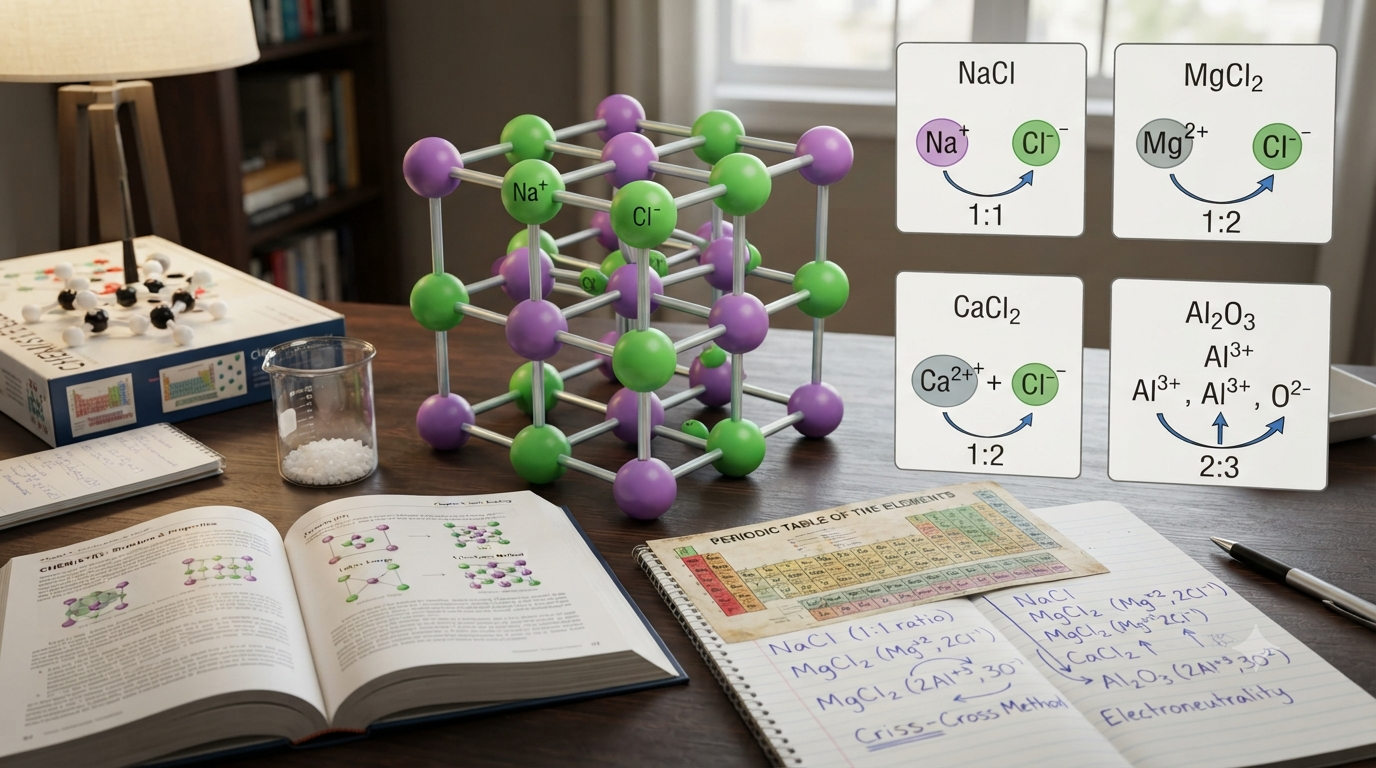
For example, magnesium has a charge of +2 and chloride has a charge of −1. One Mg²⁺ ion needs two Cl⁻ ions to balance its charge.
Therefore:
Mg²⁺ + 2Cl⁻ → MgCl₂
The formula is MgCl₂.
Use Valency or Charge to Balance the Formula
One of the most useful techniques for writing ionic formulas is balancing the charges.
Consider aluminum oxide.
Aluminum forms Al³⁺ and oxide forms O²⁻. To make the total positive and negative charges equal, we need two aluminum ions and three oxide ions.
Positive charge:
2 × (+3) = +6
Negative charge:
3 × (−2) = −6
Therefore, the formula is:
Al₂O₃
The total charge is zero, so the formula is electrically neutral.
This principle can be applied to many ionic compounds.
The Criss Cross Method
A commonly taught shortcut for determining ionic formulas is the criss cross method. In this method, the numerical values of the charges are crossed over and used as subscripts.
For example, consider calcium oxide.
Calcium → Ca²⁺
Oxide → O²⁻
Crossing the charge numbers gives Ca₂O₂. However, these subscripts can be simplified because both numbers have a common factor of 2.
The simplest ratio is 1:1.
Therefore:
CaO
The criss cross method can be useful, but the final formula must always be simplified to the lowest whole-number ratio.
For aluminum oxide:
Al³⁺ and O²⁻
Crossing the numbers gives:
Al₂O₃
No further simplification is possible, so the formula remains Al₂O₃.
Always Simplify the Formula
An important rule is that ionic compounds should normally be written using the simplest whole-number ratio of ions.
For example, magnesium oxide contains Mg²⁺ and O²⁻. Directly crossing the charges might produce Mg₂O₂, but this is not the correct simplest formula.
Divide both subscripts by 2:
Mg₂O₂ → MgO
Thus, the correct formula is MgO.
This is because the chemical formula represents the simplest ratio of ions in the ionic compound.
Handle Metals With Variable Charges
Some metals can form more than one positive ion. Transition metals are common examples.
For instance, iron can form Fe²⁺ or Fe³⁺. Copper can commonly form Cu⁺ or Cu²⁺.
The name of the compound often tells you which charge is being used through a Roman numeral.
For example:
Iron(II) chloride
Iron(II) means Fe²⁺, while chloride is Cl⁻.
Two chloride ions are needed to balance one Fe²⁺ ion:
FeCl₂
Now consider:
Iron(III) chloride
Iron(III) means Fe³⁺.
Three chloride ions are needed:
FeCl₃
The Roman numeral is therefore important. Iron(II) chloride and iron(III) chloride are different compounds with different formulas.
The same idea applies to copper compounds.
Copper(I) oxide contains Cu⁺ and O²⁻. Two Cu⁺ ions are needed for one O²⁻ ion:
Cu₂O
Copper(II) oxide contains Cu²⁺ and O²⁻. The charges balance in a 1:1 ratio:
CuO
Write Formulas With Polyatomic Ions Carefully
Polyatomic ions should be treated as complete units when determining a formula.
Consider sodium sulfate.
Sodium → Na⁺
Sulfate → SO₄²⁻
Two sodium ions are needed to balance one sulfate ion:
Na₂SO₄
Now consider aluminum sulfate.
Aluminum → Al³⁺
Sulfate → SO₄²⁻
The lowest common multiple of 3 and 2 is 6. Therefore, two aluminum ions and three sulfate ions are needed.
Al₂(SO₄)₃
Notice the parentheses around SO₄. They show that the entire sulfate ion occurs three times.
Without parentheses, Al₂SO₄₃ would not correctly represent the compound.
Know When to Use Parentheses
Parentheses are needed when a polyatomic ion appears more than once in a formula.
For example:
Calcium hydroxide
Calcium → Ca²⁺
Hydroxide → OH⁻
Two hydroxide ions are needed:
Ca(OH)₂
But sodium hydroxide contains only one hydroxide ion:
NaOH
No parentheses are necessary.
Similarly:
Magnesium nitrate → Mg(NO₃)₂
Potassium nitrate → KNO₃
The difference comes from the number of polyatomic ions required to balance the charges.
Use Prefixes for Molecular Compounds
Covalent or molecular compounds are often named using prefixes that tell you the number of atoms present.
Common prefixes include:
Mono- → 1
Di- → 2
Tri- → 3
Tetra- → 4
Penta- → 5
Hexa- → 6
Hepta- → 7
Octa- → 8
Nona- → 9
Deca- → 10
For example, carbon dioxide contains one carbon atom and two oxygen atoms.
Carbon → C
Di + oxide → O₂
Therefore:
CO₂
Consider dinitrogen pentoxide.
Di-nitrogen means two nitrogen atoms.
Penta-oxide means five oxygen atoms.
Therefore:
N₂O₅
In molecular compounds, these prefixes provide the numerical information directly, so charge balancing is generally not used in the same way as it is for ionic compounds.
Learn the Naming Changes for Nonmetals
When writing formulas from molecular compound names, the second element usually has a modified ending such as “-ide.”
For example:
Oxygen → oxide
Chlorine → chloride
Sulfur → sulfide
Nitrogen → nitride
Fluorine → fluoride
The prefix tells you how many atoms are present.
For example:
Sulfur hexafluoride
Sulfur → S
Hexafluoride → F₆
Formula:
SF₆
Similarly:
Phosphorus trichloride → PCl₃
Dinitrogen tetroxide → N₂O₄
Carbon tetrachloride → CCl₄
A Step-by-Step Method
A simple process can make formula writing much easier.
Step 1: Read the compound name
Identify every element or ion mentioned in the name.
Step 2: Determine the compound type
Decide whether it is ionic, molecular, or contains a polyatomic ion.
Step 3: Write the symbols
Write the correct chemical symbol for each element or ion.
Step 4: Determine charges if it is ionic
Use the known ionic charges or the Roman numeral given in the name.
Step 5: Balance the charges
Choose subscripts that make the total positive and negative charges equal.
Step 6: Use parentheses when necessary
If a polyatomic ion occurs more than once, place it in parentheses before adding its subscript.
Step 7: Simplify
Make sure the ionic formula is in the lowest whole-number ratio.
Step 8: Check the final formula
Confirm that the formula matches the compound name and that the total charge is zero for an ionic compound.
Worked Examples
Sodium Oxide
Sodium forms Na⁺.
Oxide forms O²⁻.
Two sodium ions are needed for one oxide ion.
Formula:
Na₂O
Calcium Chloride
Calcium forms Ca²⁺.
Chloride forms Cl⁻.
Two chloride ions balance one calcium ion.
Formula:
CaCl₂
Aluminum Nitride
Aluminum forms Al³⁺.
Nitride forms N³⁻.
The charges balance in a 1:1 ratio.
Formula:
AlN
Magnesium Hydroxide
Magnesium forms Mg²⁺.
Hydroxide forms OH⁻.
Two hydroxide ions are required.
Formula:
Mg(OH)₂
Iron(III) Oxide
Iron(III) means Fe³⁺.
Oxide is O²⁻.
Two Fe³⁺ ions provide +6, while three O²⁻ ions provide −6.
Formula:
Fe₂O₃
Carbon Dioxide
Carbon dioxide is a molecular compound.
There is one carbon atom and two oxygen atoms.
Formula:
CO₂
Dinitrogen Trioxide
Di-nitrogen means two nitrogen atoms.
Tri-oxide means three oxygen atoms.
Formula:
N₂O₃
Common Mistakes to Avoid
Several mistakes can make an otherwise correct approach produce the wrong formula.
One common mistake is confusing the number in a compound name with an ionic charge. For molecular compounds, prefixes such as di- and tri- indicate the number of atoms. For ionic compounds, charges determine the subscripts.
Another mistake is forgetting to simplify subscripts. For example, Ca₂O₂ should be simplified to CaO.
A third mistake is forgetting parentheses around repeated polyatomic ions. Calcium nitrate is Ca(NO₃)₂, not CaNO₃₂.
It is also important not to change the chemical formula merely to match a familiar pattern. The charges or prefixes should determine the formula.
Finally, pay attention to Roman numerals in names such as iron(II) chloride and iron(III) chloride. They identify the charge of the metal ion and can completely change the formula.
Why Learning Formula Writing Matters
Determining a formula from a chemical name is more than an exercise in memorization. It connects chemical language with the actual composition of matter.
A name tells us what substances or ions are involved, while the formula shows their quantitative relationship. Understanding this connection makes it easier to study chemical reactions, molar calculations, equations, stoichiometry, acids and bases, salts, and many other areas of chemistry.
Once the basic patterns are understood, formula writing becomes a logical process. Instead of trying to memorize every compound separately, you can identify the ions or atoms, determine their relationship, and construct the formula systematically.
Conclusion
Determining the formula of a compound from its name becomes much easier when the naming rules are connected to chemical composition. For ionic compounds, identify the ions, determine their charges, balance those charges, and write the simplest whole-number ratio. For molecular compounds, use prefixes in the name to determine how many atoms of each element are present. When polyatomic ions are involved, treat each ion as a single unit and use parentheses when necessary.
The most reliable approach is to work step by step rather than guess the formula. With regular practice, names such as calcium chloride, aluminum sulfate, iron(III) oxide, and dinitrogen pentoxide can be converted into formulas quickly and accurately. This skill provides a strong foundation for understanding how chemical substances are represented and how their compositions relate to chemical reactions.
FAQs
1. How can you determine the formula of a compound from its name?
To determine a compound’s formula, first identify the elements or ions mentioned in its name. For ionic compounds, write the chemical symbols of the positive and negative ions and determine their charges. Then choose subscripts that balance the total positive and negative charges, producing an electrically neutral compound. For molecular compounds, look for prefixes such as mono-, di-, tri-, and tetra-, which indicate the number of atoms of each element. If polyatomic ions are present, treat them as single units and use parentheses when more than one is required. Finally, simplify the formula whenever possible and check that it correctly represents the compound.
2. What is the first step in writing a chemical formula from a compound name?
The first step is to carefully identify the elements or ions present in the compound. Read the name and determine whether it represents an ionic compound, molecular compound, or a compound containing a polyatomic ion. For example, in calcium chloride, calcium is the positive ion and chloride is the negative ion. In carbon dioxide, carbon and oxygen are nonmetals, and the prefix “di-” indicates two oxygen atoms. Identifying the type of compound helps you choose the correct method for writing its formula. Once the components are identified, you can determine charges or atom numbers and construct the formula accurately.
3. How do you write the formula of an ionic compound?
To write an ionic formula, identify the positive ion and negative ion first. Write their symbols and determine their charges. Then select subscripts that make the total positive charge equal to the total negative charge. For example, calcium forms Ca²⁺ and chloride forms Cl⁻. One calcium ion requires two chloride ions to balance the charges, giving CaCl₂. The final formula should represent the simplest whole-number ratio of ions. Do not write the charge symbols in the final formula. Instead, use subscripts to show how many ions are present. Always check that the overall charge of the formula is zero.
4. How does valency help in determining a compound formula?
Valency helps determine how many atoms or ions are needed to form a stable compound. In ionic compounds, the valency or charge of each ion helps establish the correct ratio between positive and negative ions. For example, magnesium has a valency of 2, while chlorine has a valency of 1. Therefore, one magnesium ion combines with two chloride ions, producing MgCl₂. Similarly, aluminum has a valency of 3 and oxygen has a valency of 2, resulting in Al₂O₃. Understanding common valencies allows you to determine formulas systematically instead of memorizing every compound individually.
5. What is the criss cross method for writing chemical formulas?
The criss cross method is a shortcut commonly used to determine the subscripts of ions in an ionic compound. First, write the positive and negative ions with their charges. Then cross the numerical parts of the charges and use them as subscripts for the opposite ions. For example, aluminum is Al³⁺ and oxide is O²⁻, so crossing the numbers gives Al₂O₃. However, the resulting subscripts must always be checked and simplified if they have a common factor. The criss cross method should be used as a shortcut for charge balancing, not as a replacement for understanding why the charges must balance.
6. How do you write formulas containing polyatomic ions?
When a compound contains a polyatomic ion, identify the ion and its charge before balancing the formula. A polyatomic ion is a group of atoms that carries an overall charge, such as sulfate SO₄²⁻ or nitrate NO₃⁻. If only one polyatomic ion is required, parentheses are unnecessary. For example, sodium nitrate is NaNO₃. If more than one polyatomic ion is required, use parentheses. Calcium nitrate contains Ca²⁺ and NO₃⁻, so two nitrate ions are needed, giving Ca(NO₃)₂. The parentheses show that the entire nitrate group occurs twice in the compound.
7. When are parentheses used in a chemical formula?
Parentheses are used when a polyatomic ion appears more than once in a chemical formula. They group the atoms of the polyatomic ion together so that the subscript applies to the entire group. For example, calcium hydroxide contains Ca²⁺ and two OH⁻ ions, so its formula is Ca(OH)₂. Without parentheses, the formula would not clearly show that two complete hydroxide ions are present. However, parentheses are not needed when only one polyatomic ion occurs. Sodium hydroxide is therefore written as NaOH, while magnesium nitrate is written as Mg(NO₃)₂ because two nitrate ions are required.
8. How do Roman numerals help determine a compound formula?
Roman numerals in chemical names identify the charge of certain metals that can form more than one type of positive ion. For example, iron can commonly form Fe²⁺ and Fe³⁺. In iron(II) chloride, the Roman numeral II tells us that iron has a +2 charge. Chloride has a −1 charge, so the formula is FeCl₂. In iron(III) chloride, iron has a +3 charge, requiring three chloride ions, giving FeCl₃. Therefore, Roman numerals are important because they specify which charge of the metal is present and help determine the correct ratio of ions in the formula.
9. How do prefixes help determine formulas of molecular compounds?
Prefixes are especially important when writing formulas for molecular compounds formed between nonmetals. They indicate the number of atoms of each element in the compound. Common prefixes include mono- for one, di- for two, tri- for three, tetra- for four, and penta- for five. For example, carbon dioxide contains one carbon atom and two oxygen atoms, so its formula is CO₂. Dinitrogen pentoxide contains two nitrogen atoms and five oxygen atoms, giving N₂O₅. Unlike ionic compounds, molecular compounds named with prefixes generally do not require charge balancing because the prefixes directly provide the number of atoms.
10. What are the common mistakes when determining a formula from a name?
Common mistakes include choosing the wrong ion charge, forgetting to balance charges, failing to simplify subscripts, and incorrectly using parentheses. Another frequent mistake is confusing molecular prefixes with ionic charges. For example, “di-” in carbon dioxide means two oxygen atoms; it does not represent an ionic charge. Roman numerals in names such as iron(III) oxide must also be read carefully because they specify the metal’s charge. When polyatomic ions are present, parentheses may be required. A good final check is to confirm that the elements match the name, the subscripts are correct, and an ionic compound has a total charge of zero.
Related Posts
How to Determine Atomic Ratios From Chemical Formulas
Chemical formulas provide much more information than simply telling us which elements are present in a substance. The symbols and […]
Read MoreHow Atomic Ratios Differ From Mass Ratios in Compounds

When we study chemical compounds, we often use ratios to describe how their elements are combined. Two important types of […]
Read MoreWhy Chemical Formulas Use Whole Number Subscripts

Chemical formulas are one of the simplest ways scientists communicate information about substances. A formula such as H₂O tells us […]
Read MoreHow Whole Number Ratios Are Used in Chemical Formulas

Chemical formulas are a simple way of showing what a substance is made of. A formula tells us which elements […]
Read MoreHow to Identify the Simplest Ratio in a Chemical Formula

Chemical formulas do more than identify substances. They also show how atoms of different elements are combined. By looking carefully […]
Read MoreFormula Units vs Molecules in Chemistry

Chemistry uses formulas to describe the substances that make up the world around us. When we see formulas such as […]
Read MoreWhat Is the Meaning of Formula Units in Chemistry?
In chemistry, substances are often represented using chemical formulas. A chemical formula tells us which elements are present and, in […]
Read MoreHow Chemical Formulas Represent Fixed Composition

A chemical formula is much more than a short name for a substance. It gives important information about what a […]
Read MoreHow to Interpret the Ratio of Elements in a Compound

When a chemical compound is represented by a chemical formula, the symbols and numbers in that formula contain important information […]
Read MoreHow Chemical Formula Ratios Describe Compound Composition

A chemical formula is much more than a short way of naming a compound. It provides important information about what […]
Read MoreHow are chemical formulas used in stoichiometric calculations?

Chemical formulas are one of the most important tools used in chemistry. They tell us which elements are present in […]
Read MoreHow can chemical formulas be used to understand chemical reactions?

Chemical reactions are processes in which substances change into new substances. We can observe some reactions through changes in color, […]
Read MoreWhy do some substances have simple formulas while others have complex formulas?

Chemical formulas are one of the simplest ways to describe what a substance is made of. A formula such as […]
Read MoreHow can beginners memorize important chemical formulas without confusion?

Learning chemical formulas can feel confusing when you are just starting chemistry. There may be many formulas to remember, different […]
Read MoreWhich chemistry formulas are essential for beginners to learn first?

Chemistry becomes much easier when you understand the formulas used to represent substances, reactions, quantities, and relationships between different chemical […]
Read MoreHow should a student organize chemistry formulas for easy revision?

Chemistry involves many formulas, symbols, equations, ions, compounds, and numerical relationships. As the syllabus grows, simply memorizing formulas one after […]
Read MoreWhat is the difference between molecular and empirical formulas?

Chemical formulas give us a compact way to describe the composition of substances. Instead of writing the names and numbers […]
Read MoreWhy can different compounds have the same empirical formula?

An empirical formula gives the simplest whole-number ratio of atoms present in a compound. It is useful because it tells […]
Read MoreHow do parentheses affect the number of atoms in a formula?
Chemical formulas tell us which elements are present in a substance and how many atoms of each element are included. […]
Read MoreHow can you count atoms from a chemical formula?

A chemical formula tells us much more than the name of a substance. It also gives information about the types […]
Read MoreWhy is a subscript different from a coefficient?

When learning chemical formulas, two small numbers can appear next to chemical symbols and look surprisingly similar. One is called […]
Read MoreWhat does a coefficient mean in a chemical equation?

A chemical equation is a compact way of representing a chemical reaction. It tells us which substances take part in […]
Read MoreWhat does a subscript mean in a chemical formula?

A chemical formula is a short way of showing what a substance is made of. Instead of writing the names […]
Read MoreHow can you identify the elements present in a formula?

A chemical formula is a short way of showing what a substance is made of. Instead of writing the complete […]
Read MoreHow are element symbols used to write chemical formulas?

Chemical formulas are one of the simplest and most useful ways to represent substances in chemistry. Instead of writing the […]
Read MoreWhat is the difference between a chemical symbol and a chemical formula?

Chemistry uses a special language to describe elements, atoms, compounds, and chemical substances. Two of the most basic parts of […]
Read MoreWhat information can be obtained from a chemical formula?

A chemical formula is a short and powerful way of representing a substance. It uses chemical symbols and numbers to […]
Read MoreHow does a chemical formula represent a substance?

A chemical formula is a short and precise way of representing a substance using chemical symbols and numbers. Instead of […]
Read MoreWhy are chemical formulas important in chemistry?

Chemistry is the study of matter, its properties, composition, and the changes it undergoes. To understand and communicate these ideas […]
Read MoreWhat exactly is a chemical formula?

A chemical formula is a short way of representing a chemical substance using symbols and numbers. Instead of writing the […]
Read More