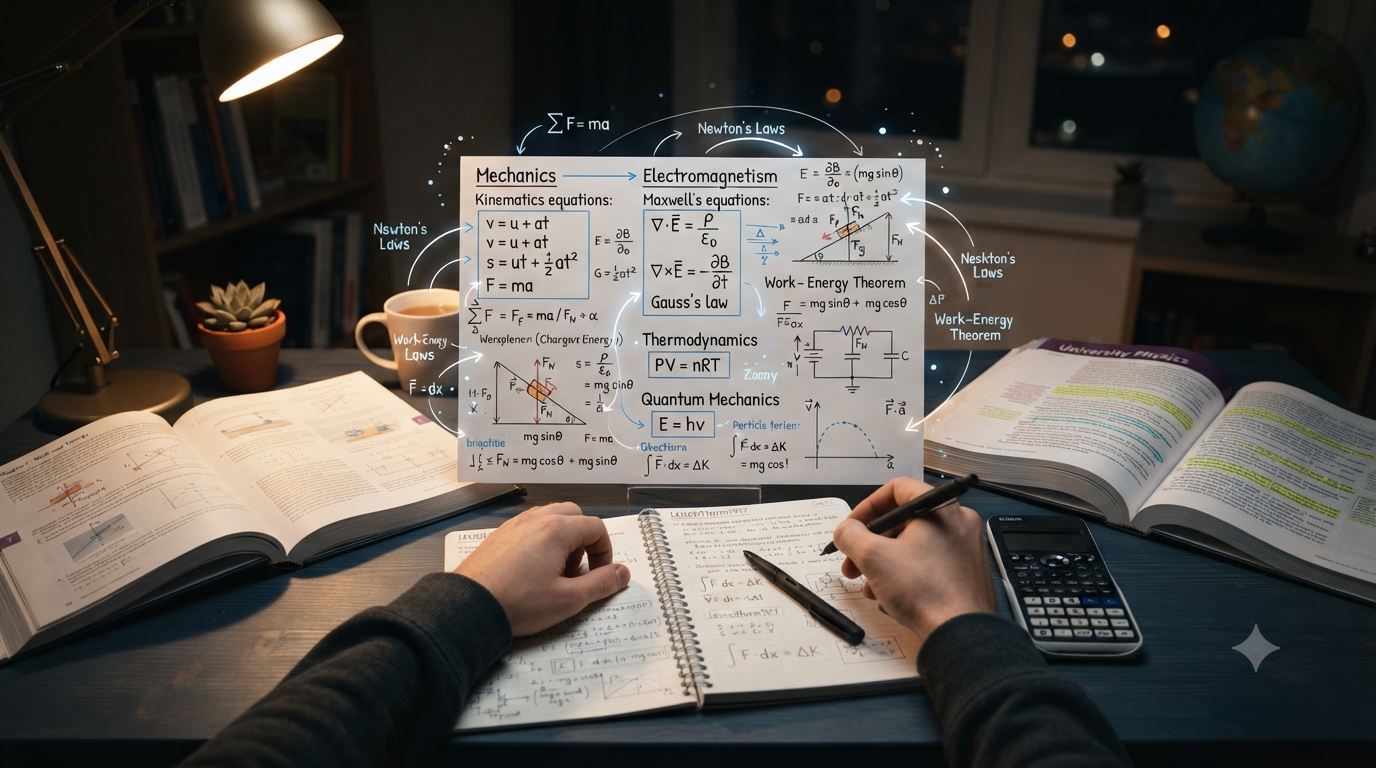
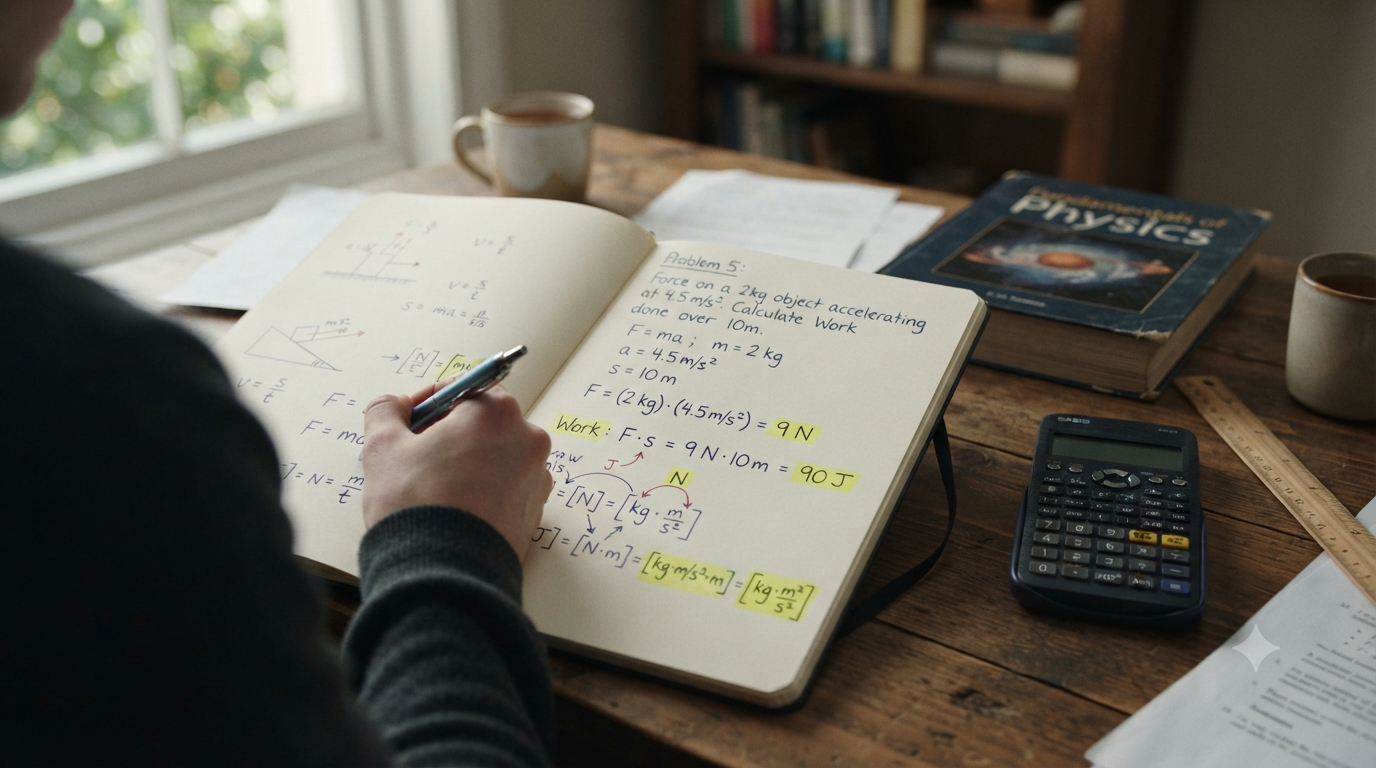
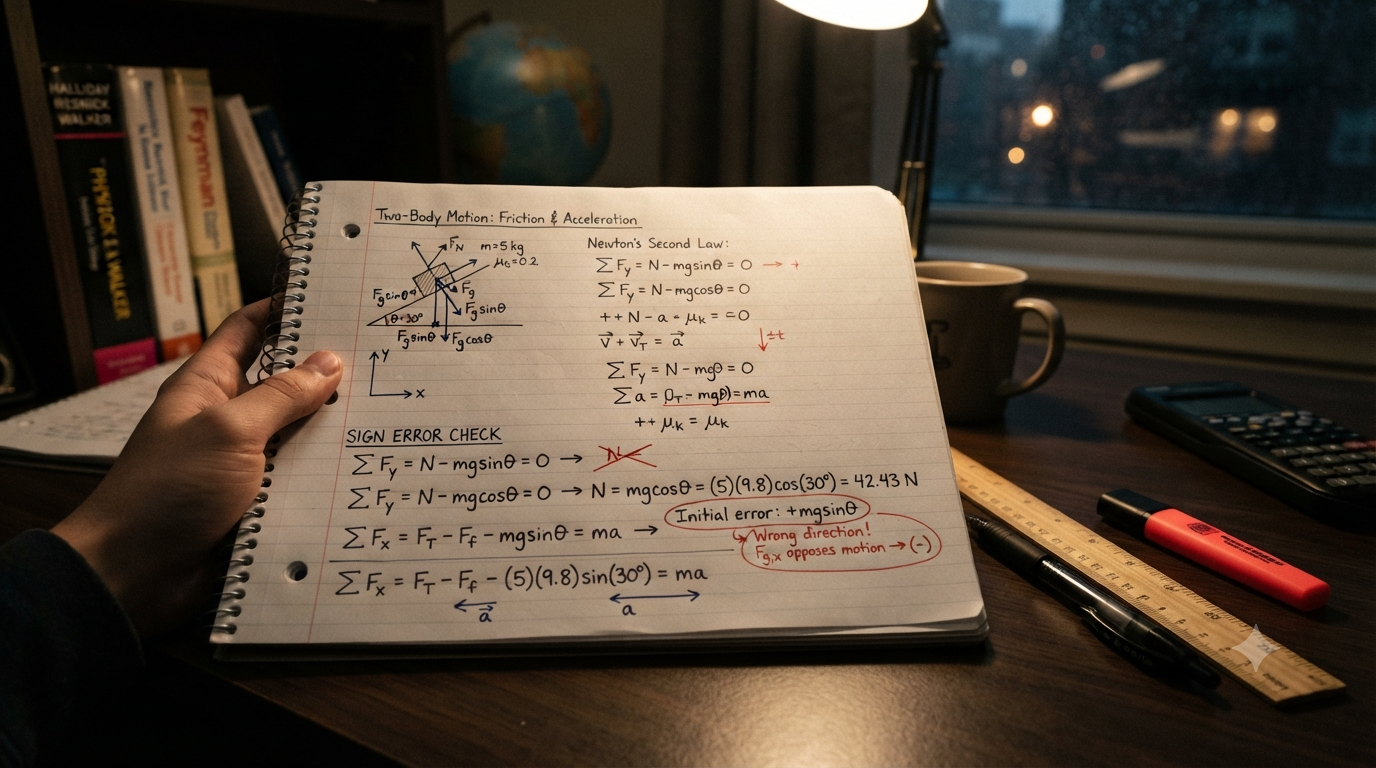
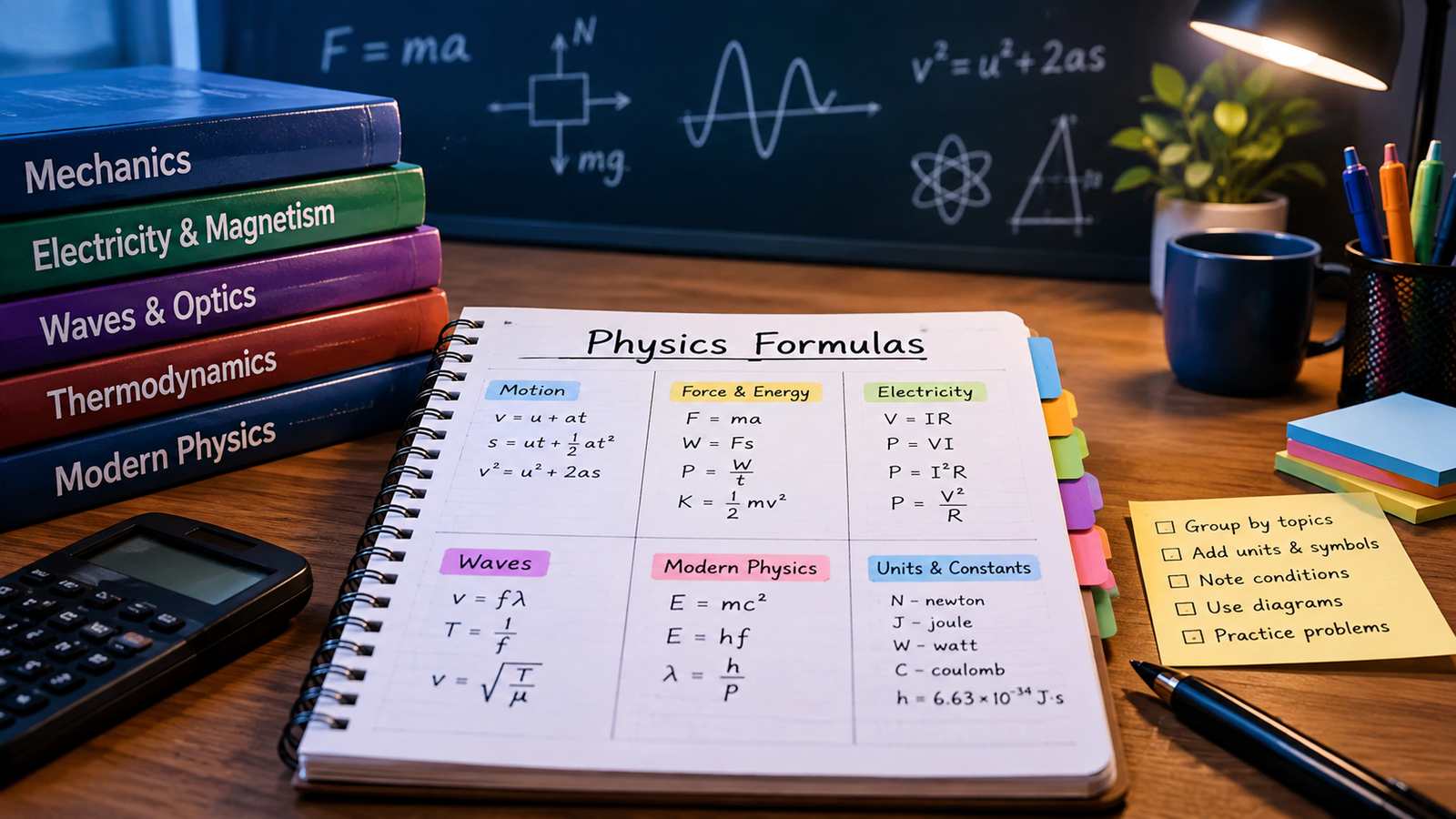
Physics involves many formulas, and remembering all of them can become difficult as you move from basic concepts to more advanced topics. However, a good physics formula sheet is not simply a collection of equations. It is a structured tool that helps you understand relationships between physical quantities, recall important formulas quickly, and choose the correct equation when solving problems.
Building your own formula sheet can also improve your understanding of physics. Instead of copying formulas from a textbook, you organize them according to topics, identify the meaning of each symbol, and connect equations with the concepts behind them. A well-designed formula sheet can therefore become a useful reference for learning, revision, and problem-solving.
Start With Physics Topics
The first step is to divide your formula sheet into clear physics topics. Avoid putting every formula into one long list because it becomes difficult to find what you need.
For example, a basic physics formula sheet can have sections such as:
Units and Measurements
Motion
Force and Laws of Motion
Work, Energy and Power
Gravitation
Properties of Matter
Heat and Thermodynamics
Waves
Electricity
Magnetism
Optics
Modern Physics
The exact topics will depend on what you are studying. The important point is to keep related formulas together.
When formulas are organized by topic, your brain can associate an equation with a particular physical idea. This makes recall easier than memorizing formulas randomly.
Write the Formula Clearly
Once you choose a topic, list the important formulas under it. Write each equation clearly and avoid unnecessary decoration.
For example, under motion, you might include:
v = u + at
s = ut + ½at²
v² = u² + 2as
s = ½(u + v)t
These equations describe relationships between displacement, initial velocity, final velocity, acceleration, and time.
Do not fill your formula sheet with every equation you find. Include formulas that are important, frequently used, or directly connected to the concepts you are studying.
A shorter formula sheet is often more useful than a crowded one.
Add the Meaning of Every Symbol
A formula without the meaning of its symbols can become confusing.
For example:
F = ma
Here:
F = force
m = mass
a = acceleration
This may seem obvious, but adding symbol meanings becomes increasingly important when formulas become more complicated.
For a formula such as:
P = W/t
you should know that P represents power, W represents work, and t represents time.
Writing these meanings beside the formula helps you avoid mistakes caused by confusing similar symbols.
Include SI Units
Units are an important part of physics. A formula sheet becomes much more useful when the SI unit of each physical quantity is included.
For example:
Force
Formula: F = ma
SI unit: newton (N)
Work
Formula: W = Fs
SI unit: joule (J)
Power
Formula: P = W/t
SI unit: watt (W)
Speed
Formula: v = s/t
SI unit: metre per second (m/s)
Including units helps you check whether an answer makes physical sense. It also makes unit conversion and dimensional analysis easier.
Mention What Each Formula Finds
Sometimes several formulas appear similar, but they are used in different situations. A short note about what a formula calculates can make your sheet much more useful.
For example:
v = u + at
Used to find final velocity when acceleration and time are known.
s = ut + ½at²
Used to find displacement when initial velocity, acceleration, and time are known.
v² = u² + 2as
Useful when time is not given.
These short descriptions turn your formula sheet into a problem-solving guide rather than a simple list of equations.
Group Related Formulas Together
Many physics formulas are connected to one another. Keeping related equations together can help you understand their relationships.
For example, in the work, energy, and power section:
W = Fs
P = W/t
K = ½mv²
U = mgh
The formulas describe different aspects of mechanical energy and its transfer.
Similarly, in electricity, related formulas can be grouped together:
V = IR
P = VI
P = I²R
P = V²/R
When related formulas appear together, it becomes easier to recognize which equation may be useful in a particular problem.
Include Important Constants
Some areas of physics frequently use physical constants. If you regularly work with them, keep a small constants section on your formula sheet.
For example:
Speed of light: c ≈ 3 × 10⁸ m/s
Gravitational constant: G ≈ 6.67 × 10⁻¹¹ N m²/kg²
Acceleration due to gravity near Earth: g ≈ 9.8 m/s²
Planck constant: h ≈ 6.626 × 10⁻³⁴ J·s
The exact constants you need will depend on your level and syllabus.
Always use the values and units appropriate to the problems you are solving.
Add Conditions and Special Cases
A formula may not work in every situation. Some equations depend on particular assumptions or conditions.
For example, the familiar equations of uniformly accelerated motion are generally used when acceleration remains constant.
Similarly, formulas involving ideal conditions may have limitations in real-world situations.
Adding a small note such as “constant acceleration” beside a formula can prevent incorrect application.
This is one of the most valuable features of a good formula sheet because it reminds you that physics formulas describe specific physical relationships under particular conditions.
Use Dimensional Analysis as a Check
Dimensions can help you check whether a formula is physically consistent.
For example, consider:
v = s/t
The dimension of displacement is [L], while time has dimension [T]. Therefore:
[v] = [L][T⁻¹]
which is the correct dimension for velocity.
You do not need to perform dimensional analysis for every formula, but including important dimensional relationships can be useful when studying physics.
It can also help you identify mistakes when rearranging or deriving equations.
Keep Derivations Separate From the Main Sheet
A formula sheet should remain easy to scan. Long derivations can make it difficult to find important equations quickly.
Instead, keep the main formula sheet focused on formulas, symbols, units, conditions, and short explanations.
If you need derivations, maintain a separate section or notebook.
For example, you may have a formula sheet containing:
v² = u² + 2as
and a separate page showing how the equation can be derived from other equations of motion.
This keeps your reference sheet compact while still supporting deeper learning.
Use Consistent Formatting
Consistency makes a formula sheet easier to read.
Use the same format for every entry. For example:
Quantity: Acceleration
Formula: a = (v − u)/t
SI unit: m/s²
Symbols: a = acceleration, v = final velocity, u = initial velocity, t = time
Use: Finds acceleration when velocities and time are known.
You do not have to follow this exact format, but using a consistent structure helps you find information quickly.
Avoid using too many colors, fonts, or decorative elements. The purpose of the sheet is clarity, not decoration.
Review and Update Your Formula Sheet
Your formula sheet should develop as your understanding of physics grows.
After studying a new chapter, add the important formulas and remove unnecessary ones. If you repeatedly make a mistake with a particular equation, add a short warning or condition beside it.
You can also mark formulas that you frequently forget.
Over time, the sheet becomes personalized to your own learning needs.
It is also useful to review the formula sheet regularly rather than looking at it only before an examination. Frequent review helps you recognize formulas naturally and understand when they should be applied.
A Formula Sheet Should Support Understanding
A formula sheet is most effective when it supports understanding rather than replacing it. Memorizing an equation without knowing what it represents can make physics problems difficult.
For every important formula, ask yourself three questions:
What physical relationship does this formula describe?
What does each symbol represent?
When should I use this formula?
If you can answer these questions, you are doing more than memorizing equations. You are learning how physics describes the behavior of the physical world.
Conclusion
Building a physics formula sheet is a simple but powerful way to organize your learning. Start by dividing physics into topics, then add important formulas along with symbols, SI units, applications, conditions, and related equations. Keep the layout clear and avoid turning the sheet into a crowded collection of formulas.
The best formula sheet is not necessarily the longest one. It is the one that helps you quickly understand what a formula means, recognize when it should be used, and apply it correctly. When combined with conceptual understanding and regular problem-solving, a well-organized formula sheet can become one of the most useful tools in learning physics.