Physics formulas can seem difficult when there are dozens of equations to remember. Students often try to memorize formulas repeatedly, hoping that they will remember them during an exam. However, physics is not simply a subject of remembering equations. Most formulas describe relationships between physical quantities, and understanding those relationships can make formulas much easier to learn and use.
Instead of treating every formula as a separate fact, it is more useful to understand where a formula comes from, what each quantity means, what units are involved, and when the formula can be applied. Once you understand the structure behind an equation, remembering it becomes much more natural. This approach can also help you solve unfamiliar problems instead of depending only on memorized patterns.
Understand What a Formula Represents
A physics formula is a compact way of describing a physical relationship. Before trying to remember an equation, ask what the equation is actually telling you.
For example, consider the formula:
F = ma
This equation tells us that force depends on mass and acceleration. If the mass increases while acceleration remains constant, the required force increases. If acceleration increases for the same mass, the force also increases.
Understanding this relationship is more useful than simply repeating “F equals m a” several times.
When you know what the variables represent, the formula becomes connected to a physical idea. This connection makes it easier to recall when solving a problem.
Learn the Meaning of Every Symbol
Never learn a formula as a collection of letters alone. Learn the physical meaning of each symbol.
For example:
v = u + at
Here:
v = final velocity
u = initial velocity
a = acceleration
t = time
Once these meanings are familiar, the equation becomes easier to understand. You can also recognize whether the formula is suitable for a particular problem.
When studying a new equation, ask:
What does each symbol represent?
Is the quantity scalar or vector?
What unit does it have?
Is the quantity measured directly or calculated?
Does the value increase or decrease under certain conditions?
These questions turn formula learning into concept learning.
Understand How the Formula Is Derived
One of the most effective ways to remember physics formulas is to understand their derivation.
Consider the equation for acceleration:
a = (v – u) / t
This comes from the definition of acceleration: the change in velocity divided by the time taken.
If you understand this relationship, the formula is no longer an isolated equation. It becomes a logical result of a physical definition.
Similarly, the equation
s = ut + ½at²
can be understood through the relationships between displacement, initial velocity, acceleration, and time under constant acceleration.
You do not necessarily need to memorize every derivation word for word. Instead, understand the important steps and the physical reasoning behind them. When the reasoning is clear, recalling the final equation becomes easier.
Connect Formulas With Units
Units provide another powerful way to understand and remember formulas.
For example:
F = ma
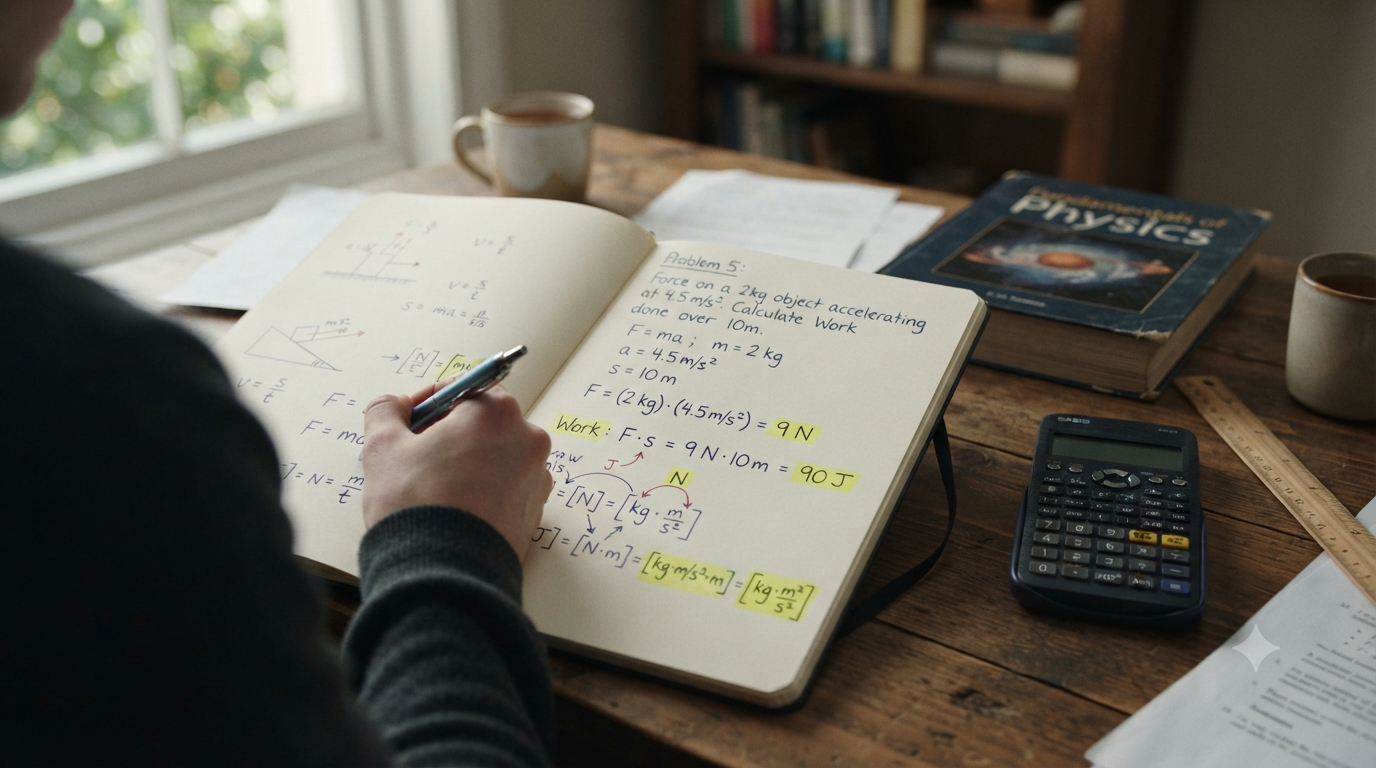
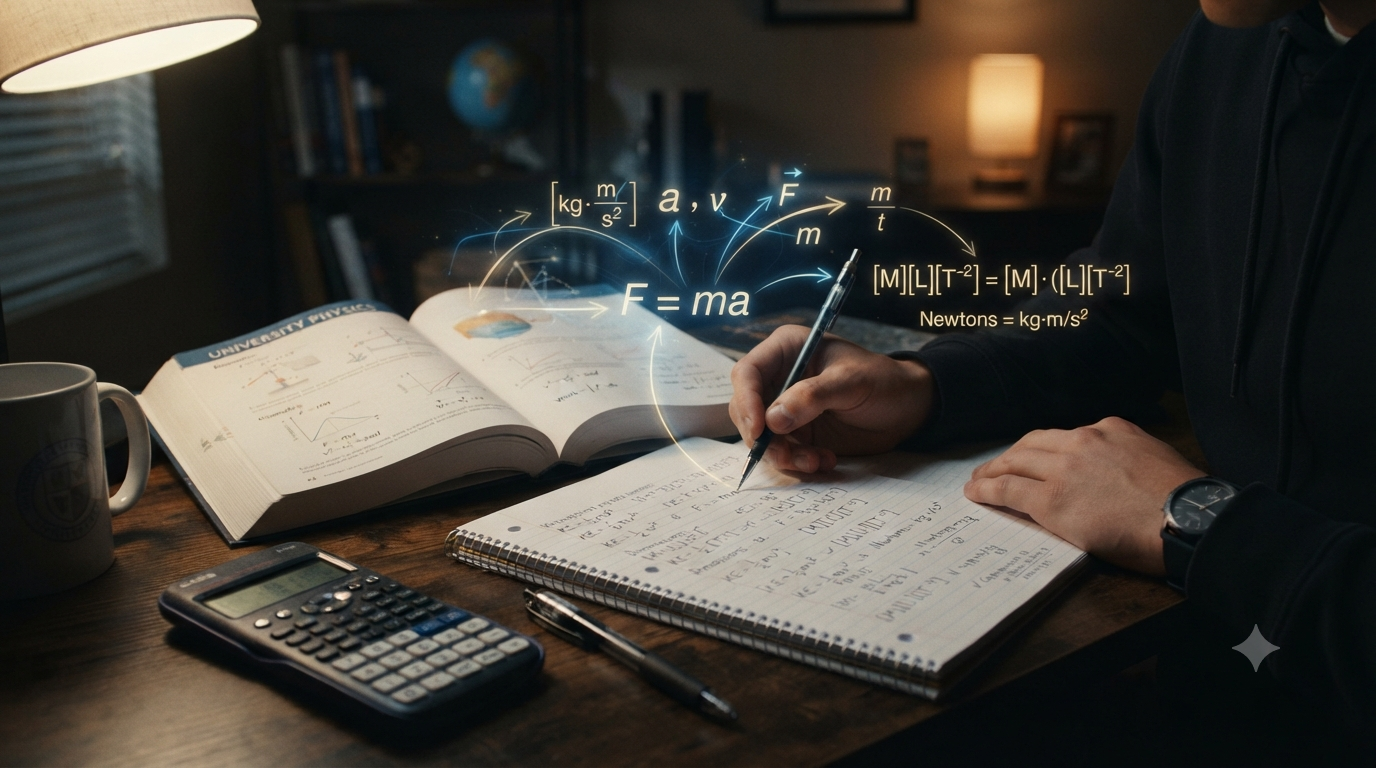
The unit of mass is kg, while acceleration has the unit m/s². Therefore:
Unit of force = kg·m/s²
This gives the SI unit of force, the newton.
Dimensional analysis can also help you check whether an equation makes physical sense. If the units on both sides of an equation do not match, something may be wrong.
For example, if a formula is supposed to calculate distance, its final unit should be a unit of length, such as metre.
Thinking about units regularly creates another mental connection to the formula.
Group Related Formulas Together
Trying to memorize formulas randomly can make physics unnecessarily difficult. Instead, organize related equations into groups.
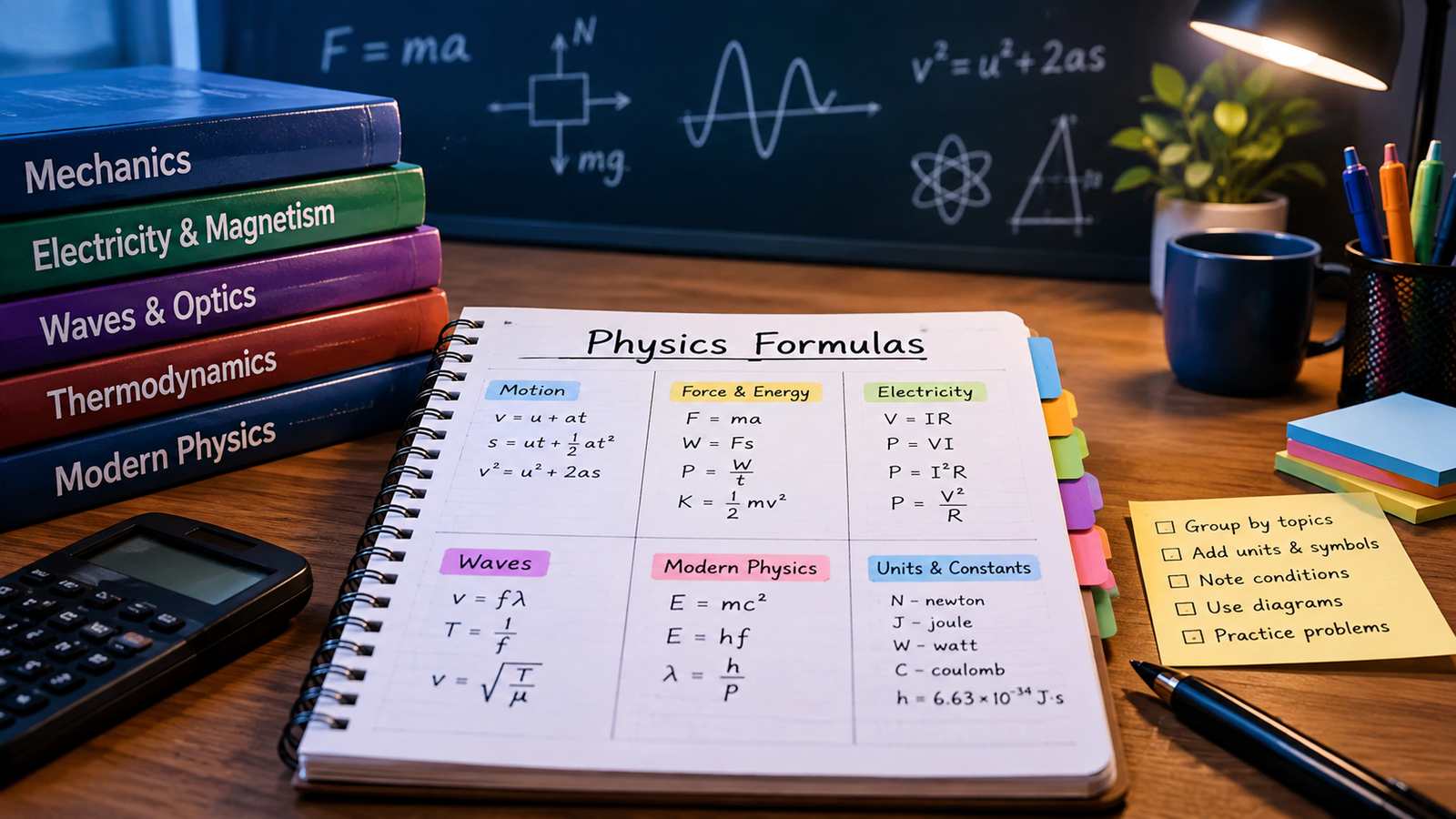
For motion, you may study:
v = u + at
s = ut + ½at²
v² = u² + 2as
These equations are connected because they describe motion with constant acceleration.
When you understand the relationship between them, you do not have to treat them as three completely independent formulas.
The same approach works in other areas of physics. Group formulas according to topics such as force, energy, momentum, electricity, waves, heat, and gravitation.
This creates a mental map of physics instead of a long list of unrelated equations.
Learn When a Formula Can Be Used
Knowing a formula is not enough. You must also understand its conditions.
For example, the standard equations of uniformly accelerated motion are used when acceleration is constant. If the acceleration is changing significantly, those equations may not be directly applicable.
Therefore, whenever you learn a formula, ask:
Under what conditions does this formula work?
This question is extremely important because many mistakes in physics happen when a correct formula is used in the wrong situation.
Understanding the conditions also makes formulas easier to remember because you associate them with a specific physical situation.
Derive Instead of Memorizing Whenever Possible
Some formulas can be quickly reconstructed from basic definitions.
For example, density is defined as mass per unit volume:
ρ = m / V
If you forget the equation, remembering the definition of density allows you to reconstruct it.
Similarly, speed is distance divided by time:
speed = distance / time
And pressure is force acting per unit area:
P = F / A
Learning important definitions can therefore reduce the number of formulas you need to memorize directly.
Instead of asking, “How can I memorize this formula?” ask, “Can I rebuild this formula from something I already understand?”
Use Formula Triangles Carefully
Formula triangles can sometimes help beginners remember relationships between three quantities.
For example, from:
v = s / t
you can rearrange the relationship to obtain:
s = vt
and
t = s / v
This can be useful for simple relationships. However, formula triangles should not replace understanding. For more complicated equations, learning the physical meaning and derivation is more reliable.
The goal should be to understand why the variables are related, not simply to remember their positions in a diagram.
Solve Problems Instead of Repeating Formulas
Repeatedly writing a formula may create temporary familiarity, but solving problems creates stronger understanding.
After learning a formula, use it in several different situations. Start with a simple numerical problem and then move toward problems where you must identify the appropriate equation yourself.
For example, after learning:
P = F / A
solve problems involving different forces and areas. Think about what happens to pressure when force increases or when the same force acts over a larger area.
This connects the equation with real physical behavior.
Explain the Formula in Your Own Words
A useful technique is to explain a formula without looking at your notes.
For example, instead of simply saying:
P = F / A
you could explain:
“Pressure tells us how much force is acting over a given area.”
Then explain what happens when force or area changes.
If you can explain the equation clearly in your own words, you probably understand it better than if you can only reproduce the symbols.
Teaching the concept to someone else, even informally, can make this method even more effective.
Use Real World Examples
Physics formulas become easier to remember when they are connected to things you can observe.
Pressure can be connected to sharp nails, snowshoes, and wide tyres. Momentum can be connected to moving vehicles and sports. Work can be connected to moving an object through a distance while applying force.
These examples give formulas a physical context.
When you remember the situation, the relevant relationship may also become easier to recall.
Practice Active Recall
Instead of repeatedly reading a formula sheet, close your book and try to reconstruct the equations yourself.
For example, write the topic “kinematics” and try to recall the important relationships without looking at your notes. Then check your answers.
This is called active recall. It forces your brain to retrieve information instead of simply recognizing it on a page.
You can also use flashcards, but make them concept-based. Instead of writing only “What is the formula for force?”, ask questions such as:
“What relationship connects force, mass, and acceleration?”
This encourages understanding rather than mechanical memorization.
Build a Formula Map
A formula map can show how different equations are connected.
For example, you might begin with a basic definition such as velocity, connect it to acceleration, and then connect acceleration to equations of motion.
Similarly, in electricity, relationships involving charge, current, voltage, resistance, and power can be organized into a connected network.
A formula map helps you see physics as a system of relationships rather than a collection of equations.
Review Formulas at Intervals
Understanding a formula once does not guarantee that you will remember it permanently. Regular review helps strengthen memory.
Instead of studying every formula repeatedly in one session, review important relationships after increasing intervals. For example, review them after a day, several days, and later while solving problems.
Each review should involve active recall and application rather than simply rereading the formula sheet.
Final Thoughts
Learning physics formulas without rote memorization is possible when you focus on meaning, relationships, units, derivations, and applications. A formula should not be treated as an isolated collection of symbols. It is a compact description of how physical quantities are connected.
Start by understanding what each variable means, learn the conditions under which the equation applies, connect it with units, and practice deriving or reconstructing it from basic definitions. Then solve different types of problems and explain the relationship in your own words.
The more you understand the physical ideas behind equations, the less you need to depend on memorization. Over time, formulas become familiar because they are connected to concepts, patterns, and real physical situations.