Time is one of the most fundamental quantities used in science. Almost every physical process involves time, from the motion of planets and the oscillation of atoms to the operation of electronic devices. To describe these processes accurately, scientists need a standard unit that can be reproduced consistently anywhere in the world. The SI unit of time is the second, represented by the symbol s. Unlike everyday definitions based on clocks or the Earth’s rotation, the modern scientific definition of the second is based on a highly precise property of the cesium-133 atom.
What Is the SI Unit of Time?
The second (s) is the SI base unit of time. It is one of the seven SI base units and provides the standard reference for measuring time in physics, chemistry, engineering, astronomy, technology, and many other scientific fields.
Time can be measured in seconds and in larger or smaller units derived from the second. For example:
1 minute = 60 seconds
1 hour = 3,600 seconds
1 millisecond = 0.001 second
1 microsecond = 0.000001 second
1 nanosecond = 0.000000001 second
Although these units are commonly used in daily life and technology, the second remains the fundamental SI unit from which these measurements are expressed.
Why Does Science Need a Standard Unit of Time?
Accurate time measurement is essential for comparing observations and performing scientific calculations. Imagine that two laboratories used slightly different definitions of a second. Measurements of speed, frequency, acceleration, energy, and many other quantities could become inconsistent.
A standard definition allows scientists around the world to communicate measurements using the same reference. It also makes it possible to synchronize technologies such as communication networks, satellite navigation systems, computers, electrical grids, and scientific instruments.
The importance of the second becomes especially clear in physics. Many physical quantities depend directly on time. For example, speed is defined as distance divided by time:
v = d/t
Acceleration is the change in velocity with time:
a = Δv/Δt
Frequency is the number of cycles occurring per second:
f = 1/T
Therefore, an accurate definition of the second supports accurate measurements across many areas of science.
How Was the Second Defined in the Past?
The definition of the second has changed as scientific measurement became more precise.
For a long time, the measurement of time was closely connected to the Earth’s rotation. A day was divided into hours, minutes, and seconds, and the second was historically related to a fraction of a day.
However, Earth’s rotation is not perfectly uniform. The rotation rate can vary slightly because of several natural effects. This means that Earth’s rotation is not precise enough to serve as the best reference for modern scientific measurements.
Scientists therefore needed a more stable and reproducible standard.
The development of atomic clocks provided a major improvement. Atoms have extremely stable properties that can be used as natural references for measuring time.
The Scientific Definition of the Second
The modern SI definition of the second is based on the cesium-133 atom.
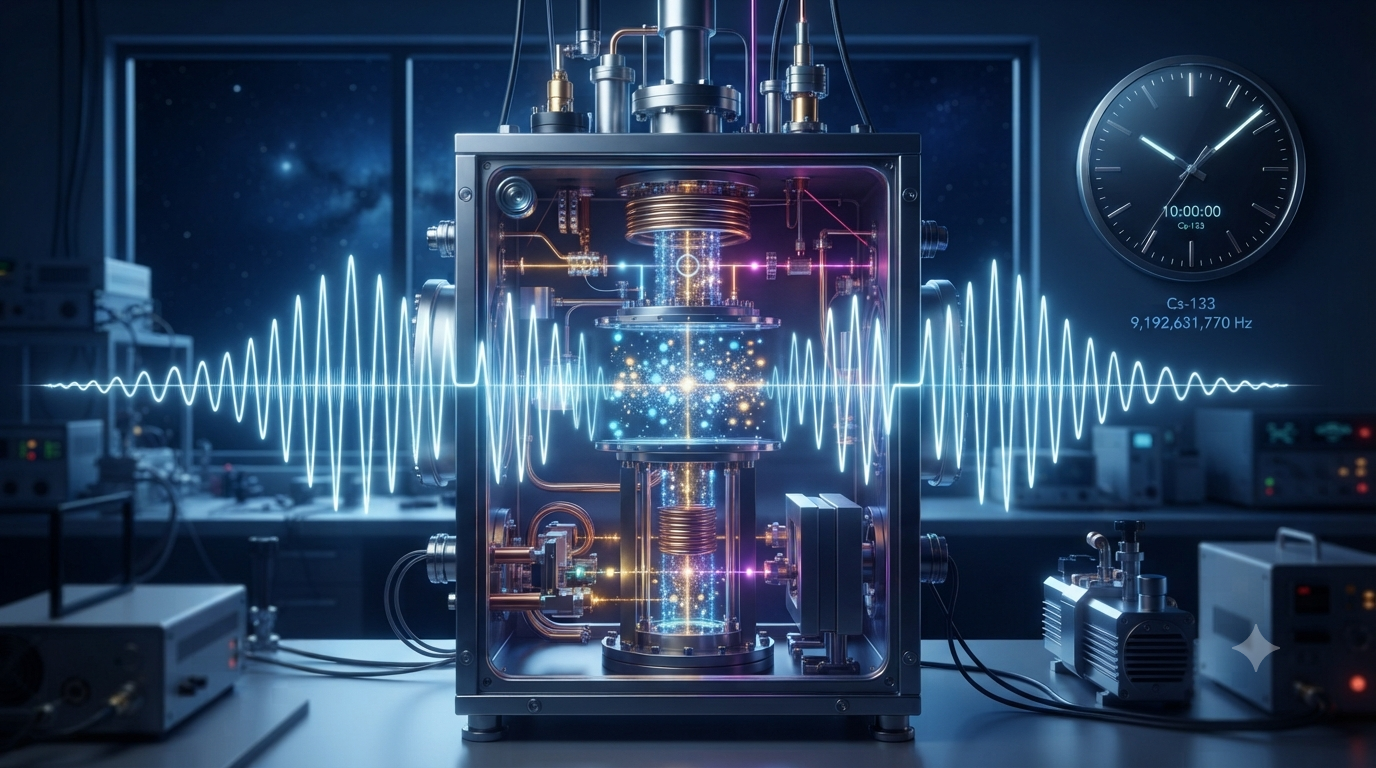
The second is defined by taking the fixed numerical value of the unperturbed ground-state hyperfine transition frequency of the cesium-133 atom, ΔνCs, to be 9,192,631,770 Hz.
In simpler terms, one second corresponds to 9,192,631,770 cycles of a specific atomic transition in cesium-133.
This definition does not depend on the rotation of Earth or the movement of mechanical parts inside a clock. Instead, it uses a precisely defined property of an atom.
The unit hertz means cycles per second. Therefore, the cesium frequency used in the definition is 9,192,631,770 cycles per second.
Why Is Cesium-133 Used?
Cesium-133 is used because its atomic transition provides an extremely stable and reproducible reference.
Atoms contain electrons and have specific energy levels. Under suitable conditions, an atom can transition between two energy states. These transitions are associated with electromagnetic radiation at very precise frequencies.
For cesium-133, the particular transition used for defining the second has a frequency of exactly 9,192,631,770 Hz.
Because atoms of cesium-133 behave according to the same physical laws everywhere, this provides a universal reference for time measurement.
How Does an Atomic Clock Measure a Second?
An atomic clock uses the natural frequency associated with an atomic transition as its reference.
In a cesium atomic clock, cesium atoms are exposed to electromagnetic radiation. The frequency of this radiation is carefully adjusted until it matches the specific transition frequency of cesium-133.
When the correct frequency is reached, the atoms respond in a characteristic way. Electronic systems detect this response and use it to control the clock’s oscillator.
The clock then counts the extremely regular cycles associated with the atomic reference. When the required number of cycles has occurred, one second has elapsed according to the SI definition.
Modern atomic clocks are extraordinarily precise and are used as references for international timekeeping.
The Second and Frequency
The definition of the second has a close connection with frequency. Frequency describes how many cycles occur in one second and is measured in hertz (Hz).
For example:
1 Hz = 1 cycle per second
The cesium-133 transition frequency used to define the second is:
ΔνCs = 9,192,631,770 Hz
This means that the reference transition has 9,192,631,770 cycles for every second.
This relationship between time and frequency is extremely important because highly accurate frequency measurement can be used to establish highly accurate time.
Why Is an Accurate Second Important?
Precise time measurement is not limited to laboratory experiments. It plays an important role in modern technology.
Satellite navigation systems depend on extremely accurate timing. Even a very small timing error can produce a significant error in determining position because radio signals travel at very high speeds.
Telecommunication networks also require accurate synchronization. Computers, financial systems, electrical power networks, scientific instruments, and data communication systems can all depend on precise timing.
In physics, precise time measurements are used to study extremely fast processes and to test fundamental theories. In astronomy, accurate timing helps scientists observe and compare events occurring across enormous distances.
The Second as an SI Base Unit
The second is one of the seven SI base units. The other SI base units are the metre, kilogram, ampere, kelvin, mole, and candela.
Although many physical quantities have their own units, several are expressed using combinations of SI base units. For example, velocity has the unit metre per second:
m/s
Acceleration has the unit:
m/s²
The second therefore appears in many derived units and equations used throughout physics.
Its role is much larger than simply measuring how long an event takes. It forms part of the foundation of the modern system of physical measurement.
How the Definition of the Second Has Improved
The history of the second shows how scientific measurement has moved from observations of large-scale natural phenomena toward extremely precise atomic references.
Earth’s rotation was useful for early timekeeping, but its natural variations limited its precision. Mechanical clocks improved practical time measurement, while quartz clocks provided greater stability. Atomic clocks then introduced an even more reliable reference based on atomic physics.
This progression demonstrates an important idea in science: definitions and measurement methods can improve as technology and understanding advance.
The modern definition of the second allows scientists to reproduce the unit with remarkable precision and provides a common reference for measurements throughout the world.
Conclusion
The second (s) is the SI base unit of time and one of the most important units in science and technology. Its modern definition is based on a precise atomic transition in cesium-133, with one second corresponding to 9,192,631,770 cycles of the specified transition frequency. This atomic definition provides a stable and reproducible reference that is far more precise than relying on Earth’s rotation. From measuring motion and frequency to synchronizing satellites and communication systems, the second provides a fundamental foundation for modern scientific measurement.
FAQs
The SI unit of time is the second, represented by the symbol s. It is one of the seven SI base units and is used as the fundamental standard for measuring time in science and technology. Other units of time, such as minutes, hours, milliseconds, and microseconds, can be expressed in terms of seconds. The second is essential in physics because many physical quantities depend on time. Speed, acceleration, frequency, and period all involve time in their definitions. A precise and internationally agreed definition of the second allows scientists, engineers, and researchers around the world to make consistent measurements.
The second is scientifically defined using a specific atomic transition in cesium-133. According to the modern SI definition, the unperturbed ground-state hyperfine transition frequency of cesium-133 is fixed at exactly 9,192,631,770 Hz. In simple terms, one second corresponds to 9,192,631,770 cycles of this specified atomic transition. This definition provides an extremely precise and reproducible standard for time measurement. Unlike older definitions based on Earth’s rotation, the modern definition depends on a stable property of an atom. This allows laboratories and advanced clocks to maintain a highly consistent measurement of time.
Cesium-133 is used because its atomic transition provides an exceptionally stable and reproducible frequency reference. Atoms have specific energy levels, and transitions between these levels occur at precisely defined frequencies. The particular transition in cesium-133 used for the SI definition has a frequency of exactly 9,192,631,770 Hz. Because cesium atoms follow the same physical laws under controlled conditions, they provide a reliable reference for time measurement. This makes cesium much more suitable for precision timekeeping than changing natural phenomena such as Earth’s rotation. Cesium atomic clocks therefore provide highly accurate standards for scientific measurements and international timekeeping.
An atomic clock uses the natural frequency of atoms as a reference for measuring time. In a cesium atomic clock, cesium-133 atoms are exposed to electromagnetic radiation. The radiation is adjusted until its frequency matches the specific atomic transition used in the SI definition. Electronic systems detect the atomic response and use it to control the clock’s oscillator. The clock continuously counts the corresponding cycles. When 9,192,631,770 cycles of the specified cesium transition have occurred, one second has elapsed according to the SI definition. This method allows atomic clocks to measure time with extraordinary precision and stability.
Earth’s rotation was historically used as the basis for measuring time, but it is not perfectly uniform. The rotation rate changes slightly because of natural effects involving Earth’s atmosphere, oceans, interior, and other factors. These variations make Earth’s rotation unsuitable as the most precise reference for modern science. Atomic transitions provide a much more stable reference. The cesium-133 transition used for defining the second can be reproduced under controlled conditions with extremely high precision. Moving from astronomical observations to atomic standards greatly improved timekeeping. This precision is essential for technologies and experiments that require extremely accurate synchronization and measurement.
The second and hertz are closely connected because frequency describes the number of cycles occurring per second. One hertz means one cycle per second. The cesium-133 transition used to define the second has a frequency of exactly 9,192,631,770 Hz. This means the specified atomic transition occurs 9,192,631,770 cycles per second. Frequency is therefore a powerful way to establish precise time. If a known frequency can be measured accurately, its cycles can be counted to determine elapsed time. This connection between frequency and time is fundamental to atomic clocks and many modern scientific technologies.
An accurate second is important because many physical quantities depend on time. For example, speed is calculated using v = d/t, while acceleration involves the change in velocity over time. Frequency also describes how many cycles occur during one second. If the measurement of time were inaccurate, calculations involving these quantities would also become less reliable. Precise time measurement is particularly important when studying extremely fast physical processes, testing theories, comparing experimental results, or synchronizing distant instruments. The accurate definition of the second therefore supports measurements across physics, astronomy, engineering, electronics, telecommunications, and many other scientific fields.
The second is essential to many technologies that depend on accurate timing and synchronization. Satellite navigation systems use precise clocks to determine distances from satellites and calculate positions. Telecommunication networks require synchronized signals to transmit information reliably. Computer networks, electrical power grids, scientific instruments, and financial systems can also depend on accurate timing. Even extremely small timing errors can become important when signals travel at high speeds or when many systems must operate together. Atomic clocks provide the highly precise timing references needed by these technologies. Therefore, the second is not simply a unit for measuring duration; it is a foundation of modern technological infrastructure.
Many commonly used time units are related directly to the second. One minute contains 60 seconds, while one hour contains 3,600 seconds. Smaller units are also defined using the second. A millisecond is one-thousandth of a second, a microsecond is one-millionth of a second, and a nanosecond is one-billionth of a second. The second also appears in many SI-derived units. Velocity is measured in metres per second (m/s), while acceleration is measured in metres per second squared (m/s²). These relationships show how the second forms an important part of scientific measurement and physical equations.
The SI definition of the second provides a universal and highly precise reference for measuring time. Scientists in different countries can use the same fundamental definition when conducting experiments, calibrating instruments, and comparing measurements. Because the definition is based on a specific atomic transition, it does not depend on local clocks, mechanical systems, or Earth’s changing rotation rate. This consistency is essential for modern science and technology. From measuring motion and frequency to operating satellite navigation and communication systems, accurate time is fundamental. The cesium-based definition therefore provides one of the most important foundations of precise scientific measurement.

Related Post
What Do Coefficients Mean in Chemistry Formulas?
When you look at a chemical equation, you may notice numbers written before chemical formulas. These numbers are called coefficients. […]
Read MoreHow to Read Subscripts in Chemical Formulas
Chemical formulas are a simple way to represent substances using symbols and numbers. When you look at a formula such […]
Read MoreHow to Identify Elements in a Chemical Formula
Chemical formulas provide a simple way to describe the substances that make up the world around us. A formula may […]
Read MoreHow Elements Are Represented in Chemical Formulas
Chemistry deals with many different substances, from the oxygen we breathe to the water we drink and the minerals found […]
Read MoreChemical Symbols and Their Role in Chemistry Formulas
Chemistry is often described as the science of matter, but understanding chemistry also means learning how scientists communicate information about […]
Read MoreHow Chemical Formulas Represent Substances
Chemical formulas are one of the simplest ways scientists communicate information about matter. A substance may contain millions or billions […]
Read MoreWhat Is a Chemical Formula in Chemistry?
Chemistry is the study of substances, their properties, and the changes they undergo. To describe these substances clearly, chemists need […]
Read MoreBasic Types of Chemistry Formulas Explained
Chemistry formulas are one of the simplest ways scientists describe substances, reactions, and relationships between different particles. A formula can […]
Read MoreHow to Read and Understand Chemistry Formulas
Chemistry formulas may look like a collection of letters, numbers, and symbols, but they are actually a simple language used […]
Read MoreWhat Are Chemistry Formulas and Why Are They Important?
Chemistry is the science of substances, their properties, and the changes they undergo. To describe these substances clearly, chemists use […]
Read MoreHow to Verify an Answer Using Units
In physics, getting a numerical answer is only part of solving a problem. The next question is whether that answer […]
Read MoreHow to Check Whether a Physics Formula Is Correct
A physics formula is more than a collection of symbols and numbers. It represents a relationship between physical quantities and […]
Read MoreHow to Avoid Unit Conversion Mistakes in Physics
Unit conversion is one of the most common sources of mistakes in physics. A formula may be correct, the calculation […]
Read MoreHow to Avoid Sign Errors in Physics Calculations
Physics calculations are not only about choosing the correct formula and putting numbers into it. The signs of physical quantities […]
Read MoreCommon Mistakes When Using Physics Formulas
Physics formulas help us describe motion, forces, energy, electricity, heat, waves, and many other phenomena using mathematical relationships. A formula […]
Read MoreHow to Study Physics Formulas Step by Step
Physics formulas are an important part of learning physics, but simply memorizing them is not enough. A formula represents a […]
Read MoreHow to Organize Physics Formulas for Easy Revision
Physics becomes much easier when formulas are organized in a clear and meaningful way. Many learners struggle not because they […]
Read MoreHow to Build a Physics Formula Sheet
Physics involves many formulas, and remembering all of them can become difficult as you move from basic concepts to more […]
Read More