Surface area is an important concept in geometry that helps us determine how much space covers the outside of a three-dimensional object. It is used in many everyday situations, such as calculating the amount of paint needed to cover a tank, the material required to make a box, or the surface available for heat transfer. Unlike the area of a flat shape, surface area deals with three-dimensional objects that have length, width, and height.
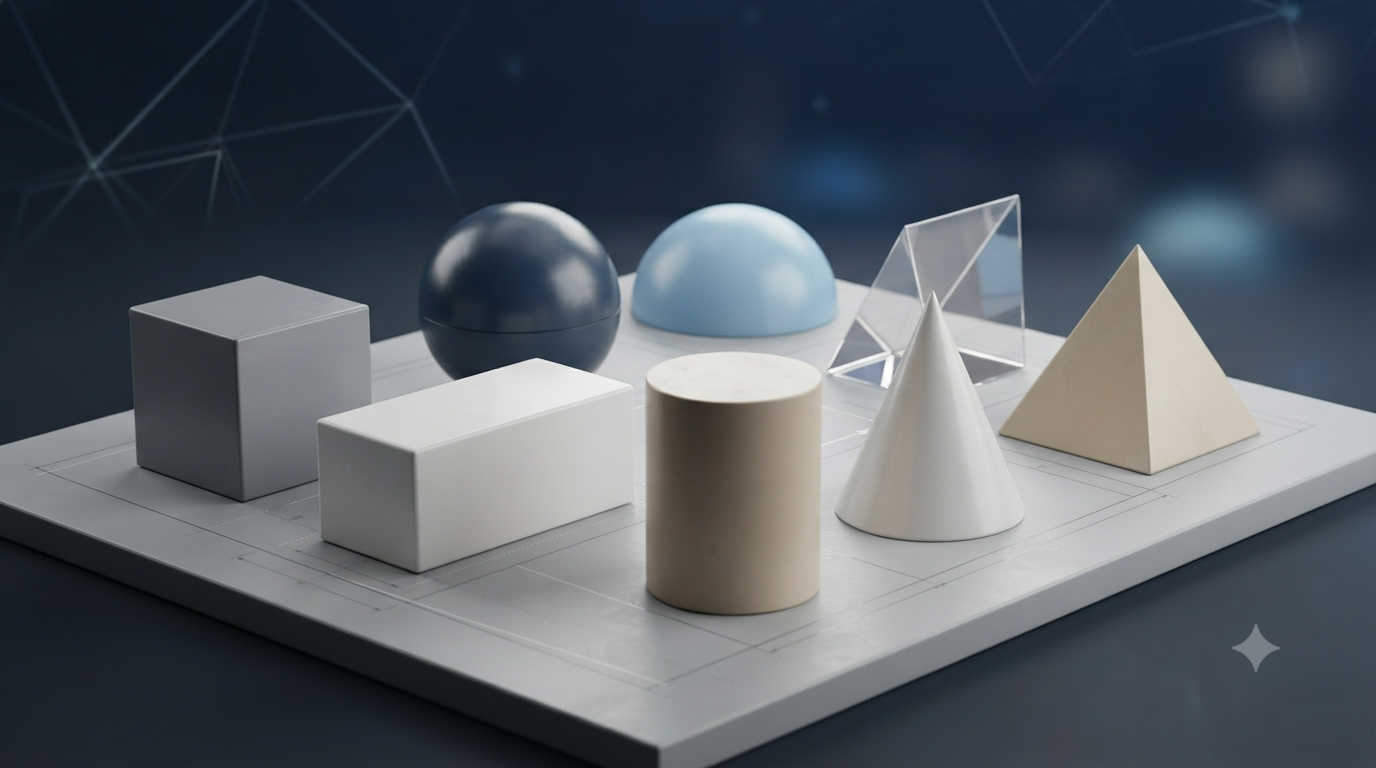
Different three-dimensional shapes have different surfaces, so each shape has its own surface area formula. Common solids include cubes, cuboids, cylinders, cones, spheres, hemispheres, and prisms. Understanding these formulas becomes much easier when you know which surfaces make up each solid and whether you need the total or curved surface area.
In this article, we will learn the main surface area formulas for common three-dimensional shapes, understand what each formula represents, and see how these formulas can be applied in practical problems.
What Is Surface Area?
The surface area of a three-dimensional object is the total area of all the surfaces that surround it. It is measured in square units such as square centimetres (cm²), square metres (m²), or square kilometres (km²).
For example, a cuboid has six rectangular faces. The total surface area is found by adding the areas of all six faces.
Surface area can generally be divided into two main types:
Total Surface Area (TSA): The area of every surface of a solid.
Curved Surface Area (CSA): The area of only the curved portion of a solid.
For some solids, the term Lateral Surface Area (LSA) is used instead of curved surface area. Lateral surface area refers to the area of the side surfaces, excluding the top and bottom bases.
Surface Area Formulas at a Glance
The following formulas cover many of the common three-dimensional shapes used in geometry.
| Three-Dimensional Shape | Surface Area Formula |
|---|---|
| Cube | TSA = 6a² |
| Cuboid | TSA = 2(lb + bh + hl) |
| Cylinder | CSA = 2πrh |
| Cylinder | TSA = 2πr(h + r) |
| Cone | CSA = πrl |
| Cone | TSA = πr(l + r) |
| Sphere | Surface Area = 4πr² |
| Hemisphere | CSA = 2πr² |
| Hemisphere | TSA = 3πr² |
| Prism | LSA = perimeter of base × height |
| Prism | TSA = LSA + 2 × area of base |
| Pyramid | LSA = ½ × perimeter of base × slant height |
| Pyramid | TSA = LSA + area of base |
Here, a is the side of a cube, l is length, b is breadth or width, h is height, r is radius, and l in the cone formula represents slant height.
Surface Area of a Cube
A cube is a three-dimensional shape with six equal square faces. All of its edges have the same length.
If the side length of the cube is a, the area of one square face is:
Area of one face = a²
Since a cube has six identical faces:
Total Surface Area = 6a²
Therefore:
TSA of cube = 6a²
The lateral surface area of a cube includes its four side faces:
LSA of cube = 4a²
Example
Suppose a cube has a side length of 5 cm.
TSA = 6 × 5²
TSA = 6 × 25
TSA = 150 cm²
So, the total surface area of the cube is 150 cm².
Surface Area of a Cuboid
A cuboid is a rectangular three-dimensional solid with six rectangular faces. Its dimensions are usually represented by length, breadth, and height.
Let:
l = length
b = breadth
h = height
The areas of the three pairs of opposite faces are:
lb, bh, and hl
Since each type of face occurs twice:
TSA = 2(lb + bh + hl)
Therefore:
Total Surface Area of cuboid = 2(lb + bh + hl)
The lateral surface area includes the four side faces:
LSA = 2h(l + b)
Example
Consider a cuboid with length 8 cm, breadth 5 cm, and height 3 cm.
TSA = 2(lb + bh + hl)
= 2[(8 × 5) + (5 × 3) + (3 × 8)]
= 2(40 + 15 + 24)
= 158 cm²
Thus, the total surface area is 158 cm².
Surface Area of a Cylinder
A cylinder has two circular bases and one curved surface. Examples include cans, pipes, and cylindrical containers.
Let:
r = radius of the circular base
h = height of the cylinder
The curved surface area of a cylinder is:
CSA = 2πrh
The two circular bases together have an area of:
2πr²
Therefore, the total surface area is:
TSA = 2πrh + 2πr²
Taking 2πr common:
TSA = 2πr(h + r)
So:
Curved Surface Area = 2πrh
Total Surface Area = 2πr(h + r)
Example
For a cylinder with radius 4 cm and height 10 cm:
TSA = 2πr(h + r)
= 2π × 4 × (10 + 4)
= 112π cm²
Using π ≈ 3.14:
TSA ≈ 351.68 cm²
Surface Area of a Cone
A cone has one circular base and one curved surface that tapers to a point. Ice-cream cones and some types of roofs have a conical shape.
For a cone:
r = radius of the base
h = perpendicular height
l = slant height
The curved surface area is:
CSA = πrl
The area of the circular base is:
πr²
Therefore, the total surface area is:
TSA = πrl + πr²
or:
TSA = πr(l + r)
So:
Curved Surface Area = πrl
Total Surface Area = πr(l + r)
The slant height can be calculated using the Pythagorean theorem when the radius and perpendicular height are known:
l² = r² + h²
Therefore:
l = √(r² + h²)
Example
Suppose a cone has radius 5 cm and slant height 13 cm.
TSA = πr(l + r)
= π × 5 × (13 + 5)
= 90π cm²
So the total surface area is approximately 282.6 cm² when π is taken as 3.14.
Surface Area of a Sphere
A sphere is a perfectly round three-dimensional object in which every point on its surface is the same distance from its centre.
The radius of a sphere is represented by r.
The surface area of a sphere is:
Surface Area = 4πr²
Unlike a cylinder or cone, a sphere has no flat bases. Its entire outer surface is curved.
Example
If the radius of a sphere is 7 cm:
Surface Area = 4πr²
= 4π × 7²
= 196π cm²
Using π = 22/7:
Surface Area = 616 cm²
Thus, the surface area of the sphere is 616 cm².
Surface Area of a Hemisphere
A hemisphere is half of a sphere. It has one curved surface and one circular flat base.
For a hemisphere with radius r, the curved surface area is:
CSA = 2πr²
The circular base has area:
Base Area = πr²
Therefore, the total surface area is:
TSA = 2πr² + πr²
TSA = 3πr²
Thus:
Curved Surface Area of hemisphere = 2πr²
Total Surface Area of hemisphere = 3πr²
It is important not to confuse these two formulas. If the flat circular base is included, use the total surface area formula.
Surface Area of a Prism
A prism is a three-dimensional solid with two identical and parallel bases connected by rectangular side faces. The shape of the base determines the type of prism.
For example, a prism may have a triangular, rectangular, or polygonal base.
The lateral surface area of a prism can be calculated using:
LSA = perimeter of base × height
The total surface area is:
TSA = LSA + 2 × area of base
Therefore:
TSA = (perimeter of base × height) + 2 × area of base
Example
Suppose a prism has a rectangular base with length 6 cm and breadth 4 cm, and its height is 10 cm.
Base area:
Area = 6 × 4 = 24 cm²
Base perimeter:
Perimeter = 2(6 + 4) = 20 cm
Lateral surface area:
LSA = 20 × 10 = 200 cm²
Total surface area:
TSA = 200 + 2(24)
TSA = 248 cm²
Surface Area of a Pyramid
A pyramid has a polygonal base and triangular faces that meet at a common point called the apex.
For a regular pyramid, the lateral surface area can be calculated using:
LSA = ½ × perimeter of base × slant height
The total surface area is:
TSA = LSA + area of base
Therefore:
TSA = ½ × perimeter of base × slant height + area of base
The exact calculation depends on the shape of the base.
For a square pyramid with side length a and slant height l:
LSA = 2al
Since the area of the square base is a²:
TSA = 2al + a²
Curved Surface Area and Total Surface Area
One of the most common sources of mistakes in surface area problems is choosing the wrong type of surface area.
Curved Surface Area includes only the curved portion of a solid. For example, the CSA of a cylinder does not include its two circular bases.
Total Surface Area includes every exposed surface of the solid. For a closed cylinder, this includes the curved surface and both circular bases.
For a hemisphere, the difference is especially important:
CSA = 2πr²
TSA = 3πr²
Before using a formula, determine exactly which surfaces the question asks you to include.
How to Calculate Surface Area Step by Step
Surface area problems become easier when you follow a consistent method.
Step 1: Identify the Three-Dimensional Shape
First determine whether the object is a cube, cuboid, cylinder, cone, sphere, hemisphere, prism, or pyramid.
Step 2: Identify the Given Measurements
Write down the dimensions you know. Make sure you distinguish between radius, diameter, height, length, breadth, and slant height.
Step 3: Select the Correct Formula
Decide whether the question requires curved, lateral, or total surface area.
Step 4: Substitute the Values
Put the given measurements into the appropriate formula.
Step 5: Calculate Carefully
Follow the correct order of operations and simplify the result.
Step 6: Add the Correct Unit
Since surface area measures two-dimensional coverage, the final unit must be squared.
For example:
cm²
m²
mm²
ft²
Surface Area and Nets
A useful way to understand surface area is through a net. A net is a two-dimensional arrangement of all the faces of a three-dimensional object.
When a solid is unfolded into a net, its surface area can be found by adding the areas of all the individual faces.
For example, the net of a cuboid contains six rectangles. Adding their areas gives the total surface area of the cuboid.
Nets are particularly useful because they show exactly which surfaces are included in a calculation.
Common Mistakes When Using Surface Area Formulas
Several mistakes occur frequently when solving surface area problems.
Confusing Radius and Diameter
The radius is half the diameter:
r = d/2
Using the diameter directly in a formula that requires radius can produce an incorrect result.
Forgetting a Base
When calculating the total surface area of a cylinder, both circular bases must be included if the cylinder is closed.
Similarly, a hemisphere has a circular base that must be included when calculating its total surface area.
Using Height Instead of Slant Height
For a cone’s curved surface area, the formula uses slant height:
CSA = πrl
The perpendicular height and slant height are not the same measurement.
Using the Wrong Unit
Surface area is measured in square units. A result such as 50 cm is not a surface area; it should be expressed as 50 cm².
Using the Wrong Formula
Always identify the shape and the specific surface being measured before selecting a formula.
Practical Applications of Surface Area
Surface area formulas are useful far beyond classroom geometry. Engineers use surface area when designing tanks, pipes, buildings, machines, and heat exchangers. Architects may use it when estimating materials needed to cover structures.
In manufacturing, surface area can help determine the amount of material required to produce containers and other objects. In science, surface area is important in topics such as heat transfer, chemical reactions, and biological structures.
For example, the surface area of a container can help determine how much paint or coating is required. Similarly, the surface area of a pipe affects how much material is needed to manufacture or insulate it.
Important Surface Area Formulas to Remember
The most commonly used formulas can be summarized as follows:
Cube
TSA = 6a²
Cuboid
TSA = 2(lb + bh + hl)
Cylinder
CSA = 2πrh
TSA = 2πr(h + r)
Cone
CSA = πrl
TSA = πr(l + r)
Sphere
Surface Area = 4πr²
Hemisphere
CSA = 2πr²
TSA = 3πr²
Prism
LSA = perimeter of base × height
TSA = LSA + 2 × area of base
Pyramid
LSA = ½ × perimeter of base × slant height
TSA = LSA + area of base
Conclusion
Surface area formulas provide a systematic way to calculate the amount of space covering the outside of three-dimensional objects. The main idea is simple: identify all the surfaces that need to be included and calculate their combined area.
For flat-faced solids such as cubes, cuboids, prisms, and pyramids, surface area is usually found by adding the areas of their individual faces. For curved solids such as cylinders, cones, spheres, and hemispheres, specific formulas make the calculation easier.
The most important step is to understand the difference between curved or lateral surface area and total surface area. Once the shape, measurements, and required surface are identified correctly, the appropriate formula can be applied directly. With regular practice, these formulas become easier to remember and useful for solving both mathematical and real-world problems.
FAQs
1. What is surface area in three-dimensional geometry?
Surface area is the total area covering the outside of a three-dimensional object. It represents the combined area of all the surfaces that make up a solid. Depending on the shape and the question, surface area may include flat faces, curved surfaces, or both. It is always expressed in square units, such as cm², m², or ft². For example, a cube has six square faces, so its total surface area is the sum of the areas of all six faces. Surface area is commonly used in geometry, construction, manufacturing, engineering, packaging, painting, and many other practical applications.
2. What is the formula for the total surface area of a cube?
The total surface area of a cube is calculated using the formula TSA = 6a², where a represents the length of one edge of the cube. A cube has six identical square faces, and the area of each face is a². Therefore, multiplying the area of one face by six gives the total surface area. For example, if the side of a cube is 4 cm, its total surface area is 6 × 4² = 96 cm². The formula assumes that all six faces of the cube are included in the calculation.
3. What is the total surface area formula for a cuboid?
The total surface area of a cuboid is given by TSA = 2(lb + bh + hl), where l is length, b is breadth or width, and h is height. A cuboid has six rectangular faces arranged in three pairs of equal opposite faces. Their combined areas are represented by 2lb, 2bh, and 2hl. Adding these areas gives the total surface area. For example, a cuboid measuring 6 cm × 4 cm × 3 cm has a total surface area of 2(24 + 12 + 18) = 108 cm².
4. What is the surface area formula for a cylinder?
A cylinder has one curved surface and two circular bases. Its curved surface area is calculated using CSA = 2πrh, where r is the radius and h is the height. If both circular bases are included, the total surface area is TSA = 2πr(h + r). The first part represents the curved surface, while the second part accounts for the two circular bases. It is important to determine whether the question asks for curved surface area or total surface area before selecting the formula. The radius should be used rather than the diameter.
5. What is the difference between curved surface area and total surface area?
Curved surface area refers only to the curved portion of a three-dimensional object, while total surface area includes every surface of the object. For example, a cylinder has a curved side and two circular bases. Its curved surface area is 2πrh, whereas its total surface area is 2πr(h + r) because the two bases are also included. Similarly, a hemisphere has a curved surface area of 2πr² and a total surface area of 3πr². Understanding which surfaces need to be included helps prevent mistakes when choosing and applying surface area formulas.
6. What is the surface area formula for a cone?
The curved surface area of a cone is CSA = πrl, where r is the radius of its circular base and l is its slant height. If the circular base is also included, the total surface area is TSA = πr(l + r). The slant height is different from the perpendicular height. If the radius and perpendicular height are known, the slant height can be found using l = √(r² + h²). The correct value of slant height should be used in the cone’s surface area formula to obtain an accurate result.
7. What is the surface area formula for a sphere?
The surface area of a sphere is calculated using Surface Area = 4πr², where r is the radius of the sphere. A sphere has one continuous curved surface and does not have separate flat bases. For example, if the radius is 7 cm, the surface area is 4π × 7² = 196π cm². Using π = 22/7 gives a result of 616 cm². The formula is useful for calculating the amount of material, coating, or other coverage required for a spherical object. Surface area is always expressed in square units.
8. What is the total surface area formula for a hemisphere?
A hemisphere is half of a sphere and has both a curved surface and one circular flat base. Its curved surface area is CSA = 2πr². When the circular base is included, the total surface area becomes TSA = 3πr². The additional πr² represents the area of the circular base. Therefore, it is important to check whether the question asks for curved surface area or total surface area. For example, a hemisphere with radius 5 cm has a total surface area of 3π × 25 = 75π cm².
9. How is the surface area of a prism calculated?
The surface area of a prism depends on the shape of its base. The lateral surface area is calculated using LSA = perimeter of base × height. To find the total surface area, the areas of both bases are added: TSA = LSA + 2 × area of base. For example, if a prism has a base perimeter of 20 cm, height of 8 cm, and base area of 24 cm², its lateral surface area is 160 cm². Its total surface area is 160 + 48 = 208 cm². This method works for different types of prisms.
10. Why are surface area formulas important in real life?
Surface area formulas are useful for many practical applications. They can help determine how much paint is needed to cover an object, how much material is required to manufacture a container, or how much coating is needed for a surface. Engineers also use surface area when designing tanks, pipes, machines, and heat-transfer systems. In science, surface area can influence processes such as heat transfer and chemical reactions. Understanding surface area also makes it easier to solve geometry problems involving cubes, cuboids, cylinders, cones, spheres, hemispheres, prisms, and pyramids. These formulas connect mathematical concepts with real-world measurements and applications.