
What Is Density and How Is It Calculated?

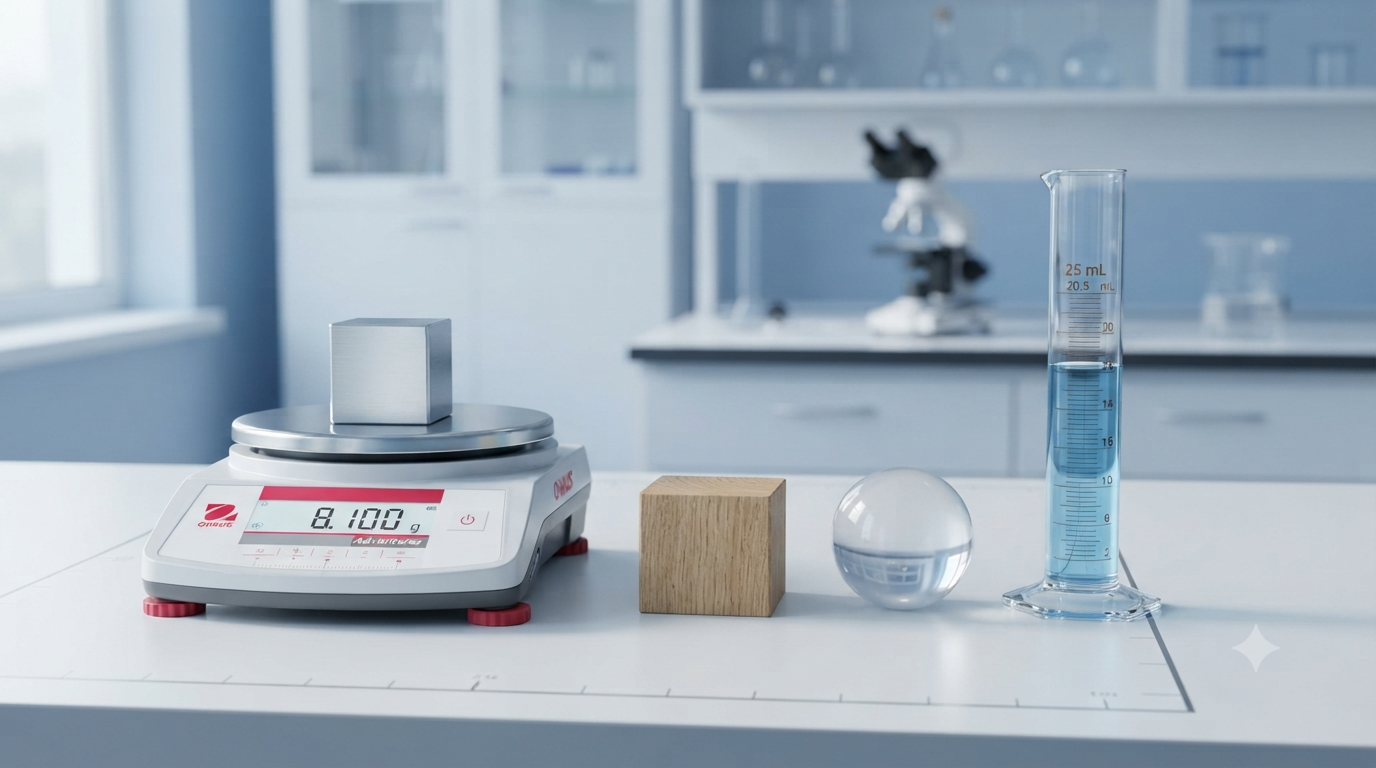
Science illustration showing mass, volume, and density calculation using objects, a balance, and a graduated cylinder.

Density is one of the most useful physical quantities in science. It helps us understand how much matter is packed into a given amount of space. Two objects can have the same size but very different masses because their densities are different. For example, a small piece of iron can feel much heavier than a similar-sized piece of wood. This happens because iron has a much higher density than wood.

Density is important in physics, chemistry, engineering, geology, astronomy, and many everyday applications. By knowing the mass and volume of an object, we can calculate its density and use that value to compare different materials.

What Is Density?

Density is defined as the mass of a substance per unit volume. In simple words, density tells us how much matter is contained in a certain amount of space.

A material with more mass packed into the same volume has a higher density. A material with less mass in the same volume has a lower density.

For example, imagine two cubes of exactly the same size. One cube is made of iron and the other is made of wood. Although both cubes occupy the same volume, the iron cube has greater mass. Therefore, iron has a higher density than wood.

Density is represented by the Greek letter ρ (rho).

How Is Density Calculated?

Density is calculated using the relationship between mass and volume:

ρ = m/V

where:

  • ρ = density

  • m = mass

  • V = volume

This formula shows that density increases when more mass is present in the same volume. Similarly, if the same mass occupies a larger volume, its density becomes smaller.

For example, suppose an object has a mass of 200 g and a volume of 50 cm³.

Using the formula:

ρ = m/V

ρ = 200/50

ρ = 4 g/cm³

Therefore, the density of the object is 4 g/cm³.

Understanding Mass and Volume

To calculate density correctly, we need to understand the two quantities used in the formula: mass and volume.

Mass

Mass is the amount of matter in an object. It is commonly measured in grams (g) or kilograms (kg).

A balance is commonly used to measure the mass of an object. Unlike weight, mass does not depend on the strength of gravity acting on the object.

For example, an object with a mass of 2 kg has the same mass whether it is on Earth or on the Moon, although its weight would be different.

Volume

Volume is the amount of space occupied by an object or substance. It is commonly measured in cubic metres (m³), cubic centimetres (cm³), or litres (L).

For regular objects, volume can often be calculated using mathematical formulas.

For example, the volume of a rectangular box is:

V = length × width × height

If a box has a length of 10 cm, a width of 5 cm, and a height of 2 cm:

V = 10 × 5 × 2

V = 100 cm³

Once the volume is known, it can be used along with mass to calculate density.

What Are the Units of Density?

The unit of density depends on the units used for mass and volume.

In the International System of Units (SI), mass is measured in kilograms and volume in cubic metres. Therefore, the SI unit of density is:

kg/m³

Density can also be expressed using other units, such as:

  • g/cm³

  • g/mL

  • kg/L

For water, the density is approximately 1 g/cm³ under common reference conditions. This is also approximately equal to 1 g/mL.

When solving density problems, it is important to make sure that the units of mass and volume are compatible.

How to Calculate Density of a Regular Object

Calculating the density of a regular object is usually straightforward.

First, measure or determine its mass. Then calculate its volume using the appropriate geometric formula. Finally, divide the mass by the volume.

Consider a rectangular metal block with:

  • Mass = 540 g

  • Length = 10 cm

  • Width = 6 cm

  • Height = 3 cm

First, calculate the volume:

V = length × width × height

V = 10 × 6 × 3

V = 180 cm³

Now calculate density:

ρ = m/V

ρ = 540/180

ρ = 3 g/cm³

Therefore, the density of the metal block is 3 g/cm³.

How to Find the Volume of an Irregular Object

Not every object has a simple shape. A stone, for example, may have an irregular shape that makes it difficult to calculate volume using a standard geometric formula.

In such cases, the water displacement method can be used.

First, water is placed in a graduated cylinder and its initial volume is recorded. The irregular object is then carefully submerged in the water. The water level rises because the object occupies space.

The difference between the final and initial water levels gives the volume of the object.

For example, if the initial water level is 50 mL and the final level is 75 mL:

Volume of object = 75 − 50

Volume = 25 mL

If the object’s mass is 100 g:

ρ = 100/25

ρ = 4 g/mL

Thus, the density of the object is 4 g/mL.

Why Is Density Important?

Density allows scientists to compare materials and identify substances. If the density of an unknown material is measured accurately, it can sometimes be compared with known density values to help identify the material.

Density is also useful for understanding whether substances will float or sink. When an object is placed in a liquid, its density compared with the liquid’s density affects its behaviour.

An object that is less dense than a liquid tends to float, while an object that is denser than the liquid tends to sink, provided other factors do not change the situation.

Density also plays an important role in engineering. Engineers consider density when designing ships, aircraft, buildings, machines, and many other structures. In geology, density helps scientists study rocks and materials inside Earth. In astronomy, density can provide important information about stars, planets, and other celestial objects.

Density and Temperature

Density can change when temperature changes, especially for gases and many liquids.

When a substance expands because of heating, its volume can increase while its mass remains the same. Since density is mass divided by volume, an increase in volume generally causes density to decrease.

Cooling can have the opposite effect in many materials, although water behaves unusually near its freezing point.

This is why density values are often given with a specific temperature or set of conditions.

Density Is Different From Mass

Mass and density are related, but they are not the same physical quantity.

Mass tells us how much matter an object contains. Density tells us how much mass is contained in a given volume.

For example, a large block of low-density material can have more mass than a small block of high-density material. Therefore, knowing only the mass of an object does not tell us its density.

We need both mass and volume to calculate density.

Conclusion

Density describes how much mass is packed into a given volume. It is calculated by dividing mass by volume using the formula ρ = m/V. By measuring mass and determining volume, we can calculate the density of regular and irregular objects. Density is expressed in units such as kg/m³, g/cm³, and g/mL, depending on the measurement system being used. Understanding density helps us compare materials, identify substances, explain floating and sinking, and study many physical processes. Although the formula is simple, density is an important concept that connects measurements of mass and volume to the physical properties of matter.

FAQs

What is density in physics?

Density is the amount of mass contained in a given volume of a substance. It tells us how closely matter is packed within a particular space. The formula for density is ρ = m/V, where ρ represents density, m represents mass, and V represents volume. For example, if an object has a mass of 100 grams and occupies a volume of 20 cm³, its density is 5 g/cm³. Density is a characteristic property of a material and can help identify or compare substances. Materials with greater mass in the same volume have higher density, while materials with less mass have lower density.

What is the formula for calculating density?

The standard formula for calculating density is ρ = m/V. Here, ρ is density, m is the mass of the substance, and V is its volume. To use the formula, first determine the object’s mass and volume using suitable measurements. Then divide the mass by the volume. For example, if a material has a mass of 300 g and a volume of 100 cm³, its density is 300 ÷ 100 = 3 g/cm³. The formula can also be rearranged to find mass or volume when the other two quantities are known. This makes density useful in many physics calculations.

What are the common units of density?

Density can be expressed using different units depending on the units used for mass and volume. The SI unit of density is kilograms per cubic metre (kg/m³). In laboratory measurements, grams per cubic centimetre (g/cm³) and grams per millilitre (g/mL) are also commonly used. Since one millilitre is equivalent to one cubic centimetre, g/mL and g/cm³ represent the same numerical density. Choosing compatible units is important when solving problems. For example, if mass is measured in grams and volume in cubic centimetres, the resulting density will normally be expressed in g/cm³. Unit conversion may be necessary when different units are given.

How do you calculate the density of a regular object?

To calculate the density of a regular object, first measure its mass. Next, determine its volume using the appropriate geometric formula. For a rectangular object, volume can be calculated using V = length × width × height. Once the mass and volume are known, use ρ = m/V to calculate density. For example, a rectangular block with a mass of 240 g and dimensions of 10 cm × 4 cm × 2 cm has a volume of 80 cm³. Its density is therefore 240 ÷ 80 = 3 g/cm³. This method works well for objects with simple, measurable shapes.

How can you find the density of an irregular object?

The density of an irregular object can be calculated by measuring its mass and finding its volume through water displacement. First, measure the object’s mass using a balance. Then place a known amount of water in a graduated cylinder and record the initial volume. Carefully submerge the object completely in the water and record the new volume. The difference between the final and initial water levels gives the object’s volume. Finally, divide the mass by the volume using ρ = m/V. This method is particularly useful for objects such as stones or other materials whose volume cannot easily be calculated using geometric formulas.

Why is density important in physics?

Density is important because it describes how mass is distributed within a volume. It helps scientists and engineers compare different materials and understand their physical behaviour. Density can also help identify an unknown substance when its measured value is compared with known values. It is useful for explaining why some objects float while others sink. Engineers consider density when selecting materials for buildings, vehicles, ships, and machines. Density is also important in fields such as geology, chemistry, astronomy, and environmental science. Because it connects mass and volume, density provides useful information about matter and helps scientists understand and predict how substances behave.

What is the difference between mass and density?

Mass and density are related but describe different properties. Mass is the amount of matter in an object, while density describes how much mass is contained within a particular volume. For example, a large object made from a low-density material can have more total mass than a small object made from a high-density material. However, the smaller object may still have greater density. Mass is commonly measured in kilograms or grams, while density can be measured in kg/m³ or g/cm³. Density is calculated by dividing mass by volume, so knowing mass alone is not enough to determine an object’s density.

Does density change with temperature?

Density can change when temperature changes because temperature can affect the volume of a substance. When many substances are heated, they expand and occupy a larger volume while their mass remains essentially unchanged. Since density is mass divided by volume, an increase in volume generally results in a decrease in density. Cooling often produces the opposite effect. However, not every substance behaves in exactly the same way. Water, for example, has unusual behaviour near its freezing point. For this reason, density values are often specified at particular temperatures. When comparing density measurements, it is important to consider the conditions under which they were measured.

What happens to density when volume increases?

If the mass of a substance remains constant while its volume increases, its density decreases. This follows directly from the density formula ρ = m/V. Because volume is in the denominator, increasing the volume spreads the same amount of mass over more space. For example, suppose an object has a mass of 100 g. If its volume is 20 cm³, its density is 5 g/cm³. If the same mass occupies 50 cm³, its density becomes 2 g/cm³. Therefore, density and volume have an inverse relationship when mass remains constant. The actual behaviour of a material depends on why its volume changes.

Why do some objects float while others sink?

Whether an object floats or sinks in a liquid depends largely on its density compared with the density of the liquid, along with its shape and buoyant force. An object whose average density is lower than the liquid can float, while an object with greater average density tends to sink. For example, many types of wood float in water because their average density is lower than water. A solid piece of iron generally sinks because its density is much higher than that of water. This principle is also important in ship design, where the overall shape allows a large vessel to displace enough water to remain afloat.

Related Post

Leave a Comment

Your email address will not be published. Required fields are marked *

Scroll to Top