Atoms are the basic building blocks of all matter. Every chemical element consists of atoms that contain protons, neutrons, and electrons. The number of protons determines the identity of an element, while the number of neutrons can vary between atoms of the same element. This variation gives rise to a fascinating concept in chemistry known as isotopes.
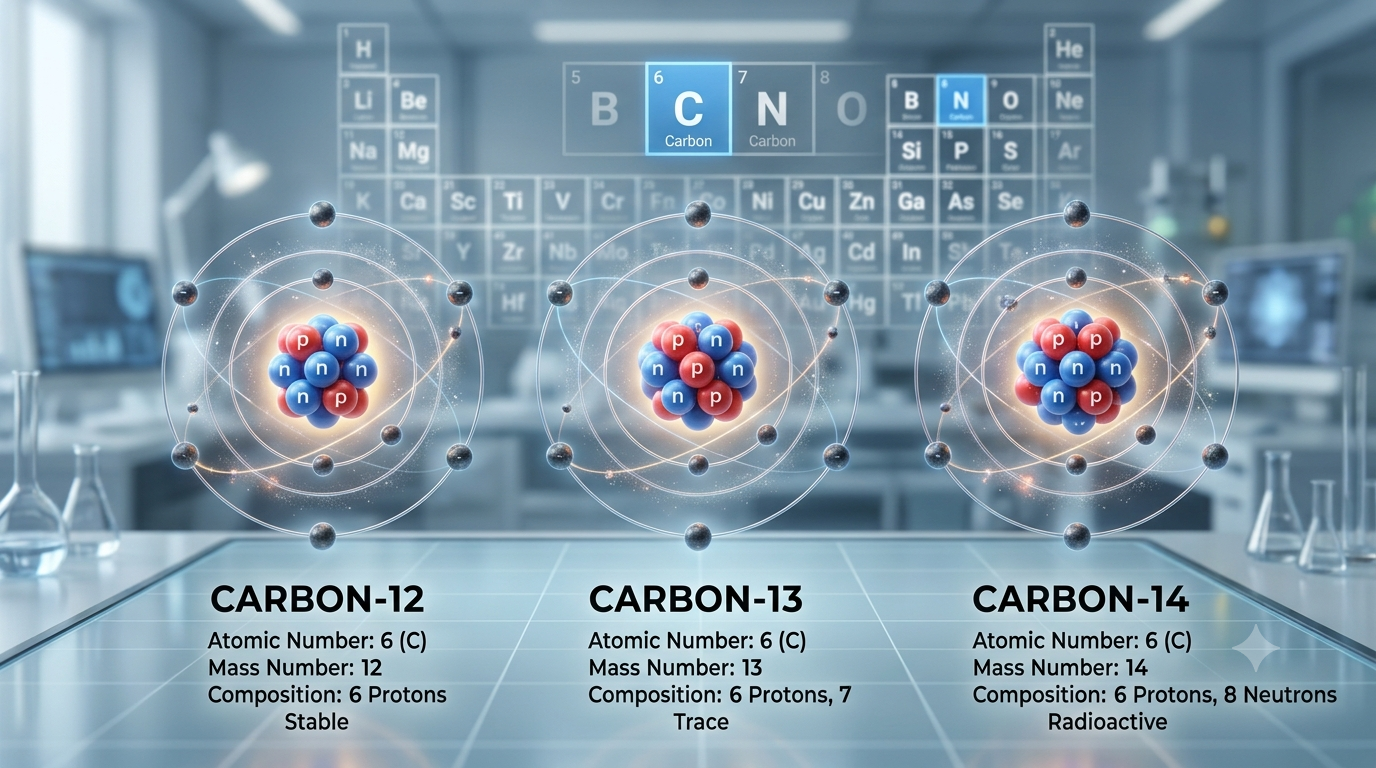
Isotopes are atoms of the same element that have the same number of protons but different numbers of neutrons. As a result, they have the same atomic number but different mass numbers. For example, carbon-12, carbon-13, and carbon-14 are three naturally occurring isotopes of carbon.
The concept of isotopes is closely connected to the periodic table. Although the periodic table organizes elements according to their atomic numbers, isotopes help explain why the atomic masses of elements are not always whole numbers. Understanding isotopes makes it easier to understand atomic structure, atomic mass, chemical properties, and the arrangement of elements in the periodic table.
What Are Isotopes?
Isotopes are different forms of the same chemical element that contain an equal number of protons but different numbers of neutrons in their atomic nuclei.
The number of protons in an atom is called its atomic number. Since isotopes of an element have the same number of protons, they always have the same atomic number. However, their different neutron counts give them different mass numbers.
For example, all carbon atoms contain six protons. However, different carbon isotopes contain different numbers of neutrons.
Carbon-12 contains 6 protons and 6 neutrons.
Carbon-13 contains 6 protons and 7 neutrons.
Carbon-14 contains 6 protons and 8 neutrons.
All three atoms belong to the element carbon because they have six protons. Their different neutron counts make them different isotopes of the same element.
Isotopes can be found in many elements, including hydrogen, oxygen, nitrogen, chlorine, uranium, and carbon. Some isotopes are stable, while others are radioactive and undergo nuclear decay.
Understanding Atomic Structure
To understand isotopes properly, it is important to know the basic structure of an atom.
An atom consists of three main subatomic particles: protons, neutrons, and electrons.
Protons
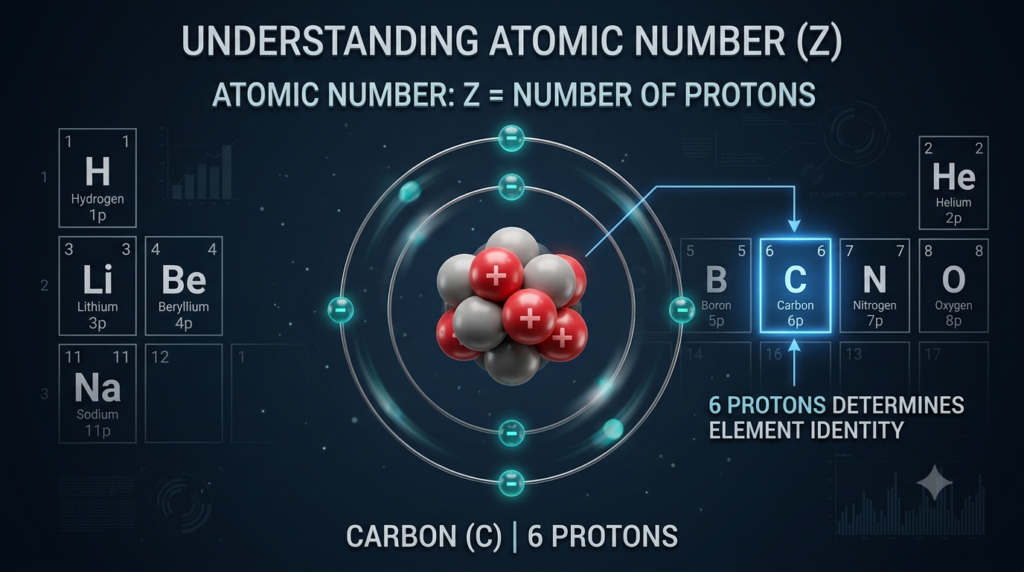
Protons are positively charged particles located inside the nucleus of an atom. The number of protons determines which chemical element an atom represents.
For example, every hydrogen atom contains one proton, every carbon atom contains six protons, and every oxygen atom contains eight protons.
Neutrons
Neutrons are electrically neutral particles found inside the nucleus. They contribute to the mass of an atom but do not carry an electrical charge.
The number of neutrons can vary among atoms of the same element. This variation is responsible for the existence of isotopes.
Electrons
Electrons are negatively charged particles found in regions surrounding the nucleus. In a neutral atom, the number of electrons is equal to the number of protons.
The arrangement of electrons plays an important role in determining the chemical properties of an element.
Atomic Number and Mass Number
Two important quantities help us identify and distinguish isotopes: atomic number and mass number.
Atomic Number
The atomic number is the total number of protons present in the nucleus of an atom.
It is represented by the symbol Z.
Atomic Number (Z) = Number of Protons
The atomic number determines the identity of an element. For example, every atom with an atomic number of 6 is carbon, regardless of how many neutrons it contains.
Mass Number
The mass number is the total number of protons and neutrons present in the nucleus of an atom.
It is represented by the symbol A.
Mass Number (A) = Number of Protons + Number of Neutrons
Therefore:
Number of Neutrons = Mass Number − Atomic Number
For example, carbon-14 has an atomic number of 6 and a mass number of 14.
Number of Neutrons = 14 − 6 = 8
This means carbon-14 contains six protons and eight neutrons.
How Are Isotopes Represented?
Isotopes are commonly represented using the chemical symbol of an element along with its mass number.
The general representation is:
ᵃ_zX
Where:
X = Chemical symbol of the element
A = Mass number
Z = Atomic number
For example, carbon-12 can be represented as ¹²₆C.
Similarly:
Carbon-13 = ¹³₆C
Carbon-14 = ¹⁴₆C
Oxygen-16 = ¹⁶₈O
Oxygen-18 = ¹⁸₈O
Another common method is to write the element’s name followed by its mass number, such as carbon-12 or uranium-235.
The mass number helps distinguish different isotopes of the same element.
Examples of Common Isotopes
Many chemical elements have multiple isotopes. Some are stable and naturally abundant, while others are radioactive.
Hydrogen Isotopes
Hydrogen is the simplest element in the periodic table. It has three commonly discussed isotopes: protium, deuterium, and tritium.
Protium (¹H): Contains one proton and no neutrons. It is the most abundant hydrogen isotope.
Deuterium (²H): Contains one proton and one neutron. It is a stable isotope of hydrogen.
Tritium (³H): Contains one proton and two neutrons. It is radioactive.
These isotopes demonstrate how the same element can exist in different forms because of variations in neutron numbers.
Carbon Isotopes
Carbon has several isotopes, but carbon-12, carbon-13, and carbon-14 are particularly important.
Carbon-12: Contains six protons and six neutrons. It is stable and is used as the standard for defining the atomic mass unit.
Carbon-13: Contains six protons and seven neutrons. It is also stable and is useful in scientific research.
Carbon-14: Contains six protons and eight neutrons. It is radioactive and is widely used in radiocarbon dating.
Carbon isotopes have important applications in biology, environmental science, archaeology, and chemistry.
Oxygen Isotopes
Oxygen has several naturally occurring isotopes, including oxygen-16, oxygen-17, and oxygen-18.
Oxygen-16 contains eight protons and eight neutrons.
Oxygen-17 contains eight protons and nine neutrons.
Oxygen-18 contains eight protons and ten neutrons.
Oxygen-16 is the most abundant isotope. Oxygen-18 is particularly useful in climate research because its relative abundance in natural materials can provide information about past environmental conditions.
Chlorine Isotopes
Chlorine naturally occurs mainly as two stable isotopes:
Chlorine-35 contains 17 protons and 18 neutrons.
Chlorine-37 contains 17 protons and 20 neutrons.
Both isotopes have the same atomic number because they contain 17 protons. However, their different mass numbers contribute to the average atomic mass of chlorine.
What Is the Relationship Between Isotopes and the Periodic Table?
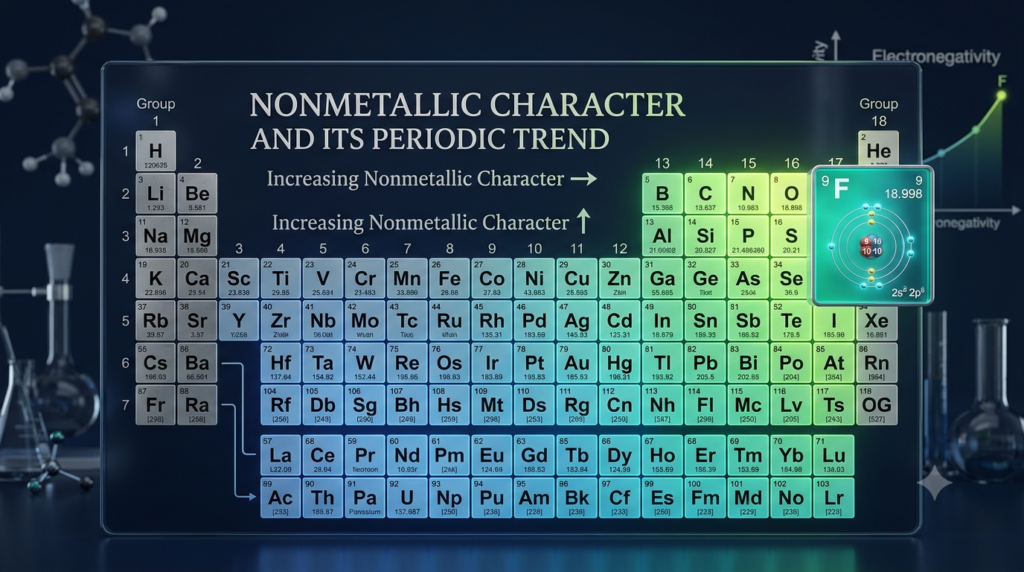
The periodic table is arranged according to the increasing atomic numbers of elements. Each element occupies a specific position based on the number of protons in its nucleus.
Isotopes are directly related to this arrangement because all isotopes of an element have the same atomic number.
For example, carbon-12, carbon-13, and carbon-14 all contain six protons. Therefore, they all belong to carbon, which has atomic number 6.
They do not occupy separate positions in the periodic table. Instead, they are considered different forms of the same element.
The periodic table represents an element rather than listing all its individual isotopes.
This relationship is important because it explains how elements can have different atomic masses while retaining the same position in the periodic table.
Why Do Isotopes Occupy the Same Position?
The position of an element in the periodic table depends on its atomic number, not its mass number.
Since isotopes have identical atomic numbers, they belong to the same element and occupy the same position.
For example:
| Isotope | Protons | Neutrons | Atomic Number |
|---|---|---|---|
| Carbon-12 | 6 | 6 | 6 |
| Carbon-13 | 6 | 7 | 6 |
| Carbon-14 | 6 | 8 | 6 |
All three isotopes belong to carbon because each contains six protons.
Their different neutron counts do not change their elemental identity.
Why Are Atomic Masses in the Periodic Table Usually Decimal Numbers?
One of the most interesting connections between isotopes and the periodic table is the atomic mass shown for each element.
You may notice that many elements have atomic masses that are not whole numbers. For example, chlorine has an atomic mass of approximately 35.45 u.
This happens because the atomic mass displayed in the periodic table is generally the weighted average of the masses of the naturally occurring isotopes of an element.
Different isotopes have different masses and occur in different proportions in nature. Therefore, their average does not necessarily produce a whole number.
Understanding Average Atomic Mass
Average atomic mass is calculated by considering the mass and natural abundance of each isotope of an element.
The formula is:
Average Atomic Mass = Σ (Isotope Mass × Fractional Abundance)
Fractional abundance is obtained by dividing the percentage abundance by 100.
For example, naturally occurring chlorine mainly consists of two isotopes:
Chlorine-35 has an approximate abundance of 75.78%.
Chlorine-37 has an approximate abundance of 24.22%.
Using simplified isotope masses:
Average Atomic Mass = (35 × 0.7578) + (37 × 0.2422)
Average Atomic Mass = 26.523 + 8.484
Average Atomic Mass = 35.007 u
This simplified calculation gives an approximate result. Actual atomic masses use the more precise isotopic masses rather than whole-number mass numbers, giving chlorine an average atomic mass of approximately 35.45 u.
This explains why the atomic mass of chlorine is not exactly 35 or 37.
Difference Between Isotopes and Atomic Mass
Atomic mass and mass number are related concepts, but they are not identical.
Mass number is the total number of protons and neutrons in a particular atom. It is always a whole number.
Atomic mass refers to the mass of an individual atom, usually expressed in atomic mass units (u). The atomic mass of a particular isotope is generally not exactly equal to its mass number.
The standard atomic weight shown in most periodic tables represents the average atomic mass of an element based on its isotopic composition.
For example, carbon has two major stable isotopes, carbon-12 and carbon-13. Its standard atomic weight is approximately 12.011 u.
This value reflects the natural abundance and actual masses of its isotopes.
Types of Isotopes
Isotopes are generally classified into two main groups based on the stability of their atomic nuclei.
Stable Isotopes
Stable isotopes are isotopes that do not spontaneously undergo radioactive decay.
Their nuclei remain stable under ordinary conditions.
Examples include:
Carbon-12
Carbon-13
Oxygen-16
Oxygen-18
Hydrogen-2
Stable isotopes are useful in chemical research, environmental studies, biological investigations, and medical research.
Radioactive Isotopes
Radioactive isotopes, also called radioisotopes, have unstable atomic nuclei. They release energy in the form of radiation as they transform into more stable forms.
This process is known as radioactive decay.
Examples include:
Carbon-14
Hydrogen-3 (Tritium)
Uranium-238
Iodine-131
Cobalt-60
Radioactive isotopes are useful in medical diagnosis, cancer treatment, archaeological dating, scientific research, and industrial applications.
Do Isotopes Have the Same Chemical Properties?
In most ordinary chemical reactions, isotopes of the same element have nearly identical chemical properties.
This is because chemical properties are mainly determined by the arrangement of electrons, particularly the electrons in the outermost shell.
Since neutral isotopes of the same element have the same atomic number, they also have the same number of electrons and generally the same electronic configuration.
For example, carbon-12 and carbon-14 both have six electrons in their neutral atomic states. Therefore, they generally participate in similar chemical reactions.
However, isotopes do not have exactly identical physical properties.
Their different masses can influence certain physical characteristics and reaction rates. These differences are known as isotope effects.
For example, reactions involving hydrogen and deuterium may occur at different rates because deuterium is heavier than ordinary hydrogen.
Therefore, isotopes have nearly identical chemical behavior but can show measurable differences in physical properties and reaction rates.
Isotopes and the Modern Periodic Table
The modern periodic table is based on the atomic number of elements rather than their atomic masses.
This arrangement was established because atomic number provides a more fundamental way of identifying elements.
Before the modern arrangement was adopted, scientists used atomic mass as an important basis for organizing elements. However, the discovery of isotopes revealed that atoms of the same element could have different masses.
This created difficulties for arrangements based only on atomic mass.
For example, different isotopes of an element have different masses but belong to the same element. They cannot be assigned separate positions simply because their masses differ.
The use of atomic number solved this problem.
The modern periodic table places all isotopes of an element in the same position because they have the same number of protons.
Thus, the discovery of isotopes helped strengthen the understanding of atomic structure and supported the development of the modern periodic table.
Applications of Isotopes in Science and Technology
Isotopes are not just important for understanding atomic structure. They also have many practical applications in different scientific and technological fields.
Carbon Dating
Carbon-14 is used to estimate the age of ancient organic materials.
Living organisms continuously exchange carbon with their environment. After death, this exchange stops, and the carbon-14 present in their remains gradually decreases through radioactive decay.
By measuring the remaining carbon-14, scientists can estimate how long ago an organism died.
This technique is known as radiocarbon dating and is widely used in archaeology and historical research.
Medical Diagnosis and Treatment
Radioactive isotopes are used in medical imaging and certain treatments.
For example, technetium-99m is widely used in diagnostic nuclear medicine to examine different organs and tissues.
Iodine-131 is used in certain treatments involving the thyroid gland.
These applications help medical professionals investigate and manage various health conditions.
Nuclear Energy
Certain radioactive isotopes can release large amounts of energy during nuclear reactions.
Uranium-235 is an important isotope used as fuel in many nuclear reactors.
When a uranium-235 nucleus undergoes nuclear fission, it releases energy along with additional neutrons. These neutrons can cause further fission reactions under suitable conditions.
This process is used to generate electricity in nuclear power plants.
Scientific Research
Stable isotopes are widely used as tracers in scientific experiments.
Researchers can follow the movement of particular elements through chemical reactions, biological systems, and environmental processes.
For example, carbon-13 can be used to study metabolic pathways and investigate how organisms process different substances.
Environmental Studies
Oxygen and hydrogen isotopes help scientists investigate environmental processes.
The relative abundance of oxygen-18 and oxygen-16 in ice cores, ocean sediments, and other natural materials can provide information about past climate conditions.
Isotope analysis also helps researchers study the movement of water through the environment and understand different ecological processes.
Why Is Understanding Isotopes Important?
Understanding isotopes provides a deeper explanation of how atoms are structured and how elements behave.
The concept connects several important topics in chemistry, including atomic number, mass number, atomic mass, nuclear stability, and radioactive decay.
It also explains why the atomic masses shown in the periodic table are often decimal values rather than whole numbers.
In addition, isotopes demonstrate that atoms of the same element can have different nuclear structures while retaining the same elemental identity.
This knowledge is useful not only in chemistry but also in physics, biology, medicine, geology, environmental science, and nuclear technology.
Conclusion
Isotopes are different forms of the same chemical element that contain equal numbers of protons but different numbers of neutrons. Because their atomic numbers remain identical, all isotopes of an element occupy the same position in the periodic table.
Their different neutron counts result in different mass numbers and contribute to the average atomic masses displayed in the periodic table. Isotopes can be stable or radioactive, and although they generally have similar chemical properties, their different masses can influence certain physical properties and reaction rates.
The relationship between isotopes and the periodic table is essential for understanding modern atomic theory. Beyond explaining atomic structure and atomic mass, isotopes have important applications in medicine, archaeology, nuclear energy, environmental research, and scientific investigations.
FAQs
1. What are isotopes?
Isotopes are atoms of the same chemical element that have the same number of protons but different numbers of neutrons. Since the number of protons determines the identity of an element, all its isotopes belong to the same element. However, their different neutron counts give them different mass numbers. For example, carbon-12, carbon-13, and carbon-14 are isotopes of carbon. They all contain six protons but have six, seven, and eight neutrons, respectively. Isotopes can be stable or radioactive and are important in chemistry, physics, medicine, and scientific research.
2. Why do isotopes have the same atomic number?
Isotopes have the same atomic number because they contain an equal number of protons in their atomic nuclei. The atomic number is the defining property of a chemical element. For example, every isotope of carbon contains six protons, so its atomic number is always six. The number of neutrons can change without changing the identity of the element. Therefore, carbon-12, carbon-13, and carbon-14 all have the same atomic number. Their different neutron counts affect their mass numbers but do not change their position in the periodic table.
3. Why do isotopes have different mass numbers?
Isotopes have different mass numbers because they contain different numbers of neutrons in their nuclei. The mass number is calculated by adding the number of protons and neutrons. Since isotopes of an element have the same number of protons but different numbers of neutrons, their mass numbers are different. For example, carbon-12 contains six protons and six neutrons, while carbon-14 contains six protons and eight neutrons. Their mass numbers are 12 and 14, respectively. This difference helps scientists distinguish between different isotopes of the same chemical element.
4. Why do all isotopes of an element occupy the same position in the periodic table?
All isotopes of an element occupy the same position in the periodic table because the periodic table is arranged according to atomic number rather than mass number. Since isotopes contain the same number of protons, they have identical atomic numbers and belong to the same chemical element. For example, carbon-12, carbon-13, and carbon-14 all have an atomic number of six. Therefore, they occupy the same position as carbon in the periodic table. Their different neutron numbers do not change their elemental identity or periodic table placement.
5. Why are atomic masses in the periodic table usually decimal numbers?
Atomic masses in the periodic table are usually decimal numbers because they generally represent the weighted average of the masses of an element’s naturally occurring isotopes. Different isotopes have different masses and occur in different proportions in nature. Their average therefore does not necessarily produce a whole number. For example, chlorine has two major naturally occurring isotopes, chlorine-35 and chlorine-37. Their different natural abundances contribute to chlorine’s standard atomic weight of approximately 35.45 u. This is why the atomic mass displayed in the periodic table often contains decimal values.
6. What is the difference between stable and radioactive isotopes?
Stable and radioactive isotopes differ in the stability of their atomic nuclei. Stable isotopes have nuclei that do not spontaneously undergo radioactive decay. Examples include carbon-12, carbon-13, and oxygen-16. Radioactive isotopes have unstable nuclei that release energy through radioactive decay as they transform into more stable forms. Examples include carbon-14, iodine-131, and uranium-238. Stable isotopes are useful in environmental and biological research, while radioactive isotopes are used in medical treatments, diagnostic procedures, archaeological dating, and nuclear energy production.
7. Do isotopes have the same chemical properties?
Isotopes of the same element generally have nearly identical chemical properties because they have the same atomic number and, in neutral atoms, the same number of electrons. Their electronic configurations are therefore generally identical. Since chemical behavior mainly depends on electron arrangement, isotopes usually participate in similar chemical reactions. However, their different masses can produce small differences in reaction rates and certain physical properties. These differences are known as isotope effects. For example, reactions involving hydrogen and deuterium can occur at different rates because deuterium has a greater mass.
8. What are the three isotopes of hydrogen?
The three commonly discussed isotopes of hydrogen are protium, deuterium, and tritium. Protium is the most abundant hydrogen isotope and contains one proton with no neutrons. Deuterium contains one proton and one neutron and is stable. Tritium contains one proton and two neutrons and is radioactive. All three isotopes have an atomic number of one because they contain one proton. However, their mass numbers are one, two, and three, respectively. These isotopes are important in nuclear research, scientific experiments, and certain energy-related applications.
9. What are the important applications of isotopes?
Isotopes have several important applications in science, medicine, industry, and environmental research. Carbon-14 is used in radiocarbon dating to estimate the age of ancient organic materials. Technetium-99m is widely used in medical imaging, while iodine-131 is used in certain thyroid treatments. Uranium-235 is used as nuclear fuel in many nuclear reactors. Stable isotopes such as carbon-13 help scientists investigate biological and chemical processes. Oxygen isotopes are also useful in studying past climate conditions. These applications demonstrate the importance of isotopes in understanding and solving real-world scientific problems.
10. What is the relationship between isotopes and average atomic mass?
Isotopes determine the average atomic mass of an element because each isotope contributes according to its mass and natural abundance. Average atomic mass is calculated by multiplying the mass of each isotope by its fractional abundance and adding the results. For example, chlorine naturally contains mainly chlorine-35 and chlorine-37. Since these isotopes occur in different proportions, their weighted average produces an atomic mass of approximately 35.45 u. This value is displayed in the periodic table instead of the mass number of any single chlorine isotope. Thus, isotopes explain the decimal atomic masses of many elements.