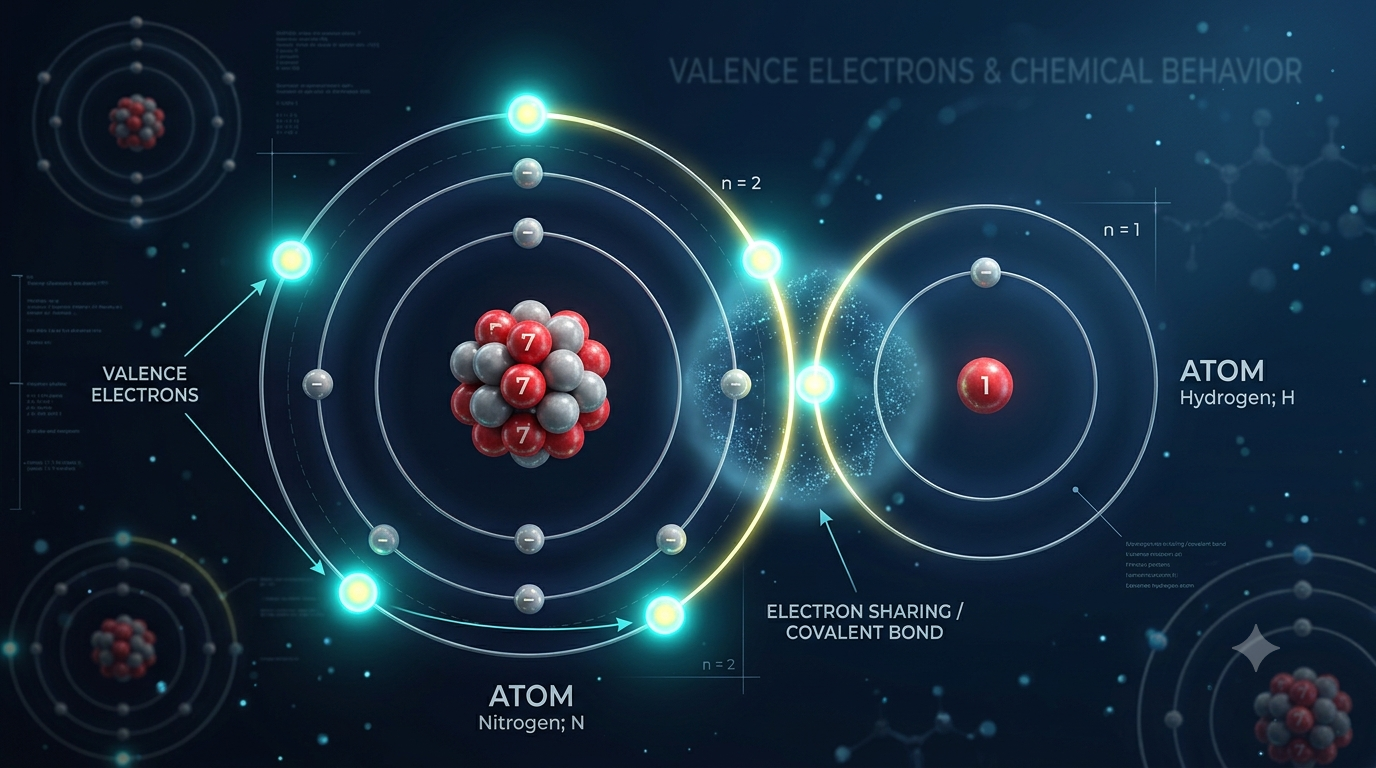
Atoms are the basic building blocks of all matter. Every substance around us, including water, air, metals, minerals, and living organisms, is made up of atoms. Although atoms contain protons, neutrons, and electrons, not all these particles play the same role in chemical reactions. Electrons, particularly those present in the outermost shell of an atom, are mainly responsible for determining how an element interacts with other elements.
These outermost electrons are called valence electrons. They play an essential role in chemical bonding, the formation of compounds, and the overall chemical behaviour of elements. The number of valence electrons helps explain why some elements readily react with others, why certain atoms form particular types of bonds, and why elements belonging to the same group of the periodic table often show similar chemical properties.
Understanding valence electrons provides a foundation for learning about chemical reactions, ionic and covalent bonding, the periodic table, and the stability of atoms.
What Are Valence Electrons?
Valence electrons are the electrons present in the outermost occupied electron shell of an atom. These electrons are most directly involved in chemical bonding and reactions.
An atom may contain several electron shells, depending on its atomic number. The electrons in the inner shells are generally held more strongly by the nucleus, while the outermost electrons are more directly involved in interactions with other atoms.
For example, a sodium atom has 11 electrons arranged in three occupied shells:
First shell: 2 electrons
Second shell: 8 electrons
Third shell: 1 electron
Its electron arrangement is 2, 8, 1. Since the outermost shell contains one electron, sodium has one valence electron.
Similarly, chlorine has 17 electrons arranged as 2, 8, 7. Its outermost shell contains seven electrons, so chlorine has seven valence electrons.
The number of valence electrons strongly influences how these elements react with other substances.
How Are Valence Electrons Arranged in Atoms?
Electrons occupy different energy levels around the nucleus. These energy levels are commonly represented as electron shells.
The shells are traditionally identified using the letters K, L, M, N, and so on. They correspond to the principal energy levels 1, 2, 3, and 4.
Electrons generally occupy lower-energy shells before entering higher-energy shells.
For the first 20 elements, the basic shell distribution can be understood using the following pattern:
| Electron shell | Maximum electron capacity |
|---|---|
| K (1st shell) | 2 |
| L (2nd shell) | 8 |
| M (3rd shell) | 18 |
| N (4th shell) | 32 |
These values represent the maximum theoretical capacity of each shell. However, the actual filling order of electron subshells follows energy rules, so electrons do not always fill an entire shell before entering another.
For example:
Carbon (Atomic number 6)
Electron arrangement: 2, 4
Valence electrons: 4
Oxygen (Atomic number 8)
Electron arrangement: 2, 6
Valence electrons: 6
Magnesium (Atomic number 12)
Electron arrangement: 2, 8, 2
Valence electrons: 2
Calcium (Atomic number 20)
Electron arrangement: 2, 8, 8, 2
Valence electrons: 2
These examples show how the outermost electron arrangement helps identify the valence electrons of an atom.
How to Determine the Number of Valence Electrons
The number of valence electrons can usually be determined by examining the electronic configuration of an element.
For elements in the main groups of the periodic table, the group number provides a convenient way to identify the number of valence electrons.
For example:
| Element | Group | Valence electrons |
|---|---|---|
| Hydrogen | 1 | 1 |
| Lithium | 1 | 1 |
| Beryllium | 2 | 2 |
| Boron | 13 | 3 |
| Carbon | 14 | 4 |
| Nitrogen | 15 | 5 |
| Oxygen | 16 | 6 |
| Fluorine | 17 | 7 |
| Neon | 18 | 8 |
Helium is an exception among the noble gases. It belongs to Group 18 but has only two electrons, which completely fill its first shell.
For transition elements, determining valence electrons can be more complicated because electrons from both the outermost s subshell and nearby d subshells may participate in chemical bonding.
Why Are Valence Electrons Important?
Valence electrons are important because they largely determine how atoms interact with one another. Their arrangement influences several fundamental chemical properties.
1. They Determine Chemical Reactivity
Chemical reactivity refers to the ability of an element to participate in chemical reactions.
Atoms often react to achieve a more stable electronic arrangement. Many main-group elements do this by gaining, losing, or sharing electrons to obtain a filled outer shell.
For example, sodium has one valence electron. It can lose this electron relatively easily to form a positively charged sodium ion (Na⁺).
Chlorine has seven valence electrons. It can gain one electron to complete its outermost shell and form a negatively charged chloride ion (Cl⁻).
When sodium and chlorine react, sodium transfers an electron to chlorine, producing sodium chloride (NaCl).
This example demonstrates how valence electrons influence the reactivity of elements.
2. They Determine Chemical Bond Formation
Chemical bonds are attractive forces that hold atoms together in molecules and compounds.
Valence electrons are directly involved in forming most chemical bonds. Depending on the elements involved, atoms may transfer or share their valence electrons.
The three major types of chemical bonding are ionic, covalent, and metallic bonding.
Ionic Bonding
Ionic bonding occurs when electrons are transferred from one atom to another, producing oppositely charged ions that attract each other.
For example, sodium transfers one valence electron to chlorine. Sodium becomes Na⁺, while chlorine becomes Cl⁻. The electrostatic attraction between these ions forms an ionic compound.
Covalent Bonding
Covalent bonding occurs when atoms share pairs of electrons.
For example, two hydrogen atoms share electrons to form a hydrogen molecule (H₂). Each hydrogen atom effectively achieves a stable two-electron arrangement.
Similarly, oxygen shares electrons with two hydrogen atoms to form water (H₂O).
Metallic Bonding
Metallic bonding occurs in metals, where valence electrons become delocalised throughout the metal structure. These mobile electrons help hold positively charged metal centres together.
This type of bonding explains important properties of metals, including electrical conductivity, thermal conductivity, and malleability.
3. They Help Determine the Valency of an Element
Valency is the combining capacity of an atom. It describes how many electrons an atom typically loses, gains, or shares when forming chemical bonds.
For many main-group elements, valency can be estimated from the number of valence electrons.
For example:
| Element | Valence electrons | Common valency |
|---|---|---|
| Hydrogen | 1 | 1 |
| Oxygen | 6 | 2 |
| Nitrogen | 5 | 3 |
| Carbon | 4 | 4 |
| Sodium | 1 | 1 |
| Magnesium | 2 | 2 |
| Chlorine | 7 | 1 |
For elements with one to four valence electrons, the common valency often corresponds to the number of electrons lost or shared. For elements with five to seven valence electrons, it often corresponds to the number needed to complete the outer shell.
However, this is a simplified rule. Many elements, especially transition metals and some nonmetals, can show variable valencies.
4. They Explain the Stability of Atoms
Atoms tend to adopt electronic arrangements that are relatively stable and have lower energy.
For many main-group elements, stability is associated with having a complete outer electron shell. This is commonly explained by the octet rule, which states that many atoms tend to gain, lose, or share electrons to achieve eight electrons in their outermost shell.
For example, neon has eight valence electrons and is chemically very unreactive under ordinary conditions. Its outer shell is already complete.
Helium is also stable, although its first shell is complete with only two electrons. This arrangement is known as a duplet.
The octet rule is a useful guideline, but it is not universal. Some compounds follow different electron-counting patterns, especially those involving hydrogen, boron, transition metals, and heavier elements.
5. They Influence the Formation of Ions
An ion is an atom or group of atoms that carries an electrical charge because it has lost or gained electrons.
Valence electrons are responsible for the formation of many common ions.
When an atom loses electrons, it becomes a positively charged ion called a cation.
When an atom gains electrons, it becomes a negatively charged ion called an anion.
Examples include:
Sodium loses one electron to form Na⁺.
Magnesium loses two electrons to form Mg²⁺.
Chlorine gains one electron to form Cl⁻.
Oxygen gains two electrons to form O²⁻.
These ions play important roles in ionic compounds, biological processes, and the electrical behaviour of substances.
Relationship Between Valence Electrons and the Periodic Table
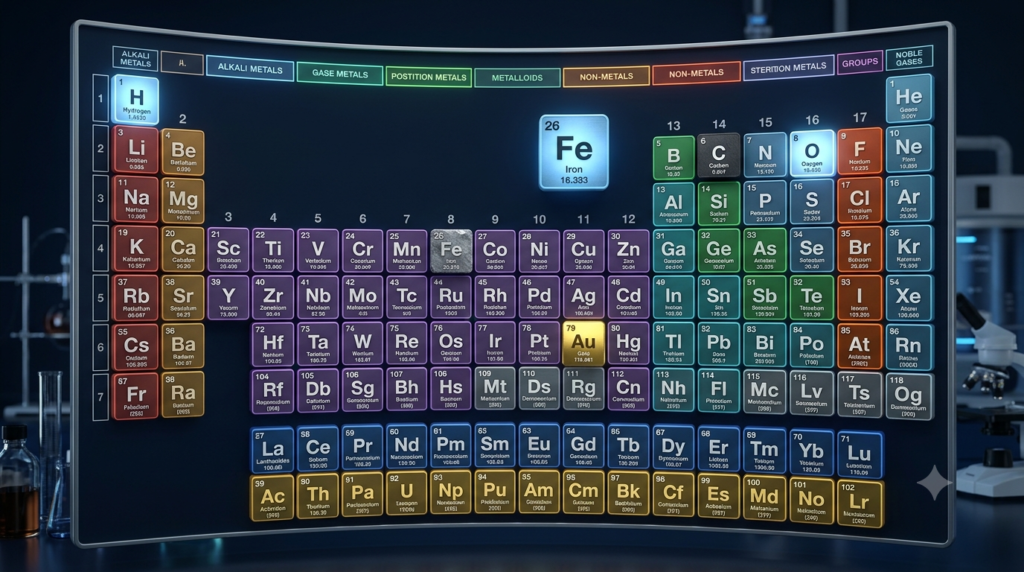
The periodic table provides a systematic way to understand the relationship between valence electrons and chemical properties.
Elements are arranged into horizontal rows called periods and vertical columns called groups.
For main-group elements, the group number is closely related to the number of valence electrons.
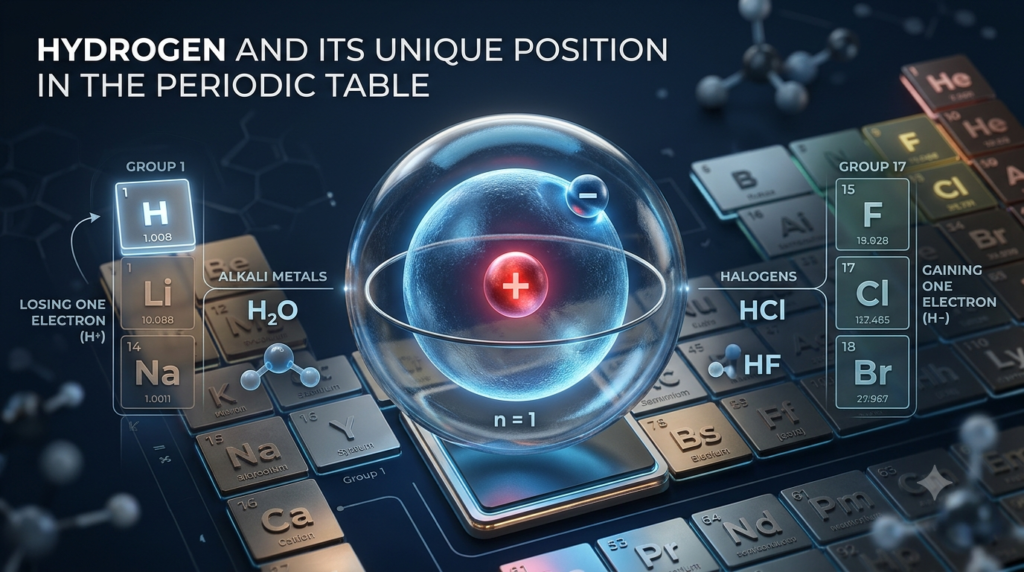
For example, elements in Group 1 generally have one valence electron, while elements in Group 2 generally have two.
Similarly, Group 17 elements generally have seven valence electrons, and Group 18 elements generally have complete outer electron shells.
This relationship explains why elements in the same group often show similar chemical behaviour.
For example, lithium, sodium, and potassium all belong to Group 1. Each has one valence electron and commonly forms a +1 ion.
Likewise, fluorine, chlorine, and bromine belong to Group 17. Each has seven valence electrons and commonly forms a −1 ion.
Therefore, valence electrons help explain the periodic trends and similarities observed among elements.
Valence Electrons and the Chemical Behaviour of Metals
Metals generally have relatively few electrons in their outermost shell. Many metals can lose these electrons to form positive ions.
For example, sodium has one valence electron and commonly forms Na⁺. Magnesium has two valence electrons and commonly forms Mg²⁺.
The tendency to lose valence electrons is an important feature of metallic chemical behaviour.
Metals also commonly form metallic bonds through the delocalisation of their valence electrons.
The availability of mobile electrons helps explain why metals conduct electricity and heat effectively.
However, the chemical behaviour of metals varies considerably. Some metals are highly reactive, while others, such as gold and platinum, are much less reactive under ordinary conditions.
Valence Electrons and the Chemical Behaviour of Nonmetals
Nonmetals generally have more valence electrons than metals. Instead of readily losing electrons, many nonmetals tend to gain or share electrons.
For example, oxygen has six valence electrons and commonly forms two covalent bonds. Chlorine has seven valence electrons and commonly forms one covalent bond or gains one electron to form Cl⁻.
Carbon has four valence electrons and can form four covalent bonds. This ability allows carbon to produce a huge variety of compounds, including those found in living organisms.
The tendency of nonmetals to gain or share electrons plays an important role in the formation of molecules and many chemical compounds.
Valence Electrons and Chemical Reactions
Chemical reactions involve the rearrangement of atoms and their electrons to produce new substances.
In many chemical reactions, valence electrons are transferred, shared, or redistributed between atoms.
Consider the formation of water:
2H₂ + O₂ → 2H₂O
In this reaction, hydrogen and oxygen atoms form covalent bonds by sharing electrons.
Another example is the reaction between sodium and chlorine:
2Na + Cl₂ → 2NaCl
In this reaction, sodium atoms transfer electrons to chlorine atoms, resulting in the formation of sodium chloride.
These examples demonstrate that valence electrons play a central role in chemical changes.
Lewis Dot Structures and Valence Electrons
Lewis dot structures are diagrams used to represent the valence electrons of atoms and molecules.
In these diagrams, the chemical symbol represents the atom, while dots placed around the symbol represent its valence electrons.
For example:
Hydrogen (H) has one dot.
Carbon (C) has four dots.
Nitrogen (N) has five dots.
Oxygen (O) has six dots.
Chlorine (Cl) has seven dots.
Lewis dot structures make it easier to understand how atoms share or transfer electrons during chemical bonding.
They are particularly useful when studying covalent compounds, molecular structures, and the octet rule.
Difference Between Valence Electrons and Core Electrons
Atoms contain two broad categories of electrons: valence electrons and core electrons.
Valence electrons are the electrons in the outermost occupied shell of an atom, while core electrons are the inner electrons that are generally less directly involved in chemical bonding.
| Valence electrons | Core electrons |
|---|---|
| Present in the outermost occupied shell | Present in inner occupied shells |
| Mainly involved in chemical bonding | Generally not directly involved in bonding |
| Strongly influence chemical reactivity | Help shield the nucleus from outer electrons |
| Determine many chemical properties | Usually remain unchanged in ordinary chemical reactions |
| More directly involved in electron transfer and sharing | More strongly attracted to the nucleus |
For example, sodium has 11 electrons arranged as 2, 8, 1. Its outermost electron is the valence electron, while the remaining ten electrons are core electrons.
This distinction helps explain why chemical reactions usually involve only a small portion of an atom’s total electrons.
Applications of Valence Electrons in Science and Technology
The importance of valence electrons extends beyond basic chemistry. They are also essential in several areas of modern science and technology.
1. Understanding Chemical Compounds
Knowledge of valence electrons helps scientists predict how elements combine to form compounds. It is useful for understanding molecular structures, chemical formulas, and bonding patterns.
2. Semiconductor Technology
Valence electrons play an important role in semiconductor materials such as silicon and germanium.
Silicon has four valence electrons. These electrons participate in covalent bonding within its crystal structure.
By introducing small amounts of other elements through a process called doping, scientists can change the electrical properties of semiconductors. This principle is fundamental to the operation of transistors, diodes, and integrated circuits.
3. Biological Systems
Many biological processes depend on chemical interactions involving valence electrons.
For example, covalent bonds hold together the molecules that make up proteins, carbohydrates, fats, and DNA.
Electron transfer also plays an important role in cellular respiration and photosynthesis, where chemical energy is transferred through a series of reactions.
4. Materials Science
The arrangement and behaviour of valence electrons influence the physical and chemical properties of materials.
They help determine electrical conductivity, bonding strength, hardness, and other important characteristics.
This knowledge allows scientists and engineers to develop materials for electronics, construction, energy storage, and industrial applications.
Conclusion
Valence electrons are among the most important features of an atom because they largely determine how elements interact with one another. These outermost electrons participate in chemical bonding, influence the formation of ions, and help explain the reactivity and stability of atoms.
Their role also provides a foundation for understanding the periodic table, ionic and covalent compounds, metallic bonding, and chemical reactions.
From the formation of simple molecules to the development of modern semiconductor technology, valence electrons are involved in many important chemical and technological processes.
Understanding valence electrons makes it easier to predict how elements behave and why different substances have different chemical properties. For this reason, they are a fundamental concept in chemistry and an essential starting point for studying atomic structure and chemical bonding.
FAQs
1. What are valence electrons?
Valence electrons are the electrons present in the outermost occupied electron shell of an atom. They play an important role in chemical bonding and reactions. These electrons determine how atoms interact with other atoms through gaining, losing, or sharing electrons. For example, sodium has one valence electron, while oxygen has six. The number and arrangement of valence electrons help explain the chemical properties, reactivity, and bonding behaviour of different elements. They are also important for understanding the periodic table and the formation of chemical compounds.
2. Why are valence electrons important in chemistry?
Valence electrons are important because they largely determine the chemical behaviour of elements. They influence how atoms form chemical bonds, gain or lose electrons, and react with other substances. The number of valence electrons also helps predict the types of compounds an element can form. For example, sodium loses one electron to form a positive ion, while chlorine gains one electron to form a negative ion. Understanding valence electrons makes it easier to study chemical reactions, ionic and covalent bonding, atomic stability, and periodic trends.
3. How can we determine the number of valence electrons in an atom?
The number of valence electrons can be determined by examining the electron configuration of an atom. For main-group elements, the group number in the periodic table usually indicates the number of valence electrons. For example, Group 1 elements have one, Group 2 elements have two, and Group 17 elements have seven valence electrons. Another method is to write the electron arrangement and count the electrons in the outermost occupied shell. For transition elements, determining valence electrons can be more complicated because electrons from different subshells may participate in bonding.
4. What is the difference between valence electrons and core electrons?
Valence electrons are the electrons present in the outermost occupied shell of an atom, whereas core electrons are located in the inner shells. Valence electrons are mainly responsible for chemical bonding and reactions because they can be shared, gained, or lost during chemical interactions. Core electrons are generally held more strongly by the nucleus and usually do not participate directly in ordinary chemical bonding. For example, sodium has 11 electrons arranged as 2, 8, 1. It has one valence electron and ten core electrons.
5. How do valence electrons affect chemical reactivity?
Valence electrons influence chemical reactivity by determining how easily an atom can gain, lose, or share electrons. Atoms often undergo chemical reactions to achieve a more stable electronic arrangement. Elements with one or two valence electrons, such as sodium and magnesium, commonly lose electrons. Elements with six or seven valence electrons, such as oxygen and chlorine, often gain or share electrons. Noble gases generally have complete outer electron shells, making them relatively unreactive. Therefore, the number and arrangement of valence electrons help explain why some elements react more readily than others.
6. What is the relationship between valence electrons and chemical bonding?
Valence electrons are directly involved in the formation of chemical bonds. Atoms form bonds by transferring or sharing their outermost electrons. In ionic bonding, one atom transfers electrons to another, producing oppositely charged ions. In covalent bonding, atoms share pairs of electrons to achieve more stable electronic arrangements. Metallic bonding involves delocalised valence electrons moving throughout a metal structure. For example, sodium chloride forms through electron transfer, while hydrogen molecules form through electron sharing. Thus, valence electrons are essential for understanding how atoms combine to form different substances.
7. What is the octet rule, and how is it related to valence electrons?
The octet rule states that many atoms tend to gain, lose, or share electrons to achieve eight electrons in their outermost shell. This arrangement is similar to the stable electronic configuration of noble gases. Valence electrons are directly involved in following this rule. For example, chlorine has seven valence electrons and commonly gains one electron to complete its octet. Oxygen has six valence electrons and commonly forms two bonds. However, the octet rule is not universal. Some elements, such as hydrogen and boron, follow different electron arrangements.
8. Do all elements have the same number of valence electrons?
No, different elements have different numbers of valence electrons. The number depends on the electronic configuration of each element. For example, lithium has one valence electron, carbon has four, oxygen has six, and neon has eight. Elements belonging to the same main-group column generally have the same number of valence electrons, which explains their similar chemical properties. However, transition elements can have more complex valence electron arrangements because electrons in nearby d subshells may also participate in chemical bonding.
9. How are valence electrons related to the periodic table?
Valence electrons are closely related to the arrangement of elements in the periodic table. For main-group elements, the group number generally indicates the number of valence electrons. Elements in the same group usually have similar outer electron configurations and often show similar chemical properties. For example, lithium, sodium, and potassium belong to Group 1 and each has one valence electron. Similarly, fluorine, chlorine, and bromine belong to Group 17 and have seven valence electrons. This relationship helps scientists understand periodic trends and predict the chemical behaviour of elements.
10. What are the practical applications of understanding valence electrons?
Understanding valence electrons has many applications in chemistry, biology, physics, and modern technology. In chemistry, they help predict chemical bonding, reactions, and compound formation. In semiconductor technology, the behaviour of valence electrons in materials such as silicon is essential for developing transistors, diodes, and computer chips. In biology, electron interactions are involved in molecular bonding, cellular respiration, and photosynthesis. Valence electrons also influence the electrical conductivity and other properties of materials. Therefore, studying valence electrons helps scientists understand natural processes and develop useful technologies.