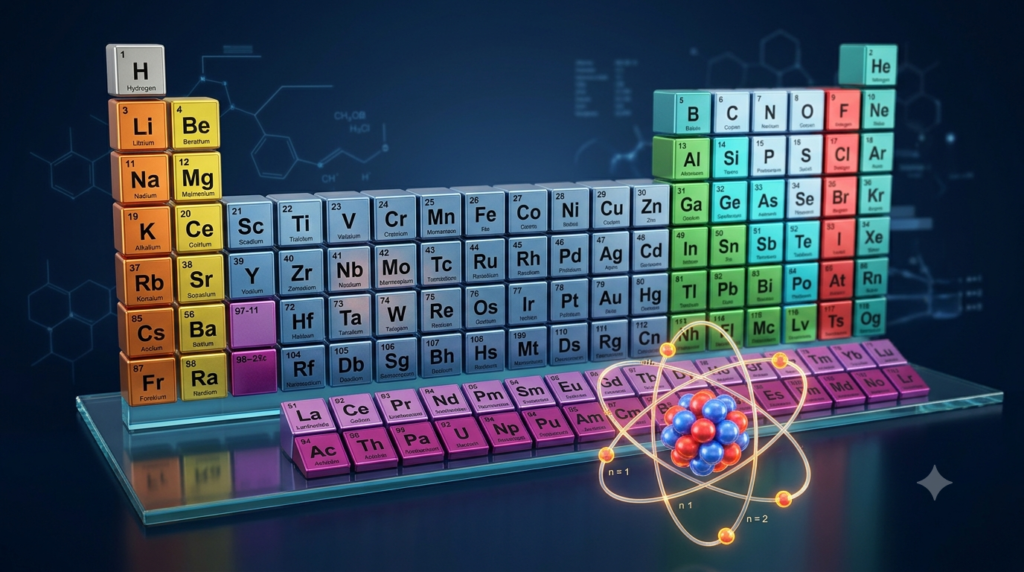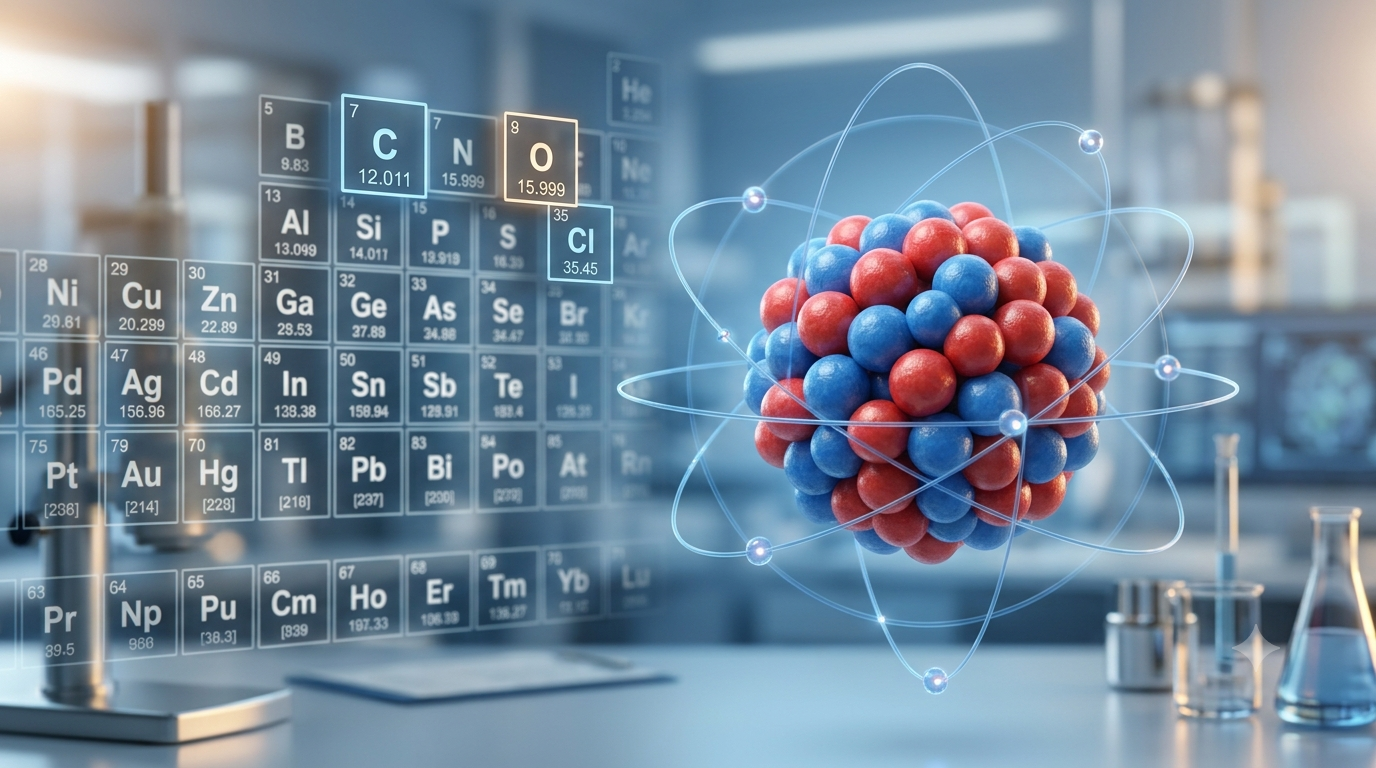
Every element in the universe is made up of atoms, and each atom contains three main subatomic particles: protons, neutrons, and electrons. Although these particles are found in different parts of an atom, their masses are not equal. Protons and neutrons contribute almost all the mass of an atom, while electrons contribute only a very small amount.
To understand the properties of elements and their arrangement in the periodic table, scientists use a measurement called atomic mass. It tells us the average mass of the atoms of an element, taking into account the different isotopes that naturally occur.
Atomic mass is an important concept in chemistry because it helps scientists compare elements, calculate chemical quantities, understand isotopes, and study chemical reactions. It also explains why the atomic masses shown in the periodic table are often decimal numbers rather than whole numbers.
In this article, we will explore what atomic mass means, how it is calculated, how it differs from atomic number and mass number, and why it plays an important role in the periodic table.
What Is Atomic Mass?
Atomic mass is the mass of an atom, generally expressed in atomic mass units (u). It represents how heavy an atom is compared with a standard reference value based on carbon-12.
The atomic mass of an element depends mainly on the number of protons and neutrons present in its nucleus. Electrons also have mass, but their contribution is extremely small compared with that of protons and neutrons.
For example:
Hydrogen has an atomic mass of approximately 1.008 u.
Carbon has an atomic mass of approximately 12.011 u.
Oxygen has an atomic mass of approximately 15.999 u.
Sodium has an atomic mass of approximately 22.990 u.
These values are commonly displayed in the periodic table.
Atomic mass is useful because atoms are extremely small and cannot conveniently be measured using ordinary units such as grams or kilograms. Therefore, scientists use a special unit called the atomic mass unit.
What Is an Atomic Mass Unit (u)?
An atomic mass unit, represented by the symbol u, is a standard unit used to express the masses of atoms and subatomic particles.
One atomic mass unit is defined as exactly one-twelfth of the mass of a neutral carbon-12 atom in its ground state.
In other words:
1 u = 1/12 of the mass of one carbon-12 atom
In kilograms, its approximate value is:
1 u ≈ 1.66054 × 10⁻²⁷ kg
The atomic mass unit makes it easier to compare the masses of different atoms without working with extremely small numbers.
For example, a carbon-12 atom has a mass of exactly 12 u, while an oxygen-16 atom has a mass of approximately 15.995 u.
The symbol u is also commonly associated with the dalton (Da). Both represent the same unit of mass.
Why Is Atomic Mass Important?
Atomic mass is important because it connects the microscopic world of atoms with the measurable quantities used in chemistry.
Every element has its own characteristic atomic mass, which helps scientists identify and compare elements. It also plays an essential role in calculating the amounts of substances involved in chemical reactions.
Some important uses of atomic mass include:
Comparing the masses of different elements.
Calculating the molar mass of elements and compounds.
Understanding isotopes of an element.
Performing chemical calculations.
Determining the relative quantities of reactants and products.
Studying the composition of natural substances.
Understanding the numerical information presented in the periodic table.
Without atomic mass, many important chemical calculations would be difficult to perform accurately.
Difference Between Atomic Mass, Mass Number, and Atomic Number
Atomic mass, mass number, and atomic number are three closely related terms in chemistry. However, they describe different properties of an atom.
Understanding the differences between them is essential for studying atomic structure and the periodic table.
1. Atomic Number
Atomic number is the number of protons present in the nucleus of an atom.
It is represented by the symbol Z.
For example:
Hydrogen has 1 proton, so its atomic number is 1.
Carbon has 6 protons, so its atomic number is 6.
Oxygen has 8 protons, so its atomic number is 8.
Sodium has 11 protons, so its atomic number is 11.
The atomic number determines the identity of an element. Every atom of the same element has the same number of protons.
2. Mass Number
Mass number is the total number of protons and neutrons present in the nucleus of an atom.
It is represented by the symbol A.
Mass Number = Number of Protons + Number of Neutrons
For example, a carbon-12 atom contains:
6 protons
6 neutrons
Therefore:
Mass Number = 6 + 6 = 12
Unlike atomic mass, mass number is always a whole number because it represents a count of particles.
3. Atomic Mass
Atomic mass represents the mass of an individual atom or, in the periodic table, the weighted average mass of the naturally occurring isotopes of an element.
It is generally expressed in atomic mass units (u).
For example, the atomic mass of naturally occurring chlorine is approximately 35.45 u. This value is not a whole number because chlorine exists mainly as two naturally occurring isotopes with different masses.
Key Differences
| Property | Atomic Number | Mass Number | Atomic Mass |
|---|---|---|---|
| Meaning | Number of protons | Total protons and neutrons | Mass of an atom or weighted average of isotopic masses |
| Symbol | Z | A | Usually expressed as atomic mass |
| Unit | No unit | No unit | Atomic mass unit (u) |
| Value | Always a whole number | Always a whole number | Often a decimal number |
| Main use | Identifies an element | Describes a particular isotope | Compares atomic masses and supports calculations |
These three terms help scientists understand the composition, identity, and mass of atoms.
How Is Atomic Mass Calculated?
The atomic mass displayed in the periodic table is generally calculated using the weighted average of the masses of an element’s naturally occurring isotopes.
This is necessary because many elements exist in nature as mixtures of different isotopes.
An isotope is a form of an element that has the same number of protons but a different number of neutrons. As a result, isotopes of the same element have different masses.
To calculate the average atomic mass, scientists consider two important factors:
The mass of each naturally occurring isotope.
The relative abundance of each isotope.
The formula is:
Average Atomic Mass = Σ (Isotopic Mass × Fractional Abundance)
Here, the Greek letter Σ means that the values for all isotopes must be added together.
Fractional abundance is the percentage abundance of an isotope divided by 100.
Example: Calculation of Chlorine Atomic Mass
Chlorine has two major naturally occurring isotopes:
Chlorine-35 has an isotopic mass of approximately 34.969 u and an abundance of about 75.78%.
Chlorine-37 has an isotopic mass of approximately 36.966 u and an abundance of about 24.22%.
To calculate the average atomic mass:
Step 1: Convert percentages into decimal fractions.
Chlorine-35 = 75.78 ÷ 100 = 0.7578
Chlorine-37 = 24.22 ÷ 100 = 0.2422
Step 2: Multiply each isotopic mass by its fractional abundance.
Chlorine-35:
34.969 × 0.7578 ≈ 26.502
Chlorine-37:
36.966 × 0.2422 ≈ 8.953
Step 3: Add the results.
Average Atomic Mass = 26.502 + 8.953
Average Atomic Mass ≈ 35.455 u
Therefore, the average atomic mass of chlorine is approximately 35.45 u.
This explains why chlorine has a decimal atomic mass in the periodic table instead of an integer value.
What Are Isotopes and How Do They Affect Atomic Mass?
Isotopes are atoms of the same element that contain the same number of protons but different numbers of neutrons.
Because they have different numbers of neutrons, their mass numbers and isotopic masses are different.
For example, carbon has three well-known isotopes:
Carbon-12: Contains 6 protons and 6 neutrons.
Carbon-13: Contains 6 protons and 7 neutrons.
Carbon-14: Contains 6 protons and 8 neutrons.
All three are carbon atoms because each contains six protons.
However, their masses are different.
Carbon-12 and carbon-13 are stable isotopes, while carbon-14 is radioactive. Naturally occurring carbon contains mostly carbon-12, along with a smaller amount of carbon-13 and a trace amount of carbon-14.
The atomic mass of carbon is therefore a weighted average of the masses and natural abundances of its isotopes.
Isotopes are important in several scientific fields, including nuclear science, medicine, archaeology, environmental research, and geology.
Why Are Atomic Mass Values Often Decimal Numbers?
When looking at the periodic table, you may notice that many elements have atomic masses containing decimal values.
For example:
Hydrogen: 1.008 u
Lithium: 6.94 u
Carbon: 12.011 u
Nitrogen: 14.007 u
Chlorine: 35.45 u
Copper: 63.546 u
These decimal values are not measurement errors.
They occur mainly because the atomic mass shown for an element is usually a weighted average of the masses of its naturally occurring isotopes.
For example, naturally occurring copper contains two major isotopes:
Copper-63
Copper-65
Since these isotopes have different masses and occur in different proportions, the average atomic mass of copper is approximately 63.546 u.
If an element has only one naturally occurring isotope, its standard atomic weight may be very close to that isotope’s atomic mass. However, the values can still differ because of measurement conventions, isotopic composition, and the distinction between isotope mass and standard atomic weight.
Therefore, decimal atomic masses are an important feature of the periodic table.
Role of Atomic Mass in the Periodic Table
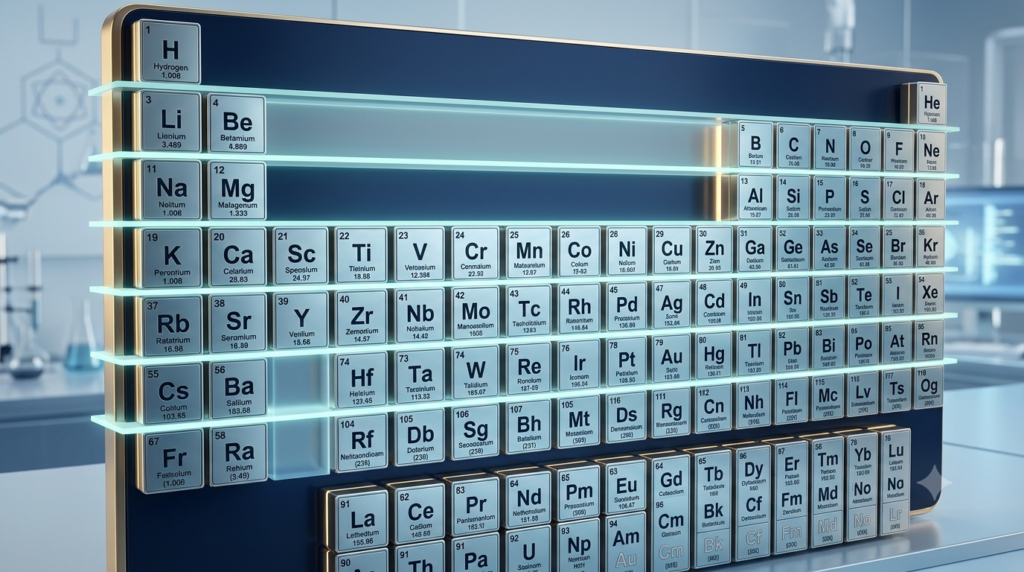
The periodic table is a systematic arrangement of chemical elements based primarily on their atomic numbers. Atomic mass is another important piece of information displayed for most elements.
Although atomic mass does not determine the modern position of an element, it provides useful information about the relative masses of atoms.
1. Helps Compare the Masses of Elements
Atomic mass allows scientists to compare how heavy the atoms of different elements are.
For example, an oxygen atom has an atomic mass of approximately 16 u, while a sulfur atom has an atomic mass of approximately 32.06 u.
This means that a sulfur atom is approximately twice as massive as an oxygen atom.
Such comparisons are useful in chemical calculations and in understanding the composition of compounds.
2. Provides Information About Isotopic Composition
The decimal values of atomic masses can provide clues about the existence of different isotopes.
For example, chlorine has an average atomic mass of approximately 35.45 u rather than exactly 35 u or 37 u.
This indicates that its naturally occurring atoms include isotopes with different masses.
Although the average atomic mass alone does not reveal the complete isotopic composition, it is useful information for understanding the element.
3. Helps Calculate Molar Mass
Atomic mass is closely related to molar mass, which is the mass of one mole of a substance.
For an element, its numerical atomic mass in u is approximately equal to its molar mass in grams per mole (g/mol).
For example:
Carbon: 12.011 u and approximately 12.011 g/mol.
Oxygen: 15.999 u and approximately 15.999 g/mol.
Sodium: 22.990 u and approximately 22.990 g/mol.
This relationship allows chemists to convert between the mass of a substance and the number of particles it contains.
4. Supports Chemical Calculations
Atomic mass is essential for calculating the quantities of substances involved in chemical reactions.
Chemists use atomic masses to determine the molar masses of compounds, convert grams into moles, and calculate the amounts of reactants and products.
For example, the molar mass of water (H₂O) can be calculated using the atomic masses of hydrogen and oxygen.
Hydrogen = 1.008 g/mol
Oxygen = 15.999 g/mol
Molar Mass of Water:
= (2 × 1.008) + 15.999
= 2.016 + 15.999
= 18.015 g/mol
Therefore, one mole of water has a mass of approximately 18.015 grams.
5. Helps Understand Periodic Trends
Atomic mass generally increases as we move from lighter elements to heavier elements in the periodic table.
For example, lithium has an atomic mass of approximately 6.94 u, while sodium has an atomic mass of approximately 22.99 u.
However, atomic mass is not the main factor responsible for periodic trends. Properties such as atomic radius, ionization energy, and electronegativity are primarily related to atomic structure and electron configuration.
Atomic mass provides additional information that helps compare elements across periods and groups.
Atomic Mass and the Modern Periodic Table
The modern periodic table arranges elements in increasing order of atomic number rather than atomic mass.
This arrangement is important because atomic number determines the number of protons in an atom and, in a neutral atom, the number of electrons.
The periodic table contains seven periods and eighteen groups. Elements in the same group often have similar chemical properties because they have similar outer electron configurations.
Atomic mass is generally displayed below the element’s chemical symbol, while atomic number is usually shown above it.
For example, a typical periodic table entry for carbon contains:
Element name: Carbon
Chemical symbol: C
Atomic number: 6
Atomic mass: Approximately 12.011 u
Although atomic mass increases broadly across the periodic table, it does not always increase perfectly from one element to the next.
For example, cobalt has an atomic mass of approximately 58.933 u, while nickel has an atomic mass of approximately 58.693 u.
Nickel has a slightly lower atomic mass than cobalt, even though its atomic number is higher.
This is one reason why the modern periodic table is arranged according to atomic number instead of atomic mass.
Difference Between Atomic Mass and Molar Mass
Atomic mass and molar mass are related concepts, but they are used in different contexts.
Atomic mass describes the mass of an individual atom, expressed in atomic mass units (u).
Molar mass describes the mass of one mole of a substance, expressed in grams per mole (g/mol).
For example:
| Element | Atomic Mass | Molar Mass |
|---|---|---|
| Hydrogen | 1.008 u | 1.008 g/mol |
| Carbon | 12.011 u | 12.011 g/mol |
| Nitrogen | 14.007 u | 14.007 g/mol |
| Oxygen | 15.999 u | 15.999 g/mol |
| Sodium | 22.990 u | 22.990 g/mol |
The numerical values are approximately the same, but the units and meanings are different.
This relationship makes atomic mass particularly useful in laboratory calculations.
Applications of Atomic Mass in Science and Everyday Life
Atomic mass is not just a theoretical concept studied in chemistry textbooks. It has practical applications in many areas of science and technology.
1. Chemical Manufacturing
Industries use atomic masses to calculate the correct quantities of raw materials required for chemical reactions.
Accurate calculations help reduce waste, improve production efficiency, and maintain product quality.
2. Pharmaceutical Research
Atomic masses are used to calculate the molecular masses and molar quantities of substances involved in the preparation and analysis of medicines.
These calculations help researchers work with chemical compounds accurately.
3. Nuclear Science
The masses of isotopes are important in understanding nuclear reactions, radioactive decay, and nuclear energy.
Differences in nuclear mass are also related to the energy released or absorbed during nuclear processes.
4. Archaeology and Geological Research
Certain radioactive isotopes are used in dating ancient materials and studying geological samples.
For example, carbon-14 is used in radiocarbon dating to estimate the age of suitable once-living materials.
5. Environmental Science
Scientists use isotopic measurements to investigate environmental processes, trace the movement of substances, and study water cycles and climate-related changes.
These applications demonstrate how knowledge of atomic mass and isotopes contributes to research across different scientific fields.
Common Misconceptions About Atomic Mass
Some students confuse atomic mass with other atomic properties. Understanding these common misconceptions makes the concept easier to learn.
1. Atomic mass and mass number are the same.
They are not the same. Mass number is the total number of protons and neutrons in a particular isotope, while the atomic mass shown in the periodic table is generally a weighted average of naturally occurring isotopic masses.
2. All atoms of an element have exactly the same mass.
Atoms of the same element can have different masses because they may contain different numbers of neutrons. These different forms are called isotopes.
3. Atomic mass determines the position of an element in the modern periodic table.
The modern periodic table is arranged according to increasing atomic number, not atomic mass.
4. Decimal atomic masses are incorrect values.
Decimal values are expected because the atomic mass of an element generally represents a weighted average of its naturally occurring isotopes.
5. Electrons contribute most of an atom’s mass.
Protons and neutrons contribute almost all of an atom’s mass. Electrons have a much smaller mass.
Understanding these points helps avoid confusion when studying atomic structure and chemical properties.
Conclusion
Atomic mass is one of the fundamental concepts in chemistry. It describes the mass of an atom and helps scientists compare different elements, understand isotopes, and perform accurate chemical calculations.
The atomic masses displayed in the periodic table are generally weighted averages of the masses of naturally occurring isotopes. This is why many elements have decimal atomic mass values instead of whole numbers.
Although atomic mass does not determine the position of an element in the modern periodic table, it remains essential for understanding the relative masses of elements and calculating the molar masses of substances.
From chemical manufacturing and pharmaceutical research to nuclear science and environmental studies, atomic mass plays an important role in connecting atomic structure with practical scientific applications. Understanding this concept provides a strong foundation for learning more advanced topics in chemistry.
FAQs
1. What is atomic mass?
Atomic mass is the mass of an atom expressed in atomic mass units (u). It represents how heavy an atom is compared with a standard reference based on carbon-12. The mass of an atom mainly depends on the number of protons and neutrons present in its nucleus because electrons contribute very little to its total mass. For elements that have multiple naturally occurring isotopes, the atomic mass displayed in the periodic table is generally the weighted average of their isotopic masses. It is an important measurement used in chemistry to compare elements and perform chemical calculations.
2. What is the unit of atomic mass?
The standard unit used to express atomic mass is the atomic mass unit, represented by the symbol u. One atomic mass unit is defined as exactly one-twelfth of the mass of a carbon-12 atom. Its approximate value in kilograms is 1.66054 × 10⁻²⁷ kg. This unit makes it easier for scientists to express and compare the extremely small masses of atoms and subatomic particles. The atomic mass unit is also known as the dalton (Da). Both units represent the same quantity and are commonly used in chemistry and related scientific fields.
3. What is the difference between atomic mass and mass number?
Atomic mass and mass number describe different properties of an atom. Mass number is the total number of protons and neutrons present in the nucleus of a particular isotope. It is always a whole number. Atomic mass, on the other hand, represents the mass of an individual atom or the weighted average mass of an element’s naturally occurring isotopes. It is expressed in atomic mass units (u) and often contains decimal values. For example, chlorine has isotopes with mass numbers 35 and 37, while its average atomic mass is approximately 35.45 u.
4. Why is atomic mass usually a decimal number?
Atomic mass is usually a decimal number because most elements naturally exist as mixtures of different isotopes. These isotopes have different numbers of neutrons and therefore different masses. The atomic mass displayed in the periodic table is generally calculated by taking the weighted average of the masses of these isotopes according to their natural abundances. For example, chlorine has two major naturally occurring isotopes, chlorine-35 and chlorine-37. Their different masses and relative abundances produce an average atomic mass of approximately 35.45 u instead of a whole number.
5. How is the average atomic mass calculated?
Average atomic mass is calculated by multiplying the mass of each naturally occurring isotope by its fractional abundance and adding the results. The formula is: Average Atomic Mass = Σ (Isotopic Mass × Fractional Abundance). To use this formula, percentage abundance must first be converted into a decimal by dividing it by 100. For example, if an isotope has an abundance of 75%, its fractional abundance is 0.75. The same calculation is performed for every isotope, and all the results are added together to obtain the weighted average atomic mass of the element.
6. What is the relationship between atomic mass and atomic number?
Atomic mass and atomic number describe two different characteristics of an atom. Atomic number represents the number of protons in the nucleus and determines the identity of an element. Atomic mass represents the mass of an atom or the weighted average mass of its naturally occurring isotopes. For example, carbon has an atomic number of 6 and an average atomic mass of approximately 12.011 u. The atomic number determines the element’s position in the modern periodic table, while atomic mass provides information about the relative mass of its atoms.
7. How does atomic mass help in the periodic table?
Atomic mass provides important information about the relative masses of elements displayed in the periodic table. It helps scientists compare elements, calculate molar masses, and understand the isotopic composition of naturally occurring elements. Although the modern periodic table is arranged according to increasing atomic number rather than atomic mass, atomic mass remains an essential property of each element. It is also useful for chemical calculations involving reactants, products, and compounds. By studying atomic mass values, students can better understand the differences between elements and the relationship between atomic structure and chemical quantities.
8. What is the difference between atomic mass and molar mass?
Atomic mass refers to the mass of an individual atom, expressed in atomic mass units (u). Molar mass refers to the mass of one mole of a substance, expressed in grams per mole (g/mol). Although their numerical values are approximately the same for an element, their units and meanings are different. For example, the atomic mass of carbon is approximately 12.011 u, while its molar mass is approximately 12.011 g/mol. Atomic mass is used to describe individual atoms, whereas molar mass is used to calculate the mass of measurable quantities of substances.
9. Why do isotopes have different atomic masses?
Isotopes have different atomic masses because they contain different numbers of neutrons in their nuclei. All isotopes of an element have the same number of protons, which means they belong to the same element. However, the difference in neutron numbers changes their mass. For example, carbon-12 contains six protons and six neutrons, while carbon-13 contains six protons and seven neutrons. Therefore, carbon-13 has a greater mass than carbon-12. The presence and natural abundance of different isotopes influence the average atomic mass displayed for an element in the periodic table.
10. What are the practical applications of atomic mass?
Atomic mass has several practical applications in science, industry, and research. Chemists use it to calculate molar masses, determine the quantities of reactants and products, and prepare chemical solutions. Pharmaceutical researchers use atomic mass when studying the composition and quantities of chemical compounds. In nuclear science, isotope masses help scientists understand nuclear reactions and radioactive processes. Atomic mass and isotopic information are also useful in archaeology, geological dating, and environmental research. These applications demonstrate that atomic mass is not only a basic chemistry concept but also an important tool in modern scientific investigations.