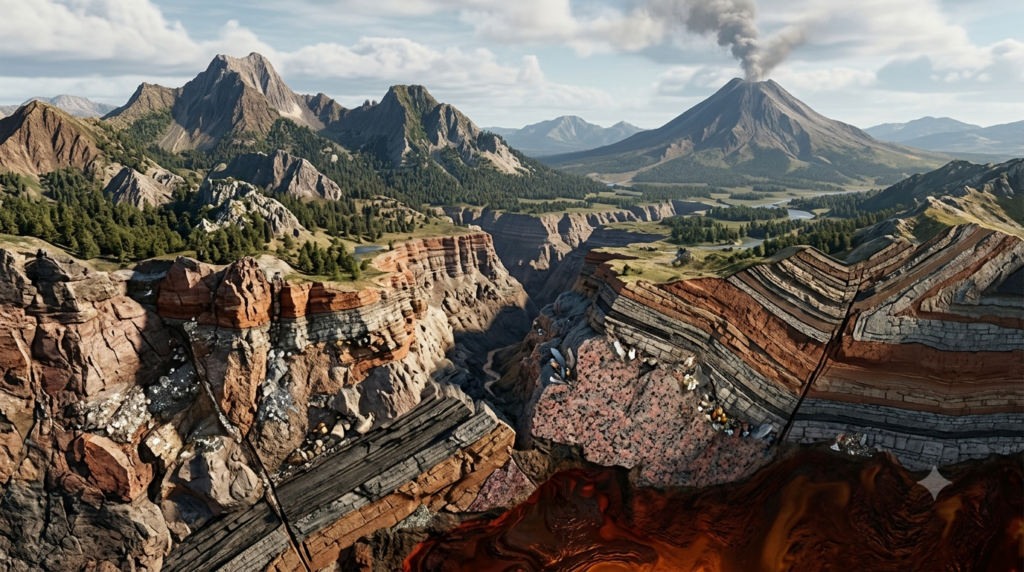
Environmental geology is the branch of geology that studies the relationship between Earth’s geological processes and the environment in which humans, plants, and animals live. It helps us understand how rocks, minerals, soil, water, landforms, and natural hazards influence human activities and how human actions affect these natural systems. From groundwater extraction and mining to urban development and waste disposal, human activities can significantly change the physical environment.
Earth is a complex system in which the atmosphere, hydrosphere, geosphere, and biosphere interact continuously. A change in one system can influence the others, sometimes creating environmental problems that extend far beyond their original location. For example, deforestation can increase soil erosion, carry sediment into rivers, reduce water quality, and damage aquatic habitats. Environmental geology helps identify these connections and provides scientific methods for managing natural resources, reducing pollution, and preventing environmental damage. Understanding this field is essential for building sustainable communities and protecting Earth’s resources for future generations.
What Is Environmental Geology?
Environmental geology applies geological knowledge to environmental problems and the sustainable management of Earth’s resources. It examines how natural geological processes affect people and how human activities modify the land, water, and other components of the environment.
Traditional geology often focuses on understanding Earth’s structure, history, rocks, minerals, and internal processes. Environmental geology builds on this knowledge by considering its practical importance for society. It investigates issues such as soil degradation, groundwater contamination, mineral extraction, coastal erosion, landslides, earthquakes, and the safe disposal of waste.
For example, before a city develops a new residential area, environmental geologists can study the local rock types, soil stability, groundwater conditions, and potential flood or landslide hazards. This information helps planners choose suitable locations and avoid unnecessary risks.
Environmental geology also supports environmental impact assessments, which evaluate the likely environmental consequences of proposed projects. These assessments can help governments, engineers, and communities make better-informed decisions about construction, mining, transportation, and industrial development.
Earth’s Major Systems and Their Interactions
To understand human impacts, it is important to recognize the four major interconnected systems of Earth.
The Geosphere
The geosphere includes Earth’s solid materials, such as rocks, minerals, soil, and the planet’s internal layers. It provides land for agriculture, settlements, transportation, and industry. It also supplies important resources, including metals, construction materials, and fossil fuels.
Mining, quarrying, construction, and intensive agriculture can change the geosphere by removing rocks, disturbing soil, altering slopes, and increasing erosion. These activities may also release contaminants that enter surrounding soil and water.
The Hydrosphere
The hydrosphere includes all water on Earth, including oceans, rivers, lakes, groundwater, glaciers, and water vapor. Water supports life, agriculture, industry, and natural ecosystems.
Human activities can affect the hydrosphere through excessive groundwater extraction, industrial discharge, agricultural runoff, and the release of untreated sewage. Pollution may make water unsafe for drinking and harm organisms living in aquatic environments.
The Atmosphere
The atmosphere is the layer of gases surrounding Earth. It regulates temperature, supports weather and climate processes, and supplies gases necessary for life.
Burning fossil fuels, industrial activities, transportation, and deforestation release gases and particles that alter atmospheric conditions. Increased concentrations of greenhouse gases contribute to global warming, while certain air pollutants cause respiratory problems and damage ecosystems.
The Biosphere
The biosphere includes living organisms and the environments in which they exist. It connects with the geosphere through soil formation, with the hydrosphere through water availability, and with the atmosphere through gas exchange.
Human activities such as habitat destruction, pollution, overfishing, and intensive land use can reduce biodiversity and disrupt ecological relationships. Changes in the biosphere can also affect geological and chemical processes, including soil formation, carbon storage, and nutrient cycling.
These four systems are not independent. They continuously exchange matter and energy, meaning that environmental damage in one system can produce consequences throughout the Earth system.
Major Human Activities That Affect Earth’s Systems
1. Mining and Mineral Extraction
Mining provides essential materials for buildings, transportation systems, electronics, energy production, and modern industries. However, extracting minerals can cause significant environmental changes when operations are poorly planned or inadequately managed.
Open-pit mining removes large quantities of surface material and creates deep excavations. Underground mining can produce subsidence, in which the ground sinks because of changes in the supporting rock layers. Both methods can disturb habitats, increase erosion, and alter natural drainage patterns.
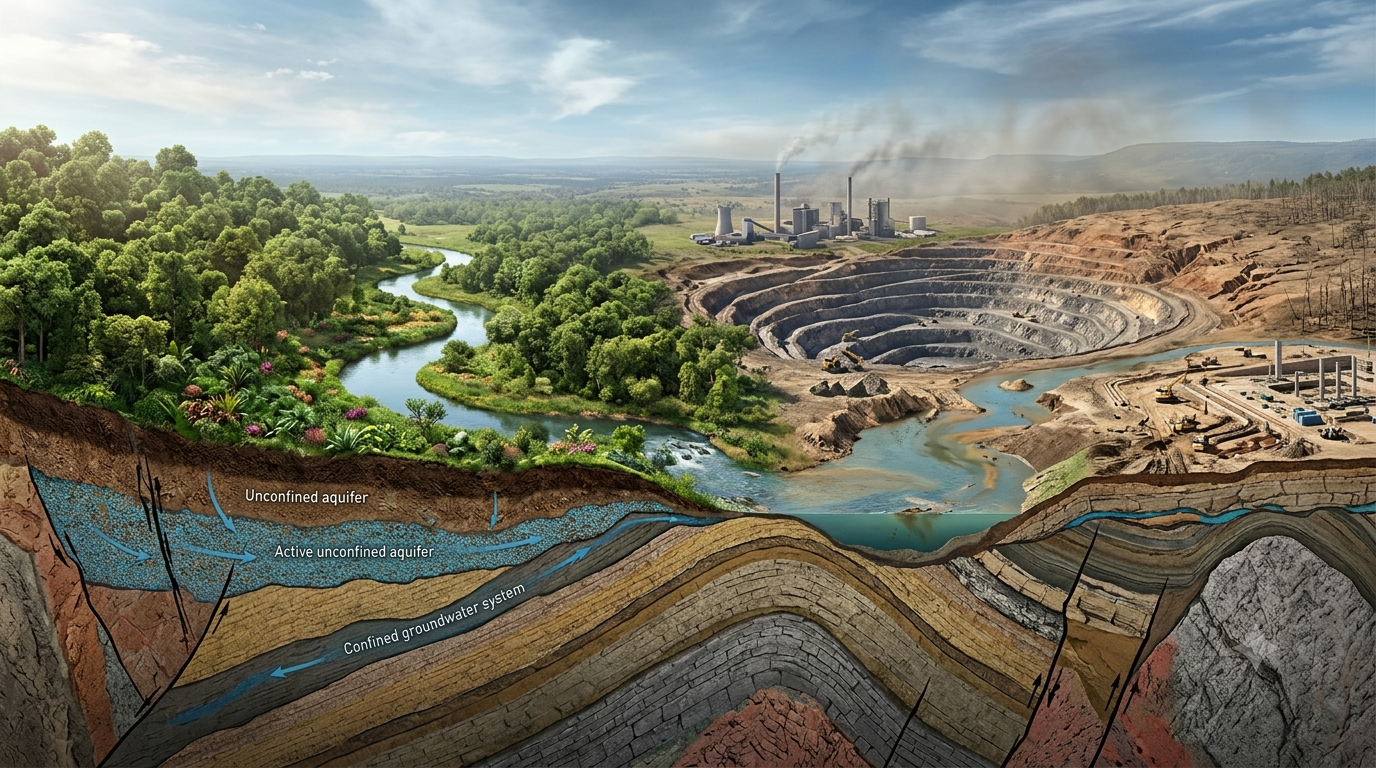
Mining may also generate waste rock and tailings containing potentially harmful substances. When water passes through certain mineral-rich materials, it can dissolve metals and transport them into streams or groundwater. The oxidation of sulfide minerals can produce acidic drainage, which may harm aquatic organisms and contaminate water supplies.
Responsible mining requires careful site selection, pollution control, safe waste storage, water treatment, and rehabilitation of disturbed land. Restoring vegetation and stabilizing slopes after mining can help reduce long-term environmental damage.
2. Deforestation and Land-Use Changes
Forests protect soil, regulate water movement, store carbon, and provide habitats for numerous species. Clearing forests for agriculture, roads, settlements, and commercial activities changes how land interacts with water and the atmosphere.
Tree roots help hold soil together, while leaves and forest litter reduce the direct impact of rainfall on the ground. When forests are removed, exposed soil becomes more vulnerable to erosion. Rainwater can carry sediment into rivers and lakes, making water more turbid and damaging aquatic habitats.
Deforestation can also reduce infiltration, depending on soil conditions and how the cleared land is managed. This may increase surface runoff and contribute to flooding in some locations. The loss of vegetation can reduce evapotranspiration and change local moisture conditions.
In addition, forests store carbon in their vegetation and soils. Clearing and burning them releases some of this stored carbon into the atmosphere and reduces the land’s future capacity to absorb carbon dioxide.
Sustainable forestry, reforestation, agroforestry, and careful land-use planning can reduce these impacts while supporting local livelihoods.
3. Agriculture and Soil Degradation
Agriculture depends on healthy soil, adequate water, and favorable climatic conditions. However, intensive farming practices can damage these resources when land is not managed sustainably.
Soil erosion occurs when wind or water removes the upper layer of soil. This layer often contains much of the organic matter and nutrients needed for plant growth. Losing it can reduce agricultural productivity and increase sediment accumulation in waterways.
Excessive irrigation may cause waterlogging or soil salinization in poorly drained areas. Salinization occurs when dissolved salts accumulate in soil to levels that interfere with plant growth. Overuse of fertilizers can also introduce excess nitrogen and phosphorus into rivers and lakes, encouraging excessive algal growth and reducing oxygen availability in water.
Some pesticides and other agricultural chemicals can contaminate soil and water if they are improperly applied or managed.
Practices such as crop rotation, cover cropping, contour farming, reduced tillage, efficient irrigation, and careful fertilizer application can help maintain soil fertility and reduce pollution.
4. Urbanization and Construction
Urbanization transforms natural landscapes into buildings, roads, parking areas, and other infrastructure. These changes affect the geosphere, hydrosphere, and biosphere in several ways.
Natural soil and vegetation allow rainfall to infiltrate the ground. In contrast, concrete and asphalt are relatively impermeable surfaces. As cities expand, more rainfall may flow directly into drains and streams rather than entering the soil.
This increase in surface runoff can contribute to urban flooding, especially when drainage systems are inadequate or waterways have been obstructed. Construction can also disturb slopes, expose soil, and increase sediment movement.
Urban development may alter groundwater recharge, while excessive pumping can lower groundwater levels. In some geological settings, this can contribute to land subsidence. Building on unstable slopes, compressible sediments, or floodplains may increase exposure to natural hazards.
Careful zoning, green spaces, permeable surfaces, rainwater harvesting, and improved drainage design can help reduce these risks.
5. Industrialization and Waste Disposal
Industries manufacture products, provide employment, and support economic development. Nevertheless, industrial activities can generate air emissions, wastewater, solid waste, and chemical residues that require careful management.
Improper disposal of hazardous materials can contaminate soil and groundwater. Pollutants may move through permeable soil into underground aquifers, which are geological formations capable of storing and transmitting groundwater. Once contamination reaches an aquifer, removing it can be technically difficult and expensive.
Landfills can also affect the environment if they are poorly designed or managed. Rainwater passing through waste can form leachate, a liquid that may contain dissolved organic matter, salts, metals, and other contaminants. Without appropriate liners, collection systems, and monitoring, leachate can threaten groundwater quality.
Modern waste management includes reducing waste generation, reusing materials, recycling, treating hazardous waste, and operating properly engineered landfills. Industrial facilities should also monitor emissions and wastewater to prevent harmful substances from entering the environment.
Human Impacts on the Geological Environment
Soil Erosion and Land Degradation
Soil erosion is a natural geological process, but human activities can accelerate it considerably. Removing vegetation, overgrazing, poorly managed farming, and construction expose soil to wind and flowing water.
As fertile topsoil is lost, agricultural productivity may decline. Sediment transported into rivers can reduce water storage capacity in reservoirs and increase the need for water treatment. In severe cases, land degradation can contribute to desertification, a process in which dryland environments experience persistent declines in biological productivity.
Preventing excessive erosion requires maintaining vegetation cover, managing grazing, protecting riverbanks, and using appropriate farming and construction practices.
Groundwater Depletion
Groundwater is stored beneath Earth’s surface in pores, fractures, and other openings within soil and rock. It supplies drinking water and supports agriculture and industry in many regions.
When groundwater is extracted faster than it is naturally replenished, the water table can decline. Wells may dry up, pumping costs can increase, and nearby wetlands or streams may receive less groundwater.
In some areas, excessive extraction can compact underground sediments and cause land subsidence. In coastal regions, overpumping may also allow seawater to move into freshwater aquifers, making groundwater more saline.
Sustainable groundwater management requires monitoring extraction rates, protecting recharge zones, reducing unnecessary water use, and supporting artificial recharge where local geological and hydrological conditions make it appropriate.
Landslides and Slope Instability
Landslides occur when rock, soil, or debris moves downslope under the influence of gravity. They can happen naturally because of intense rainfall, earthquakes, weathering, or changes in slope conditions.
Human activities can increase landslide risk by cutting into hillsides, removing vegetation, adding heavy structures, or allowing water to accumulate in unstable ground. Poorly designed roads and construction projects in mountainous areas may weaken slopes and change drainage patterns.
Environmental geologists investigate slope materials, geological structures, groundwater conditions, and previous landslide activity to identify vulnerable areas.
Appropriate measures include restricting development in high-risk zones, managing drainage, stabilizing slopes, maintaining vegetation where suitable, and designing roads and buildings according to local geological conditions.
Coastal Erosion and Sea-Level Rise
Coastal environments are shaped by waves, tides, currents, sediment transport, and changes in sea level. Human activities can interfere with these natural processes.
Coastal construction, sand mining, dams that trap river sediment, and poorly designed shoreline structures may reduce the supply of sediment to beaches or alter the movement of sand. As a result, some coastlines become more vulnerable to erosion.
Global sea-level rise, driven primarily by ocean warming and the loss of land ice, increases the risk of coastal flooding and erosion in many locations. It can also contribute to saltwater intrusion into coastal groundwater.
Environmental geology helps communities assess coastal vulnerability and evaluate approaches such as restoring coastal wetlands, protecting natural dunes, managing development, and planning suitable coastal defenses.
Climate Change and Earth’s Geological Systems
Human activities have become a major influence on the global climate, particularly through the burning of coal, oil, and natural gas and through land-use changes. These activities increase atmospheric greenhouse gas concentrations, which trap additional heat within the climate system.
Climate change can influence geological processes in several ways. Rising temperatures can accelerate the melting of glaciers and ice sheets, contribute to sea-level rise, and change the availability of water from seasonal snow and ice.
Changes in rainfall patterns can increase drought risk in some regions and intensify heavy rainfall in others. These changes may affect soil erosion, river sediment transport, landslide frequency, and groundwater recharge.
The oceans absorb a substantial portion of the carbon dioxide released by human activities. This changes seawater chemistry through ocean acidification, affecting organisms that build shells or skeletons from calcium carbonate.
Climate change does not cause every geological hazard, but it can alter the likelihood, intensity, or consequences of certain hazards. Environmental geologists help evaluate these changing risks and identify suitable adaptation strategies.
Pollution and the Movement of Contaminants
Pollution becomes a geological concern when harmful substances enter soil, rocks, groundwater, or surface water. Understanding how contaminants move through the environment is essential for predicting their effects.
The movement of water through soil and rock can transport dissolved chemicals. The speed and direction of contaminant movement depend on factors such as permeability, porosity, groundwater flow, chemical reactions, and the properties of the contaminant itself.
For example, a chemical released from an industrial site may move downward through permeable soil and eventually reach groundwater. In another location, the same chemical may be retained by clay minerals or broken down by microorganisms.
Contaminants can also move from agricultural land into rivers through runoff. Once pollutants enter aquatic systems, they may accumulate in sediments or affect organisms throughout the food web.
Environmental investigations often involve collecting soil and water samples, mapping groundwater conditions, identifying pollution sources, and evaluating possible cleanup methods. Remediation may include removing contaminated soil, treating groundwater, containing pollutants, or using suitable biological and chemical treatment techniques.
The Importance of Environmental Impact Assessment
Environmental impact assessment, commonly called EIA, is a systematic process used to evaluate the potential environmental consequences of a proposed project before major decisions are made.
Projects such as mines, highways, dams, factories, power plants, and large residential developments can significantly alter land and water systems. An EIA helps identify possible impacts and determine how they can be avoided, reduced, or managed.
An assessment may examine geological stability, groundwater availability, soil conditions, flood hazards, erosion, waste generation, biodiversity, and risks to nearby communities.
For example, a proposed highway through a mountainous region may require detailed investigation of rock strength, slope stability, drainage, and landslide susceptibility. If significant risks are identified, the project design may need to be modified or alternative routes considered.
Environmental impact assessment does not guarantee that every environmental problem will be prevented. Its effectiveness depends on the quality of the scientific investigation, transparency of decision-making, public participation, and implementation of recommended safeguards.
Sustainable Solutions for Protecting Earth’s Systems
Reducing human impacts requires cooperation among scientists, governments, industries, communities, and individuals. Environmental geology provides the scientific foundation for many practical solutions.
Responsible Natural Resource Management
Minerals, fossil fuels, soil, and groundwater are valuable resources, but their extraction and use must be managed carefully. Resource assessments, efficient extraction methods, pollution prevention, and mine-site rehabilitation can reduce environmental damage.
Recycling metals and construction materials can also reduce demand for new extraction and limit the amount of waste requiring disposal.
Soil and Water Conservation
Healthy soils and clean water are essential for food production, human health, and ecosystem stability. Sustainable farming, watershed protection, rainwater harvesting, efficient irrigation, and restoration of degraded land can help conserve these resources.
Protecting groundwater recharge areas and preventing hazardous waste from entering soil are especially important because underground contamination can remain difficult to detect and treat.
Sustainable Urban Planning
Cities can reduce environmental pressure by preserving green spaces, protecting natural drainage channels, using permeable surfaces, and avoiding development in high-risk locations.
Urban planners should consider geological conditions before approving major construction projects. Mapping floodplains, unstable slopes, and areas vulnerable to subsidence can reduce future damage and protect communities.
Renewable Energy and Emission Reduction
Solar, wind, and other low-carbon energy sources can reduce dependence on fossil fuels and lower greenhouse gas emissions. However, renewable energy projects also require geological and environmental assessment because they may involve land disturbance, mineral extraction, water use, or changes to local ecosystems.
A responsible energy transition considers the entire life cycle of technologies, including the extraction of raw materials, manufacturing, operation, and waste management.
Environmental Monitoring and Public Awareness
Regular monitoring helps identify environmental changes before they become severe. Scientists use groundwater measurements, soil sampling, satellite imagery, geological maps, and remote sensing to investigate land degradation, pollution, and natural hazards.
Public awareness is equally important. Communities that understand local environmental risks can make better decisions about waste disposal, water conservation, land use, and disaster preparedness.
The Role of Environmental Geologists in Modern Society
Environmental geologists contribute to solving problems that affect public health, infrastructure, natural resources, and ecosystems. Their work combines geological field studies, laboratory testing, mapping, data analysis, and environmental assessment.
They may investigate contaminated industrial sites, identify suitable locations for groundwater wells, assess the stability of construction sites, or study the environmental consequences of mining.
They also work with engineers, hydrologists, ecologists, urban planners, and government agencies. This cooperation is important because environmental problems rarely belong to a single scientific discipline.
For example, restoring a polluted river may require geological knowledge of sediments, chemical analysis of contaminants, biological studies of aquatic organisms, and engineering methods for controlling pollution. Environmental geologists help connect these different areas of knowledge to develop practical solutions.
As populations grow and pressure on natural resources increases, the demand for reliable environmental information becomes more important. Environmental geology can support safer development while helping society understand the long-term consequences of its decisions.
Conclusion
Environmental geology provides an essential understanding of how human activities interact with Earth’s natural systems. Mining, deforestation, intensive agriculture, urbanization, industrial pollution, and excessive groundwater extraction can alter geological processes and damage the environment. These changes may affect soil fertility, water quality, land stability, biodiversity, and climate.
Because Earth’s systems are interconnected, environmental problems often spread beyond the places where they begin. Protecting the environment therefore requires scientific investigation, responsible resource management, sustainable development, and effective environmental policies.
Environmental geology helps identify risks, evaluate possible solutions, and guide decisions that reduce environmental damage. By combining geological knowledge with modern technology and public awareness, society can meet many of its development needs while protecting the natural systems that support life. A sustainable future depends on recognizing that Earth’s resources are valuable but limited and that their responsible management is essential for both present and future generations.
FAQs
1. What is environmental geology?
Environmental geology is the branch of geology that studies the relationship between Earth’s geological processes and the environment. It examines how rocks, minerals, soil, groundwater, and landforms influence human activities and how people affect these natural systems. Environmental geologists investigate problems such as soil erosion, groundwater pollution, mining damage, landslides, coastal erosion, and waste disposal. They also help identify suitable locations for construction and assess environmental risks before development projects begin. By applying geological knowledge to real-world problems, environmental geology supports responsible resource management, pollution prevention, hazard reduction, and sustainable development while protecting natural resources for future generations.
2. How do human activities affect Earth’s major systems?
Human activities affect Earth’s four major systems: the geosphere, hydrosphere, atmosphere, and biosphere. Mining and construction disturb the geosphere, while industrial discharge and agricultural runoff can contaminate the hydrosphere. Burning fossil fuels releases greenhouse gases and air pollutants into the atmosphere. Deforestation and habitat destruction damage the biosphere by reducing biodiversity and disturbing ecosystems. These systems are interconnected, so changes in one can influence the others. For example, removing forests increases soil erosion, and the resulting sediment can enter rivers, reduce water quality, and harm aquatic organisms. Understanding these connections helps scientists develop effective environmental protection strategies.
3. How does mining cause environmental damage?
Mining can damage the environment by removing vegetation, disturbing soil, excavating rock, and changing natural drainage patterns. Open-pit mining creates large excavations, while underground mining may cause land subsidence in certain geological conditions. Mining waste can contain metals and other substances that contaminate soil and water. The oxidation of some sulfide minerals can also produce acidic drainage, which harms aquatic ecosystems. In addition, mining operations may generate dust, noise, and substantial quantities of waste rock. Environmental damage can be reduced through responsible extraction methods, effective waste management, water treatment, regular monitoring, and rehabilitation of mined land after operations end.
4. What is the relationship between deforestation and soil erosion?
Deforestation increases the risk of soil erosion because removing trees and other vegetation exposes the ground to wind and rainfall. Tree roots help stabilize soil, while leaves and forest litter reduce the impact of raindrops on the surface. Without this protection, rainwater can carry fertile topsoil into rivers and lakes. The loss of topsoil reduces soil fertility and may lower agricultural productivity. Sediment entering waterways can also damage aquatic habitats and reduce reservoir capacity. Deforestation may increase surface runoff and contribute to flooding under certain conditions. Reforestation, sustainable forestry, and maintaining vegetation cover can help control erosion and protect soil resources.
5. How does human activity affect groundwater resources?
Human activities affect groundwater through excessive extraction, pollution, and changes in land use. When groundwater is pumped faster than it is naturally replenished, the water table can decline, causing wells to become less productive. In some areas, excessive pumping also contributes to land subsidence or seawater intrusion into coastal aquifers. Industrial chemicals, agricultural fertilizers, pesticides, and poorly managed waste can contaminate underground water supplies. Because groundwater moves through soil and rock, pollutants may spread beyond their original source and remain difficult to remove. Sustainable groundwater management includes monitoring water levels, controlling extraction, protecting recharge areas, and preventing pollutants from entering the ground.
6. What role does environmental geology play in preventing natural disasters?
Environmental geology helps scientists understand natural hazards and identify areas that may be vulnerable to disasters. Geological investigations can reveal unstable slopes, earthquake-prone regions, floodplains, coastal erosion zones, and areas susceptible to land subsidence. By studying rock properties, soil conditions, groundwater movement, and geological structures, environmental geologists provide information that supports safer construction and land-use planning. Their findings can help authorities develop hazard maps, establish appropriate building guidelines, and prepare emergency management strategies. Although geological studies cannot prevent every natural disaster, they can reduce risks by identifying vulnerable locations, improving preparedness, and helping communities avoid development in particularly hazardous areas.
7. How does climate change influence geological processes?
Climate change influences several geological and environmental processes by changing temperature, precipitation, sea level, and the availability of water. Rising temperatures contribute to glacier and ice-sheet melting, which increases global sea levels. Changes in rainfall patterns can affect soil erosion, river sediment transport, groundwater recharge, and the likelihood of certain landslides or floods. Ocean warming and increased absorption of atmospheric carbon dioxide also affect marine environments and contribute to ocean acidification. These changes do not cause every geological hazard, but they can increase the likelihood or severity of particular risks in vulnerable regions. Environmental geologists study these relationships to support climate adaptation and risk reduction.
8. What is an environmental impact assessment?
An environmental impact assessment, or EIA, is a systematic process used to evaluate the potential environmental consequences of a proposed project before major decisions are made. It may be required for projects such as mines, highways, dams, factories, and large construction developments, depending on applicable regulations. An EIA examines factors such as geological stability, water availability, soil erosion, pollution, waste generation, and natural hazards. It helps identify possible environmental problems and recommends measures to avoid or reduce them. The assessment may also consider alternative project locations or designs. Effective implementation supports informed decision-making, responsible development, and better protection of nearby communities and ecosystems.
9. How can human impacts on Earth’s systems be reduced?
Human impacts on Earth’s systems can be reduced through sustainable resource use, pollution prevention, conservation, and responsible planning. Reforestation and vegetation protection help control soil erosion, while efficient irrigation and groundwater monitoring support water conservation. Industries can reduce environmental damage by treating wastewater, managing hazardous waste safely, and improving resource efficiency. Cities can preserve green spaces, protect natural drainage channels, and avoid construction in high-risk areas. Recycling metals and construction materials can reduce the need for additional mining. Renewable energy and lower greenhouse gas emissions can also help limit climate change. Cooperation among governments, scientists, industries, and communities is essential for long-term environmental protection.
10. Why is environmental geology important for sustainable development?
Environmental geology is important for sustainable development because it helps society understand the environmental consequences of using Earth’s resources. Geological knowledge supports safer construction, responsible mining, groundwater protection, pollution control, and natural hazard assessment. It also helps planners identify suitable locations for infrastructure and recognize areas vulnerable to flooding, landslides, or erosion. By understanding how the geosphere, hydrosphere, atmosphere, and biosphere interact, scientists can recommend solutions that reduce environmental damage while meeting human needs. Environmental geology therefore contributes to balancing economic development with ecosystem protection. Its principles help ensure that natural resources remain available and environmental risks are managed for future generations.