
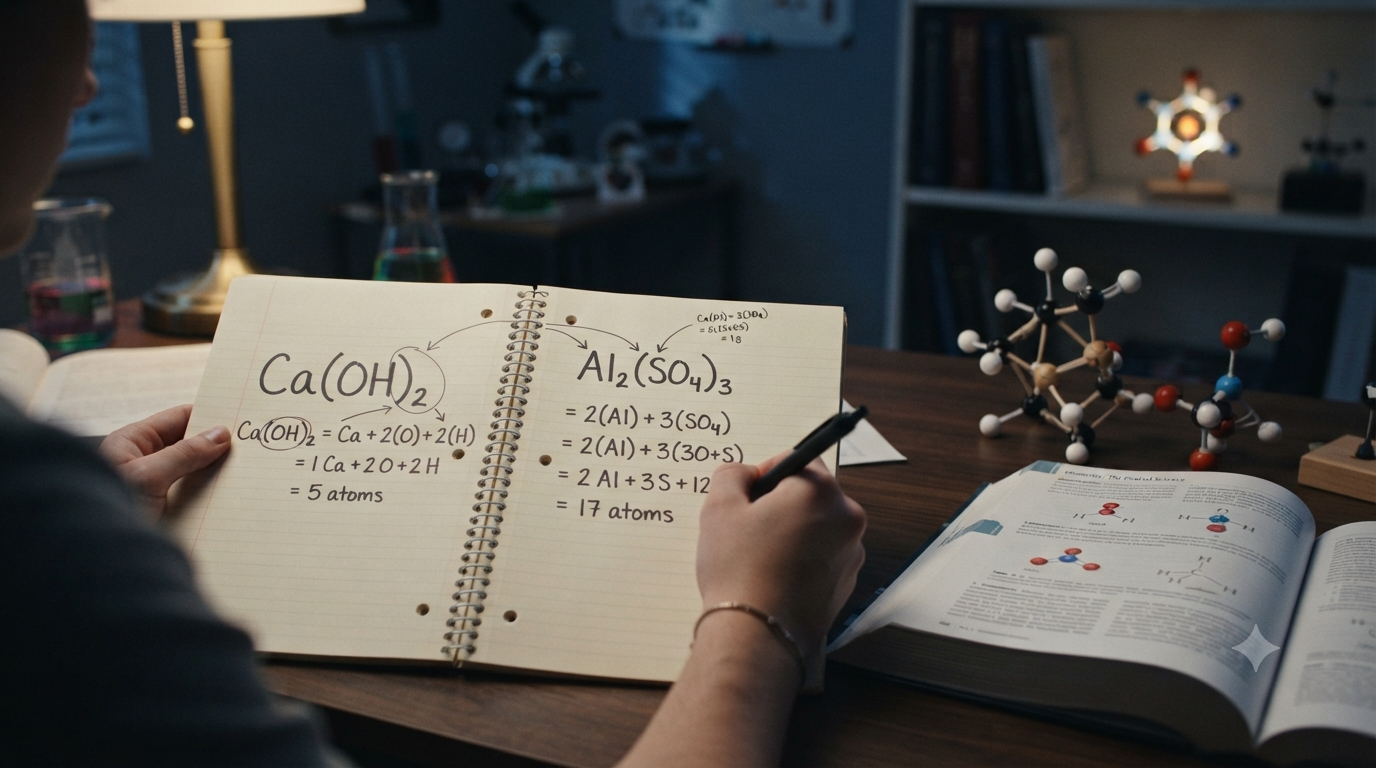
Chemical formulas give us a compact way to describe the composition of substances. Instead of writing the names and numbers of individual atoms every time, chemists use symbols and subscripts to show which elements are present and how many atoms of each element are involved. Two important types of chemical formulas are molecular formulas and empirical formulas.
Although both formulas describe the elemental composition of a compound, they do not always provide the same amount of information. A molecular formula shows the actual number of atoms of each element in one molecule, while an empirical formula shows the simplest whole-number ratio between those atoms.
Understanding the difference between molecular and empirical formulas is important because these formulas are used in chemistry to identify compounds, analyze their composition, perform calculations, and determine relationships between different substances. The two formulas are closely connected, but they answer slightly different questions.
What Is a Molecular Formula?
A molecular formula shows the actual number of atoms of each element present in a single molecule of a molecular compound.
For example, the molecular formula of water is:
H₂O
This tells us that one water molecule contains:
2 hydrogen atoms
1 oxygen atom
Similarly, the molecular formula of glucose is:
C₆H₁₂O₆
This means that one glucose molecule contains:
6 carbon atoms
12 hydrogen atoms
6 oxygen atoms
The subscripts in a molecular formula are important because they represent the actual number of atoms of each element in the molecule.
A molecular formula therefore provides detailed information about the composition of a molecule.
What Is an Empirical Formula?
An empirical formula represents the simplest whole-number ratio of the atoms of each element in a compound.
It does not necessarily show the actual number of atoms in a molecule. Instead, it reduces the subscripts to the smallest possible whole-number ratio.
For example, glucose has the molecular formula:
C₆H₁₂O₆
The subscripts 6, 12, and 6 can all be divided by 6:
C₆H₁₂O₆ → CH₂O
Therefore, the empirical formula of glucose is:
CH₂O
The empirical formula tells us that carbon, hydrogen, and oxygen occur in a ratio of:
1 : 2 : 1
It does not tell us that a glucose molecule contains only one carbon atom, two hydrogen atoms, and one oxygen atom. It only gives the simplest ratio between these elements.
Molecular Formula vs Empirical Formula
The main difference between the two formulas is the information they provide.
A molecular formula gives the actual number of atoms of each element in a molecule, whereas an empirical formula gives the simplest whole-number ratio of those atoms.
For example, consider hydrogen peroxide.
Its molecular formula is:
H₂O₂
This means one molecule contains 2 hydrogen atoms and 2 oxygen atoms.
To find the empirical formula, divide both subscripts by their greatest common factor, which is 2:
H₂O₂ → HO
Therefore:
Molecular formula = H₂O₂
Empirical formula = HO
The molecular formula gives the actual composition of the molecule, while the empirical formula gives the simplest ratio.
Examples of Molecular and Empirical Formulas
Some compounds have molecular and empirical formulas that are exactly the same. Others have different formulas.
| Compound | Molecular Formula | Empirical Formula |
|---|---|---|
| Water | H₂O | H₂O |
| Carbon dioxide | CO₂ | CO₂ |
| Glucose | C₆H₁₂O₆ | CH₂O |
| Hydrogen peroxide | H₂O₂ | HO |
| Benzene | C₆H₆ | CH |
| Acetic acid | C₂H₄O₂ | CH₂O |
| Ethyne | C₂H₂ | CH |
These examples show that a molecular formula can either be identical to the empirical formula or be a whole-number multiple of it.
When Are Molecular and Empirical Formulas the Same?
A molecular formula and an empirical formula are the same when the subscripts in the molecular formula cannot be reduced to a simpler whole-number ratio.
For example, consider water:
H₂O
The subscripts are 2 and 1. There is no common factor greater than 1 that can divide both numbers. Therefore, H₂O is already in its simplest ratio.
So:
Molecular formula = H₂O
Empirical formula = H₂O
Carbon dioxide provides another example:
CO₂
The ratio of carbon to oxygen is 1:2, which is already the simplest whole-number ratio.
Therefore:
Molecular formula = CO₂
Empirical formula = CO₂
When Are They Different?
The formulas are different when all the subscripts in the molecular formula have a common factor greater than 1.
Consider glucose:
C₆H₁₂O₆
The greatest common factor of 6, 12, and 6 is 6. Dividing each subscript by 6 gives:
C₆H₁₂O₆ ÷ 6 = CH₂O
Therefore:
Molecular formula = C₆H₁₂O₆
Empirical formula = CH₂O
The same relationship occurs with benzene:
C₆H₆ → CH
The molecular formula tells us that a benzene molecule contains six carbon atoms and six hydrogen atoms. The empirical formula only tells us that carbon and hydrogen are present in a 1:1 ratio.
How to Find an Empirical Formula from a Molecular Formula
Finding an empirical formula from a molecular formula is usually straightforward.
Step 1: Write the molecular formula
Suppose the molecular formula is:
C₆H₁₂O₆
Step 2: Identify the subscripts
The subscripts are:
C = 6
H = 12
O = 6
Step 3: Find the greatest common factor
The greatest common factor of 6, 12, and 6 is 6.
Step 4: Divide each subscript by the greatest common factor
C₆H₁₂O₆ → C₁H₂O₁
The number 1 is normally not written as a subscript.
Therefore:
Empirical formula = CH₂O
This process works whenever the molecular formula contains subscripts that can be reduced.
How to Find a Molecular Formula from an Empirical Formula
Finding a molecular formula from an empirical formula requires additional information. The empirical formula alone usually cannot tell us the actual number of atoms in a molecule.
For example, the empirical formula:
CH₂O
could represent several compounds, including glucose:
C₆H₁₂O₆
The molecular formula can be found when the molar mass of the compound is known.
The general relationship is:
Molecular formula = Empirical formula × n
where n is a whole number.
The value of n can be calculated using:
n = Molecular molar mass ÷ Empirical formula mass
For example, suppose a compound has an empirical formula of CH₂O and a molar mass of 180 g/mol.
The empirical formula mass is approximately:
12 + 2(1) + 16 = 30 g/mol
Now calculate:
n = 180 ÷ 30 = 6
Therefore, multiply every subscript in CH₂O by 6:
CH₂O × 6 = C₆H₁₂O₆
So the molecular formula is:
C₆H₁₂O₆
Why Is the Empirical Formula Important?
Empirical formulas are useful because they provide the simplest representation of a compound’s elemental ratio.
They are especially useful when chemists determine the composition of an unknown substance through experimental analysis. For example, a chemical analysis might reveal that a compound contains carbon, hydrogen, and oxygen in a particular ratio. That information can be converted into an empirical formula.
Empirical formulas are also commonly used in calculations involving percentage composition and elemental analysis.
They provide a simple way to compare the relative amounts of different elements in compounds.
Why Is the Molecular Formula Important?
The molecular formula provides more detailed information than the empirical formula for molecular substances.
It tells us the actual number of atoms of each element in one molecule. This information can be important when studying molecular structure, calculating molecular mass, and understanding chemical reactions.
For example, the empirical formula of glucose is:
CH₂O
But this formula alone does not distinguish glucose from every other compound with the same simplest ratio.
The molecular formula:
C₆H₁₂O₆
provides the actual molecular composition.
Therefore, molecular formulas are particularly useful when the identity and molecular composition of a substance need to be understood.
The Relationship Between Molecular and Empirical Formulas
A molecular formula is always a whole-number multiple of the empirical formula for a molecular compound.
For example:
CH₂O × 6 = C₆H₁₂O₆
Similarly:
CH × 6 = C₆H₆
And:
HO × 2 = H₂O₂
This relationship can be written generally as:
Molecular formula = (Empirical formula) × n
where n is a positive whole number.
If n equals 1, the molecular and empirical formulas are the same.
If n is greater than 1, the molecular formula contains larger subscripts than the empirical formula.
Molecular Formula and Empirical Formula in Chemical Calculations
Both types of formulas are useful in quantitative chemistry.
The empirical formula can be determined from the percentage composition of a compound. Once the empirical formula is known, the molecular formula can be determined if the compound’s molar mass is available.
For example, if experimental data produces the simplest ratio of carbon, hydrogen, and oxygen as:
CH₂O
the empirical formula has been established.
If the molar mass shows that the actual molecular formula must contain six times as many atoms, the molecular formula becomes:
C₆H₁₂O₆
This two-step process is common in chemical analysis.
A Simple Way to Remember the Difference
A useful way to remember the difference is to focus on the words actual and simplest.
Molecular formula = actual number of atoms
Empirical formula = simplest ratio of atoms
For example:
C₆H₁₂O₆
is the actual molecular composition of glucose.
CH₂O
is the simplest whole-number ratio of the same elements.
The molecular formula contains more specific information, while the empirical formula provides a simplified representation of elemental composition.
Common Mistakes to Avoid
One common mistake is assuming that an empirical formula gives the actual number of atoms in a molecule. It does not. It only gives the simplest ratio.
For example, CH₂O does not mean that every compound represented by this empirical formula contains exactly one carbon atom, two hydrogen atoms, and one oxygen atom.
Another mistake is reducing subscripts incorrectly. Every subscript must be divided by the same greatest common factor.
For example:
C₄H₈O₄ → CH₂O
The subscripts 4, 8, and 4 are all divided by 4.
It would be incorrect to divide the subscripts by different numbers because that would change the elemental ratio.
A further mistake is trying to determine a unique molecular formula from an empirical formula without knowing the molar mass or another suitable piece of information. The empirical formula alone does not normally provide enough information.
Conclusion
Molecular and empirical formulas both describe the elemental composition of compounds, but they do so at different levels of detail. A molecular formula shows the actual number of atoms of each element in a molecule, while an empirical formula shows the simplest whole-number ratio of those atoms.
For some substances, such as water and carbon dioxide, the molecular and empirical formulas are the same because their subscripts are already in the simplest ratio. For compounds such as glucose, hydrogen peroxide, and benzene, the molecular formula can be simplified to produce a different empirical formula.
Understanding this distinction makes it easier to interpret chemical formulas, analyze unknown compounds, calculate composition, and connect experimental data with molecular information. Once the relationship between the two is clear, moving from empirical formulas to molecular formulas becomes a straightforward mathematical process.
FAQs
1. What is a molecular formula?
A molecular formula shows the actual number of atoms of each element present in one molecule of a compound. For example, the molecular formula of glucose is C₆H₁₂O₆. This means one glucose molecule contains six carbon atoms, twelve hydrogen atoms, and six oxygen atoms. The subscripts in the formula indicate the number of atoms of each element. Molecular formulas provide detailed information about the composition of molecular substances. They are useful for calculating molecular mass, understanding chemical reactions, and identifying the actual atomic composition of a molecule. Unlike empirical formulas, molecular formulas do not necessarily represent the simplest whole-number ratio.
2. What is an empirical formula?
An empirical formula represents the simplest whole-number ratio of the elements present in a compound. It does not necessarily show the actual number of atoms in one molecule. For example, glucose has the molecular formula C₆H₁₂O₆, but its empirical formula is CH₂O. The subscripts in C₆H₁₂O₆ can all be divided by 6, giving the simplest ratio of 1:2:1. Empirical formulas are particularly useful for representing elemental composition and analyzing compounds from experimental data. They are commonly determined using percentage composition or other chemical measurements and can later be used to find the molecular formula when the molar mass is known.
3. What is the main difference between molecular and empirical formulas?
The main difference is the type of information each formula provides. A molecular formula gives the actual number of atoms of each element in one molecule, while an empirical formula gives only the simplest whole-number ratio between those atoms. For example, glucose has the molecular formula C₆H₁₂O₆ and the empirical formula CH₂O. The molecular formula provides more specific information about the molecule’s composition. The empirical formula provides a simplified representation of the elemental ratio. Therefore, molecular formulas are detailed, while empirical formulas are reduced to their simplest whole-number relationships.
4. Can a molecular formula and empirical formula be the same?
Yes, a molecular formula and empirical formula can be exactly the same. This happens when the subscripts in the molecular formula are already in their simplest whole-number ratio. For example, water has the molecular formula H₂O. The subscripts 2 and 1 cannot be divided by a common factor greater than 1, so H₂O is already its simplest ratio. Therefore, both its molecular and empirical formulas are H₂O. Carbon dioxide, CO₂, is another example. Since its subscripts are already in the simplest ratio, its molecular formula and empirical formula are also identical.
5. How do you find an empirical formula from a molecular formula?
To find an empirical formula, first write down the molecular formula and identify all its subscripts. Then find the greatest common factor shared by all the subscripts. Divide every subscript by that same number. For example, glucose has the molecular formula C₆H₁₂O₆. The greatest common factor of 6, 12, and 6 is 6. Dividing each subscript by 6 gives C₁H₂O₁. The number 1 is not written, so the empirical formula becomes CH₂O. If the subscripts cannot be reduced, the molecular formula is already the empirical formula.
6. How do you find a molecular formula from an empirical formula?
To determine a molecular formula from an empirical formula, you generally need the compound’s molar mass. First calculate the mass of the empirical formula. Then divide the compound’s molar mass by the empirical formula mass. The resulting whole number is the multiplier. For example, if the empirical formula is CH₂O and its formula mass is 30 g/mol, while the compound’s molar mass is 180 g/mol, then 180 ÷ 30 = 6. Multiply every subscript in CH₂O by 6. This gives C₆H₁₂O₆ as the molecular formula.
7. Is the empirical formula always smaller than the molecular formula?
The empirical formula is either the same as the molecular formula or has smaller subscripts. It represents the simplest whole-number ratio of the elements. For example, the molecular formula of hydrogen peroxide is H₂O₂, while its empirical formula is HO. Similarly, glucose has the molecular formula C₆H₁₂O₆ and empirical formula CH₂O. However, for water, both formulas are H₂O because the molecular formula is already in its simplest ratio. Therefore, the empirical formula is not always different or smaller in appearance. It is simply the simplest representation of the elemental ratio.
8. Why is the empirical formula important in chemistry?
The empirical formula is important because it provides a simple representation of the relative amounts of elements in a compound. Chemists can determine empirical formulas from experimental data, including the percentage composition of an unknown substance. Once the simplest ratio is known, additional information such as molar mass can be used to determine the molecular formula. Empirical formulas are also useful for comparing the elemental composition of substances and performing chemical calculations. For example, CH₂O immediately shows that carbon, hydrogen, and oxygen occur in a 1:2:1 ratio, even though the actual molecule may contain multiples of these numbers.
9. Can two different compounds have the same empirical formula?
Yes, two or more different compounds can have the same empirical formula. An empirical formula only shows the simplest ratio of elements, so it does not always uniquely identify a compound. For example, glucose has the molecular formula C₆H₁₂O₆ and acetic acid has the molecular formula C₂H₄O₂. Both reduce to the empirical formula CH₂O. However, these substances have different molecular structures and properties. This demonstrates why empirical formulas provide less detailed information than molecular formulas. Additional information, such as molar mass and molecular structure, is needed to distinguish compounds with the same empirical formula.
10. Why is the molecular formula useful for identifying a compound?
The molecular formula provides the actual number of atoms of each element in a molecule, making it more informative than an empirical formula alone. For example, the empirical formula CH₂O could represent several compounds, while the molecular formula C₆H₁₂O₆ specifies a molecule containing six carbon atoms, twelve hydrogen atoms, and six oxygen atoms. Molecular formulas are useful for calculating molecular mass, studying chemical reactions, and understanding molecular composition. However, a molecular formula does not describe how atoms are arranged or bonded. Structural formulas and molecular models provide additional information about the arrangement of atoms within a compound.
Related Posts
How do parentheses affect the number of atoms in a formula?
Chemical formulas tell us which elements are present in a substance and how many atoms of each element are included. […]
Read MoreWhat exactly is a chemical formula?

A chemical formula is a short way of representing a chemical substance using symbols and numbers. Instead of writing the […]
Read MoreHow to Find the Elemental Composition of a Compound

Every chemical compound is made from two or more elements combined in definite proportions. Knowing which elements are present and […]
Read MoreHow Does Direction Change the Meaning of a Physical Quantity?

In physics, numbers alone are often not enough to describe what is happening. A value such as 20 m/s, 10 […]
Read MoreBasic Types of Chemistry Formulas Explained

Chemistry formulas are one of the simplest ways scientists describe substances, reactions, and relationships between different particles. A formula can […]
Read MoreDifferent Forms of Energy Explained
Energy is one of the most important ideas in science. It is involved in almost everything that happens around us, […]
Read MoreWhy do some substances have simple formulas while others have complex formulas?
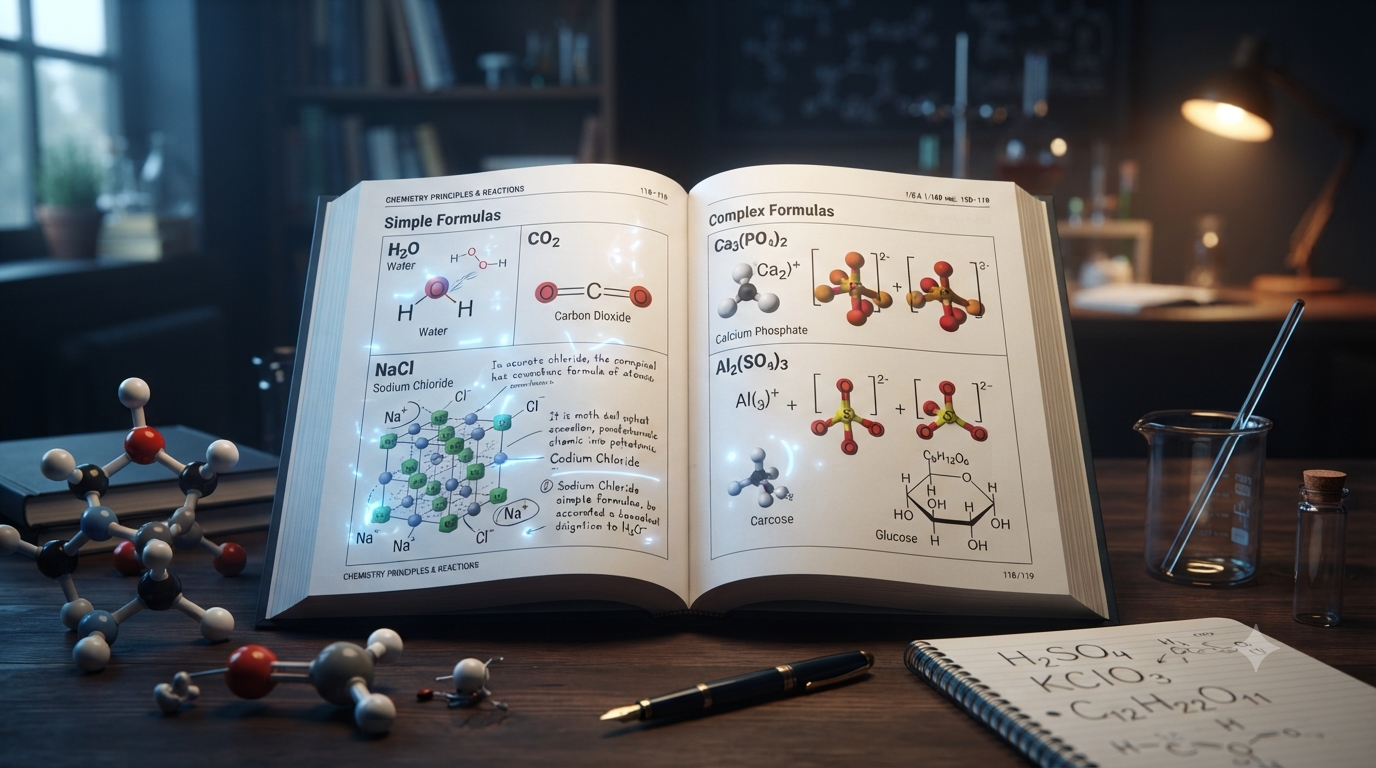
Chemical formulas are one of the simplest ways to describe what a substance is made of. A formula such as […]
Read MoreHow to Write Formulas Using Ionic Charges
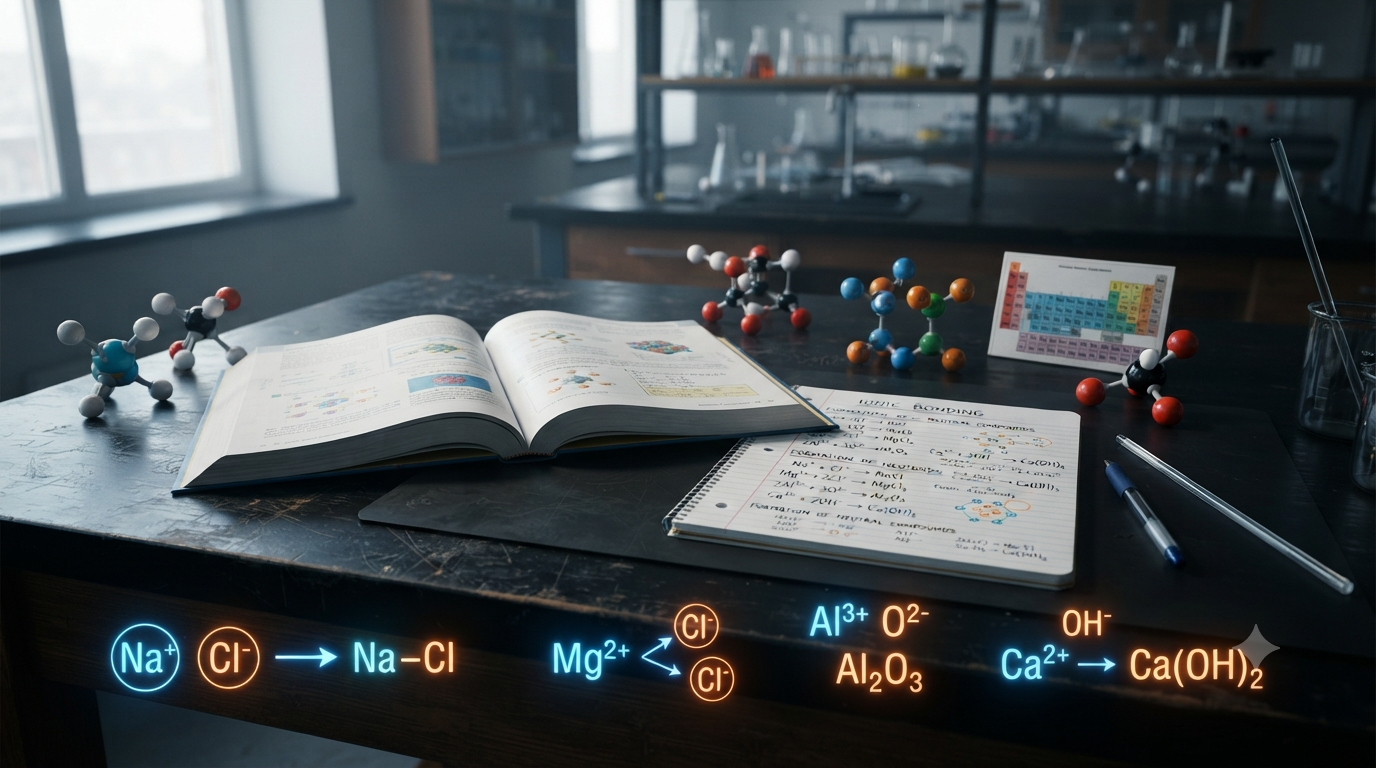
Writing chemical formulas becomes much easier when you understand how ions combine and how their charges are balanced. An ionic […]
Read MoreHow Chemical Formulas Connect Atoms, Molecules, and Compounds

Chemistry becomes much easier to understand when we know how atoms are connected and how their combinations are represented. Everything […]
Read MoreWhat Is Motion in Physics?
Motion is one of the most basic and important ideas in physics. Everything around us is in some form of […]
Read MoreHow Are Physical Quantities Represented in Physics?
Physics is the science of describing how nature works. To study motion, forces, energy, temperature, electricity, and many other phenomena, […]
Read MoreWhy does every physical quantity need a unit?
Imagine someone tells you that a table is “2” long. Does that tell you how long the table actually is? […]
Read MoreHow Elements Are Represented in Chemical Formulas

Chemistry deals with many different substances, from the oxygen we breathe to the water we drink and the minerals found […]
Read MoreWhat Is Force in Physics?
Force is one of the most important ideas in physics. We experience forces every day, even when we do not […]
Read MoreHow to Identify the Simplest Ratio in a Chemical Formula

Chemical formulas do more than identify substances. They also show how atoms of different elements are combined. By looking carefully […]
Read MoreCommon Formulas of Acids in Chemistry

Acids are among the most important substances studied in chemistry. They are found in laboratories, foods, medicines, industrial materials, and […]
Read MoreHow to Understand Units in Physics Formulas

Physics formulas are more than mathematical expressions. They describe relationships between physical quantities, and units help us understand what those […]
Read MoreSubscripts vs Coefficients in Chemical Formulas

Chemical formulas may look like simple combinations of letters and numbers, but every symbol and number has a specific meaning. […]
Read MoreCommon Formulas of Important Inorganic Compounds

Inorganic compounds are found everywhere around us, from table salt and baking soda to fertilizers, minerals, medicines, cleaning products, and […]
Read MoreSI Unit of Temperature Kelvin and Its Meaning

Temperature is one of the most important physical quantities in science. It helps us understand how hot or cold an […]
Read MoreScientific Notation in Physics: A Beginner’s Guide
Physics deals with quantities that can be extremely large or incredibly small. The distance between stars, the mass of planets, […]
Read MoreWhy Is Energy Conserved Even When It Seems to Disappear?

Energy is one of the most important ideas in science. We use energy to move objects, produce light, heat homes, […]
Read MoreWhat Are Physics Formulas and Why Are They Important?

Physics is the study of matter, energy, motion, forces, space, time, and the interactions that shape the natural world. To […]
Read MoreHow to Interpret the Ratio of Elements in a Compound

When a chemical compound is represented by a chemical formula, the symbols and numbers in that formula contain important information […]
Read MoreChemical Formula vs Chemical Equation

Chemistry uses symbols, numbers, and formulas to describe substances and chemical changes. Two important ways of representing chemical information are […]
Read MoreWhat Are Derived Units in Physics?
Physics uses measurements to describe everything from the motion of a car to the energy produced by a power plant. […]
Read MoreHow to Check Whether a Physics Formula Is Correct

A physics formula is more than a collection of symbols and numbers. It represents a relationship between physical quantities and […]
Read MoreHow to Handle Different Units in Physics Problems

Physics problems often look difficult because they contain formulas, numbers, symbols, and different units at the same time. A formula […]
Read MoreSI Unit of Amount of Substance Mole Explained

The mole is one of the seven SI base units used in science. It is the SI unit of amount […]
Read MoreHow Whole Number Ratios Are Used in Chemical Formulas

Chemical formulas are a simple way of showing what a substance is made of. A formula tells us which elements […]
Read More