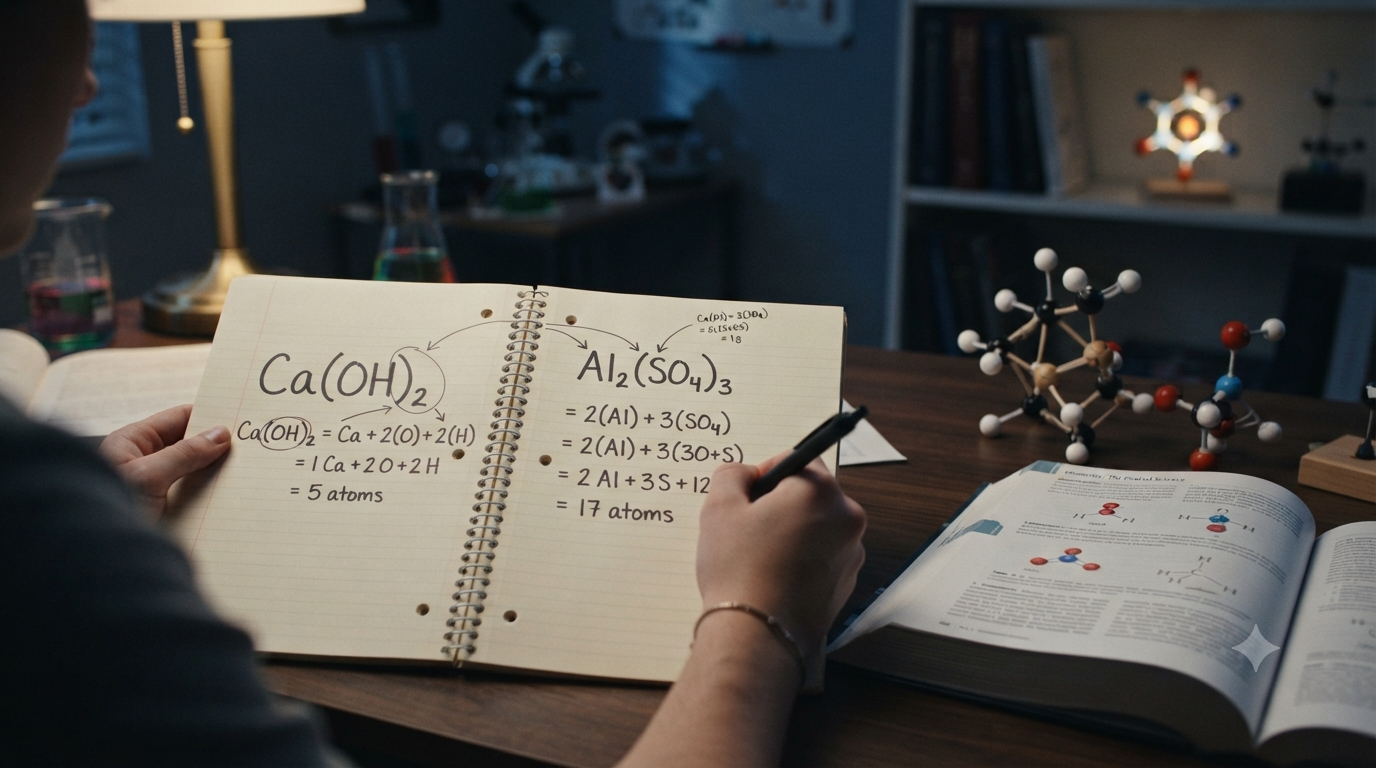
Chemical formulas tell us which elements are present in a substance and how many atoms of each element are included. Sometimes, however, a chemical formula contains parentheses, and these can make atom counting slightly more complicated. Parentheses are especially common when a group of atoms, such as a polyatomic ion, appears more than once in a compound.
Understanding how parentheses work is important because a small mistake in reading them can lead to an incorrect number of atoms. For example, in Ca(OH)₂, the subscript ₂ applies to the entire group inside the parentheses, not just to hydrogen. Therefore, the formula contains two oxygen atoms and two hydrogen atoms.
The basic rule is simple: a subscript written outside parentheses multiplies every atom inside the parentheses. Once this rule is understood, formulas containing parentheses become much easier to read and analyze.
What Do Parentheses Mean in a Chemical Formula?
Parentheses in a chemical formula group two or more atoms together. They show that the entire group should be considered as a unit when counting atoms.
For example:
Ca(OH)₂
Here, OH is enclosed in parentheses. The subscript ₂ outside the parentheses means that the OH group occurs twice.
Therefore:
O = 2 atoms
H = 2 atoms
Ca = 1 atom
The total number of atoms is:
1 + 2 + 2 = 5 atoms
Without understanding the parentheses, someone might incorrectly count only one oxygen and two hydrogen atoms. The parentheses prevent this mistake by clearly showing that the entire OH group is repeated.
The Basic Rule for Counting Atoms
The most important rule is:
A subscript outside parentheses applies to every element inside the parentheses.
Consider:
Mg(OH)₂
The group inside the parentheses is OH, and the outside subscript is ₂.
So:
O × 2 = 2 oxygen atoms
H × 2 = 2 hydrogen atoms
Magnesium has no subscript, so:
Mg = 1 atom
Therefore, Mg(OH)₂ contains:
1 magnesium atom
2 oxygen atoms
2 hydrogen atoms
It contains a total of 5 atoms.
The subscript outside the parentheses acts like a multiplier for the whole group.
Why Are Parentheses Used?
Parentheses are used when a group of atoms occurs more than once in a chemical formula. This often happens with polyatomic ions.
A polyatomic ion is a charged group of two or more atoms that behaves as a unit in a chemical reaction. Examples include:
OH⁻ — hydroxide
NO₃⁻ — nitrate
SO₄²⁻ — sulfate
CO₃²⁻ — carbonate
PO₄³⁻ — phosphate
NH₄⁺ — ammonium
When one of these groups occurs multiple times in a compound, parentheses help show how many complete groups are present.
For example:
Ca(OH)₂
This formula contains two hydroxide groups.
Similarly:
Al₂(SO₄)₃
This formula contains three sulfate groups.
The parentheses make the structure of the formula much clearer.
How to Count Atoms in a Formula With Parentheses
A reliable method can be followed whenever parentheses appear in a chemical formula.
Step 1: Identify the group inside the parentheses
Look at the atoms enclosed by the parentheses.
For example:
Al₂(SO₄)₃
The group inside the parentheses is:
SO₄
This means one sulfur atom and four oxygen atoms are present in one sulfate group.
Step 2: Find the subscript outside the parentheses
In:
Al₂(SO₄)₃
the number outside the parentheses is 3.
This means the entire SO₄ group occurs three times.
Step 3: Multiply each atom inside the parentheses
There is one sulfur atom in SO₄:
1 × 3 = 3 sulfur atoms
There are four oxygen atoms in SO₄:
4 × 3 = 12 oxygen atoms
Step 4: Count atoms outside the parentheses
Al₂ has a subscript of 2, so it contains:
2 aluminum atoms
Therefore, Al₂(SO₄)₃ contains:
2 aluminum atoms
3 sulfur atoms
12 oxygen atoms
The total number of atoms is:
2 + 3 + 12 = 17 atoms
Examples of Parentheses in Chemical Formulas
Understanding several examples makes the rule easier to apply.
Calcium Hydroxide Ca(OH)₂
In Ca(OH)₂, the OH group is repeated twice.
Calcium:
Ca = 1
Oxygen:
O = 1 × 2 = 2
Hydrogen:
H = 1 × 2 = 2
Therefore:
Ca(OH)₂ = 1 Ca + 2 O + 2 H
Total atoms:
1 + 2 + 2 = 5 atoms
Aluminum Sulfate Al₂(SO₄)₃
The formula is:
Al₂(SO₄)₃
Aluminum:
Al = 2
The sulfate group SO₄ appears three times.
Sulfur:
S = 1 × 3 = 3
Oxygen:
O = 4 × 3 = 12
Therefore:
Al₂(SO₄)₃ contains 2 aluminum atoms, 3 sulfur atoms, and 12 oxygen atoms.
Total:
2 + 3 + 12 = 17 atoms
Magnesium Nitrate Mg(NO₃)₂
The formula is:
Mg(NO₃)₂
Magnesium:
Mg = 1
The nitrate group NO₃ occurs twice.
Nitrogen:
N = 1 × 2 = 2
Oxygen:
O = 3 × 2 = 6
Therefore:
Mg(NO₃)₂ contains:
1 magnesium atom
2 nitrogen atoms
6 oxygen atoms
Total:
1 + 2 + 6 = 9 atoms
Ammonium Sulfate (NH₄)₂SO₄
This example has parentheses at the beginning of the formula:
(NH₄)₂SO₄
The ammonium group NH₄ occurs twice.
Nitrogen:
N = 1 × 2 = 2
Hydrogen:
H = 4 × 2 = 8
The sulfate group outside the parentheses contains:
S = 1
O = 4
Therefore:
N = 2
H = 8
S = 1
O = 4
Total atoms:
2 + 8 + 1 + 4 = 15 atoms
What Happens When There Is No Subscript Outside Parentheses?
If there is no number outside the parentheses, the group occurs only once.
For example:
NaOH
There are no parentheses here, but the same counting principle applies to grouped atoms when parentheses are used.
Consider a formula such as:
NH₄Cl
There is no subscript outside NH₄, so the atoms are counted according to their individual subscripts:
N = 1
H = 4
Cl = 1
If a parenthesized group has no outside subscript, it is understood to have a multiplier of 1.
For example, in a hypothetical formula:
X(AB)
the group AB occurs once.
Therefore:
A = 1
B = 1
The absence of a subscript does not mean zero. It means one.
Parentheses Do Not Change the Identity of the Atoms
Parentheses are mainly a counting and grouping tool. They do not create new elements or change the identity of the atoms.
For example:
SO₄
contains sulfur and oxygen.
When written as:
(SO₄)₃
the same sulfur and oxygen atoms are present, but the entire SO₄ group occurs three times.
Therefore:
S = 1 × 3 = 3
O = 4 × 3 = 12
The parentheses simply tell us how the atoms are grouped and how the outside subscript should be applied.
Parentheses and Subscripts Are Different From Coefficients
It is important not to confuse a subscript with a coefficient.
A subscript is a small number written within a chemical formula. It tells us how many atoms of an element, or how many groups, are present in one formula unit.
For example:
H₂O
The subscript ₂ means that one water molecule contains two hydrogen atoms.
A coefficient is a number placed in front of an entire formula.
For example:
3H₂O
The coefficient 3 means there are three water molecules.
Therefore:
H₂O contains:
2 hydrogen atoms
1 oxygen atom
3 total atoms
But 3H₂O contains:
3 × 2 = 6 hydrogen atoms
3 × 1 = 3 oxygen atoms
Total:
9 atoms
Similarly, if we have:
2Ca(OH)₂
first count one Ca(OH)₂ unit:
Ca = 1
O = 2
H = 2
Then multiply everything by the coefficient 2:
Ca = 2
O = 4
H = 4
This distinction becomes especially important when balancing chemical equations.
Parentheses Can Help Show Repeating Polyatomic Ions
One of the most common uses of parentheses is to show that a polyatomic ion appears multiple times.
Consider:
Fe(NO₃)₃
The nitrate ion is NO₃⁻.
The subscript 3 outside the parentheses means there are three nitrate ions.
Therefore:
N = 1 × 3 = 3
O = 3 × 3 = 9
Iron has:
Fe = 1
So the formula contains:
1 iron atom
3 nitrogen atoms
9 oxygen atoms
Total:
13 atoms
The parentheses make it clear that the three nitrogen atoms and nine oxygen atoms belong to three complete nitrate groups.
A Common Mistake With Parentheses
A common error is applying the outside subscript to only the last element inside the parentheses.
For example:
Al₂(SO₄)₃
An incorrect interpretation might be:
S = 1
O = 4 × 3 = 12
But sulfur is also inside the parentheses, so it must be multiplied by 3.
Correctly:
S = 1 × 3 = 3
O = 4 × 3 = 12
The correct atom count is:
Al = 2
S = 3
O = 12
The key question to ask is:
Which atoms are inside the parentheses?
Every atom inside that group is affected by the subscript outside it.
What If There Are Subscripts Inside and Outside the Parentheses?
This is where careful counting becomes important.
Consider:
Ca₃(PO₄)₂
Inside the parentheses:
PO₄
There is already a subscript 4 attached to oxygen. Then there is a subscript 2 outside the parentheses.
So oxygen is counted as:
4 × 2 = 8
Phosphorus has no subscript inside the parentheses, so:
1 × 2 = 2
Calcium has a subscript 3 outside the group:
Ca = 3
Therefore:
Ca = 3
P = 2
O = 8
Total atoms:
3 + 2 + 8 = 13 atoms
This demonstrates an important idea: subscripts inside parentheses are multiplied by the subscript outside the parentheses.
A Simple Shortcut for Atom Counting
When you see parentheses, think of the outside subscript as a multiplier.
For example:
Mg(NO₃)₂
Think:
NO₃ × 2
Then calculate:
N: 1 × 2 = 2
O: 3 × 2 = 6
Mg: 1
This simple approach works for most formulas containing parentheses.
Another useful way is to create a small counting table:
| Element | Atoms in Group | Outside Multiplier | Total Atoms |
|---|---|---|---|
| N | 1 | 2 | 2 |
| O | 3 | 2 | 6 |
Then add atoms outside the parentheses separately.
Why Correct Atom Counting Matters
Counting atoms correctly is more than an exercise in reading chemical formulas. It is an important foundation for understanding chemical reactions and quantitative chemistry.
The number of atoms in a formula helps determine the composition of a compound. It is also needed when calculating formula mass, molecular mass, percentage composition, and the amounts of substances involved in chemical reactions.
For example, if the oxygen count in Al₂(SO₄)₃ is incorrectly written as 4 instead of 12, any calculation based on the formula can also become incorrect.
Accurate atom counting therefore supports later topics such as stoichiometry, molar mass, chemical equations, and percentage composition.
A Step-by-Step Strategy to Avoid Mistakes
Whenever you encounter parentheses in a chemical formula, use this checklist:
Identify every element in the formula.
Find the atoms inside the parentheses.
Look for the subscript immediately outside the parentheses.
Multiply every atom inside the parentheses by that outside subscript.
Keep the atoms outside the parentheses separate.
Combine the results for each element.
Add all atom counts if the total number of atoms is required.
For example:
Al₂(SO₄)₃
First identify:
Al, S, O
Then identify the group:
SO₄
Outside multiplier:
3
Calculate:
S = 1 × 3 = 3
O = 4 × 3 = 12
Outside the parentheses:
Al = 2
Final count:
Al = 2, S = 3, O = 12
Total = 17 atoms
Following the same sequence every time reduces the chance of missing a subscript.
Parentheses Make Chemical Formulas Easier to Interpret
At first, parentheses in chemical formulas may look complicated, but their purpose is straightforward. They group atoms together so that a subscript outside the parentheses can be applied to the entire group.
In Ca(OH)₂, the 2 applies to both oxygen and hydrogen. In Mg(NO₃)₂, it applies to nitrogen and oxygen. In Al₂(SO₄)₃, it applies to sulfur and oxygen.
The most important idea to remember is:
Outside subscript × every atom inside the parentheses = actual number of those atoms.
Once this rule becomes familiar, formulas containing hydroxide, nitrate, sulfate, carbonate, phosphate, ammonium, and other polyatomic groups become much easier to read.
Conclusion
Parentheses show that a group of atoms is repeated within a chemical formula. When a subscript appears outside the parentheses, it multiplies every atom inside that group. For example, in Ca(OH)₂, the subscript 2 gives two oxygen atoms and two hydrogen atoms. In Al₂(SO₄)₃, the subscript 3 gives three sulfur atoms and twelve oxygen atoms.
The safest method is to identify the group inside the parentheses, find the outside multiplier, multiply each atom in the group, and then count any atoms outside the parentheses separately. With practice, this method makes even complex chemical formulas easier to understand and provides an important foundation for learning formula mass, chemical equations, and stoichiometry.
FAQs
1. What do parentheses mean in a chemical formula?
Parentheses in a chemical formula group two or more atoms together. They show that the entire group should be treated as a unit when a subscript appears outside the parentheses. For example, in Ca(OH)₂, the OH group is enclosed in parentheses, and the subscript ₂ means that the complete OH group occurs twice. Therefore, there are two oxygen atoms and two hydrogen atoms. Parentheses are commonly used when polyatomic ions such as hydroxide, nitrate, sulfate, carbonate, or phosphate occur more than once in a compound. They make the structure and atom count of a chemical formula easier to understand.
2. How does a subscript outside parentheses affect atom counting?
A subscript outside parentheses multiplies every atom inside the parentheses. For example, consider Mg(NO₃)₂. The nitrate group contains one nitrogen atom and three oxygen atoms. The subscript ₂ outside the parentheses means there are two nitrate groups. Therefore, nitrogen is 1 × 2 = 2 atoms, while oxygen is 3 × 2 = 6 atoms. Magnesium is outside the parentheses and has no subscript, so there is one magnesium atom. Thus, Mg(NO₃)₂ contains one magnesium, two nitrogen, and six oxygen atoms. The key rule is to multiply every atom inside the parentheses by the outside subscript.
3. How many atoms are present in Ca(OH)₂?
Ca(OH)₂ contains five atoms in total. Calcium is outside the parentheses and has no subscript, so there is one calcium atom. Inside the parentheses is the hydroxide group OH, which contains one oxygen atom and one hydrogen atom. The subscript ₂ outside the parentheses applies to both elements. Therefore, oxygen occurs 1 × 2 = 2 times, and hydrogen occurs 1 × 2 = 2 times. The formula therefore contains one calcium atom, two oxygen atoms, and two hydrogen atoms. Adding them gives 1 + 2 + 2 = 5 total atoms in one formula unit of calcium hydroxide.
4. How do you count atoms in Al₂(SO₄)₃?
To count atoms in Al₂(SO₄)₃, first identify the atoms inside the parentheses. The group SO₄ contains one sulfur atom and four oxygen atoms. The subscript ₃ outside the parentheses means this entire group occurs three times. Therefore, sulfur is 1 × 3 = 3 atoms, and oxygen is 4 × 3 = 12 atoms. Aluminum is outside the parentheses and has a subscript ₂, so there are two aluminum atoms. The final composition is two aluminum atoms, three sulfur atoms, and twelve oxygen atoms. Altogether, Al₂(SO₄)₃ contains 17 atoms in one formula unit.
5. Does a subscript outside parentheses apply to every element inside them?
Yes. A subscript outside parentheses applies to every element and atom count within the parentheses. For example, in Fe(NO₃)₃, the subscript ₃ applies to both nitrogen and oxygen because both are inside the parentheses. The nitrate group contains one nitrogen atom and three oxygen atoms. Therefore, nitrogen becomes 1 × 3 = 3 atoms, while oxygen becomes 3 × 3 = 9 atoms. The subscript does not apply to iron because iron is outside the parentheses. Remembering this rule prevents a common mistake in atom counting: multiplying only the last element instead of multiplying the entire grouped unit.
6. What happens if there is no subscript after parentheses?
If there is no subscript immediately outside parentheses, the entire group is understood to occur once. In other words, the multiplier is 1. For example, if a formula contains a group written as (AB), there is one A atom and one B atom. A missing subscript does not mean zero. It means one. The same principle applies to individual elements. For example, in H₂O, oxygen has no subscript, so there is one oxygen atom. When reading chemical formulas, always treat an element or group without a subscript as having a count of one.
7. Why are parentheses commonly used with polyatomic ions?
Parentheses are commonly used with polyatomic ions when more than one copy of the ion is present in a compound. A polyatomic ion is a charged group of atoms that behaves as a unit. Examples include OH⁻, NO₃⁻, SO₄²⁻, CO₃²⁻, and NH₄⁺. For example, Mg(NO₃)₂ contains two nitrate ions. The parentheses show that the subscript ₂ applies to the complete NO₃ group. Without parentheses, the formula could be misunderstood. Therefore, parentheses provide a clear way to show that a complete polyatomic ion is repeated and help readers correctly determine the number of atoms of each element.
8. What is the difference between a subscript and a coefficient?
A subscript tells how many atoms of an element or how many grouped units are present in one chemical formula. A coefficient is placed before the entire formula and tells how many formula units or molecules are present. For example, H₂O contains two hydrogen atoms and one oxygen atom. In 3H₂O, the coefficient 3 means there are three water molecules. Therefore, there are six hydrogen atoms and three oxygen atoms. Similarly, in 2Ca(OH)₂, the coefficient 2 multiplies the entire Ca(OH)₂ formula. Understanding this difference is especially important when counting atoms and balancing chemical equations.
9. How can you avoid mistakes when counting atoms with parentheses?
A simple step-by-step method can prevent most atom-counting mistakes. First, identify every element in the formula. Next, identify the complete group inside the parentheses. Then find the subscript immediately outside the parentheses and multiply every atom inside the group by that number. After that, count elements outside the parentheses separately. For example, in Mg(NO₃)₂, multiply both N and O by 2. Nitrogen becomes two atoms, while oxygen becomes six atoms. Finally, combine the counts for each element. Carefully following this sequence makes formulas containing polyatomic ions much easier to interpret accurately.
10. Why is correct atom counting important in chemistry?
Correct atom counting is important because chemical formulas are used for many calculations and chemical concepts. The number of atoms of each element helps determine a compound’s formula mass, molecular mass, percentage composition, and quantitative relationships in chemical reactions. An incorrect atom count can therefore produce incorrect calculations. For example, in Al₂(SO₄)₃, oxygen must be counted as twelve atoms, not four, because the sulfate group occurs three times. Understanding parentheses provides a foundation for later topics such as molar mass, stoichiometry, chemical equations, and percentage composition. Accurate formula reading is therefore an essential chemistry skill.
Related Posts
What Are Significant Figures in Physics?
Physics is a science based on measurement. Whether a physicist measures length, time, mass, temperature, or electrical current, every measurement […]
Read MoreHow to Write Physics Formulas Correctly

Physics formulas are a powerful way to express relationships between physical quantities. A single equation can describe motion, force, energy, […]
Read MoreEssential Chemistry Formulas for Beginners

Chemistry becomes much easier when you understand how chemical formulas represent substances. A chemical formula is a short way of […]
Read MoreWhy Is Energy Conserved Even When It Seems to Disappear?

Energy is one of the most important ideas in science. We use energy to move objects, produce light, heat homes, […]
Read MoreHow to Calculate Percentage Composition From a Formula
Percentage composition is a useful concept in chemistry that tells us how much of each element is present in a […]
Read MoreWhat does a coefficient mean in a chemical equation?

A chemical equation is a compact way of representing a chemical reaction. It tells us which substances take part in […]
Read MoreSI Unit of Amount of Substance Mole Explained

The mole is one of the seven SI base units used in science. It is the SI unit of amount […]
Read MoreWhat Is Formula Mass in Chemistry?

Chemistry often deals with substances that are made of atoms joined together in specific proportions. To understand how much matter […]
Read MoreCommon Formulas of Important Organic Compounds

Organic chemistry is the study of carbon-containing compounds and the way their atoms are arranged, bonded, and transformed during chemical […]
Read MoreWhat Is Inertia and Why Does It Matter?
Have you ever noticed how your body moves forward when a bus suddenly stops? Or why you feel pushed backward […]
Read MoreHow to Write Formulas for Polyatomic Ions

Writing chemical formulas becomes slightly more challenging when a compound contains a polyatomic ion. Unlike a single-atom ion, a polyatomic […]
Read MoreWhat Are Physics Formulas and Why Are They Important?

Physics is the study of matter, energy, motion, forces, space, time, and the interactions that shape the natural world. To […]
Read MoreHow to Read and Understand Chemistry Formulas

Chemistry formulas may look like a collection of letters, numbers, and symbols, but they are actually a simple language used […]
Read MoreWhat Is a Molecular Formula?

A molecular formula is a way of representing a substance using chemical symbols and numbers. It tells us which elements […]
Read MoreHow to Identify Variables in Physics Formulas

Physics formulas are mathematical statements that describe relationships between physical quantities. To use a formula correctly, you first need to […]
Read MoreHow to Use Chemical Formulas to Balance Chemical Equations
Chemical reactions describe how substances change into new substances. In chemistry, these changes are written using chemical equations. A chemical […]
Read MoreHow can chemical formulas be used to understand chemical reactions?

Chemical reactions are processes in which substances change into new substances. We can observe some reactions through changes in color, […]
Read MoreHow does a chemical formula represent a substance?
A chemical formula is a short and precise way of representing a substance using chemical symbols and numbers. Instead of […]
Read MoreHow Are Derived Units Built From Fundamental Units?

Physics uses units to make measurements meaningful. Saying that a car travels at a speed of 20 does not tell […]
Read MoreHow to Write Formulas Using Valency

Writing chemical formulas becomes much easier when you understand valency. A chemical formula tells us which elements are present in […]
Read MoreWhat is the difference between molecular and empirical formulas?
Chemical formulas give us a compact way to describe the composition of substances. Instead of writing the names and numbers […]
Read MoreCommon Chemical Formulas Every Student Should Know

Chemistry becomes much easier when you understand the formulas behind common substances, compounds, acids, bases, salts, and gases. A chemical […]
Read MoreHow Does Measurement Uncertainty Affect a Physics Experiment?
Every physics experiment involves measurement. We measure length, time, mass, temperature, voltage, current, speed, or other physical quantities to understand […]
Read MoreHow to Count Atoms From a Chemical Formula

Chemical formulas provide a compact way to describe what a substance is made of. A formula tells us which elements […]
Read MoreHow Are Physical Quantities Represented in Physics?
Physics is the science of describing how nature works. To study motion, forces, energy, temperature, electricity, and many other phenomena, […]
Read MoreWhy Chemical Formulas Use Whole Number Subscripts

Chemical formulas are one of the simplest ways scientists communicate information about substances. A formula such as H₂O tells us […]
Read MoreWhat Is Dimensional Consistency in Physics?

Physics uses mathematical equations to describe how different physical quantities are related. When scientists write an equation, every quantity in […]
Read MoreHow to Verify an Answer Using Units

In physics, getting a numerical answer is only part of solving a problem. The next question is whether that answer […]
Read MoreHow to Determine the Formula of a Compound From Its Name
Knowing the name of a chemical compound is often enough to determine its chemical formula if you understand the rules […]
Read MoreWhat Is a Chemical Formula in Chemistry?

Chemistry is the study of substances, their properties, and the changes they undergo. To describe these substances clearly, chemists need […]
Read More