Chemistry involves many formulas, symbols, equations, and chemical relationships. At first, remembering them can feel difficult because a single topic may contain several formulas that look similar. However, memorizing chemistry formulas does not have to mean repeatedly reading the same list until it becomes confusing. A better approach is to understand where formulas come from, organize them by topic, recognize patterns, and practice recalling them regularly.
When you understand the meaning behind a formula, it becomes much easier to remember and use it correctly. For example, knowing that density is mass divided by volume makes the formula ρ = m/V more meaningful than simply memorizing three symbols. Similarly, understanding valency and ionic charges can help you construct many chemical formulas instead of memorizing every compound separately.
This article explains practical methods for memorizing important chemistry formulas effectively. These techniques can help learners build stronger memory, reduce confusion between similar formulas, and become more confident when solving chemistry problems.
Why Chemistry Formulas Can Be Difficult to Memorize
Chemistry formulas contain symbols, numbers, charges, subscripts, coefficients, and sometimes brackets. Each part can have a specific meaning. Changing even one number or symbol can change the substance or the meaning of an equation.
For example:
H₂O represents water, while H₂O₂ represents hydrogen peroxide.
Similarly:
CO represents carbon monoxide, while CO₂ represents carbon dioxide.
The formulas are similar, but the substances and their properties are different. This is why memorizing formulas without understanding them can lead to mistakes.
Another difficulty is the large number of formulas encountered across different chemistry topics. Formulas related to atomic structure, mole calculations, acids and bases, gases, solutions, thermochemistry, and organic chemistry may all require different approaches.
The solution is not to memorize everything at once. Instead, formulas should be organized and learned systematically.
Understand the Meaning Before Memorizing
One of the most effective ways to remember a chemistry formula is to understand what it represents.
Consider the formula for density:
ρ = m/V
Here:
ρ = density
m = mass
V = volume
Instead of memorizing the three symbols separately, connect the formula with its meaning: density tells us how much mass is present in a given volume.
Once this relationship is understood, recalling the formula becomes easier.
The same principle works with the mole formula:
n = m/M
Here:
n = number of moles
m = given mass
M = molar mass
Understanding that the number of moles depends on the amount of substance and its molar mass gives the formula a logical structure.
When a formula has meaning, memory becomes connected to understanding rather than simple repetition.
Group Formulas by Chemistry Topic
Trying to memorize formulas from one huge list can quickly become overwhelming. A better method is to divide formulas into smaller groups.
For example, create separate sections for:
Atomic structure
Mole concept
Chemical equations
Stoichiometry
Gas laws
Solutions
Acids and bases
Thermochemistry
Electrochemistry
Organic chemistry
This organization makes revision easier because your brain can associate each formula with a particular concept.
For example, under the mole concept, you may keep formulas such as:
n = m/M
N = nNₐ
Molarity = moles of solute / volume of solution in litres
When related formulas are studied together, they become easier to connect and recall.
Learn Chemical Symbols First
Before trying to memorize complicated chemical formulas, become comfortable with common element symbols.
For example:
H = Hydrogen
O = Oxygen
C = Carbon
N = Nitrogen
Na = Sodium
K = Potassium
Ca = Calcium
Mg = Magnesium
Cl = Chlorine
S = Sulfur
Fe = Iron
Cu = Copper
Zn = Zinc
Knowing symbols reduces the amount of information your brain has to process when learning a compound formula.
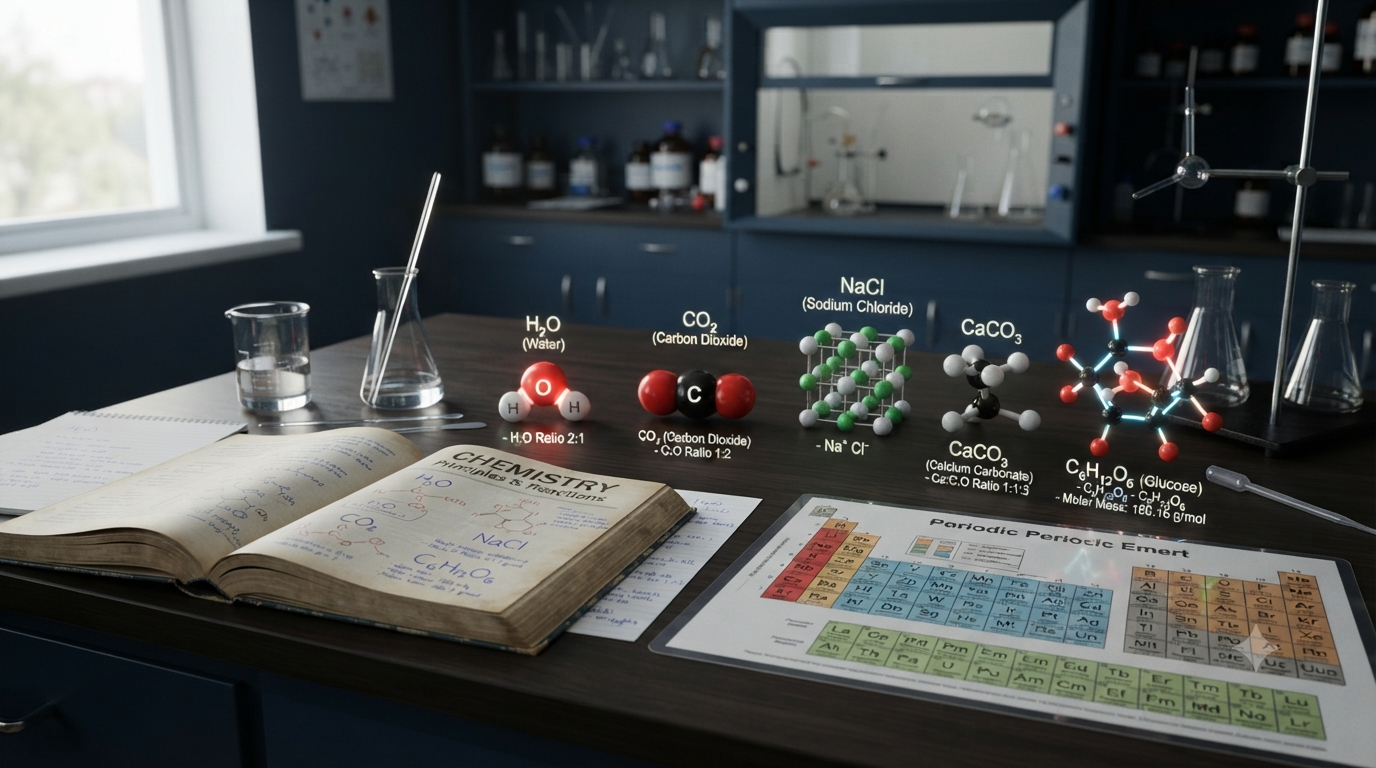
For example, once you know that sodium is Na and chlorine is Cl, the formula NaCl becomes easier to recognize.
Learning symbols is therefore an important foundation for learning chemical formulas.
Understand Valency and Ionic Charges
Valency and ionic charges can help you construct many formulas instead of memorizing them individually.
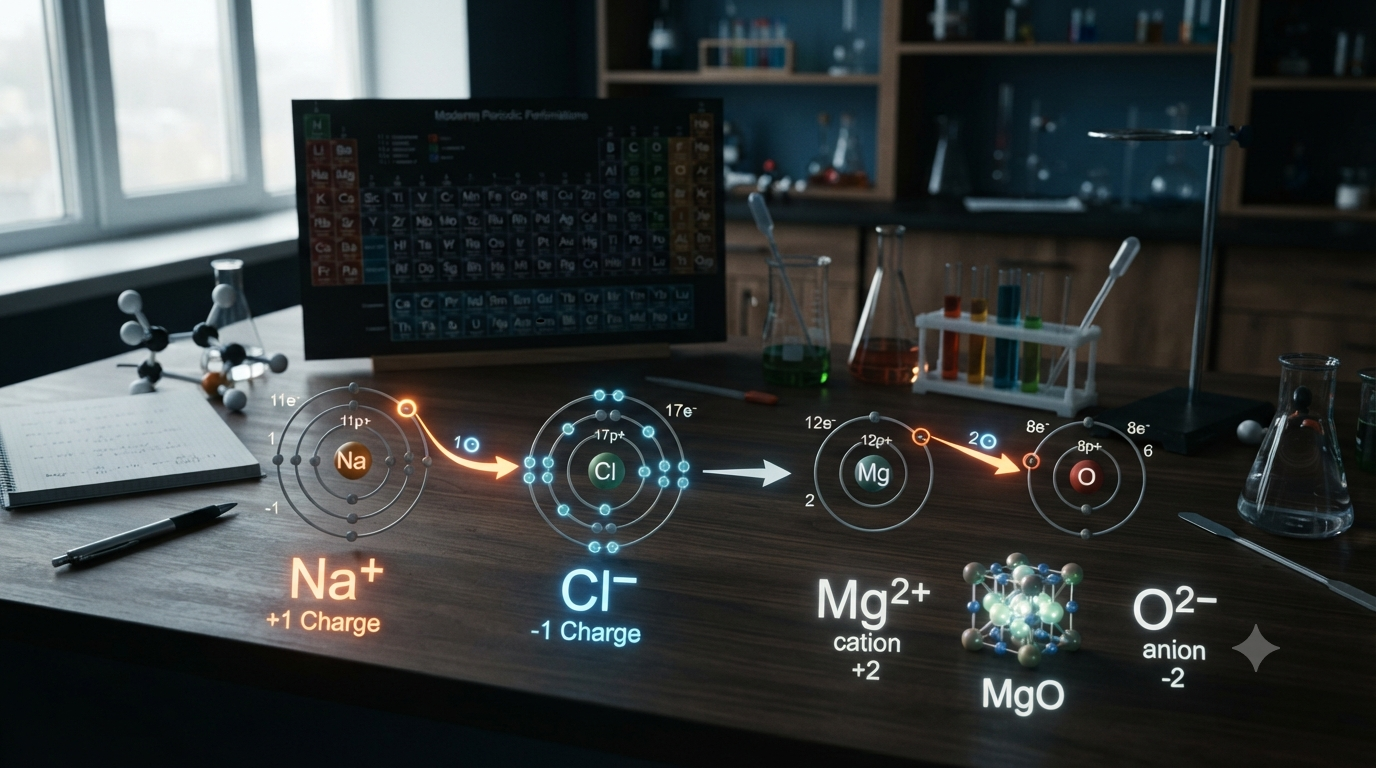
For example, sodium commonly forms Na⁺, while chlorine forms Cl⁻. Since their charges balance in a one-to-one ratio, the formula is:
NaCl
Calcium commonly forms Ca²⁺ and chloride forms Cl⁻. Two chloride ions are required to balance one calcium ion:
CaCl₂
Similarly, aluminium forms Al³⁺ and oxygen forms O²⁻. Balancing the charges gives:
Al₂O₃
This approach is more powerful than memorizing every formula separately because understanding charge balance allows you to build formulas logically.
Use Patterns Instead of Isolated Facts
Chemistry contains many patterns. Recognizing these patterns can significantly reduce memorization.
For example, compounds containing common polyatomic ions can be learned by recognizing the ion as a complete unit.
Some common ions include:
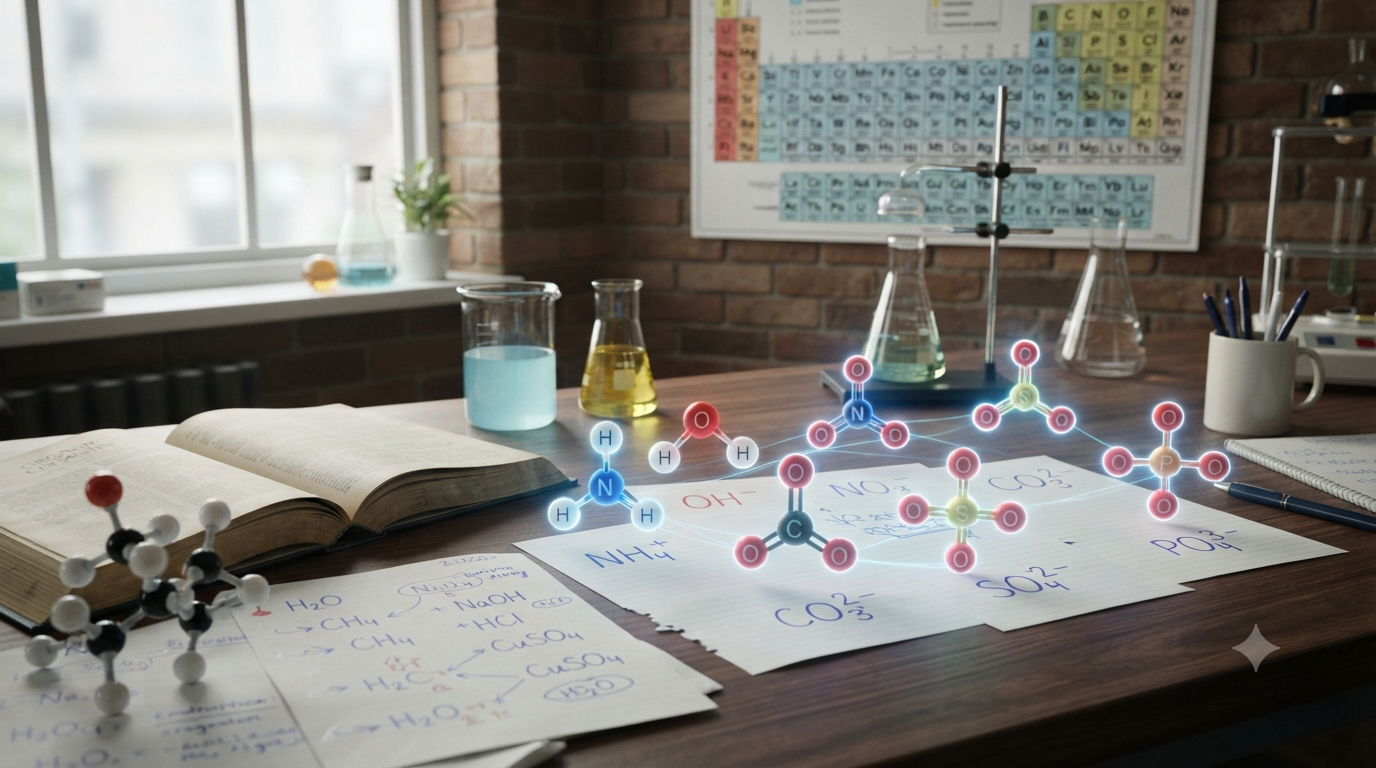
OH⁻ = Hydroxide
NO₃⁻ = Nitrate
SO₄²⁻ = Sulfate
CO₃²⁻ = Carbonate
NH₄⁺ = Ammonium
PO₄³⁻ = Phosphate
Once these ions are familiar, formulas such as Na₂SO₄, CaCO₃, and NH₄Cl become easier to understand.
Instead of memorizing the entire compound as a new fact, identify its ions and determine how their charges balance.
Create a Formula Notebook
A dedicated chemistry formula notebook can make revision much more organized.
Do not simply copy formulas into the notebook. For each formula, include:
Formula
Meaning of each symbol
SI unit, when applicable
Topic
One simple example
Important conditions or limitations
For example:
Formula: n = m/M
Meaning: Number of moles = mass ÷ molar mass
Symbols:
n = number of moles
m = mass
M = molar mass
Unit: mol
This format turns a formula sheet into a compact learning resource.
Use Active Recall
Reading formulas repeatedly creates familiarity, but familiarity does not always mean that you can recall the formula during a problem.
Active recall is more effective.
Close your textbook or formula sheet and try to write the formulas from memory.
For example, ask yourself:
What is the formula for number of moles?
Then write:
n = m/M
Afterward, check your answer.
If you make a mistake, correct it and try again later. This process forces your brain to retrieve information instead of simply recognizing it.
Active recall can be practiced with notebooks, flashcards, or short self-tests.
Use Flashcards
Flashcards are particularly useful for chemistry formulas.
Write the question on one side and the answer on the other.
For example:
Front: What is the formula for molarity?
Back: Molarity = moles of solute / volume of solution in litres
Another flashcard could ask:
Front: What is the formula for density?
Back: ρ = m/V
You can also create flashcards for chemical symbols, ions, common compounds, and reaction patterns.
The important point is to test yourself before looking at the answer.
Use Spaced Repetition
Trying to memorize all formulas in one long study session is usually less effective than reviewing them at spaced intervals.
A simple schedule could be:
First review: the same day
Second review: the next day
Third review: after three days
Fourth review: after one week
Fifth review: after two weeks
During each review, focus more on formulas that you have difficulty recalling.
Spaced repetition gives your brain repeated opportunities to strengthen memory over time.
Connect Formulas With Problems
A formula becomes easier to remember when you actually use it.
Suppose you are learning:
ρ = m/V
Do not stop after memorizing it. Solve a simple problem.
If a substance has a mass of 50 g and a volume of 10 cm³:
ρ = 50/10 = 5 g/cm³
Using the formula in a real calculation helps connect the symbols with a practical situation.
The same method can be applied to mole calculations, concentration, gas laws, and other chemistry topics.
Memorize Formulas Through Derivation
Some formulas become easier to remember when you understand how they are derived.
For example, the relationship between density, mass, and volume can be rearranged:
ρ = m/V
From this:
m = ρV
and:
V = m/ρ
If you understand the relationship between the quantities, you may not need to memorize every rearranged form separately.
Similarly, many mathematical relationships used in chemistry can be rearranged depending on what quantity needs to be calculated.
Understanding the structure of a formula therefore reduces the total amount of information that must be memorized.
Use Mnemonics Carefully
Mnemonics can be useful when a formula or sequence is difficult to remember.
However, mnemonics should support understanding rather than replace it.
For example, you might create a short phrase to remember the order of certain concepts or common ions. Personal mnemonics are often more memorable because they are connected to your own experiences and associations.
A good mnemonic should be:
Short
Easy to recall
Relevant
Unambiguous
Avoid creating complicated sentences that take more effort to remember than the formula itself.
Write Formulas by Hand
Writing formulas repeatedly can help strengthen memory, especially when combined with active recall.
Instead of copying:
n = m/M
twenty times while looking at the answer, try writing it from memory several times.
For example:
Look at the formula.
Cover it.
Write it from memory.
Check it.
Correct any mistake.
Try again later.
This approach is more useful than mechanical copying because it requires retrieval.
Pay Attention to Subscripts and Coefficients
One common chemistry mistake is confusing subscripts with coefficients.
For example:
2H₂O
The coefficient 2 means there are two molecules of water.
In H₂O, the subscript 2 means each water molecule contains two hydrogen atoms.
Changing these numbers can change the meaning of a chemical expression.
Therefore, when memorizing formulas, do not focus only on the letters. Pay attention to every subscript, coefficient, charge, and bracket.
Learn Common Formulas Through Relationships
Some formulas can be connected to one another.
For example, concentration relationships may involve quantities such as moles, mass, volume, and molar mass.
Instead of treating each equation as completely independent, understand how these quantities are related.
For example:
n = m/M
and:
Molarity = n/V
Once the relationships between mass, molar mass, moles, and volume are clear, several chemistry problems become easier to approach.
This network of relationships is more useful than a long disconnected formula list.
Practice Writing Chemical Equations
Chemical equations provide another important opportunity to reinforce formulas.
For example:
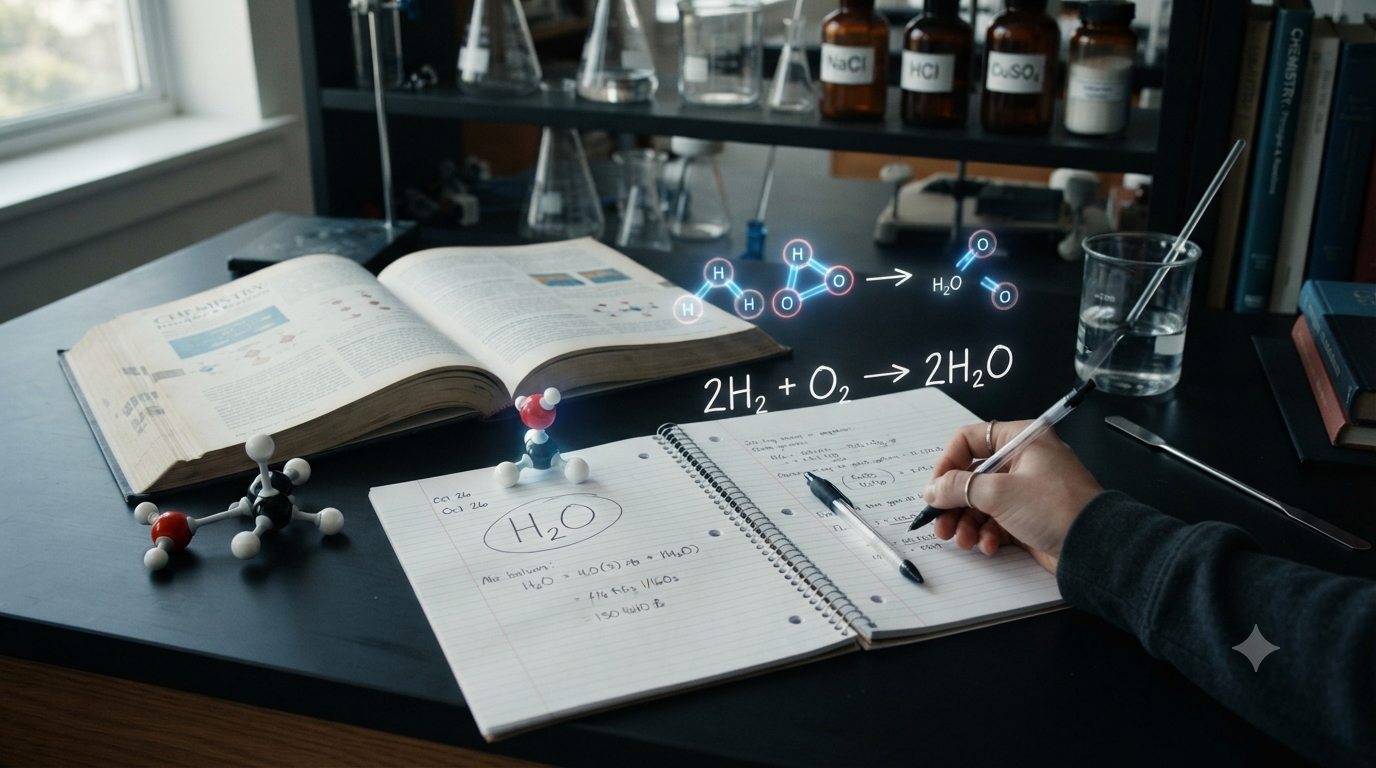
2H₂ + O₂ → 2H₂O
When balancing equations, you repeatedly work with chemical formulas and coefficients.
This helps reinforce:
Element symbols
Chemical formulas
Subscripts
Coefficients
Conservation of atoms
Reaction relationships
Practice therefore turns memorization into application.
Avoid Memorizing Too Many Formulas at Once
One of the biggest mistakes learners make is trying to memorize an entire formula sheet in one sitting.
Instead, set a small target.
For example, learn five formulas today. Understand them, write them from memory, and solve simple problems using them.
After you are comfortable with those formulas, move to the next group.
Small groups reduce mental overload and make progress easier to track.
Review Mistakes More Than Easy Formulas
During revision, not every formula deserves equal attention.
Some formulas may be recalled immediately, while others are repeatedly forgotten or confused.
Keep a small mistake list containing formulas that cause problems.
For example:
Review this list regularly.
The goal is not simply to spend more time studying. It is to spend more time on the areas that need improvement.
Build a One-Page Formula Sheet
After studying a chapter, create a one-page summary containing its most important formulas.
Keep only essential information.
For each formula, include:
A one-page sheet can then be used for quick revision before solving problems.
Creating the sheet is itself a learning activity because you must decide which formulas are important and organize them logically.
Use Chemistry Formulas in Real Contexts
Chemistry becomes easier to remember when formulas are connected to real-world examples.
Density can be connected with materials and liquids. Concentration can be connected with solutions. Gas laws can be connected with pressure and temperature. Chemical formulas can be connected with substances found in food, medicine, cleaning products, minerals, and the environment.
These connections make abstract symbols more meaningful.
When you understand what a formula describes in the real world, remembering it becomes easier.
A Simple Daily Formula Practice Routine
A short daily routine can be more effective than occasional long study sessions.
You can use this routine:
Step 1: Review five previously learned formulas.
Step 2: Learn two or three new formulas.
Step 3: Write the new formulas from memory.
Step 4: Solve one simple problem using each important formula.
Step 5: Check your mistakes.
Step 6: Add difficult formulas to your revision list.
This routine can take only a small amount of time while providing regular retrieval practice.
Conclusion
Memorizing important chemistry formulas effectively is not about repeating a formula hundreds of times. The most useful approach combines understanding, organization, active recall, spaced repetition, and problem-solving. Learning chemical symbols, valencies, ionic charges, and common patterns can also reduce the amount of information that needs to be memorized separately.
Start by grouping formulas according to topics and understanding what each symbol represents. Use flashcards and active recall to test your memory, review formulas at spaced intervals, and apply them to chemistry problems. Pay close attention to subscripts, coefficients, units, and charges because small details can change the meaning of a formula.
With regular practice, chemistry formulas can become familiar tools rather than a difficult collection of facts. The goal is not simply to remember formulas but to understand when and why each formula is used.