Coordinate geometry helps us describe the position of points on a flat surface using numbers and directions. One of its most important foundations is understanding positive and negative directions on coordinate axes. These directions tell us how to move from the origin, locate points, and interpret coordinates correctly. The concept may seem simple at first, but it is essential for learning the coordinate plane, plotting graphs, calculating distances, and studying more advanced mathematical topics.
The coordinate plane consists of two number lines that intersect at a point called the origin. The horizontal line is known as the x-axis, while the vertical line is called the y-axis. Each axis has a positive direction and a negative direction. By understanding how these directions work, learners can confidently identify locations, read coordinates, and represent mathematical relationships on a graph.
What Are Coordinate Axes?
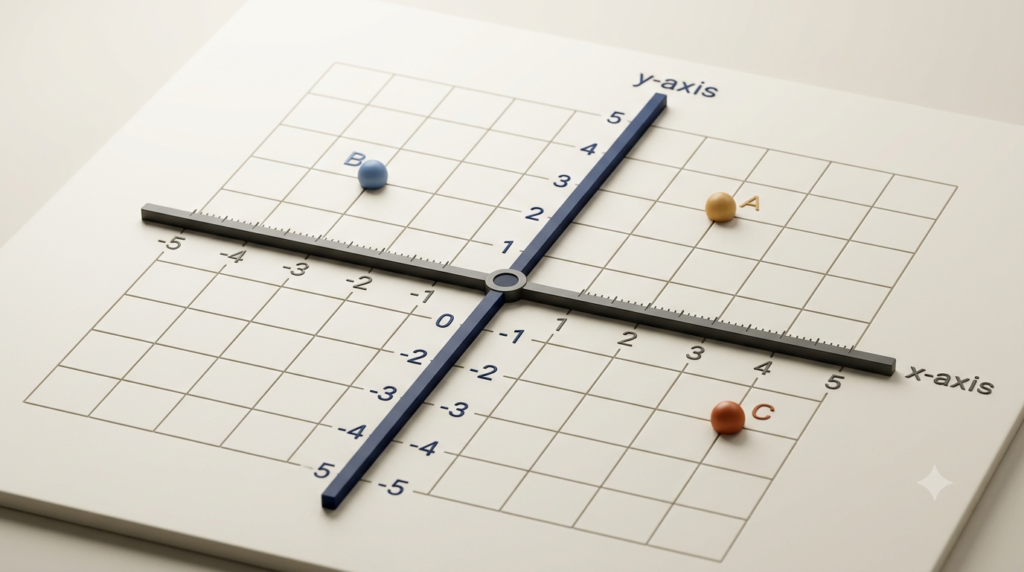
Coordinate axes are two perpendicular number lines used to locate points on a two-dimensional plane. They provide a reference system that allows us to describe the position of any point using an ordered pair of numbers.
The horizontal number line is called the x-axis, and the vertical number line is called the y-axis. These axes intersect at the origin, which is the central reference point of the coordinate plane.
The x-axis measures horizontal position, while the y-axis measures vertical position. Every point on the coordinate plane can be represented by two coordinates: the x-coordinate and the y-coordinate.
For example, the point (3, 2) represents a location that is three units to the right of the origin and two units above it.
Similarly, the point (−3, 2) represents a location three units to the left of the origin and two units above it.
The signs of the coordinates help us determine the direction in which we must move from the origin.
Understanding the Origin
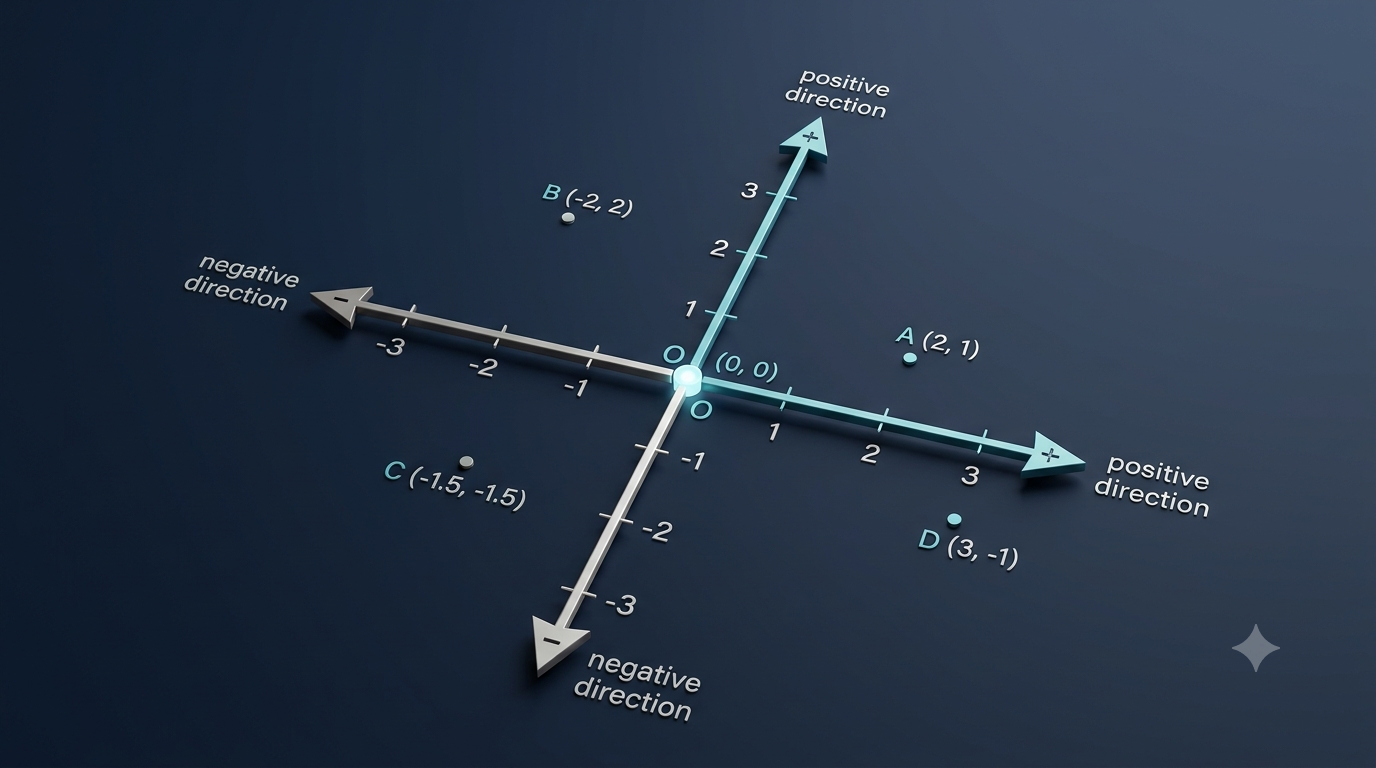
The origin is the point where the x-axis and y-axis intersect. It is the starting reference point for measuring positions in the coordinate plane.
The coordinates of the origin are:
Text block:
O = (0, 0)
At the origin, both the horizontal and vertical coordinates are zero. This means that no movement has occurred along either axis.
When locating a point, we begin at the origin and follow the directions indicated by its coordinates. The first coordinate tells us how far to move horizontally, and the second coordinate tells us how far to move vertically.
For example, to locate the point (4, 3), begin at the origin, move four units to the right, and then move three units upward.
To locate the point (−4, −3), begin at the origin, move four units to the left, and then move three units downward.
The origin makes it possible to measure every position consistently, regardless of whether the point lies in a positive or negative direction.
Positive and Negative Directions on the X-Axis
The x-axis represents horizontal movement in the coordinate plane. It extends indefinitely to the left and right of the origin.
The direction to the right is positive, while the direction to the left is negative.
Positive Direction on the X-Axis
The positive direction on the x-axis extends from the origin toward the right side of the coordinate plane. Points located to the right of the origin have positive x-coordinates.
For example, the points (1, 0), (3, 0), and (5, 0) lie on the positive side of the x-axis.
As we move farther to the right, the values of the x-coordinate increase.
Text block:
0 → 1 → 2 → 3 → 4 → 5
Each step represents one unit of movement in the positive x-direction.
A point such as (4, 0) lies four units to the right of the origin. Its y-coordinate is zero because the point does not move above or below the x-axis.
Positive x-coordinates are useful for representing positions to the right of a reference point, such as locations on a horizontal map or measurements along a straight path.
Negative Direction on the X-Axis
The negative direction on the x-axis extends from the origin toward the left side of the coordinate plane. Points located to the left of the origin have negative x-coordinates.
For example, the points (−1, 0), (−3, 0), and (−5, 0) lie on the negative side of the x-axis.
As we move farther to the left, the x-coordinate becomes more negative.
Text block:
−5 ← −4 ← −3 ← −2 ← −1 ← 0
Each step to the left represents one unit of movement in the negative x-direction.
A point such as (−4, 0) lies four units to the left of the origin. Its y-coordinate remains zero because it is positioned directly on the x-axis.
It is important to understand that a negative coordinate does not mean that a distance is physically negative. Instead, the negative sign identifies the direction relative to the origin.
Positive and Negative Directions on the Y-Axis
The y-axis represents vertical movement in the coordinate plane. It extends upward and downward from the origin.
The direction upward is positive, while the direction downward is negative.
Positive Direction on the Y-Axis
The positive direction on the y-axis extends upward from the origin. Points above the origin have positive y-coordinates.
For example, the points (0, 1), (0, 3), and (0, 5) lie on the positive side of the y-axis.
As we move upward, the y-coordinate increases.
Text block:
5
4
3
2
1
0
Each step upward represents one unit of movement in the positive y-direction.
A point such as (0, 4) lies four units above the origin. Its x-coordinate is zero because the point does not move to the left or right.
Positive y-coordinates are commonly used to represent heights, upward movement, and positions above a horizontal reference line.
Negative Direction on the Y-Axis
The negative direction on the y-axis extends downward from the origin. Points below the origin have negative y-coordinates.
For example, the points (0, −1), (0, −3), and (0, −5) lie on the negative side of the y-axis.
As we move downward, the y-coordinate becomes more negative.
Text block:
0
−1
−2
−3
−4
−5
Each step downward represents one unit of movement in the negative y-direction.
A point such as (0, −4) lies four units below the origin. Its x-coordinate is zero because it remains directly on the y-axis.
Negative y-coordinates are useful when representing positions below a reference level, such as depth below sea level or movement downward on a graph.
How Positive and Negative Directions Work Together
The x-axis and y-axis work together to locate points throughout the coordinate plane. A point is represented by an ordered pair written as (x, y).
The first number indicates horizontal movement, while the second number indicates vertical movement. The signs of these numbers determine the directions.
Consider the point (3, 2). The positive x-coordinate means three units to the right, and the positive y-coordinate means two units upward.
Now consider the point (−3, 2). The negative x-coordinate means three units to the left, while the positive y-coordinate means two units upward.
The point (−3, −2) requires movement three units to the left and two units downward.
Finally, the point (3, −2) requires movement three units to the right and two units downward.
These examples demonstrate that horizontal and vertical directions are independent. A point can move in a positive direction along one axis and a negative direction along the other.
Examples of Coordinate Directions
The following examples show how coordinate signs determine movement from the origin.
| Coordinates | Horizontal movement | Vertical movement |
|---|---|---|
| (4, 3) | 4 units right | 3 units up |
| (−4, 3) | 4 units left | 3 units up |
| (−4, −3) | 4 units left | 3 units down |
| (4, −3) | 4 units right | 3 units down |
| (5, 0) | 5 units right | No vertical movement |
| (0, −5) | No horizontal movement | 5 units down |
Notice that a coordinate equal to zero means there is no movement along the corresponding axis. For example, in (5, 0), the point lies on the x-axis. In (0, −5), the point lies on the y-axis.
The Four Quadrants and Coordinate Directions
The x-axis and y-axis divide the coordinate plane into four regions called quadrants. Each quadrant contains points with a particular combination of positive and negative coordinates.
Understanding the quadrants makes it easier to identify the approximate location of a point without drawing the entire graph.
First Quadrant
The first quadrant is located above the x-axis and to the right of the y-axis. Both coordinates are positive.
Text block:
Coordinates: (+, +)
Example: (3, 4)
A point in this quadrant lies to the right of the origin and above it.
Second Quadrant
The second quadrant is located above the x-axis and to the left of the y-axis. The x-coordinate is negative, while the y-coordinate is positive.
Text block:
Coordinates: (−, +)
Example: (−3, 4)
A point in this quadrant lies to the left of the origin and above it.
Third Quadrant
The third quadrant is located below the x-axis and to the left of the y-axis. Both coordinates are negative.
Text block:
Coordinates: (−, −)
Example: (−3, −4)
A point in this quadrant lies to the left of the origin and below it.
Fourth Quadrant
The fourth quadrant is located below the x-axis and to the right of the y-axis. The x-coordinate is positive, while the y-coordinate is negative.
Text block:
Coordinates: (+, −)
Example: (3, −4)
A point in this quadrant lies to the right of the origin and below it.
The quadrants are numbered counterclockwise, beginning with the upper-right region. Points lying directly on either axis are not part of any quadrant.
What Happens When a Coordinate Is Zero?
A coordinate of zero indicates that a point lies directly on one of the coordinate axes or at their intersection.
When the y-coordinate is zero, the point lies on the x-axis. For example, (6, 0) lies six units to the right of the origin, while (−6, 0) lies six units to the left.
When the x-coordinate is zero, the point lies on the y-axis. For example, (0, 6) lies six units above the origin, while (0, −6) lies six units below it.
If both coordinates are zero, the point is the origin.
Text block:
(x, 0) = A point on the x-axis
(0, y) = A point on the y-axis
(0, 0) = The origin
These rules are useful when plotting points, interpreting graphs, and checking whether a coordinate belongs to an axis or a quadrant.
How to Plot Points Using Positive and Negative Directions
Plotting a point becomes easier when you follow a consistent sequence. Always read the x-coordinate first and the y-coordinate second.
Follow these steps to plot any point on the coordinate plane.
Draw two perpendicular number lines that intersect at the origin.
Label the horizontal line as the x-axis and the vertical line as the y-axis.
Mark equal unit intervals along both axes.
Read the x-coordinate and determine whether to move right or left.
Starting from the origin, move the required number of units horizontally.
From that position, move vertically according to the y-coordinate.
Mark the final position and label it with the given coordinates.
For example, consider the point (−2, 4).
First, start at the origin. Since the x-coordinate is −2, move two units to the left. Then, because the y-coordinate is 4, move four units upward. Mark the final position.
Now consider the point (3, −2). Move three units to the right from the origin, followed by two units downward. The final position represents the point (3, −2).
Remember that the vertical movement begins from the horizontal position already reached. The two movements together determine the final location.
Real-Life Applications of Positive and Negative Directions
Positive and negative coordinate directions are not limited to mathematics textbooks. They help represent locations, movements, measurements, and changes in many practical situations.
Maps and Navigation
A coordinate system can represent locations relative to a reference point. Moving east or west can be represented along a horizontal axis, while moving north or south can be represented along a vertical axis. The chosen positive directions depend on how the system is defined.
For example, if east is positive on the horizontal axis, a location west of the reference point can have a negative horizontal coordinate.
Temperature Changes
Positive and negative numbers are used to represent temperatures above and below zero. A temperature of 5°C is above zero, while −5°C is below zero.
Although temperature is not automatically a coordinate-plane position, it illustrates how positive and negative numbers describe values on opposite sides of a reference point.
Elevation and Depth
Vertical coordinates can represent positions above or below a reference level. If sea level is defined as zero, locations above sea level can have positive vertical values, while depths below sea level can have negative values.
For example, an elevation of 200 metres can be represented as +200 metres, while a depth of 50 metres below sea level can be represented as −50 metres.
Computer Graphics and Gaming
Computer graphics use coordinate systems to place objects on screens and within virtual environments. In a common two-dimensional screen coordinate system, the horizontal coordinate often increases to the right, while the vertical coordinate increases downward.
This differs from the conventional mathematical coordinate plane, where the positive y-direction points upward. Understanding the chosen coordinate convention helps programmers position objects and interpret movement correctly.
Graphs and Data Representation
Graphs often use positive and negative coordinates to display values above or below a reference line. For example, a financial graph may show gains as positive values and losses as negative values.
Similarly, a graph can display changes in position, velocity, or other quantities relative to a selected reference. Correctly interpreting the signs helps readers understand what the graph represents.
Common Mistakes to Avoid
Beginners sometimes confuse positive and negative directions when plotting points. Recognizing these mistakes early can make coordinate geometry much easier.
Mistake 1: Reversing the horizontal directions
The positive x-direction points right, and the negative x-direction points left in the conventional coordinate plane. Reversing these directions places points on the wrong side of the origin.
Mistake 2: Reversing the vertical directions
The positive y-direction points upward, while the negative y-direction points downward. Always check the orientation of the axes before plotting a point.
Mistake 3: Reading coordinates in the wrong order
Coordinates are written as (x, y), not (y, x). The first number determines horizontal movement, and the second determines vertical movement.
For example, (2, 5) and (5, 2) represent different locations.
Mistake 4: Assuming negative values always mean smaller physical distances
A negative coordinate indicates direction relative to the origin. The points −4 and +4 are both four units from zero, but they lie on opposite sides of the number line.
Mistake 5: Placing points on the wrong axis
A point with a zero y-coordinate lies on the x-axis. A point with a zero x-coordinate lies on the y-axis. Check which coordinate is zero before deciding where the point belongs.
Mistake 6: Forgetting that the axes use equal intervals
When plotting points, each unit should represent the same distance along a given axis. Unequal spacing can distort the positions and make graphs inaccurate.
Conclusion
Understanding positive and negative directions on coordinate axes is a fundamental skill in coordinate geometry. The x-axis represents horizontal movement, with positive values extending to the right and negative values extending to the left. The y-axis represents vertical movement, with positive values extending upward and negative values extending downward. The origin, represented by (0, 0), provides the reference point for all coordinate measurements.
By learning how coordinate signs determine direction, you can identify quadrants, plot points accurately, interpret graphs, and solve more advanced mathematical problems. Regular practice with ordered pairs and simple coordinate diagrams will help make these concepts easier to remember. Once these basic directions become familiar, learning other topics in coordinate geometry becomes much more straightforward.
FAQs
1. What are positive and negative directions on coordinate axes?
Positive and negative directions on coordinate axes indicate the direction in which a point is located relative to the origin. In a conventional coordinate plane, the positive direction of the x-axis extends to the right, while the negative direction extends to the left. On the y-axis, the positive direction extends upward, and the negative direction extends downward. These directions help us identify the positions of points using coordinates. Understanding them is essential for plotting points, reading graphs, and solving coordinate geometry problems. The signs of coordinates indicate direction rather than simply representing physical distance.
2. Which direction is positive on the x-axis?
The positive direction on the x-axis extends from the origin toward the right side of the coordinate plane. Points located to the right of the origin have positive x-coordinates, such as 1, 2, 3, and 4. As we move farther right, the x-coordinate increases. For example, the point (5, 0) lies five units to the right of the origin. The y-coordinate is zero because the point lies directly on the horizontal axis. Remembering that positive x-values point right makes it easier to plot points and understand the structure of the coordinate plane.
3. Which direction is negative on the x-axis?
The negative direction on the x-axis extends from the origin toward the left. Points on this side have negative x-coordinates, such as −1, −2, −3, and −4. Moving farther left makes the x-coordinate more negative. For example, the point (−4, 0) lies four units to the left of the origin. Its y-coordinate is zero because it is positioned on the x-axis. Negative coordinates do not mean that the point has a negative physical distance. Instead, the negative sign indicates its direction relative to the origin. This concept is important when locating points and interpreting mathematical graphs.
4. Which direction is positive on the y-axis?
The positive direction on the y-axis extends upward from the origin. Points above the origin have positive y-coordinates, such as 1, 2, 3, and 4. As we move upward, the y-coordinate increases. For example, the point (0, 4) lies four units above the origin. Its x-coordinate is zero because it does not move horizontally from the vertical axis. Positive y-coordinates are used to describe positions above a reference level in mathematical diagrams. Understanding this direction helps learners plot points accurately and identify locations in the upper half of the coordinate plane.
5. Which direction is negative on the y-axis?
The negative direction on the y-axis extends downward from the origin. Points below the origin have negative y-coordinates, including −1, −2, −3, and −4. As we move farther downward, the y-coordinate becomes more negative. For example, the point (0, −3) lies three units below the origin. Its x-coordinate is zero because the point remains on the y-axis. Negative vertical coordinates can also represent depth below a reference level, such as sea level. Recognizing the downward direction of negative y-values helps learners plot points correctly and understand coordinate diagrams without confusing horizontal and vertical movement.
6. What is the origin in a coordinate plane?
The origin is the point where the horizontal x-axis and vertical y-axis intersect. It is the central reference point used to measure the positions of other points on the coordinate plane. The coordinates of the origin are (0, 0), meaning that neither horizontal nor vertical movement has occurred. When plotting a point, we begin at the origin and follow the directions indicated by its coordinates. For example, to plot (3, 2), move three units right and two units upward. The origin is important because it provides a common starting point for locating and comparing positions throughout the coordinate plane.
7. How do positive and negative coordinates determine the quadrant of a point?
The signs of the x-coordinate and y-coordinate determine the quadrant in which a point is located. In the first quadrant, both coordinates are positive. In the second quadrant, the x-coordinate is negative and the y-coordinate is positive. In the third quadrant, both coordinates are negative. In the fourth quadrant, the x-coordinate is positive and the y-coordinate is negative. For example, (2, 3) lies in the first quadrant, while (−2, −3) lies in the third quadrant. The quadrants are numbered counterclockwise, beginning with the upper-right region. Points on the coordinate axes do not belong to any quadrant.
8. What happens when one coordinate is zero?
When one coordinate is zero, the point lies directly on the other coordinate axis. If the y-coordinate is zero, the point lies on the x-axis. For example, (4, 0) is four units to the right of the origin, while (−4, 0) is four units to the left. If the x-coordinate is zero, the point lies on the y-axis. For example, (0, 3) is three units above the origin, while (0, −3) is three units below it. When both coordinates are zero, the point is the origin, represented by (0, 0).
9. How can you plot a point using positive and negative directions?
To plot a point, first identify its ordered pair, written as (x, y). Begin at the origin and use the first coordinate to determine horizontal movement. Move right for a positive x-coordinate or left for a negative x-coordinate. Next, use the second coordinate to determine vertical movement. Move upward for a positive y-coordinate or downward for a negative y-coordinate. Finally, mark the position reached and label the point. For example, to plot (−3, 2), move three units left and then two units upward. Following these steps consistently helps prevent mistakes when plotting points on the coordinate plane.
10. Why are positive and negative directions important in coordinate geometry?
Positive and negative directions are important because they allow us to locate points accurately and describe positions relative to a reference point. They form the foundation for understanding coordinate pairs, quadrants, graphs, distance calculations, and many other mathematical concepts. These directions are also useful in practical applications, including map navigation, computer graphics, elevation measurements, and data visualization. For example, a negative horizontal coordinate may represent a location west of a reference point, while a negative vertical coordinate may represent a position below a selected level. Understanding coordinate directions makes it easier to interpret mathematical information and solve more advanced coordinate geometry problems.