In calculus, understanding the difference between a function’s value and its limit is essential for learning how functions behave near a particular point. Although these two ideas are closely related, they describe different things. A function’s value tells us the actual output of a function when we substitute a specific input, provided the function is defined at that input. A limit, on the other hand, describes the value that a function’s output approaches as the input gets closer and closer to a particular number.
This difference becomes especially important when studying continuity, discontinuities, derivatives, and other fundamental concepts in calculus. Sometimes, a function’s value and its limit are equal. In other situations, they are different, or the function may not even have a defined value at the point. In this article, we will explore these concepts with simple explanations, examples, tables, and practical applications.
What Is the Value of a Function?
The value of a function is the output obtained when a particular input is given to the function. A function establishes a relationship between an input and an output, following a specific rule.
For example, consider the function:
f(x) = 2x + 3
To find the value of this function when x = 4, substitute 4 for x.
f(4) = 2 × 4 + 3
f(4) = 8 + 3 = 11
Therefore, the value of the function at x = 4 is 11.
This means that when the input is 4, the function produces an output of 11.
How to Find a Function’s Value
Finding the value of a function generally involves three simple steps.
Identify the given function.
Substitute the specified input for the variable.
Simplify the expression to calculate the output.
Consider another example:
f(x) = x² − 1
Find the value when x = 3.
f(3) = 3² − 1
f(3) = 9 − 1 = 8
Therefore, f(3) = 8.
The function’s value is determined by substituting the exact input into its rule, provided that the input belongs to the function’s domain.
A Function’s Value on a Graph
On a graph, the value of a function at a particular input is represented by the vertical coordinate of the corresponding point on the graph.
For example, if a graph contains a solid point at (2, 5), the function has the value 5 when x = 2, assuming that this point represents the function’s defined value.
A solid point indicates that the point is included in the graph. An open circle indicates that the corresponding point is excluded from that particular part of the graph. If another solid point exists at the same input, its vertical coordinate may represent the actual function value.
This distinction becomes important when comparing function values with limits.
What Is a Limit in Calculus?
A limit describes the value that a function approaches as its input gets closer and closer to a particular number.
Unlike a function’s value, a limit does not necessarily depend on what happens exactly at the point. Instead, it focuses on the behavior of the function near that point.
Consider the function:
f(x) = x + 2
Suppose we want to understand what happens when x approaches 3.
When x is close to 3, the output of the function is close to 5.
For example:
When x = 2.9, f(x) = 4.9.
When x = 2.99, f(x) = 4.99.
When x = 3.01, f(x) = 5.01.
When x = 3.1, f(x) = 5.1.
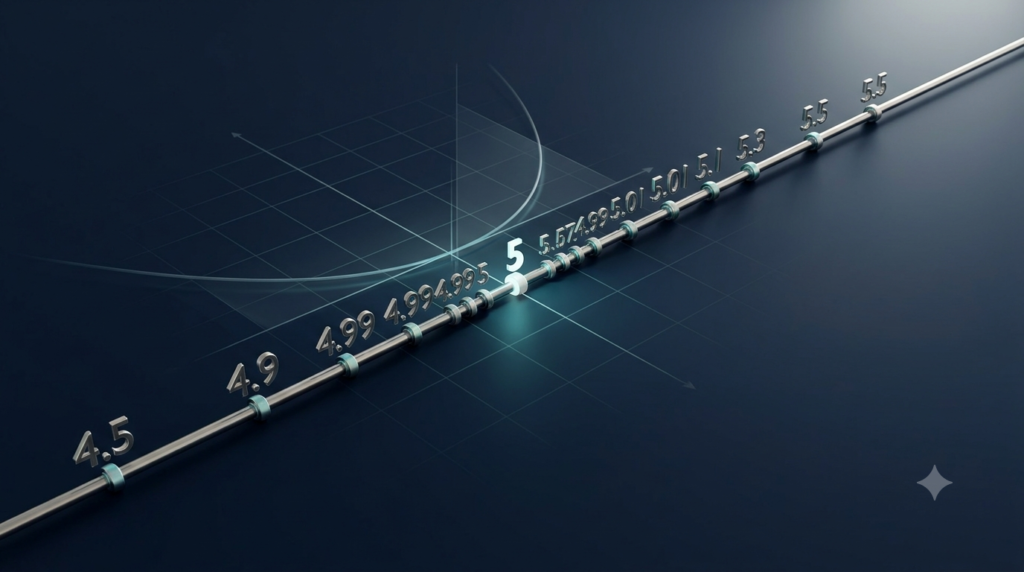
As x gets closer to 3 from either side, the function’s output gets closer to 5.
Therefore, the limit of the function as x approaches 3 is 5.
In mathematical notation:
lim x→3 f(x) = 5
This notation means that the function approaches the value 5 as x approaches 3.
Why Does a Limit Focus on Nearby Values?
The main purpose of a limit is to describe the behavior of a function near a particular input, rather than simply calculating its output at that exact input.
This becomes useful when direct substitution does not provide enough information or when a function is undefined at a point.
For example, consider:
f(x) = (x² − 4) / (x − 2)
If we substitute x = 2 directly, the denominator becomes zero. Therefore, the function is undefined at x = 2.
However, for x ≠ 2, the expression can be simplified:
f(x) = (x − 2)(x + 2) / (x − 2)
Cancel the common factor, provided x ≠ 2:
f(x) = x + 2
As x approaches 2, the function’s output approaches 4.
Therefore:
lim x→2 f(x) = 4
The limit exists even though the original function has no defined value at x = 2.
This example demonstrates one of the most important differences between a function’s value and its limit.
The Main Difference Between a Function’s Value and Its Limit
A function’s value and its limit answer two different questions.
The function’s value asks: What is the actual output when the input equals a specific number?
The limit asks: What output does the function approach when the input gets closer and closer to that number?
Although these questions may produce the same answer, they do not always have to.
Comparison Table
| Function’s Value | Function’s Limit |
|---|---|
| Describes the actual output at a particular input. | Describes the output approached near a particular input. |
| Requires the function to be defined at that input. | Can exist even if the function is undefined at that input. |
| Often found through direct substitution. | May require simplification, a table, a graph, or other limit techniques. |
| Depends on the function’s assigned value at the point. | Depends on the function’s behavior near the point. |
| Written as f(a) for an input a. | Written as lim x→a f(x). |
For example, suppose a function has the following properties at x = 2:
f(2) = 7
lim x→2 f(x) = 5
The function’s value is 7, but its limit is 5.
There is no contradiction. The function is assigned an output of 7 at exactly x = 2, while its outputs approach 5 as x gets close to 2.
Three Possible Relationships Between a Function’s Value and Its Limit
There are three important situations to understand when comparing a function’s value with its limit.
Case 1: The Function’s Value and Limit Are Equal
Consider the function:
f(x) = x²
At x = 3:
f(3) = 3² = 9
As x approaches 3, the outputs approach 9.
Therefore:
lim x→3 f(x) = 9
In this case:
f(3) = lim x→3 f(x) = 9
Both quantities are equal because the function behaves smoothly at the point.
This is the usual situation for polynomial functions, which are continuous everywhere.
Case 2: The Function’s Value and Limit Are Different
Consider a function defined by two rules:
f(x) = x + 1, when x ≠ 2
f(2) = 10
For inputs close to 2 but not equal to 2, the function follows the rule f(x) = x + 1.
Therefore, as x approaches 2, the output approaches 3.
lim x→2 f(x) = 3
However, the function is specifically assigned the value 10 at x = 2.
f(2) = 10
Thus:
f(2) ≠ lim x→2 f(x)
The function’s value is 10, while its limit is 3.
This situation illustrates how changing the value at a single point can leave the limit unchanged.
Case 3: The Function’s Limit Does Not Exist
Consider the function:
f(x) = 1, when x < 0
f(x) = 3, when x ≥ 0
At x = 0, the function’s value is:
f(0) = 3
Now examine the behavior on either side of zero.
As x approaches zero from the left, the function remains equal to 1.
As x approaches zero from the right, the function remains equal to 3.
Therefore:
Left-hand limit = 1
Right-hand limit = 3
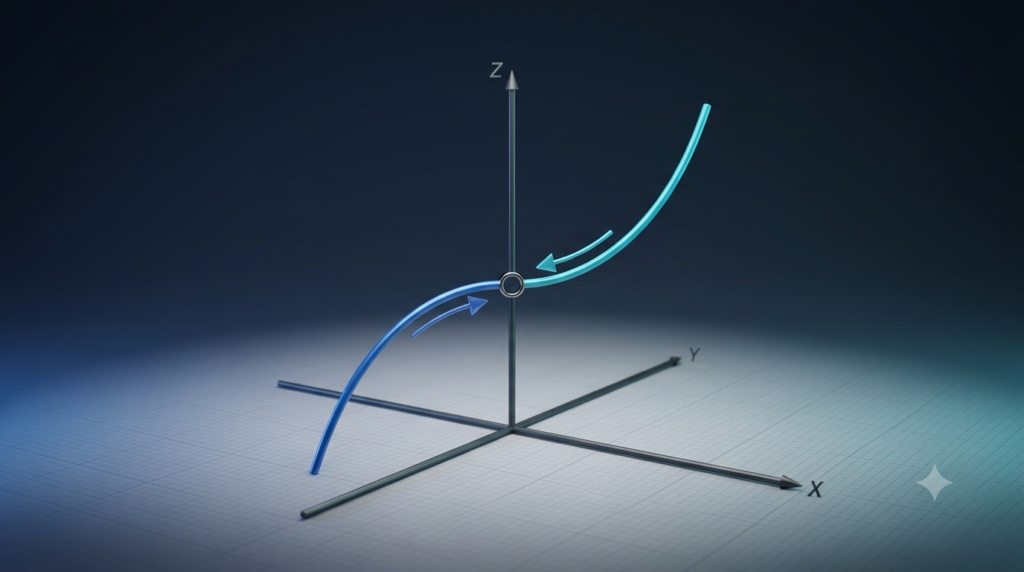
Because the left-hand and right-hand limits are different, the two-sided limit does not exist.
lim x→0 f(x) does not exist
The function has a defined value at zero, but its two-sided limit does not exist.
This is another important reason why a function’s value and its limit must be treated as separate concepts.
Understanding Limits Using a Numerical Table
A numerical table can help you understand how function outputs behave as inputs approach a specific number.
Consider the function:
f(x) = (x² − 9) / (x − 3)
The function is undefined at x = 3 because its denominator becomes zero.
For x ≠ 3, the expression simplifies to:
f(x) = x + 3
We can use this simplified expression to examine the function’s behavior near x = 3.
| Input x | Function Output f(x) |
|---|---|
| 2.0 | 5.0 |
| 2.9 | 5.9 |
| 2.99 | 5.99 |
| 3.01 | 6.01 |
| 3.1 | 6.1 |
| 4.0 | 7.0 |
The outputs approach 6 as the input approaches 3 from either side.
Therefore:
lim x→3 f(x) = 6
However, f(3) is undefined for the original function.
This example shows that a limit can be calculated even when direct substitution is impossible.
It also demonstrates why examining nearby values is useful when learning calculus.
Understanding the Difference Through Graphs
Graphs provide another way to distinguish between a function’s value and its limit.
Imagine a curve that approaches the point (2, 4) from both the left and the right. However, the point itself is represented by an open circle.
This indicates that the curve approaches a y-coordinate of 4 as x approaches 2, but the point (2, 4) is not included in that part of the graph.
Suppose a solid point is placed at (2, 7).
The graph then represents a function whose value at x = 2 is 7, while the surrounding curve approaches 4.
Consequently:
f(2) = 7
lim x→2 f(x) = 4
The open circle identifies the value approached by the curve, while the solid point identifies the actual function value.
What Should You Look for on a Graph?
When analyzing a graph, follow these steps:
Locate the input value that x is approaching.
Observe the curve from the left side.
Observe the curve from the right side.
Determine whether both sides approach the same vertical coordinate.
Check whether the graph includes a defined point at the exact input.
If both sides approach the same output, the two-sided limit exists. The function’s value can then be compared with that output.
If the two sides approach different outputs, the two-sided limit does not exist, even if the function has a defined value at the point.
The Relationship Between Function Values, Limits, and Continuity
The difference between a function’s value and its limit is closely connected to continuity.
A function is continuous at a point when three conditions are satisfied:
The function is defined at the point.
The limit exists as the input approaches that point.
The function’s value equals the limit.
For a function f(x) at x = a, these conditions can be summarized as:
f(a) = lim x→a f(x)
This equality is the central condition for continuity at that point, provided the function value and the limit are both defined.
Consider:
f(x) = x² + 1
At x = 2:
f(2) = 2² + 1 = 5
The limit is also 5.
lim x→2 f(x) = 5
Because the function’s value equals its limit, the function is continuous at x = 2.
Now consider a function whose nearby outputs approach 5 but whose assigned value at x = 2 is 8.
The limit exists, but the function’s value is different from its limit. Therefore, the function is not continuous at x = 2.
This kind of discontinuity can often be removed by redefining the function’s value at that point to equal the limit.
Understanding this relationship is essential before moving on to derivatives and more advanced topics in calculus.
Common Mistakes When Comparing Function Values and Limits
Beginners often confuse these concepts because they sometimes produce the same numerical result. The following mistakes are worth avoiding.
Assuming That a Limit Is Always Equal to the Function’s Value
A limit and a function’s value are equal when the function is continuous at the point. However, they may differ when the function has a discontinuity.
Always examine the behavior near the point instead of assuming that the two quantities are equal.
Assuming That an Undefined Function Value Means the Limit Does Not Exist
A function may be undefined at a particular input while still approaching a definite value near that input.
For example, the function (x² − 4) / (x − 2) is undefined at x = 2, but its limit at that point is 4.
An undefined function value does not automatically mean that the limit is nonexistent.
Checking Only One Side of the Point
A two-sided limit depends on the behavior from both the left and the right.
If the left-hand and right-hand limits are different, the two-sided limit does not exist.
Therefore, checking only one side can lead to an incorrect conclusion.
Confusing Substitution With Limit Evaluation
Direct substitution works for many functions, especially when they are continuous at the point being considered.
However, substitution into an expression that produces division by zero may require further analysis. The resulting expression could have a limit, or its limit might not exist.
Always distinguish between the result of direct substitution and the actual behavior of the function near the point.
Why Is This Difference Important in Calculus?
Understanding the distinction between function values and limits is useful throughout mathematics and its applications.
Understanding Continuity
Limits help determine whether a function behaves smoothly near a point. Comparing the limit with the actual function value tells us whether the function is continuous there.
Learning Derivatives
Derivatives describe instantaneous rates of change. Their definition depends on a limit that examines how the average rate of change behaves as the interval becomes smaller.
This allows us to study quantities such as an object’s instantaneous velocity or the rate at which a changing quantity increases or decreases.
Studying Discontinuities
Limits help identify different types of discontinuities, including removable discontinuities and jump discontinuities.
A function may have a hole in its graph, a sudden jump, or behavior that becomes unbounded near a point. Understanding limits helps explain these situations.
Solving Real-World Problems
Limits are useful in physics, engineering, economics, computer science, and many other fields.
For example, scientists use limits when studying instantaneous motion, engineers use calculus to analyze changing systems, and economists use derivatives to examine marginal costs and changes in production.
In each case, understanding how a quantity behaves near a particular point can be just as important as knowing its value at that exact point.
Conclusion
The difference between a function’s value and its limit is a fundamental concept in calculus. A function’s value represents its actual output at a particular input, whereas a limit describes the output that the function approaches as the input gets closer to that point.
These quantities may be equal, different, or defined in different ways. A function can have a value even when its two-sided limit does not exist, and a limit can exist even when the function is undefined at the point.
By examining numerical tables, graphs, algebraic expressions, and continuity conditions, you can develop a clearer understanding of how functions behave. Mastering this distinction provides a strong foundation for learning limits, derivatives, continuity, and more advanced mathematical concepts.
FAQs
1. What Is the Difference Between a Function’s Value and Its Limit?
A function’s value is the actual output obtained when a specific input is substituted into the function, provided the function is defined at that input. A limit describes the value that the function’s output approaches as the input gets closer to a particular number. For example, a function may have a value of 8 at a point while its limit at that point is 5. These quantities are sometimes equal, but they can also be different. Understanding this distinction is essential for learning continuity, derivatives, and other important concepts in calculus.
2. Can a Function’s Value and Its Limit Be Equal?
Yes, a function’s value and its limit can be equal. This commonly happens when a function is continuous at the point being considered. For example, consider the function f(x) = x². At x = 3, the function’s value is f(3) = 9. As x approaches 3, the function’s output also approaches 9. Therefore, the function’s value and limit are equal. This relationship is an important condition for continuity. However, equality is not guaranteed for every function, particularly when the function has a discontinuity at the point.
3. Can a Limit Exist When a Function Is Undefined at a Point?
Yes, a limit can exist even when a function is undefined at a particular point. A limit depends on how the function behaves near that point rather than requiring a defined value at the point itself. For example, consider f(x) = (x² − 4) / (x − 2). At x = 2, the denominator becomes zero, so the function is undefined. However, the expression simplifies to x + 2 when x ≠ 2. As x approaches 2, the output approaches 4. Therefore, the limit exists and equals 4.
4. What Does It Mean When a Function’s Value Is Different From Its Limit?
When a function’s value differs from its limit, the actual output at the specified input does not match the value approached by the function nearby. For example, suppose f(x) = x + 1 when x is not equal to 2, but f(2) = 10. As x approaches 2, the function’s output approaches 3. However, its actual value at x = 2 is 10. This means the function’s value and limit are different. Such a situation creates a discontinuity at that point and demonstrates why function values and limits must be examined separately.
5. How Can You Find the Limit of a Function?
You can find a function’s limit using direct substitution, algebraic simplification, numerical tables, or graphical analysis. Direct substitution works for many continuous functions. For example, if f(x) = x² + 1, the limit as x approaches 2 is 5. However, if substitution produces an indeterminate expression such as 0/0, further analysis may be necessary. Factoring and simplifying the expression can sometimes reveal the limit. Tables and graphs also help show how outputs behave as inputs approach a particular number. The appropriate method depends on the function and the information provided.
6. What Is the Relationship Between Limits and Continuity?
Limits are essential for understanding continuity. A function is continuous at a point when its value is defined, its limit exists, and the limit equals the function’s value. For example, consider f(x) = x². At x = 2, both the function’s value and its limit equal 4. Therefore, the function is continuous at that point. If the limit exists but differs from the function’s value, the function is discontinuous there. This relationship helps mathematicians identify gaps, jumps, and other interruptions in a function’s graph.
7. What Is the Difference Between a Function’s Value and Its Left-Hand Limit?
A function’s value is its actual output at a specified input, while a left-hand limit describes the output approached as the input gets closer to that point from smaller values. For example, when x approaches 2 from the left, the input values remain less than 2. The function’s outputs may approach a particular number even if the function has a different value at x = 2. A left-hand limit examines only one side of the point. To determine whether a two-sided limit exists, you must also compare it with the right-hand limit.
8. Why Are Left-Hand and Right-Hand Limits Important?
Left-hand and right-hand limits help determine whether a two-sided limit exists. The left-hand limit describes the function’s behavior as the input approaches a point from smaller values, while the right-hand limit describes its behavior from larger values. If both limits exist and are equal, the two-sided limit exists. If they approach different values, the two-sided limit does not exist. For example, a function that approaches 1 from the left and 3 from the right at the same point has no two-sided limit there. This concept is particularly useful when studying piecewise functions and jump discontinuities.
9. How Are Function Values and Limits Represented on a Graph?
On a graph, a function’s value at a specific input is represented by the vertical coordinate of the included point at that input. A limit is identified by observing the value that the curve approaches from the left and right. An open circle often represents an excluded point on a curve, while a solid point indicates an included point. For example, a curve may approach an open circle at a height of 4, while a solid point at the same input has a height of 7. In this case, the limit is 4, but the function’s value is 7.
10. Why Is Understanding Function Values and Limits Important in Calculus?
Understanding function values and limits provides the foundation for several major topics in calculus. Function values tell us the actual outputs of mathematical rules, while limits describe how outputs behave near particular inputs. This distinction is essential when studying continuity, derivatives, instantaneous velocity, and rates of change. It also helps explain why some functions have limits even when they are undefined at particular points. In practical applications, limits help scientists and engineers analyze changing quantities and predict behavior near specific conditions. Learning these concepts clearly makes more advanced mathematical topics easier to understand and apply.