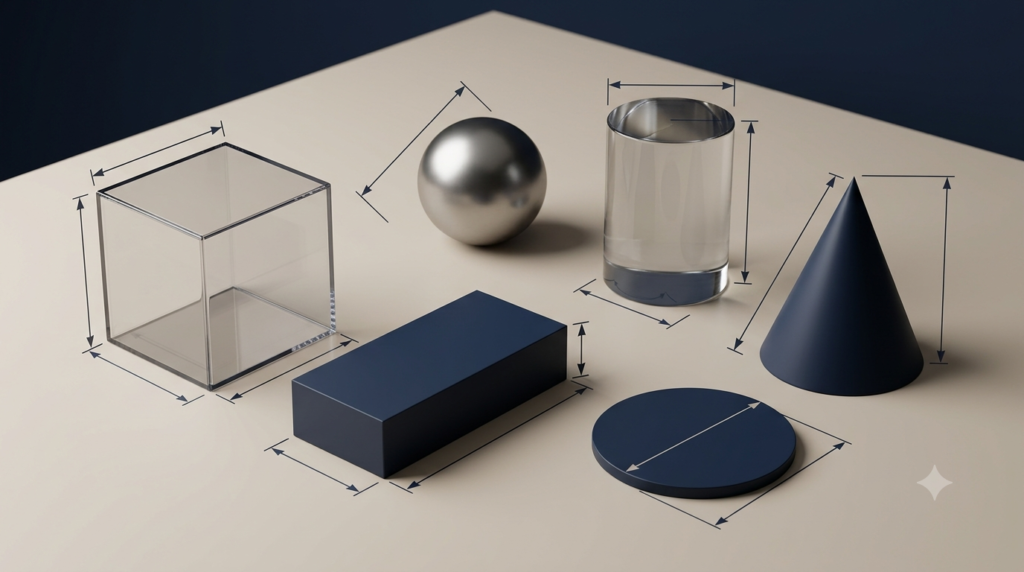
Mensuration is an important branch of mathematics that deals with measuring the lengths, perimeters, areas, surface areas, and volumes of different geometric shapes. It helps us calculate the amount of space occupied by an object, determine the area of a floor, estimate the capacity of a container, and solve many practical problems in construction, engineering, architecture, and everyday life. To understand mensuration properly, it is essential to learn about units and dimensions.
Although the terms unit and dimension are closely related, they do not mean the same thing. A unit tells us how a physical quantity is measured, while a dimension describes the fundamental nature of that quantity. For example, metres and centimetres are units of length, whereas length is the dimension itself. Understanding this difference makes mensuration formulas easier to interpret, compare, and apply correctly.
In this article, we will explore the meanings of units and dimensions, their relationship in mensuration, important formulas, practical examples, and common mistakes to avoid.
What Are Units in Mensuration?
A unit is a standard quantity used to measure a physical quantity. Without units, a numerical measurement is incomplete because the number alone does not tell us the actual size or amount being measured.
For example, if someone says that the length of a table is 2, the measurement is unclear. The table could be 2 metres, 2 centimetres, or 2 feet long. Adding the appropriate unit makes the measurement meaningful.
Common units used in mensuration include:
Millimetre (mm) for small lengths.
Centimetre (cm) for smaller objects and dimensions.
Metre (m) for room dimensions, building measurements, and longer distances.
Square centimetre (cm²) for smaller areas.
Square metre (m²) for floors, walls, and land areas.
Cubic centimetre (cm³) for the volume of small objects.
Cubic metre (m³) for the volume of rooms, tanks, and large containers.
Units allow us to communicate measurements clearly and compare quantities consistently.
Types of Units Used in Mensuration
Units in mensuration can be grouped according to the type of measurement involved.
1. Units of length
These units measure one-dimensional quantities, such as the length, width, height, radius, diameter, and perimeter of a shape.
Examples: mm, cm, m, and km.
2. Units of area
These units measure the surface covered by a two-dimensional shape. Area is expressed in square units because it involves two dimensions of length.
Examples: mm², cm², and m².
3. Units of volume
These units measure the space occupied by a three-dimensional object. Volume is expressed in cubic units because it involves three dimensions of length.
Examples: cm³, m³, and mm³.
4. Units of angles
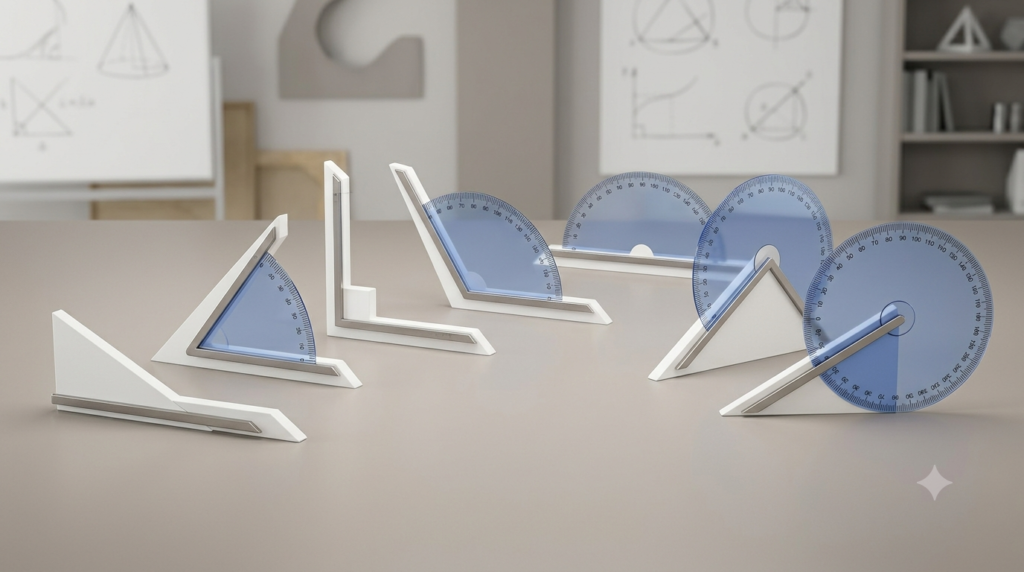
Angles are also important in geometry and mensuration, particularly when working with sectors, arcs, and circular shapes.
Examples: degrees (°) and radians.
The correct unit depends on the quantity being measured and the context of the problem.
What Are Dimensions in Mensuration?
Dimensions describe the fundamental nature of a physical quantity in terms of basic quantities such as length, mass, and time. In elementary mensuration, length is especially important because perimeter, area, and volume are calculated using measurements of length.
For example, the dimensions of a rectangle include its length and breadth. Both are measurements of length, even though they may have different numerical values.
The dimensions of a quantity remain the same regardless of the unit used to measure it. A length of 5 metres and a length of 500 centimetres have the same dimension because both represent length.
In dimensional notation, length is represented by L. Area has the dimension L², and volume has the dimension L³.
The symbol L describes the dimension of length, not a particular unit such as metres or centimetres.
Fundamental and Derived Dimensions
Fundamental dimensions represent basic types of quantities. In elementary mensuration, length is the main fundamental dimension being used.
Derived dimensions are obtained by combining fundamental dimensions mathematically.
For example:
Length has dimension L.
Area has dimension L².
Volume has dimension L³.
These relationships arise directly from the mathematical definitions of area and volume.
When a problem involves physical quantities such as density or mass, additional dimensions may be needed. For example, density depends on mass and volume, so its dimensions include mass and length.
Understanding these basic ideas provides a foundation for checking mensuration formulas.
The Relationship Between Units and Dimensions
Units and dimensions are connected because every measurable quantity has a dimension and is expressed using an appropriate unit. However, dimensions describe the type of quantity, while units provide the standard used to measure it.
Consider the following examples:
| Quantity | Dimension | SI unit |
|---|---|---|
| Length | L | metre (m) |
| Perimeter | L | metre (m) |
| Area | L² | square metre (m²) |
| Volume | L³ | cubic metre (m³) |
The table shows that length and perimeter have the same dimension, even though they describe different geometric measurements. Similarly, area and volume have different dimensions because they represent different kinds of measurement.
Units can change without changing dimensions. For instance, an area may be expressed in square metres or square centimetres. In both cases, its dimension remains L².
Dimensions help us understand what kind of quantity a formula calculates, while units help us express the result correctly.
Understanding Dimensions Through Mensuration Formulas
Mensuration formulas demonstrate the relationship between units and dimensions. Examining a formula’s structure helps us identify the dimension of the quantity being calculated.
1. Length and Perimeter
Length is a one-dimensional quantity. The perimeter of a two-dimensional shape is the total distance around its boundary, so perimeter also has the dimension L.
For a rectangle, the perimeter is calculated by adding twice its length and twice its breadth.
Text block:
P = 2 × (l + b)
Where:
If length and breadth are measured in metres, the perimeter is obtained in metres.
For example, suppose a rectangle has a length of 8 m and a breadth of 3 m.
Text block:
P = 2 × (8 m + 3 m)
P = 2 × 11 m
P = 22 m
The result has the dimension of length because the formula adds quantities that both represent length.
The same principle applies to the perimeter of a square, the circumference of a circle, and the perimeter of other plane figures.
2. Area and Its Dimension
Area measures the amount of two-dimensional surface covered by a shape. Because area is calculated by multiplying two lengths, its dimension is L².
For a rectangle:
Text block:
A = l × b
Where:
Suppose a rectangular floor is 6 m long and 4 m wide.
Text block:
A = 6 m × 4 m
A = 24 m²
The unit is square metres because metres are multiplied by metres.
Text block:
m × m = m²
This illustrates why area cannot be expressed simply in metres. Metres measure length, whereas square metres measure area.
The same relationship appears in other area formulas.
For a square:
Text block:
A = s²
For a triangle:
Text block:
A = ½ × b × h
For a circle:
Text block:
A = π × r²
In each case, the area has the dimension L² because the formula involves multiplying two quantities of length. Constants such as ½ and π do not change the dimension.
3. Volume and Its Dimension
Volume measures the space occupied by a three-dimensional object. It is calculated using three dimensions of length, so its dimension is L³.
For a cuboid:
Text block:
V = l × b × h
Where:
Suppose a storage box is 5 m long, 2 m wide, and 3 m high.
Text block:
V = 5 m × 2 m × 3 m
V = 30 m³
The result is expressed in cubic metres because three lengths are multiplied together.
Text block:
m × m × m = m³
For a cube:
Text block:
V = a³
For a cylinder:
Text block:
V = π × r² × h
For a sphere:
Text block:
V = ⁴⁄₃ × π × r³
These formulas demonstrate that volume has the dimension L³, even when the geometric shapes and formulas are different.
Why Dimensions Remain the Same When Units Change
One important feature of dimensions is that they do not depend on the measurement system. A quantity can be expressed in different units without changing its fundamental nature.
For example, a length of 2 m is equal to 200 cm. Both measurements represent the same length.
Text block:
1 m = 100 cm
Similarly, an area of 1 m² is not equal to 100 cm². Since area involves two dimensions of length, the conversion factor must be squared.
Text block:
1 m² = 100 cm × 100 cm
1 m² = 10,000 cm²
Volume requires the conversion factor to be cubed.
Text block:
1 m³ = 100 cm × 100 cm × 100 cm
1 m³ = 1,000,000 cm³
These examples reveal an important relationship: when converting length, the conversion factor is used once; for area, it is squared; and for volume, it is cubed.
Failing to account for this difference is a common source of errors in mensuration.
Dimensional Consistency in Mensuration Formulas
A formula is dimensionally consistent when the dimensions on both sides of the equation agree. This principle is useful for checking whether a formula has been written correctly.
For example, consider the area formula for a rectangle.
Text block:
A = l × b
The dimension of length is L, and the dimension of breadth is also L.
Therefore:
Text block:
Dimension of A = L × L = L²
The result agrees with the dimension of area, so the formula is dimensionally consistent.
Now consider the volume formula for a cuboid.
Text block:
V = l × b × h
The dimensions of length, breadth, and height are all L.
Text block:
Dimension of V = L × L × L = L³
The result agrees with the dimension of volume.
Dimensional consistency is a useful checking method, but it does not prove that a formula is completely correct. Two formulas may have matching dimensions while differing in their numerical constants or geometric meaning. For instance, dimensional analysis alone cannot determine whether a circular area formula should contain π.
The Role of Units and Dimensions in Circles and Curved Shapes
Units and dimensions are equally important when calculating curved surfaces and circular measurements.
The circumference of a circle is calculated using its radius or diameter. Since both radius and diameter are lengths, circumference has the dimension L.
Text block:
C = 2 × π × r
The area of a circle is:
Text block:
A = π × r²
The circumference has units of length, while the area has square units. Even though both formulas involve the radius, the power of the radius changes the dimension of the result.
For a cylinder, curved surface area is calculated by multiplying the circumference of its circular base by its height.
Text block:
Curved surface area = 2 × π × r × h
The formula contains two lengths multiplied together, so the result has the dimension L².
The volume of the same cylinder is:
Text block:
V = π × r² × h
Because the radius is squared and then multiplied by the height, the resulting dimension is L³.
These examples show why it is essential to distinguish between a measurement of length, area, and volume, even when the same geometric variables appear in different formulas.
Practical Applications of Units and Dimensions
Understanding units and dimensions is useful in many practical situations.
Construction and Architecture
Builders use metres to measure lengths, square metres to calculate floor areas, and cubic metres to estimate concrete requirements. Confusing these units can lead to incorrect material estimates and unnecessary costs.
For example, the area of a floor is calculated in square metres, but the amount of concrete needed for a slab depends on its volume, which is measured in cubic metres.
Painting and Surface Coverage
When painting a wall, the surface area determines approximately how much paint is required. Wall dimensions are measured in metres, but the calculated area is expressed in square metres.
If a wall is 4 m wide and 3 m high:
Text block:
Area = 4 m × 3 m
Area = 12 m²
The result helps estimate paint requirements, although the actual amount also depends on paint coverage, surface texture, and the number of coats.
Packaging and Storage
Manufacturers use volume calculations to estimate how much space a container can hold. The dimensions of a box are measured as lengths, but its capacity in geometric terms is calculated in cubic units.
Engineering and Manufacturing
Engineers use dimensional consistency to check calculations involving lengths, surface areas, and volumes. Selecting appropriate units also helps prevent errors when drawings, measurements, and material specifications are shared between different teams.
Common Mistakes When Working With Units and Dimensions
Several mistakes can lead to incorrect answers in mensuration.
1. Confusing units with dimensions
Metres and centimetres are units of length. The dimension of both is L. Square metres and cubic metres are units of area and volume, respectively.
2. Writing area in linear units
An area should be expressed in square units, such as cm² or m², rather than cm or m.
3. Writing volume in square units
Volume must be expressed in cubic units, such as cm³ or m³, because it measures three-dimensional space.
4. Mixing different units in the same calculation
Before using a formula, convert measurements to compatible units. For example, if the length is given in metres and the breadth in centimetres, convert one measurement so that both use the same unit.
5. Forgetting to square or cube conversion factors
Area conversions require squared conversion factors, while volume conversions require cubed conversion factors.
6. Assuming dimensional consistency proves a formula is correct
Dimensions can identify certain errors, but they cannot verify every detail of a formula. The formula must also match the geometry of the shape.
Avoiding these mistakes makes mensuration calculations more reliable and easier to understand.
Conclusion
Units and dimensions are fundamental concepts that help us understand and apply mensuration correctly. Units express measurements using standards such as metres, square metres, and cubic metres, while dimensions describe the fundamental nature of the quantities being measured. Length and perimeter have the dimension L, area has the dimension L², and volume has the dimension L³.
The relationship between units and dimensions becomes clear when we examine geometric formulas, convert measurements, and check dimensional consistency. These concepts are useful not only in mathematics but also in construction, engineering, architecture, manufacturing, and everyday measurement.
By learning how units and dimensions work together, we can select appropriate units, interpret formulas accurately, avoid common calculation errors, and develop a stronger foundation for more advanced topics in mensuration.
FAQs
1. What is the difference between units and dimensions in mensuration?
Units and dimensions are related concepts, but they serve different purposes. A unit is a standard used to express a measurement, while a dimension describes the fundamental nature of a quantity. For example, metres and centimetres are units used to measure length, whereas L represents its dimension. Similarly, square metres and square centimetres are units of area, which has the dimension L². Understanding this difference helps learners select the correct units for perimeter, area, and volume calculations and interpret mensuration formulas accurately.
2. Why are units important in mensuration?
Units are important in mensuration because they make measurements meaningful, clear, and understandable. A numerical value without a unit may not communicate the actual size of an object. For example, saying that a room is 5 long does not specify whether its length is 5 metres, centimetres, or feet. Units also help people compare measurements, calculate material requirements, and communicate results accurately. In mensuration, metres are commonly used for length, square metres for area, and cubic metres for volume. Choosing appropriate units reduces confusion and prevents errors in mathematical calculations.
3. What are the dimensions of length, area, and volume?
Length has the dimension L because it represents a one-dimensional measurement. Area has the dimension L² because it is calculated by multiplying two lengths. Volume has the dimension L³ because it involves three dimensions of length. For example, the area of a rectangle is calculated by multiplying its length by its breadth, while the volume of a cuboid is calculated using length, breadth, and height. These dimensional relationships remain the same regardless of whether measurements are expressed in metres, centimetres, or other compatible units.
4. Why is area measured in square units?
Area is measured in square units because it represents the surface covered by a two-dimensional shape. Calculating area involves multiplying two lengths, such as the length and breadth of a rectangle. For example, if a rectangle measures 4 m in length and 3 m in breadth, its area is 12 m². The unit results from multiplying metres by metres. Therefore, square metres, square centimetres, and square millimetres are commonly used for area measurements. Using linear units such as metres alone would not correctly express the size of a surface.
5. Why is volume measured in cubic units?
Volume is measured in cubic units because it represents the three-dimensional space occupied by an object. It is calculated by multiplying three lengths, usually length, breadth, and height. For example, a cuboid measuring 2 m long, 3 m wide, and 4 m high has a volume of 24 m³. The unit results from multiplying metres three times. Common volume units include cubic centimetres, cubic metres, and cubic millimetres. Cubic units are useful when measuring containers, storage boxes, rooms, water tanks, and other three-dimensional objects.
6. How are units and dimensions related to mensuration formulas?
Units and dimensions help explain why mensuration formulas produce particular types of measurements. For example, the area formula for a rectangle is A = l × b. Since length and breadth both have the dimension L, the resulting area has the dimension L². Similarly, the volume formula for a cuboid is V = l × b × h, giving the dimension L³. Units express the calculated results, such as square metres or cubic metres. Understanding this relationship helps learners identify incorrect units, interpret formulas, and check whether calculations are dimensionally consistent.
7. How do you convert units of length, area, and volume?
Unit conversion depends on the type of quantity being measured. For length, the conversion factor is used once. Since 1 m = 100 cm, a length of 2 m equals 200 cm. For area, the conversion factor must be squared, so 1 m² = 10,000 cm². For volume, the conversion factor must be cubed, giving 1 m³ = 1,000,000 cm³. These differences occur because area involves two dimensions of length and volume involves three. Understanding these rules prevents incorrect conversions in mensuration problems.
8. What is dimensional consistency in mensuration?
Dimensional consistency means that the dimensions on both sides of a mathematical equation agree. It is a useful way to check whether a mensuration formula has the correct dimensional structure. For example, the area of a rectangle is A = l × b. Both length and breadth have the dimension L, so the right-hand side has the dimension L², which agrees with the dimension of area. However, dimensional consistency cannot prove that a formula is entirely correct because it does not verify every numerical constant or geometric relationship. The formula must also be mathematically appropriate for the shape.
9. Can two quantities have the same dimensions but different units?
Yes, two quantities can have the same dimensions while being expressed in different units. For example, a length of 1 metre and a length of 100 centimetres have the same dimension, L, but different numerical values and units. Similarly, an area can be expressed in square metres or square centimetres, and both measurements have the dimension L². However, having the same dimension does not always mean two quantities represent the same kind of measurement. Perimeter and radius both have the dimension L, but they describe different geometric properties.
10. Why should we learn units and dimensions before studying advanced mensuration?
Learning units and dimensions provides a strong foundation for understanding more advanced mensuration topics. These concepts help learners distinguish between length, area, and volume, apply formulas correctly, and express answers using appropriate units. They are also useful when converting measurements, estimating materials, and checking mathematical calculations. In practical applications, such as construction, architecture, and engineering, incorrect units can produce inaccurate results and costly mistakes. Understanding dimensions also prepares students for dimensional analysis in physics and other scientific subjects. Therefore, mastering these basic concepts improves mathematical accuracy and problem-solving skills.