A coordinate plane is an important mathematical tool used to locate points, describe positions, and understand relationships between numbers. It appears in many areas of mathematics, including geometry, algebra, trigonometry, and statistics. Coordinate planes are also useful in everyday situations, such as reading maps, interpreting graphs, and identifying locations in a building or on a grid.
To read and interpret points on a coordinate plane, you need to understand its horizontal and vertical axes, the origin, ordered pairs, and the four quadrants. Each point is represented by two numbers that indicate its exact position. The first number tells you how far to move horizontally, while the second tells you how far to move vertically. Once you understand these basic ideas, you can identify points accurately, compare their positions, and interpret information shown on coordinate graphs.
What Is a Coordinate Plane?
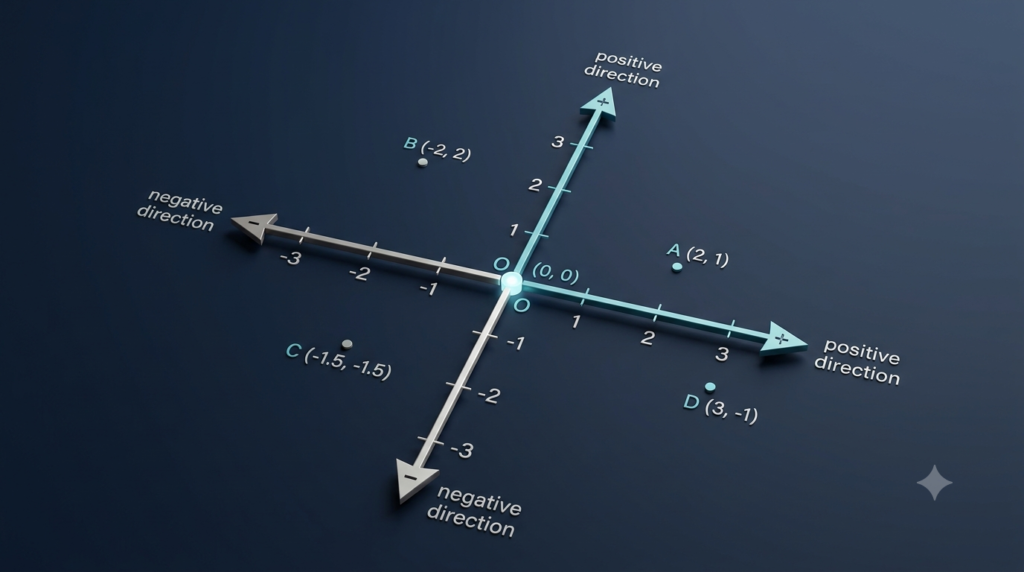
A coordinate plane is a flat, two-dimensional surface formed by two number lines that intersect at right angles. It allows us to represent the position of a point using two numerical values.
The two number lines are called the x-axis and the y-axis.
X-axis: The horizontal number line that runs from left to right.
Y-axis: The vertical number line that runs from bottom to top.
Origin: The point where the x-axis and y-axis intersect.
Coordinates: The numbers used to describe the position of a point.
Ordered pair: A pair of coordinates written in the form (x, y).
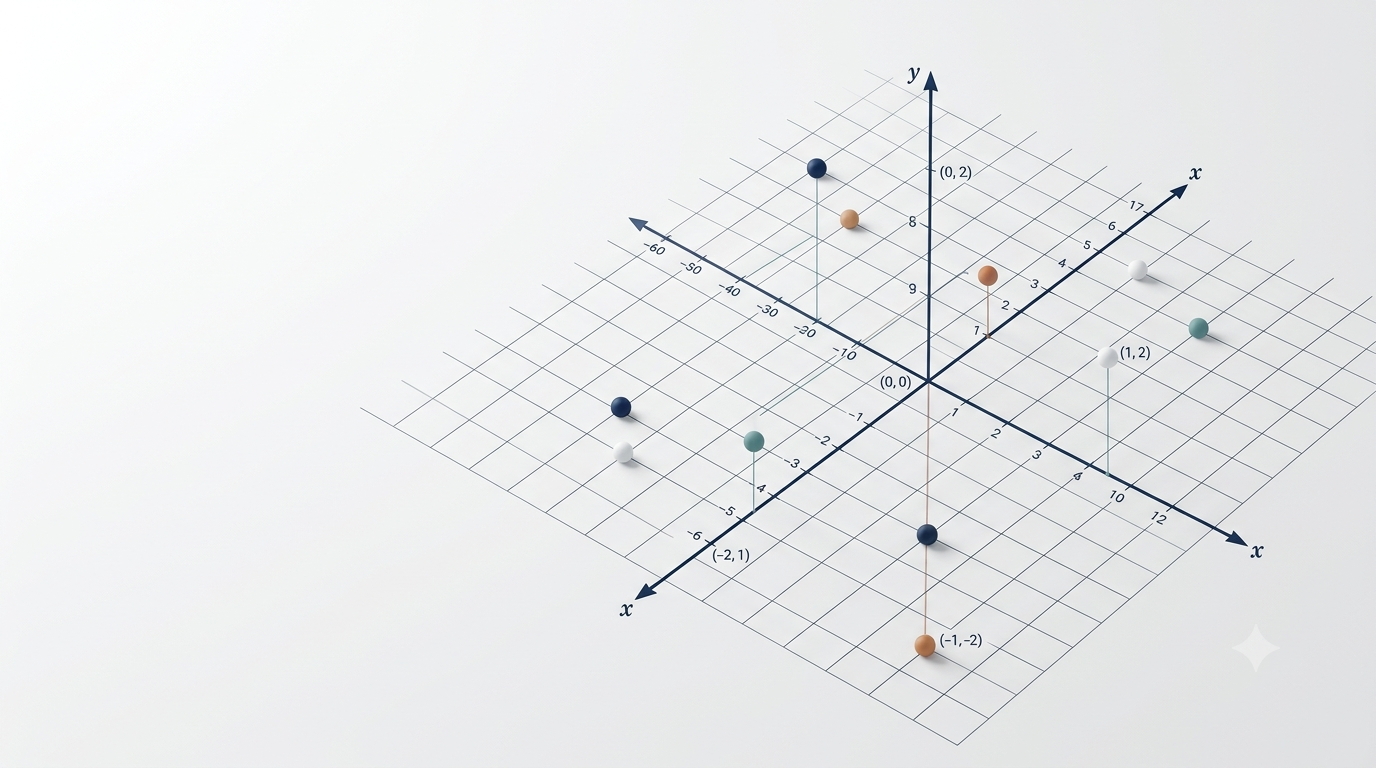
The x-axis and y-axis divide the coordinate plane into four regions called quadrants. Each quadrant has a different combination of positive and negative coordinates.
For example, the point (3, 2) represents a position three units to the right of the origin and two units above it.
Understanding the structure of the coordinate plane is the first step toward reading and interpreting points correctly.
Understanding the X-Axis and Y-Axis
Before locating a point, it is necessary to understand how the two axes work.
The X-Axis
The x-axis is the horizontal line on a coordinate plane. It measures horizontal movement.
Positive x-values are located to the right of the origin.
Negative x-values are located to the left of the origin.
Zero represents the origin when the y-coordinate is also zero.
For example, the point (4, 0) lies four units to the right of the origin. The point (−4, 0) lies four units to the left.
When a point lies directly on the x-axis, its y-coordinate is always zero.
The Y-Axis
The y-axis is the vertical line on a coordinate plane. It measures vertical movement.
Positive y-values are located above the origin.
Negative y-values are located below the origin.
Zero represents the origin when the x-coordinate is also zero.
For example, the point (0, 5) lies five units above the origin. The point (0, −5) lies five units below it.
When a point lies directly on the y-axis, its x-coordinate is always zero.
How the Axes Work Together
The x-axis and y-axis work together to identify the exact location of a point. One coordinate describes horizontal movement, and the other describes vertical movement.
A point can be positioned to the right or left of the origin and above or below it. The combination of these movements determines its final location.
What Is the Origin?
The origin is the central reference point of the coordinate plane. It is where the x-axis and y-axis intersect.
Formula and notation (Text block):
Origin = (0, 0)
Both coordinates of the origin are zero because there is no horizontal or vertical movement from the starting point.
The origin is important because it provides a common reference for locating every other point on the coordinate plane.
For example, to locate the point (3, 4), begin at the origin, move three units to the right, and then move four units upward. To locate (−2, −3), move two units to the left and three units downward.
Every point on a standard coordinate plane is located relative to this origin.
Understanding Ordered Pairs
An ordered pair is a set of two numbers written inside parentheses. These numbers are separated by a comma and follow a specific order.
Formula and notation (Text block):
Ordered pair = (x, y)
Here:
x represents the horizontal coordinate.
y represents the vertical coordinate.
The order of the numbers is important because changing their positions generally changes the location of the point.
For example, (2, 5) and (5, 2) represent different points.
For (2, 5), move two units to the right and five units upward. For (5, 2), move five units to the right and two units upward.
Although both points use the same numbers, their positions are different.
The First Coordinate: X-Coordinate
The first number in an ordered pair is called the x-coordinate. It tells you how far to move horizontally from the origin.
A positive x-coordinate indicates movement to the right, while a negative x-coordinate indicates movement to the left.
For example:
In (6, 2), the x-coordinate is 6.
In (−3, 4), the x-coordinate is −3.
In (0, −5), the x-coordinate is 0.
The Second Coordinate: Y-Coordinate
The second number is called the y-coordinate. It tells you how far to move vertically from the origin.
A positive y-coordinate indicates upward movement, while a negative y-coordinate indicates downward movement.
For example:
In (4, 7), the y-coordinate is 7.
In (−2, −6), the y-coordinate is −6.
In (5, 0), the y-coordinate is 0.
Always identify the x-coordinate first and the y-coordinate second.
How to Read Points on a Coordinate Plane
Reading a point on a coordinate plane involves identifying its horizontal and vertical positions. The process becomes easier when you follow the same steps each time.
Step 1: Find the Origin
Locate the point where the x-axis and y-axis intersect. This point is labeled (0, 0).
Use the origin as your starting position when reading coordinates from a graph.
Step 2: Identify the X-Coordinate
Look at the point and determine its horizontal position.
Count the units from the y-axis to the point. Move right for positive values and left for negative values.
For example, if a point is three units to the left of the y-axis, its x-coordinate is −3.
Step 3: Identify the Y-Coordinate
Next, determine the vertical position of the point.
Count the units from the x-axis to the point. Move upward for positive values and downward for negative values.
If the point is four units above the x-axis, its y-coordinate is 4.
Step 4: Write the Ordered Pair
Write the x-coordinate first, followed by the y-coordinate.
For example, a point that is three units to the left and four units above the origin is written as (−3, 4).
Step 5: Check the Position
Confirm that the signs of the coordinates match the point’s location.
A point on the left must have a negative x-coordinate, while a point below the x-axis must have a negative y-coordinate.
Checking both coordinates helps prevent common mistakes.
Understanding the Four Quadrants
The x-axis and y-axis divide the coordinate plane into four quadrants. These quadrants are numbered using Roman numerals, beginning with Quadrant I in the upper-right region and continuing counterclockwise.
Each quadrant has a particular combination of positive and negative coordinates.
Quadrant I
Quadrant I is located in the upper-right region of the coordinate plane.
Both coordinates are positive.
Coordinate signs (Text block):
(x, y) = (+, +)
For example, the point (3, 4) lies in Quadrant I because it is three units to the right and four units above the origin.
Other examples include (1, 6), (5, 2), and (7, 3).
Quadrant II
Quadrant II is located in the upper-left region.
The x-coordinate is negative, and the y-coordinate is positive.
Coordinate signs (Text block):
(x, y) = (−, +)
For example, the point (−4, 3) lies in Quadrant II because it is four units to the left and three units above the origin.
Other examples include (−2, 5), (−6, 1), and (−3, 7).
Quadrant III
Quadrant III is located in the lower-left region.
Both coordinates are negative.
Coordinate signs (Text block):
(x, y) = (−, −)
For example, the point (−5, −2) lies in Quadrant III because it is five units to the left and two units below the origin.
Other examples include (−1, −4), (−3, −6), and (−7, −2).
Quadrant IV
Quadrant IV is located in the lower-right region.
The x-coordinate is positive, and the y-coordinate is negative.
Coordinate signs (Text block):
(x, y) = (+, −)
For example, the point (4, −3) lies in Quadrant IV because it is four units to the right and three units below the origin.
Other examples include (2, −5), (6, −1), and (7, −4).
Summary of the Four Quadrants
| Quadrant | X-coordinate | Y-coordinate | Example |
|---|---|---|---|
| I | Positive | Positive | (3, 4) |
| II | Negative | Positive | (−3, 4) |
| III | Negative | Negative | (−3, −4) |
| IV | Positive | Negative | (3, −4) |
Remember that points lying directly on either axis do not belong to any quadrant.
How to Interpret Points on the Axes
Not every point lies inside a quadrant. Some points lie directly on the x-axis or y-axis.
These points can be identified by checking whether one of their coordinates is zero.
Points on the X-Axis
A point lies on the x-axis when its y-coordinate is zero.
Formula and notation (Text block):
Point on x-axis = (x, 0)
Examples include (4, 0), (−6, 0), and (2, 0).
The x-coordinate may be positive, negative, or zero. If both coordinates are zero, the point is the origin.
Points on the Y-Axis
A point lies on the y-axis when its x-coordinate is zero.
Formula and notation (Text block):
Point on y-axis = (0, y)
Examples include (0, 3), (0, −5), and (0, 7).
The y-coordinate may be positive, negative, or zero.
The Origin
The origin is the only point where both coordinates are zero.
Formula and notation (Text block):
Origin = (0, 0)
Recognizing these special points makes it easier to interpret graphs accurately.
Worked Examples of Reading and Interpreting Points
Worked examples help demonstrate how coordinate pairs represent positions on the plane.
Example 1: Interpreting the Point (5, 3)
The point is (5, 3).
The x-coordinate is 5, so move five units to the right.
The y-coordinate is 3, so move three units upward.
Both coordinates are positive.
Therefore, the point lies in Quadrant I.
Example 2: Interpreting the Point (−4, 2)
The point is (−4, 2).
The x-coordinate is −4, so move four units to the left.
The y-coordinate is 2, so move two units upward.
The x-coordinate is negative, and the y-coordinate is positive.
Therefore, the point lies in Quadrant II.
Example 3: Interpreting the Point (−3, −5)
The point is (−3, −5).
The x-coordinate is −3, so move three units to the left.
The y-coordinate is −5, so move five units downward.
Both coordinates are negative.
Therefore, the point lies in Quadrant III.
Example 4: Interpreting the Point (6, −2)
The point is (6, −2).
The x-coordinate is 6, so move six units to the right.
The y-coordinate is −2, so move two units downward.
The x-coordinate is positive, and the y-coordinate is negative.
Therefore, the point lies in Quadrant IV.
Example 5: Interpreting the Point (0, 4)
The point is (0, 4).
The x-coordinate is zero, so there is no horizontal movement.
The y-coordinate is 4, so move four units upward.
The point lies directly on the y-axis.
Therefore, it does not belong to any quadrant.
Example 6: Interpreting the Point (−5, 0)
The point is (−5, 0).
The x-coordinate is −5, so move five units to the left.
The y-coordinate is zero, so there is no vertical movement.
The point lies directly on the x-axis.
Therefore, it does not belong to any quadrant.
How to Compare Points on a Coordinate Plane
Comparing points helps you understand how their positions differ.
You can compare their horizontal coordinates, vertical coordinates, or both.
Comparing Horizontal Positions
To compare horizontal positions, examine the x-coordinates.
For example, consider A(2, 3) and B(5, 3). Point B lies farther to the right because its x-coordinate is greater.
If two points have the same y-coordinate, they lie on the same horizontal level.
Comparing Vertical Positions
To compare vertical positions, examine the y-coordinates.
For example, consider C(4, 2) and D(4, 6). Point D lies higher than point C because its y-coordinate is greater.
If two points have the same x-coordinate, they lie on the same vertical line.
Comparing Points with Negative Coordinates
Negative coordinates must be interpreted carefully.
For example, the point (−2, 3) lies farther to the right than (−6, 3), even though −6 has a greater absolute value. This is because −2 is greater than −6 on the number line.
Similarly, (3, −2) lies higher than (3, −5) because −2 is greater than −5.
Understanding the number line helps you compare negative coordinates correctly.
How to Interpret Patterns in a Set of Points
A coordinate plane can display several points at once. Studying their coordinates can reveal patterns and relationships.
For example, consider the points (1, 2), (2, 4), (3, 6), and (4, 8).
The x-coordinate increases by one each time, while the y-coordinate increases by two. This pattern shows a relationship in which the y-coordinate is twice the x-coordinate.
Relationship (Text block):
y = 2x
When points follow a consistent pattern, they may form a straight line or another recognizable shape when connected.
Consider another set of points: (1, 5), (2, 5), (3, 5), and (4, 5). All these points have the same y-coordinate. Therefore, they lie on a horizontal line.
Similarly, points such as (3, 1), (3, 2), (3, 3), and (3, 4) have the same x-coordinate and lie on a vertical line.
Patterns in coordinates are useful for understanding linear relationships, graphing equations, and interpreting mathematical data.
Real-Life Applications of Coordinate Planes
Coordinate planes are not limited to textbook exercises. They are used in many practical situations.
Maps and Navigation
Maps often use coordinate systems to describe locations. A simple grid map can represent streets, buildings, parks, and other places using pairs of numbers.
For example, a location at (4, 6) on a grid can be identified by moving four units horizontally and six units vertically from a reference point.
Real geographic navigation systems use more advanced coordinate systems, such as latitude and longitude, but the basic idea of identifying a location with coordinates is closely related.
Computer Graphics and Gaming
Computers use coordinates to position objects on a screen. A character in a video game, for example, may move to the right when its horizontal coordinate increases or move upward when its vertical coordinate increases in a conventional mathematical coordinate system.
Screen coordinate systems sometimes use a different convention, with the vertical coordinate increasing downward. Understanding the coordinate system being used is therefore important.
Science and Data Analysis
Scientists use coordinate graphs to display measurements and identify relationships between variables.
For example, a graph may show how temperature changes with time or how distance changes with speed. Each plotted point represents a pair of measured values.
By reading these points, researchers can compare results, identify trends, and make informed conclusions.
Architecture and Design
Architects and designers use coordinate systems to describe positions in plans, drawings, and digital models. Coordinates help them locate walls, doors, windows, and other features precisely.
In each of these applications, the central principle remains the same: coordinates provide a systematic way to describe positions.
Common Mistakes When Reading Coordinate Points
Although coordinate planes are straightforward once understood, several mistakes can lead to incorrect answers.
Reversing the Coordinates
One of the most common mistakes is writing the y-coordinate first.
For example, (2, 5) is not the same as (5, 2). Always read and write the x-coordinate first.
Ignoring Negative Signs
A negative sign changes the direction of movement.
For example, (−3, 4) lies to the left of the origin, while (3, 4) lies to the right. The points have the same vertical position but different horizontal positions.
Counting Units Incorrectly
When counting grid units, begin at zero and count each interval carefully. The lines represent coordinate values, while the spaces between consecutive lines represent one-unit intervals when the scale increases by one.
Do not confuse the number of grid lines crossed with the coordinate value.
Assuming Every Point Belongs to a Quadrant
Points on the x-axis and y-axis do not belong to any quadrant. A point with one coordinate equal to zero lies on an axis, while the point (0, 0) is the origin.
Forgetting the Scale
Not every coordinate graph uses one grid interval to represent one unit. Some graphs may use intervals of two, five, ten, or another value.
Always check the axis labels and scale before reading a point.
Tips for Practising Coordinate Plane Skills
Regular practice is one of the best ways to become confident in reading coordinate points.
Start by identifying the x-axis, y-axis, and origin.
Practise locating points with positive coordinates before working with negative coordinates.
Read the x-coordinate first and the y-coordinate second.
Use the signs of the coordinates to determine the quadrant.
Pay special attention to points that lie on an axis.
Check the scale of the graph before counting intervals.
Practise describing a point’s position in words before writing its ordered pair.
Compare several points to identify horizontal, vertical, and numerical patterns.
You can also draw a simple coordinate plane on graph paper and plot points such as (2, 3), (−3, 2), (−4, −2), and (4, −3). Identify the quadrant of each point and explain how its coordinates determine its location.
As your skills improve, practise interpreting points from unfamiliar graphs and real-world data.
Conclusion
Reading and interpreting points on a coordinate plane is a fundamental mathematical skill that supports the study of algebra, geometry, graphing, and many practical applications. The key is to understand how the x-coordinate describes horizontal movement and the y-coordinate describes vertical movement. By reading ordered pairs in the correct order, recognizing positive and negative directions, and identifying the four quadrants, you can locate points accurately.
It is equally important to recognize points on the axes, check the scale of a graph, and compare coordinates to identify patterns. With regular practice, these skills become easier and more natural. Once you can confidently interpret coordinate points, you will be better prepared to understand graphs, solve mathematical problems, and explore more advanced topics involving coordinate geometry.
FAQs
1. What is a coordinate plane?
A coordinate plane is a two-dimensional surface formed by two perpendicular number lines called the x-axis and y-axis. These axes intersect at a point called the origin, represented by (0, 0). A coordinate plane helps us locate points using ordered pairs of numbers. The first number indicates the horizontal position, while the second indicates the vertical position. Coordinate planes are widely used in mathematics, science, graphing, and navigation. They help represent numerical relationships visually and make it easier to understand the positions of objects, compare values, and interpret information displayed on graphs.
2. How do you read a point on a coordinate plane?
To read a point on a coordinate plane, first locate the origin, where the x-axis and y-axis intersect. Then identify the point’s horizontal position by reading its x-coordinate. Move right for positive values and left for negative values. Next, identify its vertical position using the y-coordinate. Move upward for positive values and downward for negative values. Finally, write the coordinates as an ordered pair in the form (x, y). Always read the horizontal coordinate first and the vertical coordinate second. Checking the point’s position against the axes helps you avoid mistakes when interpreting coordinates.
3. What is an ordered pair in coordinate geometry?
An ordered pair is a pair of numbers written inside parentheses and separated by a comma. It identifies the exact position of a point on a coordinate plane. The standard notation is (x, y), where x represents the horizontal coordinate and y represents the vertical coordinate. For example, (3, 5) means moving three units to the right and five units upward from the origin. The order of the numbers is important because changing their positions generally changes the point’s location. For instance, (3, 5) and (5, 3) represent two different points on the coordinate plane.
4. What are the four quadrants of a coordinate plane?
The four quadrants are the regions created when the x-axis and y-axis divide a coordinate plane. Quadrant I is in the upper-right region, where both coordinates are positive. Quadrant II is in the upper-left region, where x is negative and y is positive. Quadrant III is in the lower-left region, where both coordinates are negative. Quadrant IV is in the lower-right region, where x is positive and y is negative. Quadrants are numbered counterclockwise, beginning with Quadrant I. Points that lie directly on either axis do not belong to any quadrant.
5. How can you identify the quadrant of a point?
You can identify the quadrant of a point by examining the signs of its x-coordinate and y-coordinate. If both coordinates are positive, the point lies in Quadrant I. If x is negative and y is positive, it lies in Quadrant II. If both coordinates are negative, it lies in Quadrant III. If x is positive and y is negative, it lies in Quadrant IV. For example, the point (−4, 3) lies in Quadrant II because its horizontal coordinate is negative and its vertical coordinate is positive. If either coordinate is zero, the point lies on an axis rather than inside a quadrant.
6. What is the origin on a coordinate plane?
The origin is the point where the x-axis and y-axis intersect. It is represented by the ordered pair (0, 0), meaning that both the horizontal and vertical coordinates are zero. The origin serves as the reference point for locating every other point on the coordinate plane. Positive x-values extend to the right, negative x-values extend to the left, positive y-values extend upward, and negative y-values extend downward. For example, the point (2, 4) is located two units right and four units above the origin. Understanding the origin makes it easier to read, plot, and interpret coordinates accurately.
7. What does a negative coordinate mean?
A negative coordinate indicates a position in the direction opposite to the positive direction on an axis. A negative x-coordinate means that the point lies to the left of the origin, while a negative y-coordinate means that it lies below the origin. For example, the point (−3, 2) is three units left and two units above the origin. Similarly, (4, −5) is four units right and five units below the origin. Negative coordinates are important because they allow us to represent positions in all four quadrants. Always pay attention to negative signs when reading or writing ordered pairs.
8. How do you identify points that lie on the x-axis or y-axis?
To identify a point on an axis, check whether one of its coordinates is zero. A point lies on the x-axis when its y-coordinate is zero, as shown by (4, 0) or (−3, 0). A point lies on the y-axis when its x-coordinate is zero, as shown by (0, 5) or (0, −2). The origin, (0, 0), lies on both axes. These points do not belong to any of the four quadrants. Recognizing zero coordinates helps you distinguish points on the axes from points located within the quadrants of a coordinate plane.
9. Why is the order of coordinates important when reading points?
The order of coordinates is important because the first number represents horizontal movement, while the second represents vertical movement. Coordinates must be written in the form (x, y), with the x-coordinate first and the y-coordinate second. For example, the point (2, 6) is two units right and six units above the origin. The point (6, 2) is six units right and two units above the origin. Although both points contain the same numbers, they occupy different positions. Reversing coordinates can lead to incorrect answers when plotting points, interpreting graphs, or solving coordinate geometry problems.
10. Where are coordinate planes used in everyday life?
Coordinate planes are useful in many everyday and professional situations. Maps use coordinate systems to help identify locations, while computer graphics and video games use coordinates to position objects on screens. Scientists use graphs to display measurements and study relationships between variables, such as temperature and time. Architects and designers use coordinate systems to locate features accurately in plans and digital models. Students use coordinate planes to solve problems in algebra and geometry. Although real-world systems may use different conventions or more advanced coordinates, the basic principle remains similar: numerical values provide a systematic way to describe positions and interpret spatial information.