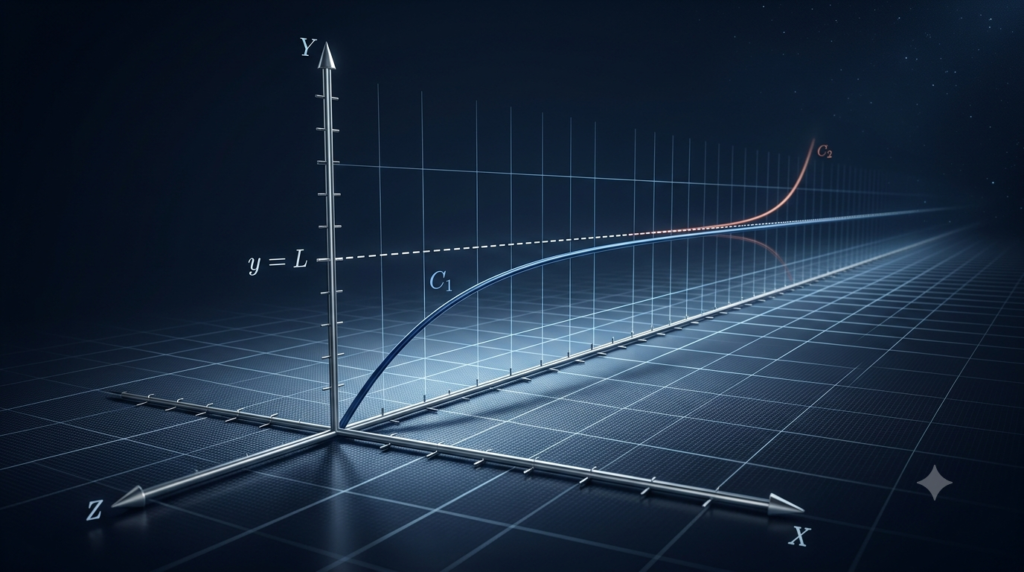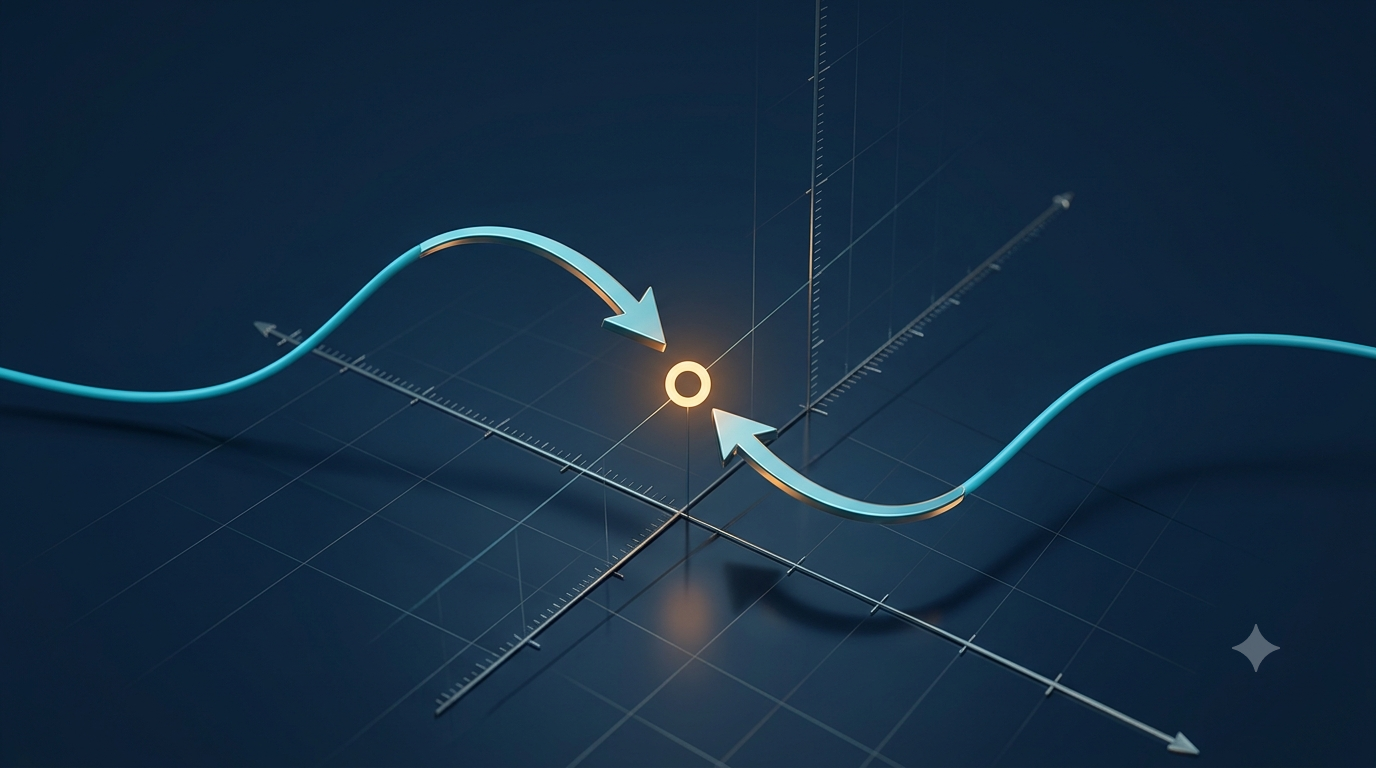
A two-sided limit is one of the fundamental concepts in calculus that helps us understand how a function behaves as its input approaches a particular value from both directions. Instead of focusing only on the value of a function at a specific point, a limit examines the value that the function approaches when the input gets closer and closer to that point. This idea is important because a function may approach a definite value even when it is not defined at that point. In calculus, two-sided limits are used to study continuity, understand the behavior of graphs, calculate derivatives, and solve many mathematical problems. Learning how two-sided limits work provides a strong foundation for understanding more advanced topics in calculus.
What Is a Two-Sided Limit?
A two-sided limit describes the value that a function approaches as its input approaches a particular number from both the left and the right sides.
In mathematics, the input of a function is commonly represented by the variable x, while the output is represented by f(x). When x approaches a specific number, the function’s output may move closer to a particular value. If the function approaches the same value from both directions, the two-sided limit exists.
For example, consider the function:
f(x) = x + 2
As x approaches 3, the output of the function approaches 5. This happens whether x approaches 3 from values smaller than 3 or from values greater than 3.
Therefore, the two-sided limit is:
lim x→3 f(x) = 5
This expression means that the value of f(x) approaches 5 as x approaches 3.
A two-sided limit focuses on the behavior of a function near a point rather than simply evaluating the function at that point. This distinction becomes especially important when a function contains a gap, a discontinuity, or a point where its usual formula cannot be evaluated directly.
Understanding Left-Hand and Right-Hand Limits
A two-sided limit consists of two important parts: the left-hand limit and the right-hand limit. Understanding these two concepts makes it easier to determine whether a two-sided limit exists.
What Is a Left-Hand Limit?
A left-hand limit describes the value that a function approaches when its input approaches a particular number from smaller values.
For example, suppose x approaches 4 from the left. The input values might be 3.9, 3.99, 3.999, and so on. These numbers become increasingly close to 4 without reaching it.
For the function:
f(x) = x + 1
The corresponding output values are 4.9, 4.99, and 4.999. These outputs approach 5.
The left-hand limit is written as:
lim x→4⁻ f(x) = 5
The minus sign indicates that x approaches 4 from the left side, using values smaller than 4.
What Is a Right-Hand Limit?
A right-hand limit describes the value that a function approaches when its input approaches a particular number from greater values.
For example, if x approaches 4 from the right, the input values might be 4.1, 4.01, 4.001, and so on.
For the same function:
f(x) = x + 1
The corresponding outputs are 5.1, 5.01, and 5.001. These values approach 5.
The right-hand limit is written as:
lim x→4⁺ f(x) = 5
The plus sign indicates that x approaches 4 from the right side, using values greater than 4.
How Do Left-Hand and Right-Hand Limits Form a Two-Sided Limit?
A two-sided limit exists when the left-hand and right-hand limits approach the same finite value.
The condition is:
lim x→a⁻ f(x) = lim x→a⁺ f(x) = L
Here, a represents the input value being approached, and L represents the common value approached by the function.
If both one-sided limits equal L, the two-sided limit exists and equals L.
However, if the left-hand and right-hand limits approach different values, the two-sided limit does not exist.
How to Understand a Two-Sided Limit Using a Graph
Graphs provide a visual way to understand limits. Instead of calculating values algebraically, we can observe how a curve behaves as it approaches a particular point.
Imagine a graph with a curve that approaches the point (2, 4) from both sides. The curve may contain an open circle at that location, indicating that the function is not defined there. Even so, the curve approaches the same height from the left and the right.
In this situation, the two-sided limit is 4, even if the function does not have a value at x = 2.
When examining a graph, follow these steps:
Locate the input value that x approaches.
Follow the curve toward that input from the left.
Identify the output value the curve approaches.
Follow the curve toward the same input from the right.
Compare the two output values.
If both sides approach the same value, the two-sided limit exists. If they approach different values, the two-sided limit does not exist.
It is important to distinguish between an open circle and a filled circle. An open circle often indicates a missing function value, while a filled circle identifies an actual point on the graph. The location of a filled point does not necessarily determine the limit.
Examples of Two-Sided Limits
Working through examples is one of the best ways to understand how two-sided limits are calculated.
Example 1: A Simple Linear Function
Consider the function:
f(x) = 2x + 1
Find the limit as x approaches 3.
As x gets closer to 3 from the left, the function’s output approaches:
2 × 3 + 1 = 7
As x gets closer to 3 from the right, the output also approaches 7.
Therefore:
lim x→3 (2x + 1) = 7
The two-sided limit exists because both one-sided limits equal 7.
For a linear function such as this one, direct substitution works because the function is continuous at the point being considered.
Example 2: A Function With a Missing Point
Consider the function:
f(x) = (x² − 4) / (x − 2), for x ≠ 2
Find the limit as x approaches 2.
Direct substitution gives a numerator of zero and a denominator of zero. This produces the indeterminate form 0/0, which means further simplification is necessary.
Factor the numerator:
x² − 4 = (x − 2)(x + 2)
For x ≠ 2, the function simplifies to:
f(x) = x + 2
Now consider what happens as x approaches 2. The simplified expression approaches:
2 + 2 = 4
Therefore:
lim x→2 [(x² − 4) / (x − 2)] = 4
The original function is undefined at x = 2, but the two-sided limit still exists because the function approaches 4 from both sides.
This example demonstrates why a limit is not the same as the actual function value.
Example 3: A Two-Sided Limit That Does Not Exist
Consider the function:
f(x) = 1, when x < 0
f(x) = 3, when x > 0
Find the limit as x approaches 0.
When x approaches 0 from the left, the function remains equal to 1.
Therefore:
lim x→0⁻ f(x) = 1
When x approaches 0 from the right, the function remains equal to 3.
Therefore:
lim x→0⁺ f(x) = 3
Since the left-hand and right-hand limits are different, the two-sided limit does not exist.
In this case, the function approaches two different output values depending on the direction from which x approaches zero.
Example 4: A Function With an Absolute Value
Consider the function:
f(x) = |x| / x, for x ≠ 0
Find the limit as x approaches 0.
For negative values of x, the absolute value of x equals −x. Therefore, the function becomes:
f(x) = −1, when x < 0
For positive values of x, the absolute value of x equals x. Therefore, the function becomes:
f(x) = 1, when x > 0
The left-hand limit is −1, while the right-hand limit is 1.
Since these values are different, the two-sided limit does not exist.
This example shows that a function can behave differently on opposite sides of a point even when its expression looks simple.
When Does a Two-Sided Limit Exist?
A two-sided limit exists when the function approaches the same finite value from both directions.
The mathematical condition is:
lim x→a⁻ f(x) = lim x→a⁺ f(x) = L
There are three common situations to consider.
Both One-Sided Limits Are Equal
If the left-hand and right-hand limits approach the same value, the two-sided limit exists.
For example, if both sides approach 6 as x approaches 2, the two-sided limit is 6.
The One-Sided Limits Are Different
If the left-hand limit approaches 2 and the right-hand limit approaches 5, the two-sided limit does not exist.
This situation commonly occurs at a jump discontinuity, where the graph changes suddenly from one level to another.
The Function Does Not Approach a Single Value
Sometimes the function keeps oscillating as x approaches a point. In such cases, it may never settle toward one definite value.
For example, the function sin(1/x) oscillates increasingly rapidly as x approaches zero. Its output does not approach a single value, so the two-sided limit at zero does not exist.
A two-sided limit may also fail to exist as a finite number when the function grows without bound. In some contexts, mathematicians describe such behavior using infinite limits, but that is different from an ordinary finite two-sided limit.
The Difference Between a Limit and a Function Value
One of the most important ideas in calculus is that the limit of a function and its value at a point are not necessarily the same.
The function value f(a) tells us the actual output when the input equals a, provided the function is defined there.
The limit as x approaches a tells us what the function’s output approaches when x gets close to a.
For example, consider a function that behaves like x + 1 near x = 2 but is assigned the value 10 at x = 2.
For all nearby values other than 2, the function follows:
f(x) = x + 1, for x ≠ 2
At x = 2, the function is defined separately:
f(2) = 10
As x approaches 2 from either direction, the function approaches 3. Therefore:
lim x→2 f(x) = 3
However:
f(2) = 10
The limit is 3, while the actual function value is 10.
This distinction is essential when studying continuity and removable discontinuities.
The Relationship Between Two-Sided Limits and Continuity
Continuity describes whether a function behaves without a break at a particular point. Two-sided limits are central to determining whether a function is continuous.
A function f(x) is continuous at x = a when all three conditions are satisfied:
The function value f(a) is defined.
The two-sided limit as x approaches a exists.
The limit equals the function value.
The mathematical condition is:
lim x→a f(x) = f(a)
If the limit exists but the function is undefined at the point, the function is not continuous there. Similarly, if the function value differs from the limit, the function is also discontinuous at that point.
For example, the function f(x) = x² is continuous at x = 2 because the limit is 4 and the actual function value is also 4.
However, a function with a missing point or a jump may fail one or more of these conditions.
Understanding two-sided limits therefore provides a practical method for identifying and explaining discontinuities.
Why Are Two-Sided Limits Important in Calculus?
Two-sided limits are important because they help mathematicians describe function behavior near specific points. They also form the foundation for several major concepts in calculus.
Understanding Derivatives
A derivative measures the instantaneous rate of change of a function. Its definition uses a limit to examine how the average rate of change behaves as the interval becomes smaller.
The derivative is defined by:
f′(a) = lim h→0 [f(a + h) − f(a)] / h
When this limit exists as a finite value, it describes the derivative at the point, subject to the usual conditions of the definition.
This concept is used to calculate velocity, acceleration, slopes of curves, and rates of change in scientific models.
Understanding Continuity
Limits help determine whether a function is continuous or contains a break. This is important in mathematics, physics, engineering, economics, and many other fields where predictable changes must be studied.
Analyzing Graphs
Two-sided limits help identify holes, jumps, and other unusual features in graphs. They allow us to understand the behavior of a function even when a particular point is missing or defined differently.
Solving Complex Mathematical Problems
Limits are also important in integration, infinite series, optimization, and the study of functions that behave in complicated ways.
Learning two-sided limits early makes these advanced topics easier to understand.
Common Mistakes When Solving Two-Sided Limits
Students often make a few common mistakes when learning this concept.
Confusing the Limit With the Function Value
A function’s value at a point may differ from the value approached by the function. Always examine the behavior near the point rather than looking only at the function’s defined value.
Checking Only One Direction
A left-hand limit alone is not enough to establish a two-sided limit. Both the left-hand and right-hand limits must be considered.
Assuming Every Limit Exists
Some functions approach different values from opposite sides or oscillate without settling toward a single value. In these situations, an ordinary finite two-sided limit does not exist.
Treating 0/0 as the Final Answer
When direct substitution produces 0/0, the result is indeterminate. The expression may need to be factored, simplified, or analyzed using another method before the limit can be determined.
Misreading Graphs
A filled point on a graph indicates a function value, but the surrounding curve determines the limit. Pay attention to how the graph approaches the point from both directions.
Avoiding these mistakes makes limit problems easier to solve and helps build a stronger understanding of calculus.
Conclusion
A two-sided limit describes the value that a function approaches as its input moves toward a particular number from both the left and the right. The limit exists when the left-hand and right-hand limits approach the same finite value. If the two sides approach different values or fail to settle toward one value, the two-sided limit does not exist. This concept is essential for understanding continuity, analyzing graphs, and defining derivatives. It also provides the foundation for many advanced topics in calculus. By practicing one-sided limits, simplifying algebraic expressions, and interpreting graphs carefully, learners can develop the skills needed to solve two-sided limit problems confidently and understand how functions behave near important points.
FAQs
1. What Is a Two-Sided Limit in Calculus?
A two-sided limit in calculus describes the value that a function approaches when its input approaches a particular number from both the left and the right sides. It exists when the left-hand and right-hand limits approach the same finite value. For example, if a function approaches 5 as x approaches 3 from both directions, its two-sided limit is 5. Two-sided limits help mathematicians understand function behavior near a point, even when the function is not defined at that point. They are essential for studying continuity, derivatives, and other important concepts in calculus.
2. How Is a Two-Sided Limit Different From a One-Sided Limit?
A two-sided limit considers how a function behaves as its input approaches a particular value from both directions. In contrast, a one-sided limit examines the function from only one direction. A left-hand limit approaches the point using smaller input values, while a right-hand limit approaches it using greater input values. A two-sided limit exists when both one-sided limits approach the same finite value. If they approach different values, the two-sided limit does not exist. Understanding this difference helps learners analyze graphs, solve limit problems, and identify discontinuities in mathematical functions.
3. When Does a Two-Sided Limit Exist?
A two-sided limit exists when the left-hand and right-hand limits approach the same finite value. For example, if both limits approach 4 as x approaches 2, the two-sided limit equals 4. However, if the left-hand limit approaches 3 and the right-hand limit approaches 6, the two-sided limit does not exist. A limit may also fail to exist when a function oscillates without approaching a single value. Therefore, solving two-sided limit problems requires examining the function’s behavior from both directions rather than relying on only one side or the function’s value at the point.
4. Can a Two-Sided Limit Exist When a Function Is Undefined at a Point?
Yes, a two-sided limit can exist even when a function is undefined at the point being approached. A limit describes the behavior of a function near a point, not necessarily its value at that point. For example, consider f(x) = (x² − 4) / (x − 2). The function is undefined at x = 2 because the denominator becomes zero. However, simplifying the expression gives f(x) = x + 2 for x ≠ 2. As x approaches 2 from either direction, the function approaches 4. Therefore, the two-sided limit exists and equals 4.
5. How Can You Find a Two-Sided Limit Using a Graph?
To find a two-sided limit using a graph, first identify the input value that the variable approaches. Then follow the curve toward that point from the left side and observe the output value it approaches. Repeat the process from the right side. If both directions approach the same output value, that value is the two-sided limit. If the directions approach different values, the two-sided limit does not exist. Remember that a filled circle shows the actual function value, while an open circle may indicate a missing point. The surrounding curve, rather than the circle alone, determines the limit.
6. What Happens When the Left-Hand and Right-Hand Limits Are Different?
When the left-hand and right-hand limits approach different values, the two-sided limit does not exist. For example, suppose a function approaches 2 from the left and 5 from the right as x approaches zero. Since the two directions produce different limiting values, there is no single value that describes the function’s behavior from both sides. This situation commonly occurs in functions with jump discontinuities. Comparing both one-sided limits is therefore an essential step when solving two-sided limit problems. Checking only one direction can lead to an incorrect conclusion about whether the limit exists.
7. What Is the Difference Between a Two-Sided Limit and a Function Value?
A two-sided limit describes the value a function approaches as its input gets closer to a particular number. A function value represents the actual output when the input equals that number. These values may be equal, different, or the function value may be undefined. For example, a function may approach 3 from both directions near x = 2 but be assigned the value 10 at x = 2. In this case, the two-sided limit is 3, while the function value is 10. Understanding this distinction is important for studying continuity and identifying missing points in graphs.
8. How Are Two-Sided Limits Related to Continuity?
Two-sided limits help determine whether a function is continuous at a particular point. For a function to be continuous at x = a, its value must be defined there, the two-sided limit must exist, and the limit must equal the function value. This relationship is expressed as lim x→a f(x) = f(a). If any of these conditions fails, the function is not continuous at that point. For example, a graph may contain a hole even though the limit exists. Studying two-sided limits helps learners identify such situations and understand how continuity describes the behavior of mathematical functions.
9. Why Are Two-Sided Limits Important for Derivatives?
Two-sided limits are important for derivatives because the derivative measures the instantaneous rate of change of a function. It is defined using a limit that examines how the average rate of change behaves as the interval approaches zero. For a derivative to exist under the standard definition, the relevant difference quotient must approach a finite value from both sides. This concept is used to calculate slopes of curves, velocities, and rates of change in scientific applications. Learning two-sided limits therefore provides an essential foundation for differential calculus and helps students understand how quantities change at specific moments.
10. What Are the Most Common Mistakes When Solving Two-Sided Limits?
Common mistakes include checking only one side of a function, confusing the limit with the function value, and assuming that every limit exists. Students may also treat the indeterminate form 0/0 as the final answer instead of simplifying the expression. When using graphs, they sometimes focus on a filled or open circle rather than observing how the curve approaches the point. To avoid these mistakes, calculate or examine both one-sided limits, compare their values, and simplify algebraic expressions when necessary. Practicing different types of problems helps develop a clear understanding of two-sided limits and improves accuracy in calculus.