Halogens are a group of highly reactive non-metallic elements found in Group 17 of the periodic table. The word halogen comes from two Greek words: hals, meaning salt, and genes, meaning producing. Therefore, halogen means salt producer. These elements readily react with metals to form salts, which is how they received their name.
Halogens play an important role in chemistry, nature, industry, and everyday life. They are used in water purification, medicines, disinfectants, plastics, photographic materials, and many other applications. Although they share several chemical properties, each halogen has its own physical characteristics and level of reactivity.
The five commonly studied stable or naturally occurring halogens are fluorine, chlorine, bromine, iodine, and astatine. Tennessine is also placed in Group 17, but it is a synthetic, highly radioactive element whose chemical properties are not yet fully established.
Understanding halogens helps explain periodic trends, chemical bonding, oxidation reactions, and the formation of many important compounds.
1. Position of Halogens in the Periodic Table
Halogens are located in Group 17 of the modern periodic table. This group is situated immediately before the noble gases in Group 18.
The elements belonging to Group 17 are:
Fluorine (F) – Atomic number 9
Chlorine (Cl) – Atomic number 17
Bromine (Br) – Atomic number 35
Iodine (I) – Atomic number 53
Astatine (At) – Atomic number 85
Tennessine (Ts) – Atomic number 117
Fluorine, chlorine, bromine, and iodine are the most commonly studied halogens because their properties and compounds are comparatively well understood. Astatine is extremely rare and radioactive, while tennessine is artificially produced in laboratories.
All halogens belong to the p-block of the periodic table. They have seven electrons in their outermost electron shell, which gives them similar chemical properties.
2. Electronic Configuration of Halogens
The electronic configuration of an element describes how its electrons are distributed among different energy levels and orbitals.
The general outer electronic configuration of halogens is:
ns² np⁵
This means that every halogen has seven valence electrons: two electrons in the s-orbital and five electrons in the p-orbital of its outermost shell.
The electronic configurations of the commonly studied halogens are:
| Element | Atomic Number | Electronic Configuration |
|---|---|---|
| Fluorine | 9 | 1s² 2s² 2p⁵ |
| Chlorine | 17 | [Ne] 3s² 3p⁵ |
| Bromine | 35 | [Ar] 3d¹⁰ 4s² 4p⁵ |
| Iodine | 53 | [Kr] 4d¹⁰ 5s² 5p⁵ |
| Astatine | 85 | [Xe] 4f¹⁴ 5d¹⁰ 6s² 6p⁵ |
Since halogens have seven valence electrons, they need only one additional electron to complete their outermost shell and achieve a stable noble gas configuration.
For this reason, halogens readily accept electrons during chemical reactions and commonly form negatively charged ions with a charge of −1.
For example:
Cl + e⁻ → Cl⁻
The chloride ion has a stable electronic configuration similar to that of argon.
3. General Physical Properties of Halogens
Halogens have several common physical properties, although their appearance and physical states change considerably down the group.
3.1 Physical State
Halogens exist in different physical states at room temperature.
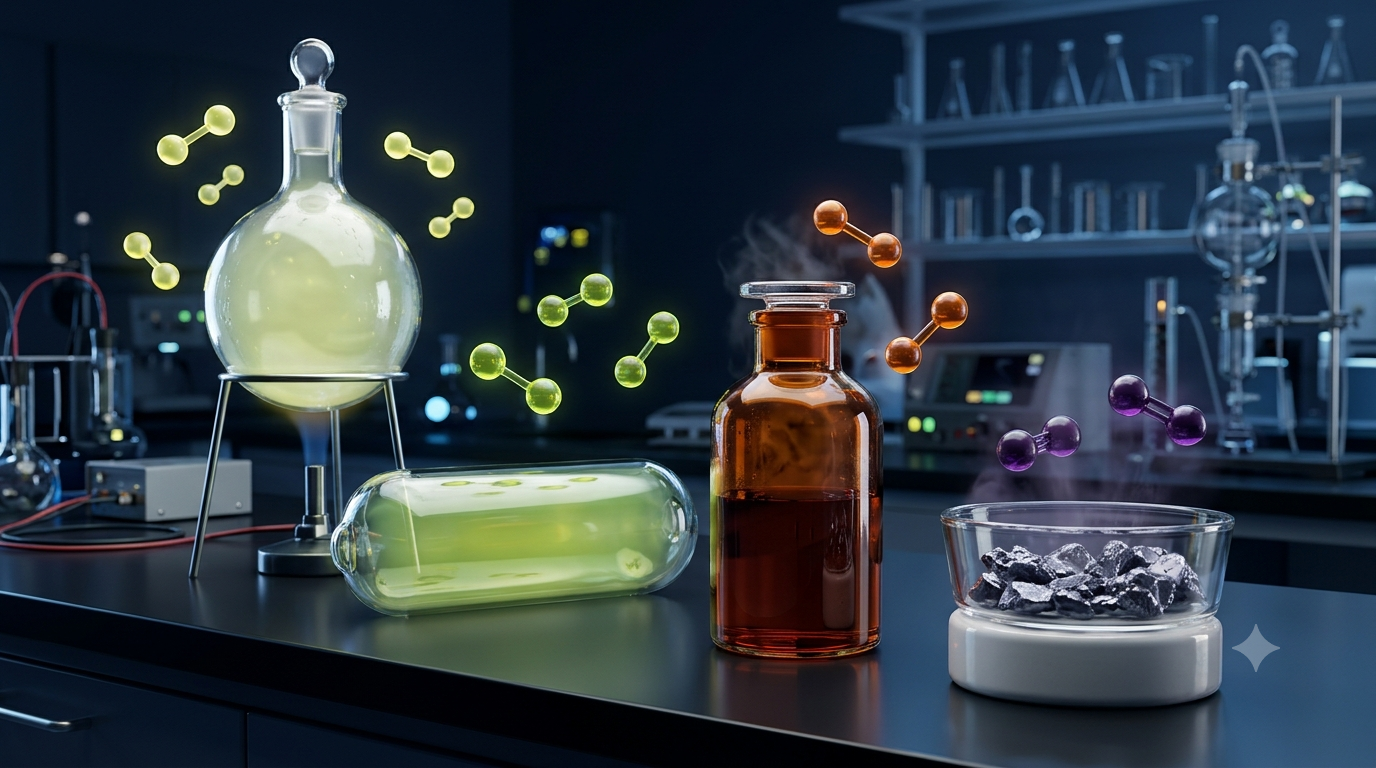
Fluorine is a pale yellow gas.
Chlorine is a greenish-yellow gas.
Bromine is a reddish-brown liquid.
Iodine is a dark grey or violet-black solid.
Astatine is a radioactive solid.
This variation occurs because intermolecular forces become stronger as the size and electron cloud of halogen molecules increase down the group.
Consequently, melting points and boiling points generally increase from fluorine to iodine.
3.2 Colour
All commonly studied halogens are coloured substances. Their colours become progressively darker down the group.
Fluorine is pale yellow, chlorine is greenish-yellow, bromine is reddish-brown, and iodine is greyish-black in its solid state. Iodine vapour has a characteristic violet colour.
The increasing intensity of colour is associated with changes in the electronic energy levels and light absorption of halogen molecules.
3.3 Molecular Nature
Halogens generally exist as diatomic molecules under ordinary conditions.
This means that two atoms of the same halogen combine to form one molecule.
Their molecular formulas are:
Fluorine – F₂
Chlorine – Cl₂
Bromine – Br₂
Iodine – I₂
Each molecule contains two halogen atoms connected by a single covalent bond.
For example, one fluorine atom shares one electron with another fluorine atom to form an F₂ molecule.
3.4 Melting and Boiling Points
The melting and boiling points of halogens generally increase down Group 17.
This happens because the molecules become larger and contain more electrons as atomic number increases. Their electron clouds become more easily polarised, resulting in stronger London dispersion forces between molecules.
More energy is therefore required to separate the molecules.
This explains why fluorine and chlorine are gases, bromine is a liquid, and iodine is a solid at room temperature.
3.5 Atomic and Molecular Size
Atomic size increases down the halogen group.
As we move from fluorine to iodine, additional electron shells are added. These shells increase the distance between the nucleus and the outermost electrons.
Therefore, the atomic radius increases down the group.
The size of the halogen molecules also increases in the same direction.
3.6 Density
The density of halogens generally increases down the group.
This is mainly because their atomic and molecular masses increase considerably from fluorine to iodine.
For example, fluorine is a very light gas, while iodine is a relatively dense solid.
4. General Chemical Properties of Halogens
Halogens are highly reactive elements because they have seven electrons in their outermost shell. Their tendency to gain one electron makes them strong oxidising agents.
However, their chemical reactivity is not identical. Fluorine is the most reactive halogen, and reactivity generally decreases down the group.
4.1 Reactivity of Halogens
The general order of chemical reactivity is:
F₂ > Cl₂ > Br₂ > I₂
Fluorine is the most reactive element in Group 17. It reacts readily with many other elements and compounds.
Chlorine is also highly reactive, while bromine and iodine are comparatively less reactive.
This trend is mainly related to the ability of halogen atoms to gain an electron during chemical reactions.
Although atomic size increases down the group, the attraction between the nucleus and an incoming electron generally becomes weaker. As a result, the tendency to gain an electron decreases.
Astatine is not normally included in simple experimental reactivity comparisons because of its extreme rarity and radioactivity.
4.2 Electron Gain and Formation of Halide Ions
Halogens readily accept one electron to complete their outermost electron shell.
When a halogen atom gains an electron, it forms a negatively charged ion called a halide ion.
The general reaction is:
X + e⁻ → X⁻
Here, X represents a halogen atom.
Examples include:
F + e⁻ → F⁻
Cl + e⁻ → Cl⁻
Br + e⁻ → Br⁻
I + e⁻ → I⁻
These ions are commonly found in ionic compounds such as sodium chloride (NaCl), potassium bromide (KBr), and potassium iodide (KI).
4.3 Reaction with Metals
Halogens react with metals to form ionic compounds called metal halides.
During these reactions, metal atoms generally lose electrons, while halogen atoms gain electrons.
For example, sodium reacts with chlorine to form sodium chloride.
2Na + Cl₂ → 2NaCl
Similarly, magnesium reacts with chlorine to produce magnesium chloride.
Mg + Cl₂ → MgCl₂
These reactions demonstrate why halogens are known as salt-forming elements.
4.4 Reaction with Hydrogen
Halogens react with hydrogen to form hydrogen halides.
The general chemical equation is:
H₂ + X₂ → 2HX
The products are:
Hydrogen fluoride (HF)
Hydrogen chloride (HCl)
Hydrogen bromide (HBr)
Hydrogen iodide (HI)
The reaction conditions and rate differ among halogens.
Fluorine reacts explosively with hydrogen, even at low temperatures. Chlorine reacts rapidly in the presence of light, while bromine requires heating or suitable conditions. The reaction between hydrogen and iodine is reversible and requires heating.
When hydrogen chloride dissolves in water, it forms hydrochloric acid. Similarly, hydrogen bromide and hydrogen iodide form hydrobromic acid and hydroiodic acid in aqueous solution.
Hydrogen fluoride forms hydrofluoric acid in water, although its behaviour differs from that of the other hydrogen halides.
4.5 Reaction with Water
Different halogens react with water in different ways.
Fluorine reacts vigorously with water and produces hydrogen fluoride and oxygen.
2F₂ + 2H₂O → 4HF + O₂
Chlorine reacts with water to form hydrochloric acid and hypochlorous acid.
Cl₂ + H₂O ⇌ HCl + HClO
This reaction is important because hypochlorous acid is responsible for much of the disinfecting action of chlorine in water.
Bromine also reacts with water, producing hydrogen bromide and hypobromous acid, although the reaction is less pronounced.
Iodine reacts only slightly with water because of its low reactivity and limited solubility.
4.6 Reaction with Alkalis
Halogens react with alkalis such as sodium hydroxide. The products depend on the reaction conditions and the halogen involved.
For example, chlorine reacts with cold, dilute sodium hydroxide to produce sodium chloride, sodium hypochlorite, and water.
Cl₂ + 2NaOH → NaCl + NaClO + H₂O
Sodium hypochlorite is an important chemical used in household bleach and disinfectants.
With hot, concentrated sodium hydroxide, chlorine produces sodium chloride and sodium chlorate.
3Cl₂ + 6NaOH → 5NaCl + NaClO₃ + 3H₂O
These reactions demonstrate that halogens can undergo disproportionation, in which the same element is simultaneously oxidised and reduced.
4.7 Oxidising Nature of Halogens
Halogens are strong oxidising agents because they readily accept electrons from other substances.
An oxidising agent causes another substance to lose electrons while itself gaining electrons.
For example:
Cl₂ + 2e⁻ → 2Cl⁻
In this reaction, chlorine gains electrons and is reduced to chloride ions.
The oxidising power of halogens generally decreases down the group.
The order is:
F₂ > Cl₂ > Br₂ > I₂
This property explains why a more reactive halogen can displace a less reactive halogen from its salt solution.
4.8 Displacement Reactions
A more reactive halogen can displace a less reactive halogen from an aqueous solution of its halide salt.
For example, chlorine can displace bromine from potassium bromide solution.
Cl₂ + 2KBr → 2KCl + Br₂
Similarly, bromine can displace iodine from potassium iodide solution.
Br₂ + 2KI → 2KBr + I₂
However, iodine cannot displace bromine or chlorine from their halide salts because it is less reactive.
Displacement reactions provide a useful experimental method for comparing the relative reactivity of halogens.
5. Trends in Properties Down Group 17
Several physical and chemical properties show regular changes as we move from fluorine to iodine.
| Property | Trend Down the Group |
|---|---|
| Atomic radius | Increases |
| Molecular size | Increases |
| Atomic mass | Increases |
| Density | Generally increases |
| Melting point | Increases |
| Boiling point | Increases |
| Colour intensity | Generally increases |
| Chemical reactivity | Decreases |
| Oxidising power | Decreases |
| Electronegativity | Decreases |
| Electron affinity | Does not decrease regularly |
One important point is that electron affinity does not follow a perfectly regular decreasing trend. Chlorine has a more negative electron affinity than fluorine because the very small size of fluorine causes greater electron-electron repulsion when an additional electron enters its compact 2p orbital.
Therefore, although fluorine is the most reactive halogen, chlorine has a more negative electron affinity.
6. Electronegativity of Halogens
Electronegativity is the ability of an atom to attract shared electrons towards itself in a chemical bond.
Halogens have high electronegativity values because they need only one additional electron to complete their outermost shell.
Fluorine is the most electronegative element in the periodic table.
The general order of electronegativity is:
F > Cl > Br > I
Electronegativity decreases down the group because atomic size and shielding effects increase.
Fluorine strongly attracts shared electrons, making many of its compounds highly polar.
7. Oxidation States of Halogens
Halogens commonly show an oxidation state of −1 in their compounds because they tend to gain one electron.
For example:
NaF: Fluorine has an oxidation state of −1.
NaCl: Chlorine has an oxidation state of −1.
KBr: Bromine has an oxidation state of −1.
KI: Iodine has an oxidation state of −1.
Fluorine generally shows only the −1 oxidation state in its compounds because it is the most electronegative element.
Other halogens, particularly chlorine, bromine, and iodine, can also show positive oxidation states such as +1, +3, +5, and +7 when combined with more electronegative elements, especially oxygen and fluorine.
For example, chlorine shows different oxidation states in the following compounds:
HCl: −1
HClO: +1
HClO₂: +3
HClO₃: +5
HClO₄: +7
These different oxidation states allow halogens to form a wide variety of chemical compounds.
8. Occurrence of Halogens in Nature
Halogens are found in nature mainly in the form of compounds rather than as free elements because of their high chemical reactivity.
Fluorine occurs in minerals such as fluorite (CaF₂), cryolite (Na₃AlF₆), and fluorapatite.
Chlorine is commonly found as chloride ions in seawater and underground salt deposits. Sodium chloride is one of its most important naturally occurring compounds.
Bromine occurs mainly in seawater, salt lakes, and underground brines.
Iodine is present in seawater, marine organisms, and certain mineral deposits. Seaweed is a natural source of iodine.
Astatine is extremely rare and occurs naturally in tiny quantities as a product of radioactive decay. Tennessine does not occur naturally in significant quantities and is produced artificially.
9. Uses of Halogens
Halogens and their compounds have many practical applications in modern life.
9.1 Uses of Fluorine
Fluorine compounds are widely used in industry and healthcare.
Important applications include:
Fluoride compounds are added to certain dental products to help prevent tooth decay.
Fluoropolymers such as PTFE are used to manufacture non-stick coatings.
Hydrofluoric acid is used in specialised industrial processes, including glass etching.
Certain fluorinated compounds are used in refrigeration and chemical manufacturing.
Fluorine compounds are used in the production of specialised materials and pharmaceuticals.
Elemental fluorine is extremely reactive and hazardous, so its handling requires specialised equipment and safety procedures.
9.2 Uses of Chlorine
Chlorine is one of the most widely used halogens.
Its important applications include:
Disinfection of drinking water and swimming pools.
Production of household bleach.
Manufacturing of PVC plastic.
Production of chemicals and industrial solvents.
Manufacture of certain medicines and pesticides.
Disinfection of industrial water systems.
Chlorine is especially important in public health because it helps control the spread of waterborne diseases.
9.3 Uses of Bromine
Bromine and its compounds have several industrial applications.
Some important uses include:
Production of certain flame-retardant materials.
Manufacture of specialised photographic chemicals.
Preparation of pharmaceutical compounds.
Use in selected water-treatment applications.
Manufacture of certain industrial chemicals.
Bromine is a hazardous liquid and can cause serious skin and respiratory injuries. It must be handled carefully.
9.4 Uses of Iodine
Iodine is an essential element for human health because it is required for the production of thyroid hormones.
Its important applications include:
Production of iodised salt to help prevent iodine deficiency.
Use in certain antiseptic preparations.
Manufacture of pharmaceutical products.
Use in laboratory chemical reactions.
Production of certain contrast agents used in medical imaging.
Iodine is also used in starch testing. When iodine solution comes into contact with starch, it produces a characteristic blue-black colour.
9.5 Uses of Astatine
Astatine is extremely rare and radioactive, so it has very limited practical applications.
Researchers are studying certain astatine isotopes, particularly astatine-211, for possible use in targeted alpha-particle cancer therapy.
However, this is a specialised area of medical research rather than a common clinical application.
10. Biological Importance of Halogens
Some halogens are important for living organisms, while others can be harmful depending on their chemical form and concentration.
Iodine is essential for the production of thyroid hormones, which help regulate metabolism, growth, and development.
Fluoride, in controlled amounts, helps strengthen tooth enamel and reduce the risk of dental cavities.
Chloride ions are essential electrolytes in the human body. They help maintain fluid balance, support normal nerve and muscle function, and contribute to the formation of hydrochloric acid in the stomach.
Bromine is present in trace amounts in the human body and has biological roles, including a contribution to the formation of certain tissue structures.
However, excessive exposure to halogens or their harmful compounds can cause serious health problems. For example, chlorine gas can damage the respiratory system, while excessive fluoride intake can affect teeth and bones.
11. Difference Between Halogens and Noble Gases
Halogens and noble gases are located next to each other in the periodic table, but their chemical properties are very different.
| Property | Halogens | Noble Gases |
|---|---|---|
| Group | 17 | 18 |
| Valence electrons | 7 | Generally 8 (helium has 2) |
| Chemical reactivity | Generally high | Generally very low |
| Electron tendency | Usually gain one electron | Usually do not gain or lose electrons |
| Natural molecular form | Generally diatomic | Generally monatomic |
| Common ions | −1 ions | Usually do not form common ions |
| Examples | F, Cl, Br, I | He, Ne, Ar, Kr |
Halogens are reactive because they need one additional electron to complete their outermost shell. Noble gases already have stable outer electron configurations, which explains their generally low chemical reactivity.
12. Safety and Environmental Considerations
Although halogens are useful in many applications, some of them are dangerous when handled improperly.
Fluorine is extremely reactive and can react violently with many substances. Chlorine gas is toxic and can cause severe respiratory damage. Bromine is corrosive and can cause serious burns. Iodine may cause irritation or harmful effects when exposure is excessive.
Some halogen-containing compounds can also create environmental problems.
Certain older chlorofluorocarbons (CFCs), for example, contribute to the depletion of the ozone layer when released into the atmosphere. Their production and use have been restricted under international agreements such as the Montreal Protocol.
Some persistent organohalogen compounds can remain in the environment for long periods and may accumulate in living organisms.
Therefore, the production, use, storage, and disposal of halogens and their compounds must follow appropriate safety and environmental regulations.
Conclusion
Halogens are an important group of elements belonging to Group 17 of the periodic table. They have seven valence electrons, which explains their tendency to gain one electron and form negatively charged halide ions. Their general properties include high chemical reactivity, diatomic molecular structures, characteristic colours, and strong oxidising behaviour.
As we move down the group, atomic size, density, melting points, and boiling points generally increase, while electronegativity, oxidising power, and chemical reactivity decrease. Halogens also form a wide range of compounds through reactions with metals, hydrogen, water, and alkalis.
From water purification and dental care to medicine, plastics, and industrial manufacturing, halogens have significant applications in everyday life. Understanding their properties and periodic trends provides a strong foundation for studying inorganic chemistry and chemical reactions.
FAQs
1. What are halogens?
Halogens are a group of highly reactive non-metallic elements found in Group 17 of the modern periodic table. The commonly studied halogens are fluorine, chlorine, bromine, iodine, and astatine. Tennessine is also included in this group. The word halogen means salt producer because these elements readily react with metals to form salts. Halogens have seven electrons in their outermost shell, which makes them likely to gain one electron during chemical reactions. They are important in chemistry, medicine, water purification, industrial manufacturing, and several everyday applications.
2. Why are halogens called salt-producing elements?
Halogens are called salt-producing elements because they react with metals to form compounds known as salts. During these reactions, metal atoms generally lose electrons, while halogen atoms gain electrons to form negatively charged halide ions. For example, sodium reacts with chlorine to produce sodium chloride, commonly known as table salt. The chemical equation is 2Na + Cl₂ → 2NaCl. Similarly, other halogens form compounds such as potassium bromide and sodium fluoride. Their ability to produce salts is the reason behind the name halogen, which comes from Greek words meaning salt producer.
3. Why do halogens have seven valence electrons?
Halogens have seven valence electrons because their outermost electron configuration is ns² np⁵. This means they contain two electrons in the s-orbital and five electrons in the p-orbital of their outermost shell. Having seven valence electrons makes them one electron short of achieving a stable noble gas configuration. Therefore, halogens readily gain one electron during many chemical reactions. After gaining an electron, they form negatively charged ions with a −1 charge. For example, chlorine gains one electron to form a chloride ion (Cl⁻), which has a stable electronic configuration.
4. Which is the most reactive halogen?
Fluorine is the most reactive halogen in Group 17 and is also the most electronegative element in the periodic table. It reacts readily with many elements and compounds because of its strong tendency to gain electrons. Its small atomic size and high attraction for electrons contribute to its exceptional reactivity. The general order of reactivity is F₂ > Cl₂ > Br₂ > I₂. Fluorine can react with many substances, sometimes very violently. Because of its extreme chemical reactivity, elemental fluorine requires specialised equipment and strict safety precautions during storage and handling.
5. Why does the reactivity of halogens decrease down the group?
The reactivity of halogens generally decreases down Group 17 because atomic size and electron shielding increase. As we move from fluorine to iodine, additional electron shells are added. These inner shells reduce the effective attraction between the nucleus and an incoming electron. Consequently, the ability of halogen atoms to gain an electron generally decreases. This explains why fluorine is more reactive than chlorine, bromine, and iodine. The decreasing reactivity is also reflected in displacement reactions, where a more reactive halogen can displace a less reactive halogen from its halide solution.
6. Why do halogens exist as diatomic molecules?
Halogens generally exist as diatomic molecules because two atoms of the same halogen share one pair of electrons to achieve a more stable electronic arrangement. Each halogen atom has seven valence electrons and requires one additional electron to complete its outermost shell. By sharing one electron each, two halogen atoms form a single covalent bond. Therefore, their molecular formulas are F₂, Cl₂, Br₂, and I₂. These molecules are stable under ordinary conditions. Their diatomic molecular structure is an important characteristic that distinguishes halogens from noble gases, which generally exist as individual atoms.
7. Why do the melting and boiling points of halogens increase down the group?
The melting and boiling points of halogens increase down Group 17 because their molecules become larger and contain more electrons. Larger electron clouds are more easily polarised, resulting in stronger London dispersion forces between neighbouring molecules. More energy is therefore required to overcome these intermolecular attractions during melting and boiling. This explains why fluorine and chlorine are gases, bromine is a liquid, and iodine is a solid at room temperature. The increasing melting and boiling points are important physical trends that help explain the different physical states of halogens.
8. What is the difference between halogens and halide ions?
Halogens are neutral atoms or elemental forms of Group 17 elements, whereas halide ions are negatively charged ions formed when halogen atoms gain electrons. For example, chlorine is a halogen, while chloride (Cl⁻) is its halide ion. Similarly, fluorine forms fluoride ions (F⁻), bromine forms bromide ions (Br⁻), and iodine forms iodide ions (I⁻). Halogens commonly exist as diatomic molecules, such as Cl₂, while halide ions are commonly present in ionic compounds such as sodium chloride (NaCl) and potassium iodide (KI).
9. What are the important uses of halogens in everyday life?
Halogens and their compounds have several important applications in everyday life. Chlorine is widely used to disinfect drinking water and swimming pools, while sodium hypochlorite is a common ingredient in household bleach. Fluoride compounds are used in dental products to help prevent tooth decay, and fluoropolymers are used in non-stick coatings. Iodine is added to table salt to prevent iodine deficiency and is also used in antiseptic preparations. Bromine compounds are used in certain flame-retardant materials and industrial processes. These applications demonstrate the importance of halogens in healthcare, sanitation, and manufacturing.
10. Are halogens dangerous to humans?
Some halogens can be dangerous to humans, particularly when they are present in high concentrations or handled without proper safety precautions. Fluorine is extremely reactive and can cause severe chemical injuries. Chlorine gas is toxic and can damage the respiratory system when inhaled. Bromine is corrosive and can cause serious burns, while excessive exposure to iodine may also produce harmful health effects. However, certain halogen compounds are useful and safe when appropriately manufactured and used. For example, controlled amounts of fluoride help protect teeth, and iodine is essential for normal thyroid function. Safe handling is important when working with halogens.