The periodic table is one of the most important tools in chemistry. It organizes all known chemical elements according to their atomic numbers and chemical properties. Each element has a specific position in the table, which helps scientists understand its structure, behaviour, and relationship with other elements.
One of the most important features of the periodic table is its groups. Groups are the vertical columns that run from top to bottom. Elements placed in the same group generally have similar chemical properties because they have the same number of valence electrons or a similar outer electron configuration.
Understanding groups makes it easier to study the properties of elements, predict their chemical reactions, and understand how different elements combine to form compounds.
In this article, we will explore what groups are, how they are numbered, the characteristics of different groups, and why they are important in chemistry.
What Are Groups in the Periodic Table?
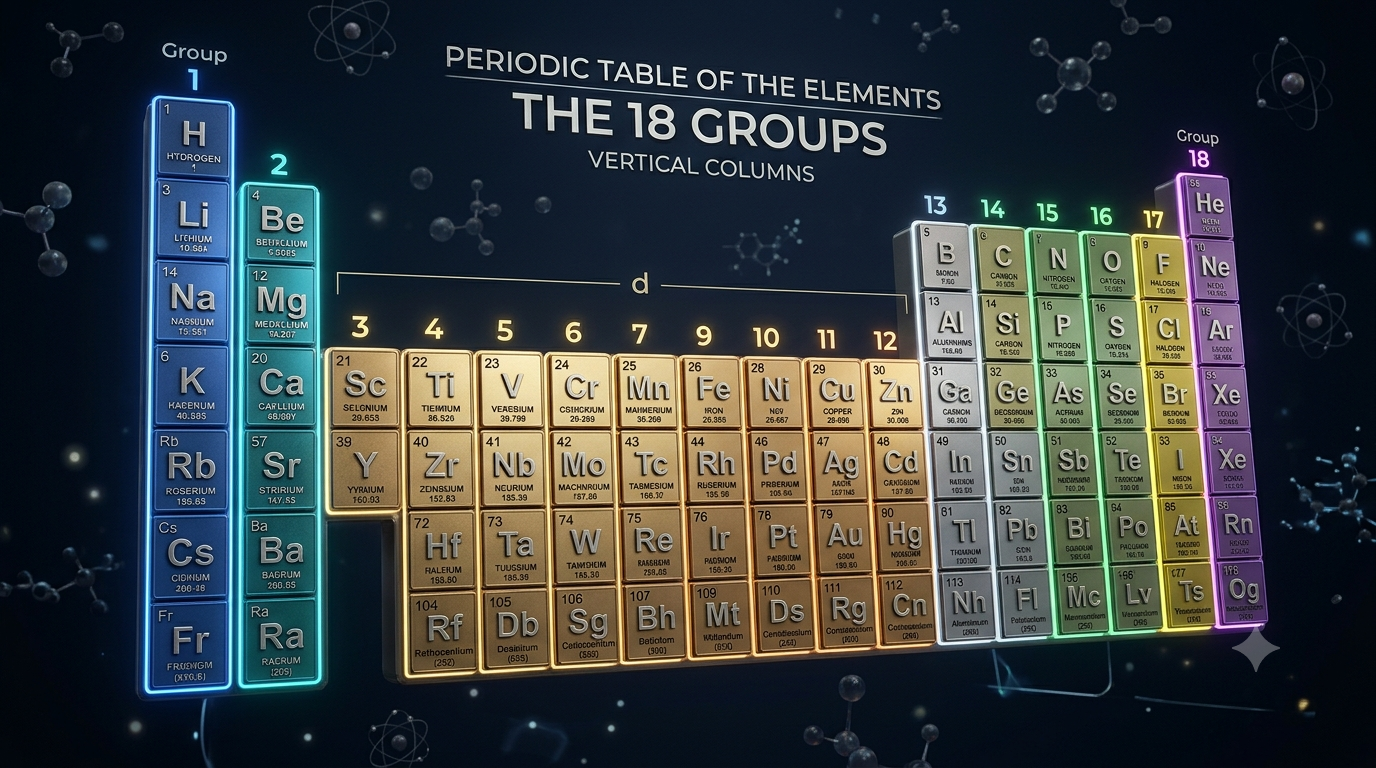
Groups are the 18 vertical columns of the periodic table. Each group contains elements with similar chemical characteristics and related electron configurations.
The modern periodic table contains 18 groups, numbered from 1 to 18. Elements in the same group often react in similar ways because their outermost electrons play similar roles during chemical reactions.
For example, lithium (Li), sodium (Na), and potassium (K) belong to Group 1. These elements are known as alkali metals. They are generally soft, highly reactive metals and react with water to produce hydrogen gas and alkaline solutions.
Similarly, fluorine (F), chlorine (Cl), and bromine (Br) belong to Group 17. These elements are called halogens and are highly reactive non-metals.
The similarities between elements in the same group make the periodic table useful for understanding and predicting chemical behaviour.
How Are Groups Numbered in the Periodic Table?
In the modern periodic table, groups are numbered from 1 to 18, starting from the left side and moving towards the right side.
Each vertical column has a specific group number. The numbering system is accepted internationally and helps scientists identify elements and compare their properties.
The 18 groups include metals, non-metals, and metalloids. Some groups contain elements with very similar properties, while others include elements with more varied characteristics.
The groups can be broadly identified as follows:
Group 1: Alkali Metals
Group 2: Alkaline Earth Metals
Groups 3–12: Transition Metals
Group 13: Boron Group
Group 14: Carbon Group
Group 15: Nitrogen Group
Group 16: Oxygen Group
Group 17: Halogens
Group 18: Noble Gases
The lanthanides and actinides are displayed separately at the bottom of most periodic tables to keep the table compact. They are part of periods 6 and 7, respectively, and are commonly associated with the f-block.
Why Do Elements in the Same Group Have Similar Properties?
The main reason elements in the same group show similar chemical properties is their electron configuration, particularly the arrangement of electrons in the outermost shell.
The electrons present in the outermost shell are called valence electrons. These electrons are mainly responsible for the chemical reactions and bonding behaviour of an element.
For example:
Lithium has 1 valence electron.
Sodium has 1 valence electron.
Potassium has 1 valence electron.
All three elements belong to Group 1. They tend to lose one electron during chemical reactions and form positively charged ions with a +1 charge.
Similarly, elements in Group 17 generally have 7 valence electrons. They tend to gain one electron to complete their outermost shell, forming ions with a -1 charge.
Therefore, the number and arrangement of valence electrons help explain why elements within the same group often have similar chemical properties.
Characteristics of Different Groups in the Periodic Table
Each group of the periodic table has its own characteristics. Some groups contain highly reactive metals, while others contain non-metals or elements that are relatively unreactive.
Group 1: Alkali Metals
Group 1 elements, excluding hydrogen, are known as alkali metals. They include lithium (Li), sodium (Na), potassium (K), rubidium (Rb), caesium (Cs), and francium (Fr).
These elements have one valence electron in their outermost shell. They generally lose this electron during chemical reactions and form positive ions with a +1 charge.
Important characteristics of alkali metals:
They are soft metals and can generally be cut with a knife.
They are highly reactive, especially with water.
They have relatively low densities compared with many other metals.
Their reactivity generally increases down the group.
They form alkaline hydroxides when they react with water.
They are usually stored under oil to prevent unwanted reactions with air and moisture.
Examples and uses:
Lithium is used in rechargeable batteries.
Sodium compounds are used in food production and chemical industries.
Potassium compounds are important in fertilizers.
Hydrogen is placed above Group 1 because it has one electron, but it is a non-metal and does not share all the properties of alkali metals.
Group 2: Alkaline Earth Metals
Group 2 elements are known as alkaline earth metals. They include beryllium (Be), magnesium (Mg), calcium (Ca), strontium (Sr), barium (Ba), and radium (Ra).
These elements have two valence electrons in their outermost shell. They generally lose both electrons to form ions with a +2 charge.
Important characteristics of alkaline earth metals:
They are generally harder than alkali metals.
They are reactive metals, but usually less reactive than Group 1 elements in the same period.
Their reactivity generally increases down the group.
They form basic oxides and hydroxides.
They commonly form ionic compounds.
Examples and uses:
Magnesium is used in lightweight alloys and fireworks.
Calcium is essential for strong bones and teeth.
Barium compounds are used in certain medical imaging procedures.
Groups 3–12: Transition Metals
Groups 3 to 12 contain the transition metals. These elements are located in the central part of the periodic table and are important in many industrial and technological applications.
Examples include iron (Fe), copper (Cu), nickel (Ni), chromium (Cr), silver (Ag), and gold (Au).
Transition metals have partially filled d-subshells in their atoms or in one or more of their common ions. They often display properties that distinguish them from metals in Groups 1 and 2.
Important characteristics of transition metals:
Most are hard, strong, and dense metals.
They generally have high melting and boiling points.
Many can form ions with different oxidation states.
Many transition metal compounds are coloured.
Several act as catalysts in chemical reactions.
They are generally good conductors of heat and electricity.
Examples and uses:
Iron is used in construction and steel production.
Copper is widely used in electrical wiring.
Nickel is used in alloys and batteries.
Chromium is used in stainless steel production.
Gold and silver are used in jewellery and electronics.
Group 13: Boron Group
Group 13 is known as the boron group. Its elements include boron (B), aluminium (Al), gallium (Ga), indium (In), thallium (Tl), and nihonium (Nh).
These elements generally have three valence electrons in their outermost shell. The +3 oxidation state is common, although heavier elements can also show other oxidation states.
Important characteristics of Group 13:
Boron is a metalloid, while most other members are metals.
Aluminium is a lightweight and widely used metal.
These elements commonly form compounds with three bonds.
Their metallic character generally increases down the group.
Examples and uses:
Boron is used in heat-resistant glass and detergents.
Aluminium is used in aircraft, vehicles, packaging, and construction.
Gallium is used in semiconductor technology.
Group 14: Carbon Group
Group 14 is called the carbon group. It includes carbon (C), silicon (Si), germanium (Ge), tin (Sn), lead (Pb), and flerovium (Fl).
These elements generally have four valence electrons. They can form different types of chemical bonds and compounds.
Important characteristics of Group 14:
Carbon is a non-metal and is essential for life.
Silicon and germanium are metalloids.
Tin and lead are metals.
The +4 and +2 oxidation states are important in this group.
Carbon can form long chains and complex structures.
Examples and uses:
Carbon is present in living organisms and many fuels.
Silicon is widely used in computer chips and solar cells.
Tin is used in coatings and solder.
Lead has applications in lead-acid batteries, although its toxicity requires careful handling.
Group 15: Nitrogen Group
Group 15 is known as the nitrogen group or pnictogens. It includes nitrogen (N), phosphorus (P), arsenic (As), antimony (Sb), bismuth (Bi), and moscovium (Mc).
These elements generally have five valence electrons. They commonly show oxidation states such as -3, +3, and +5, depending on the element and compound.
Important characteristics of Group 15:
Nitrogen and phosphorus are non-metals.
Arsenic and antimony are metalloids.
Bismuth is a metal.
Nitrogen forms a major part of Earth’s atmosphere.
Phosphorus is essential for living organisms.
Examples and uses:
Nitrogen is used in fertilizers and food packaging.
Phosphorus is important in fertilizers and biological molecules.
Arsenic compounds have limited industrial applications because of their toxicity.
Bismuth is used in certain medicines and specialised alloys.
Group 16: Oxygen Group
Group 16 is known as the oxygen group or chalcogens. Its elements include oxygen (O), sulfur (S), selenium (Se), tellurium (Te), polonium (Po), and livermorium (Lv).
These elements generally have six valence electrons. They often gain two electrons or share electrons during chemical bonding.
Important characteristics of Group 16:
Oxygen and sulfur are non-metals.
Selenium and tellurium have metalloid characteristics.
Polonium is a radioactive metal.
Oxygen is essential for aerobic respiration.
These elements form many important compounds.
Examples and uses:
Oxygen is required for respiration and supports combustion.
Sulfur is used in the production of sulfuric acid and fertilizers.
Selenium is used in electronics and certain glass applications.
Tellurium is used in some semiconductor and solar technologies.
Group 17: Halogens
Group 17 elements are called halogens. They include fluorine (F), chlorine (Cl), bromine (Br), iodine (I), astatine (At), and tennessine (Ts).
Halogens generally have seven valence electrons. They tend to gain one electron to achieve a stable outer electron configuration.
Important characteristics of halogens:
They are highly reactive non-metals, although their properties vary down the group.
They commonly form ions with a -1 charge.
They react with many metals to form salts.
Their reactivity generally decreases down the group.
They exist in different physical states at room temperature.
Examples and uses:
Fluorine compounds are used in dental products and certain industrial materials.
Chlorine is used to disinfect drinking water and swimming pools.
Bromine compounds have specialised industrial applications.
Iodine is important for normal thyroid function.
Group 18: Noble Gases
Group 18 elements are called noble gases. They include helium (He), neon (Ne), argon (Ar), krypton (Kr), xenon (Xe), and radon (Rn). Oganesson (Og), a synthetic element, is also placed in this group.
Most noble gases have eight electrons in their outermost shell. Helium is an exception because its first and only electron shell is complete with two electrons.
Important characteristics of noble gases:
They are gases at room temperature.
They are generally colourless and odourless.
They have very low chemical reactivity compared with most other elements.
They exist as individual atoms rather than molecules under ordinary conditions.
They have complete outer electron shells.
Examples and uses:
Helium is used in balloons and cryogenic applications.
Neon is used in lighting and advertising signs.
Argon is used in welding and protective atmospheres.
Krypton is used in specialised lighting.
Xenon is used in certain lamps and medical applications.
Radon is radioactive and requires careful handling.
Difference Between Groups and Periods in the Periodic Table
Groups and periods are two important ways of organizing elements in the periodic table. Although both help explain the arrangement of elements, they represent different directions and properties.
Groups are vertical columns, while periods are horizontal rows.
| Basis | Groups | Periods |
|---|---|---|
| Arrangement | Vertical columns | Horizontal rows |
| Number | 18 | 7 |
| Direction | Top to bottom | Left to right |
| Main relationship | Similar valence electron configurations | Same number of occupied electron shells |
| Chemical properties | Often similar within a group | Generally change across a period |
| Examples | Group 1, Group 17 | Period 2, Period 3 |
For example, lithium, sodium, and potassium belong to Group 1 and have one valence electron each. However, lithium, beryllium, boron, carbon, nitrogen, oxygen, fluorine, and neon belong to Period 2 and have two occupied electron shells.
Therefore, groups mainly help us understand similarities in chemical behaviour, while periods help us understand how properties change across a row.
Trends in Properties of Elements Down a Group
When moving from the top to the bottom of a group, the properties of elements change in predictable ways. These changes are known as periodic trends.
Some important trends include:
1. Atomic Radius Increases
Atomic radius generally increases down a group because each successive element has an additional occupied electron shell.
For example, potassium has a larger atomic radius than sodium, and sodium has a larger atomic radius than lithium.
2. Number of Electron Shells Increases
Each element moving down a group has one additional occupied electron shell compared with the element directly above it.
For example:
Lithium has 2 occupied electron shells.
Sodium has 3 occupied electron shells.
Potassium has 4 occupied electron shells.
3. Ionisation Energy Generally Decreases
Ionisation energy is the energy required to remove an electron from an isolated gaseous atom.
It generally decreases down a group because the outermost electrons are farther from the nucleus and experience greater shielding from inner electrons.
As a result, these electrons are generally easier to remove.
4. Electronegativity Generally Decreases
Electronegativity is the ability of an atom to attract shared electrons in a chemical bond.
It generally decreases down a group because atomic size and electron shielding increase.
However, the exact trend can vary depending on the group and the elements being compared.
5. Metallic Character Increases
Metallic character generally increases down a group. Elements tend to become more metallic as atomic size increases and outer electrons become easier to remove.
For example, in Group 14, carbon is a non-metal, silicon and germanium are metalloids, while tin and lead are metals.
6. Reactivity Changes Depending on the Group
The reactivity of elements does not follow one identical trend in every group.
For Group 1 alkali metals, reactivity generally increases down the group because the outermost electron becomes easier to remove.
For Group 17 halogens, reactivity generally decreases down the group because the ability to attract an additional electron decreases.
Understanding these differences is important when comparing the chemical behaviour of elements.
How to Identify the Group Number of an Element?
The group number of an element can be identified by locating its position in the periodic table. However, understanding its electron configuration can also help determine its group.
For many main-group elements, the number of valence electrons is directly related to their group number.
Examples:
Sodium (Na): Electron configuration 2, 8, 1 — Group 1.
Magnesium (Mg): Electron configuration 2, 8, 2 — Group 2.
Aluminium (Al): Electron configuration 2, 8, 3 — Group 13.
Carbon (C): Electron configuration 2, 4 — Group 14.
Nitrogen (N): Electron configuration 2, 5 — Group 15.
Oxygen (O): Electron configuration 2, 6 — Group 16.
Chlorine (Cl): Electron configuration 2, 8, 7 — Group 17.
Neon (Ne): Electron configuration 2, 8 — Group 18.
For transition metals, determining the group from electron configuration is more complex because d-electrons also contribute to their chemical behaviour.
Importance of Groups in the Periodic Table
Groups play an important role in understanding chemistry. They help organize elements and make it easier to predict their chemical and physical properties.
Some major reasons why groups are important include:
1. Predicting Chemical Properties
Elements in the same group often have similar chemical properties. This makes it easier to predict how an element may behave in chemical reactions.
2. Understanding Valence Electrons
Groups help identify the general number of valence electrons in main-group elements. This is useful for understanding chemical bonding and ion formation.
3. Predicting Chemical Reactions
By studying the properties of a group, scientists can predict how its elements may react with water, oxygen, acids, and other substances.
4. Understanding Periodic Trends
Groups help explain how atomic radius, ionisation energy, electronegativity, metallic character, and reactivity change down a column.
5. Organizing Chemical Knowledge
The grouping of elements makes the periodic table easier to study. Instead of learning the properties of every element separately, students and researchers can understand many elements through their group characteristics.
6. Supporting Scientific and Industrial Applications
Knowledge of groups helps scientists select suitable elements for applications in medicine, electronics, construction, agriculture, energy production, and manufacturing.
Conclusion
Groups are an essential part of the modern periodic table. They are the 18 vertical columns that organize elements according to their electronic configurations and chemical properties. Elements in the same group generally have similar numbers of valence electrons, which explains many similarities in their chemical behaviour.
From the highly reactive alkali metals in Group 1 to the relatively unreactive noble gases in Group 18, every group has its own important characteristics and applications. Understanding these groups also helps explain periodic trends, chemical bonding, ion formation, and the reactivity of elements.
By learning the arrangement and properties of the 18 groups, anyone studying chemistry can develop a stronger understanding of the periodic table and the behaviour of chemical elements.
FAQs
1. What are groups in the periodic table?
Groups are the 18 vertical columns of the modern periodic table. Each group contains elements that generally have similar chemical properties because their atoms have similar outer electron configurations. For main-group elements, members of the same group usually have the same number of valence electrons. For example, lithium, sodium, and potassium belong to Group 1 and each has one valence electron. Groups help scientists understand the behaviour of elements, predict chemical reactions, and study similarities between different elements.
2. How many groups are there in the modern periodic table?
The modern periodic table contains 18 groups, numbered from 1 to 18. These groups are arranged vertically from top to bottom. Each group contains elements with related electronic configurations and chemical properties. Groups 1 and 2 contain the alkali metals and alkaline earth metals, respectively. Groups 3 to 12 mainly contain transition metals, while Groups 13 to 18 include different metals, non-metals, metalloids, halogens, and noble gases. This arrangement makes it easier to classify and study all known chemical elements.
3. Why do elements in the same group have similar chemical properties?
Elements in the same group generally have similar chemical properties because their atoms have similar outer electron configurations. For main-group elements, they usually have the same number of valence electrons. These electrons determine how atoms form chemical bonds, gain or lose electrons, and participate in chemical reactions. For example, sodium and potassium both have one valence electron and commonly form positive ions with a +1 charge. Although their properties are not exactly identical, their similar electronic structures explain why they show related chemical behaviour.
4. What is the difference between groups and periods in the periodic table?
Groups and periods represent two different arrangements in the periodic table. Groups are the 18 vertical columns, while periods are the seven horizontal rows. Elements in the same group generally have similar valence electron configurations and chemical properties. Elements in the same period have the same number of occupied electron shells. For example, lithium, sodium, and potassium belong to Group 1, whereas lithium, beryllium, and boron belong to Period 2. Both arrangements help explain the organization and periodic trends of chemical elements.
5. What are the most important groups in the periodic table?
Some particularly important groups include Group 1 (alkali metals), Group 2 (alkaline earth metals), Groups 3–12 (transition metals), Group 16 (oxygen group), Group 17 (halogens), and Group 18 (noble gases). These groups contain elements with important chemical, biological, and industrial applications. For example, sodium and potassium are important in biological processes, iron is used in construction, oxygen supports respiration, chlorine is used in water disinfection, and helium is used in specialised applications. Every group contributes to understanding the properties and uses of elements.
6. What are valence electrons, and how are they related to groups?
Valence electrons are the electrons present in the outermost occupied electron shell of an atom. They play an important role in chemical bonding and reactions. For main-group elements, the number of valence electrons is generally related to the group number. For example, Group 1 elements have one valence electron, Group 2 elements have two, and Group 17 elements have seven. This relationship helps explain why elements in the same group often form similar ions and chemical compounds. Transition metals have more complex electron configurations and bonding behaviour.
7. How does atomic size change down a group?
Atomic size, commonly described using atomic radius, generally increases when moving down a group in the periodic table. This happens because each successive element has an additional occupied electron shell. The extra shells increase the distance between the nucleus and the outermost electrons. For example, potassium has a larger atomic radius than sodium, while sodium has a larger atomic radius than lithium. Although the nuclear charge also increases down a group, the effects of additional electron shells and shielding generally result in a larger atomic size.
8. Which group contains the most reactive metals?
Group 1 contains the alkali metals, which are among the most reactive metals in the periodic table. These elements have one valence electron, which they can lose relatively easily to form positive ions with a +1 charge. Their reactivity generally increases down the group. Lithium, sodium, and potassium are common examples. They react with water to produce hydrogen gas and metal hydroxides. Because of their high reactivity, alkali metals are usually stored under suitable protective conditions to prevent unwanted reactions with air and moisture.
9. Why are Group 18 elements called noble gases?
Group 18 elements are called noble gases because they generally have very low chemical reactivity compared with most other elements. Their outermost electron shells are complete, making them relatively stable. Helium has two electrons in its first shell, while most other noble gases have eight electrons in their outermost shell. Examples include helium, neon, argon, krypton, xenon, and radon. Although they are generally unreactive, some heavier noble gases, particularly xenon, can form chemical compounds under suitable conditions.
10. How can groups in the periodic table help predict the properties of elements?
Groups help predict the properties of elements by showing relationships between their electron configurations and chemical behaviour. Elements in the same group generally have similar numbers of valence electrons, allowing scientists to estimate how they may form ions, create chemical bonds, and react with other substances. For example, Group 17 elements commonly gain one electron, while Group 1 elements generally lose one electron. Groups also help explain trends in atomic size, ionisation energy, electronegativity, and reactivity. This makes the periodic table a useful tool for understanding elements without studying each one separately.