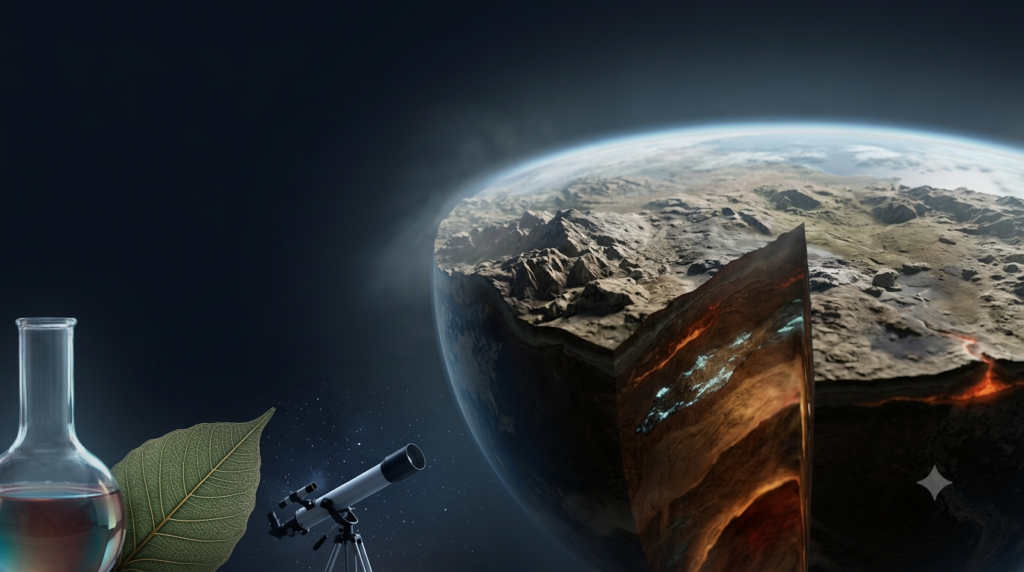
Science helps us understand the world around us, from the smallest particles of matter to the behavior of people and the structure of human societies. However, not every scientific question focuses on the same subject. Some questions explore how the natural world works, such as why objects fall toward the ground, how plants grow, or how planets move around the Sun. Other questions examine human behavior, social relationships, economic activities, and the development of cultures. These different areas of investigation are broadly represented by natural science and social science.
Natural science and social science are two important branches of systematic knowledge. Although both use observation, evidence, research, and logical reasoning, they focus on different aspects of reality. Natural science investigates nature and physical processes, while social science studies human beings, their behavior, and the societies they create. Understanding their scope and differences helps us recognize how both contribute to knowledge, solve practical problems, and improve our understanding of the world.
What Is Natural Science?
Natural science is the branch of science that studies the natural world and the processes that occur within it. It investigates living organisms, nonliving matter, energy, physical forces, Earth’s systems, and the universe. Its primary purpose is to understand natural phenomena through observation, experimentation, measurement, and the development of scientific explanations.
Natural scientists ask questions about how and why things happen in nature. For example, a physicist may investigate how electricity flows through a circuit, while a biologist may study how cells function. A chemist examines how substances interact, and an astronomer investigates the formation and movement of celestial objects.
Natural science relies heavily on empirical evidence, meaning information obtained through observation or measurement. Researchers often conduct controlled experiments to test hypotheses and determine whether their explanations are supported by evidence. When findings are repeatedly confirmed, they may contribute to the development of scientific theories, laws, and models.
However, not every natural science investigation involves a laboratory experiment. Astronomers cannot usually manipulate stars or galaxies directly, and geologists cannot recreate every process that shaped Earth over millions of years. In such cases, scientists use observations, measurements, computer models, and comparisons of available evidence.
Main Characteristics of Natural Science
Natural science has several important characteristics.
1. Evidence-based investigation: Natural scientists develop explanations using observations, measurements, experiments, and other reliable evidence.
2. Systematic methods: Research follows organized procedures designed to investigate questions and test possible explanations.
3. Testability: Scientific hypotheses should produce predictions or observations that can be evaluated against evidence.
4. Reproducibility: When practical, other researchers should be able to repeat experiments or independently examine the evidence and assess the findings.
5. Predictive ability: Scientific models can often predict the outcomes of natural processes under specified conditions.
6. Continuous development: Scientific explanations may be revised when new evidence reveals limitations in existing knowledge.
These characteristics help natural science develop reliable explanations of natural phenomena while remaining open to correction and improvement.
Scope of Natural Science
The scope of natural science is broad because it covers many different aspects of nature. Its major branches investigate matter, energy, life, Earth, and the universe.
1. Physics
Physics studies matter, energy, motion, forces, space, time, and the fundamental interactions of nature. It explains phenomena such as gravity, electricity, magnetism, sound, light, and heat.
Physics is essential in developing technologies such as electric motors, medical imaging equipment, communication systems, renewable energy devices, and spacecraft. It also provides fundamental principles used in engineering and many other scientific fields.
2. Chemistry
Chemistry investigates the composition, structure, properties, and transformations of matter. It examines how atoms and molecules interact to form different substances and how chemical reactions occur.
Chemistry contributes to medicine, agriculture, food production, environmental protection, materials science, and industrial manufacturing. For example, understanding chemical reactions helps researchers develop medicines, improve batteries, and identify pollutants in water.
3. Biology
Biology is the study of living organisms and life processes. It explores cells, genetics, evolution, reproduction, ecosystems, and the relationships between organisms and their environments.
Biological research supports medical science, biotechnology, agriculture, wildlife conservation, and disease prevention. Studying microorganisms, for instance, helps scientists understand infections and develop methods to control harmful pathogens.
4. Earth Science
Earth science examines Earth’s structure, materials, history, and natural processes. It includes geology, meteorology, oceanography, and related disciplines.
Earth scientists investigate earthquakes, volcanoes, rocks, minerals, weather systems, oceans, and changes in the Earth’s climate. Their research helps communities assess natural hazards, manage resources, and understand environmental changes.
5. Astronomy and Space Science
Astronomy studies celestial objects and phenomena beyond Earth, including stars, planets, moons, galaxies, black holes, and the large-scale structure of the universe.
Space science also investigates planetary environments, space weather, and the physical conditions encountered during space exploration. These fields expand our knowledge of the universe and help develop technologies used in satellites, navigation, and astronomical observation.
6. Environmental Science
Environmental science investigates the relationships between natural systems and the factors that influence environmental quality. It draws on biology, chemistry, geology, physics, and other disciplines.
Researchers examine air and water pollution, biodiversity loss, climate change, waste management, and the sustainable use of natural resources. The findings help guide conservation efforts and environmental management.
What Is Social Science?
Social science is the systematic study of human beings, their behavior, social relationships, institutions, and communities. It seeks to explain how individuals behave, how groups interact, how societies change, and how economic, political, and cultural systems operate.
Social scientists investigate questions such as why people migrate, how education influences opportunities, why prices change, how governments make decisions, and how cultural traditions develop. Their research helps explain patterns of human behavior and the social conditions that influence people’s lives.
Unlike many investigations in natural science, social science research often involves people whose behavior can change according to their experiences, beliefs, circumstances, and surroundings. Human decisions are influenced by numerous factors, making social phenomena complex and sometimes difficult to predict precisely.
Social scientists use a variety of research methods, including surveys, interviews, observations, experiments, historical analysis, statistical studies, and case studies. Some research is quantitative, involving numerical data and statistical analysis. Other research is qualitative, focusing on experiences, meanings, attitudes, and social interactions.
Many social science studies combine both approaches to develop a more complete understanding of a particular issue.
Main Characteristics of Social Science
Social science has several defining characteristics.
1. Focus on human society: It examines individuals, groups, institutions, cultures, and social relationships.
2. Evidence-based research: Social scientists collect and analyze information to investigate questions about human behavior and social conditions.
3. Multiple research methods: Researchers use surveys, interviews, observations, experiments, statistical analysis, and historical records.
4. Contextual understanding: Human behavior is often influenced by cultural, economic, political, historical, and environmental conditions.
5. Interpretation of human behavior: Researchers may need to understand people’s beliefs, motivations, experiences, and perspectives.
6. Changing research conditions: Social patterns can change as societies develop, technologies advance, and people’s circumstances evolve.
Social science aims to identify meaningful patterns and develop explanations that are supported by evidence. Its findings can inform public policy, education, economic planning, social services, and community development.
Scope of Social Science
Social science includes several disciplines, each focusing on a different aspect of human life and society.
1. Sociology
Sociology studies social relationships, institutions, groups, and the structure of society. It examines how family, education, religion, social class, and cultural expectations influence human behavior.
Sociologists investigate issues such as inequality, urbanization, population change, social mobility, and the effects of technology on relationships. Their research helps explain how societies function and why social problems develop.
2. Psychology
Psychology studies mental processes and behavior. It investigates learning, memory, emotions, motivation, personality, decision-making, and human development.
Psychological research helps explain how individuals respond to different situations and how experiences influence behavior. It has applications in education, workplace development, mental health services, and human-computer interaction.
Psychology also overlaps with natural science, particularly neuroscience and biological psychology, which examine the biological processes associated with mental activity and behavior.
3. Economics
Economics examines how individuals, businesses, and governments make decisions about the use of limited resources. It studies production, consumption, markets, employment, prices, trade, and economic growth.
Microeconomics focuses on individual consumers, firms, and specific markets, while macroeconomics examines broader economic systems, including inflation, unemployment, national income, and economic growth.
Economic research helps policymakers evaluate taxation, public spending, development strategies, and measures designed to improve living standards.
4. Political Science
Political science studies governments, political institutions, public policies, political behavior, and relations between countries. It explores how power is distributed, how laws are developed, and how political decisions affect society.
Political scientists investigate elections, democratic systems, international conflicts, diplomacy, public administration, and political participation. Their findings help explain political processes and the functioning of different forms of government.
5. Anthropology
Anthropology studies human beings, human societies, cultures, and development across time. Depending on its branch, it may investigate cultural practices, languages, human evolution, archaeology, or biological variation.
Cultural anthropology explores how communities develop traditions, beliefs, values, and social practices. Archaeology examines material evidence from past societies, helping researchers understand earlier ways of life.
Anthropology is interdisciplinary because it connects social and cultural research with biological and historical investigations.
6. Human Geography
Human geography examines the relationships between people, places, and environments. It studies population distribution, migration, cities, settlements, cultural landscapes, and economic activities across different regions.
Human geographers investigate why people settle in particular locations, how cities expand, and how geographical conditions influence social and economic development.
The field connects social science with physical geography, particularly when examining interactions between human activities and natural environments.
7. History
History studies past events, societies, people, and changes over time. Historians analyze documents, letters, records, artifacts, and other sources to reconstruct and interpret the past.
Historical research helps explain the origins of present-day institutions, cultural traditions, political systems, and social conditions. Although history uses methods that differ from experimental science, it shares the importance of evidence, critical analysis, and evaluating competing explanations.
Key Differences Between Natural Science and Social Science
Natural science and social science share a commitment to systematic investigation, but they differ in their primary subjects, common methods, and types of questions.
1. Subject of Study
The most fundamental difference is the subject each field investigates.
Natural science focuses on the natural world, including matter, energy, living organisms, Earth’s systems, and the universe. Social science focuses on human behavior, relationships, institutions, cultures, and societies.
For example, studying how temperature affects the rate of a chemical reaction belongs to natural science. Investigating how rising prices influence household spending belongs to social science.
2. Research Methods
Natural science frequently uses controlled experiments, precise measurements, laboratory investigations, field observations, and mathematical models.
Social science uses surveys, interviews, experiments, observations, statistical analysis, historical records, and case studies. Its methods depend on the research question and the social conditions being investigated.
However, these methods are not exclusive to either branch. Social scientists conduct experiments, while natural scientists often rely on observational and historical evidence.
3. Nature of Evidence
Natural science commonly examines measurable physical properties and observable biological or environmental processes. For example, researchers can measure the mass of an object, the concentration of a chemical, or the growth rate of a plant.
Social science may examine numerical information, such as employment rates and population figures, as well as qualitative evidence, such as interview responses and descriptions of people’s experiences.
Both branches evaluate evidence carefully, but the type of evidence and its interpretation vary according to the subject.
4. Predictability
Many natural processes can be predicted accurately under well-defined conditions. For example, established physical principles can be used to calculate the motion of objects when relevant forces and initial conditions are known.
Human behavior is often more difficult to predict because individuals respond differently to circumstances and may change their decisions. Social scientists can identify trends and estimate probabilities, but social predictions may be affected by unexpected events, changing policies, and human choices.
This does not mean that natural systems are always predictable or that social science cannot make useful predictions. Both fields encounter uncertainty and limitations.
5. Role of Experiments
Controlled experiments play an important role in many natural sciences because researchers can often manipulate specific variables while keeping others relatively constant.
In social science, experiments are also valuable, particularly in psychology and behavioral economics. However, experiments involving people may face practical and ethical limitations. Researchers must protect participants’ rights, privacy, safety, and informed consent.
Consequently, social scientists often combine experimental findings with surveys, observations, and other forms of evidence.
6. Influence of Values and Culture
Natural scientists must also consider bias, assumptions, and ethical responsibilities. Nevertheless, many natural phenomena can be investigated without needing to interpret cultural meanings or individual intentions.
Social science frequently requires researchers to consider cultural values, social norms, historical circumstances, and differences in people’s experiences. These factors can influence both the behavior being studied and the interpretation of research findings.
Researchers in both fields must use transparent methods and critically evaluate their assumptions.
7. Practical Applications
Natural science contributes to medical treatments, technological development, agricultural improvements, environmental monitoring, and space exploration.
Social science contributes to public policy, education, economic planning, urban development, conflict resolution, and the understanding of social inequality.
Many real-world challenges require both. For example, reducing air pollution involves understanding its chemical composition and health effects while also studying transport choices, industrial behavior, economic incentives, and environmental regulations.
Comparison Table of Natural Science and Social Science
| Basis | Natural Science | Social Science |
|---|---|---|
| Main focus | Natural world and natural processes | Human behavior and society |
| Common subjects | Matter, energy, life, Earth, space | People, cultures, institutions, economies |
| Major disciplines | Physics, chemistry, biology, geology, astronomy | Sociology, economics, psychology, political science |
| Common methods | Experiments, measurements, observations, modeling | Surveys, interviews, experiments, observations, statistics |
| Evidence | Physical measurements and observations of natural processes | Numerical data, observations, interviews, historical records |
| Predictability | Often strong under defined conditions, depending on the system | Frequently influenced by changing social conditions |
| Common challenges | Measurement limits, complex systems, experimental constraints | Human variability, context, bias, ethical limitations |
| Applications | Medicine, technology, energy, environmental research | Public policy, education, economics, social development |
These differences describe general tendencies rather than absolute rules. Both branches use diverse methods, and many disciplines combine approaches from both.
Similarities Between Natural Science and Social Science
Although natural science and social science study different subjects, they share several important principles.
1. Both Use Systematic Research
Both branches begin with questions and use organized methods to investigate them. Researchers identify problems, gather information, analyze evidence, and develop explanations based on their findings.
2. Both Depend on Evidence
Neither field should rely solely on personal opinions or unsupported assumptions. Researchers must examine available evidence and evaluate whether it supports their conclusions.
3. Both Use Theories and Models
Natural scientists develop theories and models to explain natural processes. Social scientists develop theoretical frameworks to understand social relationships, economic behavior, and institutional changes.
These theories help organize existing knowledge, guide further research, and generate questions that can be investigated.
4. Both Change With New Evidence
Scientific knowledge is not permanently fixed. New discoveries, improved research methods, and better data can challenge earlier explanations in both natural and social science.
5. Both Help Solve Real-World Problems
Natural science helps address challenges such as infectious diseases, energy shortages, and environmental pollution. Social science helps investigate poverty, unemployment, educational inequality, and public health behavior.
Working together, the two branches can provide more complete solutions to complex problems.
How Natural Science and Social Science Work Together
Many important questions cannot be answered fully by one branch of science alone. Interdisciplinary research combines knowledge and methods from multiple fields to examine problems from different perspectives.
Consider climate change. Natural scientists investigate greenhouse gases, atmospheric processes, ocean temperatures, and changes in ecosystems. Social scientists examine energy consumption, public attitudes, economic consequences, government policies, and the behavior of industries and communities.
Together, these perspectives help explain both the physical causes of climate change and the social decisions that influence its progression.
Public health provides another example. Biology and chemistry help researchers understand pathogens, medicines, and disease processes. Psychology investigates health-related decisions, while sociology and economics examine access to healthcare, social inequality, and the cost of treatment.
Similarly, developing artificial intelligence requires knowledge of computer science and mathematics, while psychology, economics, political science, and sociology help researchers understand its effects on employment, privacy, decision-making, and social relationships.
These examples show that natural science and social science are not competing approaches. They are complementary ways of understanding different but interconnected dimensions of the world.
Importance of Natural Science and Social Science
Both branches play an essential role in modern life.
Natural science expands our understanding of the physical universe and supports advances in technology, healthcare, agriculture, transportation, and environmental protection. Without natural science, many of the medicines, communication systems, and energy technologies used today would not exist in their current forms.
Social science helps us understand the people who use these technologies and the societies in which they operate. It provides insights into human needs, economic behavior, cultural differences, political institutions, and the causes of social problems.
Together, they support informed decision-making. Governments can use natural science to assess environmental risks and social science to evaluate how policies affect different communities. Businesses can use scientific research to develop products and social research to understand customer needs. Communities can combine both approaches to improve public health, education, and sustainable development.
Learning about both branches also encourages critical thinking. It helps people distinguish reliable evidence from unsupported claims, understand different perspectives, and recognize the limitations of individual explanations.
Challenges in Natural Science and Social Science
Both branches face challenges that researchers must address to produce trustworthy findings.
In natural science, limitations may arise from measurement errors, insufficient data, complex systems, technological constraints, and the difficulty of repeating certain natural events. Scientific models may simplify reality, so their predictions must be interpreted within the conditions for which they were developed.
In social science, researchers may encounter biased survey responses, incomplete historical records, cultural differences, changing social conditions, and difficulties separating the influence of different factors. Ethical considerations can also limit the types of experiments that researchers can conduct.
Both fields must address research bias, communicate uncertainty, evaluate alternative explanations, and maintain appropriate ethical standards. Collaboration, transparent methods, peer review, and independent verification help improve the quality of research.
Recognizing these challenges does not weaken science. Instead, it encourages careful investigation and a more accurate understanding of what the evidence can and cannot establish.
Conclusion
Natural science and social science are two major branches of systematic knowledge that help us understand the world from different but complementary perspectives. Natural science investigates the natural world, including matter, energy, living organisms, Earth, and the universe. Social science examines human behavior, social relationships, institutions, cultures, and economic and political systems.
Their main differences lie in their subjects of study, commonly used research methods, types of evidence, and the challenges involved in explaining the phenomena they investigate. However, both rely on evidence, logical reasoning, systematic research, and the continuous improvement of knowledge.
Understanding these branches helps us appreciate their individual contributions and the value of interdisciplinary research. From developing medical treatments to addressing climate change and improving education, many of today’s challenges require insights from both natural and social science. Together, they provide a broader understanding of nature, humanity, and the complex relationship between them.
FAQs
1. What is natural science?
Natural science is the branch of science that studies the natural world and the processes occurring within it. It investigates living organisms, matter, energy, Earth’s systems, and the universe. Natural scientists use observation, experimentation, measurement, and scientific models to understand how natural phenomena work. Physics, chemistry, biology, geology, and astronomy are major examples of natural science. Its discoveries contribute to medicine, technology, agriculture, environmental protection, and space exploration. Natural science also helps researchers explain natural events, develop useful technologies, and make predictions about physical and biological processes under specific conditions.
2. What is social science?
Social science is the systematic study of human behavior, social relationships, institutions, and societies. It examines how individuals interact, how communities develop, and how economic, political, and cultural systems influence people’s lives. Sociology, psychology, economics, political science, anthropology, and human geography are important social science disciplines. Researchers use surveys, interviews, observations, experiments, statistical analysis, and historical records to investigate social questions. Social science helps explain issues such as poverty, migration, education, unemployment, and inequality. Its findings support public policy, economic planning, community development, and a better understanding of human behavior in different social environments.
3. What is the main difference between natural science and social science?
The main difference is their subject of study. Natural science investigates the natural world, including matter, energy, living organisms, Earth, and space. Social science focuses on human behavior, social relationships, institutions, cultures, and societies. For example, studying how plants convert sunlight into chemical energy belongs to natural science, while investigating how education influences employment opportunities belongs to social science. Both branches use systematic research and evidence to develop explanations. However, their research methods and challenges may differ because natural processes and human behavior have different characteristics. Together, these branches provide a broader understanding of the world.
4. What are the main branches of natural science?
The main branches of natural science include physics, chemistry, biology, Earth science, astronomy, and environmental science. Physics studies matter, energy, forces, and motion. Chemistry investigates substances, their properties, and chemical reactions. Biology focuses on living organisms and life processes. Earth science examines Earth’s structure, geology, oceans, and atmosphere. Astronomy studies stars, planets, galaxies, and other celestial objects. Environmental science investigates interactions between natural systems and environmental conditions. These branches often overlap and support one another. For example, environmental research combines chemistry, biology, geology, and physics to understand pollution, climate change, and the effects of human activities.
5. What are the main branches of social science?
The main branches of social science include sociology, psychology, economics, political science, anthropology, and human geography. Sociology examines social relationships and institutions, while psychology studies mental processes and behavior. Economics investigates how people and organizations use limited resources. Political science explores governments, political systems, and public policies. Anthropology studies human cultures, societies, and development across time. Human geography investigates relationships between people, places, and environments. Each discipline provides a different perspective on human life. Although their research questions differ, these branches frequently overlap when investigating complex issues such as migration, poverty, education, urbanization, and social inequality.
6. What research methods are used in natural and social science?
Natural science commonly uses laboratory experiments, field observations, precise measurements, mathematical models, and controlled investigations. These methods help researchers test hypotheses and explain natural processes. Social science uses surveys, interviews, observations, statistical analysis, experiments, case studies, and historical research. Quantitative methods examine numerical information, while qualitative methods explore experiences, beliefs, and social meanings. The methods selected depend on the research question. However, the distinction is not absolute. Natural scientists also conduct observational studies, and social scientists frequently perform experiments. Both branches require reliable evidence, careful analysis, transparent procedures, and critical evaluation of research findings.
7. Why is natural science important in everyday life?
Natural science is important because it helps explain the natural processes that influence everyday life and supports the development of useful technologies. Physics contributes to electricity, transportation, and communication systems. Chemistry helps produce medicines, cleaning products, fertilizers, and improved materials. Biology supports healthcare, food production, and disease prevention. Earth science helps people understand weather, earthquakes, and natural resources. Environmental science contributes to pollution control and conservation. Scientific knowledge also helps people evaluate health information, understand environmental changes, and make informed decisions. Many modern conveniences and technological advances depend on discoveries made through natural science research.
8. Why is social science important in society?
Social science helps people understand how individuals, communities, institutions, and governments function. It provides evidence about social issues such as poverty, unemployment, inequality, migration, and access to education. Economics supports decisions about resources and development, while sociology helps explain social relationships and institutions. Psychology contributes to understanding learning, motivation, and decision-making. Political science examines governance and public policy. These insights can help governments design better services, organizations improve working conditions, and communities address social challenges. Social science also encourages critical thinking, cultural understanding, and informed public discussion, helping people recognize the different factors that influence human behavior and social change.
9. Can natural science and social science work together?
Yes, natural science and social science often work together to investigate complex problems that involve both nature and human behavior. Climate change is one example. Natural scientists study greenhouse gases, atmospheric processes, and rising temperatures, while social scientists examine energy consumption, public attitudes, economic effects, and government policies. Public health also combines biological research on diseases with psychological studies of behavior and sociological research on healthcare access. Similarly, artificial intelligence involves computer science alongside research into employment, privacy, and social relationships. Combining these perspectives provides a more complete understanding of problems and supports solutions that consider both scientific evidence and human needs.
10. Are natural science and social science equally important?
Yes, natural science and social science are both important because they answer different but interconnected questions about the world. Natural science explains physical and biological processes and supports advances in medicine, engineering, agriculture, and environmental protection. Social science explains human behavior, economic activities, cultural practices, and social institutions. Neither branch can fully replace the other because understanding natural processes does not automatically explain how societies respond to them. Similarly, understanding human behavior alone cannot explain every physical or biological phenomenon. Both branches contribute valuable knowledge, encourage evidence-based decisions, and help address modern challenges. Their combined insights support technological progress, social development, and improved quality of life.