Mathematical formulas are used to describe relationships between numbers, quantities, shapes, measurements, and patterns. A formula can look complicated at first, especially when it contains several symbols, numbers, variables, and mathematical operations. However, most formulas are built from a small number of basic parts. Once these parts are understood, reading and using formulas becomes much easier.
For example, the formula for the area of a rectangle is A = l × w. Here, each symbol has a specific meaning, and the multiplication sign tells us how the quantities are related. Understanding what A, l, w, and × represent is just as important as knowing the formula itself.
This article explains the main parts of a mathematical formula, including constants, variables, coefficients, operators, terms, exponents, brackets, equality signs, and mathematical functions. It also explains how these parts work together and how to read a formula correctly.
What Is a Mathematical Formula?
A mathematical formula is a concise way of expressing a mathematical relationship between different quantities. It usually uses numbers, symbols, variables, and mathematical operations to represent a rule or relationship.
For example:
A = l × w
This formula tells us that the area A of a rectangle can be found by multiplying its length l by its width w.
Another example is:
v = d/t
This formula expresses the relationship between speed, distance, and time. The speed v is calculated by dividing distance d by time t.
Instead of explaining the relationship in many words, a formula expresses it in a short mathematical form.
Main Parts of a Mathematical Formula
A mathematical formula can contain several different components. The most common parts are variables, constants, coefficients, operators, terms, exponents, brackets, equality signs, and functions.
Not every formula contains every part. A simple formula may contain only a few symbols, while a more advanced formula may contain many different components.
Variables
A variable is a symbol that represents a quantity whose value can change. Letters such as x, y, a, b, n, and t are commonly used as variables.
For example:
y = 2x + 3
Here, x and y are variables.
If the value of x changes, the value of y can also change according to the formula.
Suppose:
x = 2
Then:
y = 2(2) + 3 = 7
If:
x = 5
Then:
y = 2(5) + 3 = 13
Variables make formulas flexible because one formula can be used for many different values.
Dependent and Independent Variables
In some formulas, variables have different roles.
For example:
y = 3x + 2
Here, x is generally treated as the independent variable, while y depends on the value of x. Therefore, y is called the dependent variable.
This distinction is especially useful when studying equations, functions, graphs, and mathematical models.
Constants
A constant is a fixed value that does not change within a particular formula or situation.
For example:
y = 4x + 7
The numbers 4 and 7 are constants in this expression. Their values remain fixed.
Some constants have special names and symbols. For example, π is a mathematical constant representing the ratio of a circle’s circumference to its diameter. Its value is approximately:
π ≈ 3.14159
Another important constant is e, which is approximately:
e ≈ 2.71828
Constants provide fixed values that help define mathematical relationships.
Coefficients
A coefficient is a number that multiplies a variable or another algebraic quantity.
Consider:
5x
The number 5 is the coefficient of x.
In:
7ab
The coefficient is 7, while a and b are variables.
Sometimes the coefficient is not written explicitly. For example:
x
This can be understood as:
1x
Therefore, the coefficient of x is 1, even though the 1 is usually omitted.
Coefficients are important because they determine how strongly a variable contributes to a mathematical expression.
Terms
A term is a part of a mathematical expression separated from other parts by addition or subtraction signs.
Consider:
3x² + 5x – 7
This expression contains three terms:
The first term is 3x², the second is 5x, and the third is -7.
A term can contain a coefficient, variable, and exponent. A term can also be a single constant number.
For example:
4x²y
is one term because there is no addition or subtraction separating its components.
Understanding terms is important when simplifying expressions and solving algebraic equations.
Mathematical Operators
Operators are symbols that tell us which mathematical operation should be performed.
Common operators include:
For example:
8 + 4 = 12
The + sign tells us to add 8 and 4.
In:
20 ÷ 5 = 4
The division symbol tells us to divide 20 by 5.
Operators connect numbers and mathematical quantities and show how they are related.
Exponents and Powers
An exponent tells us how many times a number or variable is multiplied by itself.
For example:
x³
means:
x × x × x
Here, 3 is the exponent, and x is the base.
Similarly:
2⁴ = 2 × 2 × 2 × 2 = 16
The number 2 is the base, while 4 is the exponent.
Exponents are commonly used in formulas involving areas, volumes, scientific notation, growth, and many other mathematical relationships.
For example, the area of a square is:
A = s²
The exponent 2 indicates that the side length is multiplied by itself.
Bases
The base is the quantity that is raised to a power.
In:
x⁴
the base is x, and the exponent is 4.
In:
10³
the base is 10, and the exponent is 3.
Bases can be numbers, variables, or expressions. Understanding the difference between a base and an exponent is essential when working with powers and exponential formulas.
Brackets and Parentheses
Brackets and parentheses are used to group parts of a mathematical expression. They also help determine the order in which operations should be performed.
For example:
2(3 + 4)
First, calculate the expression inside the parentheses:
3 + 4 = 7
Then:
2 × 7 = 14
Without the parentheses, the expression:
2 × 3 + 4
would normally be evaluated as:
6 + 4 = 10
Therefore, brackets can significantly change the result of a formula.
Common grouping symbols include:
( )
[ ]
{ }
They are particularly important in algebra and more advanced mathematics.
The Equality Sign
The equality sign = is one of the most important symbols in mathematics.
It indicates that the expressions on its two sides have the same value.
For example:
A = l × w
This means that the value of A is equal to the value obtained by multiplying l and w.
Another example is:
2x + 3 = 11
The equality sign tells us that 2x + 3 has the same value as 11.
When solving equations, the equality sign represents a relationship that must remain balanced.
Fractions and Division
Fractions are another common part of mathematical formulas. A fraction represents division between two quantities.
For example:
v = d/t
can also be written as:
v = d ÷ t
Here, d is divided by t.
In a fraction:
a/b
the quantity a is called the numerator, while b is called the denominator.
The numerator represents the quantity being divided, while the denominator represents the quantity by which it is divided.
Fractions are widely used in formulas involving rates, ratios, averages, probabilities, slopes, and measurements.
Mathematical Functions
A function describes a relationship in which an output depends on an input.
For example:
f(x) = 2x + 1
Here, f(x) represents the output of the function for a particular value of x.
If:
x = 3
then:
f(3) = 2(3) + 1 = 7
Functions can also appear in more advanced forms, such as:
sin(x)
cos(x)
log(x)
√x
These functions are used in areas such as geometry, trigonometry, calculus, physics, engineering, and scientific modeling.
Mathematical Symbols and Notation
Formulas often use special symbols to represent mathematical ideas efficiently.
For example:
√x
represents the square root of x.
The symbol π represents a special mathematical constant.
The symbol Σ is commonly used to represent summation.
The symbol ∞ represents infinity.
Different branches of mathematics use different notation. Learning common symbols makes formulas easier to read and understand.
Subscripts
A subscript is a small number or symbol written below and to the right of a variable.
For example:
x₁, x₂, x₃
The subscripts distinguish between different quantities represented by the same basic variable.
Subscripts are frequently used in sequences, statistics, physics, chemistry, and engineering.
For example:
a₁, a₂, a₃, …
may represent different terms in a sequence.
A subscript does not necessarily mean multiplication. It is usually used to identify or distinguish quantities.
Units in Mathematical Formulas
Many formulas used in science and everyday measurements involve units.
For example:
v = d/t
If distance is measured in metres and time is measured in seconds, speed is measured in metres per second:
m/s
Similarly, the formula:
A = l × w
can produce an area in square metres if both length and width are measured in metres.
Units help us understand what a quantity represents and whether a calculation is physically meaningful.
Order of Operations
When a formula contains several operations, they cannot always be performed randomly. Mathematics uses rules for determining the order of operations.
For example:
2 + 3 × 4
Multiplication is performed before addition:
2 + 12 = 14
But:
(2 + 3) × 4
requires the parentheses to be evaluated first:
5 × 4 = 20
Understanding the order of operations helps prevent mistakes when substituting values into formulas.
Substitution in a Formula
Substitution means replacing variables with known values.
Consider the formula:
A = l × w
Suppose:
l = 8 m
and:
w = 5 m
Substituting these values gives:
A = 8 × 5
Therefore:
A = 40 m²
The formula itself does not change. Only the values represented by the variables are replaced.
Substitution is one of the most important skills for using mathematical and scientific formulas.
Rearranging a Formula
Sometimes the quantity we need is not isolated on one side of a formula. In such cases, the formula may need to be rearranged.
For example:
v = d/t
If we want to find distance instead of speed, we can rearrange the formula:
d = vt
If we want to find time:
t = d/v
The relationship between the quantities remains the same, but the formula is rearranged to make the required quantity the subject.
This skill becomes especially useful in physics, algebra, engineering, and applied mathematics.
A Formula Can Contain Several Parts at Once
Consider the formula:
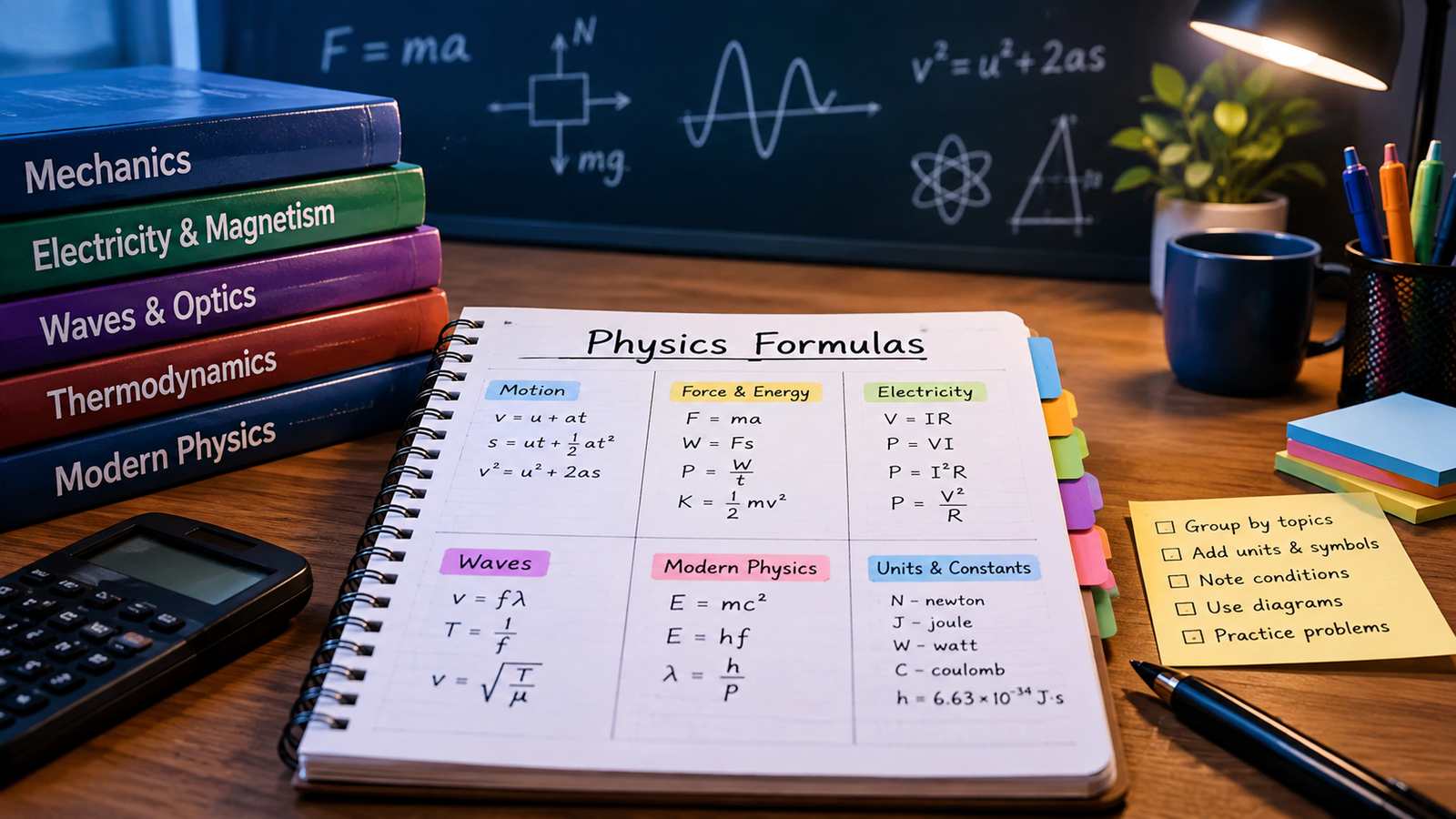
s = ut + ½at²
This formula contains several different mathematical components.
s is a variable representing displacement.
u is a variable representing initial velocity.
t is a variable representing time.
a is a variable representing acceleration.
½ is a constant coefficient.
a t² contains a variable and an exponent.
+ is an addition operator.
= is the equality sign.
This example shows that a single formula can combine many different mathematical parts.
The ability to identify each component makes the formula easier to interpret and apply.
How to Read a Mathematical Formula
A useful way to read a formula is to break it into small parts instead of trying to understand everything at once.
For example:
y = 3x² + 2
Start with the equality sign. It tells us that y is equal to the expression on the right.
Next, identify the variable x and the exponent 2. The coefficient of x² is 3, and 2 is a constant.
The formula therefore describes a relationship in which the value of y depends on the value of x.
When reading scientific formulas, it is also important to identify the units and understand what each symbol represents.
Common Mistakes When Reading Formulas
Several common mistakes can make formulas confusing.
One mistake is treating every number as a variable. A fixed number may actually be a constant or coefficient.
Another mistake is confusing a coefficient with an exponent. In 5x², the 5 is the coefficient, while 2 is the exponent.
It is also easy to overlook parentheses. For example:
2(x + 3)
is different from:
2x + 3
Another common mistake is ignoring units when working with formulas in science. A numerical answer may look correct but still have an incorrect or missing unit.
Carefully identifying each part of a formula can prevent many of these errors.
Why Understanding Formula Parts Matters
Memorizing formulas can help in some situations, but understanding their structure is much more useful in the long term.
When you understand what each symbol means, you can determine which values are needed, substitute them correctly, rearrange the formula when necessary, and interpret the final result.
This understanding also makes it easier to learn formulas from different areas of mathematics and science. Instead of seeing every formula as a completely new set of symbols, you begin to recognize familiar patterns.
For example, variables, coefficients, exponents, fractions, operators, and functions appear repeatedly across algebra, geometry, trigonometry, calculus, physics, chemistry, statistics, and other fields.
Conclusion
A mathematical formula is made up of different parts that work together to express a relationship clearly and efficiently. Variables represent changing quantities, constants provide fixed values, coefficients multiply variables, operators indicate mathematical operations, and exponents represent powers. Brackets group expressions, equality signs connect equivalent quantities, and functions describe specific mathematical relationships.
Understanding these components makes formulas easier to read, interpret, calculate, and rearrange. Rather than simply memorizing a formula, learning how each part works provides a stronger foundation for mathematics and its applications in science and everyday life.