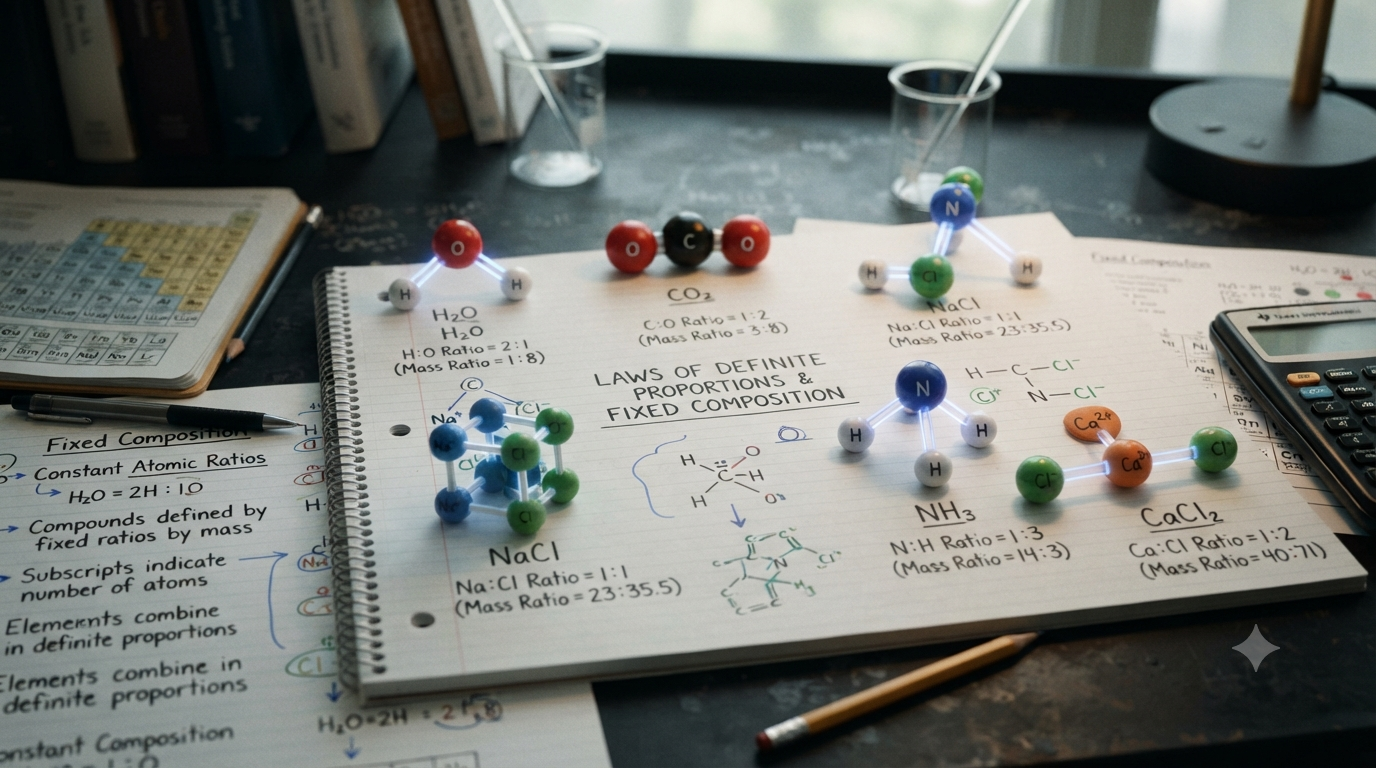
Learning chemical formulas can feel confusing when you are just starting chemistry. There may be many formulas to remember, different symbols for elements, subscripts, brackets, charges, and formulas that look very similar. Trying to memorize everything at once often makes the subject harder instead of easier.
The good news is that beginners do not need to memorize hundreds of chemical formulas blindly. Most formulas follow simple patterns based on element symbols, valency, ionic charges, chemical composition, and common groups of atoms. Once these patterns become familiar, remembering formulas becomes much more natural.
The goal is not simply to store formulas in your memory. It is to understand how formulas are constructed, organize them into useful groups, practise them regularly, and connect them with familiar substances. This approach reduces confusion and makes it easier to recall formulas when solving chemistry problems.
Start by Understanding What a Chemical Formula Means
Before trying to memorize a formula, understand what the formula tells you.
A chemical formula represents the composition of a substance using symbols and numbers. The symbols identify the elements present, while subscripts show how many atoms of each element are represented.
For example, water has the formula H₂O. It contains hydrogen and oxygen. The subscript ₂ means that two hydrogen atoms are present for every one oxygen atom.
Similarly, carbon dioxide is written as CO₂. It contains one carbon atom and two oxygen atoms.
Understanding this meaning is important because it gives your memory something logical to connect with. Instead of seeing H₂O as a random combination of letters and numbers, you recognize it as the composition of water.
Learn Element Symbols Before Chemical Formulas
One of the easiest ways to reduce confusion is to become comfortable with common element symbols first.
For example:
Hydrogen = H
Oxygen = O
Carbon = C
Nitrogen = N
Sulfur = S
Sodium = Na
Potassium = K
Calcium = Ca
Magnesium = Mg
Aluminium = Al
Chlorine = Cl
Iron = Fe
Copper = Cu
Zinc = Zn
Some symbols are easy to predict from English names, while others come from older or Latin names. For example, sodium is Na, potassium is K, iron is Fe, and copper is Cu.
If element symbols are not familiar, chemical formulas will appear much more difficult than they really are. Spend some time learning the symbols of commonly used elements before attempting to memorize large numbers of compounds.
Learn Valency and Ionic Charges
Valency is one of the most useful concepts for understanding chemical formulas.
Valency describes the combining capacity of an atom or ion in a particular chemical context. Ionic charges also help determine how ions combine to form electrically neutral compounds.
For example, sodium commonly forms Na⁺, while chlorine commonly forms Cl⁻. One sodium ion combines with one chloride ion, giving NaCl.
Calcium commonly forms Ca²⁺, while chloride forms Cl⁻. Two chloride ions are therefore needed to balance one calcium ion, giving CaCl₂.
The formula is not random. The subscripts come from the need to balance the charges.
This is why understanding valency can be much more effective than memorizing every ionic formula separately.
Learn Formulas in Small Groups
Do not try to memorize every important chemical formula in one sitting. Divide formulas into manageable groups.
You can organize them as:
For example, you might first learn a small group of familiar compounds:
Water = H₂O
Carbon dioxide = CO₂
Sodium chloride = NaCl
Ammonia = NH₃
Methane = CH₄
Once these become familiar, move to another group.
Small groups reduce mental overload and make revision easier.
Connect the Formula With the Substance
Memory becomes stronger when a formula is connected with something meaningful.
Instead of memorizing NaCl only as “NaCl,” connect it with common salt. When you see H₂O, think about water. When you see CO₂, connect it with carbon dioxide.
For example:
H₂O → water → hydrogen + oxygen
CO₂ → carbon dioxide → carbon + oxygen
NaCl → sodium chloride → sodium + chlorine
This creates several memory connections instead of relying on a single visual pattern.
You can also connect formulas with their common uses. Sodium chloride is associated with table salt, carbon dioxide with respiration and combustion, and calcium carbonate with materials such as limestone and marble.
Understand Subscripts Carefully
Subscripts are a common source of confusion for beginners.
A small number written after an element symbol tells you how many atoms of that element are represented in the formula.
For example:
H₂O
There are two hydrogen atoms and one oxygen atom.
In:
CO₂
There is one carbon atom and two oxygen atoms.
If there is no subscript, the number is understood to be one.
Therefore, CO does not mean one carbon and zero oxygen. It means one carbon atom and one oxygen atom.
Learning to read subscripts correctly prevents many mistakes.
Do Not Confuse Subscripts With Coefficients
A subscript and a coefficient have different meanings.
Consider:
H₂O
The subscript ₂ belongs only to hydrogen. It tells you that each water molecule contains two hydrogen atoms.
Now consider:
2H₂O
The coefficient 2 applies to the entire formula. It means two water molecules.
Therefore, 2H₂O represents:
4 hydrogen atoms
2 oxygen atoms
This distinction becomes especially important when balancing chemical equations.
Understanding the difference helps prevent beginners from memorizing formulas incorrectly.
Learn Common Polyatomic Ions
Some formulas become easier to remember when you learn common polyatomic ions as units.
A polyatomic ion is a charged group of atoms that behaves as a unit in many compounds.
Some commonly encountered examples include:
Hydroxide = OH⁻
Nitrate = NO₃⁻
Sulfate = SO₄²⁻
Carbonate = CO₃²⁻
Phosphate = PO₄³⁻
Ammonium = NH₄⁺
Once these groups are familiar, many formulas become easier to construct.
For example, calcium is Ca²⁺ and hydroxide is OH⁻. Two hydroxide ions are required to balance one calcium ion:
Ca²⁺ + 2OH⁻ → Ca(OH)₂
The brackets show that the entire hydroxide group is repeated twice.
Instead of memorizing Ca(OH)₂ as an isolated formula, you can understand where it comes from.
Pay Attention to Brackets
Brackets can look confusing at first, but they follow a simple rule.
When a polyatomic group occurs more than once in a compound, brackets are commonly used to show that the whole group is repeated.
For example:
Ca(OH)₂
The subscript ₂ applies to the entire OH group.
This means the compound contains:
1 calcium atom
2 oxygen atoms
2 hydrogen atoms
Compare this with:
CaOH₂
This is not simply another way of writing calcium hydroxide. The placement of the subscript changes the meaning of the formula.
Therefore, when memorizing formulas, do not ignore brackets. Learn what each bracketed group represents.
Use Patterns Instead of Pure Memorization
Chemical formulas often contain patterns.
For example, many metal chlorides can be understood using the charge of the metal and the charge of chloride.
Sodium chloride:
NaCl
Magnesium chloride:
MgCl₂
Aluminium chloride:
AlCl₃
These formulas show a relationship between the positive charge of the metal ion and the negative charge of chloride.
Similarly, oxides can often be understood by considering the charge of oxygen, which commonly forms O²⁻ in ionic compounds.
Recognizing these patterns reduces the number of formulas you need to memorize individually.
Create a Formula Notebook
A small formula notebook can make revision much easier.
Divide each page into simple categories. For example:
| Substance | Formula | Type |
|---|
| Water | H₂O | Molecular compound |
| Carbon dioxide | CO₂ | Molecular compound |
| Sodium chloride | NaCl | Ionic compound |
| Hydrochloric acid | HCl | Acid |
| Sodium hydroxide | NaOH | Base |
| Calcium carbonate | CaCO₃ | Salt |
Do not fill the notebook with hundreds of formulas immediately. Add formulas gradually as you learn them.
Writing formulas by hand can also help you notice spelling, subscripts, brackets, and capitalization.
Use Active Recall
Reading formulas repeatedly is not the same as remembering them.
A more effective method is active recall. Look at the name of a substance and try to write its formula without looking at the answer.
For example:
Water → ?
Try to recall H₂O.
Then check your answer.
You can reverse the exercise:
CO₂ → ?
Try to recall carbon dioxide.
This two-way practice helps you remember both names and formulas.
Use Spaced Revision
Do not study a formula once and expect it to remain in your memory permanently.
Review it at increasing intervals.
A simple revision pattern could be:
Day 1 → Learn
Day 2 → Quick revision
Day 4 → Test yourself
Day 7 → Review again
Day 14 → Test again
The exact schedule does not need to be perfect. The important idea is to return to the information after some time instead of repeatedly reading it in one long session.
Write Formulas From Memory
Writing is particularly useful for chemistry because formulas contain small details that can easily be missed.
For example, compare:
CaCO₃
and
CaCO₂
A single subscript changes the formula.
Similarly:
Al₂O₃
should not be confused with:
AlO
When you practise writing formulas from memory, you train yourself to pay attention to these details.
Learn Similar Formulas Together
Sometimes formulas are easier to remember when similar compounds are studied together.
For example:
Studying these together can help you see how the number of chloride ions changes according to the charge of the metal ion.
Another useful group is:
The common hydroxide group, OH⁻, becomes easier to recognize.
Learning related formulas together can turn memorization into pattern recognition.
Avoid Memorizing Too Many Formulas at Once
One of the biggest mistakes beginners make is trying to learn a very large formula list in one session.
This can lead to confusion between similar formulas.
Instead, choose a small target.
For example, learn five formulas today. Once you can recall them comfortably, add another five.
Quality is more important than quantity.
If you remember ten formulas correctly and understand how they are formed, that is more useful than memorizing fifty formulas temporarily and forgetting most of them later.
Use Flashcards for Quick Practice
Flashcards are simple but effective.
Write the chemical name on one side and the formula on the other.
For example:
Front: Calcium carbonate
Back: CaCO₃
You can also reverse the cards:
Front: CaCO₃
Back: Calcium carbonate
Separate cards into three groups:
Spend more time on the formulas that cause difficulty.
Practise Formula Writing Through Questions
Memorization becomes stronger when formulas are used in actual chemistry problems.
For example, instead of only memorizing that sodium chloride is NaCl, practise questions such as:
What is the formula of sodium chloride?
Which elements are present in NaCl?
What are the ions present in sodium chloride?
What is the ratio of sodium ions to chloride ions?
Similarly, after learning Ca(OH)₂, practise identifying its elements, ions, and number of atoms.
This connects memorization with understanding.
Keep a List of Commonly Confused Formulas
If two formulas repeatedly confuse you, place them side by side.
For example:
CO → carbon monoxide
CO₂ → carbon dioxide
The difference is the number of oxygen atoms.
Another example is:
NaOH → sodium hydroxide
NaCl → sodium chloride
Both contain sodium, but the second element or group is different.
A comparison list can help your brain focus on the exact feature that distinguishes similar formulas.
Learn Chemical Names Along With Formulas
Do not learn formulas independently from chemical names.
For every important formula, try to know:
Name → Formula → Elements → Type → Meaning
For example:
Calcium carbonate → CaCO₃ → calcium, carbon, oxygen → ionic compound → common carbonate compound
This creates a stronger mental connection.
You do not necessarily need to memorize every property of every substance. The aim is to build enough understanding that the formula has meaning.
Make Formula Practice a Short Daily Habit
You do not need to spend an hour every day memorizing formulas.
Even a short practice session can help.
A simple routine could be:
Review five previously learned formulas.
Learn two or three new formulas.
Write the new formulas without looking.
Check your answers.
Revisit the formulas you got wrong.
This takes only a few minutes but provides regular exposure.
What Beginners Should Memorize First
Beginners can start with formulas that appear frequently in basic chemistry.
Some useful examples include:
Water = H₂O
Hydrogen = H₂
Oxygen = O₂
Nitrogen = N₂
Chlorine = Cl₂
Carbon dioxide = CO₂
Ammonia = NH₃
Methane = CH₄
Sodium chloride = NaCl
Hydrochloric acid = HCl
Sulfuric acid = H₂SO₄
Nitric acid = HNO₃
Sodium hydroxide = NaOH
Calcium hydroxide = Ca(OH)₂
Calcium carbonate = CaCO₃
Sodium carbonate = Na₂CO₃
The purpose of such a list is not to encourage blind memorization. These formulas should gradually become familiar through understanding, writing, and repeated use.
Build Understanding Before Increasing the Formula List
As your chemistry knowledge grows, you will encounter more complicated formulas. At that stage, the best strategy is still the same: understand the structure before trying to memorize it.
Ask yourself:
Which elements are present?
What are their symbols?
Is the substance ionic or molecular?
What are the relevant charges or valencies?
Is a polyatomic ion present?
Why is a particular subscript used?
Why are brackets necessary?
Can the formula be derived from known ions or groups?
These questions turn chemical formulas into something you can reason about rather than something you must remember mechanically.
Conclusion
Memorizing chemical formulas does not have to mean repeatedly reading a long list until the formulas somehow stick. Beginners can make the process much easier by understanding element symbols, valency, ionic charges, subscripts, coefficients, polyatomic ions, and common patterns.
Start with a small number of familiar formulas and organize them into groups. Connect each formula with its substance, practise writing it from memory, use flashcards, and revise at spaced intervals. When possible, understand how a formula is constructed instead of memorizing it as a random collection of symbols.
With regular practice, many formulas that initially seem confusing will become familiar. More importantly, you will begin to recognize the patterns behind chemical formulas, making it easier to learn new compounds without having to memorize every formula separately.