

Chemistry uses a special language to describe elements, atoms, compounds, and chemical substances. Two of the most basic parts of this language are chemical symbols and chemical formulas. They may look similar because both use letters and numbers, but they provide different kinds of information.
A chemical symbol represents a single chemical element, such as H for hydrogen, O for oxygen, Fe for iron, or Na for sodium. A chemical formula, on the other hand, represents a substance and shows which elements are present and how many atoms of each element are included. For example, H₂O represents water and tells us that each water molecule contains two hydrogen atoms and one oxygen atom.
Understanding the difference between a chemical symbol and a chemical formula is important because it helps us read chemical equations, understand compounds, interpret chemical reactions, and communicate chemical information accurately.
What Is a Chemical Symbol?
A chemical symbol is a short notation used to represent a chemical element. Each element has its own internationally recognized symbol. Chemical symbols usually contain one or two letters.
The first letter of a chemical symbol is always capitalized. If there is a second letter, it is written in lowercase.
Examples include:
H = Hydrogen
O = Oxygen
C = Carbon
N = Nitrogen
Na = Sodium
Cl = Chlorine
Ca = Calcium
Fe = Iron
Cu = Copper
Ag = Silver
A chemical symbol is therefore a concise way of identifying an element without writing its full name.
For example, instead of writing “oxygen” every time, chemists use O. Instead of writing “calcium,” they can use Ca.
Why Do Elements Have Symbols?
Writing the complete names of elements repeatedly would make chemical equations, formulas, and scientific descriptions unnecessarily long. Chemical symbols provide a universal shorthand.
For example, the reaction between hydrogen and oxygen can be written using their symbols:
2H₂ + O₂ → 2H₂O
Without chemical symbols, the same information would require the full names of the substances and would be much less convenient to write.
Chemical symbols also make chemistry easier to communicate internationally because symbols do not depend on the language being used.
What Does a Chemical Symbol Represent?
A chemical symbol primarily identifies an element. Depending on the context, it can represent an atom of that element or a particular amount of the element.
For example:
H represents hydrogen.
O represents oxygen.
Fe represents iron.
The symbol itself does not tell us that an element is part of a compound. It simply identifies the element.
When a symbol appears by itself in a chemical equation or formula, its exact meaning depends on the context.
For example:
Fe
represents iron as an element.
Similarly:
Cu
represents copper.
The important point is that one chemical symbol corresponds to one element.
What Is a Chemical Formula?
A chemical formula is a symbolic representation of a chemical substance. It tells us which elements are present in the substance and, in many cases, the relative number of atoms of each element.
A chemical formula may contain one chemical symbol or several chemical symbols, along with numbers called subscripts.
Examples include:
H₂O = water
CO₂ = carbon dioxide
NaCl = sodium chloride
NH₃ = ammonia
CH₄ = methane
CaCO₃ = calcium carbonate
H₂SO₄ = sulfuric acid
A chemical formula provides more information about a substance than a single chemical symbol usually does.
For example, O represents the element oxygen, while O₂ represents oxygen molecules containing two oxygen atoms.
Similarly, H represents hydrogen, while H₂O represents water, which contains hydrogen and oxygen.
How Does a Chemical Formula Work?
Chemical formulas are constructed using chemical symbols and, when necessary, subscripts.
Consider the formula:
H₂O
The symbols are:
H = hydrogen
O = oxygen
The subscript 2 after H tells us that there are two hydrogen atoms.
There is no subscript after O. When a chemical symbol has no subscript, the number of atoms is understood to be 1.
Therefore:
H₂O = 2 hydrogen atoms + 1 oxygen atom
Now consider:
CO₂
C = carbon
O = oxygen
The subscript 2 after O means there are two oxygen atoms.
Therefore:
CO₂ = 1 carbon atom + 2 oxygen atoms
This is one of the main reasons chemical formulas are useful. They communicate the composition of a substance in a compact form.
Chemical Symbol vs Chemical Formula
The main difference between a chemical symbol and a chemical formula is what they represent.
A chemical symbol identifies one element, while a chemical formula represents the composition of a substance.
For example:
O
is the chemical symbol for oxygen.
O₂
is the chemical formula for molecular oxygen.
The difference is small in appearance but important in meaning.
Another example is:
H
which represents hydrogen.
H₂O
represents water and shows that water contains hydrogen and oxygen in a specific ratio.
A Simple Comparison
| Chemical Symbol | Chemical Formula |
|---|---|
| Represents an element | Represents a substance |
| Usually contains one or two letters | May contain several symbols and numbers |
| Identifies a chemical element | Shows the elements present in a substance |
| Example: O | Example: H₂O |
| Example: Fe | Example: Fe₂O₃ |
| Does not normally show a compound composition | Shows the relative number of atoms or ions in a substance |
The Role of Subscripts
One of the clearest differences between symbols and formulas is the use of subscripts.
A subscript is a small number written at the lower right of a chemical symbol. It tells us how many atoms of that element are represented in the formula.
For example:
H₂
The subscript 2 means two hydrogen atoms.
O₂
The subscript 2 means two oxygen atoms.
CO₂
The subscript 2 applies only to oxygen, so the formula contains one carbon atom and two oxygen atoms.
C₂H₆
The subscript 2 means two carbon atoms, while the subscript 6 means six hydrogen atoms.
If no subscript appears, the number is understood to be one.
Thus:
NaCl
contains one sodium and one chlorine in the formula unit.
Chemical Symbols Can Be Part of Chemical Formulas
Chemical symbols are the building blocks of chemical formulas.
For example, the formula:
CO₂
contains two chemical symbols:
C
O
The formula:
H₂SO₄
contains three chemical symbols:
H
S
O
The symbols identify the elements, while the subscripts provide information about the number of atoms.
This relationship can be summarized simply:
Chemical symbols identify elements, while chemical formulas combine symbols and numbers to describe substances.
Examples of Chemical Symbols and Formulas
Looking at examples makes the difference easier to understand.
Hydrogen
Chemical symbol:
H
Hydrogen gas:
H₂
Here, H identifies the element hydrogen, while H₂ represents hydrogen molecules containing two hydrogen atoms.
Oxygen
Chemical symbol:
O
Oxygen gas:
O₂
Again, O identifies the element, while O₂ represents the molecular form of oxygen.
Carbon
Chemical symbol:
C
Carbon dioxide:
CO₂
The symbol C represents carbon. In CO₂, carbon is combined with oxygen to form carbon dioxide.
Sodium
Chemical symbol:
Na
Sodium chloride:
NaCl
Na identifies sodium, while NaCl represents the compound sodium chloride.
Calcium
Chemical symbol:
Ca
Calcium carbonate:
CaCO₃
Ca identifies calcium, while CaCO₃ represents a compound containing calcium, carbon, and oxygen.
What Is the Difference Between H and H₂?
This is a useful example because the difference can be easy to overlook.
H is the chemical symbol for hydrogen.
H₂ is a chemical formula representing a molecule of hydrogen gas containing two hydrogen atoms.
The subscript changes the meaning.
Similarly:
O = oxygen element symbol
O₂ = oxygen molecule
This demonstrates that a chemical symbol and a chemical formula are not always separated simply by the number of letters. Numbers and chemical context are also important.
What Is the Difference Between a Symbol and a Formula in a Compound?
A compound contains two or more different elements chemically combined in a definite proportion.
For example:
H₂O
contains hydrogen and oxygen.
The chemical symbols H and O tell us which elements are present. The complete formula H₂O tells us how those elements are combined.
Similarly:
CO₂
contains carbon and oxygen.
The symbols C and O identify the elements, while the formula CO₂ tells us their atomic ratio.
Therefore, when reading a compound formula, it is useful to separate two questions:
Which chemical symbols are present?
What do the subscripts tell us about their quantities?
This approach makes formulas much easier to interpret.
What About Coefficients?
A coefficient is a number placed in front of a chemical formula. It is different from a subscript.
For example:
2H₂O
The coefficient 2 means there are two water molecules or two formula units of water.
Each H₂O contains two hydrogen atoms and one oxygen atom. Therefore, 2H₂O represents:
4 hydrogen atoms
2 oxygen atoms
The subscript describes the composition of one molecule or formula unit, while the coefficient tells us how many molecules or formula units are involved.
This distinction becomes especially important when reading and balancing chemical equations.
Why Is This Difference Important?
Knowing the difference between chemical symbols and chemical formulas helps us understand chemistry more accurately.
If someone sees Cl, it identifies chlorine.
If someone sees Cl₂, it represents molecular chlorine containing two chlorine atoms per molecule.
If someone sees NaCl, it represents sodium chloride, a compound made from sodium and chlorine.
These are three different types of information even though they use related symbols.
Understanding this difference is particularly useful when learning:
Chemical equations
Chemical reactions
Atomic structure
Molecular composition
Ionic compounds
Valency and chemical formulas
Stoichiometry
The periodic table
Chemical nomenclature
Common Mistakes to Avoid
One common mistake is treating a chemical symbol as if it were always the complete formula of a substance.
For example, O and O₂ do not mean exactly the same thing. O is the symbol for the element oxygen, whereas O₂ represents oxygen molecules.
Another common mistake is ignoring subscripts.
For example, CO and CO₂ are different substances. CO contains one carbon atom and one oxygen atom, while CO₂ contains one carbon atom and two oxygen atoms.
Capitalization is also important. Co and CO do not mean the same thing.
Co is the symbol for cobalt.
CO consists of C and O, representing carbon and oxygen in a chemical formula.
Therefore, the correct use of uppercase and lowercase letters is essential in chemistry.
Chemical Symbol and Chemical Formula in Everyday Chemistry
Chemical symbols and formulas are not limited to laboratories or textbooks. They appear in many areas of everyday life.
For example, the formula H₂O is commonly used to represent water. CO₂ is used when discussing carbon dioxide in the atmosphere and carbonated drinks. NaCl represents sodium chloride, commonly known as table salt.
Labels, scientific articles, laboratory instructions, environmental reports, and educational materials frequently use chemical symbols and formulas to communicate information quickly.
Once these symbols and formulas become familiar, many chemical descriptions become much easier to read.
Final Difference Between Chemical Symbol and Chemical Formula
A chemical symbol is the short notation used to identify a chemical element, while a chemical formula is a notation used to represent a chemical substance and its composition.
For example:
H → chemical symbol for hydrogen
O → chemical symbol for oxygen
H₂ → chemical formula for molecular hydrogen
O₂ → chemical formula for molecular oxygen
H₂O → chemical formula for water
CO₂ → chemical formula for carbon dioxide
Chemical symbols are the basic units used to write chemical formulas. When symbols are combined with subscripts and other notation, they can communicate detailed information about the composition of substances.
The easiest way to remember the difference is:
A chemical symbol tells you which element you are looking at, while a chemical formula tells you what a substance contains and, through its subscripts, how its atoms are arranged in the stated composition.
Once this distinction is clear, reading chemical formulas becomes much easier and provides a strong foundation for understanding chemical equations, reactions, and stoichiometry.
FAQs
1. What is a chemical symbol?
A chemical symbol is a short notation used to represent a chemical element. It usually contains one or two letters. The first letter is always capitalized, while the second letter, if present, is lowercase. For example, H represents hydrogen, O represents oxygen, and C represents carbon. Some symbols come from older or Latin names, such as Na for sodium and Fe for iron. A chemical symbol identifies an element and is used throughout chemistry to make scientific communication shorter and clearer. Chemical symbols are also the basic building blocks used to write chemical formulas and chemical equations.
2. What is a chemical formula?
A chemical formula is a symbolic representation of a chemical substance. It shows which elements are present and, through subscripts, indicates the relative number of atoms or ions in the substance. For example, H₂O represents water and contains two hydrogen atoms for every one oxygen atom. Similarly, CO₂ represents carbon dioxide, containing one carbon atom and two oxygen atoms. Chemical formulas make it possible to describe substances accurately without writing their complete names. They are widely used when studying compounds, chemical reactions, equations, molecular structures, and the quantitative relationships involved in chemistry.
3. What is the main difference between a chemical symbol and a chemical formula?
The main difference is what each notation represents. A chemical symbol identifies a chemical element, such as H for hydrogen or Fe for iron. A chemical formula represents a chemical substance and gives information about its composition. For example, H₂O is the formula for water and contains hydrogen and oxygen. A chemical formula may contain one or more chemical symbols, along with subscripts or other notation. In simple terms, a chemical symbol tells us the identity of an element, while a chemical formula tells us which elements make up a substance and their relative amounts.
4. Is H₂ a chemical symbol or a chemical formula?
H₂ is a chemical formula, not simply a chemical symbol. The chemical symbol H represents the element hydrogen. When a subscript 2 is added, H₂ represents a molecule of hydrogen containing two hydrogen atoms. This distinction is important because the symbol and formula provide different information. H identifies the element, while H₂ describes the molecular form of hydrogen. Similarly, O is the chemical symbol for oxygen, whereas O₂ represents molecular oxygen. Therefore, a subscript can change the meaning of a notation from identifying an element to representing a particular molecular substance or form.
5. What information does a chemical formula provide?
A chemical formula provides information about the composition of a substance. It identifies the elements present using their chemical symbols and often shows their relative numbers using subscripts. For example, CaCO₃ contains calcium, carbon, and oxygen. The formula indicates one calcium, one carbon, and three oxygen atoms in the stated formula unit. A formula can also help chemists calculate molar mass, determine elemental composition, interpret chemical reactions, and perform stoichiometric calculations. However, a chemical formula does not always show the complete three-dimensional structure or arrangement of atoms within a substance.
6. Why are chemical symbols used in chemical formulas?
Chemical symbols are used in chemical formulas because they provide a short and internationally recognized way to identify elements. Instead of writing the complete names of elements, chemists can combine their symbols to describe substances efficiently. For example, NaCl uses Na for sodium and Cl for chlorine. H₂O uses H for hydrogen and O for oxygen. Subscripts can then provide additional information about the relative number of atoms. This system makes chemical formulas compact, easier to read, and useful for writing chemical equations. It also allows scientists from different countries to communicate chemical information consistently.
7. What does a subscript mean in a chemical formula?
A subscript is a small number written at the lower right of a chemical symbol in a chemical formula. It tells us how many atoms of that element are represented in the formula. For example, H₂O contains a subscript 2 after H, meaning there are two hydrogen atoms for each oxygen atom. There is no subscript after O, so one oxygen atom is understood. In CO₂, the subscript 2 applies only to oxygen. Subscripts are important because changing them can change the composition and identity of the substance represented by the formula.
8. Can one chemical symbol be a chemical formula?
In some contexts, a single chemical symbol can also function as the chemical formula for an elemental substance, particularly when the substance is represented by individual atoms or a formula unit. For example, Fe represents the element iron and can also be used to represent iron in chemical equations. However, the terms have different purposes: a symbol identifies an element, while a formula represents the composition of a substance. For molecular elements such as hydrogen and oxygen, their common molecular formulas are H₂ and O₂ rather than H and O.
9. What is the difference between O and O₂?
O is the chemical symbol for the element oxygen, while O₂ is the chemical formula representing a molecule of oxygen gas containing two oxygen atoms. The subscript 2 is important because it indicates that two oxygen atoms are joined in the molecule. The distinction is similar for hydrogen: H represents hydrogen as an element symbol, whereas H₂ represents molecular hydrogen. Therefore, O and O₂ should not automatically be treated as identical notation. One identifies the element, while the other describes a specific molecular form containing two oxygen atoms.
10. Why is it important to understand chemical symbols and formulas?
Understanding chemical symbols and formulas provides a foundation for learning chemistry. These notations help you identify elements, understand the composition of compounds, read chemical equations, interpret reactions, and perform calculations in stoichiometry. For example, recognizing that H represents hydrogen and that H₂O represents water makes it easier to understand how atoms are combined in substances. Knowing how subscripts work also prevents mistakes when interpreting formulas. This basic knowledge becomes increasingly important when studying chemical bonding, acids and bases, reactions, molar mass, molecular composition, and other areas of chemistry.
Related Posts
Why Is Energy Conserved Even When It Seems to Disappear?
Energy is one of the most important ideas in science. We use energy to move objects, produce light, heat homes, […]
Read MoreWhy Is Physics Important in Everyday Life?
Physics is often introduced as the study of matter, energy, motion, forces, and the laws that govern the universe. It […]
Read MoreHow Chemical Formulas Help Calculate Composition

Chemical formulas are much more than short combinations of element symbols. They provide a compact way to describe what a […]
Read MoreHow to Identify the Simplest Ratio in a Chemical Formula

Chemical formulas do more than identify substances. They also show how atoms of different elements are combined. By looking carefully […]
Read MoreHow to Convert Units in Physics
Unit conversion is one of the most important skills in physics. Measurements are expressed using units such as metres, kilometres, […]
Read MoreWhat Is Gravity and Why Do Objects Fall?

Gravity is one of the most familiar forces in everyday life, yet it is also one of the most fascinating […]
Read MoreHow Valency Helps in Writing Chemical Formulas

Writing a chemical formula is not simply a matter of putting element symbols together. A correct formula must show how […]
Read MoreWhat information can be obtained from a chemical formula?

A chemical formula is a short and powerful way of representing a substance. It uses chemical symbols and numbers to […]
Read MoreHow Chemical Formulas Connect Atoms, Molecules, and Compounds

Chemistry becomes much easier to understand when we know how atoms are connected and how their combinations are represented. Everything […]
Read MoreWhen Should You Simplify Chemical Formula Ratios?

Chemical formulas are more than collections of symbols and numbers. They show which elements are present in a substance and, […]
Read MoreSI Base Units and Their Symbols Explained
Science depends on measurement. Whether scientists are studying the motion of a spacecraft, the temperature of a material, the mass […]
Read MoreWhat Is Density and How Is It Calculated?

Density is one of the most useful physical quantities in science. It helps us understand how much matter is packed […]
Read MoreHow does a chemical formula represent a substance?

A chemical formula is a short and precise way of representing a substance using chemical symbols and numbers. Instead of […]
Read MoreHow to Write Formulas for Molecular Compounds

Writing the formula of a molecular compound is an important skill in chemistry. A chemical formula tells us which elements […]
Read MoreSubscripts vs Coefficients in Chemical Formulas

Chemical formulas may look like simple combinations of letters and numbers, but every symbol and number has a specific meaning. […]
Read MoreHow to Avoid Unit Conversion Mistakes in Physics

Unit conversion is one of the most common sources of mistakes in physics. A formula may be correct, the calculation […]
Read MoreWhat Is a Structural Formula?

A structural formula is a way of representing a chemical compound by showing how its atoms are arranged and connected […]
Read MoreCommon Formulas of Bases in Chemistry

Bases are an important group of chemical substances that we encounter in laboratories, industries, medicines, agriculture, and everyday life. They […]
Read MoreWhat Is the Meaning of Formula Units in Chemistry?
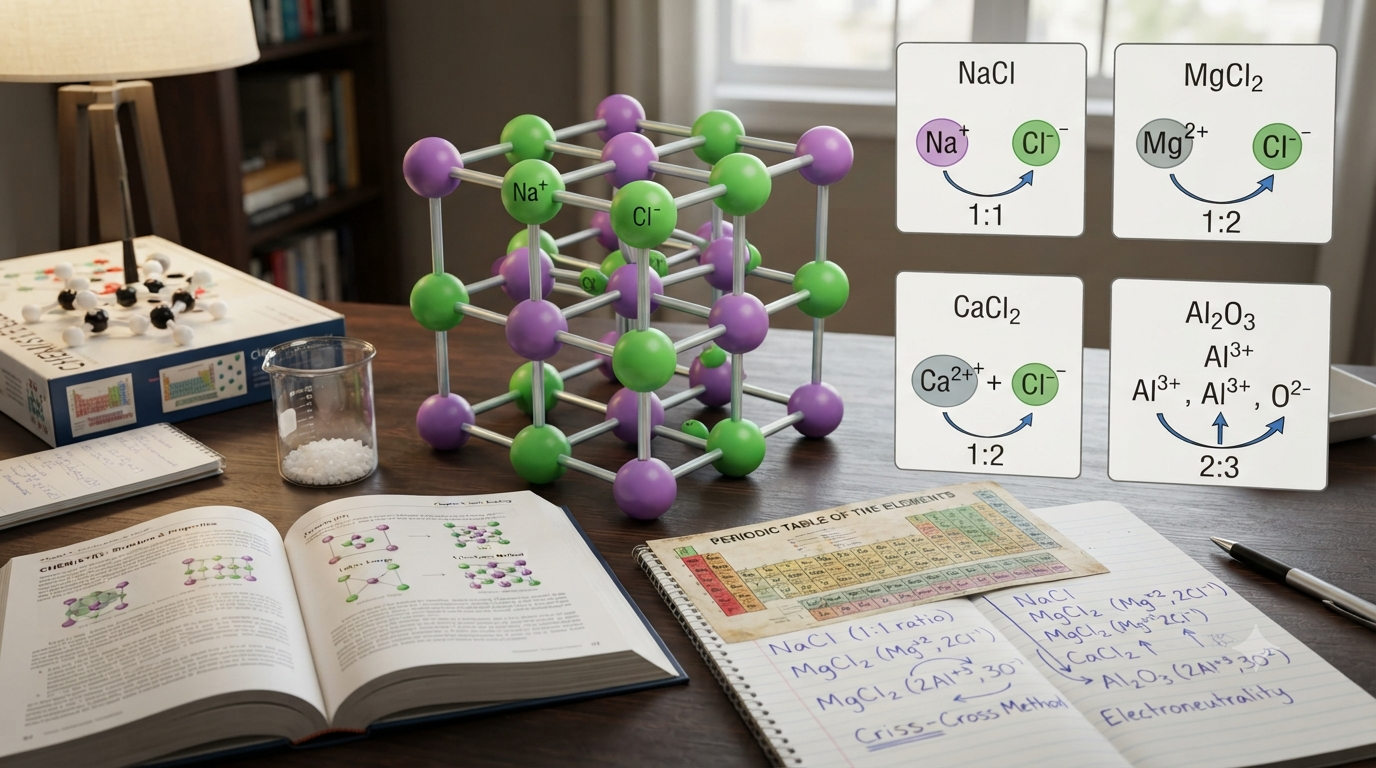
In chemistry, substances are often represented using chemical formulas. A chemical formula tells us which elements are present and, in […]
Read MoreHow Charges Affect Chemical Formulas

Chemical formulas are a simple way to represent substances using symbols and numbers. A formula can tell us which elements […]
Read MoreHow Does Direction Change the Meaning of a Physical Quantity?

In physics, numbers alone are often not enough to describe what is happening. A value such as 20 m/s, 10 […]
Read MoreHow to Organize Physics Formulas for Easy Revision

Physics becomes much easier when formulas are organized in a clear and meaningful way. Many learners struggle not because they […]
Read MoreHow Does Force Affect the Motion of an Object?
Force is one of the most important ideas in physics because it helps explain why objects start moving, stop moving, […]
Read MoreHow to Calculate Molar Mass From a Chemical Formula

Molar mass is one of the most useful concepts in chemistry because it connects the microscopic world of atoms and […]
Read MoreWhat Is Formula Mass in Chemistry?

Chemistry often deals with substances that are made of atoms joined together in specific proportions. To understand how much matter […]
Read MoreHow to Identify Elements in a Chemical Formula

Chemical formulas provide a simple way to describe the substances that make up the world around us. A formula may […]
Read MoreHow Are Derived Units Built From Fundamental Units?

Physics uses units to make measurements meaningful. Saying that a car travels at a speed of 20 does not tell […]
Read MoreHow to Learn Physics Formulas Without Rote Memorization

Physics formulas can seem difficult when there are dozens of equations to remember. Students often try to memorize formulas repeatedly, […]
Read MoreHow to Calculate Percentage Composition From a Formula

Percentage composition is a useful concept in chemistry that tells us how much of each element is present in a […]
Read MoreWhat Are Physics Formulas and Why Are They Important?

Physics is the study of matter, energy, motion, forces, space, time, and the interactions that shape the natural world. To […]
Read More