When scientists measure the world, they need a common language for describing quantities such as time, length, mass, temperature, and electric current. Without a standard system, measurements made in different places could be difficult to compare. The International System of Units, known as the SI system, provides this common language.
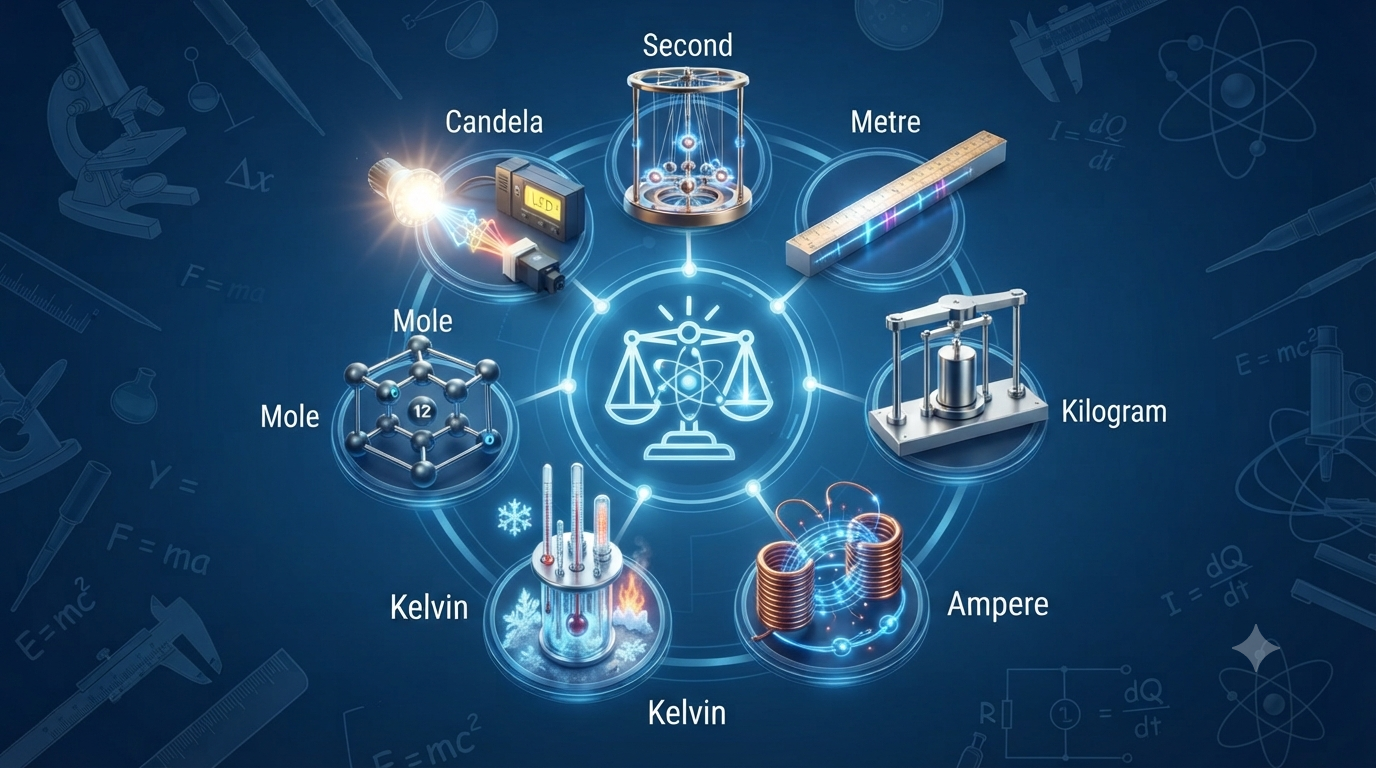
The SI system has seven base units: second, metre, kilogram, ampere, kelvin, mole, and candela. At first, seven may seem like an arbitrary number. Why not five, ten, or twenty? The reason is that these seven units are chosen to form a practical and independent foundation from which many other units can be derived. Understanding why there are exactly seven base units reveals how scientists organize physical quantities and measurements.
What Is a Base Unit?
A base unit is a unit selected as part of the fundamental foundation of a measurement system. Other units can be expressed using combinations of these base units.
For example, speed is measured in metres per second. The unit of speed, metre per second (m/s), is not a separate SI base unit. It is derived from the metre and the second.
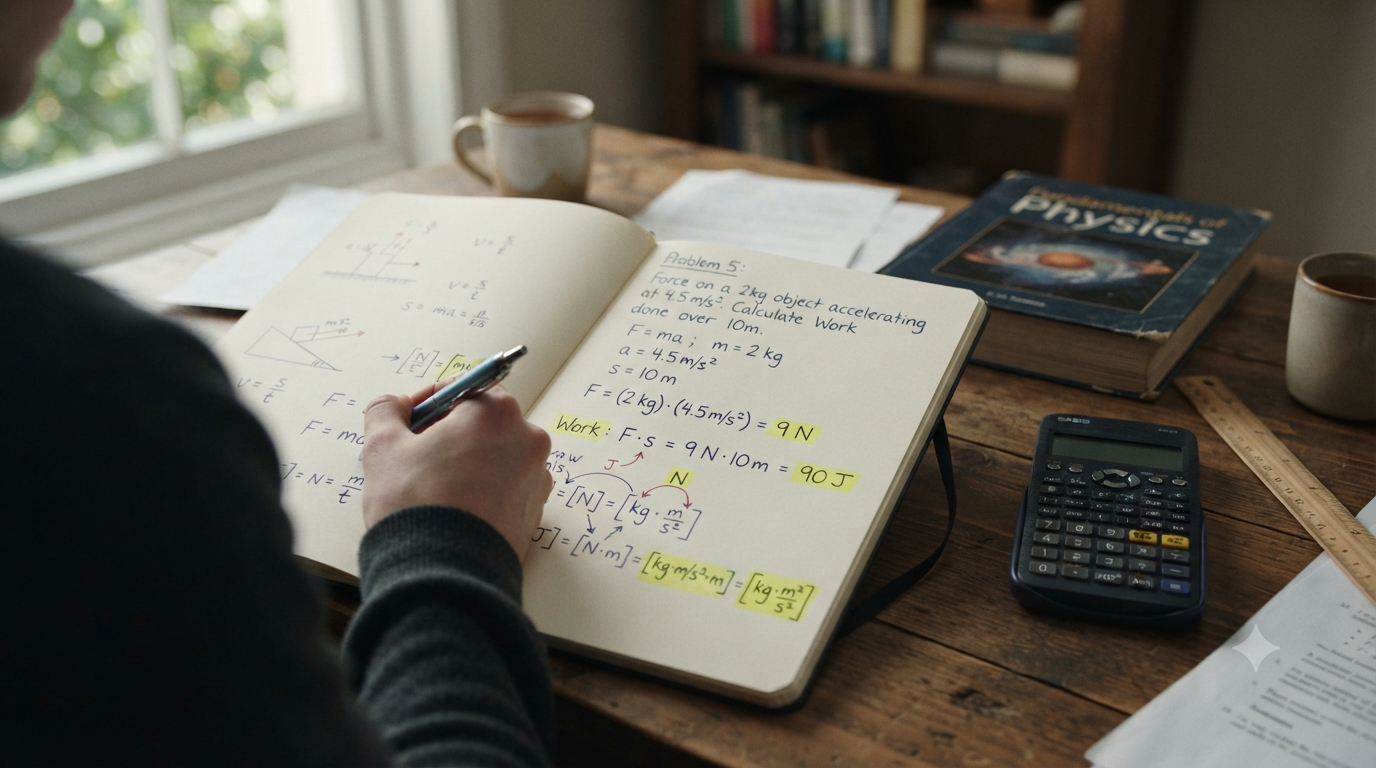
Similarly, force is measured in newtons. One newton can be written as:
1 N = 1 kg·m/s²
This shows that the newton depends on the kilogram, metre, and second. Therefore, it is called a derived SI unit.
The idea behind base units is to provide a small set of independent building blocks rather than creating a separate fundamental unit for every physical quantity.
The Seven SI Base Units
The SI system currently defines seven base units:
| Physical quantity | SI base unit | Symbol |
|---|---|---|
| Time | second | s |
| Length | metre | m |
| Mass | kilogram | kg |
| Electric current | ampere | A |
| Thermodynamic temperature | kelvin | K |
| Amount of substance | mole | mol |
| Luminous intensity | candela | cd |
Each represents a different physical dimension that is considered necessary for the structure of the SI system.
Why Are These Seven Quantities Independent?
The most important reason there are seven base units is independence.
A base quantity should not be expressible in terms of the other base quantities within the SI framework. If one quantity could be completely described using the others, there would be no need to treat it as an additional base quantity.
For example, length and time describe different aspects of physical reality. A metre cannot be expressed simply as a combination of seconds. Likewise, time cannot be replaced by a combination of metres and kilograms.
This independence allows scientists to construct a consistent system in which other quantities can be derived mathematically.
The seven base quantities therefore act like coordinates in the measurement system. They provide the basic dimensions needed to describe a wide range of physical phenomena.
Why Isn’t Force a Base Quantity?
Force is extremely important in physics, so it may seem strange that it is not one of the seven base quantities.
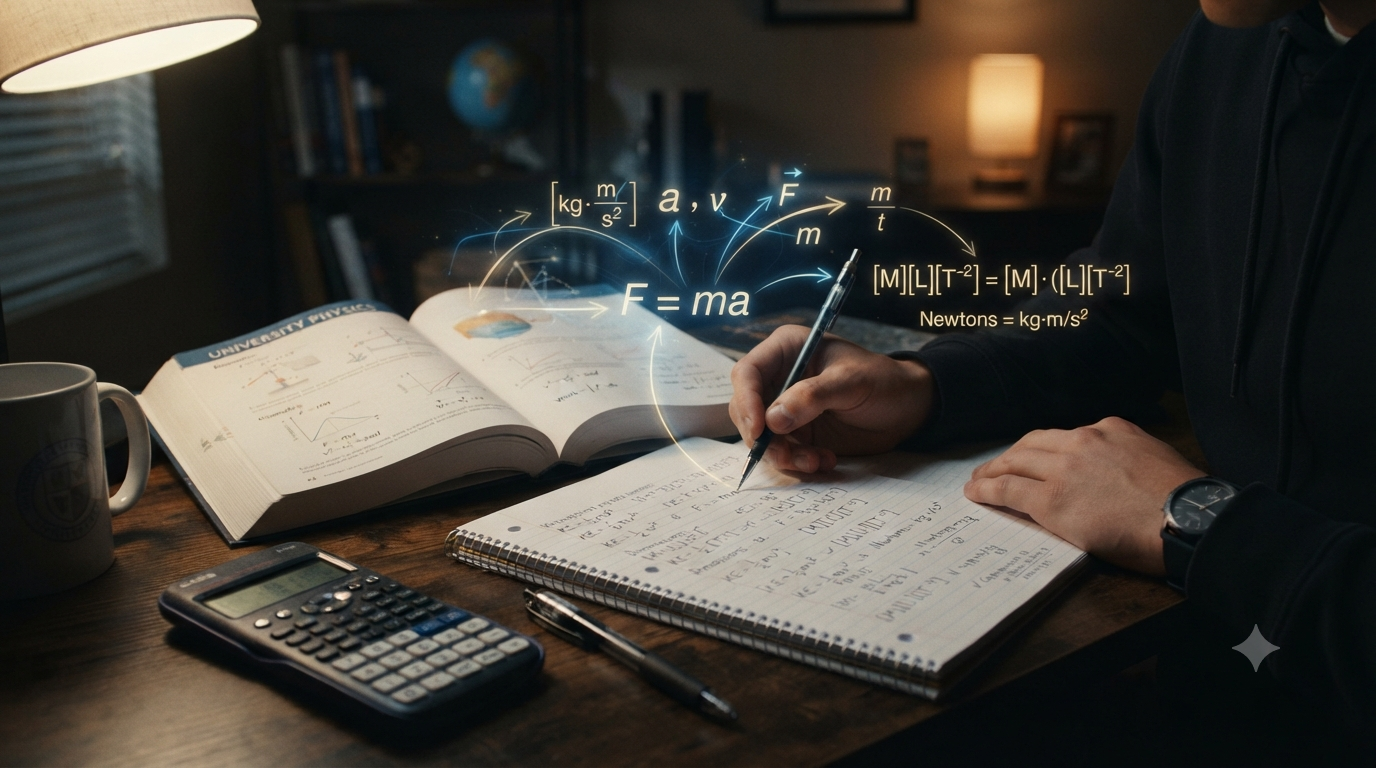
The reason is that force can be described using mass, length, and time through Newton’s second law:
F = ma
Since acceleration is length divided by time squared, force has the dimensions:
[F] = [M][L][T⁻²]
Therefore, the SI unit of force is:
kg·m/s² = newton
Because force can be derived from existing base quantities, it does not need its own base unit.
The same principle applies to quantities such as energy, pressure, power, velocity, and acceleration.
Why Is Mass Represented by the Kilogram?
Mass has a special position among the seven SI base units because the kilogram is the only base unit whose name includes an SI prefix.
The metre is the base unit of length, while the gram is not the SI base unit of mass. Instead, the kilogram is the base unit.
Other mass units can be constructed from the kilogram. For example, a milligram is related to the kilogram through SI prefixes.
The kilogram was historically connected to a physical prototype, but its modern definition is based on a fixed value of the Planck constant. This change makes the unit part of a measurement system based on fundamental constants of nature.
Why Is Temperature a Base Quantity?
Temperature describes the thermal state of matter and is not simply another form of mass, length, or time.
The SI base unit for thermodynamic temperature is the kelvin. Temperature is important in thermodynamics, statistical physics, chemistry, atmospheric science, engineering, and many other fields.
Although temperature is connected to energy at the microscopic level, it is treated as an independent base quantity because its measurement plays a fundamental role in describing thermal systems.
Why Is Electric Current a Base Quantity?
Electricity introduces another fundamental dimension into the SI system.
The SI base unit of electric current is the ampere. Quantities such as electric charge, voltage, resistance, and electrical power can then be expressed using combinations of SI base units.
For example, electric charge can be expressed as:
Q = It
Therefore, its unit is:
coulomb = ampere × second
This demonstrates how an important electrical quantity can be derived from a base quantity and time.
Why Are the Mole and Candela Included?
The mole and candela may seem less familiar than the metre or second, but they serve specific purposes.
The mole is the SI base unit for amount of substance. It is useful because scientists often need to count enormous numbers of microscopic entities such as atoms, molecules, and ions. One mole represents a specified number of elementary entities, based on the Avogadro constant.
The candela is the SI base unit of luminous intensity. It is used to describe the strength of light emitted in a particular direction according to the SI definition of luminous intensity.
These quantities are important in chemistry, physics, lighting, engineering, and other scientific applications.
Why Not Have More Than Seven Base Units?
The SI system does not need a separate base unit for every important physical quantity.
Suppose every quantity had its own base unit. We would need separate fundamental units for force, energy, pressure, velocity, acceleration, power, charge, voltage, resistance, and many others. The system would become unnecessarily complicated.
Instead, SI uses a smaller set of independent base quantities and builds other quantities from them.
For example:
Velocity = length/time
Acceleration = length/time²
Force = mass × length/time²
Energy = mass × length²/time²
Power = mass × length²/time³
This approach keeps the system organized and makes relationships between physical quantities clear.
Could There Be a Different Number of Base Units?
Yes, in principle, the number of base quantities depends on how a measurement system is organized. The choice of seven is not a claim that nature contains exactly seven fundamental properties.
It is a carefully established convention for constructing the SI system.
Scientists could theoretically choose another set of independent quantities and express the remaining quantities differently. However, changing the SI foundation would create major practical problems because science, engineering, manufacturing, education, and international trade all depend on standardized measurements.
The seven-unit structure provides a balance between independence, usefulness, and simplicity.
How the Seven Units Build the SI System
The power of the SI system comes from the relationships among its base units.
From the seven base units, scientists can construct derived units for many physical quantities. Some derived units receive special names.
For example:
Force = newton (N)
Energy = joule (J)
Power = watt (W)
Pressure = pascal (Pa)
Frequency = hertz (Hz)
Each of these can ultimately be expressed using the seven base units.
For example:
1 J = 1 kg·m²/s²
1 W = 1 kg·m²/s³
1 Pa = 1 kg/(m·s²)
This creates a connected system rather than a collection of unrelated units.
The Deeper Idea Behind Seven Base Units
The seven SI base units are best understood as the foundation of a measurement framework, not as seven completely isolated features of nature.
They provide independent dimensions that allow scientists to describe measurements consistently. Once these dimensions are established, mathematical relationships can generate the units of countless other physical quantities.
The system also makes dimensional analysis possible. By examining the dimensions of a quantity, physicists can check whether an equation is physically consistent.
For example, in the equation:
s = ut + ½at²
the terms on the right-hand side all have the dimension of length. This agreement helps confirm that the equation has the correct dimensional structure.
Conclusion
The SI system has exactly seven base units because it uses seven carefully selected independent base quantities as the foundation for a coherent measurement system. These are the second, metre, kilogram, ampere, kelvin, mole, and candela.
The number seven is therefore not arbitrary in the practical design of SI, but it is also not a statement that the universe has exactly seven fundamental properties. The seven quantities were selected because they provide an effective independent foundation from which other physical quantities and units can be derived. This structure keeps scientific measurement consistent, organized, and internationally understandable.
FAQs
The SI system has seven base units because they provide an independent foundation for measuring physical quantities. These units represent seven base quantities: time, length, mass, electric current, thermodynamic temperature, amount of substance, and luminous intensity. Other physical quantities can be expressed by combining these base quantities mathematically. The number seven is therefore a result of how the SI system is designed, rather than a statement that nature has only seven fundamental properties. The seven-unit structure provides a practical balance between simplicity and completeness, allowing scientists worldwide to use a consistent and interconnected measurement system.
The seven SI base units are the second, metre, kilogram, ampere, kelvin, mole, and candela. They correspond respectively to time, length, mass, electric current, thermodynamic temperature, amount of substance, and luminous intensity. These units form the foundation of the International System of Units. Many other units are derived from them. For example, velocity uses metres per second, while force uses kilograms, metres, and seconds. Each base unit has a specific symbol: s, m, kg, A, K, mol, and cd. Together, these seven units provide a standardized framework for scientific measurement used internationally.
Not exactly. The seven SI base units are fundamental within the structure of the SI measurement system, but this does not mean that nature itself contains exactly seven independent fundamental properties. The selection is a scientific convention designed to create a coherent and useful measurement framework. Modern SI definitions are linked to fixed numerical values of fundamental constants, such as the speed of light and the Planck constant. This connects measurements to stable properties of nature. Therefore, the seven base units should be understood as independent foundations of the SI system rather than seven separate building blocks from which the universe itself is constructed.
Force is not an SI base quantity because it can be expressed using other base quantities. Newton’s second law gives the relationship F = ma. Acceleration is length divided by time squared, so force has dimensions of mass multiplied by length divided by time squared. Its SI unit is therefore the newton, which can be written as kg·m/s². Since force can be completely described using the kilogram, metre, and second, it does not require an independent base unit. The same principle applies to many other quantities, including energy, pressure, power, velocity, and acceleration.
The kilogram is the SI base unit of mass because this is how the SI system was historically structured and internationally standardized. Unlike the other base units, the kilogram already contains an SI prefix, “kilo-,” in its name. The gram is not the SI base unit of mass. Units such as the gram and milligram are derived from the kilogram. In the modern SI system, the kilogram is defined using a fixed numerical value of the Planck constant. This allows the definition of mass to be connected to a fundamental constant of nature rather than depending on a physical object.
The second is an SI base unit because time is an independent physical quantity needed to describe change and motion. Many physical processes depend directly on time, including movement, oscillations, radioactive decay, and the operation of electronic systems. The modern SI definition of the second is based on a specific transition frequency of the caesium-133 atom. This provides an extremely stable and reproducible way to define time. Other quantities can then be derived using the second. For example, velocity uses metres per second and acceleration uses metres per second squared, demonstrating how time supports many areas of physics.
Derived units are not treated as base units because they can be expressed mathematically in terms of the seven base units. Creating a separate base unit for every physical quantity would make the measurement system unnecessarily large and complicated. For example, energy has the SI unit joule, but one joule can be expressed as kg·m²/s². Similarly, power is measured in watts, which can be expressed as kg·m²/s³. This approach allows the SI system to remain compact while still describing a huge range of physical quantities. Derived units also clearly show mathematical relationships between different measurements.
The mole and candela are included because they represent important independent quantities within the SI framework. The mole is the base unit for amount of substance and is especially useful for counting microscopic entities such as atoms, molecules, and ions. The candela is the base unit of luminous intensity and is important for describing visible light in a particular direction. Neither quantity is simply replaced by combinations of the other base quantities within the SI structure. Including them allows chemistry, photometry, lighting science, and related fields to express measurements using the same internationally standardized system.
The SI system can be revised when scientists determine that a change would improve its definitions or consistency. However, changing the number of base units would be a major structural decision and is not something done simply for convenience. The modern SI has seven base units because they provide a well-established independent foundation. Scientific organizations periodically review measurement standards and definitions as measurement technology improves. Definitions can change while the overall seven-base-unit structure remains. For example, several SI units were redefined in 2019 using fixed values of fundamental constants, making the system more closely connected to universal physical constants.
The seven base units give scientists a common and coherent language for measurement. Researchers in different countries can describe physical quantities using standardized units, making experimental results easier to compare and reproduce. The base units also allow derived quantities to be expressed consistently. For example, force can be written as kg·m/s², while energy can be written as kg·m²/s². This interconnected structure is useful in physics, chemistry, engineering, astronomy, medicine, and technology. By providing a common foundation, the seven SI base units reduce confusion and help scientists communicate measurements accurately across different fields and countries.
Related Posts
What Do Coefficients Mean in Chemistry Formulas?
When you look at a chemical equation, you may notice numbers written before chemical formulas. These numbers are called coefficients. […]
Read MoreHow to Read Subscripts in Chemical Formulas
Chemical formulas are a simple way to represent substances using symbols and numbers. When you look at a formula such […]
Read MoreHow to Identify Elements in a Chemical Formula
Chemical formulas provide a simple way to describe the substances that make up the world around us. A formula may […]
Read MoreHow Elements Are Represented in Chemical Formulas
Chemistry deals with many different substances, from the oxygen we breathe to the water we drink and the minerals found […]
Read MoreChemical Symbols and Their Role in Chemistry Formulas
Chemistry is often described as the science of matter, but understanding chemistry also means learning how scientists communicate information about […]
Read MoreHow Chemical Formulas Represent Substances
Chemical formulas are one of the simplest ways scientists communicate information about matter. A substance may contain millions or billions […]
Read MoreWhat Is a Chemical Formula in Chemistry?
Chemistry is the study of substances, their properties, and the changes they undergo. To describe these substances clearly, chemists need […]
Read MoreBasic Types of Chemistry Formulas Explained
Chemistry formulas are one of the simplest ways scientists describe substances, reactions, and relationships between different particles. A formula can […]
Read MoreHow to Read and Understand Chemistry Formulas
Chemistry formulas may look like a collection of letters, numbers, and symbols, but they are actually a simple language used […]
Read MoreWhat Are Chemistry Formulas and Why Are They Important?
Chemistry is the science of substances, their properties, and the changes they undergo. To describe these substances clearly, chemists use […]
Read MoreHow to Verify an Answer Using Units
In physics, getting a numerical answer is only part of solving a problem. The next question is whether that answer […]
Read MoreHow to Check Whether a Physics Formula Is Correct
A physics formula is more than a collection of symbols and numbers. It represents a relationship between physical quantities and […]
Read MoreHow to Avoid Unit Conversion Mistakes in Physics
Unit conversion is one of the most common sources of mistakes in physics. A formula may be correct, the calculation […]
Read MoreHow to Avoid Sign Errors in Physics Calculations
Physics calculations are not only about choosing the correct formula and putting numbers into it. The signs of physical quantities […]
Read MoreCommon Mistakes When Using Physics Formulas
Physics formulas help us describe motion, forces, energy, electricity, heat, waves, and many other phenomena using mathematical relationships. A formula […]
Read MoreHow to Study Physics Formulas Step by Step
Physics formulas are an important part of learning physics, but simply memorizing them is not enough. A formula represents a […]
Read MoreHow to Organize Physics Formulas for Easy Revision
Physics becomes much easier when formulas are organized in a clear and meaningful way. Many learners struggle not because they […]
Read MoreHow to Build a Physics Formula Sheet
Physics involves many formulas, and remembering all of them can become difficult as you move from basic concepts to more […]
Read More