Every measurement in science needs a standard unit. Without standard units, it would be difficult to compare measurements made by different people, in different places, or at different times. Imagine measuring the length of a table using one person’s hand span and another person’s hand span. The results could be different even though the table has not changed.
To solve this problem, scientists use the International System of Units, known as the SI system. It provides a common and internationally accepted way to measure physical quantities. At the foundation of the SI system are seven base units. These units represent seven independent physical quantities and are used to build many other units.
Understanding the seven SI base units is therefore important for learning physics, chemistry, engineering, and other sciences.
What Are SI Base Units?
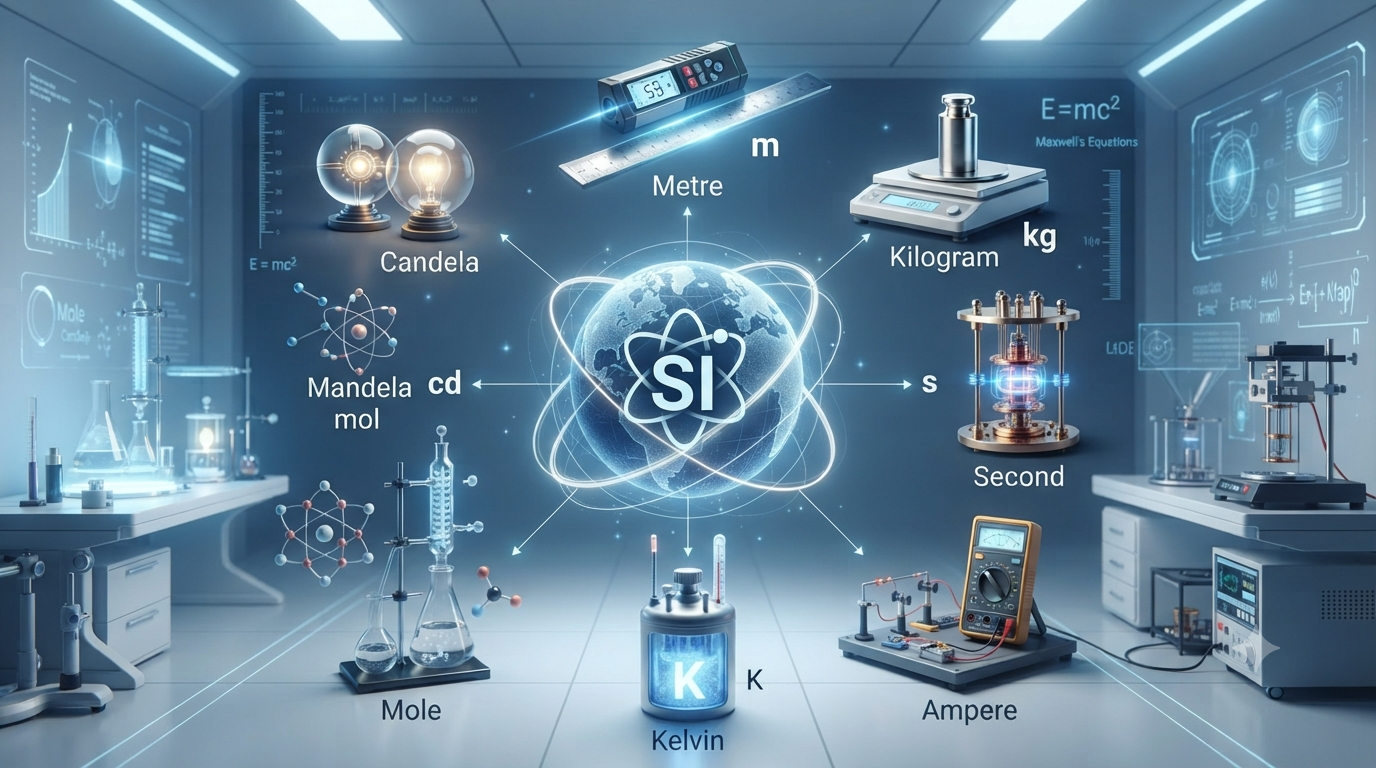
SI base units are the fundamental units of measurement in the International System of Units. They are associated with seven base quantities: length, mass, time, electric current, thermodynamic temperature, amount of substance, and luminous intensity.
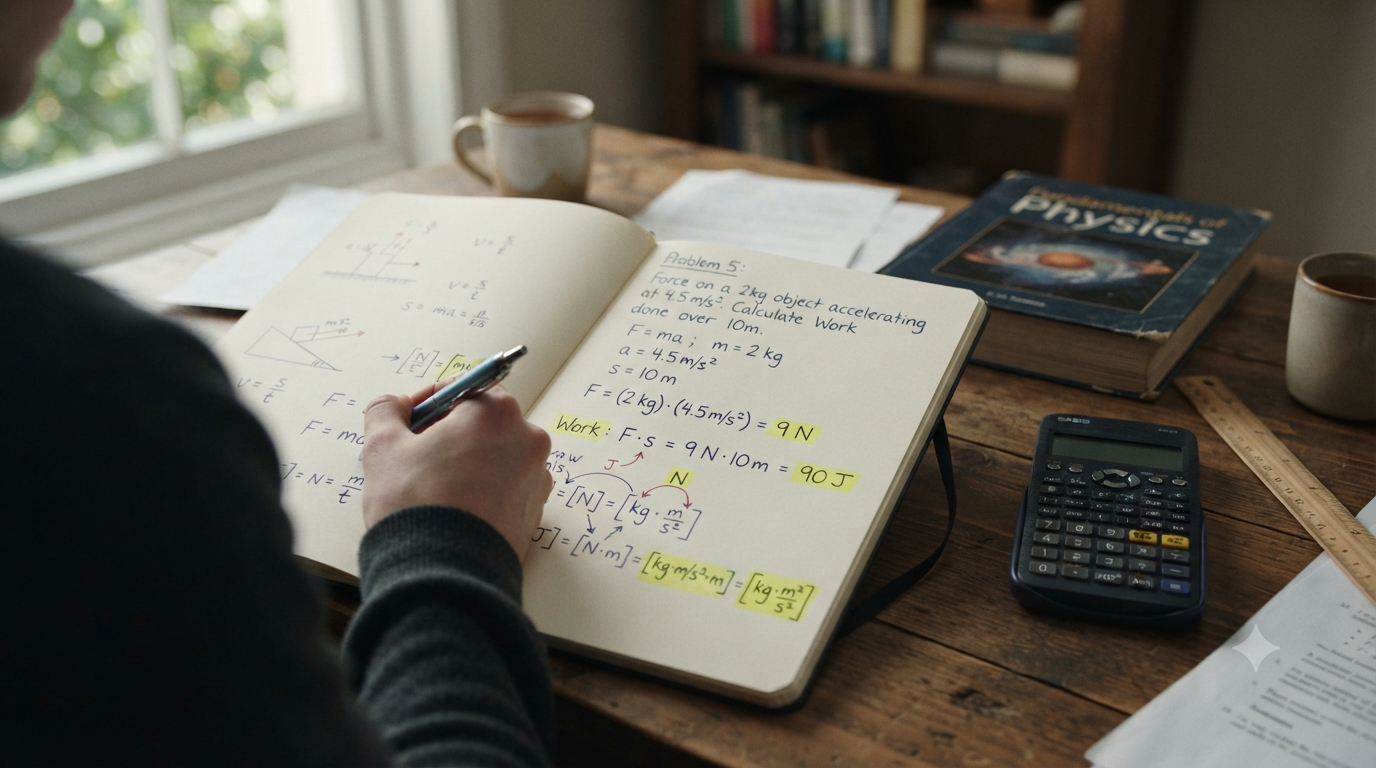
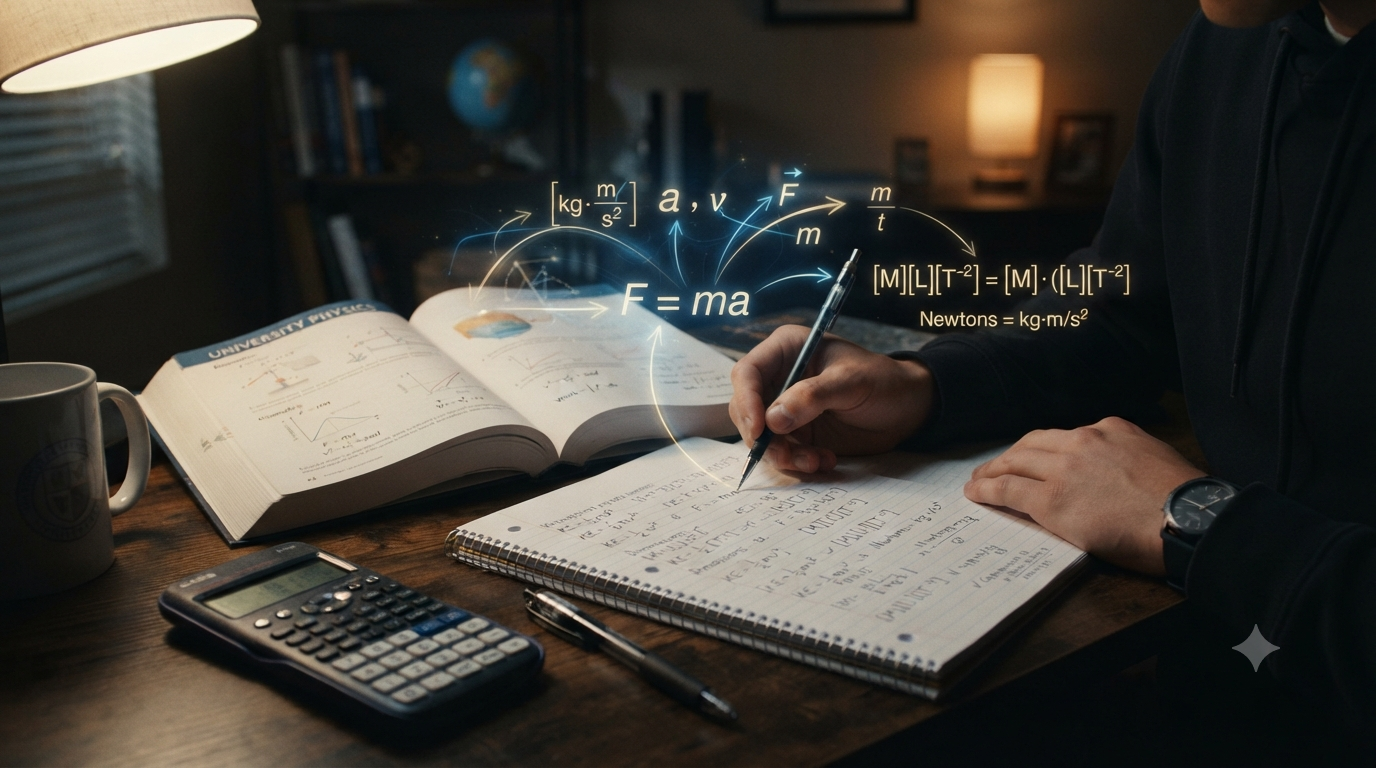
Many familiar units are derived from these seven base units. For example, the unit of speed, metre per second, is formed from the metre and second. Similarly, the unit of force, newton, can be expressed using kilograms, metres, and seconds.
The seven SI base units are:
| Base Quantity | SI Base Unit | Symbol |
|---|---|---|
| Length | metre | m |
| Mass | kilogram | kg |
| Time | second | s |
| Electric current | ampere | A |
| Thermodynamic temperature | kelvin | K |
| Amount of substance | mole | mol |
| Luminous intensity | candela | cd |
Let us understand each of these units with simple examples.
1. Metre for Length
The metre is the SI base unit of length. Length tells us how far apart two points are or how large an object is in one dimension.
The symbol for metre is m.
Length is used in many everyday and scientific measurements. The height of a person, the length of a road, the distance between two objects, and the wavelength of light can all be measured in terms of length.
For example, if a table is 2 metres long, its length can be written as:
Length = 2 m
The metre is also used to construct other units of length. A kilometre is equal to 1000 metres, while a centimetre is one-hundredth of a metre.
In physics, length is particularly important because quantities such as area, volume, displacement, wavelength, and distance are based on it.
2. Kilogram for Mass
The kilogram is the SI base unit of mass. Mass represents the amount of matter in an object and is different from weight, which is a force caused by gravity.
The symbol for kilogram is kg.
For example, if a bag has a mass of 5 kilograms, we write:
Mass = 5 kg
Unlike many other SI base units, the kilogram already includes a prefix in its name. It is the SI base unit itself, rather than the gram.
Mass is used throughout science. The mass of a small object may be measured in grams, while the mass of a vehicle or building may be measured in kilograms or tonnes.
Mass also appears in important physical quantities such as force, momentum, density, and energy.
3. Second for Time
The second is the SI base unit of time. Time helps us describe the duration between events and how quickly physical processes occur.
Its symbol is s.
For example, if a ball takes 4 seconds to reach the ground, we can write:
Time = 4 s
Larger units such as minutes and hours are commonly used in everyday life, but they can be converted into seconds. One minute contains 60 seconds, while one hour contains 3600 seconds.
Time is fundamental to physics because motion, speed, acceleration, frequency, and many other quantities depend on it.
For example, speed can be expressed as:
Speed = distance / time
Its SI unit is metre per second, or m/s, which is derived from the metre and second.
4. Ampere for Electric Current
The ampere is the SI base unit of electric current. Electric current describes the flow of electric charge through a conductor.
Its symbol is A.
For example, a circuit carrying an electric current of 2 amperes can be written as:
Current = 2 A
Electric current is an essential concept in electrical and electronic systems. Household appliances, batteries, motors, generators, and electronic devices all involve electric current.
The ampere is also used when studying electrical quantities such as voltage, resistance, and electric power. Many electrical units are derived from the SI base units.
For example, the SI unit of electric charge is the coulomb, which can be expressed using amperes and seconds:
1 C = 1 A × 1 s
This shows how a derived unit can be connected to SI base units.
5. Kelvin for Thermodynamic Temperature
The kelvin is the SI base unit of thermodynamic temperature. Its symbol is K.
Temperature tells us about the thermal state of a system. In science, thermodynamic temperature is particularly important because it provides an absolute temperature scale.
For example:
Temperature = 300 K
The kelvin scale begins at absolute zero, the theoretical lowest possible temperature. Absolute zero corresponds to approximately −273.15°C.
Kelvin is widely used in physics, chemistry, astronomy, and thermodynamics. Scientists use it when studying gases, thermal energy, radiation, stars, and many other physical processes.
It is important to note that the unit is written as kelvin, not “degree kelvin.” We write 300 K, not 300°K.
6. Mole for Amount of Substance
The mole is the SI base unit of amount of substance. It is represented by the symbol mol.
The mole is especially important in chemistry because atoms, molecules, and other microscopic particles are extremely small and cannot conveniently be counted one by one in ordinary laboratory quantities.
One mole contains exactly 6.02214076 × 10²³ specified elementary entities. This number is known as the Avogadro constant when expressed as a constant with units.
For example, if a sample contains one mole of water molecules, it contains approximately 6.022 × 10²³ water molecules.
The mole allows scientists to connect the microscopic world of atoms and molecules with measurable quantities such as mass.
For example, the molar mass of water is approximately 18 grams per mole. This means that about 18 grams of water contains one mole of water molecules.
7. Candela for Luminous Intensity
The candela is the SI base unit of luminous intensity. Its symbol is cd.
Luminous intensity describes the intensity of visible light emitted by a source in a particular direction.
For example, a light source may have a luminous intensity of several candelas in a particular direction.
The candela is used in photometry, the science of measuring visible light as perceived by the human eye. It is useful when studying lamps, lighting systems, displays, and other sources of visible light.
Luminous intensity is different from total light output. The candela specifically considers light emitted in a particular direction.
How the Seven Base Units Build Other Units
One of the most useful features of the SI system is that many physical units can be derived from the seven base units.
For example, the SI unit of area is the square metre:
Area = m²
The SI unit of volume is the cubic metre:
Volume = m³
Speed has the unit metre per second:
Speed = m/s
Acceleration has the unit metre per second squared:
Acceleration = m/s²
Force has the SI unit newton. A newton can be expressed in terms of base units as:
1 N = 1 kg·m/s²
Energy has the SI unit joule:
1 J = 1 kg·m²/s²
These examples show why understanding the seven base units is so important. Once the base units are understood, many derived units become easier to understand.
Why Are the Seven SI Base Units Important?
The seven SI base units provide a common foundation for scientific measurement. Scientists around the world can use the same units to report experimental results, describe physical laws, manufacture equipment, and communicate scientific information.
They also make it possible to connect different physical quantities mathematically. For example, equations in physics often involve several quantities with different units. By expressing these quantities using SI units, scientists can check whether equations are dimensionally consistent.
SI units are also essential in laboratories, engineering, medicine, technology, industry, and scientific research. Using standardized units reduces confusion and makes measurements easier to compare.
Conclusion
The seven SI base units form the foundation of modern scientific measurement. The metre measures length, the kilogram measures mass, the second measures time, the ampere measures electric current, the kelvin measures thermodynamic temperature, the mole measures amount of substance, and the candela measures luminous intensity.
These seven units are more than just a list to memorize. They provide the foundation from which many other units are derived. By understanding their meanings, symbols, and applications, it becomes much easier to understand measurements, physical equations, and the wider SI system used throughout science and technology.
FAQs
The seven SI base units are the fundamental units used in the International System of Units. They are metre (m) for length, kilogram (kg) for mass, second (s) for time, ampere (A) for electric current, kelvin (K) for thermodynamic temperature, mole (mol) for amount of substance, and candela (cd) for luminous intensity. These units provide the foundation for scientific measurement. Many other units are derived from them. For example, speed is measured in metres per second (m/s), while force is measured in newtons (N), which can be expressed as kg·m/s² using SI base units.
SI base units provide a common measurement system used by scientists, engineers, and researchers around the world. They make measurements consistent and allow results from different experiments and locations to be compared easily. For example, measuring distance in metres and time in seconds allows scientists to calculate speed using a standard unit of metres per second. SI units also make physical equations easier to analyze because derived units can be expressed in terms of base units. This helps scientists check equations, perform calculations, communicate results, and develop technologies using a consistent international measurement system.
The metre (m) is the SI base unit of length. Length describes the distance between two points or the size of an object in one dimension. For example, if a table has a length of 2 metres, its measurement is written as 2 m. Other common length units, such as kilometres, centimetres, and millimetres, are related to the metre. The metre is also used to form derived units. For example, area is measured in square metres (m²), volume in cubic metres (m³), and speed in metres per second (m/s). Length is fundamental to many areas of physics.
The kilogram (kg) is the SI base unit of mass. Mass describes the amount of matter associated with an object and is different from weight, which is a force caused by gravity. For example, an object with a mass of 5 kilograms can be written as 5 kg. The kilogram is unusual because it is the only SI base unit whose name already contains a prefix. Smaller quantities can be expressed using grams and milligrams, while larger quantities may be expressed using tonnes. Mass is important in physics because it appears in quantities such as force, momentum, density, and energy.
The second (s) is the SI base unit of time. Time describes the duration between events and is essential for understanding how physical processes change. For example, if a car takes 10 seconds to travel a particular distance, its travel time is 10 s. Minutes and hours are commonly used in daily life, but they can be converted into seconds. Time is especially important in physics because quantities such as speed, acceleration, frequency, and period depend on it. For example, speed is calculated using distance divided by time and has the SI derived unit metre per second (m/s).
The ampere (A) is the SI base unit of electric current. Electric current describes the rate at which electric charge flows through a circuit. For example, if a circuit carries a current of 3 amperes, it can be written as 3 A. The ampere is widely used in electrical engineering, electronics, and physics. It is also connected to other electrical units. For example, electric charge is measured in coulombs, and one coulomb can be expressed as one ampere-second. Understanding the ampere helps explain how batteries, electrical circuits, motors, generators, and electronic devices operate.
The kelvin (K) is the SI base unit of thermodynamic temperature. It is an absolute temperature scale that begins at absolute zero, the lowest theoretical temperature. For example, a temperature of 300 K is commonly used when describing conditions near room temperature. Unlike Celsius, kelvin measurements are written without a degree symbol, so we write 300 K rather than 300°K. Kelvin is widely used in physics and chemistry, especially when studying thermodynamics, gases, thermal radiation, and astronomical objects. Temperature measurements in kelvin are particularly useful in scientific calculations because the scale is based on absolute zero.
The mole (mol) is the SI base unit of amount of substance. It is used to describe quantities of microscopic particles such as atoms, molecules, ions, and other specified entities. One mole contains exactly 6.02214076 × 10²³ specified elementary entities. This number allows scientists to connect the microscopic world with measurable laboratory quantities. For example, one mole of water contains approximately 6.022 × 10²³ water molecules. The mole is especially important in chemistry, where it is used to calculate molar mass, chemical reactions, concentrations, and the quantities of substances involved in chemical processes.
The candela (cd) is the SI base unit of luminous intensity. Luminous intensity describes the strength of visible light emitted by a source in a particular direction. It is commonly used in photometry, the scientific measurement of visible light. For example, the luminous intensity of a light source can be expressed in candelas. The candela is different from measurements such as total light output because it considers the intensity of light in a specific direction. It is useful in lighting technology, lamp design, displays, optical systems, and other applications where understanding the distribution of visible light is important.
SI derived units are formed by combining the seven SI base units according to physical relationships. For example, speed is distance divided by time, so its SI unit is metre per second (m/s). Acceleration has the unit metre per second squared (m/s²). Force is measured in newtons, and one newton can be expressed as kg·m/s². Similarly, energy is measured in joules, which can be written as kg·m²/s². This relationship shows that the seven base units provide the foundation for many other units used throughout physics, chemistry, engineering, and scientific measurement.
Related Post
What Do Coefficients Mean in Chemistry Formulas?
When you look at a chemical equation, you may notice numbers written before chemical formulas. These numbers are called coefficients. […]
Read MoreHow to Read Subscripts in Chemical Formulas
Chemical formulas are a simple way to represent substances using symbols and numbers. When you look at a formula such […]
Read MoreHow to Identify Elements in a Chemical Formula
Chemical formulas provide a simple way to describe the substances that make up the world around us. A formula may […]
Read MoreHow Elements Are Represented in Chemical Formulas
Chemistry deals with many different substances, from the oxygen we breathe to the water we drink and the minerals found […]
Read MoreChemical Symbols and Their Role in Chemistry Formulas
Chemistry is often described as the science of matter, but understanding chemistry also means learning how scientists communicate information about […]
Read MoreHow Chemical Formulas Represent Substances
Chemical formulas are one of the simplest ways scientists communicate information about matter. A substance may contain millions or billions […]
Read MoreWhat Is a Chemical Formula in Chemistry?
Chemistry is the study of substances, their properties, and the changes they undergo. To describe these substances clearly, chemists need […]
Read MoreBasic Types of Chemistry Formulas Explained
Chemistry formulas are one of the simplest ways scientists describe substances, reactions, and relationships between different particles. A formula can […]
Read MoreHow to Read and Understand Chemistry Formulas
Chemistry formulas may look like a collection of letters, numbers, and symbols, but they are actually a simple language used […]
Read MoreWhat Are Chemistry Formulas and Why Are They Important?
Chemistry is the science of substances, their properties, and the changes they undergo. To describe these substances clearly, chemists use […]
Read MoreHow to Verify an Answer Using Units
In physics, getting a numerical answer is only part of solving a problem. The next question is whether that answer […]
Read MoreHow to Check Whether a Physics Formula Is Correct
A physics formula is more than a collection of symbols and numbers. It represents a relationship between physical quantities and […]
Read MoreHow to Avoid Unit Conversion Mistakes in Physics
Unit conversion is one of the most common sources of mistakes in physics. A formula may be correct, the calculation […]
Read MoreHow to Avoid Sign Errors in Physics Calculations
Physics calculations are not only about choosing the correct formula and putting numbers into it. The signs of physical quantities […]
Read MoreCommon Mistakes When Using Physics Formulas
Physics formulas help us describe motion, forces, energy, electricity, heat, waves, and many other phenomena using mathematical relationships. A formula […]
Read MoreHow to Study Physics Formulas Step by Step
Physics formulas are an important part of learning physics, but simply memorizing them is not enough. A formula represents a […]
Read MoreHow to Organize Physics Formulas for Easy Revision
Physics becomes much easier when formulas are organized in a clear and meaningful way. Many learners struggle not because they […]
Read MoreHow to Build a Physics Formula Sheet
Physics involves many formulas, and remembering all of them can become difficult as you move from basic concepts to more […]
Read More