One of the most important ideas in calculus is the concept of approaching a value. In everyday life, we often describe something as getting closer to a particular point, distance, temperature, or target without necessarily reaching it. For example, a moving car may approach a traffic signal, the temperature of a hot object may approach room temperature, or a sequence of numbers may get closer and closer to a specific number. Calculus uses this idea to understand how quantities behave near a particular value. The concept is especially important when studying limits, continuity, derivatives, and rates of change. Understanding what it means to approach a value makes many calculus problems easier to interpret and solve. In this article, we will explore the meaning of approaching a value, its mathematical representation, practical examples, and its importance in calculus.
What Does Approaching a Value Mean?
In mathematics, approaching a value means getting closer and closer to a particular number without requiring that the number be reached exactly.
Suppose a number is getting closer to 5. It might take the values 4, 4.5, 4.9, 4.99, and 4.999. Each number is closer to 5 than the previous one. The numbers are moving toward 5, even though they may remain slightly below it.
The same idea works from the opposite direction. A sequence such as 6, 5.5, 5.1, 5.01, and 5.001 approaches 5 from above.
In both cases, the numbers become increasingly close to 5. This is the central meaning of approaching a value in calculus.
Important point: Approaching a value does not always mean reaching it. Mathematics can describe what happens as a quantity gets closer to a particular number, even if the quantity never becomes exactly equal to that number.
A Simple Numerical Example
Consider the following values approaching 10 from below.
| Number | Distance from 10 |
|---|---|
| 8 | 2 |
| 9 | 1 |
| 9.5 | 0.5 |
| 9.9 | 0.1 |
| 9.99 | 0.01 |
| 9.999 | 0.001 |
As the values get closer to 10, the distance between each value and 10 becomes smaller.
This pattern illustrates how approaching works. The numbers do not need to arrive at 10 for us to study their behavior near that value.
Understanding Approaching a Value Through Limits
The idea of approaching a value is directly connected to limits, one of the fundamental topics in calculus.
A limit describes the value that a function approaches as its input gets closer to a specified number.
For example, consider the function:
f(x) = x + 2
When x gets closer to 3, the value of the function gets closer to 5.
This can be seen from the following table.
| Input x | Function value f(x) |
|---|---|
| 2 | 4 |
| 2.5 | 4.5 |
| 2.9 | 4.9 |
| 2.99 | 4.99 |
| 2.999 | 4.999 |
As x approaches 3 from below, f(x) approaches 5.
The same result occurs when x approaches 3 from above. For example, if x is 3.1, the function value is 5.1. If x is 3.01, the function value is 5.01. These values also get closer to 5.
The limit is written in standard mathematical notation as:
lim x→3 (x + 2) = 5
This means that as x approaches 3, the expression x + 2 approaches 5.
The notation describes the behavior of the function near a particular input. It does not simply state what happens when the input is exactly equal to that number.
Why Limits Focus on Nearby Values
A limit is concerned with what happens close to a particular point rather than only at the point itself.
For many functions, the value at a point and the limit at that point are the same. However, this is not always true.
A function might be undefined at a particular input while its values on either side approach a clear number. A function might also have a value at that input that differs from the number approached by nearby function values.
This is why calculus studies approaching behavior separately from the actual value of a function.
Approaching a Value From the Left and Right
A quantity can approach a number from two directions. Understanding these directions is essential for evaluating limits.
Approaching From the Left
A value approaches a number from the left when it comes from smaller numbers.
For example, consider values approaching 4 from below:
3, 3.5, 3.9, 3.99, and 3.999.
Each value is smaller than 4, but the distance between the value and 4 becomes increasingly small.
In limit notation, approaching 4 from the left is represented by:
x → 4⁻
The minus sign indicates that x approaches 4 through values smaller than 4. It does not mean that x is necessarily negative.
Approaching From the Right
A value approaches a number from the right when it comes from larger numbers.
For example:
5, 4.5, 4.1, 4.01, and 4.001.
These values are larger than 4 but get closer to it.
In limit notation, approaching 4 from the right is represented by:
x → 4⁺
The plus sign indicates that x approaches 4 through values greater than 4.
Why Both Directions Matter
Consider a function whose graph has different behavior on either side of a particular point. The values approaching that point from the left may move toward one number, while the values approaching from the right may move toward another.
For an ordinary two-sided limit to exist, both one-sided limits must exist and equal the same finite value.
For example, if the left-hand limit is 6 and the right-hand limit is also 6, the two-sided limit is 6.
However, if the left-hand limit is 6 and the right-hand limit is 8, the two-sided limit does not exist.
Therefore, checking both directions helps us determine whether a function approaches a single value.
Approaching Does Not Mean Reaching
One of the most common misunderstandings in calculus is the belief that a quantity must reach a value for that value to be its limit.
In reality, approaching and reaching describe different ideas.
Imagine walking toward a wall. As you move closer, the distance between you and the wall decreases. You can study how the distance changes even before you touch the wall.
A mathematical example makes this distinction clearer.
Consider the function:
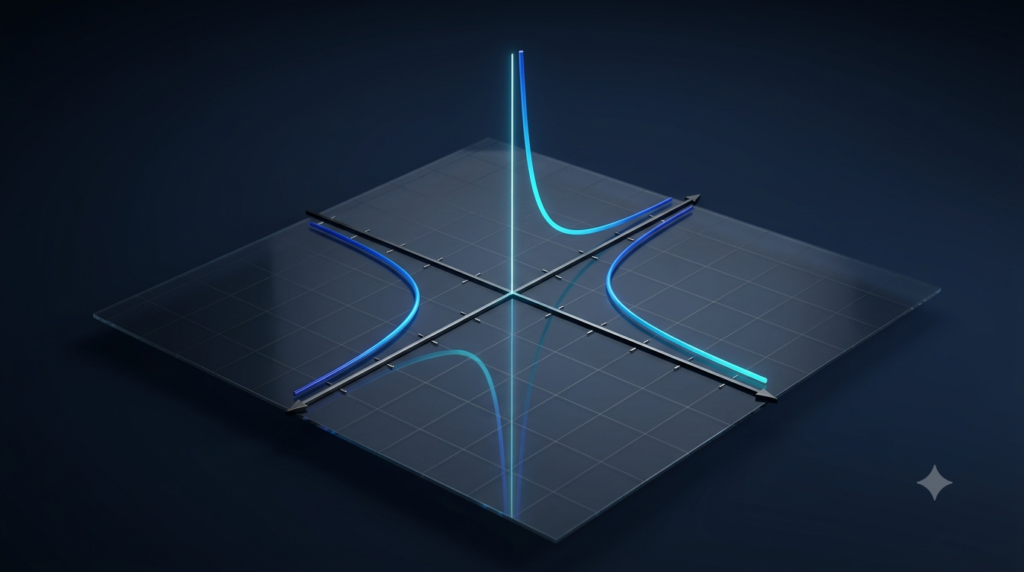
f(x) = 1 ÷ x
As x becomes larger and larger, the value of the function becomes smaller and smaller.
| Value of x | Value of f(x) |
|---|---|
| 10 | 0.1 |
| 100 | 0.01 |
| 1,000 | 0.001 |
| 10,000 | 0.0001 |
The function values approach zero as x increases without bound.
The important distinction is that f(x) remains positive for every positive finite value of x. It does not become exactly zero.
This behavior is described using the limit:
lim x→∞ (1 ÷ x) = 0
Here, x approaches positive infinity, and the function approaches zero.
Infinity is not an ordinary real number that x reaches. It describes a process in which x increases without an upper bound.
This example demonstrates that a limit can describe a value approached by a function even when the function never actually takes that value during the process being considered.
Approaching a Value in a Function
A function establishes a relationship between an input and an output. When the input changes, the output may also change.
The concept of approaching helps us understand what happens to the output when the input gets closer to a particular number.
Consider the function:
f(x) = x²
Suppose x approaches 2. The function values approach 4.
| Input x | Output x² |
|---|---|
| 1.5 | 2.25 |
| 1.9 | 3.61 |
| 1.99 | 3.9601 |
| 2 | 4 |
| 2.01 | 4.0401 |
| 2.1 | 4.41 |
From the left, the output values get closer to 4. From the right, they also get closer to 4.
Therefore, the limit is:
lim x→2 (x²) = 4
In this example, the function is defined at x = 2, and its actual value is 4. The limit and the function value agree.
However, this agreement is not guaranteed for every function. Calculus provides methods for investigating the limit even when direct substitution is not possible or does not reveal the full behavior.
Approaching a Value When a Function Is Undefined
Sometimes, a function is not defined at a particular input, but its values can still approach a definite number near that input.
Consider the function:
f(x) = (x² − 9) ÷ (x − 3)
This expression is undefined when x = 3 because the denominator becomes zero.
However, when x is not equal to 3, the numerator can be factored:
x² − 9 = (x − 3)(x + 3)
Therefore, for x ≠ 3, the function simplifies to:
f(x) = x + 3
As x approaches 3, the function values approach 6.
The corresponding limit is:
lim x→3 [(x² − 9) ÷ (x − 3)] = 6
The function is undefined at x = 3, but the limit exists and equals 6.
This is an important example because it shows that the limit depends on the behavior of the function near the input, not necessarily on the function’s value at that input.
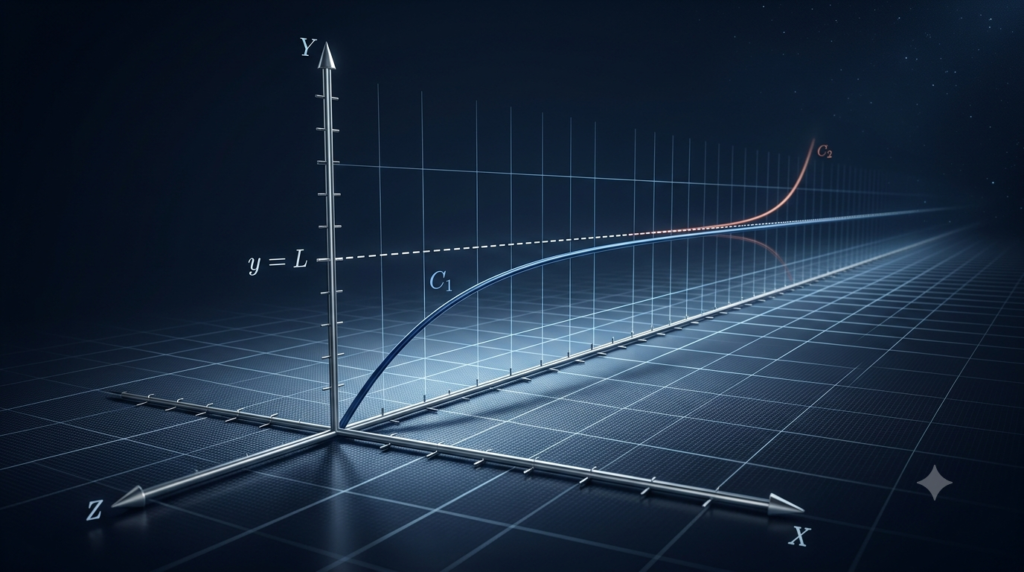
On a graph, this situation can be represented by a curve with a missing point at the location where x = 3 and y = 6. The surrounding curve approaches that point from both directions even though the point itself is absent.
Approaching a Value on a Graph
Graphs provide a visual way to understand approaching behavior.
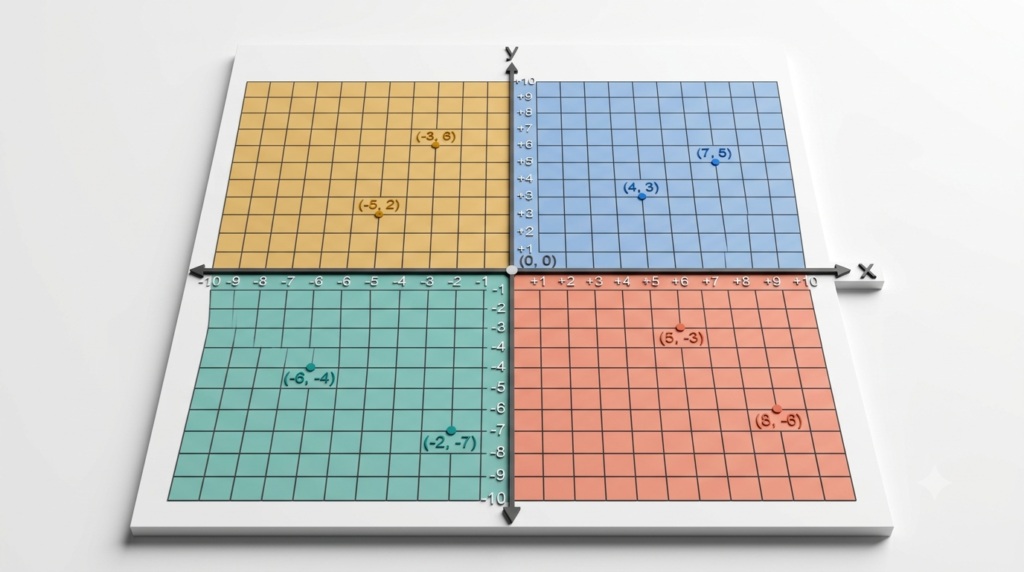
Imagine a curve drawn on a coordinate plane. As you move along the curve toward a particular input, you can observe the corresponding output values.
If the curve gets closer to a height of 7 as the input approaches 2, the function may have a limit of 7 at that input.
There are several possible situations.
A Smooth and Continuous Curve
On a smooth curve, the output usually changes gradually as the input changes. If the curve passes through a point without interruption, the limit at that point generally equals the function’s value.
For example, the graph of f(x) = x + 2 approaches a height of 5 as x approaches 3.
A Curve With a Missing Point
A graph may contain a small gap or an open circle. The curve can approach the same height from both sides even though the point is missing.
The limit can still exist because the nearby values approach a single number.
A Sudden Jump
A graph may approach one height from the left and a different height from the right. In this case, the two-sided limit does not exist.
An Unbounded Curve
Some functions increase or decrease without bound near a particular input. For example, a function may rise indefinitely as x approaches a vertical asymptote.
In such cases, the function does not approach a finite real number. The behavior can still be studied using infinite limits.
These graphical situations demonstrate why understanding the behavior near a point is more important than examining only the point itself.
The Difference Between Approaching a Value and Being Equal to It
Approaching a value and being equal to a value are related but distinct mathematical ideas.
When a quantity is equal to a number, its value is exactly that number. When a quantity approaches a number, it gets closer to that number according to the behavior being studied.
For example, 4.999 is not equal to 5, but it is close to 5. Similarly, 5.001 is also close to 5, although it is slightly greater than 5.
As the difference becomes smaller, the values approach 5.
In calculus, this distinction is important because a limit can exist even if the function’s value at the input is different from the limit or is not defined at all.
Consider a function that approaches 10 from both directions near x = 2. If its actual value at x = 2 is 15, the limit can still be 10, provided the nearby function values approach 10 from both sides.
The limit describes nearby behavior, while the function value describes the output at the exact input.
The Role of Approaching a Value in Derivatives
The concept of approaching a value is essential for understanding derivatives.
A derivative measures the instantaneous rate of change of a function. It tells us how quickly an output changes at a particular input.
To understand this idea, consider the average rate of change between two points on a graph. The slope between these points is calculated by dividing the change in output by the change in input.
For a function f(x), the average rate of change between x and x + h is:
Average rate of change = [f(x + h) − f(x)] ÷ h
Here, h represents the change in the input.
To find the instantaneous rate of change at x, calculus examines what happens as h approaches zero. The two input points become increasingly close, allowing us to investigate the slope at a single point.
The derivative is defined by the limit:
f′(x) = lim h→0 [f(x + h) − f(x)] ÷ h
The condition h ≠ 0 applies while evaluating the difference quotient before taking the limit.
This formula is a direct application of approaching a value. The change in input gets closer to zero, and the corresponding average rate of change may approach a definite number.
For example, consider the function:
f(x) = x²
Using the derivative definition, we obtain:
f′(x) = lim h→0 [(x + h)² − x²] ÷ h
Expanding and simplifying the expression gives:
f′(x) = lim h→0 (2x + h)
As h approaches zero, the expression approaches 2x. Therefore:
f′(x) = 2x
The derivative tells us the instantaneous rate of change of x² at any input x.
This example shows how the idea of approaching a value forms the foundation of differentiation.
Real-Life Applications of Approaching a Value
The concept of approaching a value is not limited to theoretical mathematics. It is useful in science, engineering, economics, and everyday problem-solving.
Motion and Speed
When a vehicle travels along a road, its position changes over time. Calculus uses limits to determine its instantaneous speed at a particular moment.
Instead of measuring the average speed over a long interval, we consider shorter and shorter time intervals. The average speed may approach the instantaneous speed as the interval approaches zero.
Temperature Changes
A hot object placed in a cooler room gradually loses heat. Under suitable conditions, its temperature approaches the surrounding temperature over time.
Mathematical models can describe this process and help predict how quickly the object cools.
Engineering and Design
Engineers use limits when analyzing changing loads, fluid flow, electrical signals, and the behavior of mechanical systems.
Approaching values can help describe what happens when a system operates close to a critical point or when a small change in one variable affects another.
Economics and Business
In economics, models may describe how costs, revenue, or production change as output approaches a particular level.
Limits can help analyze marginal quantities, long-term behavior, and values that a model approaches under specified conditions.
Computer Science
Numerical algorithms often use repeated calculations to approximate a solution. The results may approach a desired value as the number of iterations increases.
This approach is useful in numerical analysis, optimization, simulations, and scientific computing.
These examples demonstrate how the mathematical meaning of approaching a value can help explain real-world changes and support accurate calculations.
Common Mistakes When Learning This Concept
Beginners often make several mistakes when studying approaching values in calculus.
1. Assuming that approaching means reaching
A quantity can get arbitrarily close to a number without becoming exactly equal to it. Limits describe this behavior.
2. Looking only at the exact input
A function’s value at a point does not always determine its limit. The nearby values must also be examined.
3. Ignoring the direction of approach
The behavior from the left may differ from the behavior from the right. Both directions must be checked when evaluating a two-sided limit.
4. Believing that every function has a limit
Some functions approach different values from opposite directions, while others become unbounded or oscillate without approaching a single value. A limit does not always exist.
5. Confusing a very small number with zero
A number such as 0.0001 is close to zero, but it is not zero. This distinction is important when working with limits and derivatives.
Avoiding these mistakes helps build a clearer understanding of calculus and prepares learners for more advanced mathematical concepts.
Conclusion
Approaching a value is a fundamental idea in calculus that describes how a quantity gets closer and closer to a particular number. It helps explain limits, the behavior of functions near specific inputs, and situations in which a function may be undefined at a point while still approaching a definite value. Approaching can occur from the left, from the right, or through values that increase or decrease without bound. The concept also provides the foundation for derivatives, which measure instantaneous rates of change. From motion and temperature changes to engineering and computer science, approaching values helps mathematics describe continuous change. By understanding the difference between approaching a value and reaching it, learners can develop a strong foundation for studying limits, continuity, differentiation, and other essential topics in calculus.
FAQs
1. What does approaching a value mean in calculus?
Approaching a value in calculus means getting closer and closer to a particular number without necessarily reaching it. For example, the numbers 4, 4.9, 4.99, and 4.999 approach 5 from below. Each number is closer to 5 than the previous one. This idea helps mathematicians understand how functions behave near specific inputs. Approaching a value is especially important when studying limits, continuity, and derivatives. It allows us to investigate the behavior of a mathematical expression even when the expression is undefined at a particular point or never actually reaches the value being approached.
2. What is the relationship between approaching a value and limits?
Approaching a value is the central idea behind limits in calculus. A limit describes the number that a function approaches as its input gets closer to a particular value. For example, if f(x) = x + 2, then f(x) approaches 5 as x approaches 3. The limit is written as lim x→3 (x + 2) = 5. This notation describes the behavior of the function near the specified input. The function does not always need to be defined at that input for the limit to exist. Therefore, understanding approaching values makes it easier to understand and evaluate limits.
3. Does approaching a value mean reaching it exactly?
No, approaching a value does not necessarily mean reaching it exactly. A number can get increasingly close to another number while remaining different from it. For example, 4.9, 4.99, and 4.999 approach 5 from below, but none of these numbers equals 5. Calculus uses this idea to study limits and changing quantities. A function may approach a particular number even if it never takes that exact value during the process being considered. However, some functions do reach the value they approach. Whether the value is actually reached depends on the function and the situation being studied.
4. What is the difference between approaching a value from the left and the right?
Approaching a value from the left means using numbers smaller than the target value, while approaching from the right means using numbers greater than it. For example, 3.9 and 3.99 approach 4 from the left, whereas 4.1 and 4.01 approach 4 from the right. In calculus, these directions are represented by x → 4⁻ and x → 4⁺, respectively. Studying both directions helps determine whether a two-sided limit exists. If the function approaches the same value from both sides, the two-sided limit exists, provided the common limit is finite. If the values differ, the two-sided limit does not exist.
5. Can a limit exist when a function is undefined at a point?
Yes, a limit can exist even when a function is undefined at a particular point. A limit depends on the behavior of the function near that point rather than requiring a function value at the exact input. For example, consider f(x) = (x² − 9) ÷ (x − 3). The function is undefined at x = 3 because its denominator becomes zero. However, for other inputs, the expression simplifies to x + 3. As x approaches 3, the function approaches 6. Therefore, the limit exists and equals 6, even though the original function is undefined at that input.
6. Why is approaching a value important in calculus?
Approaching a value is important because it provides the foundation for understanding limits, continuity, and derivatives. Limits describe how functions behave near particular inputs. Continuity examines whether a function behaves without a break at a point, while derivatives measure instantaneous rates of change. These concepts depend on understanding what happens as a quantity gets closer to a specified value. Without this idea, it would be difficult to explain how calculus studies changing quantities and instantaneous behavior. Approaching values is also useful in physics, engineering, economics, and computer science, where mathematical models describe processes that change gradually or approach particular results.
7. How can a graph show that a function approaches a value?
A graph shows approaching behavior through the movement of a curve toward a particular point. As the input gets closer to a specified number, we observe the corresponding output values. If the curve approaches the same height from both sides, that height represents the two-sided limit, provided the common value is finite. The graph may contain a missing point, yet the limit can still exist if the surrounding curve approaches one definite value. However, if the curve approaches different heights from the left and right, the two-sided limit does not exist. Graphs make these behaviors easier to visualize and understand.
8. How is approaching a value used to calculate derivatives?
Calculating derivatives involves examining what happens to the average rate of change as the change in the input approaches zero. The derivative is defined using a limit that compares the change in a function’s output with the change in its input. As the interval becomes smaller, the average rate of change may approach the instantaneous rate of change at a particular point. For example, the derivative of f(x) = x² is f′(x) = 2x. This result can be obtained using the limit definition of a derivative. Therefore, approaching a value is essential for understanding instantaneous speed, slopes of curves, and changing quantities.
9. What happens when a function approaches different values from each side?
When a function approaches different values from the left and right of a particular input, its two-sided limit does not exist. For example, suppose the function approaches 3 from the left but approaches 7 from the right. Since these values are different, the function does not approach one common value at that input. This behavior often occurs in functions with sudden jumps. To determine whether a two-sided limit exists, we must examine both one-sided limits. If both approach the same finite number, the two-sided limit exists. If they approach different numbers, the two-sided limit does not exist.
10. Where is the concept of approaching a value used in real life?
The concept of approaching a value appears in many real-life situations. In physics, it helps calculate instantaneous speed by examining motion over increasingly small time intervals. In science, mathematical models describe how an object’s temperature approaches the surrounding temperature as it cools. Engineers use limits to study changing systems, electrical signals, and fluid behavior. In computer science, numerical methods repeatedly calculate approximations that may approach a desired solution. Economics also uses related mathematical ideas to analyze costs, production, and changing quantities. These applications demonstrate that approaching a value is more than an abstract mathematical concept; it is a useful tool for understanding change and making predictions.