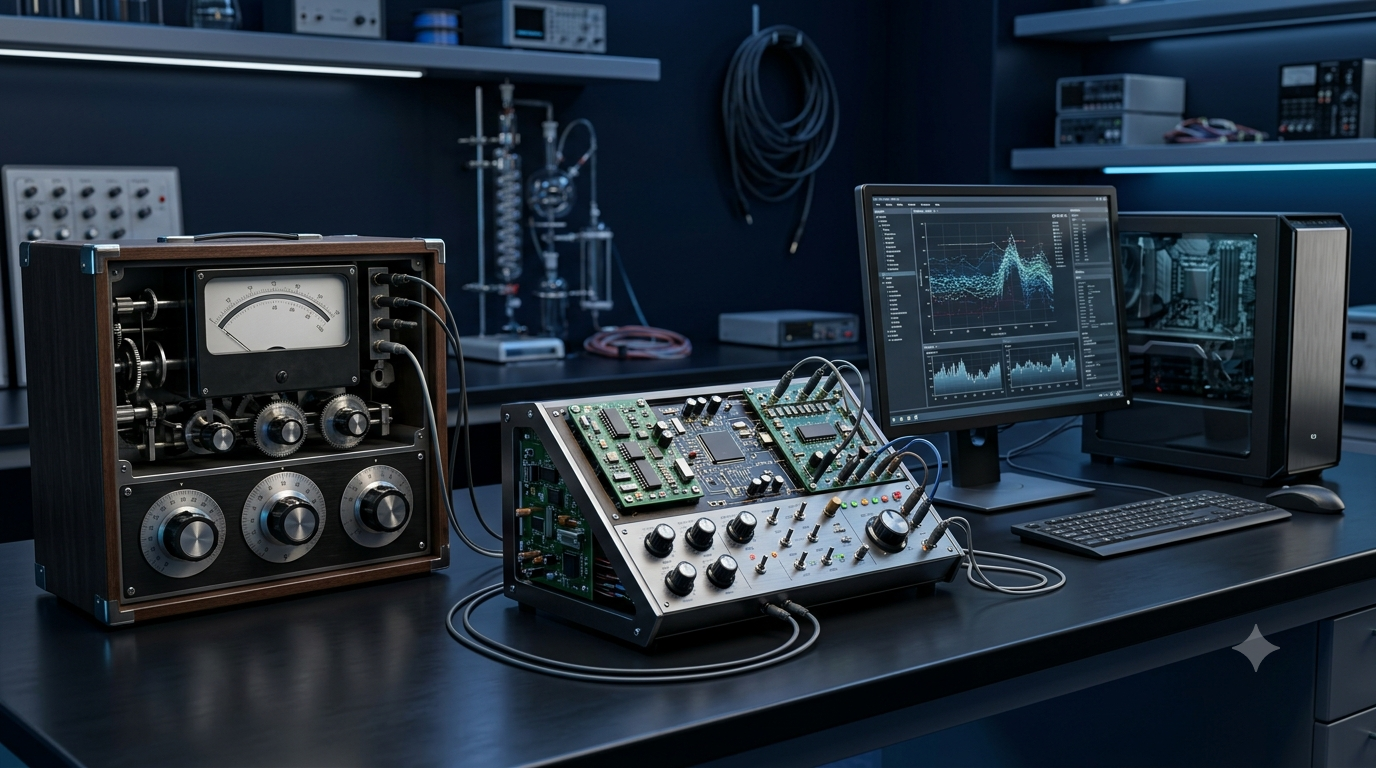
Computers are essential tools in modern life, helping people solve problems, process information, perform calculations, and control machines. Although most people use digital computers such as laptops, desktops, and smartphones, not all computers work in the same way. Based on how they process data, computers can be classified into three main types: analog computers, digital computers, and hybrid computers. Each type has its own operating principles, characteristics, advantages, limitations, and applications.
Analog computers work with continuously changing physical quantities, digital computers process data using discrete values, and hybrid computers combine features of both. Understanding these three types makes it easier to recognize how computers are used in scientific research, healthcare, engineering, industrial automation, and everyday activities. This article explains how analog, digital, and hybrid computers work, how they differ, and where each type is most useful.
What Are Analog Computers?
An analog computer is a type of computer that represents and processes information using continuously changing physical quantities. These quantities may include voltage, electric current, temperature, pressure, speed, or mechanical movement. Instead of representing information as separate numerical values, an analog computer uses changes in a physical signal to represent changes in the system being studied.
For example, a traditional analog speedometer represents a vehicle’s speed through the movement of a needle across a graduated scale. Similarly, certain electronic analog computing systems use electrical voltages to represent mathematical variables and perform calculations.
Analog computers are particularly useful when studying systems that change continuously over time. They have historically been important in scientific experiments, engineering calculations, aircraft control systems, and simulations of physical processes.
How Do Analog Computers Work?
Analog computers operate by establishing a relationship between a physical quantity and the information being represented. For instance, an electrical voltage may represent the temperature of a system or the speed of an object.
When the physical quantity changes, the corresponding signal changes as well. The computer uses these changes to perform calculations or represent the behavior of a system.
Traditional electronic analog computers use circuits containing components such as operational amplifiers, resistors, capacitors, and other electronic elements. These circuits can perform mathematical operations such as addition, integration, and differentiation.
For example, an analog circuit can be designed to represent how the position of a moving object changes over time. By connecting appropriate circuits, engineers can model more complicated physical systems.
Unlike digital computers, which generally process information through discrete binary states, analog computers work with continuously varying signals. However, physical limitations such as electrical noise, component tolerances, and measurement uncertainty can affect the accuracy of their results.
Characteristics of Analog Computers
Analog computers have several distinctive characteristics:
Continuous data processing: They represent changing quantities through continuous physical signals.
Real-time response: Many analog systems respond directly to changes in their inputs.
Physical representation: Information may be represented through voltage, current, rotation, pressure, or another measurable quantity.
Specialized operation: Traditional analog computers are often designed for particular calculations or physical models.
Limited precision: Their accuracy depends on the quality of components, measurement methods, and environmental conditions.
Direct interaction with physical systems: They can be useful for modeling or controlling processes that change continuously.
These characteristics make analog computing useful for specific engineering and scientific applications, even though digital computers are more common today.
Examples of Analog Computers
Several familiar devices and specialized systems illustrate analog computing principles.
1. Analog speedometer
A traditional needle-based speedometer displays vehicle speed through the movement of a pointer. The pointer’s position corresponds to the measured speed. Although modern speedometers may use digital electronics internally, a traditional mechanical or electromechanical speedometer illustrates analog representation.
2. Analog voltmeter
An analog voltmeter measures electrical potential difference and displays the result through a moving needle. The pointer moves continuously according to the measured voltage.
3. Differential analyzer
A differential analyzer is a historical mechanical analog computer designed to solve differential equations. It used rotating shafts, wheels, and mechanical components to represent mathematical relationships.
4. Electronic analog computers
These computers use electronic circuits to model physical systems and perform mathematical operations. They have been used in engineering research, control-system design, and the simulation of dynamic processes.
5. Analog control systems
Certain industrial control systems use continuously varying signals to regulate temperature, pressure, speed, or other physical quantities. Such systems demonstrate how analog processing can support automatic control.
Advantages of Analog Computers
Analog computers offer several advantages in suitable applications.
They can respond continuously to changing inputs.
Some analog circuits perform particular operations with very low latency.
They can model physical systems directly.
They are useful for understanding the behavior of continuously changing processes.
Specialized analog circuits may consume relatively little power when performing particular tasks.
They can support real-time control in appropriately designed systems.
Limitations of Analog Computers
Despite their benefits, analog computers have important limitations.
Their precision is affected by noise and component variations.
Storing and reproducing results accurately can be difficult.
Reconfiguring a complex analog computing system may require changes to its circuits.
They are generally less convenient than digital computers for general-purpose data processing.
Their results may require calibration and careful interpretation.
Scaling a system to handle many different calculations can be challenging.
Because of these limitations, traditional analog computers are now used less frequently for general computing. Nevertheless, analog electronics remain important in measurement, communication, control, and specialized computing applications.
What Are Digital Computers?
A digital computer is a computer that processes data using discrete values, most commonly represented by binary digits called bits. A bit can have one of two logical values, conventionally represented as 0 and 1.
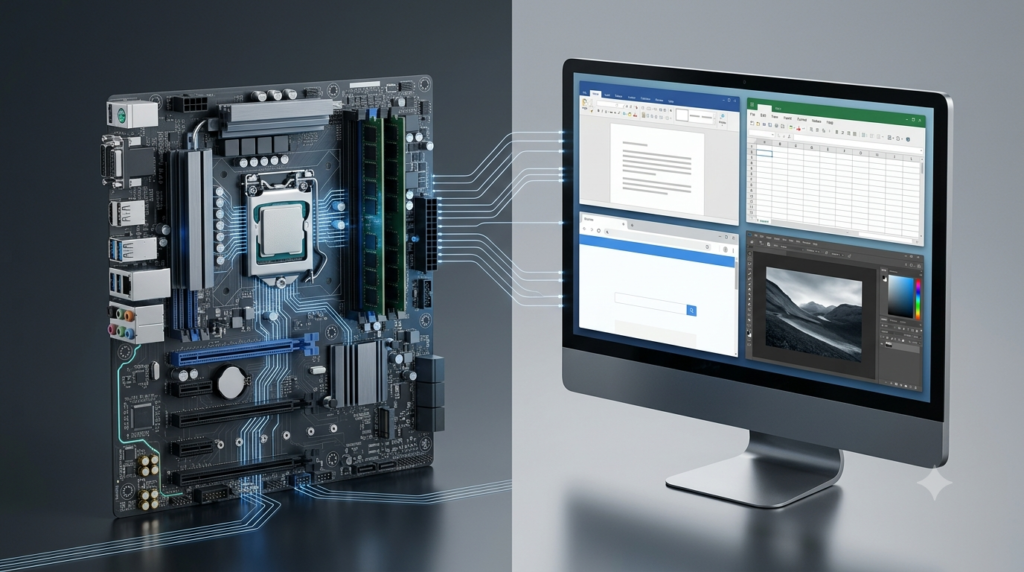
Modern desktops, laptops, tablets, smartphones, servers, and most embedded computing devices are digital computers. They use electronic circuits to represent binary information and execute instructions through hardware and software.
Digital computers are designed to perform many different tasks, including mathematical calculations, document editing, internet browsing, database management, image processing, and scientific simulations.
Their flexibility, reliability, storage capabilities, and ability to execute complex programs have made them the dominant form of general-purpose computing.
How Do Digital Computers Work?
Digital computers receive data through input devices, process it according to instructions, store information when required, and produce output.
At the hardware level, digital circuits represent and manipulate binary states. A computer’s processor executes instructions, while memory stores data and programs. Storage devices preserve information for later use.
For example, when a person enters two numbers into a calculator application, the computer receives the input, processes the values according to the program’s instructions, and displays the result.
Digital computers also use software to control their operations. An operating system manages resources, while application programs perform specific tasks.
The binary system is fundamental to digital computing because electronic circuits can be designed to distinguish between two logical states. These states are commonly represented as 0 and 1, although their physical implementation depends on the hardware.
For example, a simplified binary representation of the decimal number 5 is:
Text block:
Decimal number = 5
Binary representation = 101
Here, the binary digits represent the same numerical value using base 2 rather than base 10.
Digital computers use binary representations for numbers, characters, images, audio, video, and other forms of information. Complex programs can therefore process many different kinds of data using the same underlying digital principles.
Characteristics of Digital Computers
Digital computers have several important characteristics.
Discrete data processing: They process information as distinct values represented through digital states.
High precision: They can produce highly repeatable results when the program, data, and hardware are correct, subject to numerical representation and rounding limitations.
Programmability: They can execute different programs without requiring a complete redesign of the hardware.
Large storage capacity: They can store substantial amounts of data and retrieve it when needed.
Automation: They can perform repetitive tasks automatically according to programmed instructions.
Versatility: They support a wide range of applications, from entertainment to scientific research.
Reliable data reproduction: Digital information can often be copied without the gradual degradation associated with repeated copying of some analog signals.
Digital computers are especially effective when tasks require complex instructions, large datasets, precise data manipulation, and flexible software.
Examples of Digital Computers
Digital computers are found in homes, workplaces, schools, hospitals, factories, and research facilities.
1. Desktop computers
Desktop computers are used for office work, programming, gaming, graphic design, education, and other activities. They generally consist of a processor, memory, storage, input devices, and output devices.
2. Laptops
Laptops provide portable digital computing. They support activities such as online learning, document preparation, software development, communication, and multimedia editing.
3. Smartphones
Smartphones are compact digital computers that combine processing, memory, storage, communication, cameras, sensors, and touchscreen interfaces.
4. Supercomputers
Supercomputers perform extremely demanding calculations for applications such as climate modeling, scientific simulations, engineering research, and large-scale numerical analysis.
5. Embedded computers
Embedded computers are built into devices such as washing machines, traffic controllers, digital cameras, and automotive systems. They perform specific functions within larger products.
Advantages of Digital Computers
Digital computers offer many advantages.
They provide flexible, general-purpose computing.
They can store and process large amounts of information.
They support complex mathematical calculations and logical operations.
Their results can be reproduced reliably when the same conditions apply.
They can execute programs automatically at high speed.
They support networking and digital communication.
They can process text, numerical data, images, sound, and video.
They can be updated or extended through software.
These advantages make digital computers suitable for most modern information-processing tasks.
Limitations of Digital Computers
Digital computers also have certain limitations.
They require electrical power or another suitable energy source.
Their processing speed and storage capacity depend on hardware resources.
Digital measurements of continuous physical quantities require suitable sensors and analog-to-digital conversion.
Numerical calculations may introduce rounding errors or overflow when values exceed the available representation.
Complex computing tasks may require substantial energy, cooling, and infrastructure.
Their operation depends on correctly designed hardware and software.
Digital computers can model continuous processes, but their models use numerical representations and may require approximations when dealing with real-world physical quantities.
What Are Hybrid Computers?
A hybrid computer combines analog and digital computing techniques in one system. It uses analog components to handle continuously varying signals and digital components to process discrete data, perform logical operations, store information, or control the overall process.
Hybrid computing is particularly useful when a system must measure or respond to physical quantities while also performing digital calculations and decision-making.
For example, a patient monitoring system may receive continuously changing signals from medical sensors. Electronic circuits condition these signals, and digital processors analyze the measurements, identify patterns, and display the results. Such systems can contain both analog and digital components, although not every device with both types of electronics is formally classified as a hybrid computer.
Traditional hybrid computers were developed for specialized scientific, medical, and industrial applications. They combined the real-time behavior of analog computing with the programmability and data-processing capabilities of digital computing.
How Do Hybrid Computers Work?
A hybrid computer typically uses analog and digital components for different parts of a task.
The analog section receives or processes continuously changing signals. These may represent temperature, pressure, electrical activity, speed, or another physical quantity.
The digital section processes numerical data, executes instructions, stores information, and performs logical operations. Depending on the system, analog-to-digital converters transform analog signals into digital values. Digital-to-analog converters can convert digital results into analog signals when needed.
Consider an industrial temperature-control system. A sensor measures temperature, and an analog circuit may condition the sensor signal. An analog-to-digital converter then provides numerical measurements to a digital processor. The processor compares the measured temperature with a target value and calculates the necessary control action. The system may then use a digital-to-analog converter or another suitable output interface to control a heater or cooling device.
The combined system can monitor a continuously changing physical process while using software to make decisions.
Not every hybrid system follows exactly this arrangement. The design depends on the application’s requirements, the types of signals involved, and the desired speed and precision.
Characteristics of Hybrid Computers
Hybrid computers have several important characteristics.
Combined processing methods: They use analog and digital techniques within a coordinated system.
Real-time measurement: They can process signals from physical processes as those processes change.
Digital programmability: Their digital components can execute instructions and make decisions based on measured information.
Signal conversion: Many systems use analog-to-digital and digital-to-analog converters.
Specialized design: They are often developed for particular scientific, medical, or industrial tasks.
Integrated operation: Analog signal processing and digital computation work together to achieve a common objective.
Their main strength is the ability to connect physical measurements with digital analysis and control.
Examples of Hybrid Computers
Hybrid computing principles appear in several specialized applications.
1. Medical monitoring systems
Medical equipment may measure continuously changing physiological signals and use digital processing to display measurements, identify irregularities, or support clinical assessment. Electrocardiogram equipment, for example, commonly combines analog signal acquisition with digital processing.
However, modern medical monitors are not all formally classified as hybrid computers. The term is most appropriate when discussing systems that meaningfully combine analog and digital computing functions.
2. Industrial process-control systems
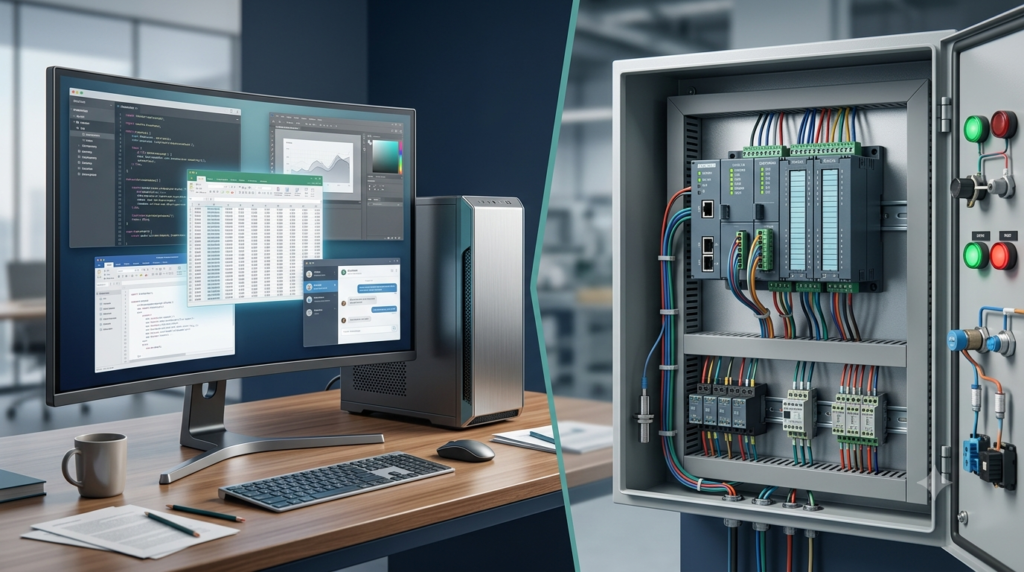
Factories use control systems to monitor physical quantities such as temperature, pressure, flow rate, and liquid level. Analog circuits can condition sensor signals, while digital processors execute control algorithms and record operating data.
3. Scientific simulation systems
Some specialized systems combine analog processing of dynamic physical behavior with digital calculations. Such arrangements can be useful for studying complicated processes in engineering and research.
4. Flight simulation and control applications
Specialized flight simulators and control systems may combine continuous physical models, electronic signal processing, and digital computation. The exact architecture varies depending on whether the system is intended for simulation, testing, or operational control.
5. Power-system monitoring
Electrical power systems involve continuously varying electrical signals. Monitoring and control equipment may combine analog measurement circuits with digital processors that analyze conditions and support protection or control functions.
Advantages of Hybrid Computers
Hybrid computers provide several benefits when analog and digital processing are both useful.
They can handle continuous physical signals and digital information within one system.
They support real-time monitoring and control.
They combine specialized analog processing with programmable digital analysis.
They can help connect physical processes with automated decision-making.
They are useful for applications that require both measurement and computation.
They can provide a practical balance between fast signal handling and flexible data processing.
Limitations of Hybrid Computers
Hybrid computers also have disadvantages.
Their design can be more complicated than that of a system using only one computing approach.
They may require specialized hardware and technical expertise.
Analog-to-digital conversion introduces limitations related to sampling, resolution, and measurement accuracy.
Calibration and maintenance can be demanding in some applications.
Integration between analog and digital components can increase development costs.
The best design depends heavily on the specific task, so hybrid systems are not always necessary.
A hybrid computer is most beneficial when combining analog and digital techniques solves a real technical problem. For tasks that do not need this combination, a conventional digital computer may be simpler and more economical.
Difference Between Analog, Digital, and Hybrid Computers
Analog, digital, and hybrid computers differ mainly in how they represent information and perform computations. Understanding these differences helps explain why different computing approaches are suitable for different applications.
| Feature | Analog Computer | Digital Computer | Hybrid Computer |
|---|---|---|---|
| Basic principle | Processes continuous quantities | Processes discrete values | Combines analog and digital processing |
| Data representation | Physical signals such as voltage or movement | Binary digits, usually 0 and 1 | Continuous signals and digital values |
| Processing | Based on continuous signal relationships | Based on digital instructions and logic | Uses both processing approaches |
| Accuracy | Affected by noise and component tolerances | Depends on numerical representation, hardware, and software | Depends on analog and digital components |
| Programmability | Often limited in traditional designs | Generally highly programmable | Depends on the digital section and overall design |
| Storage | Often limited or specialized | Supports extensive digital storage | Usually uses digital storage for data |
| Typical applications | Specialized measurement, simulation, and control | General computing, data processing, and communication | Scientific instrumentation, medical monitoring, and industrial control |
| Complexity | Varies by application | Varies from simple devices to large systems | Can be more complex because of integration |
| Flexibility | Often specialized | High for general-purpose systems | Flexible within its intended application |
The most important distinction is that analog computers represent continuously changing quantities, digital computers process discrete information, and hybrid computers combine both approaches.
Applications of Analog, Digital, and Hybrid Computers
Different computing methods are suitable for different problems. Their applications depend on the type of data, required accuracy, response time, and complexity of the task.
Applications of Analog Computers
Analog computing principles are useful in systems that deal directly with continuously varying signals.
Measurement instruments: Analog meters display electrical quantities through continuously moving indicators.
Electronic circuits: Analog circuits amplify, filter, and process signals from sensors.
Control engineering: Analog controllers can regulate physical processes using continuously varying signals.
Scientific modeling: Specialized analog computing systems can represent dynamic physical relationships.
Communication systems: Analog signal-processing techniques are used in radio-frequency and other electronic circuits.
Applications of Digital Computers
Digital computers are used in nearly every area of modern society.
Education: They support online learning, digital libraries, simulations, and educational software.
Business: They manage accounts, inventory, communication, and business records.
Healthcare: They maintain medical records, analyze diagnostic data, and support medical imaging.
Science: They perform numerical calculations, process experimental data, and run scientific simulations.
Communication: They support email, messaging, video calls, and internet services.
Manufacturing: They control machines, manage production processes, and monitor equipment.
Entertainment: They power video games, streaming services, animation, and digital media production.
Applications of Hybrid Computers
Hybrid systems are especially useful where physical measurement and digital decision-making must work together.
Healthcare: They support systems that measure physiological signals and digitally analyze them.
Industrial automation: They monitor physical variables and control machinery.
Engineering: They combine signal processing with digital calculations for testing and control.
Power systems: They help monitor electrical conditions and support automated protection.
Scientific instruments: They combine sensor signals with digital analysis and data storage.
Process monitoring: They support the observation and control of continuously changing industrial processes.
These examples demonstrate that no single computing approach is ideal for every task. The appropriate design depends on what needs to be measured, calculated, stored, or controlled.
Why Are Digital Computers More Common Today?
Digital computers dominate modern computing because they are versatile, programmable, and well suited to storing and processing large amounts of information.
A single digital computer can perform many different tasks simply by running different software. A laptop, for example, can be used for writing documents, editing images, conducting scientific calculations, managing databases, and communicating over the internet.
Digital information can also be stored, copied, transmitted, and checked using established techniques. Modern semiconductor technology has made digital processors increasingly powerful and compact, supporting everything from small embedded devices to large data centers.
Another important advantage is the digital ecosystem. Operating systems, programming languages, communication standards, and software applications allow digital devices to work together efficiently.
However, analog computing has not disappeared. Electronic systems still rely on analog components to interact with real-world signals. Many modern digital devices use analog-to-digital converters, digital-to-analog converters, amplifiers, and filters.
Hybrid approaches also remain valuable when continuous signals must be measured and processed alongside digital information. Therefore, the widespread use of digital computers does not eliminate the need for analog or hybrid techniques.
Role of Analog, Digital, and Hybrid Computers in Modern Technology
Modern technology frequently combines the strengths of different computing methods.
A digital thermometer, for instance, uses a sensor to detect temperature. The sensor may produce an analog electrical signal, which is converted into a digital value. A processor then calculates or interprets the temperature and displays it on a screen.
Similarly, an automobile may contain digital processors for engine management, navigation, and driver assistance while relying on analog circuits to condition signals from physical sensors.
Medical instruments may acquire continuously changing biological signals and use digital algorithms to analyze them. Industrial automation systems may measure pressure and flow while running digital control software.
These examples show that the distinction between analog, digital, and hybrid computing is useful for understanding how systems operate, but real-world devices often combine several technologies. A product containing both analog and digital electronics is not automatically a hybrid computer in the traditional sense. The classification depends on its computing architecture and the way its components work together.
As technology advances, specialized analog computing, digital processing, and mixed-signal systems continue to develop. Each approach serves a different purpose, and engineers select the most suitable architecture according to the requirements of the application.
Conclusion
Analog, digital, and hybrid computers represent three important approaches to computing. Analog computers process continuously changing physical quantities and are useful for specialized signal-processing, measurement, and control tasks. Digital computers process discrete information, usually represented in binary form, and provide the flexibility required for most modern computing applications. Hybrid computers combine analog and digital techniques to connect continuous physical processes with programmable computation.
Although digital computers are the most common type today, analog and hybrid technologies remain important in engineering, healthcare, scientific instruments, and industrial automation. Understanding how these systems differ helps explain how computers interact with the physical world, process information, and solve different kinds of problems. The best computing approach depends on the task, the nature of the data, the required accuracy, and the performance needs of the system.
FAQs
1. What is an analog computer?
An analog computer is a type of computer that processes information using continuously changing physical quantities, such as voltage, current, temperature, pressure, or movement. It represents data through physical signals rather than discrete binary values. Analog computers are useful for modeling continuous processes, performing specialized calculations, and supporting real-time control systems. Examples include traditional mechanical computing devices, electronic analog computers, and certain specialized control systems. However, many modern devices that display analog measurements use digital electronics internally, so an analog display alone does not necessarily mean the entire device is an analog computer.
2. What is a digital computer?
A digital computer is an electronic computing device that processes information using discrete values, usually represented as binary digits called bits. Each bit has a logical value of 0 or 1. Digital computers execute programmed instructions to perform calculations, store information, process data, and produce results. Common examples include desktop computers, laptops, smartphones, tablets, servers, and supercomputers. Digital computers are widely used because they are programmable, versatile, and capable of handling different types of information, including text, images, sound, and video. Their performance depends on factors such as processor speed, memory, storage, and software.
3. What is a hybrid computer?
A hybrid computer combines analog and digital computing techniques within one system. Its analog components can handle continuously changing signals, while its digital components process numerical data, execute instructions, and store information. This combination is useful when a system must measure physical quantities and perform digital analysis or control. Hybrid computing principles are applied in specialized scientific instruments, industrial automation, and medical monitoring equipment. For example, a system may measure a continuously changing physiological signal and use digital processing to analyze it. However, not every device containing both analog and digital electronics is formally classified as a hybrid computer.
4. What is the main difference between analog and digital computers?
The main difference between analog and digital computers is how they represent and process information. Analog computers use continuously changing physical quantities, such as voltage or mechanical movement, to represent data. Digital computers process discrete values, generally represented using binary digits 0 and 1. Analog computers can be useful for specialized real-time modeling and signal processing, while digital computers are better suited to general-purpose tasks such as programming, data storage, document editing, and complex calculations. Digital computers generally offer greater flexibility, whereas analog systems can be advantageous for particular continuous-processing applications.
5. What is the main difference between digital and hybrid computers?
A digital computer processes information using discrete digital values and programmed instructions. A hybrid computer combines digital processing with analog computing techniques to handle both discrete information and continuously changing quantities. Digital computers are commonly used for general-purpose activities such as browsing the internet, running software, and managing databases. Hybrid systems are especially useful when digital analysis must work alongside continuous measurement, simulation, or control. For example, a specialized monitoring system may process sensor signals and use a digital processor to analyze the measurements. The main distinction is the integration of analog and digital computing functions within a hybrid architecture.
6. What are some examples of analog computers?
Examples of analog computing include traditional mechanical differential analyzers, electronic analog computers, and specialized systems that use continuous electrical signals to represent mathematical variables. Analog measurement instruments, such as needle-based voltmeters and certain speedometers, also illustrate analog representation, although they are not necessarily general-purpose computers. Analog circuits are widely used for signal amplification, filtering, and control. These applications demonstrate how continuously varying physical quantities can represent and process information. The exact classification depends on the system’s design and purpose, because an analog instrument and a complete analog computer are not always the same thing.
7. What are some examples of digital computers?
Common examples of digital computers include desktop computers, laptops, smartphones, tablets, servers, and supercomputers. These devices process information using digital circuits and programmed instructions. Desktop computers and laptops support office work, education, programming, and entertainment. Smartphones combine computing with communication, photography, navigation, and internet access. Servers manage websites, databases, and online services, while supercomputers perform demanding scientific calculations and simulations. Embedded digital computers are also found in household appliances, vehicles, and industrial equipment. These examples show that digital computers are not limited to traditional personal computers but are integrated into many technologies used in everyday life.
8. Where are hybrid computers used?
Hybrid computers and hybrid computing systems are useful in applications that combine continuous physical measurements with digital processing. They can be found in specialized medical monitoring, industrial process control, scientific instrumentation, engineering research, and certain power-system applications. For example, industrial equipment may measure temperature or pressure using sensors, convert the signals into digital data, and use a processor to determine the appropriate control action. Medical equipment may similarly acquire physiological signals and analyze them digitally. These systems help connect the physical world with automated computation. The exact hardware architecture varies, and not every modern monitoring or control device is formally considered a hybrid computer.
9. Why are digital computers more widely used than analog computers?
Digital computers are more widely used because they are flexible, programmable, and capable of performing many different tasks with the same hardware. They can store large amounts of information, execute complex software, process different data types, and communicate through computer networks. Digital information can also be copied and transmitted reliably when suitable error-control methods are used. Modern semiconductor technology has made digital computers powerful, compact, and relatively affordable for many applications. Analog computers remain useful for specialized continuous-processing tasks, but they are generally less convenient for general-purpose computing. As a result, digital systems dominate personal computing, business, education, and information technology.
10. Can a computer combine analog and digital technologies?
Yes, many modern electronic systems combine analog and digital technologies. Sensors often produce continuously varying electrical signals, which analog circuits can amplify or filter before an analog-to-digital converter transforms them into digital values. A digital processor can then analyze the data, perform calculations, and make decisions. If the system needs to produce a continuously varying output, a digital-to-analog converter may convert digital results into an analog signal. This arrangement is common in measurement equipment, communication devices, industrial control, and medical instrumentation. However, a system that merely contains analog and digital components is not automatically classified as a hybrid computer.