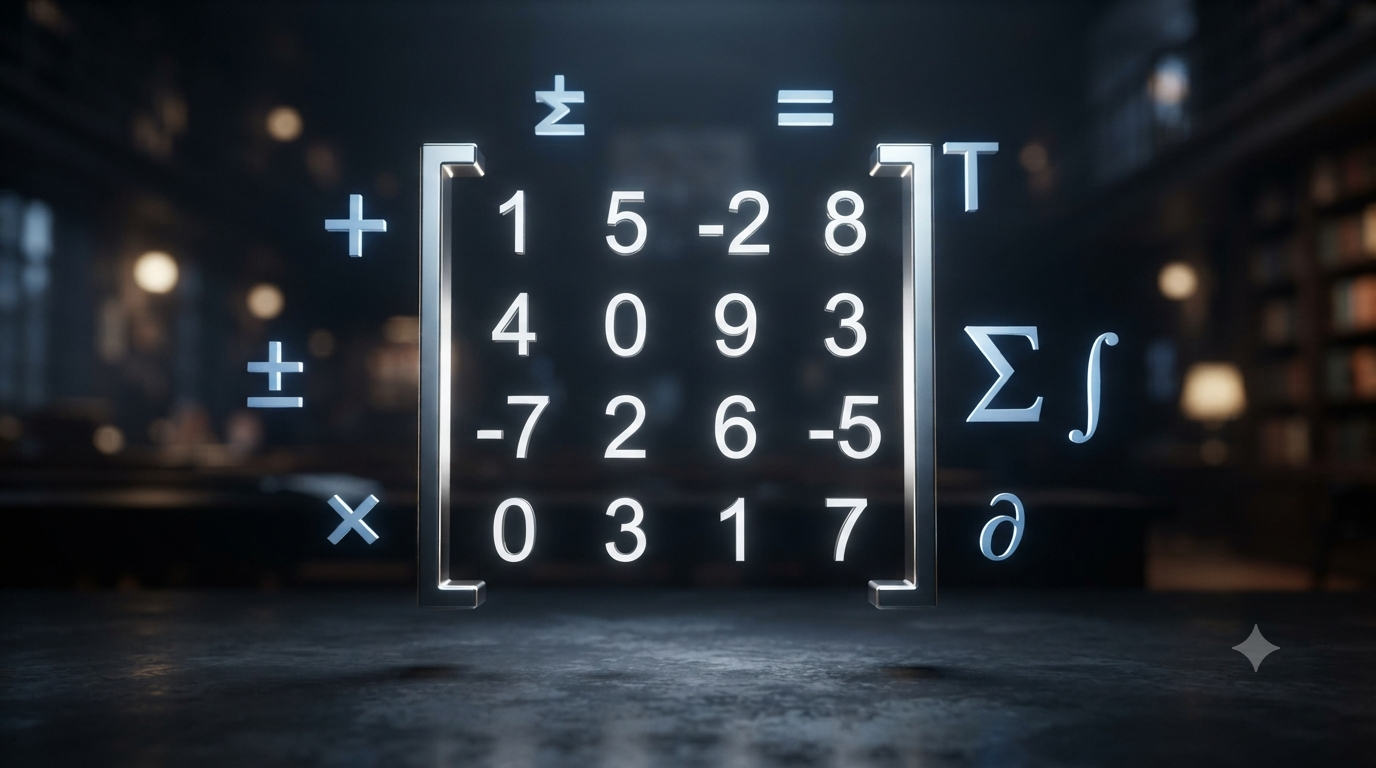
Matrices are an important part of mathematics because they provide a simple way to organize numbers and work with large amounts of information. A matrix can represent data, equations, transformations, relationships, and many other mathematical quantities in a compact form. Matrix operations are also widely used in physics, computer science, engineering, statistics, economics, graphics, and many areas of applied mathematics.
Learning the basic matrix formulas and operations begins with understanding how matrices are written, how their order is determined, and how their elements are handled. The most common operations include matrix addition, subtraction, scalar multiplication, matrix multiplication, and transpose. Basic concepts such as determinants and inverse matrices are also important because they are used when solving systems of linear equations.
In this article, you will learn the fundamental matrix formulas and operations in a clear and practical way, with simple examples to make the concepts easier to understand.
What Is a Matrix?
A matrix is a rectangular arrangement of numbers, symbols, or mathematical expressions organized into rows and columns. Each individual value in a matrix is called an element or entry.
For example, consider the following matrix:
This matrix has 2 rows and 2 columns. Therefore, its order is 2 × 2. The number 2 in the first row and first column is one element, while 5 is in the first row and second column.
General Form of a Matrix
A matrix is commonly represented by a capital letter such as A, B, or C. If a matrix has m rows and n columns, its order is written as m × n.
The general notation for an element is aij, where i represents the row number and j represents the column number.
The total number of elements in an m × n matrix is:
Number of elements = m × n
Types of Matrices
There are several common types of matrices. Understanding them makes later matrix operations easier.
Row Matrix
A matrix containing only one row is called a row matrix.
Its order is 1 × 3.
Column Matrix
A matrix containing only one column is called a column matrix.
Its order is 3 × 1.
Square Matrix
A matrix having the same number of rows and columns is called a square matrix. Examples include 2 × 2, 3 × 3, and 4 × 4 matrices.
Zero Matrix
A matrix in which every element is zero is called a zero matrix.
Diagonal Matrix
A square matrix in which all elements outside the main diagonal are zero is called a diagonal matrix.
Identity Matrix
An identity matrix is a square matrix with 1s on the main diagonal and 0s everywhere else.
The identity matrix is usually represented by I.
Equality of Matrices
Two matrices are equal when they have the same order and their corresponding elements are equal.
If matrices A and B are equal, then:
A = B
This means that every corresponding element of A and B must have the same value.
Matrix Addition
Two matrices can be added only when they have the same order. To add matrices, add their corresponding elements.
Suppose:
and:
Then:
The general formula is:
(A + B)ij = aij + bij
Matrix Subtraction
Matrix subtraction also requires matrices of the same order. Each element of one matrix is subtracted from the corresponding element of the other matrix.
The general formula is:
(A − B)ij = aij − bij
For example:
minus:
gives:
Scalar Multiplication
A scalar is an ordinary number. Scalar multiplication means multiplying every element of a matrix by the same number.
For example, multiplying a matrix by 3 gives:
by 3:
The formula is:
(kA)ij = k aij
where k is a scalar.
Matrix Multiplication
Matrix multiplication is different from ordinary element-by-element multiplication. Two matrices can be multiplied only when the number of columns in the first matrix equals the number of rows in the second matrix.
If matrix A has order m × n and matrix B has order n × p, then their product AB has order:
m × p
For example, consider:
and:
The product is found by multiplying rows of the first matrix by columns of the second matrix.
The general formula for matrix multiplication is:
(AB)ij = Σ aikbkj
This means that each element of the product is obtained by multiplying corresponding row and column elements and then adding the results.
Important Properties of Matrix Multiplication
Associative Property
Matrix multiplication is associative when the dimensions of the matrices allow the operations:
(AB)C = A(BC)
Distributive Property
Matrix multiplication distributes over matrix addition:
A(B + C) = AB + AC
Similarly:
(A + B)C = AC + BC
Matrix Multiplication Is Not Generally Commutative
Unlike ordinary numbers, matrices generally do not satisfy the commutative property of multiplication.
AB ≠ BA
In some special cases AB and BA may be equal, but this cannot be assumed for arbitrary matrices.
Transpose of a Matrix
The transpose of a matrix is obtained by changing its rows into columns and its columns into rows. The transpose of matrix A is written as AT or Aᵀ.
For example:
Its transpose is:
Important transpose formulas include:
(AT)T = A
(A + B)T = AT + BT
(AB)T = BTAT
Symmetric Matrix
A square matrix is called a symmetric matrix when it is equal to its transpose.
AT = A
For example:
The elements on opposite sides of the main diagonal are equal.
Skew-Symmetric Matrix
A square matrix is called a skew-symmetric matrix when its transpose is equal to the negative of the original matrix.
AT = −A
For a skew-symmetric matrix, all diagonal elements are zero.
Determinant of a 2 × 2 Matrix
The determinant is a special value associated with a square matrix. For a 2 × 2 matrix:
the determinant is:
|A| = ad − bc
The determinant is useful for finding the inverse of a matrix and solving systems of linear equations.
Inverse of a 2 × 2 Matrix
If a square matrix has a non-zero determinant, it may have an inverse. For a 2 × 2 matrix:
its inverse is:
A−1 = 1/(ad − bc)
The inverse exists only when:
ad − bc ≠ 0
An important identity involving the inverse is:
AA−1 = A−1A = I
Matrix Form of Linear Equations
Matrices provide a convenient way to represent and solve systems of linear equations. A system of equations can often be written in the form:
AX = B
where A is the coefficient matrix, X is the column matrix containing the unknown variables, and B is the column matrix containing the constants.
If A has an inverse, the solution can be written as:
X = A−1B
This approach is particularly useful when working with several simultaneous linear equations.
Important Matrix Formulas
The following formulas summarize many of the basic results used in matrix operations:
- Order of a matrix: m × n
- Number of elements: m × n
- Matrix addition: (A + B)ij = aij + bij
- Matrix subtraction: (A − B)ij = aij − bij
- Scalar multiplication: (kA)ij = k aij
- Matrix multiplication: (AB)ij = Σ aikbkj
- Transpose: (AT)T = A
- Transpose of a sum: (A + B)T = AT + BT
- Transpose of a product: (AB)T = BTAT
- Symmetric matrix: AT = A
- Skew-symmetric matrix: AT = −A
- 2 × 2 determinant: |A| = ad − bc
- Inverse condition: ad − bc ≠ 0
- Inverse identity: AA−1 = A−1A = I
- Identity property: AI = IA = A
- Inverse of a product: (AB)−1 = B−1A−1
Common Rules to Remember
Several simple rules can prevent mistakes when performing matrix operations.
- Matrix addition and subtraction require matrices of the same order.
- Scalar multiplication affects every element of the matrix.
- For matrix multiplication, the number of columns in the first matrix must equal the number of rows in the second.
- The order of AB is determined by the outside dimensions after matching the inside dimensions.
- Matrix multiplication is generally not commutative.
- The transpose changes rows into columns.
- Only square matrices have determinants.
- A matrix has an inverse only when it is square and its determinant is non-zero.
- The identity matrix acts like 1 in matrix multiplication.
Applications of Matrices
Matrices are not limited to theoretical mathematics. They are used in many practical fields. In physics, matrices can represent transformations, coordinate systems, and quantum mechanical quantities. In computer graphics, matrices are used to rotate, scale, translate, and transform objects.
Computer science uses matrices in algorithms, image processing, machine learning, data analysis, and computer vision. Engineers use them for systems of equations, structural analysis, electrical circuits, and control systems. Economists and statisticians can also use matrices to organize and analyze large collections of data.
Because matrices can store and process many related quantities at once, they are especially useful when a problem contains several variables and equations.
Why Basic Matrix Operations Matter
Basic matrix operations form the foundation for more advanced topics in linear algebra. Addition and subtraction teach how corresponding elements are handled, while scalar multiplication shows how an entire matrix can be changed by a single number. Matrix multiplication introduces a more structured operation based on rows and columns.
Transpose, determinants, and inverse matrices build another important part of matrix theory. These ideas are later used in systems of linear equations, vector spaces, transformations, eigenvalues, eigenvectors, and many applications of linear algebra.
A strong understanding of the basic rules is therefore more useful than simply memorizing formulas. When you understand why an operation is performed in a particular way, it becomes easier to work with larger and more complicated matrices.
Conclusion
Matrices provide an organized way to represent numbers, equations, and relationships in mathematics. The basic operations include addition, subtraction, scalar multiplication, matrix multiplication, and transpose. Important concepts such as symmetric matrices, determinants, inverse matrices, and identity matrices build on these fundamental operations.
The most important point to remember is that different matrix operations have different conditions. Addition and subtraction require matrices of the same order, while multiplication depends on compatible dimensions. Understanding these rules and practicing simple examples provides a strong foundation for studying linear algebra and its many applications in science, mathematics, engineering, and technology.
FAQs
1. What is a matrix in mathematics?
A matrix is a rectangular arrangement of numbers, symbols, or mathematical expressions organized into rows and columns. Each individual value in a matrix is called an element or entry. The size of a matrix is described by its order, such as 2 × 2 or 3 × 3. The first number represents the number of rows, while the second represents the number of columns. Matrices are used to organize information and solve mathematical problems involving multiple quantities. They have important applications in algebra, physics, engineering, computer science, statistics, economics, data analysis, and many other fields.
2. What is the order of a matrix?
The order of a matrix describes its number of rows and columns. It is written as m × n, where m represents the number of rows and n represents the number of columns. For example, a matrix with 3 rows and 2 columns has an order of 3 × 2. The order also helps determine which operations can be performed on matrices. A matrix with 4 rows and 5 columns contains 4 × 5 = 20 elements. Therefore, knowing the order of a matrix is one of the first steps when working with matrix operations.
3. How do you add two matrices?
Two matrices can be added only when they have the same order. Matrix addition is performed by adding corresponding elements. For example, if one matrix has 2 in its first position and another matrix has 5 in the same position, their sum contains 7 in that position. The same process is applied to every corresponding pair of elements. If A and B are matrices, their addition is written as A + B. The general rule is (A + B)ij = aij + bij. Matrix addition is therefore an element-by-element operation.
4. What is matrix subtraction?
Matrix subtraction is similar to matrix addition, but corresponding elements are subtracted instead of added. Two matrices can be subtracted only if they have the same order. For example, if corresponding elements are 9 and 4, subtracting the second matrix from the first gives 5. This process is repeated for every position in the matrices. If A and B are matrices, their difference is written as A − B. The general formula is (A − B)ij = aij − bij. The order of the resulting matrix remains the same as the original matrices.
5. What is scalar multiplication of a matrix?
Scalar multiplication means multiplying every element of a matrix by the same ordinary number, called a scalar. For example, if a matrix contains 2, 4, 6, and 8 and it is multiplied by 3, each element becomes 6, 12, 18, and 24 respectively. If the scalar is represented by k, the operation can be written as kA. The general formula is (kA)ij = k aij. Scalar multiplication does not change the order of the matrix. It only changes the values of its elements.
6. When can two matrices be multiplied?
Two matrices can be multiplied when the number of columns in the first matrix is equal to the number of rows in the second matrix. If matrix A has order m × n and matrix B has order n × p, then the product AB exists and has order m × p. Matrix multiplication is performed by multiplying the elements of each row of the first matrix by the corresponding elements of a column of the second matrix and then adding the products. This dimension rule must always be checked before performing matrix multiplication.
7. What is the transpose of a matrix?
The transpose of a matrix is obtained by changing its rows into columns and its columns into rows. The transpose of matrix A is written as AT. For example, if the first row of a matrix contains 1, 2, and 3, these values become the first column of its transpose. Similarly, the second row becomes the second column. An important property is (AT)T = A. Another important formula is (AB)T = BTAT. Transpose operations are widely used in linear algebra and matrix calculations.
8. What is the determinant of a 2 × 2 matrix?
The determinant is a special numerical value associated with a square matrix. For a 2 × 2 matrix containing the elements a, b, c, and d, the determinant is calculated using the formula |A| = ad − bc. This means that the product of the elements on the main diagonal is found first, followed by the product of the other diagonal elements. The second product is then subtracted from the first. Determinants are important for finding matrix inverses, studying properties of square matrices, and solving systems of linear equations.
9. When does a matrix have an inverse?
A square matrix has an inverse when its determinant is non-zero. For a 2 × 2 matrix with elements a, b, c, and d, the determinant is ad − bc. Therefore, its inverse exists when ad − bc ≠ 0. The inverse of a matrix A is written as A−1. When the inverse exists, multiplying the matrix by its inverse gives the identity matrix: AA−1 = A−1A = I. Matrix inverses are particularly useful when solving systems of linear equations using matrix methods.
10. What are the main applications of matrices?
Matrices are used in many areas of mathematics, science, and technology. In computer graphics, they help perform transformations such as rotation, scaling, and translation. In physics and engineering, matrices are used to represent equations, transformations, and systems of related quantities. Computer science uses matrices in algorithms, image processing, machine learning, data analysis, and computer vision. Matrices are also useful in statistics, economics, and scientific computing for organizing and processing large amounts of information. Learning basic matrix operations provides a foundation for more advanced topics such as linear algebra, eigenvalues, eigenvectors, and matrix-based computational methods.