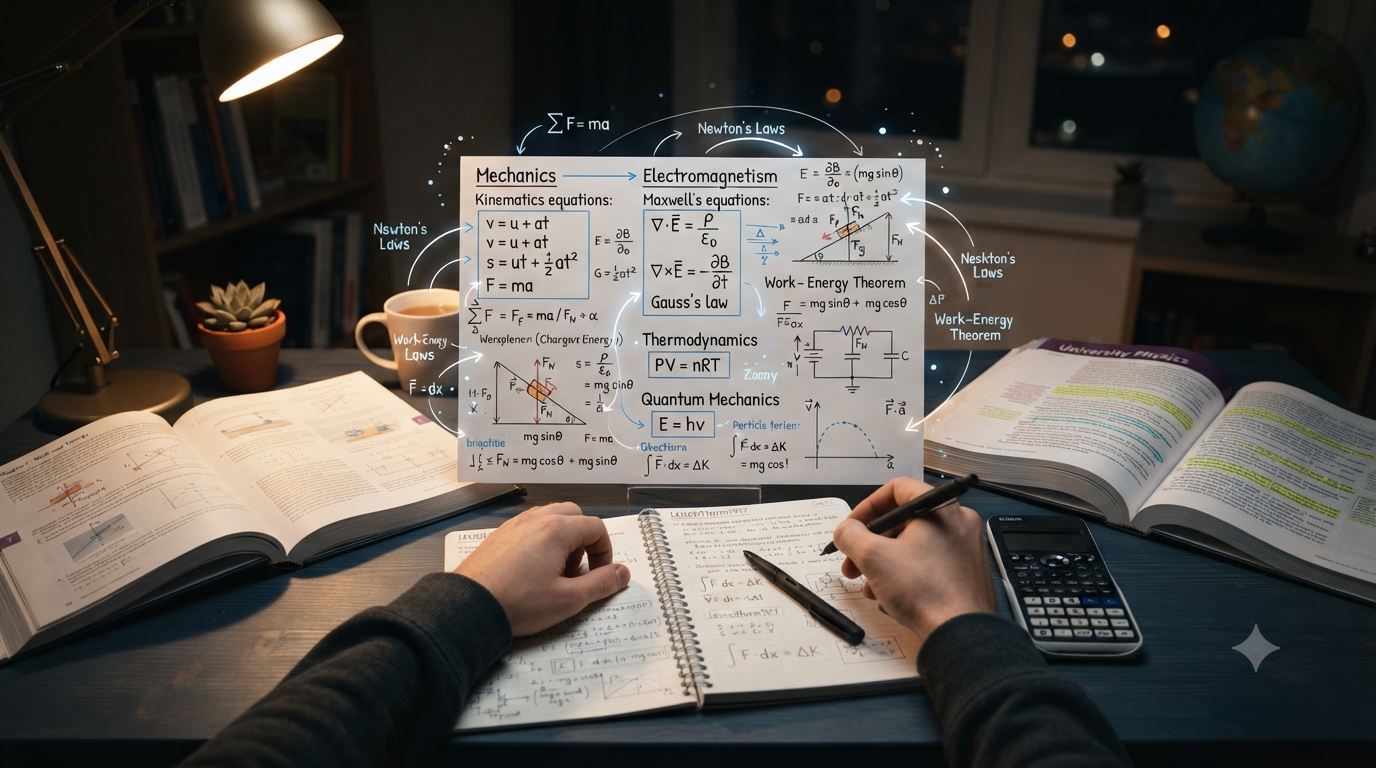
Physics equations often contain several symbols, numbers, and quantities. To understand an equation correctly, it is important to know which quantities can change and which remain fixed. A constant is a quantity that keeps the same value under the conditions being considered. Constants help describe physical relationships and make equations useful for predicting how one quantity depends on another.
When solving physics problems, identifying constants is not just about finding numbers. A symbol can also represent a constant even when its numerical value is not written in the equation. Learning how to recognize these quantities makes equations easier to understand, rearrange, and apply correctly.
What Is a Constant in Physics?
A constant is a quantity whose value does not change within a particular physical situation or equation. It is different from a variable, whose value can change.
For example, consider the equation:
F = ma
Here, force F, mass m, and acceleration a can vary depending on the situation. If we study an object with a fixed mass, however, its mass can be treated as a constant during that particular problem.
Another example is:
v = u + at
If the acceleration a is constant, then the equation describes motion under constant acceleration. In this case, acceleration does not change with time.
The important point is that whether a quantity is a constant can depend on the physical situation being studied.
Constants and Variables Are Different
The easiest way to identify a constant is to compare it with a variable.
A variable can take different values. A constant remains unchanged under the specified conditions.
For example:
s = vt
If an object moves at a fixed speed, v is constant while time t changes. As time increases, displacement s changes.
In this equation:
Therefore, the same symbol may sometimes act as a variable and sometimes as a constant depending on the conditions of the problem.
Look for Fixed Numerical Values
One of the simplest ways to identify constants is to look for numbers that do not change.
Consider:
y = 3x + 5
The numbers 3 and 5 are fixed numerical values in this equation. They do not change when x changes.
The value of y changes as x changes, but the coefficients 3 and 5 remain fixed.
In physics, numerical constants often appear as coefficients in equations. For example:
F = 2ma
If 2 is simply a numerical factor in the relationship, it remains fixed while the physical quantities change.
However, not every number appearing in a physics equation should automatically be called a physical constant. Some numbers may simply be coefficients, conversion factors, or values supplied for a particular problem.
Recognize Universal Physical Constants
Some constants have fixed values throughout physics and are known as fundamental or universal constants.
Examples include:
Speed of light: c ≈ 3.00 × 10⁸ m/s
Gravitational constant: G ≈ 6.67 × 10⁻¹¹ N m²/kg²
Planck constant: h ≈ 6.626 × 10⁻³⁴ J s
Elementary charge: e ≈ 1.602 × 10⁻¹⁹ C
These constants have specific values and units. They appear in equations describing fundamental physical laws.
For example, Einstein’s mass-energy relationship is:
E = mc²
Here, c represents the speed of light in vacuum. It is treated as a universal constant, while E and m can vary.
Recognizing commonly used physical constants can make advanced physics equations much easier to interpret.
Identify Constants by Their Role in an Equation
Sometimes a constant is easier to identify by looking at what role it plays.
Consider Hooke’s law:
F = kx
Here, k is the spring constant. For a particular spring within its elastic limit, k remains constant. The force F and displacement x can change.
The symbol k therefore represents a constant for that particular spring.
Another example is Newton’s law of universal gravitation:
F = Gm₁m₂/r²
The gravitational constant G is fixed. The masses m₁ and m₂ and the distance r can vary.
This shows that constants can have specific physical meanings rather than being simple numbers.
Check the Conditions of the Problem
A quantity should not be classified as a constant without considering the conditions.
For example:
v = u + at
In this equation, a is often described as constant when studying uniformly accelerated motion. But acceleration does not have to be constant in every physical situation.
If acceleration changes with time, then treating a as a constant would be incorrect.
Similarly, in the equation:
p = ρgh
for fluid pressure under certain conditions, density ρ and gravitational acceleration g may be treated as constants while depth h changes.
Thus, always ask: Is this quantity changing under the conditions being studied?
Constants in Equations of Motion
Equations of motion provide useful examples of constants and variables.
Consider:
s = ut + ½at²
When studying motion with constant acceleration:
s can change.
t changes as time passes.
u is the initial velocity and remains fixed for the chosen motion.
a is treated as constant.
The initial velocity u is therefore a fixed starting value for that particular motion, while acceleration a remains constant according to the assumption of the equation.
Understanding these roles helps prevent confusion when substituting values into motion equations.
Constants Can Be Hidden in Symbols
Not all constants appear as ordinary numbers.
Consider:
C = 2πr
The number 2 and π are constants. The radius r can change.
The constant π has an exact mathematical value, approximately 3.14159. It appears frequently in physics equations involving circles, waves, rotation, and oscillations.
Similarly, equations may contain symbols such as G, c, h, or k that represent constants.
Therefore, when reading an equation, do not look only for ordinary numerical values. Pay attention to symbols that have fixed physical or mathematical meanings.
Use Units to Recognize Physical Constants
Units can also provide clues.
Suppose an equation contains:
F = kx
Force has units of newtons, while displacement has units of metres. Therefore, k must have units that allow the equation to remain dimensionally correct:
k = F/x
So the unit of k is N/m.
The units of a constant often reveal what physical quantity it represents.
For example, the gravitational constant G has units that are quite different from the speed of light c. Knowing these units can help distinguish different constants in an equation.
Do Not Confuse Constants With Known Values
A known value is not always a constant.
Suppose a physics problem says that a car has a mass of 1,000 kg. The value 1,000 kg is fixed for that particular problem, so mass can be treated as constant during the calculation.
But mass itself is not a universal constant.
This distinction is important:
A quantity can be constant in a particular problem without being a universal physical constant.
The mass of an object may remain unchanged during an experiment, while the gravitational constant G has a fixed fundamental value.
A Simple Method to Identify Constants
When you encounter a new physics equation, use the following steps.
Step 1: Write Down the Equation
Start by looking at the complete equation.
For example:
F = Gm₁m₂/r²
Step 2: Identify Every Symbol
Determine what each symbol represents.
F is force, G is the gravitational constant, m₁ and m₂ are masses, and r is distance.
Step 3: Ask Which Quantities Can Change
Consider the physical situation. Masses or distance may change between different situations.
Step 4: Look for Fixed Values
Check for mathematical constants, numerical coefficients, or known physical constants.
Step 5: Check the Conditions
Determine whether a quantity is assumed to remain unchanged during the problem.
Step 6: Check the Units
Units can help confirm whether a symbol represents a particular physical constant.
This process provides a reliable way to separate constants from variables.
Why Identifying Constants Matters
Knowing which quantities are constant makes physics equations easier to understand and solve.
If a constant is identified correctly, you can simplify an equation, compare different situations, and understand how variables affect one another.
For example, if:
F = ma
and mass remains constant, then force is directly proportional to acceleration:
F ∝ a
The constant mass controls the relationship between force and acceleration.
This way of thinking is important not only for solving numerical problems but also for understanding graphs, experiments, formulas, and physical laws.
Conclusion
Identifying constants in physics equations requires more than simply searching for numbers. A constant is a quantity that remains unchanged under the conditions being considered. It may be a mathematical constant such as π, a universal physical constant such as G or c, or a quantity that is fixed for a particular experiment or problem.
The best approach is to identify each symbol, determine which quantities can change, examine the conditions, and use units to confirm their physical roles. Once you become comfortable distinguishing constants from variables, physics equations become much easier to read, interpret, and apply.