Length, area, and volume are three fundamental measurements used in mathematics and everyday life. They help us describe the size of objects, calculate the space they occupy, and understand the dimensions of the world around us. Although these measurements are closely related, each represents something different. Length tells us how long an object is, area measures the surface it covers, and volume describes the space occupied by a three-dimensional object. For example, we use length to measure the height of a door, area to determine how much floor space a room has, and volume to calculate how much water a tank can hold. Understanding the difference between these measurements makes geometry, mensuration, construction, and many practical calculations easier to learn.
What Is Length in Mathematics?
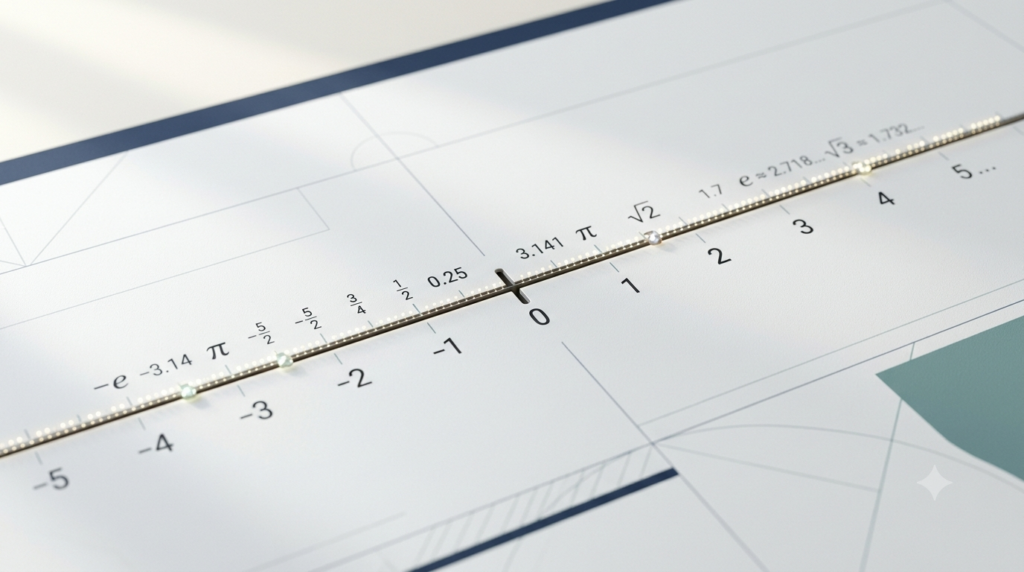
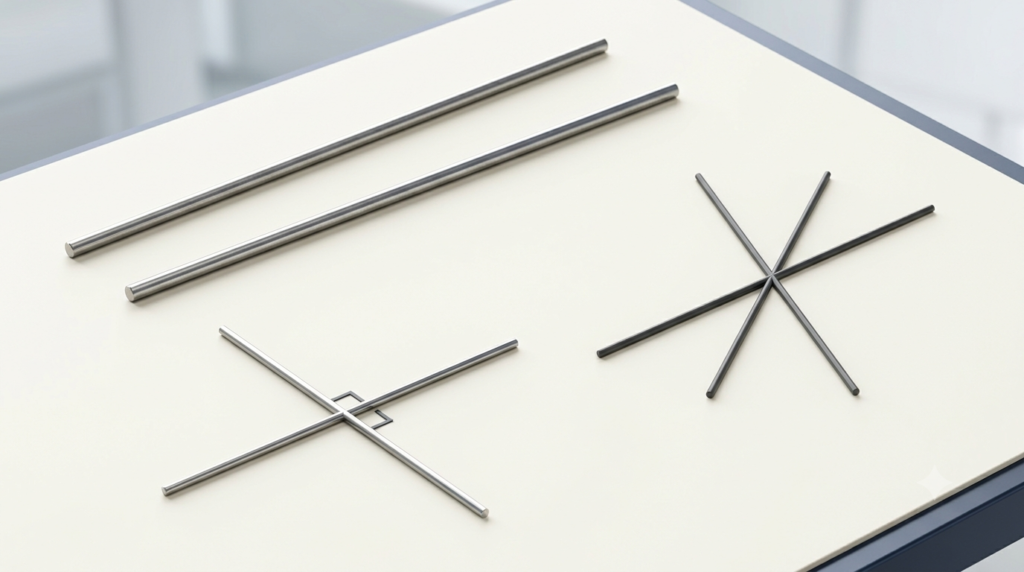
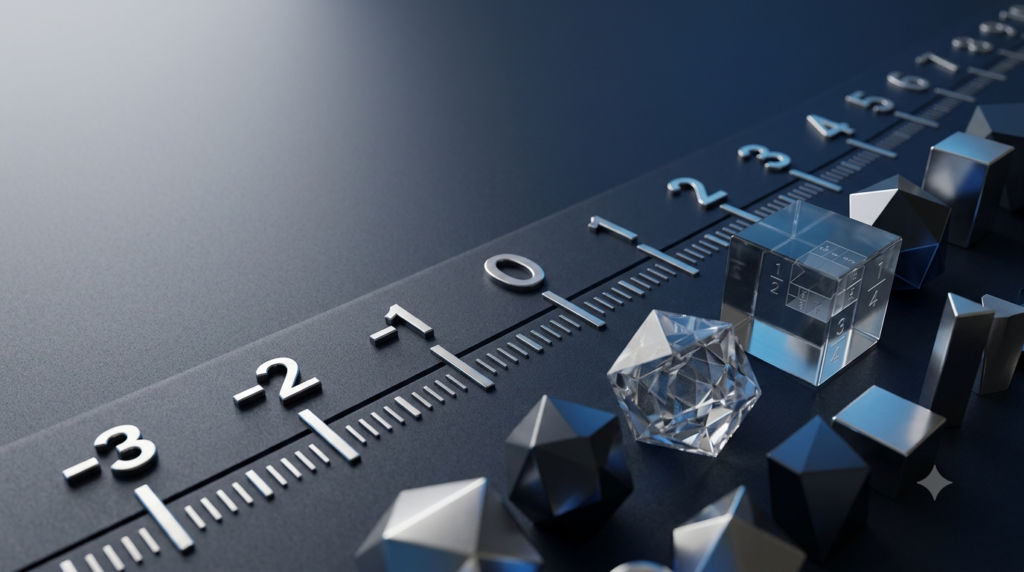
Length is the measurement of the distance between two points. It describes how long, wide, tall, or deep an object is along a single direction. Length is a one-dimensional measurement because it involves only one dimension.
Imagine a straight line drawn on a piece of paper. The distance from one endpoint to the other represents its length. Similarly, the length of a pencil tells us how far it extends from one end to the other.
Length is one of the simplest measurements in mathematics, but it is essential for understanding more complex concepts such as area and volume.
Examples of Length
Length is used to measure many objects and distances, including:
The height of a person.
The length of a table.
The width of a book.
The distance between two cities.
The depth of a swimming pool.
For example, if a table is 120 centimetres long, this measurement describes the distance from one end of the table to the other along its length.
Units Used to Measure Length
Length can be measured using different units depending on the size of the object or distance.
Common metric units include:
Millimetre (mm)
Centimetre (cm)
Metre (m)
Kilometre (km)
A millimetre is suitable for measuring very small dimensions, while a kilometre is useful for measuring long distances.
Some common conversions are:
1 cm = 10 mm
1 m = 100 cm
1 km = 1,000 m
For example, a pencil might be 15 cm long, a classroom might be 8 m long, and the distance between two towns might be 25 km.
How Is Length Calculated?
For a straight object, length can often be measured directly with a ruler, measuring tape, or other suitable instrument.
For a rectangular object, the perimeter can be calculated by adding the lengths of all its sides. However, perimeter is not the same as length in general; it represents the total distance around a two-dimensional shape.
For a rectangle:
Perimeter = 2 × (Length + Width)
Suppose a rectangular garden has a length of 12 m and a width of 5 m.
Perimeter = 2 × (12 + 5)
Perimeter = 34 m
This calculation gives the total distance around the garden, not the length of one side.
What Is Area in Mathematics?
Area is the measurement of the surface covered by a two-dimensional shape. It tells us how much space lies inside the boundaries of a flat surface.
Unlike length, which measures one dimension, area involves two dimensions: length and width, or other equivalent dimensions depending on the shape.
For example, when you look at the top of a desk, the amount of flat surface it covers is its area. Similarly, the floor of a room has an area that tells us how much floor space is available.
Area is an important concept in geometry and mensuration because it helps us calculate the size of surfaces.
Examples of Area
Area is useful in many everyday situations, such as:
Finding the floor space of a room.
Calculating the amount of paint needed for a wall.
Determining the surface covered by a carpet.
Measuring the land occupied by a garden.
Calculating the surface area of a sheet of paper.
For example, if a rectangular floor is 6 m long and 4 m wide, its area tells us how much floor space it covers.
Units Used to Measure Area
Area is measured in square units because it covers two dimensions.
Common units include:
Square millimetre (mm²)
Square centimetre (cm²)
Square metre (m²)
Square kilometre (km²)
The small raised number ² indicates that the unit is squared.
For example, a square metre represents the area of a square whose sides are each one metre long.
Common conversions include:
1 cm² = 100 mm²
1 m² = 10,000 cm²
1 km² = 1,000,000 m²
Area conversions differ from length conversions because both dimensions must be converted.
How Is Area Calculated?
The method used to calculate area depends on the shape.
For a rectangle:
Area = Length × Width
Suppose a rectangular room is 6 m long and 4 m wide.
Area = 6 × 4
Area = 24 m²
Therefore, the floor covers an area of 24 square metres.
For a square:
Area = Side × Side
For a triangle:
Area = ½ × Base × Height
For a circle:
Area = π × Radius²
These formulas show that area depends on two-dimensional measurements. The correct formula must be selected according to the shape being measured.
What Is Volume in Mathematics?
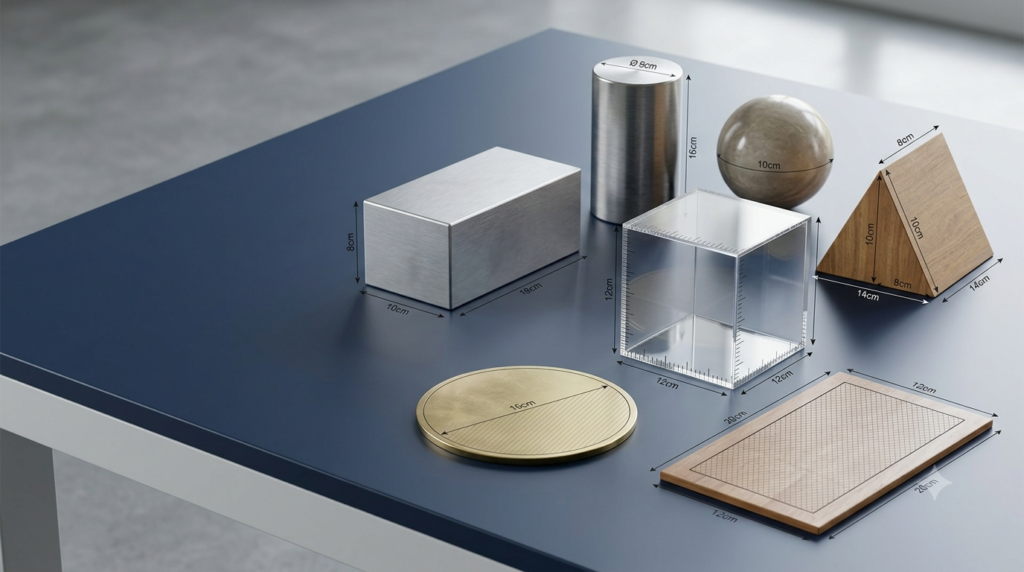
Volume is the measurement of the space occupied by a three-dimensional object. It describes how much space an object takes up or, in suitable cases, how much a container can hold.
Volume involves three dimensions: length, width, and height. These dimensions allow us to understand the space occupied by solid objects.
For example, a box has length, width, and height. Measuring all three dimensions helps us calculate the amount of space inside the box, provided we are considering its internal dimensions.
Volume is particularly important when working with containers, storage spaces, liquids, and solid objects.
Examples of Volume
Volume is used in many practical situations, including:
Calculating the capacity of a water tank.
Determining how much water a swimming pool can hold.
Measuring the space occupied by a cardboard box.
Estimating the amount of concrete needed for a structure.
Calculating the space available inside a storage container.
For example, a rectangular water tank has three dimensions. Its volume can be calculated to estimate its capacity, assuming its internal shape is rectangular.
Units Used to Measure Volume
Volume is commonly measured in cubic units because it involves three dimensions.
Common units include:
Cubic millimetre (mm³)
Cubic centimetre (cm³)
Cubic metre (m³)
The raised number ³ indicates that the unit is cubed.
One cubic metre is the volume of a cube whose sides are each one metre long.
Common conversions include:
1 cm³ = 1,000 mm³
1 m³ = 1,000,000 cm³
1 m³ = 1,000 litres
Liquid capacity is often measured in litres and millilitres.
1 litre = 1,000 millilitres
1 cm³ = 1 millilitre
These relationships are useful when converting between the volume of a container and the amount of liquid it can hold.
How Is Volume Calculated?
The formula for volume depends on the three-dimensional shape.
For a rectangular prism:
Volume = Length × Width × Height
Suppose a rectangular storage box is 5 m long, 3 m wide, and 2 m high.
Volume = 5 × 3 × 2
Volume = 30 m³
Therefore, the box occupies a volume of 30 cubic metres.
For a cube:
Volume = Side × Side × Side
For a cylinder:
Volume = π × Radius² × Height
For a sphere:
Volume = ⁴⁄₃ × π × Radius³
Each formula uses the dimensions required to calculate the three-dimensional space occupied by the shape.
The Main Difference Between Length, Area, and Volume
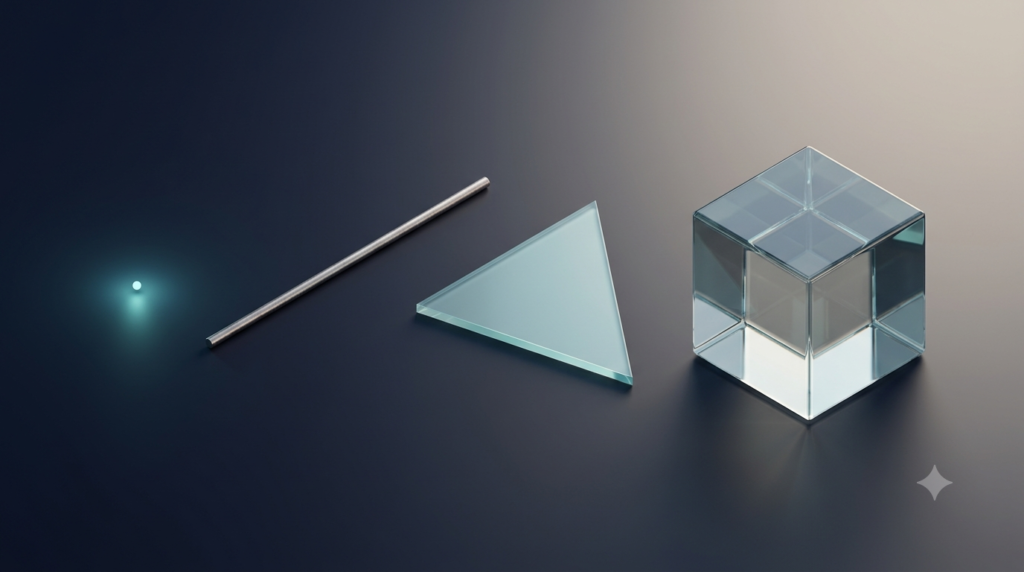
Length, area, and volume describe different properties of objects. The easiest way to distinguish them is to consider the number of dimensions involved.
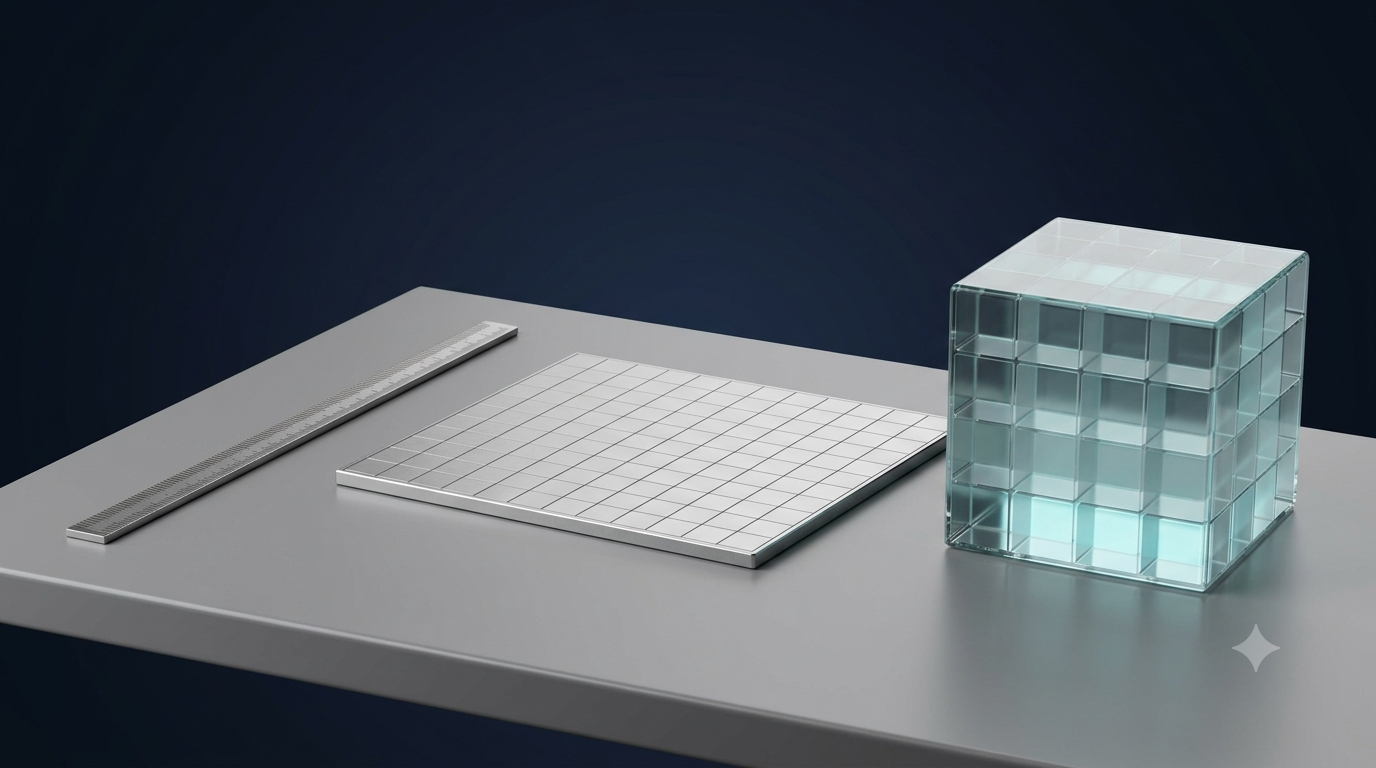
Length measures one dimension. Area measures two dimensions. Volume measures three dimensions.
Consider a rectangular box. Its length describes the distance along one side. The area of its top surface describes how much flat surface that side covers. Its volume describes the space occupied by the entire box.
Length: One-Dimensional Measurement
Length describes distance along a single direction.
It is measured in units such as metres, centimetres, and kilometres.
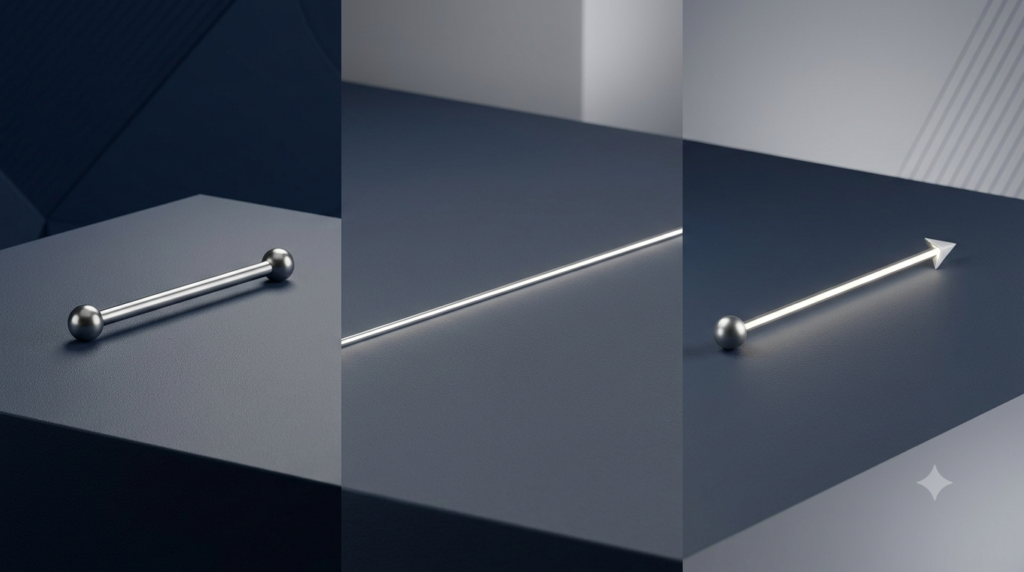
A line segment is a simple example of a one-dimensional measurement. It has length but no area or volume of its own in the ideal mathematical model.
Area: Two-Dimensional Measurement
Area describes the size of a surface.
It is measured in square units, such as square metres or square centimetres.
A flat rectangle has length and width, which together determine its area. An ideal flat shape has area but no volume because it has no thickness.
Volume: Three-Dimensional Measurement
Volume describes the space occupied by a three-dimensional object.
It is measured in cubic units, such as cubic metres or cubic centimetres.
A solid box has length, width, and height. These dimensions determine its volume when the box is rectangular.
Comparison Table of Length, Area, and Volume
| Feature | Length | Area | Volume |
|---|---|---|---|
| Meaning | Distance along one dimension | Surface covered by a shape | Space occupied by an object |
| Dimensions | One | Two | Three |
| Common units | m, cm, km | m², cm², km² | m³, cm³, litres |
| Typical shape | Line segment | Rectangle or circle | Cube or cylinder |
| Example measurement | Length of a pencil | Area of a floor | Volume of a tank |
| Common formula | Length = Distance between endpoints | Rectangle: A = Length × Width | Rectangular prism: V = Length × Width × Height |
The table highlights the key distinction: length measures distance, area measures surface, and volume measures three-dimensional space.
Understanding Length, Area, and Volume Through a Real-Life Example
Imagine that you want to build a small rectangular garden shed. You need to understand length, area, and volume at different stages of the project.
Step 1: Measuring Length
First, you measure the dimensions of the shed. Suppose it is 4 m long, 3 m wide, and 2.5 m high.
These measurements describe its individual dimensions. Each measurement is expressed in metres because it represents a distance.
Step 2: Calculating Area
Next, you calculate the floor area to determine how much ground space the shed will occupy.
Area = Length × Width
Area = 4 × 3
Area = 12 m²
The shed’s rectangular floor covers 12 square metres.
You could also calculate the area of a wall to estimate how much paint or wall covering is required.
Step 3: Calculating Volume
Finally, you calculate the internal volume, assuming the stated dimensions are internal measurements.
Volume = Length × Width × Height
Volume = 4 × 3 × 2.5
Volume = 30 m³
The shed has an internal volume of 30 cubic metres.
This example demonstrates how the same dimensions can be used for different calculations. Length describes individual distances, area describes a surface, and volume describes three-dimensional space.
How Are Length, Area, and Volume Related?
Length, area, and volume are connected because area and volume are calculated using dimensions based on length.
For a rectangle, multiplying length by width produces area. For a rectangular prism, multiplying length by width and height produces volume.
This relationship can be expressed as follows:
Length × Length = Area
Length × Length × Length = Volume
For example, if all dimensions are measured in metres, multiplying two dimensions gives square metres, while multiplying three dimensions gives cubic metres.
These relationships explain why the units are different.
How Scaling Affects Area and Volume
An important mathematical idea is that area and volume do not increase at the same rate as length when an object is enlarged.
Suppose every side of a square becomes twice as long. Its area becomes four times as large.
If the side length of a square is represented by s:
Area = s × s
If the side becomes 2s:
New Area = 2s × 2s
New Area = 4 × s²
Therefore, doubling the side length multiplies the area by four.
For a cube, doubling every side multiplies its volume by eight.
Volume = s × s × s
New Volume = 2s × 2s × 2s
New Volume = 8 × s³
This explains why a slightly larger three-dimensional container can hold considerably more material than a smaller one.
Common Mistakes When Measuring Length, Area, and Volume
Although these concepts are straightforward, learners sometimes confuse their meanings or units.
Using the Wrong Units
A common mistake is writing square metres when measuring a single length or using cubic metres to describe a flat surface.
Remember:
Length uses units such as m or cm.
Area uses units such as m² or cm².
Volume uses units such as m³ or cm³.
Always check whether the measurement represents a distance, surface, or three-dimensional space.
Confusing Area With Perimeter
Area and perimeter are different measurements.
Area describes the surface inside a two-dimensional boundary. Perimeter describes the total distance around that boundary.
A rectangular garden measuring 8 m by 5 m has an area of 40 m² and a perimeter of 26 m.
Although both calculations use the same dimensions, they answer different questions.
Confusing Volume With Surface Area
Volume describes the space occupied by a three-dimensional object, whereas surface area describes the total area of its outer surfaces.
For example, a closed box has an internal volume and an external surface area. Volume may be used to determine storage capacity, while surface area may help estimate the material needed to cover the outside.
Forgetting to Convert Units
Another mistake is multiplying measurements expressed in incompatible units without converting them first.
For example, if one dimension is given in metres and another in centimetres, convert them to the same unit before calculating area or volume. This helps prevent incorrect results.
Why Are Length, Area, and Volume Important?
These measurements are useful in mathematics and many real-world activities.
In construction, length helps determine dimensions, area helps estimate flooring and painting materials, and volume helps calculate the amount of concrete needed for certain structures.
In agriculture, length is used to measure boundaries, area helps determine the size of fields, and volume helps estimate the capacity of irrigation tanks.
In science, length is important when measuring distances and dimensions, area is used when studying surfaces and coverage, and volume is essential for studying gases, liquids, and solid objects.
In everyday life, these concepts help us select furniture, arrange rooms, fill containers, package products, and estimate storage space.
Learning the differences between them also provides a foundation for geometry, mensuration, engineering, physics, and other scientific subjects.
Conclusion
Length, area, and volume are three essential mathematical measurements that describe different properties of objects. Length measures distance in one dimension, area measures the surface covered in two dimensions, and volume measures the space occupied in three dimensions. Their units reflect these differences: length uses ordinary units, area uses square units, and volume uses cubic units. Understanding how these measurements work together makes it easier to solve mathematical problems and handle everyday tasks involving construction, storage, land, and containers. By learning their definitions, units, formulas, and practical applications, anyone can build a strong foundation in geometry and mensuration. The key is to identify what needs to be measured before selecting the appropriate formula.
FAQs
1. What is the main difference between length, area, and volume?
Length, area, and volume are three different types of measurements used in mathematics. Length measures the distance between two points in one dimension. Area measures the surface covered by a two-dimensional shape, such as a rectangle or circle. Volume measures the space occupied by a three-dimensional object, such as a box or cylinder. Length is expressed in units such as metres, area in square metres, and volume in cubic metres. For example, the length of a table describes its size along one direction, its top surface has an area, and the space occupied by the entire table has a volume.
2. What is length in mathematics?
Length is the measurement of the distance between two points. It describes how long an object is or how far apart two points are. Length is a one-dimensional measurement because it involves only one direction. Common units used to measure length include millimetres, centimetres, metres, and kilometres. For example, the length of a pencil might be 15 centimetres, while the distance between two cities might be 100 kilometres. Length can be measured using tools such as rulers, measuring tapes, and metre scales. It is a fundamental concept used in geometry, mensuration, construction, engineering, and everyday measurements.
3. What is area in mathematics?
Area is the measurement of the surface covered by a two-dimensional shape. It tells us how much space lies within the boundaries of a flat surface. Area is calculated using two-dimensional measurements, such as length and width. Common units include square centimetres, square metres, and square kilometres. For example, the area of a rectangular floor can help determine how much flooring material is required. Different shapes have different area formulas. The area of a rectangle is calculated by multiplying its length by its width. Understanding area is useful in construction, painting, gardening, agriculture, and many other practical activities.
4. What is volume in mathematics?
Volume is the measurement of the three-dimensional space occupied by an object. It is used to describe how much space a solid object takes up or how much a container can hold. Volume involves three dimensions: length, width, and height. Common units include cubic centimetres, cubic metres, and cubic millimetres. Liquids are also commonly measured in litres and millilitres. For example, the volume of a rectangular water tank can be calculated by multiplying its length, width, and height. Volume is important in geometry, science, engineering, packaging, and construction because it helps determine the capacity and space requirements of objects.
5. What are the units of length, area, and volume?
Length, area, and volume use different units because they measure different dimensions. Length is measured in units such as millimetres, centimetres, metres, and kilometres. Area is measured in square units, including square centimetres and square metres. Volume is measured in cubic units, such as cubic centimetres and cubic metres. For example, the length of a wall might be 5 metres, its surface area might be 15 square metres, and a rectangular container might have a volume of 2 cubic metres. Using the correct units is essential when solving mathematical problems and communicating measurement results accurately.
6. How do you calculate length, area, and volume?
The method depends on the property and shape being measured. Length is usually measured directly using a ruler or measuring tape. The area of a rectangle is calculated by multiplying its length by its width. Its formula is Area = Length × Width. The volume of a rectangular prism is calculated by multiplying its length, width, and height. Its formula is Volume = Length × Width × Height. For example, a rectangle measuring 6 metres by 4 metres has an area of 24 square metres. A box with those dimensions and a height of 2 metres has a volume of 48 cubic metres.
7. Why is area measured in square units?
Area is measured in square units because it represents a two-dimensional surface. A square unit describes the area of a square whose sides each have a length of one unit. For example, one square metre is the area of a square measuring one metre on each side. When calculating the area of a rectangle, we multiply its length by its width. Multiplying metres by metres produces square metres. Similarly, multiplying centimetres by centimetres produces square centimetres. This relationship between dimensions and units helps explain why area uses squared units rather than ordinary length units.
8. Why is volume measured in cubic units?
Volume is measured in cubic units because it describes three-dimensional space. A cubic unit represents the volume of a cube whose length, width, and height are each one unit. For example, one cubic metre is the volume of a cube measuring one metre along every side. When calculating the volume of a rectangular prism, we multiply length by width and height. If all three measurements are expressed in metres, the result is in cubic metres. Cubic centimetres are commonly used for smaller objects, while cubic metres are suitable for larger spaces, containers, tanks, and construction materials.
9. What is the difference between area and volume?
Area measures the surface covered by a two-dimensional shape, while volume measures the space occupied by a three-dimensional object. Area involves two dimensions, such as length and width, and is expressed in square units. Volume involves three dimensions, such as length, width, and height, and is expressed in cubic units. For example, the area of a box’s base tells us how much flat surface it covers. Its volume tells us how much space is inside the box when calculated using its internal dimensions. Area is useful for measuring surfaces, whereas volume is useful for calculating capacity and three-dimensional space.
10. Where are length, area, and volume used in everyday life?
Length, area, and volume are used in many everyday activities. Length helps us measure furniture, room dimensions, road distances, and the height of objects. Area is useful for determining the size of floors, walls, gardens, and agricultural fields. It also helps estimate the amount of paint, carpet, or flooring material required for a project. Volume is used to calculate the capacity of water tanks, bottles, storage boxes, and swimming pools. These measurements are also important in construction, science, engineering, and manufacturing. Understanding them makes everyday calculations easier and helps people choose suitable measurement methods and units.