Every element in the periodic table has a unique atomic number and an atomic mass. While the atomic number tells us how many protons are present in the nucleus of an atom, atomic mass provides information about the mass of an atom. However, the atoms of the same element do not always have exactly the same mass. This is because many elements exist naturally as different isotopes, which contain the same number of protons but different numbers of neutrons.
To account for these differences, scientists use a concept called relative atomic mass. It represents the weighted average mass of the naturally occurring isotopes of an element compared with one-twelfth of the mass of a carbon-12 atom.
Relative atomic mass is an important concept in chemistry because it helps scientists understand the properties of elements, calculate chemical quantities, determine molecular masses, and organize elements in the periodic table. It also explains why the atomic masses shown in the periodic table are often decimal numbers rather than whole numbers.
What Is Relative Atomic Mass?
Relative atomic mass is the weighted average mass of the atoms of an element compared with one-twelfth of the mass of a carbon-12 atom.
It is represented by the symbol Aᵣ.
The standard definition of relative atomic mass is:
Relative Atomic Mass (Aᵣ) = Weighted average mass of an atom / (1/12 × Mass of a carbon-12 atom)
Carbon-12 is used as the reference standard because it is a stable isotope with exactly 12 atomic mass units by definition.
Relative atomic mass does not represent the mass of a single atom of an element. Instead, it considers the natural abundance and masses of all its naturally occurring isotopes.
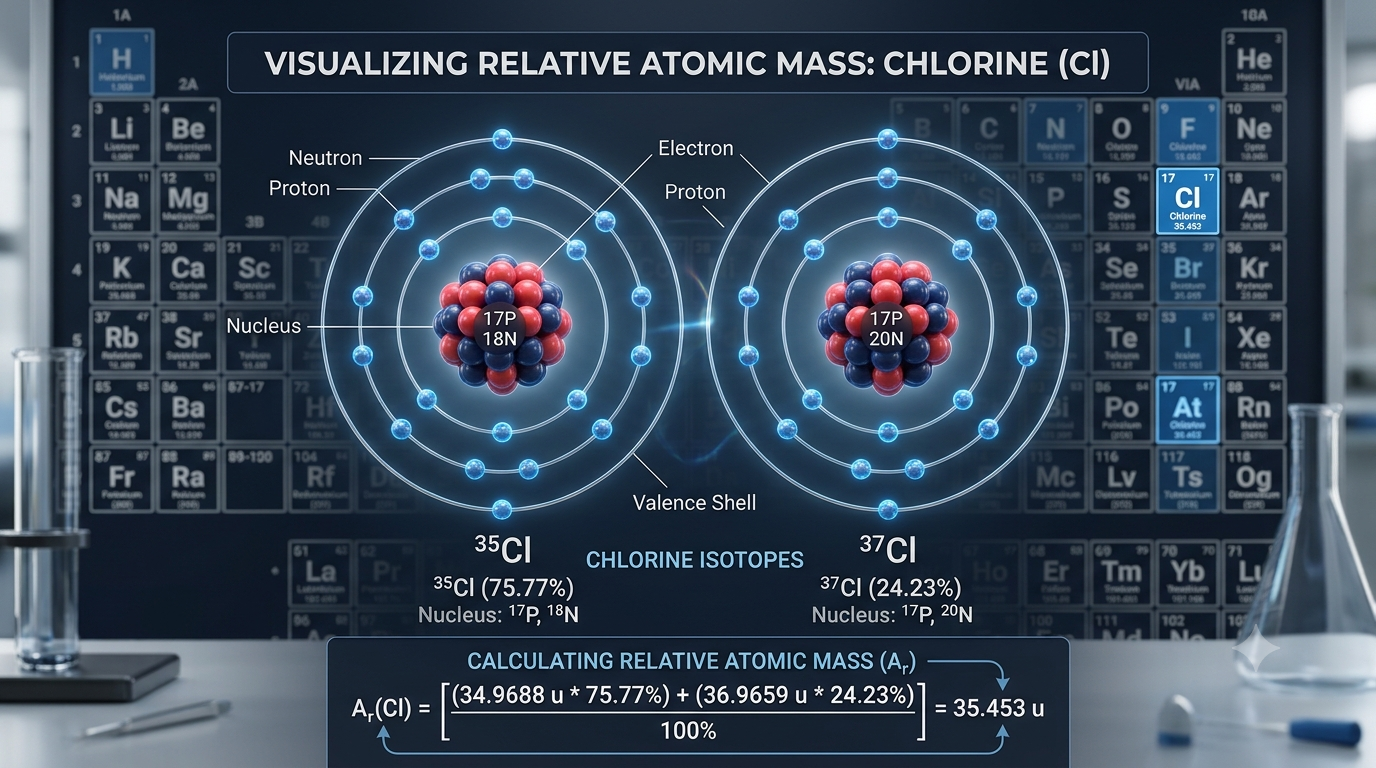
For example, chlorine has two major naturally occurring isotopes:
Chlorine-35, which has an approximate isotopic mass of 35.
Chlorine-37, which has an approximate isotopic mass of 37.
Because both isotopes occur naturally in different proportions, the relative atomic mass of chlorine is approximately 35.45 rather than exactly 35 or 37.
This demonstrates why relative atomic mass is generally a decimal value.
Understanding the Atomic Mass Unit
To understand relative atomic mass, it is useful to know about the atomic mass unit.
Atoms are extremely small, and their masses are too tiny to express conveniently in grams or kilograms. Therefore, scientists use a special unit called the atomic mass unit.
It is represented by the symbol u.
One atomic mass unit is defined as one-twelfth of the mass of a carbon-12 atom.
1 u = 1/12 × Mass of one carbon-12 atom
The approximate value of one atomic mass unit is:
1 u ≈ 1.66054 × 10⁻²⁷ kg
The atomic mass unit makes it easier to compare the masses of different atoms.
For example:
Hydrogen-1 has an isotopic mass of approximately 1 u.
Carbon-12 has an isotopic mass of exactly 12 u.
Oxygen-16 has an isotopic mass of approximately 16 u.
It is important to understand the difference between atomic mass and relative atomic mass. Atomic mass is expressed in atomic mass units, whereas relative atomic mass is a ratio and therefore has no unit.
What Are Isotopes?
Isotopes are atoms of the same element that have the same number of protons but different numbers of neutrons.
Since the number of protons determines the identity of an element, all isotopes of an element have the same atomic number.
However, their mass numbers are different because they contain different numbers of neutrons.
For example, chlorine has two important naturally occurring isotopes:
Chlorine-35
Atomic number: 17
Number of protons: 17
Number of neutrons: 18
Mass number: 35
Chlorine-37
Atomic number: 17
Number of protons: 17
Number of neutrons: 20
Mass number: 37
Both are chlorine atoms because they contain 17 protons. However, their masses are different because they have different numbers of neutrons.
The existence of isotopes is the main reason why the relative atomic masses of many elements are not whole numbers.
How Is Relative Atomic Mass Calculated?
Relative atomic mass is calculated by considering the masses of different isotopes and their relative abundances in nature.
The most important point is that all isotopes do not necessarily occur in equal amounts. Therefore, scientists use a weighted average rather than a simple average.
The formula for calculating relative atomic mass is:
Aᵣ = Σ (Isotopic mass × Fractional abundance)
When percentage abundances are provided, the formula becomes:
Aᵣ = [(Mass of isotope 1 × % abundance) + (Mass of isotope 2 × % abundance) + …] / 100
This formula can be used for elements containing two or more naturally occurring isotopes.
Example: Calculation of the Relative Atomic Mass of Chlorine
Chlorine naturally occurs mainly as two isotopes:
Chlorine-35: approximately 75% abundance.
Chlorine-37: approximately 25% abundance.
Using the weighted average formula:
Aᵣ = [(35 × 75) + (37 × 25)] / 100
Aᵣ = (2625 + 925) / 100
Aᵣ = 3550 / 100
Aᵣ = 35.5
Therefore, the approximate relative atomic mass of chlorine is 35.5.
The standard relative atomic mass of chlorine is approximately 35.45 because the actual isotopic masses and abundances are more precise than the rounded values used in this example.
Why Is a Weighted Average Used?
A weighted average is used because different isotopes occur in different proportions.
Consider an imaginary element with two isotopes:
Isotope A has a mass of 10 and an abundance of 90%.
Isotope B has a mass of 12 and an abundance of 10%.
Its relative atomic mass is:
Aᵣ = [(10 × 90) + (12 × 10)] / 100
Aᵣ = (900 + 120) / 100
Aᵣ = 10.2
The result is closer to 10 because isotope A is much more abundant than isotope B.
If both isotopes occurred in equal proportions, the average would be 11.
This shows that the abundance of each isotope plays an important role in determining the relative atomic mass of an element.
Difference Between Mass Number, Atomic Mass and Relative Atomic Mass
Mass number, atomic mass and relative atomic mass are related concepts, but they do not have exactly the same meaning.
Understanding their differences is important for studying atomic structure and the periodic table.
Mass Number
Mass number is the total number of protons and neutrons present in the nucleus of a particular atom.
Mass Number = Number of Protons + Number of Neutrons
It is always a whole number.
For example, a carbon-12 atom contains 6 protons and 6 neutrons.
Mass number = 6 + 6 = 12.
Atomic Mass
Atomic mass refers to the mass of an individual atom, usually expressed in atomic mass units (u).
Unlike mass number, atomic mass does not always have to be a whole number because the actual masses of protons, neutrons and electrons are not exactly equal to whole atomic mass units, and nuclear binding energy also affects atomic mass.
For example, the isotopic mass of carbon-12 is exactly 12 u by definition.
Relative Atomic Mass
Relative atomic mass is the weighted average mass of the atoms of an element compared with one-twelfth of the mass of a carbon-12 atom.
It takes the natural isotopic composition of an element into account.
For example, the relative atomic mass of chlorine is approximately 35.45.
Key Differences
| Property | Mass Number | Atomic Mass | Relative Atomic Mass |
|---|---|---|---|
| Meaning | Protons + neutrons | Mass of an individual atom | Weighted average relative mass |
| Symbol | A | No single universal symbol | Aᵣ |
| Unit | None | u | No unit |
| Value | Whole number | Can be decimal | Usually decimal |
| Isotopes considered | One specific isotope | One specific isotope | Naturally occurring isotopes |
Why Do Elements Have Decimal Atomic Masses in the Periodic Table?
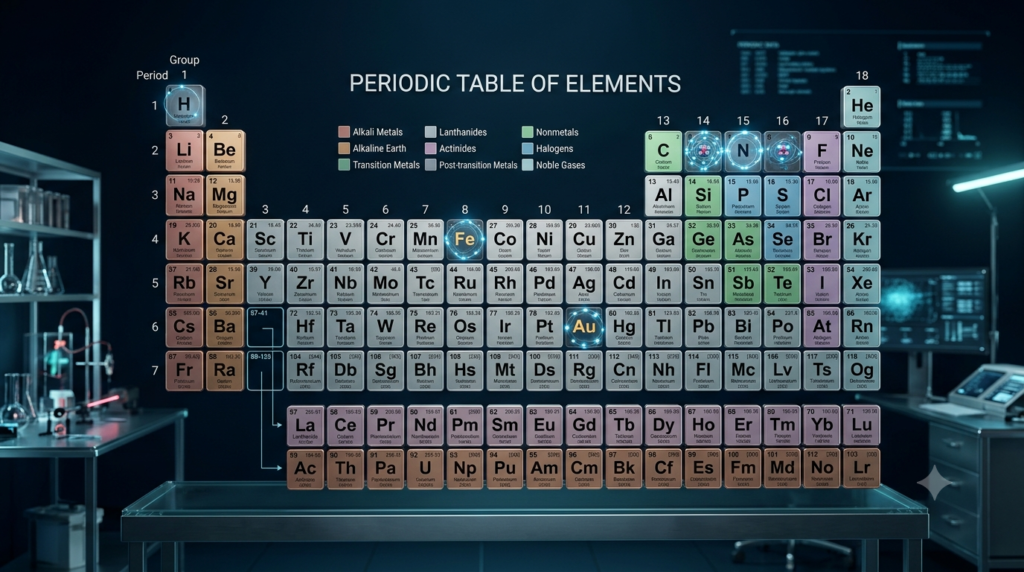
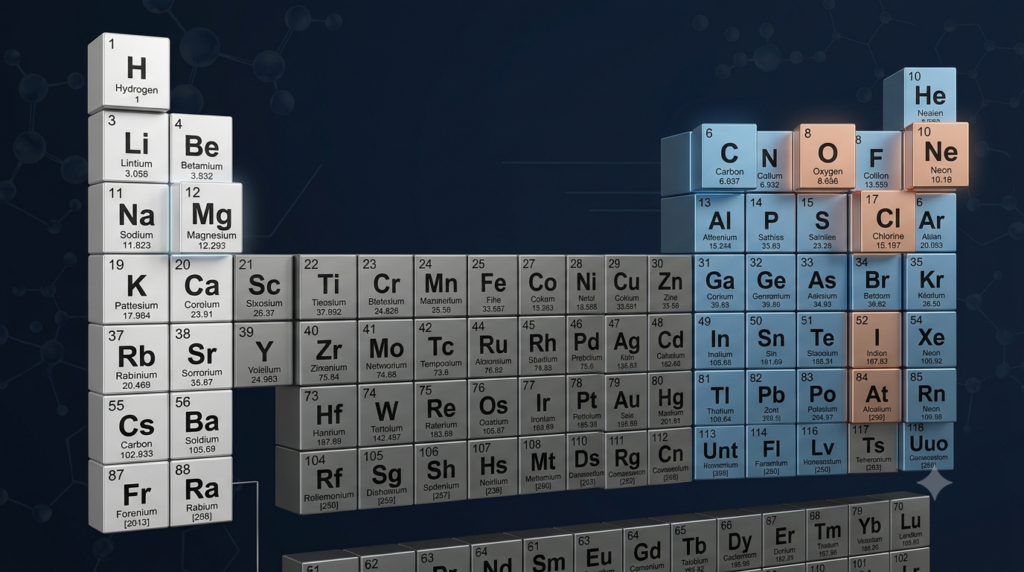
One of the most noticeable features of the periodic table is that many elements have decimal numbers listed below their chemical symbols.
These numbers represent the standard relative atomic masses of elements.
Many elements have multiple naturally occurring isotopes. Each isotope has a different mass and occurs in a particular proportion in nature.
The periodic table generally displays the weighted average of these isotopic masses rather than the mass number of just one isotope.
For example:
Hydrogen: approximately 1.008
Carbon: approximately 12.011
Nitrogen: approximately 14.007
Oxygen: approximately 15.999
Chlorine: approximately 35.45
Copper: approximately 63.546
These values are decimal numbers because they represent weighted averages of naturally occurring isotopes.
However, not every element has a decimal relative atomic mass. Some elements have only one naturally occurring isotope with a characteristic isotopic composition, while other elements have standard atomic weights expressed as intervals because their natural isotopic compositions can vary.
Therefore, decimal values in the periodic table are not calculation errors. They provide more accurate information about the natural isotopic composition of elements.
Significance of Relative Atomic Mass in the Periodic Table
Relative atomic mass plays an important role in understanding the chemical properties and organization of elements.
Although the modern periodic table is arranged according to increasing atomic number, relative atomic mass remains an essential property used in chemistry.
1. Helps Understand the Atomic Mass of Elements
Relative atomic mass provides a standard way to compare the average masses of different elements.
For example, the relative atomic mass of oxygen is approximately 16, while that of carbon is approximately 12.
This means that an average oxygen atom has a greater mass than an average carbon atom.
Such comparisons help scientists understand the mass relationships between different elements.
2. Explains Decimal Values in the Periodic Table
Relative atomic mass explains why many elements have decimal values instead of whole numbers in the periodic table.
Since elements can contain different naturally occurring isotopes, their average atomic masses are often fractional.
For example, chlorine has a relative atomic mass of approximately 35.45 because it contains different proportions of chlorine-35 and chlorine-37.
Without understanding relative atomic mass, these decimal values can be confusing.
3. Helps in Chemical Calculations
Relative atomic mass is essential for performing many chemical calculations.
It is used to calculate the relative formula mass of compounds, determine the amount of substances and solve numerical problems involving chemical reactions.
For example, the relative atomic masses of hydrogen and oxygen are used to calculate the relative molecular mass of water.
Water has the chemical formula H₂O.
Relative molecular mass = (2 × 1.008) + 15.999
Relative molecular mass = 18.015
This value is important in quantitative chemistry.
4. Helps Determine Molar Mass
Relative atomic mass is closely related to molar mass.
The numerical value of the relative atomic mass of an element is equal to its molar mass when expressed in grams per mole, using the conventional approximation.
For example:
Relative atomic mass of carbon ≈ 12.011.
Molar mass of carbon ≈ 12.011 g/mol.
This relationship allows chemists to convert between the mass of a substance and the number of moles.
5. Helps Understand Isotopic Composition
Relative atomic mass provides information about the average mass resulting from the natural isotopic composition of an element.
For example, the relative atomic mass of chlorine is approximately 35.45 rather than 35 or 37.
This indicates that naturally occurring chlorine contains a mixture of isotopes.
Scientists can use isotopic measurements to investigate the composition and origin of different materials.
6. Supports the Study of Chemical Reactions
Chemical reactions involve atoms combining, separating and rearranging.
Relative atomic masses help chemists calculate the quantities of reactants and products involved in these reactions.
For example, when hydrogen reacts with oxygen to form water, the relative atomic masses help determine the mass relationships between the substances.
These calculations are important for laboratory experiments, industrial chemical production and scientific research.
7. Useful in Scientific Research
Relative atomic mass is important in several scientific fields, including chemistry, physics, geology and environmental science.
Scientists use isotopic mass measurements to study natural materials, investigate geological processes and understand the composition of substances.
Isotope ratios can also provide useful information about environmental changes and the history of natural samples.
Relative Atomic Mass and the Modern Periodic Table
The modern periodic table is arranged according to increasing atomic number, not increasing relative atomic mass.
Atomic number represents the number of protons in the nucleus of an atom. It determines the identity of an element and plays a central role in its chemical properties.
However, relative atomic mass is still displayed in most periodic tables because it is useful for comparing elements and performing chemical calculations.
The distinction between atomic number and relative atomic mass is important.
For example, tellurium has an atomic number of 52, while iodine has an atomic number of 53. Their relative atomic masses are approximately 127.60 and 126.90, respectively.
Although tellurium has a greater relative atomic mass than iodine, it appears before iodine in the modern periodic table because its atomic number is lower.
This demonstrates that the modern periodic table follows atomic number rather than relative atomic mass.
Factors That Affect Relative Atomic Mass
The relative atomic mass of an element depends mainly on the masses and natural abundances of its isotopes.
Several factors are important when determining its value.
1. Number of Naturally Occurring Isotopes
An element may have one or several naturally occurring isotopes.
If an element has multiple isotopes, the masses of all relevant isotopes contribute to its relative atomic mass.
2. Isotopic Mass
Each isotope has its own mass, which depends on the number of protons and neutrons and the effects of nuclear binding energy.
Different isotopic masses contribute differently to the weighted average.
3. Natural Abundance
Natural abundance refers to the percentage of each isotope present in a naturally occurring sample of an element.
An isotope with a higher natural abundance has a greater influence on the relative atomic mass.
4. Variation in Isotopic Composition
The isotopic composition of some elements can vary between natural sources.
As a result, the measured relative atomic mass may differ slightly depending on the origin of the sample.
This is why some elements have standard atomic weight intervals rather than a single fixed value.
Applications of Relative Atomic Mass in Everyday Science
Relative atomic mass is not limited to theoretical chemistry. It is also useful in practical scientific applications.
Some important applications include:
1. Pharmaceutical Chemistry
In pharmaceutical research, scientists use relative atomic masses to calculate the quantities of chemical substances required to prepare medicines and other chemical compounds.
Accurate calculations help maintain the correct composition of pharmaceutical products.
2. Environmental Science
Scientists use isotopic measurements to investigate environmental processes, water sources and changes in natural systems.
The relative masses and proportions of isotopes can provide useful information about environmental samples.
3. Geology
Geologists study isotopes in rocks and minerals to investigate the age and history of geological materials.
Different radioactive isotopes are used in radiometric dating methods.
4. Industrial Chemistry
Industries use relative atomic masses to calculate the quantities of raw materials required for chemical manufacturing.
These calculations help improve production efficiency and reduce material waste.
5. Laboratory Experiments
In chemistry laboratories, relative atomic masses are used to prepare solutions, measure reactants and calculate the expected quantities of products.
They are essential for obtaining accurate experimental results.
Common Mistakes When Studying Relative Atomic Mass
Students and beginners sometimes confuse relative atomic mass with other atomic properties.
Understanding the following points helps avoid common errors.
Confusing mass number with relative atomic mass: Mass number is the total number of protons and neutrons in one isotope, whereas relative atomic mass is a weighted average.
Assuming all isotopes have equal abundance: Naturally occurring isotopes usually exist in different proportions.
Thinking relative atomic mass has a unit: Relative atomic mass is a ratio and has no unit.
Using a simple average instead of a weighted average: Isotopic abundances must be considered when calculating relative atomic mass.
Assuming the periodic table is arranged by relative atomic mass: The modern periodic table is arranged according to increasing atomic number.
Treating relative atomic mass as the mass of one specific atom: It represents an average based on isotopic composition, not necessarily the mass of an individual atom.
Avoiding these mistakes makes it easier to understand atomic structure and perform chemical calculations correctly.
Conclusion
Relative atomic mass is an important concept in chemistry that describes the weighted average mass of the atoms of an element compared with one-twelfth of the mass of a carbon-12 atom. It takes into account the masses and natural abundances of the different isotopes of an element.
It explains why many elements have decimal values in the periodic table and provides essential information for chemical calculations, determining molar masses and understanding isotopic composition. Although the modern periodic table is arranged according to atomic number, relative atomic mass remains an important property for studying elements and their chemical behaviour.
Understanding relative atomic mass provides a strong foundation for learning more advanced topics such as isotopes, molecular mass, mole calculations, stoichiometry and quantitative chemistry.
FAQs
1. What is relative atomic mass?
Relative atomic mass is the weighted average mass of the atoms of an element compared with one-twelfth of the mass of a carbon-12 atom. It is represented by the symbol Aᵣ. It considers the masses and natural abundances of all naturally occurring isotopes of an element. Since different isotopes may have different masses and occur in different proportions, relative atomic mass is often a decimal value. It is an important concept in chemistry because it helps scientists compare elements and perform calculations involving atomic masses, molecular masses and chemical reactions.
2. Why is relative atomic mass important in the periodic table?
Relative atomic mass is important because it provides information about the average mass of the atoms of each element. It helps explain why many elements have decimal values in the periodic table instead of whole numbers. These values result from the different masses and natural abundances of isotopes. Relative atomic mass is also useful for comparing elements, calculating molar masses and solving chemical problems. Although the modern periodic table is arranged according to increasing atomic number, relative atomic mass remains an essential property for understanding elements and their chemical behaviour.
3. Why is the relative atomic mass of chlorine approximately 35.45?
Chlorine has two major naturally occurring isotopes: chlorine-35 and chlorine-37. These isotopes have different masses and natural abundances. Chlorine-35 is more abundant, making up approximately 75% of naturally occurring chlorine, while chlorine-37 accounts for approximately 25%. Relative atomic mass is calculated using the weighted average of these isotopic masses and abundances. This produces an approximate value of 35.45 when more precise isotopic masses and abundance values are used. Therefore, chlorine has a decimal relative atomic mass rather than a whole-number value.
4. What is the difference between relative atomic mass and mass number?
Relative atomic mass and mass number describe different properties of atoms. Mass number is the total number of protons and neutrons in the nucleus of a particular isotope. It is always a whole number. Relative atomic mass, on the other hand, is the weighted average mass of the atoms of an element compared with one-twelfth of the mass of a carbon-12 atom. It considers the natural abundances of different isotopes and is usually a decimal value. Mass number describes one isotope, whereas relative atomic mass represents the average for an element.
5. Does relative atomic mass have a unit?
No, relative atomic mass does not have a unit because it is a ratio between two masses. It compares the weighted average mass of an element’s atoms with one-twelfth of the mass of a carbon-12 atom. Since both quantities are measured in the same unit, their units cancel during division. However, the actual mass of an individual atom is commonly expressed in atomic mass units (u). Similarly, molar mass is expressed in grams per mole (g/mol). It is important not to confuse these three related measurements.
6. How is relative atomic mass calculated?
Relative atomic mass is calculated by multiplying the mass of each naturally occurring isotope by its fractional abundance and adding the results. When percentage abundances are given, the calculation is divided by 100. The formula is Aᵣ = [(Mass of isotope 1 × Percentage abundance) + (Mass of isotope 2 × Percentage abundance) + …] / 100. For example, if an element has two isotopes with masses of 10 and 12 and abundances of 90% and 10%, respectively, its relative atomic mass is 10.2. This method is called the weighted average calculation.
7. What is the relationship between relative atomic mass and isotopes?
Relative atomic mass is directly related to the isotopes of an element. Isotopes are atoms of the same element that contain the same number of protons but different numbers of neutrons. As a result, they have different masses. Most elements have more than one naturally occurring isotope, and these isotopes may occur in different proportions. Relative atomic mass considers both their individual masses and natural abundances to calculate an average value. Therefore, the isotopic composition of an element determines its relative atomic mass.
8. Is relative atomic mass the same as atomic mass?
No, relative atomic mass and atomic mass are related but different concepts. Atomic mass refers to the mass of an individual atom and is generally expressed in atomic mass units (u). Relative atomic mass is the weighted average mass of the atoms of an element compared with one-twelfth of the mass of a carbon-12 atom. It is a dimensionless ratio and has no unit. Atomic mass may describe a particular isotope, while relative atomic mass generally considers the naturally occurring isotopes of an element and their abundances.
9. Is the periodic table arranged according to relative atomic mass?
No, the modern periodic table is arranged according to increasing atomic number, not relative atomic mass. Atomic number represents the number of protons in the nucleus and determines the identity of an element. Relative atomic mass is also displayed in the periodic table because it is useful for chemical calculations and comparing the average masses of elements. For example, tellurium has a greater relative atomic mass than iodine, but it appears before iodine because its atomic number is lower. This demonstrates the importance of atomic number in the modern periodic table.
10. What are the practical applications of relative atomic mass?
Relative atomic mass has several practical applications in chemistry and other scientific fields. It is used to calculate molecular masses, determine molar masses and solve stoichiometric problems involving chemical reactions. Pharmaceutical scientists use it when calculating the quantities of substances required for medicines. Industrial chemists use it to determine the correct proportions of raw materials during manufacturing. It is also useful in geology and environmental science, where isotopic measurements help investigate natural materials and environmental processes. Overall, relative atomic mass is essential for accurate scientific measurements and quantitative chemical analysis.