Atoms are constantly involved in chemical reactions, and their ability to gain or lose electrons plays an important role in determining their chemical behaviour. One of the important properties that helps us understand how atoms interact with electrons is electron affinity. It describes the energy change that occurs when a neutral atom in the gaseous state accepts an electron to form a negatively charged ion.
Electron affinity is closely related to the electronic configuration of an atom and its position in the periodic table. It helps explain why some elements readily accept electrons while others show very little tendency to gain them. For example, halogens such as chlorine have a strong tendency to accept an additional electron, whereas noble gases generally do not readily accept electrons.
Understanding electron affinity is important in chemistry because it helps explain chemical reactivity, ionic bond formation, periodic properties, and the behaviour of different elements. In this article, we will explore the meaning of electron affinity, its definition, factors affecting it, and its periodic trends across periods and down groups.
What Is Electron Affinity?
Electron affinity is the energy change that occurs when an isolated neutral atom in the gaseous state gains an electron and forms a negatively charged ion.
In simple terms, it measures how an atom responds when an additional electron is added to it.
The general representation of electron affinity is:
A(g) + e⁻ → A⁻(g) + Energy
Here:
A(g) represents a neutral gaseous atom.
e⁻ represents an incoming electron.
A⁻(g) represents the negatively charged gaseous ion.
Energy represents the energy released during the process.
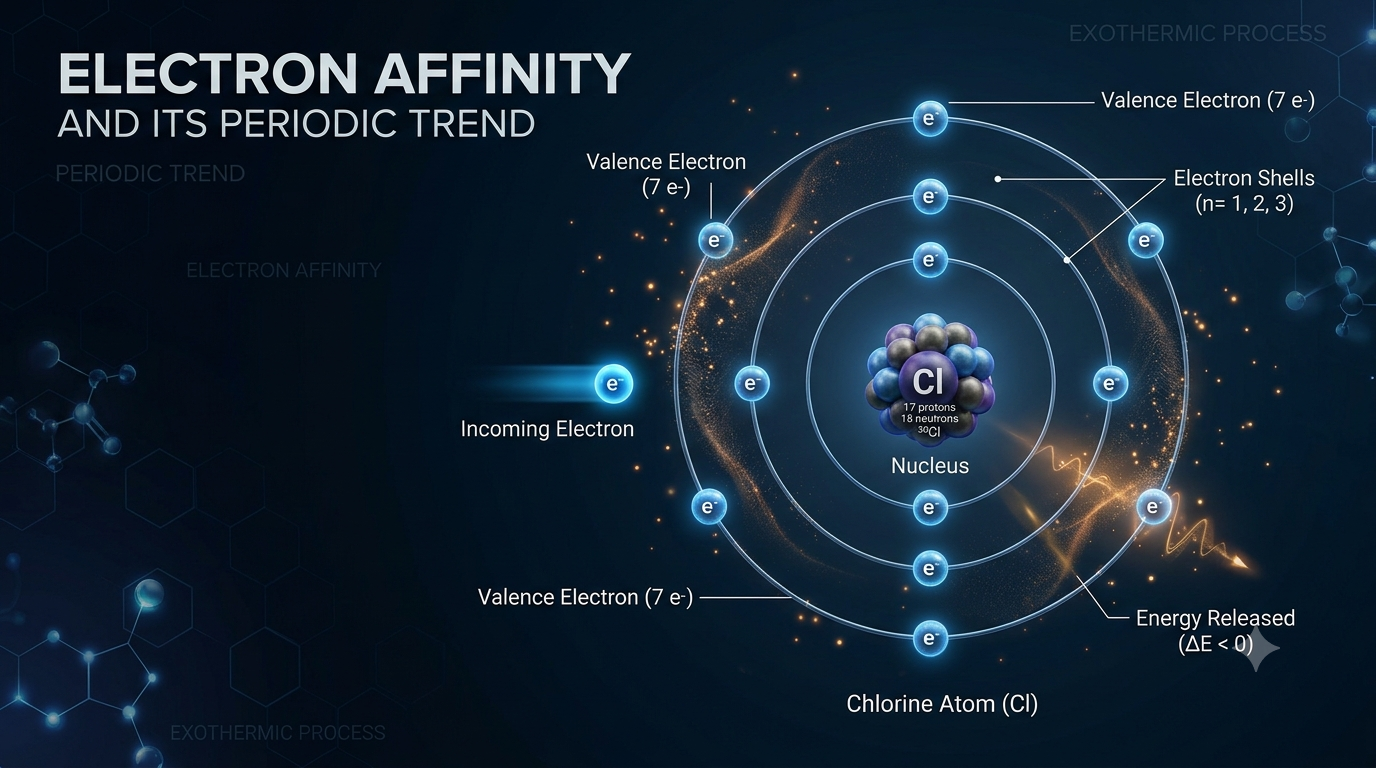
For example, when a chlorine atom accepts an electron, it forms a chloride ion.
Cl(g) + e⁻ → Cl⁻(g) + Energy
This process releases energy because the incoming electron is attracted to the positively charged nucleus of the chlorine atom.
The amount of energy released or absorbed during this process is associated with the electron affinity of the element.
Definition of Electron Affinity
Electron affinity can be defined as the energy released or absorbed when an isolated neutral atom in the gaseous state accepts an electron to form a gaseous negative ion.
It is generally expressed in kilojoules per mole (kJ/mol) or electronvolts per atom (eV).
A higher tendency to release energy when gaining an electron generally indicates a stronger attraction for the incoming electron.
However, it is important to understand that electron affinity can be expressed using different sign conventions. This is particularly important when comparing textbook values.
Electron Affinity Equation
The general chemical equation for the first electron affinity is:
A(g) + e⁻ → A⁻(g)
If the process releases energy, the energy change is exothermic.
For example:
Cl(g) + e⁻ → Cl⁻(g)
The chlorine atom releases approximately 349 kJ/mol of energy when it gains an electron.
This means that the electron is attracted strongly to the chlorine atom, making the formation of the chloride ion energetically favourable.
The energy change can also be represented using enthalpy notation:
ΔH = Energy released or absorbed during electron addition
When ΔH is negative, the process is exothermic and energy is released. When ΔH is positive, the process is endothermic and energy is absorbed.
Types of Electron Affinity
Electron affinity is commonly discussed in terms of the first, second, and sometimes third electron affinities. These describe the successive addition of electrons to an atom or ion.
1. First Electron Affinity
First electron affinity refers to the energy change when a neutral gaseous atom gains its first electron to form a negatively charged ion.
The general equation is:
A(g) + e⁻ → A⁻(g)
For example:
Cl(g) + e⁻ → Cl⁻(g)
This process releases energy for chlorine because the incoming electron experiences a strong attraction from the nucleus.
Most non-metal atoms release energy when they gain their first electron, although there are exceptions.
2. Second Electron Affinity
Second electron affinity refers to the energy change when a negatively charged gaseous ion accepts another electron to form a doubly negative ion.
The general equation is:
A⁻(g) + e⁻ → A²⁻(g)
For example:
O⁻(g) + e⁻ → O²⁻(g)
The second electron affinity of oxygen is positive when expressed as an enthalpy change because energy must be supplied to add another electron to an already negatively charged ion.
This happens because the incoming electron experiences electrostatic repulsion from the existing negative charge.
3. Third Electron Affinity
Third electron affinity refers to the energy change when a doubly negatively charged ion gains a third electron.
The general equation is:
A²⁻(g) + e⁻ → A³⁻(g)
Adding another electron to an already negatively charged ion requires considerable energy because of the strong repulsion between the incoming electron and the existing electrons.
Therefore, successive electron additions generally become less favourable.
Factors Affecting Electron Affinity
Electron affinity does not depend on a single factor. Several atomic properties influence how strongly an atom attracts an incoming electron.
1. Atomic Size
Atomic size plays an important role in determining electron affinity.
In smaller atoms, the incoming electron can generally experience a stronger attraction from the nucleus because it is closer to the nuclear charge.
In larger atoms, the incoming electron is added farther from the nucleus. As a result, the attractive force may be weaker.
Therefore, smaller atomic size often favours a more negative electron gain enthalpy.
However, this relationship is not universal because electron-electron repulsion and electronic configuration also affect the process.
2. Effective Nuclear Charge
Effective nuclear charge is the net positive charge experienced by an electron after considering the shielding effect of other electrons.
A higher effective nuclear charge generally means that the nucleus attracts electrons more strongly.
When an atom has a greater effective nuclear charge, an incoming electron may experience stronger attraction.
As a result, the atom may release more energy when it gains an electron.
This is one of the major reasons why electron affinity generally becomes more favourable across a period.
3. Shielding Effect
The shielding effect occurs when inner-shell electrons reduce the attractive force exerted by the nucleus on outer electrons.
When an atom has more electron shells, the incoming electron may experience greater shielding.
This reduces the effective attraction between the nucleus and the incoming electron.
Therefore, increased shielding generally reduces the attraction for an additional electron.
This factor helps explain the general decrease in electron affinity down a group.
4. Electronic Configuration
The electronic configuration of an atom strongly influences its tendency to accept an additional electron.
Atoms with stable electronic configurations generally show less tendency to gain electrons.
For example, noble gases have completely filled outermost electron shells. Adding another electron would require placing it in a higher-energy shell or subshell.
Similarly, elements with half-filled or completely filled subshells may show relatively low electron affinity because their existing configurations possess additional stability.
5. Electron-Electron Repulsion
When an additional electron enters an atom, it experiences repulsion from the electrons already present.
This repulsion can reduce the energy released during electron addition.
In small atoms, electrons occupy a relatively compact region of space. Consequently, adding an electron to an already occupied orbital can produce significant electron-electron repulsion.
This explains why some small atoms do not follow the expected periodic trend.
For example, chlorine has a more negative electron gain enthalpy than fluorine, even though fluorine is smaller.
Periodic Trend of Electron Affinity
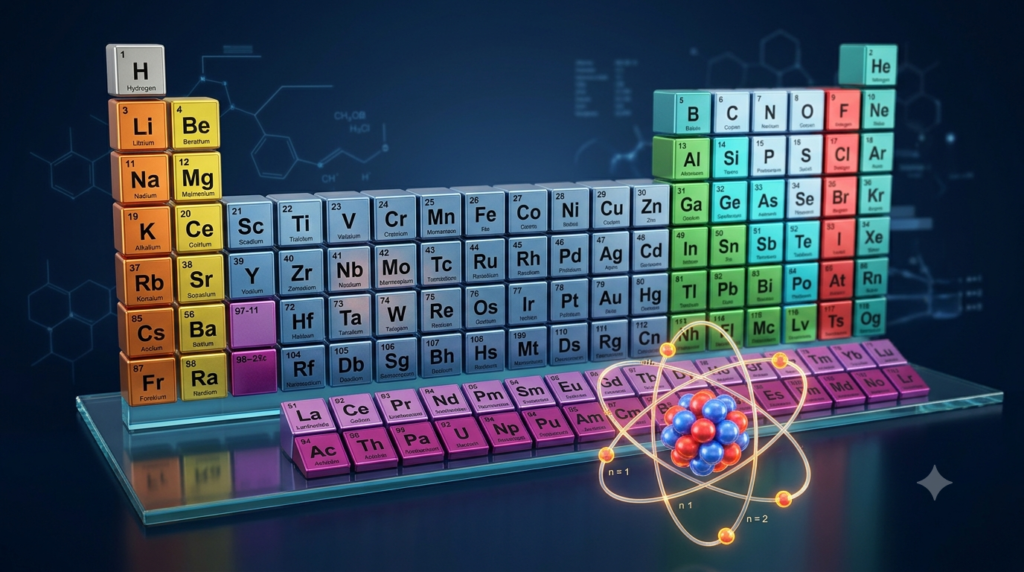
Electron affinity shows a general pattern across the periodic table. It generally becomes more favourable from left to right across a period and less favourable from top to bottom within a group.
However, this trend is not perfectly regular. Differences in atomic size, electron configuration, and electron-electron repulsion create several exceptions.
1. Trend Across a Period
As we move from left to right across a period, the atomic number increases. The number of protons in the nucleus increases, while the added electrons generally enter the same principal energy shell.
The shielding effect does not increase as much as the nuclear charge. Therefore, the effective nuclear charge generally increases.
This causes the nucleus to attract an incoming electron more strongly.
As a result, electron addition generally becomes more favourable across a period.
For example, elements such as chlorine have a strong tendency to accept electrons compared with many elements on the left side of the periodic table.
General trend: Electron affinity generally becomes more favourable from left to right across a period.
There are some important exceptions:
Group 2 elements have relatively low electron affinities because they possess stable ns² configurations.
Group 15 elements have relatively low electron affinities because their p orbitals are half-filled.
Group 18 elements generally have very low or unfavourable electron affinities because their outermost shells are completely filled.
2. Trend Down a Group
As we move from top to bottom in a group, the number of electron shells increases.
The atomic radius generally increases, and the shielding effect becomes stronger.
An incoming electron is added farther from the nucleus and experiences a reduced effective attraction in many cases.
Therefore, electron addition generally becomes less favourable down a group.
For example, the halogens generally show a decrease in electron affinity as we move down the group, although fluorine and chlorine show an important exception to the simple expected pattern.
General trend: Electron affinity generally becomes less favourable down a group.
3. Trend in Halogens
Halogens belong to Group 17 of the periodic table. They have seven electrons in their outermost shell and need only one additional electron to achieve a stable noble gas configuration.
Therefore, they generally have high electron affinities.
The halogens include:
Fluorine (F)
Chlorine (Cl)
Bromine (Br)
Iodine (I)
Astatine (At)
An interesting feature of this group is that chlorine has a more negative first electron gain enthalpy than fluorine.
This may seem surprising because fluorine is smaller and has a stronger attraction for electrons in many situations.
However, fluorine has a very small 2p orbital. When an additional electron enters this compact orbital, electron-electron repulsion becomes relatively strong.
In chlorine, the incoming electron enters the larger 3p orbital, where there is comparatively less repulsion.
Consequently, chlorine releases more energy when it gains an electron than fluorine.
This makes chlorine an important exception to the simple relationship between atomic size and electron affinity.
4. Trend in Noble Gases
Noble gases belong to Group 18 of the periodic table.
They have completely filled outermost electron shells, which makes their electronic configurations highly stable.
Examples include:
Helium (He)
Neon (Ne)
Argon (Ar)
Krypton (Kr)
Xenon (Xe)
Radon (Rn)
Because their outer shells are already complete, they have little tendency to accept additional electrons.
An incoming electron would generally have to enter a higher-energy shell, making the process energetically unfavourable.
Therefore, noble gases usually have positive first electron gain enthalpies under the usual convention.
Their electron affinities are generally very low or unfavourable.
Important Exceptions to the Periodic Trend
Although electron affinity follows general periodic trends, several elements show unexpected behaviour.
Understanding these exceptions is essential for correctly interpreting the property.
1. Fluorine and Chlorine
Fluorine is smaller than chlorine, so we might expect fluorine to have a more negative electron gain enthalpy.
However, chlorine releases more energy when it gains an electron.
The reason is the compact size of fluorine’s 2p orbital. The incoming electron experiences considerable repulsion from the electrons already present.
Chlorine has a larger 3p orbital, which provides more space for the additional electron.
As a result, chlorine has a more negative first electron gain enthalpy than fluorine.
2. Oxygen and Sulfur
Oxygen is smaller than sulfur. However, sulfur has a more negative first electron gain enthalpy than oxygen.
This happens because oxygen has a compact 2p orbital, where electron-electron repulsion is relatively high.
In sulfur, the incoming electron enters the larger 3p orbital and experiences comparatively less repulsion.
Therefore, sulfur releases more energy when accepting an electron than oxygen.
3. Group 2 Elements
Group 2 elements have two electrons in their outermost s subshell.
Their general outer electronic configuration is ns².
Because the s subshell is already completely filled, adding another electron requires placing it in a higher-energy p subshell.
This makes the process less favourable.
Therefore, Group 2 elements generally have relatively low electron affinities.
4. Group 15 Elements
Group 15 elements have a half-filled p subshell.
Their general outer electronic configuration is ns²np³.
Half-filled subshells possess additional stability. Adding another electron requires pairing it with an existing electron in one of the p orbitals.
This increases electron-electron repulsion and reduces the tendency to accept an electron.
Therefore, Group 15 elements generally show relatively low electron affinities compared with neighbouring Group 16 elements.
Difference Between Electron Affinity and Electronegativity
Electron affinity and electronegativity are related concepts, but they are not the same.
Both describe aspects of an atom’s attraction for electrons. However, they refer to different situations.
Electron affinity describes the energy change when an isolated gaseous atom accepts an electron.
Electronegativity describes the ability of an atom to attract shared electrons towards itself when it forms a chemical bond.
The major differences are:
| Electron Affinity | Electronegativity |
|---|---|
| Refers to an isolated gaseous atom gaining an electron. | Refers to an atom attracting shared electrons in a chemical bond. |
| It involves an energy change. | It is a relative measure of electron attraction. |
| Commonly expressed in kJ/mol or eV. | It is expressed using relative scales, such as the Pauling scale. |
| It can be measured experimentally. | It is determined using different theoretical and empirical methods. |
| It is influenced by atomic size, nuclear charge, and electronic configuration. | It depends on factors such as atomic size, effective nuclear charge, and bonding environment. |
For example, chlorine has a high electron affinity because it releases considerable energy when it gains an electron. It also has high electronegativity because it strongly attracts shared electrons in chemical bonds.
Although the two properties are related, they should not be used interchangeably.
Difference Between Electron Affinity and Electron Gain Enthalpy
Electron affinity and electron gain enthalpy are closely related terms, but their sign conventions are often different in chemistry textbooks.
Electron affinity is commonly described as the energy released when an atom gains an electron. Under this convention, a larger positive electron affinity means more energy is released.
Electron gain enthalpy describes the enthalpy change when an isolated gaseous atom accepts an electron.
When energy is released, electron gain enthalpy is negative.
For example:
Cl(g) + e⁻ → Cl⁻(g)
The first electron gain enthalpy of chlorine is approximately −349 kJ/mol.
The corresponding energy released is approximately 349 kJ/mol.
Therefore, always check the sign convention being used when comparing electron affinity values.
Importance of Electron Affinity in Chemistry
Electron affinity is an important periodic property that helps explain several chemical processes.
1. Understanding Chemical Reactivity
Electron affinity helps explain why some elements readily accept electrons while others do not.
For example, halogens readily gain electrons because doing so produces stable negative ions.
This property contributes to their high chemical reactivity.
2. Formation of Ionic Compounds
Electron affinity plays an important role in the formation of ionic compounds.
When a metal transfers an electron to a non-metal, the non-metal gains an electron and forms a negative ion.
For example, sodium transfers an electron to chlorine to form sodium chloride.
Na → Na⁺ + e⁻
Cl + e⁻ → Cl⁻
The attraction between Na⁺ and Cl⁻ helps form the ionic compound NaCl.
However, electron affinity alone does not determine whether an ionic compound forms. Ionisation energy, lattice enthalpy, and other energy changes must also be considered.
3. Understanding Periodic Properties
Electron affinity helps explain the chemical behaviour of elements across periods and down groups.
It also helps identify similarities and differences between elements belonging to the same group.
4. Predicting the Formation of Negative Ions
Elements with favourable electron gain enthalpies are generally more likely to form negative ions.
For example, chlorine readily accepts an electron to form Cl⁻.
This makes electron affinity useful for understanding the formation of anions in chemical reactions.
5. Understanding Atomic Stability
Electron affinity provides information about how the energy of an atom changes when it gains an electron.
It helps explain why some electronic configurations are more favourable than others and why elements with stable configurations may resist accepting additional electrons.
Frequently Observed Electron Affinity Patterns
The following points summarise some important observations:
Halogens generally have high electron affinities.
Chlorine has a more negative first electron gain enthalpy than fluorine.
Sulfur has a more negative first electron gain enthalpy than oxygen.
Noble gases generally have unfavourable first electron affinities.
Group 2 elements generally have relatively low electron affinities.
Group 15 elements generally have relatively low electron affinities because of their half-filled p subshells.
Electron affinity generally becomes more favourable across a period.
Electron affinity generally becomes less favourable down a group.
These patterns are useful for understanding and predicting the behaviour of elements in the periodic table.
Conclusion
Electron affinity is an important periodic property that describes the energy change when a neutral gaseous atom accepts an electron to form a negative ion. It provides valuable information about the ability of different elements to gain electrons and helps explain their chemical behaviour.
In general, electron addition becomes more favourable from left to right across a period and less favourable down a group. However, factors such as atomic size, effective nuclear charge, shielding effect, electron-electron repulsion, and electronic configuration produce several exceptions.
The behaviour of fluorine, chlorine, oxygen, sulfur, and noble gases demonstrates why electron affinity cannot be understood through atomic size alone.
By studying electron affinity and its periodic trends, we can develop a better understanding of chemical reactivity, ionic bonding, anion formation, and the relationship between atomic structure and the properties of elements.
FAQs
1. What is electron affinity?
Electron affinity is the energy change that occurs when an isolated neutral atom in the gaseous state gains an electron to form a negatively charged ion. It helps explain how strongly an atom attracts an additional electron. When energy is released during this process, the electron gain enthalpy is negative. For example, chlorine releases energy when it accepts an electron and forms a chloride ion. Electron affinity is an important periodic property because it helps explain the chemical behaviour, reactivity, and tendency of different elements to form negative ions.
2. What is the periodic trend of electron affinity?
Electron affinity generally becomes more favourable from left to right across a period because the effective nuclear charge increases. This allows the nucleus to attract an incoming electron more strongly. Down a group, electron affinity generally becomes less favourable because atomic size and shielding increase. However, these trends are not perfectly regular. Electronic configuration and electron-electron repulsion create several exceptions. For example, chlorine has a more negative first electron gain enthalpy than fluorine, even though fluorine is smaller.
3. Which element has the highest electron affinity?
Among the elements, chlorine has the most negative first electron gain enthalpy, meaning it releases the greatest amount of energy when accepting an electron under standard gaseous conditions. Its value is approximately −349 kJ/mol. Chlorine has a strong tendency to accept an electron because doing so produces a stable electronic configuration similar to that of argon. Although fluorine is more electronegative and smaller in size, its compact 2p orbital creates greater electron-electron repulsion when an additional electron enters it.
4. Why does chlorine have a higher electron affinity than fluorine?
Chlorine has a more negative first electron gain enthalpy than fluorine because of differences in their atomic sizes and electron-electron repulsion. Fluorine has a very small atomic size, and its 2p orbital is compact. When an additional electron enters this orbital, it experiences considerable repulsion from the electrons already present. Chlorine has a larger 3p orbital, providing more space for the incoming electron. Consequently, chlorine releases more energy than fluorine when it gains an electron.
5. Why does electron affinity generally increase across a period?
Electron affinity generally becomes more favourable across a period because the number of protons increases while the additional electrons enter the same principal energy shell. The effective nuclear charge therefore generally increases. This stronger nuclear attraction helps the atom attract an incoming electron. As a result, more energy is generally released when the atom gains an electron. However, elements with stable electronic configurations, such as Group 2, Group 15, and Group 18 elements, may show deviations from this general trend.
6. Why does electron affinity generally decrease down a group?
Electron affinity generally becomes less favourable down a group because atomic size and the number of electron shells increase. The incoming electron is added farther from the nucleus and experiences greater shielding from inner-shell electrons. This reduces the effective attraction between the nucleus and the incoming electron. Consequently, less energy is generally released when an atom gains an electron. However, electron affinity does not follow a perfectly regular pattern because electronic configuration and electron-electron repulsion also influence the energy change.
7. Why do noble gases have low electron affinity?
Noble gases have low or unfavourable electron affinities because their outermost electron shells are already completely filled. This gives them highly stable electronic configurations. When an additional electron is added, it generally has to enter a higher-energy shell rather than the already filled outermost shell. This process is energetically unfavourable and usually requires energy. Therefore, noble gases such as helium, neon, and argon do not readily accept additional electrons under ordinary conditions.
8. What is the difference between electron affinity and electronegativity?
Electron affinity refers to the energy change when an isolated gaseous atom accepts an electron to form a negative ion. Electronegativity, on the other hand, describes the ability of an atom to attract shared electrons towards itself in a chemical bond. Electron affinity is expressed in units such as kJ/mol or eV, whereas electronegativity is represented using relative scales, such as the Pauling scale. Both properties are related to the attraction between the nucleus and electrons, but they describe different chemical situations.
9. What is the difference between first and second electron affinity?
First electron affinity describes the energy change when a neutral gaseous atom gains its first electron to form a singly negatively charged ion. Second electron affinity describes the energy change when that negative ion accepts another electron to form a doubly negatively charged ion. For example, oxygen first forms O⁻ and can then accept another electron to form O²⁻. The second electron addition generally requires energy because the incoming electron experiences repulsion from the existing negative charge.
10. What are the main factors affecting electron affinity?
Electron affinity is influenced by several atomic properties. The most important factors include atomic size, effective nuclear charge, shielding effect, electronic configuration, and electron-electron repulsion. A smaller atomic size and higher effective nuclear charge can increase the attraction for an incoming electron. However, strong electron-electron repulsion can reduce the energy released during electron addition. Electronic configurations also matter because completely filled and half-filled subshells possess additional stability. These factors together explain the general periodic trends and exceptions observed in electron affinity.