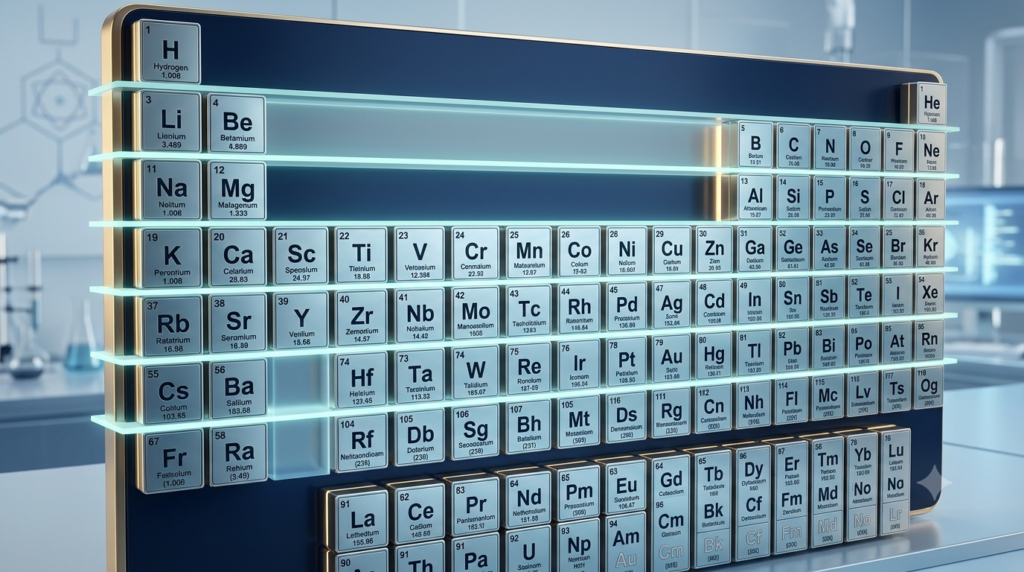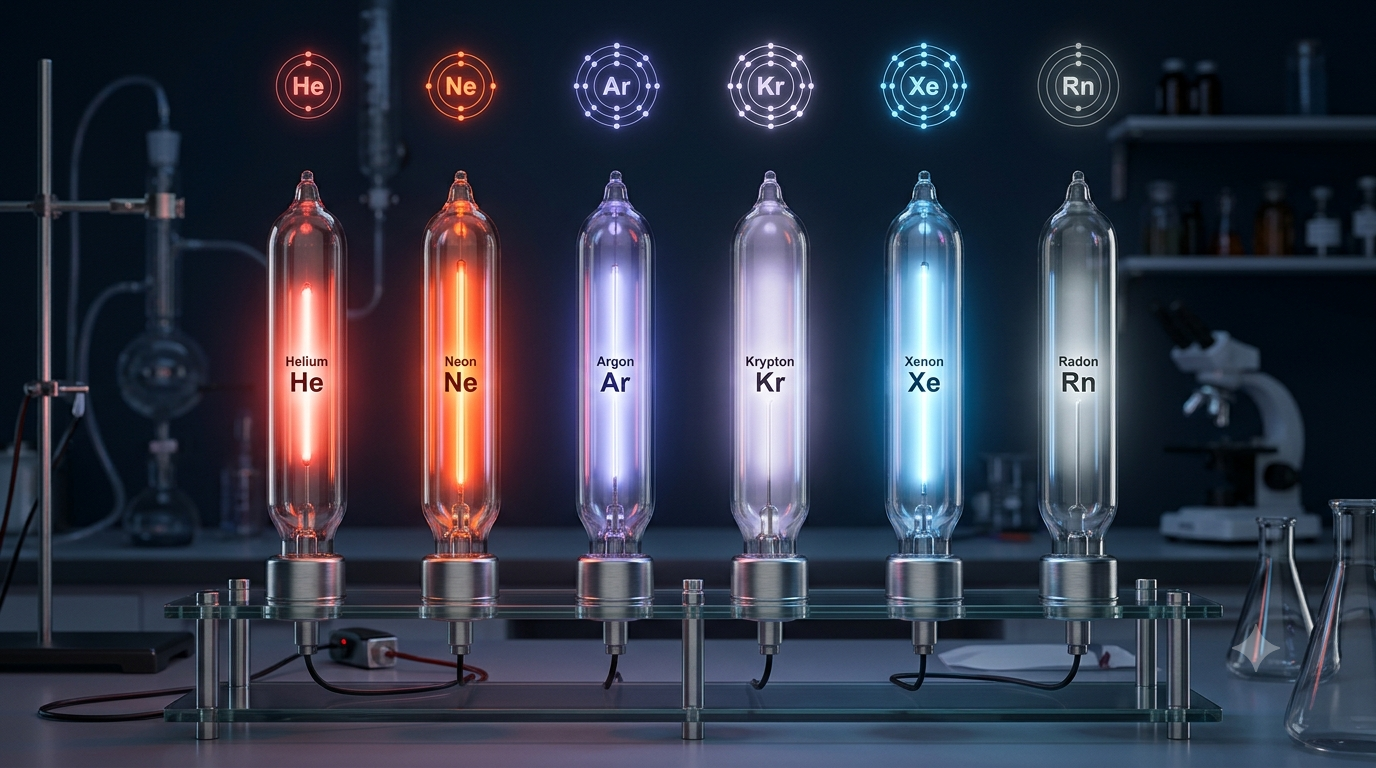
Noble gases are a group of chemical elements known for their extremely low chemical reactivity and unique physical properties. They are found in Group 18 of the periodic table and include helium, neon, argon, krypton, xenon, radon, and oganesson. These elements are called noble gases because they generally do not react easily with other elements to form chemical compounds.
Noble gases are colourless, odourless, and tasteless under normal conditions. They exist as individual atoms rather than molecules, which makes them different from many other gaseous elements. Their low reactivity is mainly due to their stable electronic configurations, particularly their completely filled outermost electron shells.
Although noble gases were once considered chemically inactive, scientists have discovered that some of them, especially xenon and krypton, can form chemical compounds under specific conditions. Noble gases also have many important applications in lighting, medicine, scientific research, electronics, and industrial processes.
Understanding noble gases helps explain chemical stability, atomic structure, periodic trends, and the relationship between electron configurations and chemical properties.
What Are Noble Gases?
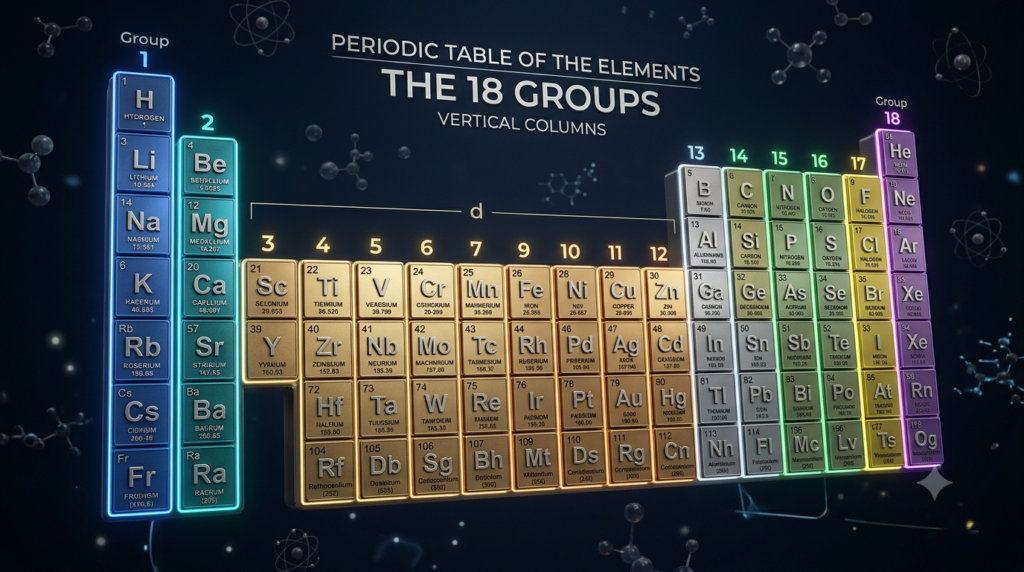
Noble gases are the chemical elements belonging to Group 18 of the modern periodic table. They are characterised by their stable electronic configurations and very low tendency to participate in chemical reactions.
The seven elements commonly placed in the noble gas group are:
Helium (He)
Neon (Ne)
Argon (Ar)
Krypton (Kr)
Xenon (Xe)
Radon (Rn)
Oganesson (Og)
All these elements occupy the last column of the periodic table. They are called noble gases because their outermost electron shells are filled or, in the case of oganesson, are predicted to have a closed-shell configuration influenced by relativistic effects.
Noble gases are generally present in the atmosphere in small quantities. Argon is the most abundant noble gas in Earth’s atmosphere, while helium is found in natural gas deposits and is also produced through radioactive decay in Earth’s crust.
These elements have several similarities, but their properties are not exactly the same. As atomic size increases down the group, their boiling points and melting points generally increase, and their chemical reactivity also tends to increase.
Position of Noble Gases in the Periodic Table
Noble gases are located in Group 18 of the periodic table. They form the final group on the right-hand side of the periodic table and are classified as non-metals.
Their position is directly related to their electronic configurations. Most noble gases have completely filled outermost electron shells, which makes their atoms highly stable.
The general valence-shell electronic configuration of noble gases, except helium, is:
ns² np⁶
Helium has a different electronic configuration because its first and only electron shell can accommodate a maximum of two electrons.
Its electronic configuration is:
1s²
The position of noble gases in Group 18 reflects the completion of electron shells and explains many of their chemical characteristics.
List of Noble Gases and Their Electronic Configurations
The following table presents the seven elements of Group 18 along with their atomic numbers and electronic configurations.
| Element | Symbol | Atomic Number | Electronic Configuration |
|---|---|---|---|
| Helium | He | 2 | 1s² |
| Neon | Ne | 10 | 1s² 2s² 2p⁶ |
| Argon | Ar | 18 | 1s² 2s² 2p⁶ 3s² 3p⁶ |
| Krypton | Kr | 36 | [Ar] 3d¹⁰ 4s² 4p⁶ |
| Xenon | Xe | 54 | [Kr] 4d¹⁰ 5s² 5p⁶ |
| Radon | Rn | 86 | [Xe] 4f¹⁴ 5d¹⁰ 6s² 6p⁶ |
| Oganesson | Og | 118 | [Rn] 5f¹⁴ 6d¹⁰ 7s² 7p⁶ |
Helium has two electrons in its first shell, while the other traditional noble gases have eight electrons in their outermost shells.
Oganesson is a synthetic, highly radioactive element. Its chemical properties have not been experimentally established in the same way as those of the lighter noble gases.
Why Are Noble Gases Chemically Inert?
One of the most important characteristics of noble gases is their extremely low chemical reactivity. This behaviour is mainly explained by their electronic configurations.
Atoms generally participate in chemical reactions to achieve more stable electronic arrangements. Many elements gain, lose, or share electrons to complete their outermost electron shells.
Noble gases already possess stable outermost electron configurations. Helium has a completely filled first shell containing two electrons, while the other established noble gases have eight electrons in their outermost shells.
Because their outermost shells are already filled, noble gases have very little tendency to gain, lose, or share electrons.
For example, neon has the electronic configuration:
1s² 2s² 2p⁶
Its second electron shell contains eight electrons, making it highly stable.
Similarly, argon has eight electrons in its third shell. Therefore, it does not easily participate in ordinary chemical reactions.
However, noble gases are not absolutely chemically inert. Xenon, krypton, and, under certain conditions, radon can form compounds. Their reactivity is generally greater than that of lighter noble gases.
General Physical Properties of Noble Gases
Noble gases share several physical characteristics. These properties are influenced by their atomic structures and the weak attractive forces between their atoms.
1. Colourless, Odourless, and Tasteless
Noble gases are generally colourless, odourless, and tasteless under normal conditions.
They cannot usually be identified by their appearance or smell. Special instruments and laboratory techniques are required to detect and identify them.
However, noble gases produce characteristic colours when an electric discharge passes through them. This property is used in various lighting applications.
2. Exist as Monoatomic Gases
Noble gases generally exist as individual atoms rather than molecules.
For example, helium exists as He, neon as Ne, and argon as Ar.
Unlike oxygen (O₂) and nitrogen (N₂), which exist as diatomic molecules, noble gases do not normally form chemical bonds with other atoms of the same element.
Their monoatomic nature is a result of their stable electronic configurations.
3. Low Melting and Boiling Points
Noble gases have very low melting and boiling points compared with most other elements.
Their atoms are held together in the liquid and solid states by weak London dispersion forces. These forces are much weaker than the chemical bonds found in many other substances.
As a result, only a small amount of energy is required to separate noble gas atoms.
The melting and boiling points generally increase down Group 18 because larger atoms have more electrons and are more easily polarised, resulting in stronger dispersion forces.
4. Low Density
The density of noble gases varies from one element to another.
Helium is the lightest noble gas and is much less dense than air. Neon is also lighter than air, while argon, krypton, xenon, and radon are progressively heavier.
Their density generally increases down the group because atomic mass increases.
This difference in density is useful in several practical applications. For example, helium is used to fill balloons because it is lighter than air.
5. Poor Electrical Conductivity Under Normal Conditions
Noble gases are poor electrical conductors under ordinary conditions because they do not contain freely moving charged particles.
However, when a sufficiently high voltage is applied, their atoms can become ionised. The resulting charged particles allow electrical current to pass through the gas.
This property is used in neon signs, discharge lamps, and other lighting devices.
6. Low Solubility in Water
Noble gases generally have low solubility in water.
Since noble gas atoms are non-polar and do not form strong interactions with water molecules, only small quantities dissolve in water.
Their solubility generally increases with increasing atomic size and polarizability, although the exact values depend on temperature and pressure.
7. High Ionisation Energy
Noble gases generally have high first ionisation energies compared with other elements in the same period.
Ionisation energy is the minimum energy required to remove an electron from an isolated gaseous atom.
Their stable electronic configurations make it difficult to remove electrons.
Helium has the highest first ionisation energy among all elements. As we move down Group 18, the first ionisation energy generally decreases because the outermost electrons are located farther from the nucleus and experience greater shielding.
General Chemical Properties of Noble Gases
Noble gases are known for their low chemical reactivity. However, their chemical behaviour is not identical throughout the group.
1. Very Low Chemical Reactivity
Noble gases generally do not react with most elements under ordinary conditions.
Their stable electronic configurations make them less likely to gain, lose, or share electrons.
Helium and neon are particularly unreactive. Argon is also highly unreactive and is widely used in situations where chemical reactions must be prevented.
2. Do Not Normally Form Compounds
Most noble gases do not readily form chemical compounds under normal conditions.
However, heavier noble gases such as xenon and krypton can form compounds with highly electronegative elements, particularly fluorine and oxygen.
Examples include:
Xenon difluoride (XeF₂)
Xenon tetrafluoride (XeF₄)
Xenon hexafluoride (XeF₆)
Krypton difluoride (KrF₂)
These compounds demonstrate that noble gases are not completely chemically inactive.
3. Reactivity Increases Down the Group
The chemical reactivity of noble gases generally increases down Group 18.
As atomic size increases, the outermost electrons become farther from the nucleus and are more easily influenced or removed.
Consequently, heavier noble gases such as xenon are more capable of forming compounds than lighter noble gases such as helium and neon.
Oganesson is expected to show unusual chemical behaviour, and its properties remain largely theoretical because of its extremely short half-life.
4. Formation of Compounds with Highly Electronegative Elements
Some heavier noble gases form compounds with elements that have a strong attraction for electrons.
Fluorine and oxygen are particularly important in noble gas chemistry.
Xenon forms several stable compounds with fluorine, while krypton forms krypton difluoride under suitable conditions.
These reactions are important because they demonstrate the chemical possibilities of elements traditionally considered inert.
General Trends in Group 18
Several physical and chemical properties show regular changes as we move from helium to oganesson.
1. Atomic Size Increases
Atomic size generally increases down Group 18 because each successive element has an additional electron shell.
For example, helium has only one occupied electron shell, while neon has two and argon has three.
The increasing number of electron shells results in larger atomic radii.
2. Atomic Mass Increases
Atomic mass increases down the group because the number of protons and neutrons generally increases.
Helium has an atomic mass of approximately 4 u, whereas radon has an atomic mass of approximately 222 u.
Oganesson has an atomic number of 118 and is extremely heavy.
3. Boiling Points Increase
The boiling points of noble gases generally increase down the group.
Larger atoms have more electrons and greater polarizability. This produces stronger London dispersion forces between atoms.
Consequently, more energy is required to separate the atoms during boiling.
4. Melting Points Increase
Melting points also generally increase down Group 18 because intermolecular attractive forces become stronger with increasing atomic size.
However, the precise trend depends on the crystal structures and physical behaviour of the individual elements.
5. Ionisation Energy Decreases
First ionisation energy generally decreases down the group.
The outermost electrons become farther from the nucleus and are increasingly shielded by inner electron shells.
As a result, less energy is generally required to remove an outer electron from a heavier noble gas than from a lighter one.
6. Chemical Reactivity Increases
The tendency of noble gases to form chemical compounds generally increases down the group.
Helium and neon are extremely unreactive, whereas xenon forms several well-known chemical compounds.
This trend is related to decreasing ionisation energy and increasing atomic size.
Important Uses of Noble Gases
Noble gases have many practical applications in everyday life, industry, medicine, and scientific research.
1. Uses of Helium
Helium is widely used because it is lightweight, non-flammable, and chemically stable.
Important applications include:
Filling weather balloons and scientific balloons.
Filling decorative balloons and airships.
Cooling superconducting magnets in MRI machines.
Providing an inert atmosphere in specialised industrial processes.
Detecting leaks in vacuum systems.
Supporting deep-sea breathing mixtures in specialised diving applications.
Liquid helium is particularly important in scientific research because it can achieve extremely low temperatures.
2. Uses of Neon
Neon is mainly known for its use in lighting.
Its important applications include:
Neon advertising signs.
Decorative lighting.
High-voltage indicator lamps.
Specialised gas-discharge tubes.
Certain laser systems.
When an electric current passes through neon gas at low pressure, it produces a characteristic reddish-orange glow.
3. Uses of Argon
Argon is the most abundant noble gas in Earth’s atmosphere.
Its low chemical reactivity makes it useful in applications where oxygen and moisture must be excluded.
Important applications include:
Providing an inert shielding gas during welding.
Filling certain electric light bulbs.
Protecting sensitive materials during manufacturing.
Creating controlled atmospheres in laboratories.
Filling some energy-efficient windows.
Argon is particularly useful in welding because it helps prevent unwanted oxidation of hot metals.
4. Uses of Krypton
Krypton is used in specialised lighting and scientific applications.
Its important uses include:
High-performance photographic flash lamps.
Specialised discharge lamps.
Certain types of lasers.
Insulating gas in some high-performance windows.
Scientific research involving rare gases.
Krypton produces characteristic light emissions when electrically excited.
5. Uses of Xenon
Xenon has several important applications because of its physical and chemical properties.
Its uses include:
Xenon flash lamps.
High-intensity vehicle headlights.
Specialised medical imaging applications.
Certain types of lasers.
Ion propulsion systems used in spacecraft.
General and specialised scientific research.
Xenon is particularly important in electric propulsion systems because xenon atoms can be ionised and accelerated to produce thrust.
6. Uses of Radon
Radon is a radioactive noble gas produced naturally through the radioactive decay of uranium and radium in rocks and soil.
Historically, radon was used in some forms of radiation therapy and scientific research.
Today, its use is very limited because exposure to radon is a significant health hazard. It can accumulate inside buildings and increase the risk of lung cancer when inhaled over long periods.
Radon monitoring is therefore important for indoor air safety.
7. Uses of Oganesson
Oganesson is a synthetic radioactive element produced in specialised nuclear research facilities.
It has no established commercial or everyday applications.
Its main importance is in scientific research, particularly in studying superheavy elements, nuclear stability, and the limits of the periodic table.
Occurrence of Noble Gases in Nature
Noble gases occur naturally in the atmosphere, Earth’s crust, and other parts of the environment.
Their natural abundance varies considerably.
Argon is the most abundant noble gas in Earth’s atmosphere, making up approximately 0.934% of dry air by volume.
Neon, helium, krypton, and xenon are present in much smaller quantities.
Helium is also found in certain natural gas deposits. It is continuously produced in Earth’s crust through the radioactive decay of heavy elements such as uranium and thorium.
Radon is produced naturally during radioactive decay processes. Because it is radioactive and has a relatively short half-life, its concentration varies depending on geological conditions.
Oganesson does not occur naturally in measurable quantities. It is produced artificially through nuclear reactions in laboratories.
Why Are Noble Gases Important in Chemistry?
Noble gases are important for understanding several fundamental concepts in chemistry.
First, they help explain the relationship between electronic configuration and chemical stability. Their stable outer electron shells provide a useful example of why atoms gain, lose, or share electrons during chemical reactions.
Second, noble gases help scientists understand periodic trends such as atomic size, ionisation energy, electron configuration, and boiling points.
Third, their low chemical reactivity makes them useful in industrial processes where unwanted chemical reactions must be avoided.
Finally, the discovery of xenon and krypton compounds expanded scientific understanding of chemical bonding and demonstrated that even highly stable atoms can participate in chemical reactions under suitable conditions.
Conclusion
Noble gases are a unique group of chemical elements located in Group 18 of the periodic table. They include helium, neon, argon, krypton, xenon, radon, and oganesson. Their most important characteristic is their low chemical reactivity, which is mainly due to their stable electronic configurations.
These elements are generally colourless, odourless, monoatomic gases with low melting and boiling points. Their atomic size, density, and boiling points generally increase down the group, while their first ionisation energy decreases.
Although noble gases were traditionally considered chemically inert, research has shown that heavier members, particularly xenon and krypton, can form compounds under suitable conditions.
Their applications in lighting, welding, medical equipment, spacecraft propulsion, scientific research, and industrial processes make them an important part of modern science and technology. Studying noble gases provides a better understanding of atomic structure, chemical stability, and periodic properties.
FAQs
1. What are noble gases?
Noble gases are a group of chemical elements found in Group 18 of the periodic table. They include helium, neon, argon, krypton, xenon, radon, and oganesson. These elements are known for their extremely low chemical reactivity because they have stable electronic configurations. Most noble gases have eight electrons in their outermost electron shell, while helium has two electrons in its first shell. They generally exist as individual atoms rather than molecules and are colourless, odourless, and tasteless under normal conditions. Noble gases have important applications in lighting, medicine, scientific research, and industrial processes.
2. Why are noble gases called inert gases?
Noble gases are traditionally called inert gases because they have a very low tendency to participate in chemical reactions. Their outermost electron shells are already filled, making their electronic configurations highly stable. Therefore, they do not easily gain, lose, or share electrons with other atoms. However, the term inert does not mean that these elements can never react. Scientists have discovered that heavier noble gases, particularly xenon and krypton, can form chemical compounds under suitable conditions. For this reason, the term noble gases is generally preferred over the term inert gases.
3. How many noble gases are present in the periodic table?
There are seven elements in Group 18, commonly classified as noble gases. These are helium (He), neon (Ne), argon (Ar), krypton (Kr), xenon (Xe), radon (Rn), and oganesson (Og). The first six elements occur naturally, although radon is produced through radioactive decay. Oganesson is a synthetic element created in specialised nuclear research facilities. All seven elements occupy the last column of the periodic table. They share similar electronic characteristics, but their physical and chemical properties vary according to their atomic numbers and positions within the group.
4. Why do noble gases exist as monoatomic gases?
Noble gases generally exist as monoatomic gases because their atoms already possess stable electronic configurations. Unlike many other elements, they do not need to share electrons with other atoms to achieve a more stable arrangement. Consequently, they usually do not form chemical bonds with atoms of the same element. For example, helium exists as He rather than He₂, and neon exists as Ne rather than Ne₂. Their individual atoms remain separate under ordinary conditions. Weak London dispersion forces can attract noble gas atoms, allowing them to form liquids and solids at sufficiently low temperatures.
5. What is the electronic configuration of noble gases?
The electronic configuration of noble gases describes the arrangement of electrons in their atomic shells and orbitals. Most noble gases have eight electrons in their outermost electron shell, following the general configuration ns² np⁶. Helium is an exception because its only electron shell contains two electrons, represented by 1s². For example, neon has the electronic configuration 1s² 2s² 2p⁶, while argon has 1s² 2s² 2p⁶ 3s² 3p⁶. These completely filled outermost shells explain their high stability and low chemical reactivity.
6. Which is the most abundant noble gas in Earth’s atmosphere?
Argon is the most abundant noble gas in Earth’s atmosphere. It makes up approximately 0.934% of dry air by volume, making it the third most abundant gas in the atmosphere after nitrogen and oxygen. Argon is produced naturally through radioactive decay, particularly the decay of potassium-40 in Earth’s crust. It is colourless, odourless, and chemically unreactive under ordinary conditions. Due to its low reactivity, argon is widely used in welding, electric light bulbs, laboratories, and industrial manufacturing processes where an inert atmosphere is required.
7. Which noble gas is the most chemically reactive?
Among the well-studied naturally occurring noble gases, xenon is one of the most chemically reactive. It can form several chemical compounds, particularly with highly electronegative elements such as fluorine and oxygen. Examples include xenon difluoride (XeF₂), xenon tetrafluoride (XeF₄), and xenon hexafluoride (XeF₆). Xenon has a relatively large atomic size and lower first ionisation energy than lighter noble gases such as helium and neon. These properties make it easier to participate in certain chemical reactions. Oganesson is predicted to have unusual chemical behaviour, but its properties remain largely experimentally unexplored.
8. Why do noble gases have low boiling points?
Noble gases have low boiling points because the attractive forces between their individual atoms are relatively weak. These forces are known as London dispersion forces, which arise from temporary fluctuations in electron distribution. Since noble gases exist as individual atoms and do not normally form strong chemical bonds with one another, only a small amount of energy is required to separate their atoms during boiling. Their boiling points generally increase down Group 18 because larger atoms have more electrons and greater polarizability, resulting in stronger dispersion forces.
9. What are the important uses of noble gases?
Noble gases have several important applications in modern science, technology, and industry. Helium is used in balloons, MRI cooling systems, and scientific research. Neon is commonly used in advertising signs and decorative lighting. Argon provides an inert atmosphere during welding and is also used in electric bulbs. Krypton is used in specialised lamps and lasers, while xenon is used in high-intensity lighting, ion propulsion systems, and specialised scientific applications. Radon has limited applications because of its radioactivity, and oganesson is mainly used for scientific research into superheavy elements.
10. Are noble gases completely chemically inert?
No, noble gases are not completely chemically inert. Although they have stable electronic configurations and show very low chemical reactivity, some heavier noble gases can form chemical compounds under suitable conditions. Xenon is the best-known example because it forms several compounds with fluorine and oxygen. Krypton can also form compounds, such as krypton difluoride (KrF₂). The ability of these elements to participate in chemical reactions demonstrates that noble gases are not absolutely unreactive. Their chemical behaviour depends on factors such as atomic size, ionisation energy, and the reaction conditions.