Every chemical element has a unique identity that distinguishes it from all other elements. Hydrogen, oxygen, carbon, iron, and gold may have different physical and chemical properties, but each element is defined by one fundamental number called the atomic number. It is one of the most important concepts in chemistry because it determines the identity of an element and its position in the periodic table.
The atomic number tells us how many protons are present in the nucleus of an atom. Since every element has a specific number of protons, no two different elements have the same atomic number. For example, hydrogen has an atomic number of 1, carbon has an atomic number of 6, and oxygen has an atomic number of 8.
Understanding atomic number makes it easier to study atomic structure, identify elements, understand the periodic table, and explain why elements have different chemical properties. It also provides the foundation for learning about electron configurations, isotopes, ions, and periodic trends.
What Is Atomic Number?
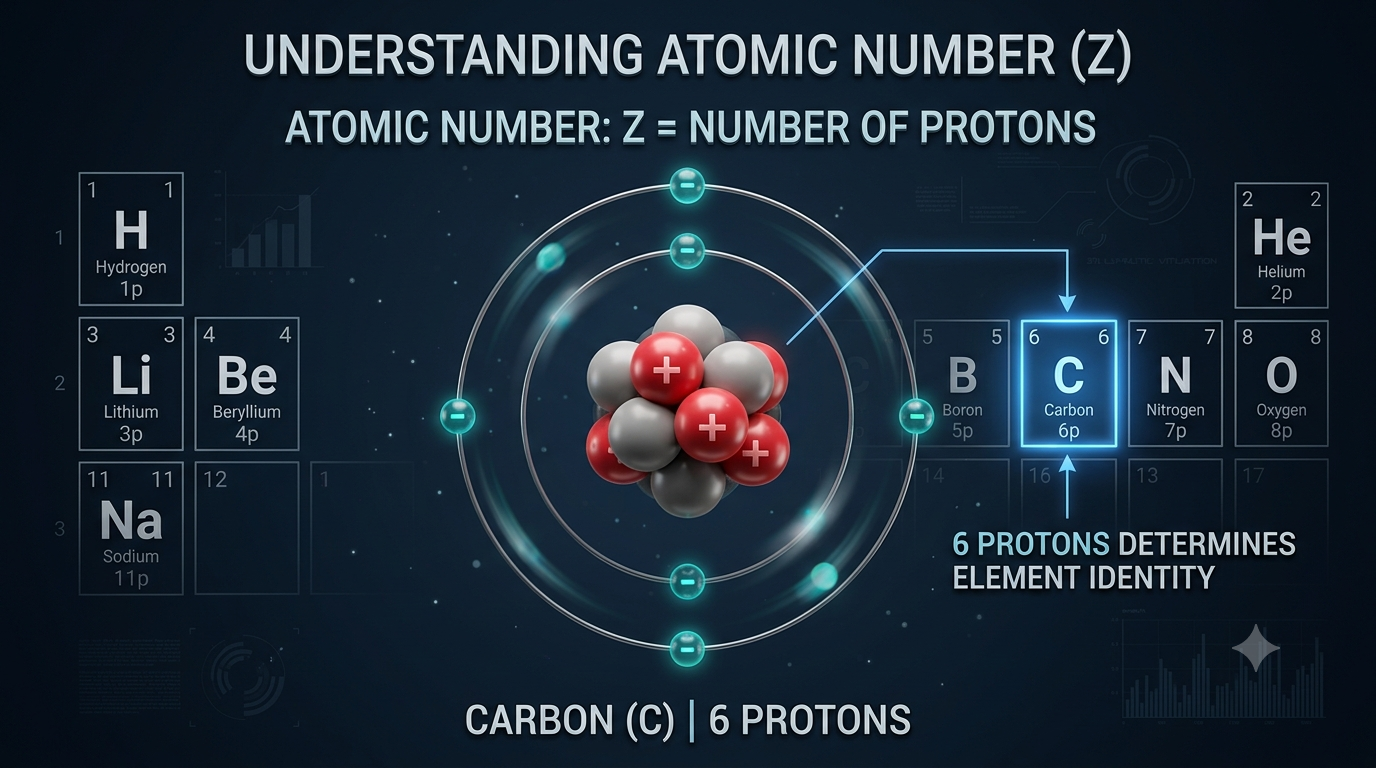
The atomic number is the number of protons present in the nucleus of an atom of an element. It is represented by the letter Z.
Every chemical element has a unique atomic number. This number remains the same for all atoms of a particular element, regardless of the number of neutrons present in their nuclei.
For example:
Hydrogen has 1 proton, so its atomic number is 1.
Helium has 2 protons, so its atomic number is 2.
Lithium has 3 protons, so its atomic number is 3.
Carbon has 6 protons, so its atomic number is 6.
Oxygen has 8 protons, so its atomic number is 8.
The atomic number is used to identify an element because the number of protons determines which element an atom belongs to.
For instance, every carbon atom must contain exactly 6 protons. If an atom contains 7 protons, it is nitrogen, not carbon.
Symbol and Representation of Atomic Number
The atomic number is commonly represented by the letter Z. In the standard chemical notation of an element, the atomic number is written at the lower-left side of the element’s symbol.
The general representation of an atom is:
ᴬₙX
More commonly, it is written as:
ᴬ_ZX
Where:
X = Chemical symbol of the element
A = Mass number
Z = Atomic number
For example, carbon-12 can be represented as:
¹²₆C
In this representation:
C represents carbon.
6 represents its atomic number.
12 represents its mass number.
This means that a carbon-12 atom contains 6 protons and 6 neutrons.
The atomic number and mass number provide different information about the structure of an atom.
How Is Atomic Number Determined?
The atomic number is determined by counting the number of protons present in the nucleus of an atom.
Protons are positively charged subatomic particles located in the nucleus. Every element has a fixed number of protons, which gives it a unique atomic number.
For example, consider an atom with 11 protons. Its atomic number is 11, which identifies it as sodium.
Similarly, an atom containing 17 protons has an atomic number of 17 and is identified as chlorine.
In a neutral atom, the number of electrons is equal to the number of protons. Therefore, the atomic number also tells us the number of electrons in a neutral atom.
However, this relationship changes when an atom gains or loses electrons to form an ion. The number of protons remains unchanged, so the atomic number also remains unchanged.
Atomic Number and the Structure of an Atom
To understand the importance of atomic number, it is necessary to understand the basic structure of an atom.
An atom consists of three main subatomic particles:
1. Protons
Protons are positively charged particles found inside the nucleus. Their number determines the atomic number and the identity of an element.
2. Neutrons
Neutrons are electrically neutral particles located in the nucleus. They contribute to the mass of an atom but do not determine its atomic number.
3. Electrons
Electrons are negatively charged particles found in regions around the nucleus called shells or energy levels. They play an important role in chemical bonding and reactions.
The relationship between these particles and atomic number can be understood through the following points:
Atomic number = Number of protons.
In a neutral atom, number of electrons = Number of protons.
Mass number = Number of protons + Number of neutrons.
For example, a neutral oxygen-16 atom contains:
Protons = 8
Electrons = 8
Neutrons = 8
Atomic number = 8
Mass number = 16
Thus, atomic number provides essential information about the internal structure of an atom.
Difference Between Atomic Number and Mass Number
Atomic number and mass number are two important terms used to describe atoms. Although they are related, they represent different properties.
The atomic number represents the total number of protons in the nucleus, whereas the mass number represents the combined number of protons and neutrons.
Consider carbon-12 and carbon-14.
Carbon-12 contains:
6 protons
6 neutrons
Mass number = 12
Carbon-14 contains:
6 protons
8 neutrons
Mass number = 14
Both atoms have the same atomic number of 6 because they contain the same number of protons. However, their mass numbers are different because they contain different numbers of neutrons.
The main differences are:
| Atomic Number | Mass Number |
|---|---|
| Represented by Z | Represented by A |
| Equal to the number of protons | Equal to protons + neutrons |
| Identifies an element | Identifies a particular isotope |
| Remains unchanged in ordinary chemical reactions | Can differ between isotopes |
| Determines the element’s position in the periodic table | Does not determine the position |
Therefore, atomic number is more important than mass number when identifying a chemical element.
Importance of Atomic Number in the Periodic Table
The atomic number plays a central role in the modern periodic table. It determines the arrangement of elements and helps explain their chemical and physical properties.
1. Atomic Number Determines the Identity of an Element
The most important function of atomic number is to identify an element.
Every element has a unique number of protons. For example, all hydrogen atoms contain one proton, while all helium atoms contain two protons.
If the number of protons changes, the element itself changes.
For example:
1 proton = Hydrogen
2 protons = Helium
3 protons = Lithium
6 protons = Carbon
8 protons = Oxygen
26 protons = Iron
This makes atomic number the fundamental identifying property of an element.
2. Atomic Number Determines the Position of Elements
In the modern periodic table, elements are arranged in increasing order of atomic number.
This means that the elements are placed according to the number of protons in their atoms, starting with hydrogen, which has atomic number 1.
For example:
Hydrogen (1)
Helium (2)
Lithium (3)
Beryllium (4)
Boron (5)
Carbon (6)
Nitrogen (7)
Oxygen (8)
Fluorine (9)
Neon (10)
The atomic number increases by one from one element to the next.
This arrangement is known as the modern periodic law, which states that the physical and chemical properties of elements are periodic functions of their atomic numbers.
3. Atomic Number Helps Determine Electron Configuration
In a neutral atom, the number of electrons is equal to its atomic number.
These electrons are distributed among different shells, subshells, and orbitals according to specific rules.
For example, sodium has an atomic number of 11. Therefore, a neutral sodium atom contains 11 electrons.
Its electronic configuration is:
1s² 2s² 2p⁶ 3s¹
Its shell-wise electron distribution is:
2, 8, 1
Similarly, chlorine has an atomic number of 17, so its electronic configuration is:
1s² 2s² 2p⁶ 3s² 3p⁵
Its shell-wise distribution is:
2, 8, 7
These electron configurations help explain the chemical behaviour of elements and their ability to form chemical bonds.
4. Atomic Number Helps Determine Valence Electrons
Valence electrons are the electrons present in the outermost occupied shell of an atom. They play an important role in chemical bonding and reactions.
Since the atomic number determines the total number of electrons in a neutral atom, it helps us determine the electron arrangement and the number of valence electrons.
For example:
Sodium (11): 1 valence electron
Magnesium (12): 2 valence electrons
Carbon (6): 4 valence electrons
Oxygen (8): 6 valence electrons
Chlorine (17): 7 valence electrons
Elements in the same main group generally have similar outer-shell electron configurations. This is one reason they often show similar chemical properties.
5. Atomic Number Helps Explain Periodic Trends
Periodic trends are regular patterns in the properties of elements across periods and down groups of the periodic table.
Some important periodic trends include:
Atomic radius
Ionization energy
Electronegativity
Electron affinity
Metallic and non-metallic character
Atomic number helps determine the number of protons and, in neutral atoms, the number of electrons. As atomic number increases, the nuclear charge generally increases.
However, periodic trends also depend on electron shielding, electron configuration, and the distance of electrons from the nucleus.
For example, across a period, the effective nuclear charge generally increases, causing the atomic radius to decrease.
Therefore, atomic number provides the foundation for understanding periodic trends.
6. Atomic Number Helps Classify Elements
The periodic table classifies elements into different groups, periods, and blocks.
The position of an element is determined by its atomic number and electron configuration.
Elements are divided into four main blocks:
s-block
p-block
d-block
f-block
The block of an element generally depends on the subshell into which its differentiating electron enters.
For example:
Sodium belongs to the s-block.
Carbon belongs to the p-block.
Iron belongs to the d-block.
Uranium belongs to the f-block.
This classification helps chemists study the properties and behaviour of different elements systematically.
Relationship Between Atomic Number and Isotopes
Isotopes are atoms of the same element that have the same number of protons but different numbers of neutrons.
Since isotopes have the same number of protons, they also have the same atomic number.
For example, carbon has three commonly discussed isotopes:
Carbon-12
Carbon-13
Carbon-14
All three isotopes contain 6 protons, so their atomic number is 6.
However, their neutron numbers are different:
| Isotope | Protons | Neutrons | Mass Number |
|---|---|---|---|
| Carbon-12 | 6 | 6 | 12 |
| Carbon-13 | 6 | 7 | 13 |
| Carbon-14 | 6 | 8 | 14 |
Although their masses differ, all three are forms of carbon.
This demonstrates that atomic number remains constant among isotopes of the same element.
Relationship Between Atomic Number and Ions
An ion is an atom or group of atoms that carries an electrical charge because it has gained or lost electrons.
When an atom loses electrons, it forms a positively charged ion called a cation. When it gains electrons, it forms a negatively charged ion called an anion.
The atomic number does not change during the formation of an ion because the number of protons remains constant.
For example, a sodium atom has:
11 protons
11 electrons
When it loses one electron, it forms a sodium ion (Na⁺).
The sodium ion has:
11 protons
10 electrons
Its atomic number remains 11.
Similarly, a chlorine atom has 17 protons and 17 electrons. When it gains one electron, it forms a chloride ion (Cl⁻), containing 17 protons and 18 electrons.
Its atomic number remains 17.
Therefore, atomic number is independent of the electrical charge of an atom.
First 20 Elements and Their Atomic Numbers
The following table shows the first 20 elements of the periodic table along with their atomic numbers and chemical symbols.
| Atomic Number | Element | Symbol |
|---|---|---|
| 1 | Hydrogen | H |
| 2 | Helium | He |
| 3 | Lithium | Li |
| 4 | Beryllium | Be |
| 5 | Boron | B |
| 6 | Carbon | C |
| 7 | Nitrogen | N |
| 8 | Oxygen | O |
| 9 | Fluorine | F |
| 10 | Neon | Ne |
| 11 | Sodium | Na |
| 12 | Magnesium | Mg |
| 13 | Aluminium | Al |
| 14 | Silicon | Si |
| 15 | Phosphorus | P |
| 16 | Sulfur | S |
| 17 | Chlorine | Cl |
| 18 | Argon | Ar |
| 19 | Potassium | K |
| 20 | Calcium | Ca |
This sequence demonstrates how elements are arranged in the modern periodic table according to increasing atomic number.
Applications of Atomic Number in Chemistry and Science
Atomic number is not only important for studying the periodic table but also has several applications in chemistry, physics, medicine, and other scientific fields.
1. Identification of Unknown Elements
Scientists use atomic number to identify elements based on their nuclear properties. It provides a reliable way to distinguish one element from another.
2. Understanding Chemical Reactions
Atomic number helps determine the electron configuration of neutral atoms. This information helps scientists understand how elements form chemical bonds and participate in chemical reactions.
3. X-ray Spectroscopy
The characteristic X-ray emissions of an element are related to its atomic number. Techniques such as X-ray fluorescence spectroscopy use these characteristic emissions to identify elements in different materials.
4. Nuclear Chemistry
Atomic number is essential in nuclear reactions because it helps track changes in the number of protons when one element is transformed into another.
For example, nuclear decay can change the atomic number of an atom, resulting in the formation of a different element.
5. Medical and Industrial Applications
Elements are identified and studied according to their atomic numbers in many scientific and technological applications. For example, certain elements are used in medical imaging, radiation therapy, material analysis, and industrial research.
Why Is Atomic Number More Important Than Atomic Mass for Identifying Elements?
Atomic number is more fundamental than atomic mass when identifying an element.
Atomic mass can vary because different isotopes of the same element contain different numbers of neutrons.
For example, carbon-12 and carbon-14 have different mass numbers, but both are carbon because they contain six protons.
Similarly, the average atomic mass shown in the periodic table may not be a whole number because it represents the weighted average of the naturally occurring isotopes of an element.
However, the atomic number is always a whole number and remains unique for each element.
This is why the modern periodic table is arranged according to increasing atomic number rather than increasing atomic mass.
Conclusion
Atomic number is one of the fundamental concepts in chemistry because it determines the identity of an element and its position in the modern periodic table. It represents the number of protons present in the nucleus of an atom and provides essential information about atomic structure.
Atomic number also helps determine the electron configuration of neutral atoms, understand valence electrons, explain periodic trends, and study the chemical behaviour of elements. It remains unchanged when an atom forms an ion or when different isotopes of the same element are considered.
The modern periodic table is based on increasing atomic number, making it an essential tool for organizing and understanding all known chemical elements. Learning this concept provides a strong foundation for studying atomic structure, chemical bonding, periodic properties, and advanced chemistry.
FAQs
1. What is atomic number?
Atomic number is the total number of protons present in the nucleus of an atom. It is represented by the letter Z and is unique for every chemical element. For example, hydrogen has an atomic number of 1 because it contains one proton, while carbon has an atomic number of 6 because it contains six protons. Atomic number determines the identity of an element and its position in the modern periodic table. It also helps determine the number of electrons in a neutral atom and understand its electronic configuration and chemical properties.
2. Why is atomic number important in the periodic table?
Atomic number is important because it determines the arrangement of elements in the modern periodic table. Elements are arranged in increasing order of their atomic numbers, starting with hydrogen (1). This arrangement follows the modern periodic law, which explains the periodic repetition of physical and chemical properties. Atomic number also helps determine the electronic configuration of elements, their groups, periods, and blocks. By studying atomic numbers, scientists can understand the similarities and differences between elements and explain their chemical behaviour more systematically.
3. Who introduced the concept of atomic number?
The concept of atomic number was established through the work of several scientists, but Henry Moseley played a major role in demonstrating its importance. In 1913, English physicist Henry Moseley studied the characteristic X-ray frequencies produced by different elements. His experiments showed that these frequencies were related to the positive charge of the nucleus. This provided strong evidence that atomic number represents the nuclear charge and should determine the order of elements in the periodic table. His work helped establish the modern periodic law and the foundation of the modern periodic table.
4. What is the difference between atomic number and mass number?
Atomic number and mass number represent different properties of an atom. Atomic number is the number of protons present in the nucleus, whereas mass number is the total number of protons and neutrons. Atomic number is represented by Z, while mass number is represented by A. For example, a carbon-12 atom has 6 protons and 6 neutrons. Its atomic number is 6, and its mass number is 12. Atomic number identifies the element, whereas mass number helps distinguish different isotopes of the same element.
5. Does atomic number change when an atom becomes an ion?
No, atomic number does not change when an atom becomes an ion. This is because ion formation involves the loss or gain of electrons, not a change in the number of protons. For example, a neutral sodium atom contains 11 protons and 11 electrons. When it loses one electron, it becomes a positively charged sodium ion (Na⁺), but it still contains 11 protons. Therefore, its atomic number remains 11. Similarly, chlorine retains its atomic number of 17 when it gains an electron to form a chloride ion (Cl⁻).
6. What is the relationship between atomic number and electrons?
In a neutral atom, the number of electrons is equal to the atomic number because the number of electrons must balance the positive charge of the protons. For example, an oxygen atom has an atomic number of 8, meaning it contains 8 protons and 8 electrons when neutral. These electrons are arranged in different energy levels around the nucleus. The electron arrangement helps determine the chemical properties of an element, including its bonding behaviour and reactivity. However, in ions, the number of electrons can differ from the atomic number.
7. Can two different elements have the same atomic number?
No, two different chemical elements cannot have the same atomic number. The atomic number represents the number of protons in an atom’s nucleus, and each element has a unique number of protons. For example, carbon always has 6 protons, while nitrogen always has 7 protons. If the number of protons changes, the identity of the element also changes. However, different isotopes of the same element have the same atomic number because they contain equal numbers of protons but different numbers of neutrons.
8. What is the atomic number of the first 10 elements?
The atomic numbers of the first 10 elements are as follows: Hydrogen (1), Helium (2), Lithium (3), Beryllium (4), Boron (5), Carbon (6), Nitrogen (7), Oxygen (8), Fluorine (9), and Neon (10). These elements occupy the first two periods of the modern periodic table. Their atomic numbers increase consecutively from 1 to 10. Learning these atomic numbers helps beginners understand the arrangement of elements and makes it easier to study electronic configurations, periodic trends, and the basic structure of the periodic table.
9. How does atomic number help determine the electronic configuration of an element?
Atomic number determines the number of electrons in a neutral atom. These electrons are distributed among different shells, subshells, and orbitals according to established principles of electron filling. For example, sodium has an atomic number of 11, so a neutral sodium atom contains 11 electrons. Its electronic configuration is 1s² 2s² 2p⁶ 3s¹. Similarly, oxygen has an atomic number of 8 and an electronic configuration of 1s² 2s² 2p⁴. Understanding this relationship helps explain valence electrons, chemical bonding, and periodic properties.
10. Why is atomic number always a whole number?
Atomic number is always a whole number because it represents the actual number of protons in the nucleus of an atom. Protons are individual particles, so their number cannot be a fraction or decimal. For example, carbon has exactly 6 protons, and oxygen has exactly 8 protons. Therefore, their atomic numbers are 6 and 8, respectively. Unlike atomic number, the average atomic mass of an element can contain decimal values because it depends on the relative abundance and masses of its naturally occurring isotopes.