The periodic table is one of the most important achievements in the history of chemistry. It is a systematic arrangement of chemical elements based on their increasing atomic numbers and recurring chemical properties. It helps scientists understand the characteristics of elements, compare their behaviour, and identify relationships between different substances.
However, the periodic table did not develop in a single day. Its development involved centuries of scientific research, experiments, observations, and discoveries. As scientists discovered more elements, they began searching for a systematic way to classify them according to their properties.
Several scientists contributed to the development of the periodic table. Antoine Lavoisier, Johann Wolfgang Döbereiner, John Newlands, Dmitri Mendeleev, Henry Moseley, and Glenn T. Seaborg made particularly important contributions. Their discoveries gradually transformed the classification of elements into the modern periodic table that we use today.
Understanding the history of the periodic table helps us appreciate how scientific knowledge develops and how different discoveries contribute to a better understanding of matter.
Early Attempts to Classify Elements
Before the development of the periodic table, scientists had limited knowledge of chemical elements. Only a relatively small number of elements had been discovered, and there was no universally accepted method of arranging them.
As more elements were identified, chemists noticed that certain elements shared similar physical and chemical properties. For example, some elements reacted with water in similar ways, while others showed comparable characteristics during chemical reactions.
These observations encouraged scientists to search for patterns among elements. Their early classification systems were not perfect, but they established the foundation for the modern periodic table.
Antoine Lavoisier’s Classification of Elements (1789)
In 1789, French chemist Antoine Lavoisier published a list of 33 substances that he considered to be chemical elements.
He divided these substances into four major groups:
Gases
Metals
Non-metals
Earths
His classification included substances such as oxygen, hydrogen, sulfur, iron, copper, and gold.
Lavoisier’s work was important because it introduced a more systematic approach to identifying and classifying substances. It helped chemists distinguish between different categories of materials based on their properties.
However, his classification was not completely accurate. Some substances included in his list were later found to be compounds rather than elements.
Importance of Lavoisier’s Classification
It provided one of the earliest systematic lists of chemical elements.
It introduced a basic method of grouping substances according to their properties.
It helped establish the foundation for future attempts to classify elements.
Although Lavoisier did not develop a periodic table, his contribution was an important starting point in the history of element classification.
Döbereiner’s Law of Triads (1829)
In 1829, German chemist Johann Wolfgang Döbereiner proposed a classification system known as Döbereiner’s Law of Triads.
He observed that certain elements could be arranged into groups of three based on their similar chemical properties. These groups were called triads.
Döbereiner also noticed a relationship between the atomic masses of these elements. The atomic mass of the middle element in a triad was approximately equal to the average of the atomic masses of the other two elements.
For example, consider the triad consisting of lithium, sodium, and potassium.
Lithium: 7
Sodium: 23
Potassium: 39
The average atomic mass of lithium and potassium is:
(7 + 39) ÷ 2 = 23
This value is approximately equal to the atomic mass of sodium.
Other examples included calcium, strontium, and barium, as well as chlorine, bromine, and iodine.
Importance of Döbereiner’s Triads
Döbereiner’s work demonstrated that elements could be grouped according to similar chemical properties. It also showed that atomic masses were related to the properties of elements.
However, his classification had limitations. Only a small number of known elements could be arranged into triads. Many other elements did not fit into this system.
Despite these limitations, Döbereiner introduced an important idea that influenced later attempts to develop a systematic classification of elements.
Newlands’ Law of Octaves (1864–1865)
In 1864–1865, English chemist John Newlands proposed another method of classifying chemical elements.
He arranged the known elements in increasing order of their atomic masses. While studying this arrangement, he observed that every eighth element showed similarities in its chemical properties, beginning with the first element in his arrangement.
He compared this repeating pattern with musical octaves and called it the Law of Octaves.
In music, an octave represents a pattern in which a musical note repeats at a higher frequency. Newlands noticed a similar repetition in the properties of chemical elements.
For example, lithium and sodium showed similar chemical properties. Similarly, beryllium and magnesium had certain similarities.
Importance of the Law of Octaves
It introduced the concept of periodic repetition of elemental properties.
It showed that arranging elements according to atomic mass could reveal patterns.
It helped develop the idea that the properties of elements repeat at regular intervals.
Limitations of Newlands’ Classification
Newlands’ classification had several limitations:
The law worked reasonably well only for lighter elements.
It did not leave gaps for elements that had not yet been discovered.
Some elements with different properties were placed together.
The pattern became difficult to maintain as more elements were discovered.
Although his proposal initially received criticism, Newlands made an important contribution by recognizing the periodic nature of elemental properties.
Mendeleev’s Periodic Table (1869)
The development of the periodic table reached a major turning point in 1869 when Russian chemist Dmitri Mendeleev proposed his periodic classification of elements.
Mendeleev studied the physical and chemical properties of the known elements. He arranged them mainly in increasing order of their atomic masses and observed that elements with similar chemical properties appeared at regular intervals.
Based on these observations, he developed a periodic table that grouped elements with similar characteristics into the same columns.
Mendeleev’s Periodic Law
Mendeleev stated:
“The properties of elements are periodic functions of their atomic masses.”
According to this law, when elements are arranged in increasing order of their atomic masses, their physical and chemical properties repeat periodically.
Main Features of Mendeleev’s Periodic Table
Mendeleev’s periodic table had several important features:
Elements were arranged mainly in increasing order of atomic masses.
Elements with similar chemical properties were placed in the same vertical groups.
The table contained horizontal rows and vertical columns.
Empty spaces were left for elements that had not yet been discovered.
He predicted the properties of several undiscovered elements.
One of the greatest strengths of Mendeleev’s classification was that he did not force every element into a position simply to maintain the order of atomic masses. He considered chemical properties when deciding the positions of elements.
Prediction of Undiscovered Elements
Mendeleev’s ability to predict the existence and properties of undiscovered elements was one of his most remarkable achievements.
He noticed that certain positions in his periodic table were occupied by no known elements. Instead of leaving these gaps unexplained, he predicted that new elements would eventually be discovered.
He used the term “eka” to describe some of these predicted elements.
Three important predictions were:
| Predicted name | Discovered element |
|---|---|
| Eka-boron | Scandium |
| Eka-aluminium | Gallium |
| Eka-silicon | Germanium |
When these elements were discovered, their actual properties were found to be remarkably close to Mendeleev’s predictions.
These discoveries provided strong evidence supporting his periodic classification.
Achievements of Mendeleev’s Periodic Table
Mendeleev’s periodic table was a major improvement over earlier classification systems.
Systematic Classification: It provided an organized arrangement of known elements based on their properties and atomic masses.
Prediction of New Elements: It successfully predicted the existence and approximate properties of several undiscovered elements.
Correction of Atomic Masses: Mendeleev suggested that the atomic masses of certain elements needed correction when their positions did not match their chemical properties.
Grouping of Similar Elements: Elements with similar chemical properties were placed in the same groups, making their relationships easier to understand.
Limitations of Mendeleev’s Periodic Table
Despite its success, Mendeleev’s periodic table had some limitations.
The position of hydrogen was uncertain because it showed similarities to both alkali metals and halogens.
The positions of isotopes could not be explained because isotopes have different atomic masses but the same atomic number and similar chemical properties.
Some elements did not follow the increasing order of atomic masses.
The positions of certain rare earth elements were not properly explained.
The table did not explain the actual reason behind the periodic repetition of elemental properties.
These limitations encouraged scientists to investigate the internal structure of atoms and search for a more fundamental basis for classifying elements.
Discovery of Noble Gases (1894–1898)
The discovery of noble gases was another important development in the history of the periodic table.
In 1894, British scientist Lord Rayleigh and Scottish chemist William Ramsay discovered argon. Their research showed that the atmosphere contained a gas that was chemically different from the known elements.
Later, William Ramsay and other scientists identified additional noble gases, including helium, neon, krypton, and xenon.
Noble gases are generally very unreactive under ordinary conditions because their outer electron shells are complete.
Their discovery created a challenge because these elements did not fit naturally into the existing groups of Mendeleev’s periodic table.
To accommodate them, scientists introduced a new group, initially known as Group 0. In the modern periodic table, noble gases are placed in Group 18.
Importance of Noble Gas Discovery
It expanded the known classification of elements.
It demonstrated that new groups could be added to the periodic table.
It improved the arrangement of elements.
It contributed to the understanding of chemical stability and atomic structure.
The discovery of noble gases showed that the periodic table could be modified as new scientific evidence became available.
Henry Moseley’s Contribution and Modern Periodic Law (1913)
A major improvement in the periodic table came from the work of English physicist Henry Moseley in 1913.
Before Moseley’s research, elements were generally arranged according to increasing atomic mass. However, this arrangement created problems because certain elements appeared in positions that did not match their chemical properties.
Moseley used X-ray spectroscopy to study different elements. He discovered a relationship between the frequencies of characteristic X-rays and the nuclear charges of atoms.
His research established that every element has a unique atomic number, which represents the number of protons in its nucleus.
This discovery provided a more accurate basis for arranging elements.
Modern Periodic Law
Based on Moseley’s discovery, the modern periodic law was established:
The physical and chemical properties of elements are periodic functions of their atomic numbers.
This means that when elements are arranged in increasing order of atomic number, their physical and chemical properties repeat periodically.
Importance of Moseley’s Discovery
Moseley’s work solved several problems associated with Mendeleev’s periodic table.
It established atomic number as the correct basis for arranging elements.
It explained the correct positions of elements such as cobalt and nickel.
It helped resolve inconsistencies in the order of certain elements.
It provided a scientific explanation for the organization of the periodic table.
It contributed to the development of the modern periodic table.
After Moseley’s discovery, atomic number replaced atomic mass as the fundamental basis for arranging elements.
Development of the Long Form Periodic Table
Following Moseley’s discovery, scientists continued improving the arrangement of elements.
The periodic table gradually developed into its present long-form structure, in which elements are arranged according to increasing atomic number and electron configuration.
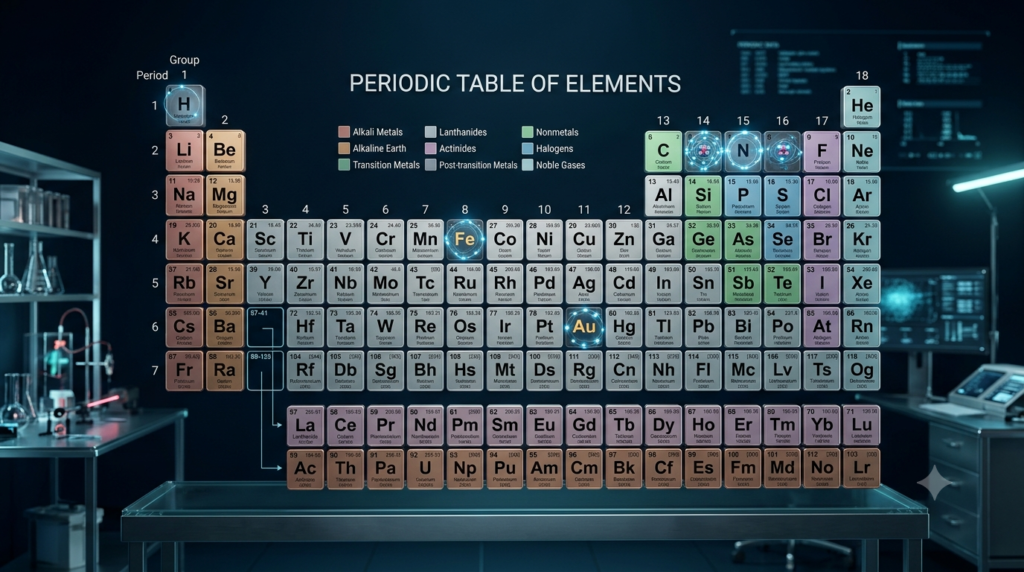
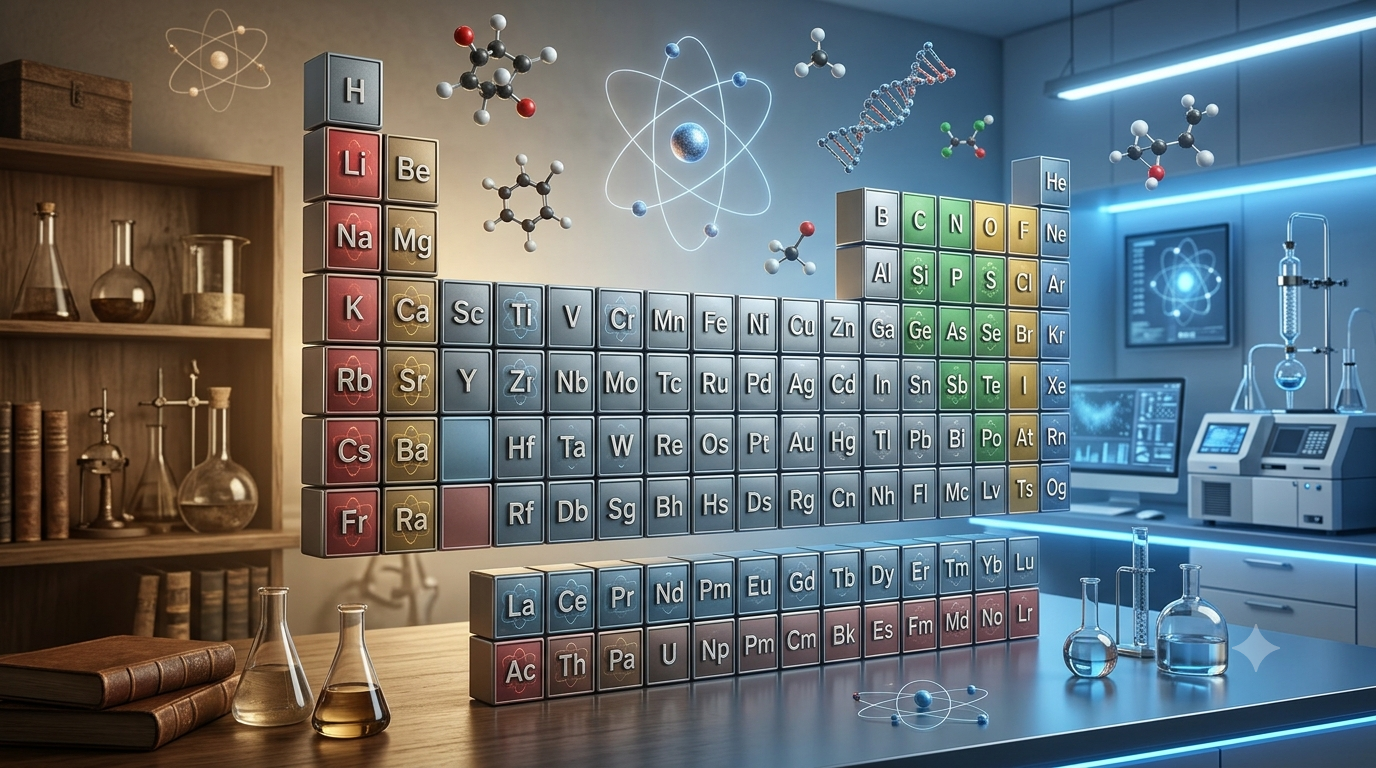
The modern periodic table contains seven horizontal rows called periods and eighteen vertical columns called groups.
It is also divided into four blocks based on the electron subshell into which the differentiating electron enters.
These blocks are:
s-block: Includes Groups 1 and 2, along with hydrogen and helium based on their electron configurations.
p-block: Includes Groups 13 to 18, except helium.
d-block: Includes Groups 3 to 12 and contains the transition elements.
f-block: Includes the lanthanoids and actinoids, which are generally displayed separately at the bottom of the periodic table.
This arrangement provides a clearer understanding of the relationship between electron configurations and the chemical properties of elements.
Glenn T. Seaborg’s Contribution (1940s)
American chemist Glenn T. Seaborg made another important contribution to the development of the periodic table during the 1940s.
He studied transuranium elements, which are elements with atomic numbers greater than uranium (92).
Seaborg proposed that the actinoid series should be placed below the lanthanoid series rather than being included within the main body of the periodic table.
This arrangement created the familiar modern structure in which two rows of f-block elements appear separately at the bottom.
His work also contributed to the discovery and investigation of several artificial elements.
Importance of Seaborg’s Contribution
It improved the organization of the periodic table.
It established the modern arrangement of the actinoid series.
It helped accommodate newly discovered heavy elements.
It contributed to the development of nuclear chemistry.
Seaborg’s work played an important role in shaping the structure of the modern periodic table.
Discovery of New Elements and Completion of the Seventh Period
As scientific technology improved, researchers developed advanced methods to produce and identify new chemical elements.
Many heavy elements that do not occur naturally in significant quantities were created in laboratories through nuclear reactions. These are known as synthetic elements.
Scientists used particle accelerators and advanced detection techniques to study these elements.
In January 2016, the International Union of Pure and Applied Chemistry (IUPAC) approved the names and symbols of four elements:
| Atomic number | Element | Symbol |
|---|---|---|
| 113 | Nihonium | Nh |
| 115 | Moscovium | Mc |
| 117 | Tennessine | Ts |
| 118 | Oganesson | Og |
The approval of these names completed the naming of the seventh period of the periodic table.
Today, the periodic table contains 118 officially recognized elements, beginning with hydrogen (atomic number 1) and ending with oganesson (atomic number 118).
Scientists continue to investigate whether additional elements with atomic numbers greater than 118 can be produced and identified.
The Modern Periodic Table
The modern periodic table is the result of centuries of scientific research and discoveries. It is based on the modern periodic law and arranges elements in increasing order of atomic number.
Each element occupies a specific position according to its atomic number and electron configuration.
The modern periodic table provides important information about the structure and behaviour of matter.
Its main characteristics include:
Seven Periods: The modern periodic table contains seven horizontal rows called periods.
Eighteen Groups: It contains eighteen vertical columns called groups.
Four Blocks: Elements are divided into s-block, p-block, d-block, and f-block according to their electron configurations.
Metals and Non-metals: Metals are mainly located on the left and in the centre, while non-metals are mostly found on the upper right side. Metalloids are generally located along the boundary between metals and non-metals.
Similar Chemical Properties: Elements belonging to the same group often show similar chemical properties because they have related outer-electron configurations.
Separate Placement of Lanthanoids and Actinoids: These two series are generally displayed below the main body of the periodic table to keep its overall structure compact.
The modern periodic table makes it easier to study the relationships between elements and understand their chemical behaviour.
Timeline of the Development of the Periodic Table
The development of the periodic table involved several important scientific contributions over many years.
The following timeline highlights the major milestones:
| Year | Scientist or discovery | Contribution |
|---|---|---|
| 1789 | Antoine Lavoisier | Classified 33 substances into groups |
| 1829 | Johann Döbereiner | Proposed the Law of Triads |
| 1864–1865 | John Newlands | Proposed the Law of Octaves |
| 1869 | Dmitri Mendeleev | Developed the periodic table based mainly on atomic mass |
| 1894 | Lord Rayleigh and William Ramsay | Discovered argon |
| 1895–1898 | William Ramsay and collaborators | Identified additional noble gases |
| 1913 | Henry Moseley | Established the importance of atomic number |
| 1940s | Glenn T. Seaborg | Proposed the actinoid concept |
| 2016 | IUPAC | Approved the names of elements 113, 115, 117, and 118 |
This timeline demonstrates how different discoveries gradually transformed the classification of elements into the modern periodic table.
Future Development of the Periodic Table
Although the periodic table currently contains 118 officially recognized elements, scientific research continues.
Scientists are investigating whether elements with atomic numbers greater than 118 can be created and studied. Producing these superheavy elements is extremely difficult because their nuclei are often unstable and decay rapidly.
One important research concept is the island of stability. It is a theoretical region where certain superheavy atomic nuclei may have relatively longer lifetimes than nearby nuclei.
However, further experimental research is required to confirm the existence and properties of such elements.
Future discoveries may extend the periodic table and improve our understanding of atomic nuclei, electron configurations, and the limits of chemical elements.
The periodic table therefore remains an evolving scientific framework that continues to develop as new discoveries are made.
Conclusion
The history and development of the periodic table is a remarkable example of how scientific knowledge grows through observation, experimentation, and discovery. Early scientists such as Lavoisier, Döbereiner, and Newlands introduced different methods of classifying elements. Their work provided the foundation for Dmitri Mendeleev, who developed a more systematic periodic table and successfully predicted the existence of undiscovered elements.
Later, Henry Moseley’s research established atomic number as the correct basis for arranging elements, leading to the modern periodic law. The contributions of Glenn T. Seaborg further improved the structure of the periodic table and helped accommodate newly discovered heavy elements.
Today, the modern periodic table contains 118 officially recognized elements and remains one of the most important tools in chemistry. Its development demonstrates how scientific discoveries from different generations can combine to create a systematic understanding of the fundamental building blocks of matter.
FAQs
1. Who developed the first periodic table?
Dmitri Mendeleev, a Russian chemist, developed the first widely recognized periodic table in 1869. He arranged the known elements mainly according to increasing atomic masses and grouped elements with similar chemical properties together. One of his greatest achievements was leaving gaps for elements that had not yet been discovered. He also predicted the properties of these missing elements with remarkable accuracy. His work provided the foundation for the modern periodic table, although later scientific discoveries improved its arrangement and established atomic number as the correct basis for classifying elements.
2. What was the first attempt to classify chemical elements?
One of the earliest important attempts to classify chemical elements was made by Antoine Lavoisier in 1789. He published a list of 33 substances that he considered elements and divided them into four groups: gases, metals, non-metals, and earths. Although some substances in his classification were later found not to be elements, his work introduced a systematic approach to classifying chemical substances. It helped scientists recognize the importance of organizing elements according to their properties and provided a foundation for later classification systems developed by other chemists.
3. What is Döbereiner’s Law of Triads?
Döbereiner’s Law of Triads was proposed by German chemist Johann Wolfgang Döbereiner in 1829. According to this classification, certain elements with similar chemical properties could be arranged into groups of three called triads. He observed that the atomic mass of the middle element was approximately equal to the average atomic masses of the other two elements. For example, lithium, sodium, and potassium form a triad. This classification demonstrated a relationship between atomic mass and chemical properties, but it was limited because only a small number of known elements could be arranged into such groups.
4. What is Newlands’ Law of Octaves?
Newlands’ Law of Octaves was proposed by English chemist John Newlands in 1864–1865. He arranged elements in increasing order of their atomic masses and observed that every eighth element showed similarities in its chemical properties. He compared this repeating pattern with musical octaves, where a note repeats after seven intervening notes. His classification worked reasonably well for lighter elements but failed when more elements were included. Some elements with different properties were grouped together, and the system did not leave gaps for undiscovered elements. Nevertheless, it introduced the important idea of periodic repetition.
5. What is Mendeleev’s Periodic Law?
Mendeleev’s Periodic Law states that the properties of elements are periodic functions of their atomic masses. This means that when elements are arranged in increasing order of atomic masses, their physical and chemical properties repeat at regular intervals. Mendeleev used this principle to develop his periodic table in 1869. He grouped elements with similar properties together and left gaps for elements that had not yet been discovered. His periodic law was an important scientific achievement because it established a systematic relationship between the atomic masses and chemical properties of elements.
6. Which elements did Mendeleev predict before their discovery?
Mendeleev predicted the existence and properties of several elements that had not been discovered during his lifetime. Three important examples were eka-boron, eka-aluminium, and eka-silicon. These elements were later discovered and named scandium, gallium, and germanium, respectively. Their actual properties were found to be remarkably close to Mendeleev’s predictions. This achievement provided strong evidence supporting his periodic classification. His ability to predict undiscovered elements demonstrated that the periodic table was more than a simple arrangement of known elements; it could also help scientists anticipate future discoveries.
7. Why was Henry Moseley’s contribution important to the periodic table?
Henry Moseley’s contribution was important because he established atomic number as the correct basis for arranging chemical elements. In 1913, he used X-ray spectroscopy to investigate elements and demonstrated a relationship between X-ray frequencies and nuclear charge. His research showed that every element has a unique atomic number corresponding to its number of protons. This discovery solved several problems in Mendeleev’s arrangement, where certain elements did not follow increasing atomic mass. It led to the modern periodic law, according to which the properties of elements are periodic functions of their atomic numbers.
8. How many elements are present in the modern periodic table?
The modern periodic table contains 118 officially recognized chemical elements. These elements are arranged in increasing order of atomic number, beginning with hydrogen (atomic number 1) and ending with oganesson (atomic number 118). The table consists of seven horizontal periods and eighteen vertical groups. It also contains four major blocks: s-block, p-block, d-block, and f-block. Some elements occur naturally, while others have been produced artificially in laboratories. Scientists continue researching superheavy elements to determine whether additional elements can be created and added to the periodic table in the future.
9. What are the main differences between Mendeleev’s periodic table and the modern periodic table?
The main difference is the basis used to arrange elements. Mendeleev arranged elements mainly according to increasing atomic masses, whereas the modern periodic table arranges them according to increasing atomic numbers. Mendeleev’s periodic law described the periodicity of properties in relation to atomic mass, while the modern periodic law relates periodic properties to atomic number. The modern table also provides a clearer explanation of elemental positions through electron configurations. It accommodates isotopes correctly and contains seven periods and eighteen groups. These improvements make the modern periodic table more scientifically accurate and useful.
10. Why is the periodic table important in chemistry?
The periodic table is important because it provides a systematic way to study and understand chemical elements. It helps scientists compare elemental properties, predict chemical behaviour, and understand relationships between different elements. The position of an element provides useful information about its electron configuration, atomic size, ionization energy, and electronegativity. It also helps predict how elements may react with other substances. The periodic table is widely used in chemistry, materials science, medicine, electronics, and engineering. It remains an essential scientific tool for students, researchers, teachers, and anyone interested in understanding the composition and behaviour of matter.