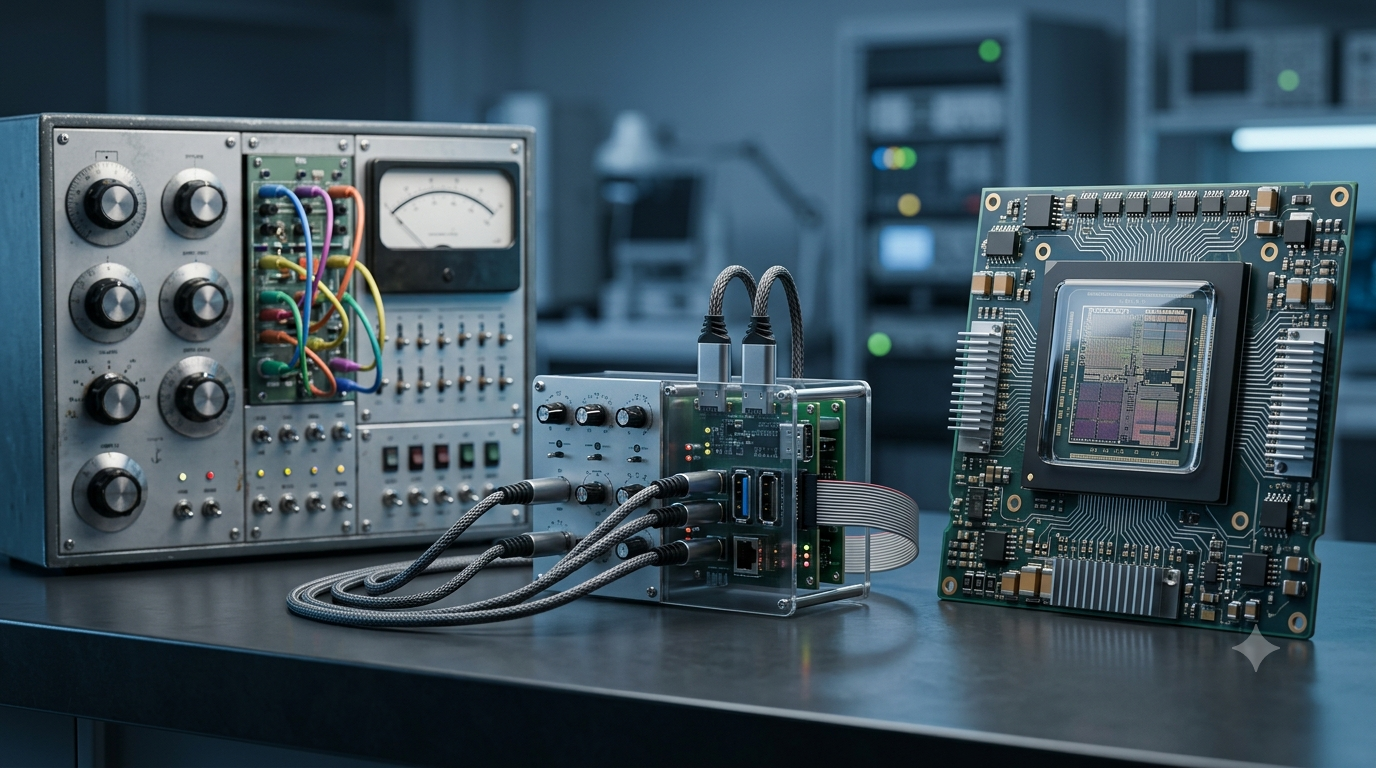
Computers are electronic devices that accept data, process it according to instructions, and produce meaningful information. They are used in almost every field, including education, banking, healthcare, business, scientific research, engineering, and communication. Although computers perform many different tasks, they do not all process data in the same way.
One important way to classify computers is according to their data processing method. Based on this method, computers are traditionally divided into three main categories: analog computers, digital computers, and hybrid computers. Each category works with data differently and is suitable for particular types of problems.
Analog computers work with continuously changing physical quantities, digital computers process data in discrete form, and hybrid computers combine features of both. Understanding these categories helps explain how different computing systems measure physical conditions, perform calculations, and solve complex problems.
What Is Data Processing in a Computer?
Data processing is the process of converting raw data into useful information. A computer receives input, performs operations on that input, and produces results that can be understood or used for decision-making.
For example, a computer in a hospital may receive a patient’s temperature, heart rate, and blood pressure readings. It processes these measurements and displays the results for medical professionals. Similarly, a digital computer used in an office can process sales records to calculate total revenue and prepare reports.
The method used to represent and process data determines the category of computer.
The three main stages of computer data processing are:
Input: The computer receives data through devices such as keyboards, sensors, or measuring instruments.
Processing: The computer performs calculations or other operations on the received data.
Output: The computer presents the results through a screen, printer, control system, or another output device.
Different computers may perform these stages using different techniques. The following sections explain the three main categories.
1. Analog Computers
An analog computer is a type of computer that processes data by representing it through continuously varying physical quantities. These quantities may include voltage, electric current, temperature, pressure, speed, or rotational movement.
Unlike a typical digital computer, which represents information using discrete values, an analog computer works with signals that can change smoothly over a range. It is particularly useful for studying physical systems and representing relationships between continuously changing quantities.
How Do Analog Computers Work?
Analog computers use physical properties to represent data. For example, an electrical voltage may represent the temperature of a system, while another voltage represents its pressure. Electronic circuits can then perform operations on these signals to produce a result.
Some analog computers use mechanical movements, rotating components, or fluid systems instead of electronic signals.
An analog computer does not necessarily calculate by counting numbers. Instead, it uses relationships between physical quantities to represent and solve a problem.
For example, a traditional mechanical differential analyzer can use rotating shafts, gears, and other mechanical components to solve certain mathematical equations. Electronic analog computers can use circuits to represent mathematical operations such as addition, integration, and multiplication.
Characteristics of Analog Computers
Analog computers have several important characteristics:
They process continuously varying physical quantities.
They are often designed for specific measurement, simulation, or control tasks.
They can represent the changing behavior of physical systems in real time.
Their accuracy depends on factors such as component quality, calibration, electrical noise, and environmental conditions.
They may provide results as continuous signals, meter readings, or physical movements.
They are particularly useful when a system must be represented through continuously changing variables.
Examples of Analog Computers
1. Differential analyzer: A mechanical or electromechanical computing device used to solve certain differential equations. It was historically important in engineering and scientific research.
2. Analog flight simulators: Some traditional simulation systems use analog computing circuits to represent aircraft motion and flight dynamics.
3. Electronic analog computing systems: These systems use electrical circuits to model mathematical relationships and simulate physical processes.
4. Analog process-control systems: Certain specialized systems use continuously varying signals to represent physical conditions and help regulate industrial processes.
5. Slide rules: A slide rule is a manual analog calculating instrument that represents numbers through logarithmic scales. It is not an electronic computer, but it demonstrates the analog principle of representing quantities through physical positions.
Advantages of Analog Computers
Analog computers offer several advantages in suitable applications.
Continuous representation: They can represent quantities that change smoothly over time.
Real-time behavior: Specialized analog circuits can respond directly to changing input signals.
Useful for simulation: They can model the behavior of physical systems without necessarily calculating every step as a sequence of digital instructions.
Specialized efficiency: For certain tasks, a dedicated analog circuit can perform a required operation with very low processing delay.
Limitations of Analog Computers
Despite their advantages, analog computers have limitations.
Limited precision: Physical noise, component tolerances, and calibration errors can affect results.
Difficult data storage: Preserving and reproducing analog states precisely can be challenging.
Limited flexibility: Many analog systems are designed for particular tasks and may require hardware changes for different problems.
Complex scaling: Modifying a system to handle a much wider range of values may require substantial adjustments.
Less convenient for general-purpose computing: They are generally less suitable than digital computers for tasks involving documents, databases, complex software, and diverse information-processing requirements.
Applications of Analog Computers
Analog computing techniques have been used in engineering, scientific research, process control, and simulation. They are particularly useful for representing systems governed by continuously changing physical quantities.
For example, engineers can use analog circuits to model electrical networks or study the behavior of dynamic systems. Analog signal-processing circuits also remain important in communication equipment, audio devices, and measurement instruments.
However, an analog circuit used for a specific operation is not always a complete analog computer. Modern systems often combine analog circuits with digital processors to obtain the advantages of both approaches.
2. Digital Computers
A digital computer is a computer that processes data represented in discrete values. Most modern computers use the binary number system, which represents information using two digits: 0 and 1.
These binary digits are called bits. A bit can represent one of two logical states, commonly implemented through different voltage levels or other physical states in electronic circuits.
Digital computers process binary data using electronic logic circuits and instructions stored in memory. They can perform arithmetic operations, compare values, store information, execute programs, and communicate with other devices.
Unlike traditional analog computers, digital computers generally represent information using distinct numerical or symbolic values rather than continuously varying quantities.
How Do Digital Computers Work?
A digital computer receives input from devices such as keyboards, mice, cameras, sensors, or network connections. The input is converted into a suitable digital representation and processed according to program instructions.
The processor performs operations using logic circuits. Memory stores instructions and data, while storage devices preserve information for future use. The results can then be displayed, printed, saved, or transmitted.
For example, when a user enters two numbers into a calculator application, the digital computer represents those numbers in binary form, performs the requested arithmetic operation, and displays the result in a readable format.
A digital computer can also process text, images, sound, video, and scientific data because these forms of information can be encoded as digital data.
Characteristics of Digital Computers
Digital computers have several important characteristics:
They process discrete data values.
They commonly use binary digits, 0 and 1.
They perform calculations through electronic logic circuits.
They can store large amounts of digital information.
They support a wide variety of programs and applications.
They generally provide highly repeatable results for the same inputs and instructions.
They can perform arithmetic, logical, comparison, and data-management operations.
They are suitable for general-purpose tasks as well as specialized computing.
Examples of Digital Computers
1. Desktop computers: These computers are widely used in homes, schools, offices, laboratories, and businesses for document preparation, programming, calculations, and other tasks.
2. Laptop computers: Laptops provide portable computing capabilities for communication, education, entertainment, and professional work.
3. Smartphones: Smartphones are digital computing devices that process applications, messages, photographs, videos, and internet data.
4. Digital calculators: These devices perform arithmetic and other mathematical operations using digital electronic circuits.
5. Servers: Servers process requests, manage data, host websites, and provide services to other computers over networks.
6. Supercomputers: Supercomputers perform extremely demanding calculations and simulations in fields such as climate research, physics, molecular science, and engineering.
Advantages of Digital Computers
Digital computers provide several advantages that have made them the most widely used type of general-purpose computer.
High accuracy: Digital calculations can produce highly accurate results when the data, instructions, and numerical precision are appropriate.
Programmability: The same computer can perform many different tasks by running different programs.
Data storage: Digital information can be stored, copied, searched, and retrieved efficiently.
Reliability: Digital systems can produce consistent results when operating correctly.
Easy communication: Digital computers can exchange information through wired and wireless networks.
Versatility: They support applications ranging from basic calculations to artificial intelligence and scientific simulation.
Error detection: Many digital systems use techniques such as checksums and error-correcting codes to detect or correct certain types of data errors.
Limitations of Digital Computers
Digital computers also have some limitations.
Conversion requirements: Real-world quantities such as temperature and sound often require sensors and analog-to-digital conversion before digital processing.
Finite precision: Digital computers use finite representations of numbers, so rounding errors or limited resolution can occur.
Power consumption: Powerful digital processors and large computing systems may require substantial electrical energy.
Dependence on instructions: Computers need suitable software or hardware logic to perform their intended tasks.
Processing overhead: Some real-time physical measurements require additional circuitry and conversion steps before the data can be processed.
Applications of Digital Computers
Digital computers are used in almost every modern industry.
In education, they support online learning, digital libraries, simulations, and examinations. In banking, they process transactions, maintain account records, and detect suspicious activities. In healthcare, they manage patient records, analyze medical images, and support diagnostic equipment.
Digital computers are also essential in scientific research, manufacturing, transportation, communication, weather forecasting, entertainment, and space exploration.
Their flexibility, storage capabilities, and ability to execute complex programs make them suitable for a wide range of applications.
3. Hybrid Computers
A hybrid computer combines features of analog and digital computing. It is designed to take advantage of the continuous representation used in analog systems and the discrete processing and storage capabilities of digital systems.
Hybrid computers are particularly useful when information originates from continuously changing physical conditions but must also be analyzed, stored, or processed digitally.
A hybrid system may use analog components to measure or process signals and digital components to perform calculations, store records, display information, or control a process.
It is important to understand that not every computer connected to a sensor is automatically called a hybrid computer. The term generally refers to a system in which analog and digital computing functions are meaningfully integrated.
How Do Hybrid Computers Work?
A hybrid computer often receives measurements from sensors that monitor physical quantities such as temperature, pressure, heart rate, or electrical voltage.
These measurements may initially exist as analog signals. An analog-to-digital converter (ADC) converts the signals into digital values that a processor can analyze.
The digital section processes the converted data, performs calculations, stores information, and may determine what action should be taken. If the system must control a physical device, a digital-to-analog converter (DAC) can convert digital output into an analog signal for an actuator or control circuit.
The exact arrangement depends on the application. Some hybrid systems use specialized analog computing circuits directly, while others primarily combine analog measurement and conditioning circuits with digital computing.
Characteristics of Hybrid Computers
Hybrid computers have the following characteristics:
They combine analog and digital computing functions.
They can work with real-world measurements and digital information.
They are useful for monitoring and controlling physical processes.
They may provide rapid responses to changing conditions.
They can store measurements and process them using digital programs.
They can combine continuous signals with discrete calculations.
Their overall performance depends on the design and capabilities of their analog and digital components.
Examples of Hybrid Computers
1. Medical monitoring systems: Some advanced monitoring systems measure continuous physiological signals and use digital processors to calculate values, identify patterns, display trends, and generate alerts. These systems illustrate hybrid computing principles when analog signal-processing functions and digital computation are integrated.
2. Patient-monitoring equipment: Devices that measure electrocardiogram (ECG) signals, blood pressure, or other physiological parameters may use analog front-end circuits and digital processing to analyze the measurements.
3. Industrial process-control systems: Some industrial systems combine analog measurement and control circuits with digital processors to monitor pressure, temperature, flow, and other variables.
4. Scientific measurement systems: Laboratory instruments may combine analog signal conditioning, digital conversion, numerical analysis, and data storage to obtain meaningful measurements.
5. Hybrid simulation systems: Specialized simulators can combine analog computation of continuous system behavior with digital calculations for discrete events or complex control operations.
These examples illustrate hybrid computing techniques. Whether a particular device is formally classified as a hybrid computer depends on its architecture and the extent to which it combines analog and digital computing.
Advantages of Hybrid Computers
Hybrid computers offer several benefits.
Combined capabilities: They can use analog techniques for continuous signals and digital techniques for numerical calculations and data management.
Real-time monitoring: They can process changing measurements and respond to conditions in suitable applications.
Flexible analysis: Digital processing allows measurements to be analyzed using programmable methods.
Data storage: Measurements and results can be stored for later examination.
Improved system integration: They can connect physical sensors, control mechanisms, and digital applications within one system.
Specialized performance: A well-designed hybrid system can provide an effective solution for complex measurement and control tasks.
Limitations of Hybrid Computers
Hybrid computers also have some disadvantages.
Complex design: Integrating analog and digital components requires careful engineering.
Higher development costs: Specialized hardware, software, and calibration may increase the overall cost.
Conversion errors: Analog-to-digital and digital-to-analog conversion can introduce quantization errors and other inaccuracies.
Maintenance requirements: Both analog and digital components may require testing, calibration, and servicing.
Application-specific design: Many hybrid systems are designed for specialized tasks rather than general-purpose use.
Applications of Hybrid Computers
Hybrid computing is valuable in areas where digital calculations must interact closely with physical measurements.
In healthcare, integrated measurement systems help collect and analyze physiological signals. In manufacturing, hybrid systems can monitor production conditions and regulate equipment. In scientific research, they help measure changing variables and process experimental results.
They are also useful in specialized simulation, energy systems, aerospace engineering, and industrial automation. Their primary strength is the integration of continuous physical information with digital processing and decision-making.
Difference Between Analog, Digital, and Hybrid Computers
The three categories differ mainly in how they represent and process data.
| Basis of Comparison | Analog Computer | Digital Computer | Hybrid Computer |
|---|---|---|---|
| Data representation | Continuously varying physical quantities | Discrete values, commonly binary | Combination of continuous signals and discrete values |
| Processing method | Uses physical or electrical relationships | Uses digital logic and instructions | Integrates analog and digital processing |
| Typical output | Continuous signals or physical readings | Numerical, textual, graphical, or digital output | Measurement signals and digital results |
| Accuracy | Affected by noise, calibration, and component tolerances | Depends on numerical precision, input quality, and system design | Depends on both analog and digital components |
| Programming | Often task-specific or configured through specialized circuits | Supports a wide range of software programs | Depends on the design; often combines specialized hardware and digital software |
| Data storage | Can be challenging to store analog states precisely | Supports efficient digital storage | Can store data digitally while handling analog signals |
| Common applications | Specialized simulation and continuous signal processing | Personal computing, servers, calculations, and data processing | Medical monitoring, measurement, and industrial control |
| Main advantage | Direct handling of continuous quantities | Flexibility, storage, and repeatable calculations | Integration of analog measurement and digital processing |
| Main limitation | Sensitivity to noise and limited flexibility | Requires suitable digital representation of real-world inputs | Greater design and integration complexity |
How to Identify the Type of Computer
A computer’s category can be identified by examining how it represents and processes information.
Step 1: Examine the Data Representation
Determine whether the system works mainly with continuously varying physical quantities or discrete digital values. Continuous voltage used to represent a changing physical variable is an example of analog representation, while information encoded as binary digits is an example of digital representation.
Step 2: Examine the Processing Method
Identify whether the system performs operations through analog relationships, digital logic and instructions, or a combination of both.
Step 3: Examine the System Architecture
Check whether the system includes integrated analog and digital computing functions. A device that merely measures an analog signal and sends it to a digital computer may contain both analog and digital components, but its classification depends on the complete system design.
Step 4: Consider Its Main Purpose
A traditional analog computing device may be designed to model physical behavior. A digital computer may support many different programs, while a hybrid computing system may be designed to measure, analyze, and control a physical process using both computing approaches.
These steps provide a practical way to understand the differences without relying only on the appearance or size of a device.
Are Modern Computers Analog, Digital, or Hybrid?
Most modern general-purpose computers, including desktops, laptops, tablets, and smartphones, are classified as digital computers because their processors operate on digital data.
However, modern digital computers frequently contain analog circuits. For example, microphones produce analog electrical signals, temperature sensors may produce analog outputs, and radio-frequency circuits process signals used in wireless communication.
These signals are often converted into digital data before being processed by the main digital processor. Digital-to-analog conversion may also be used to produce sound or control physical equipment.
Therefore, the presence of analog components does not automatically make a personal computer a hybrid computer. The classification depends on how the system’s computing functions are organized and whether analog and digital computation are integrated as defining features.
Modern technology increasingly combines analog and digital techniques because each approach has strengths that can be useful in different stages of a computing task.
Conclusion
Computers can be classified by data processing method into three main categories: analog computers, digital computers, and hybrid computers. Analog computers represent and process continuously varying physical quantities, making them useful for certain measurement, simulation, and signal-processing tasks. Digital computers process discrete data, commonly represented in binary form, and are widely used for calculations, communication, storage, and general-purpose applications. Hybrid computers integrate analog and digital computing functions to handle physical measurements and digital analysis within the same system.
Each category has its own advantages, limitations, and applications. Although digital computers dominate general-purpose computing today, analog techniques remain important in electronics, measurement, and control, while hybrid systems are valuable in specialized scientific, medical, and industrial applications. Understanding these three categories provides a useful foundation for learning about computer fundamentals and modern computing technology.
FAQs
1. What is the classification of computers by data processing method?
Computers are classified by data processing method into three main categories: analog computers, digital computers, and hybrid computers. Analog computers process continuously varying physical quantities, such as temperature, pressure, and voltage. Digital computers process discrete data, usually represented using binary digits, 0 and 1. Hybrid computers combine features of analog and digital computing to handle physical measurements and digital calculations. Each type has different characteristics, advantages, and applications. This classification helps us understand how computers represent information, perform operations, and solve problems in scientific research, healthcare, engineering, business, and industrial automation.
2. What is an analog computer?
An analog computer is a computing device that represents and processes data using continuously varying physical quantities. These quantities may include voltage, electric current, temperature, pressure, or mechanical movement. Analog computers can model physical systems and perform certain calculations through electrical or mechanical relationships. Traditional analog computers were used in scientific research, engineering, and simulation. For example, a differential analyzer could solve specific mathematical equations using mechanical components. Analog computing techniques are still useful in specialized applications involving continuous signals. However, analog computers can be affected by electrical noise, component variations, and calibration errors, which may limit their precision.
3. What is a digital computer?
A digital computer is a computer that processes data represented as discrete values, commonly using the binary digits 0 and 1. It performs calculations and logical operations through electronic circuits and programmed instructions. Digital computers can store information, execute software, communicate through networks, and handle different forms of data, including text, images, audio, and video. Common examples include desktop computers, laptops, smartphones, servers, and supercomputers. Digital computers are widely used because they offer flexibility, efficient data storage, and reliable processing. Their applications include education, banking, healthcare, scientific research, business management, entertainment, and communication.
4. What is a hybrid computer?
A hybrid computer combines analog and digital computing functions in one system. It can work with continuously changing physical signals while also using digital processing to calculate results, store information, and execute instructions. For example, a specialized medical monitoring system may receive analog signals from sensors and convert them into digital data for analysis. Industrial control systems may similarly combine analog measurement circuits with digital processors. Hybrid computing is useful when a system needs to interact with real-world physical conditions and perform digital calculations. Its main advantages include integrated measurement, analysis, and control, although its design can be more complex and expensive.
5. What is the main difference between analog and digital computers?
The main difference between analog and digital computers is how they represent and process information. Analog computers use continuously varying physical quantities, whereas digital computers process discrete values, commonly represented in binary form. Analog systems are suitable for certain continuous simulations and specialized signal-processing tasks. Digital computers are better suited to general-purpose activities such as document preparation, numerical calculations, data storage, and software applications. Analog results may be affected by noise and component variations, while digital calculations can provide repeatable results within their numerical precision limits. The choice depends on the requirements of the particular application.
6. What are the main characteristics of digital computers?
Digital computers process discrete data, commonly represented using binary digits. They use electronic logic circuits to perform arithmetic, comparison, and logical operations. Their main characteristics include programmability, data storage, processing speed, versatility, and the ability to execute complex instructions. Digital computers can handle various types of information, including text, numbers, images, sound, and video. They can also communicate with other devices through computer networks. Another important characteristic is their ability to produce consistent results when the same valid inputs and instructions are used. These features make digital computers useful in education, healthcare, scientific research, banking, communication, and many other fields.
7. What are the advantages of hybrid computers?
Hybrid computers offer the advantages of both analog and digital computing. Their analog components can receive or process continuously changing signals, while digital components can perform calculations, store data, and execute programmed instructions. This combination makes them useful for real-time measurement, scientific experiments, medical monitoring, and industrial control. Hybrid systems can analyze sensor readings and help control physical equipment based on the results. They also allow measurements to be recorded and examined later using digital tools. However, hybrid computers may require specialized components, careful calibration, and more complex system integration than simpler computing arrangements.
8. Where are analog, digital, and hybrid computers used?
Analog computers are associated with specialized simulation, continuous signal processing, and certain engineering applications. Digital computers are used in homes, schools, offices, hospitals, banks, laboratories, and data centers. Examples include laptops, smartphones, servers, and supercomputers. Hybrid computing systems are useful in medical monitoring, industrial process control, scientific measurement, and specialized simulation. For instance, a monitoring system may collect continuously changing physiological signals and use digital processing to calculate measurements and display trends. These applications show that different computing approaches serve different purposes. The most appropriate type depends on the nature of the data, required accuracy, processing needs, and operating environment.
9. Why are digital computers more common than analog computers today?
Digital computers are more common because they can perform many different tasks using software, store large amounts of information, and communicate efficiently with other devices. They are suitable for general-purpose applications such as internet browsing, programming, education, banking, and scientific calculations. Digital data can also be copied, searched, transmitted, and processed conveniently. Advances in semiconductor technology have made digital processors increasingly powerful and affordable. Analog computing remains useful in specialized applications involving continuous signals and physical systems. However, digital computers offer greater flexibility for most everyday computing requirements, which explains their widespread use in modern technology.
10. Can a modern computer contain both analog and digital components?
Yes, modern computers commonly contain both analog and digital components. For example, a microphone produces an analog signal from sound, and an analog-to-digital converter can transform that signal into digital data for processing. Similarly, digital-to-analog converters can help produce audio output through speakers. Computers may also use analog circuits for power management, radio communication, and sensor interfaces. However, having both types of components does not automatically mean that a device is classified as a hybrid computer. Most laptops and smartphones remain digital computers because their main computing operations use digital processing. Classification depends on the overall system architecture and its computing functions.