A mathematical formula can sometimes look like a simple collection of symbols, numbers, and operations. Yet a well-designed general formula can work for hundreds, thousands, or even infinitely many different values. This raises an important question: why does a general formula work for many values instead of just one example?
The key is that a general formula is not created to describe one particular calculation. It is designed to express a general relationship between quantities. Instead of using fixed numbers for one situation, it usually contains variables that can represent different values. As long as those values satisfy the conditions of the formula, the same relationship continues to hold.
For example, the formula for the area of a rectangle is:
A = l × w
Here, A represents area, l represents length, and w represents width. If the length is 5 cm and the width is 3 cm, the area is 15 cm². But the formula is not limited to 5 cm and 3 cm. The same formula works for a rectangle measuring 10 cm by 4 cm, 20 cm by 7 cm, or any other valid dimensions.
Understanding why this happens is an important step toward understanding algebra, equations, identities, formulas, and mathematical reasoning.
What Is a General Formula?
A general formula is a mathematical expression that represents a relationship that remains valid for a whole set of allowed values.
Consider the formula:
A = l × w
This is a general formula for the area of a rectangle. It does not tell us the area of only one particular rectangle. Instead, it tells us how the area depends on the rectangle’s length and width.
Suppose:
Then:
A = 5 × 3 = 15 cm²
Now change the dimensions:
The formula still works:
A = 8 × 4 = 32 cm²
The numbers changed, but the relationship did not.
This is the central idea behind a general formula: the values may change, but the rule connecting them remains the same.
A Formula Is a Rule, Not a Single Answer
One of the easiest ways to understand a general formula is to think of it as a rule.
For example:
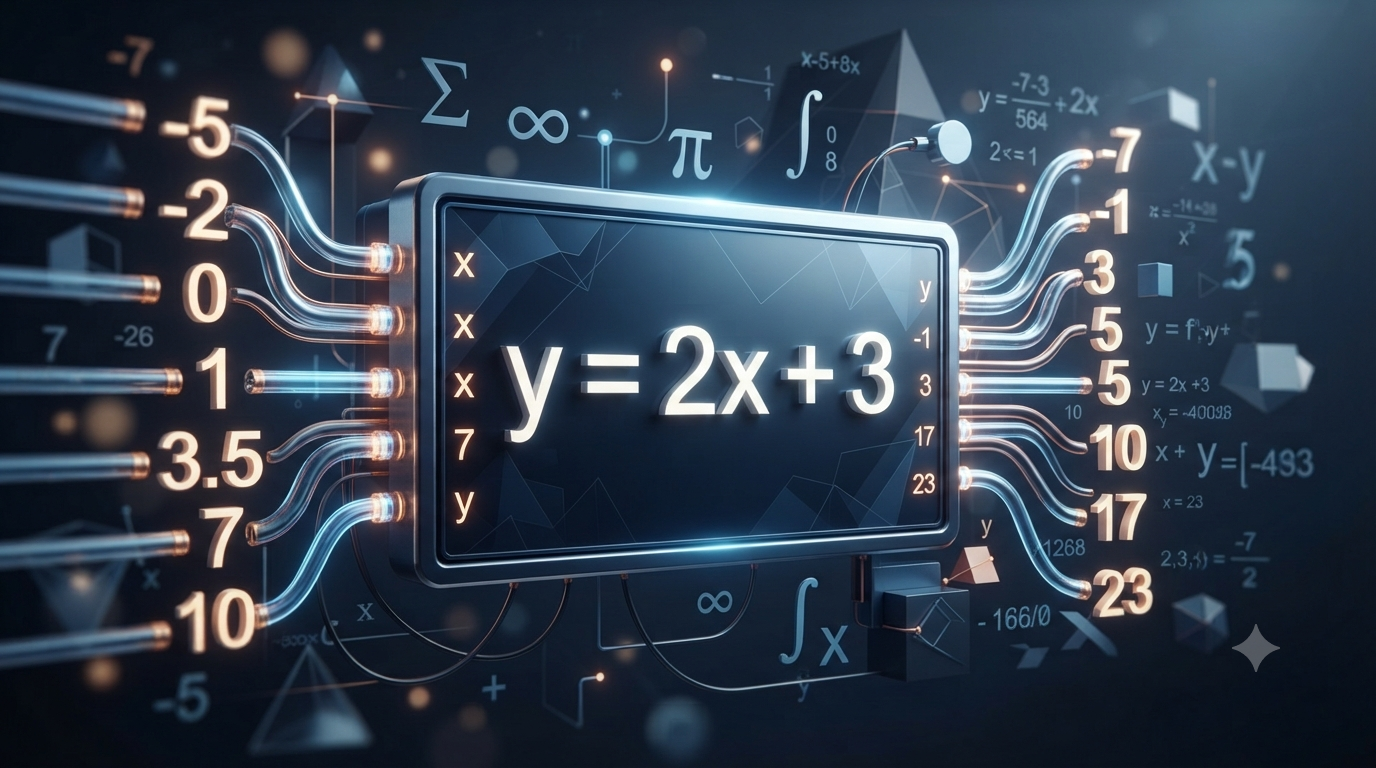
y = 2x + 3
This formula does not give one fixed value for y. Instead, it tells us what to do whenever we choose a valid value of x.
If:
x = 1
then:
y = 2(1) + 3 = 5
If:
x = 4
then:
y = 2(4) + 3 = 11
If:
x = 10
then:
y = 2(10) + 3 = 23
The formula works each time because it describes a relationship between x and y. The particular numbers are only inputs.
This is very different from a single example such as:
2(4) + 3 = 11
That statement tells us what happens for one particular value of x. The formula tells us what happens for every allowed value of x.
Variables Allow a Formula to Represent Many Cases
Variables are one of the main reasons general formulas can work for many values.
A variable is a symbol that can represent different values depending on the situation.
For example:
P = 2(l + w)
is the formula for the perimeter of a rectangle.
The symbols l and w are not fixed numbers. They can represent different lengths and widths.
For one rectangle:
So:
For another rectangle:
So:
The formula did not change. Only the values assigned to the variables changed.
This is why variables make mathematical statements general. They allow one symbolic rule to represent many individual cases.
The Formula Describes a Relationship
A general formula works for many values because it captures a relationship rather than memorizing individual results.
Imagine calculating the perimeter of hundreds of rectangles.
You could calculate each rectangle separately:
But this would be repetitive.
Instead, mathematics identifies the common relationship:
P = 2(l + w)
Now one formula can handle all these cases.
The formula is useful because the same mathematical structure appears every time. A rectangle always has two lengths and two widths. Therefore, its perimeter can always be found by adding these sides:
l + w + l + w
which can be simplified to:
2l + 2w
or:
2(l + w)
The formula works for many values because the underlying structure remains the same.
Why Doesn’t Changing the Numbers Break the Formula?
Changing the values does not normally break a general formula because the formula was constructed to represent the relationship between those quantities.
Consider:
C = 2πr
This formula gives the circumference of a circle.
If the radius is 2 cm:
C = 2π(2) = 4π cm
If the radius is 5 cm:
C = 2π(5) = 10π cm
If the radius is 10 cm:
C = 2π(10) = 20π cm
The radius changes, and the circumference changes with it. But the relationship between circumference and radius remains the same.
The number 2π tells us how circumference is related to radius. The variable r allows the formula to adapt to different circle sizes.
So a general formula does not require the answer to remain constant. The relationship remains constant even when the values change.
General Formulas Are Built From Patterns
Many mathematical formulas are discovered by observing patterns.
Suppose we look at the sum of the first few odd numbers:
1 = 1²
1 + 3 = 4 = 2²
1 + 3 + 5 = 9 = 3²
1 + 3 + 5 + 7 = 16 = 4²
A pattern begins to appear.
The sum of the first n odd numbers is:
n²
This is a general formula.
For n = 5:
1 + 3 + 5 + 7 + 9 = 25 = 5²
For n = 10, the sum is:
10² = 100
The formula works because the pattern is not accidental. There is an underlying mathematical structure connecting the number of terms to their sum.
However, there is an important distinction: seeing that a pattern works for several examples is not always enough to prove that a formula works for every possible value. Mathematics often requires a proof to establish that a general statement is universally true.
An Example Does Not Create the General Rule by Itself
Suppose you calculate:
3² + 4² = 5²
This is true:
9 + 16 = 25
But this one example does not mean that every three numbers satisfy the same relationship.
For example:
4² + 5² ≠ 6²
because:
16 + 25 = 41
while:
6² = 36
This shows why a single example cannot establish a general rule.
A general formula must describe a relationship that is valid under its stated conditions.
For instance, the Pythagorean relationship:
a² + b² = c²
works for the side lengths of a right triangle when a and b are the legs and c is the hypotenuse.
It is not simply a rule that works for any three numbers. Its validity depends on the conditions of the situation.
General Does Not Mean “Works for Absolutely Everything”
The word “general” does not mean that a formula can accept every possible value without restriction.
Every formula has a domain or set of conditions under which it is valid.
Consider:
y = 1/x
This formula works for many values of x:
x = 1 → y = 1
x = 2 → y = 0.5
x = 5 → y = 0.2
But x cannot be zero because division by zero is undefined.
So the formula is general, but it has a restriction:
x ≠ 0
This is an important part of understanding formulas. A formula can work for infinitely many values while still excluding certain values.
Why One Formula Can Represent Infinitely Many Cases
A variable can represent an entire collection of possible values.
For example:
x + 2
can represent:
Instead of writing every possible case separately, mathematics uses the symbol x to represent the general case.
This is one of the great advantages of algebra.
Without variables, we would need separate statements for countless situations. With variables, one expression can represent all of them.
For example, instead of writing:
2 + 4 + 6 = 12
4 + 6 + 8 = 18
10 + 12 + 14 = 36
we can use a general expression to describe a pattern involving consecutive even numbers.
Symbols allow mathematics to move from individual examples to general reasoning.
A General Formula Preserves Structure
Another reason formulas work for many values is that their mathematical structure remains unchanged.
Consider:
(a + b)² = a² + 2ab + b²
This identity works for many values of a and b.
Take:
a = 2, b = 3
Then:
(2 + 3)² = 2² + 2(2)(3) + 3²
25 = 4 + 12 + 9
25 = 25
Now choose different values:
a = 5, b = 2
Then:
(5 + 2)² = 5² + 2(5)(2) + 2²
49 = 25 + 20 + 4
49 = 49
The numbers changed, but the structure of the identity stayed exactly the same.
This is why an algebraic identity can work for many values: it represents a structural relationship between expressions.
Substitution Turns a General Formula Into a Specific Calculation
When we put a particular value into a general formula, we are performing substitution.
For example:
A = πr²
is a general formula for the area of a circle.
If:
r = 3 cm
we substitute 3 for r:
A = π(3)²
So:
A = 9π cm²
The formula itself has not become a different formula. We have simply selected one specific case from the general relationship.
This distinction is important:
The first describes many possible circles. The second describes one particular circle.
Why General Formulas Are So Useful
General formulas save time, reveal patterns, and allow us to solve problems that we have never encountered before.
Suppose you know:
Distance = speed × time
You do not need a separate formula for a car traveling at 40 km/h and another formula for a train traveling at 100 km/h.
The same relationship can be used in both situations.
If:
then:
distance = 40 × 3 = 120 km
If:
then:
distance = 100 × 2 = 200 km
The formula remains unchanged because the relationship between distance, speed, and time remains the same.
A General Formula Is a Compressed Mathematical Idea
A useful way to think about a general formula is as a compact way of expressing a much larger collection of individual statements.
For example:
A = l × w
can represent:
A = 5 × 3
A = 8 × 4
A = 12 × 7
A = 25 × 10
and countless other cases.
Writing the general formula once is much more efficient than writing every possible case separately.
This is one reason mathematics can express complicated relationships so efficiently. A small number of symbols can represent an enormous number of possibilities.
How Can We Know That a Formula Really Works Generally?
There are several ways mathematicians establish general formulas.
Sometimes a formula follows directly from a definition or a known mathematical relationship. Sometimes it can be derived from other formulas. In other cases, mathematical proof is used to show that the relationship holds for every value within the required conditions.
For simple formulas, we can often understand the reason visually or logically.
For example, the area of a rectangle comes from multiplying its length by its width. Since this relationship follows from how rectangular area is defined, it naturally applies to rectangles of different dimensions.
For more complicated formulas, however, checking several examples is not enough. A formula may work for the first ten or even the first thousand values and still fail later.
A general mathematical statement needs justification that covers the entire required range of values.
The Difference Between a Pattern and a Proven Formula
This distinction is especially important.
Suppose you notice:
1 + 2 = 3
2 + 3 = 5
3 + 4 = 7
You might conclude that adding two consecutive numbers always produces an odd number.
That observation is reasonable, but mathematics asks a deeper question: why?
Let the first number be n. The next consecutive number is n + 1.
Their sum is:
n + (n + 1)
which becomes:
2n + 1
Since 2n is even, adding 1 produces an odd number.
Now the pattern has been explained generally rather than simply observed in a few examples.
This is the power of algebraic reasoning.
The Main Idea: The Numbers Change, the Relationship Does Not
The most important idea is simple:
A general formula works for many values because it represents a relationship or rule that remains valid while the variables change within the allowed conditions.
The numbers in a problem may change. The answer may change. The size of an object may change. The time, distance, mass, or temperature may change.
But if the underlying relationship remains the same, the same formula can be used.
For example:
A = l × w
works for a small rectangle and a large rectangle.
C = 2πr
works for a small circle and a large circle.
y = 2x + 3
works for different values of x.
The formula is general because it describes the relationship rather than one particular numerical example.
Conclusion
A general formula works for many values because it is designed to express a general mathematical relationship, not just one specific calculation. Variables allow the formula to represent different values, while the mathematical structure of the relationship stays the same.
When we substitute different valid values into a formula, we are simply applying the same rule to different situations. The result may change, but the relationship described by the formula does not.
This is one of the most important ideas in algebra. A numerical example shows what happens in one case, while a general formula explains what happens across an entire range of cases. That ability to move from individual examples to general relationships is what makes mathematics powerful.
In short, a general formula works for many values because the formula captures the rule behind the calculation, not merely the numbers used in one example.
FAQs
1. What is a general formula?
A general formula is a mathematical rule that describes a relationship between quantities for a whole set of valid values. Instead of using fixed numbers for only one example, it usually uses variables that can represent different values. For example, A = l × w is a general formula for the area of a rectangle. The length and width can change, but the relationship between them remains the same. When particular values are substituted into the formula, it produces the answer for that specific situation. Therefore, a general formula provides a method that can be applied repeatedly rather than giving only one fixed answer.
2. Why can one formula work for many different values?
One formula can work for many different values because it represents a relationship rather than a single numerical result. Variables allow different numbers to be substituted into the same mathematical rule. For example, y = 2x + 3 works when x is 1, 5, 10, or many other valid values. Each substitution produces a different value of y, but the relationship between x and y remains unchanged. The formula therefore does not depend on one particular example. It describes the general rule that connects the quantities, allowing the same calculation method to be used across many different situations.
3. What is the role of variables in a general formula?
Variables make it possible for a formula to represent many different cases. A variable is a symbol that can take different values depending on the situation. For example, in A = πr², the symbol r represents the radius of a circle. If the radius is 2 cm, the formula calculates the area of that circle. If the radius is 10 cm, the same formula calculates the area of a larger circle. The formula does not need to be rewritten because r can represent different valid values. Variables therefore allow mathematics to express a general relationship using a compact symbolic form.
4. Does a general formula always work for every possible value?
No. A general formula works for the values that satisfy its conditions or restrictions. Some formulas cannot accept certain values. For example, consider y = 1/x. This formula works for many values of x, such as 1, 2, 5, and 10. However, x cannot be zero because division by zero is undefined. Similarly, some formulas are valid only in particular mathematical or physical situations. Therefore, “general” does not mean “works for absolutely everything.” It means that the formula applies broadly to the complete set of values for which the relationship is defined and valid.
5. How is a general formula different from an example?
An example shows what happens in one particular case, while a general formula describes a rule that can apply to many cases. For example, 2 × 5 = 10 is one specific calculation. It uses fixed numbers and produces one result. In contrast, A = l × w is a general formula for the area of a rectangle. Different values can be substituted for l and w, producing different areas. The example demonstrates one application of the rule, while the formula describes the relationship itself. This difference allows formulas to be reused instead of calculating every situation from scratch.
6. Why does changing the numbers usually not change the formula?
Changing the numbers usually does not change the formula because the formula represents the underlying relationship between the quantities. For example, the circumference of a circle is given by C = 2πr. If the radius changes from 2 cm to 5 cm, the circumference changes, but the relationship between circumference and radius remains the same. The value of r changes while the structure of the formula remains unchanged. This is the purpose of a general formula. It provides a stable mathematical rule that can be applied to different numerical situations without creating a new formula each time the input values change.
7. How does substitution help us use a general formula?
Substitution allows us to apply a general formula to a particular situation. In a formula, variables represent values that may change. When a specific value is known, we replace the corresponding variable with that value and perform the calculation. For example, the area of a circle is A = πr². If the radius is 4 cm, we substitute 4 for r: A = π(4)², giving 16π cm². The original formula remains general, while the substitution gives the answer for one particular circle. Substitution therefore connects general mathematical rules with specific real-world calculations.
8. Can a formula work for infinitely many values?
Yes, some general formulas can work for infinitely many valid values. For example, the formula y = 2x + 1 can be used for any value of x within its mathematical domain. We could substitute 1, 10, 100, 1,000, or many other numbers, and the same relationship would continue to apply. The formula does not need to list every possible value individually. The variable represents the entire set of allowed possibilities. This ability to describe infinitely many cases using a small symbolic expression is one of the major strengths of algebra and mathematical notation.
9. Is checking several examples enough to prove a formula is always true?
No. Checking several examples can provide evidence that a formula works, but it does not necessarily prove that it works for every possible value. A pattern may appear correct for many initial examples and still fail later. To establish a general mathematical statement, a proof or logical derivation is usually required. For example, testing an algebraic identity with five different values can show that it works in those cases, but it does not establish universal validity. Mathematical proof explains why the relationship must hold for every value that satisfies the required conditions, rather than relying only on examples.
10. Why are general formulas important in mathematics?
General formulas are important because they allow one mathematical rule to solve many different problems. Instead of creating a separate calculation for every possible situation, a formula captures the common relationship between quantities. For example, distance = speed × time can be used for cars, trains, airplanes, or other moving objects when the relationship and conditions are appropriate. General formulas save time, reveal patterns, support predictions, and make mathematical reasoning more efficient. They also help us understand why results change when variables change. In this way, formulas allow mathematics to move beyond individual examples and describe broad relationships.