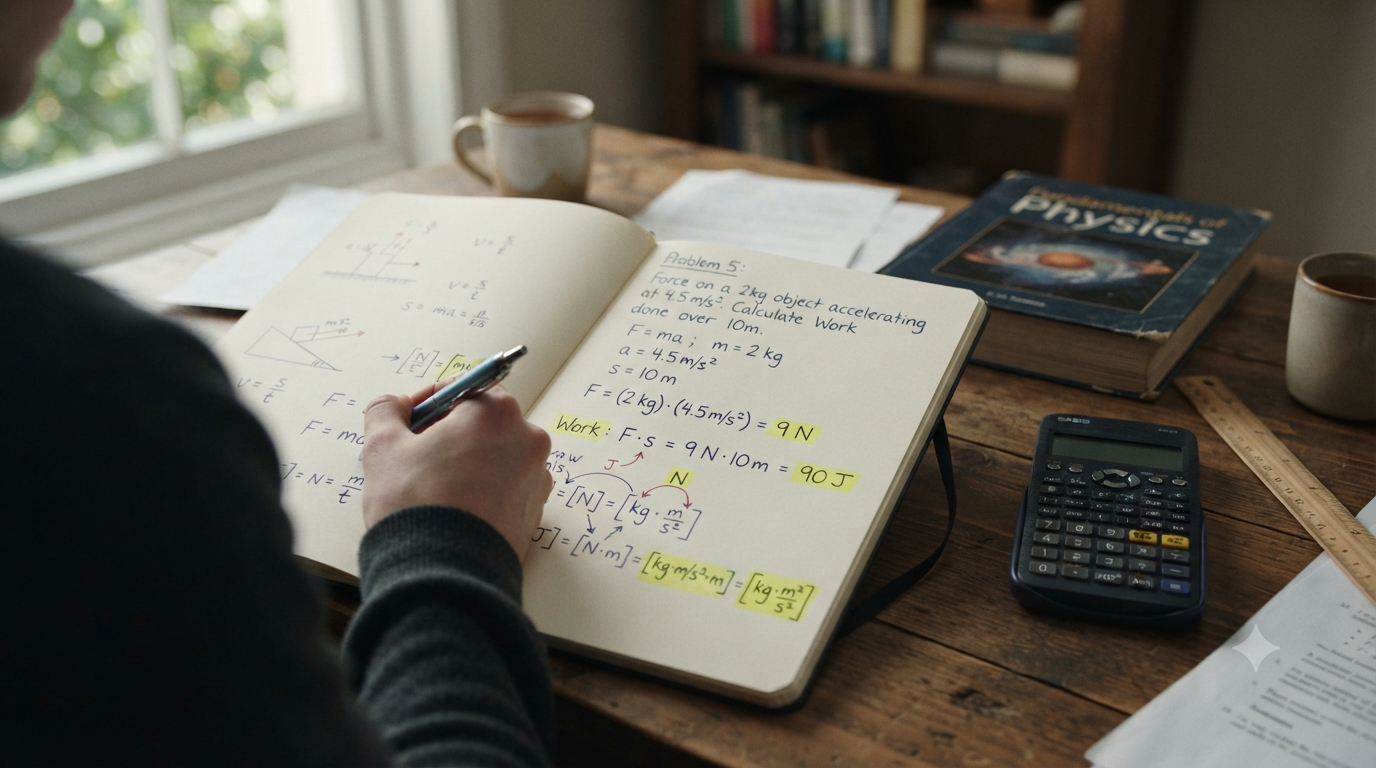
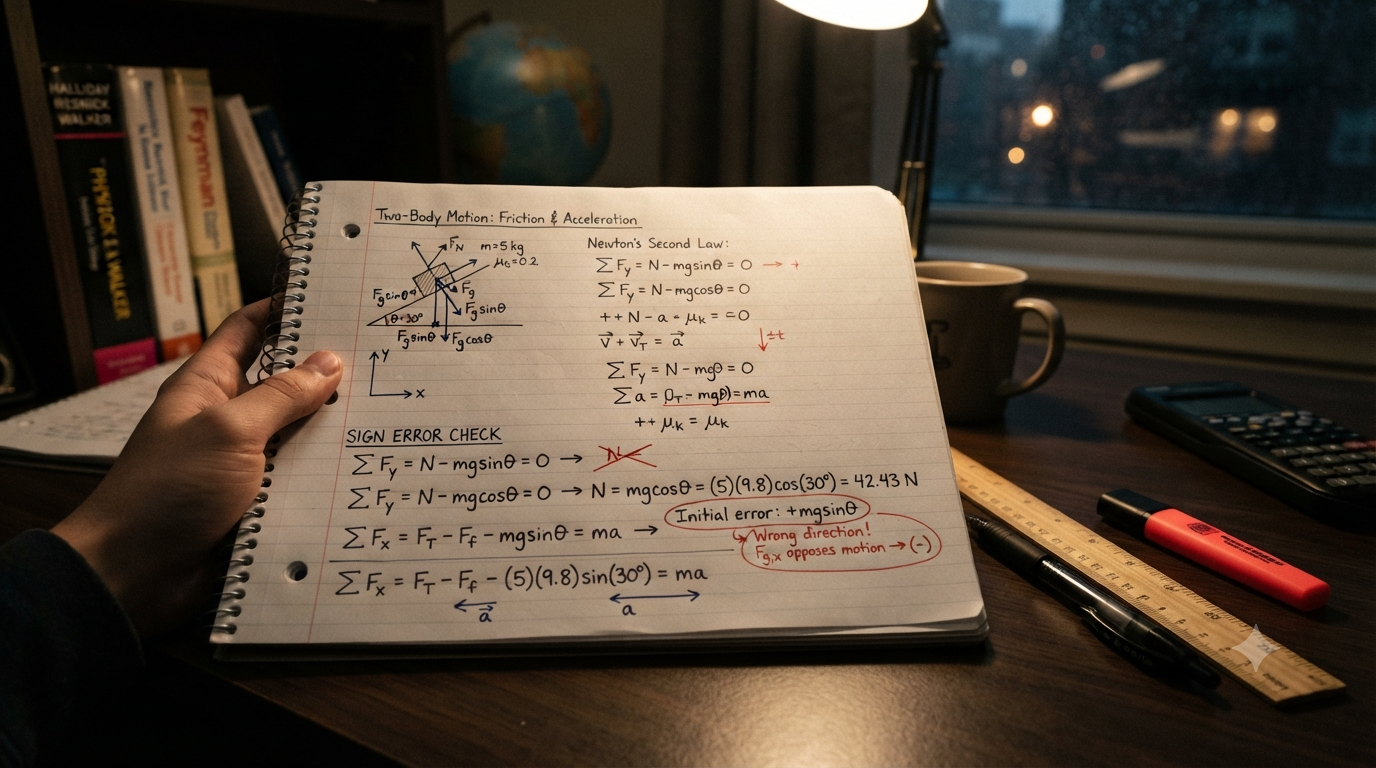
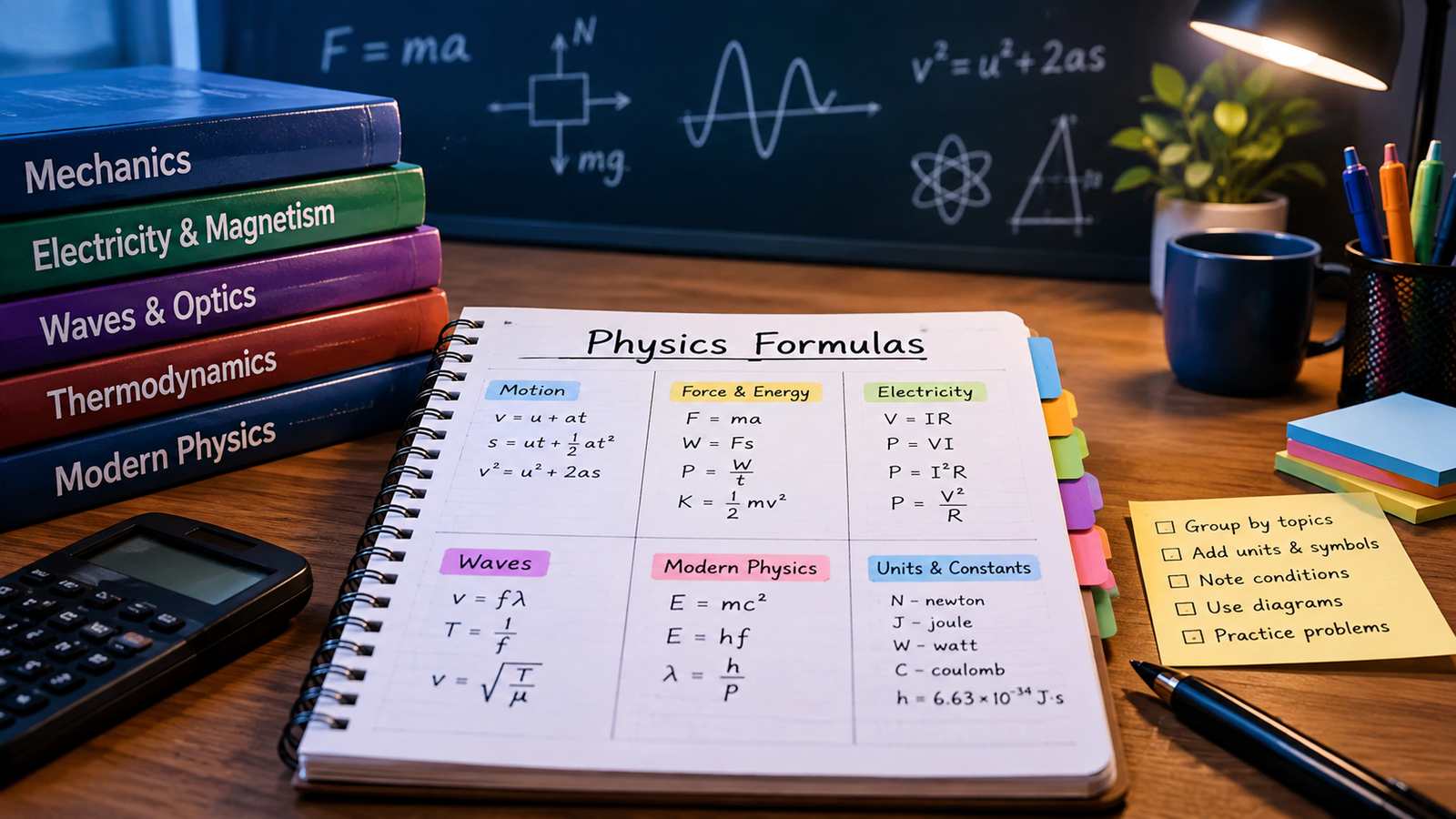
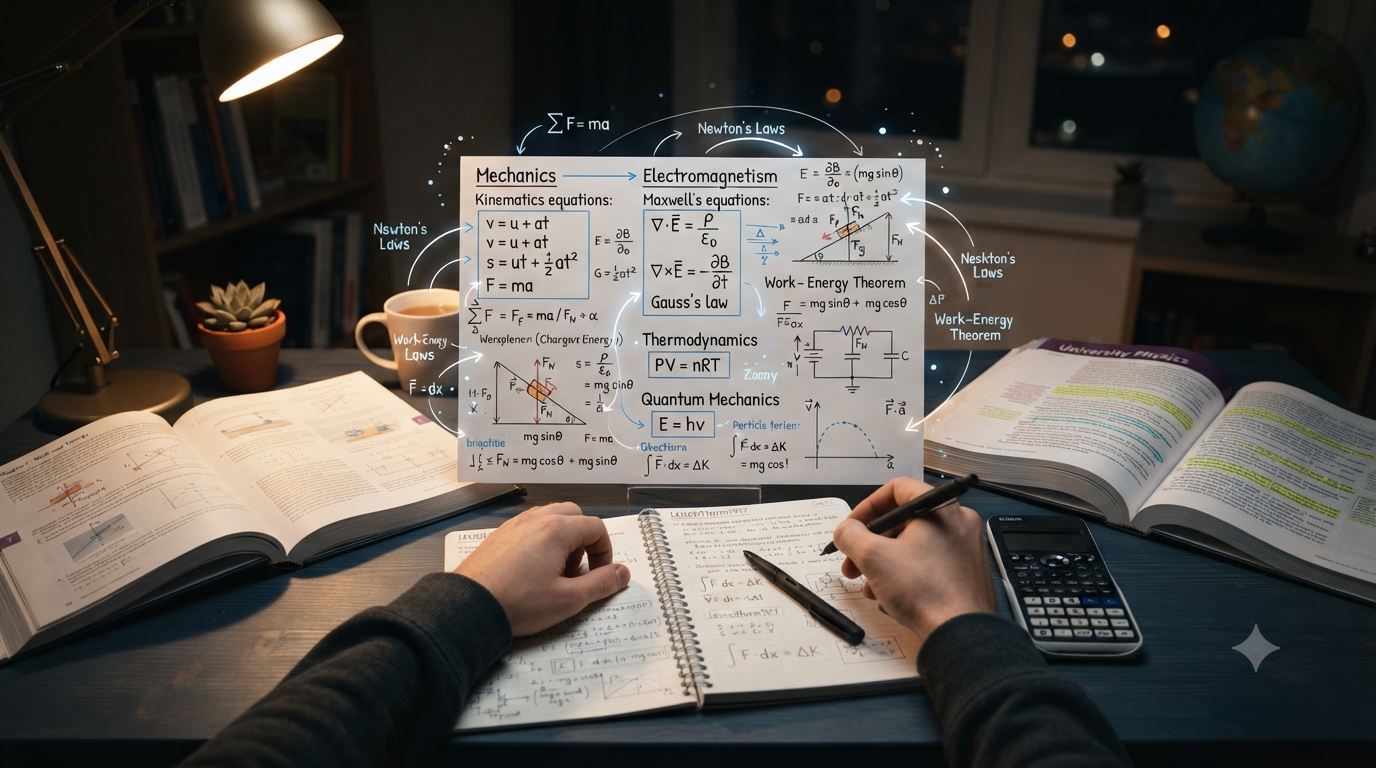
Physics problems often seem difficult not because the mathematics is complicated, but because it can be hard to decide which formula to use. A question may provide several values, mention motion, force, energy, or electricity, and include information that looks important. The real skill is identifying what the question is asking and connecting it with the correct physical relationship.
Knowing physics formulas is useful, but memorizing a long list of equations is not enough. A better approach is to understand what each formula represents, recognize the physical situation described in the question, and identify the quantities that are known and unknown. Once you develop this habit, choosing a formula becomes much more natural.
Start by Understanding What the Question Asks
The first step is to identify the unknown quantity. Before looking at formulas, read the question carefully and ask, “What do I need to find?”
For example, if a question asks for the acceleration of an object, the final answer must be acceleration. This immediately narrows the possible formulas.
Suppose a car changes its velocity from 10 m/s to 20 m/s in 5 seconds. The question may ask for acceleration. You can connect the given quantities directly with the acceleration formula:
a = (v – u) / t
Here, a is acceleration, v is final velocity, u is initial velocity, and t is time.
The important point is that the question itself gives clues about the formula.
List the Given Quantities
After identifying the unknown, write down the information provided in the problem.
For example:
Initial velocity, u = 10 m/s
Final velocity, v = 20 m/s
Time, t = 5 s
Required quantity = acceleration
This simple step prevents you from choosing a formula randomly. It also helps you see which equations can actually be used with the available information.
If a formula requires a quantity that the question does not provide and cannot be determined from another relationship, it may not be the appropriate formula for that problem.
Understand What Each Formula Represents
Instead of memorizing formulas as isolated mathematical expressions, understand their physical meaning.
For example:
F = ma
This formula describes the relationship between force, mass, and acceleration. If a problem gives mass and acceleration and asks for force, this relationship is directly useful.
Similarly:
v = u + at
connects initial velocity, final velocity, acceleration, and time during uniformly accelerated motion.
And:
W = Fs
relates work to force and displacement when the force acts in the direction of displacement.
When you understand the quantities connected by a formula, you can recognize when that formula belongs to a particular problem.
Look for Clue Words
Physics questions often contain words that point toward a particular concept.
Words such as “mass,” “acceleration,” and “force” may indicate Newton’s laws of motion.
Words such as “distance,” “time,” “speed,” and “velocity” often indicate motion-related relationships.
Words such as “height,” “mass,” and “gravity” may suggest gravitational potential energy:
PE = mgh
Words such as “speed” and “mass” may suggest kinetic energy:
KE = ½mv²
Similarly, “voltage,” “current,” and “resistance” can indicate Ohm’s law:
V = IR
These words should not be treated as automatic instructions to use one particular formula. Instead, they help you identify the physics concept involved.
Check Which Quantities Are Connected
One of the most reliable ways to select a formula is to look for an equation that connects the known quantities with the unknown quantity.
Imagine that a question gives:
Mass
Acceleration
Required force
The relationship
F = ma
contains all three quantities. Therefore, it is a logical choice.
Now imagine that a problem gives mass, velocity, and asks for kinetic energy. The formula
KE = ½mv²
contains exactly those quantities.
This method is much more effective than choosing a formula simply because it looks familiar.
Pay Attention to the Conditions
Some physics formulas are valid only under particular conditions. Therefore, knowing the equation is not enough; you also need to understand when it applies.
For example, the equations of uniformly accelerated motion are used when acceleration remains constant. One of these equations is:
s = ut + ½at²
If the acceleration is changing significantly, using this equation without considering the situation can produce an incorrect result.
Similarly, the simple equation W = Fs applies directly when the force and displacement are in the same direction. More generally, work depends on the component of force along the displacement.
Understanding the conditions behind a formula helps prevent incorrect applications.
Use Units as a Formula Check
Units can provide an important clue when solving physics problems.
Suppose you need to find speed. Speed has the unit m/s. If you calculate a result with units of kilograms, something has gone wrong.
Consider:
v = s / t
Distance has the unit metre and time has the unit second, so the resulting unit is m/s, which is appropriate for speed.
Dimensional checking can also help you reject an inappropriate formula. If the units on the two sides of an equation do not match, the equation has been used incorrectly or written incorrectly.
Units do not always tell you which formula to choose, but they are an excellent way to check whether your selected relationship makes physical sense.
Draw a Simple Diagram
A small diagram can make a difficult physics problem much easier.
For motion problems, draw the object and indicate its direction of movement. For force problems, draw the forces acting on the object. For problems involving height, show the vertical distance. For circuits, sketch the components and their connections.
A force diagram, for example, may reveal that several forces act on an object. You can then consider the net force:
Fnet = ma
The diagram turns words into a physical picture, making it easier to identify the relevant formula.
Do Not Use Every Given Number
Some physics questions contain extra information. Not every number in the question must appear in the final calculation.
For example, a problem might describe the mass, color, shape, speed, and height of an object but ask only about a quantity that depends on some of those values. The color and shape may have no role in the calculation.
Do not force every given value into a formula. Instead, use the quantities that are physically relevant to the question.
Compare Similar Formulas Carefully
Physics often contains formulas that look similar. This can cause confusion.
For example, speed and velocity are related but represent different ideas. Likewise, distance and displacement are not identical.
In mechanics, you may encounter several equations involving velocity, acceleration, time, and displacement. The correct choice depends on which quantities are known.
For example:
v = u + at
is useful when initial velocity, acceleration, and time are involved.
Another relationship is:
v² = u² + 2as
This can be useful when time is not given but velocity, acceleration, and displacement are involved.
The key is not to memorize which formula comes “first” or “second.” Instead, look at the quantities available in the problem.
Work Backward From the Unknown
Another useful strategy is to work backward.
Suppose the problem asks for distance, but no formula immediately seems suitable. Ask yourself:
“What quantities could help me calculate distance?”
If you know initial velocity, acceleration, and time, then:
s = ut + ½at²
may connect the available information to the required quantity.
Working backward from the unknown helps you build a logical path rather than guessing.
Build a Formula Map
As you learn physics, organize formulas according to concepts instead of memorizing them as one long list.
For example:
Motion
v = u + at
s = ut + ½at²
v² = u² + 2as
Force
F = ma
p = mv
Energy
KE = ½mv²
PE = mgh
W = Fs
Electricity
V = IR
P = VI
This type of organization helps you quickly identify the relevant group of formulas when solving a problem.
Practice Formula Selection
The ability to choose a formula improves through practice. When solving a problem, do not immediately substitute numbers. First write the following:
Required: What must be found?
Given: What information is available?
Concept: Which area of physics is involved?
Formula: Which relationship connects the known and unknown quantities?
Substitution: Put the values into the formula.
Unit: Check the final unit.
This process turns formula selection into a repeatable method.
Final Thoughts
Knowing which physics formula to use is mainly a skill of understanding relationships, not memorizing equations. Start by identifying what the question asks, list the known quantities, recognize the physics concept, and choose an equation that connects the known values with the unknown. Always consider the conditions under which the formula applies, check the units, and use diagrams when necessary.
With regular practice, formulas stop looking like separate mathematical expressions and start becoming tools for describing physical situations. The goal is not to remember every formula instantly. The goal is to understand what each formula means and recognize when it provides the relationship needed to solve a problem.

FAQs
1. How do I know which physics formula to use?
Start by identifying what the question asks you to find. Then list the quantities given in the problem and identify the physics concept involved. Look for a formula that connects the known quantities with the unknown quantity. For example, if mass and acceleration are given and force is required, F = ma is directly relevant. Do not choose a formula simply because it looks familiar. Also check whether the conditions of the problem match the formula. Finally, verify your answer by checking the units. With practice, this step-by-step approach makes formula selection much easier and more reliable.
2. Should I memorize all physics formulas?
You do not need to memorize every physics formula as an isolated equation. Understanding what each formula represents is more useful because it helps you recognize when to apply it. For example, knowing that F = ma connects force, mass, and acceleration makes it easier to identify situations where the relationship is useful. It is still helpful to remember important formulas, especially frequently used ones. However, try to learn the quantities involved, their units, and the conditions under which the formula applies. Organizing formulas by topics such as motion, force, energy, and electricity can also make remembering and applying them easier.
3. What should I identify first in a physics problem?
The first thing to identify is what the question is asking you to find. This is your unknown quantity. Once you know the unknown, look through the information provided and separate the relevant quantities from unnecessary details. For example, if the problem asks for acceleration, identify whether initial velocity, final velocity, time, or other relevant quantities are available. Then determine which physics concept applies. This process reduces confusion because you are working toward a specific target instead of searching through every formula you know. Clearly identifying the required quantity is one of the most useful habits in solving physics problems.
4. Can the units help me choose a physics formula?
Units can help you check whether a formula is appropriate, although they may not always identify the formula by themselves. Every physical quantity has a corresponding unit. For example, velocity is measured in m/s, force in newtons, and energy in joules. If you calculate velocity but your final result has units of kilograms, something is wrong. Dimensional analysis can also help compare the units on both sides of an equation. Before accepting your answer, check whether the final unit matches the quantity you were asked to find. This simple habit can reveal calculation, substitution, or formula errors.
5. Why are there several formulas for the same physics topic?
Physics topics often contain several formulas because different equations connect different combinations of physical quantities. For example, equations of motion can involve velocity, acceleration, time, and displacement in different combinations. One equation may be useful when time is known, while another may be more convenient when time is not given. The formulas are not necessarily competing with one another; they describe different relationships within the same physical situation. Instead of trying to remember when a formula appears in a textbook, examine which quantities are given and which quantity is unknown. Choose the equation that connects the information you actually have.
6. What if I know several formulas that could solve a problem?
Sometimes more than one formula can be used to solve a physics problem. In such cases, choose the equation that connects the given quantities with the unknown most directly. A shorter solution is often easier to understand and reduces unnecessary calculations. However, different valid approaches should generally lead to the same physical result if the equations are applied correctly. You can also use another formula as a check when appropriate. The important thing is to understand why the chosen equation applies. Do not select a formula only because it produces numbers; make sure it represents the physical situation described in the question.
7. How do I avoid using the wrong physics formula?
To avoid using the wrong formula, do not begin by randomly searching your memory for an equation. First identify the unknown, write down the given quantities, and determine the relevant physics concept. Then check whether the formula contains the quantities you have and the quantity you need. Pay attention to conditions such as constant acceleration or particular directions of force. After solving, check the units and consider whether the result is physically reasonable. Drawing a simple diagram can also help. These steps make formula selection more logical and reduce mistakes caused by choosing equations based only on familiar symbols.
8. Does every number given in a physics question need to be used?
No. A physics problem may contain information that is not necessary for the calculation. Some details may provide context or describe the physical situation without directly affecting the required answer. For example, a problem might mention an object’s color, shape, or other information that has no mathematical role. The important task is to identify which quantities are physically connected to the unknown. Using every number simply because it is provided can lead to unnecessary or incorrect calculations. Read the question carefully and use only the information required by the physical relationship you are applying.
9. Should I draw a diagram before choosing a physics formula?
Drawing a diagram can be very helpful, especially for problems involving forces, motion, geometry, circuits, or multiple physical quantities. A simple sketch can show directions, distances, angles, forces, or changes in motion that may not be obvious from the written question. For force problems, a free-body diagram can help identify the forces acting on an object. For motion problems, marking initial and final positions can clarify displacement and direction. A diagram is not required for every problem, but when the situation is difficult to visualize, it can make the relevant physics concept and formula much easier to identify.
10. How can I become better at choosing physics formulas?
The best way to improve is to practice selecting formulas before performing calculations. For each problem, identify the required quantity, list the given values, name the physics concept, and then choose a formula that connects them. After solving, check the units and whether the result makes physical sense. When reviewing mistakes, focus on why the formula was inappropriate rather than only correcting the arithmetic. You can also organize formulas into topic-based groups such as motion, force, energy, waves, and electricity. Over time, repeated practice helps you recognize physical relationships quickly instead of relying only on formula memorization.
Related Posts
What Do Coefficients Mean in Chemistry Formulas?
When you look at a chemical equation, you may notice numbers written before chemical formulas. These numbers are called coefficients. […]
Read MoreHow to Read Subscripts in Chemical Formulas
Chemical formulas are a simple way to represent substances using symbols and numbers. When you look at a formula such […]
Read MoreHow to Identify Elements in a Chemical Formula
Chemical formulas provide a simple way to describe the substances that make up the world around us. A formula may […]
Read MoreHow Elements Are Represented in Chemical Formulas
Chemistry deals with many different substances, from the oxygen we breathe to the water we drink and the minerals found […]
Read MoreChemical Symbols and Their Role in Chemistry Formulas
Chemistry is often described as the science of matter, but understanding chemistry also means learning how scientists communicate information about […]
Read MoreHow Chemical Formulas Represent Substances
Chemical formulas are one of the simplest ways scientists communicate information about matter. A substance may contain millions or billions […]
Read MoreWhat Is a Chemical Formula in Chemistry?
Chemistry is the study of substances, their properties, and the changes they undergo. To describe these substances clearly, chemists need […]
Read MoreBasic Types of Chemistry Formulas Explained
Chemistry formulas are one of the simplest ways scientists describe substances, reactions, and relationships between different particles. A formula can […]
Read MoreHow to Read and Understand Chemistry Formulas
Chemistry formulas may look like a collection of letters, numbers, and symbols, but they are actually a simple language used […]
Read MoreWhat Are Chemistry Formulas and Why Are They Important?
Chemistry is the science of substances, their properties, and the changes they undergo. To describe these substances clearly, chemists use […]
Read MoreHow to Verify an Answer Using Units
In physics, getting a numerical answer is only part of solving a problem. The next question is whether that answer […]
Read MoreHow to Check Whether a Physics Formula Is Correct
A physics formula is more than a collection of symbols and numbers. It represents a relationship between physical quantities and […]
Read MoreHow to Avoid Unit Conversion Mistakes in Physics
Unit conversion is one of the most common sources of mistakes in physics. A formula may be correct, the calculation […]
Read MoreHow to Avoid Sign Errors in Physics Calculations
Physics calculations are not only about choosing the correct formula and putting numbers into it. The signs of physical quantities […]
Read MoreCommon Mistakes When Using Physics Formulas
Physics formulas help us describe motion, forces, energy, electricity, heat, waves, and many other phenomena using mathematical relationships. A formula […]
Read MoreHow to Study Physics Formulas Step by Step
Physics formulas are an important part of learning physics, but simply memorizing them is not enough. A formula represents a […]
Read MoreHow to Organize Physics Formulas for Easy Revision
Physics becomes much easier when formulas are organized in a clear and meaningful way. Many learners struggle not because they […]
Read MoreHow to Build a Physics Formula Sheet
Physics involves many formulas, and remembering all of them can become difficult as you move from basic concepts to more […]
Read More