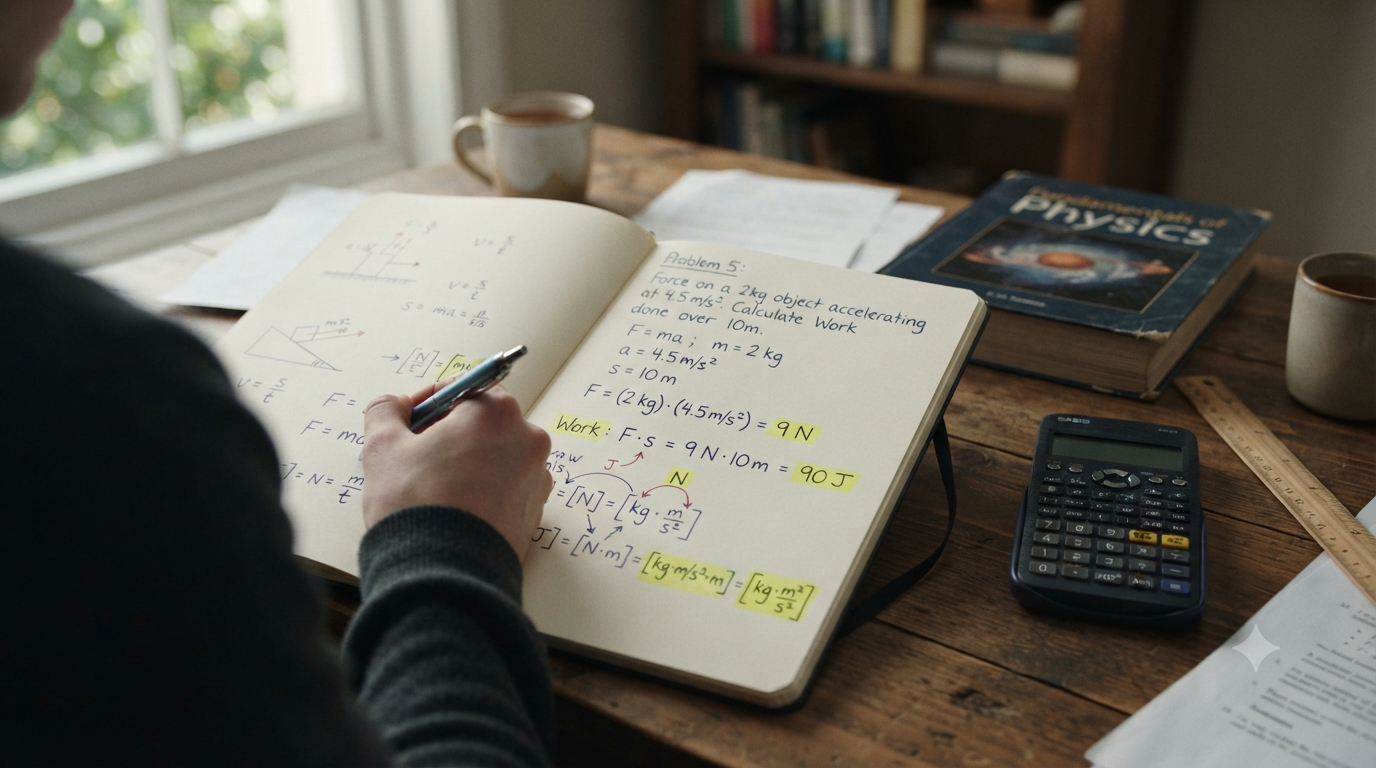
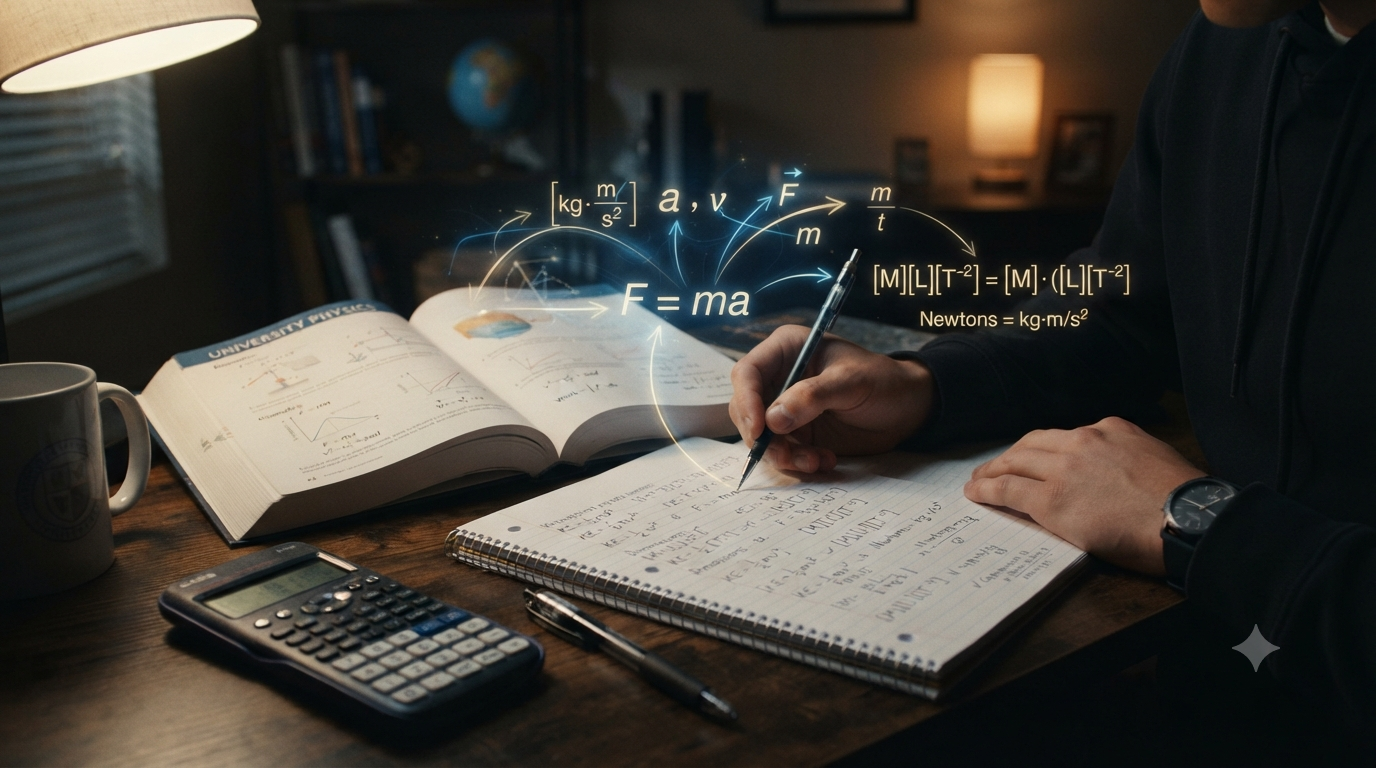
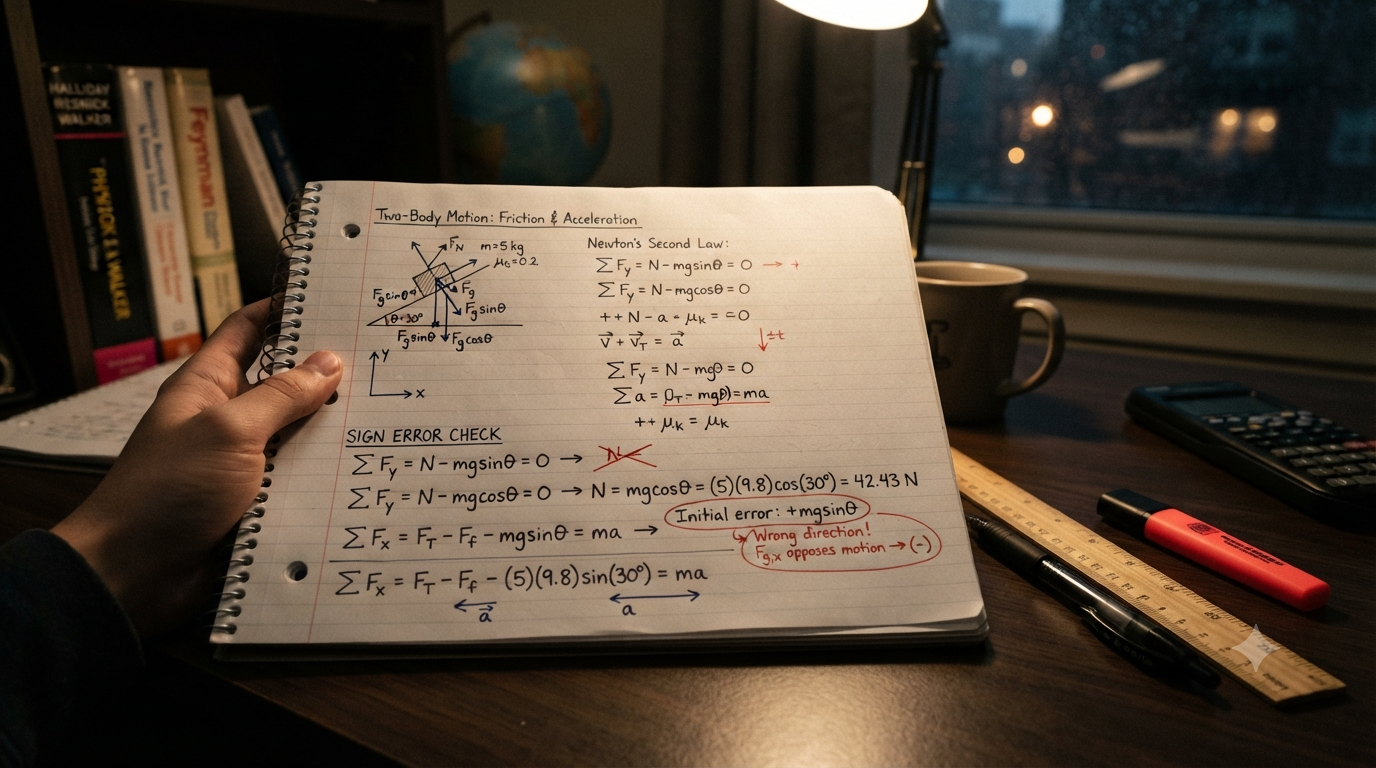
Physics formula-based problems become much easier when you understand what a formula means and how to use it correctly. Many learners find numerical problems difficult because they try to remember formulas without understanding the physical quantities involved. In reality, solving a physics problem is usually a step-by-step process: understand the question, identify the known and unknown quantities, choose the correct formula, substitute the values with proper units, and check whether the answer makes physical sense. Developing this method can make even unfamiliar problems more manageable. Whether you are working with motion, force, work, energy, pressure, electricity, or waves, the same basic approach can be applied.
Understand What the Problem Is Asking
The first step is to read the entire problem carefully. Do not immediately search for a formula. First determine what the question wants you to find.
For example, a problem may ask you to calculate speed, acceleration, force, work, power, or energy. The wording of the question often gives an important clue about the required physical quantity.
Ask yourself:
What information is given?
What quantity needs to be calculated?
Which physical quantities are related to it?
Are all the given values expressed in compatible units?
Understanding the question prevents you from selecting a formula simply because it looks familiar.
Write Down the Given Quantities
After understanding the problem, list the information provided in the question. This makes the problem more organized and helps you identify the relationship between the quantities.
For example, suppose a moving object has an initial velocity of 5 m/s, an acceleration of 2 m/s², and moves for 4 seconds.
You can write:
Writing the known quantities clearly separates the information you have from the quantity you need to find.
Identify the Unknown Quantity
The next step is to identify the unknown quantity. Usually, the question directly tells you what needs to be calculated.
If a question asks, “What is the final velocity of the object?” then the unknown quantity is final velocity, represented by v.
If it asks for force, the unknown quantity is F. If it asks for work, the unknown quantity is W.
Knowing the unknown quantity helps you select a formula that contains that quantity.
Choose the Correct Formula
Once you know the given and unknown quantities, select a formula connecting them.
For example, if initial velocity, acceleration, and time are given and final velocity is required, the appropriate equation is:
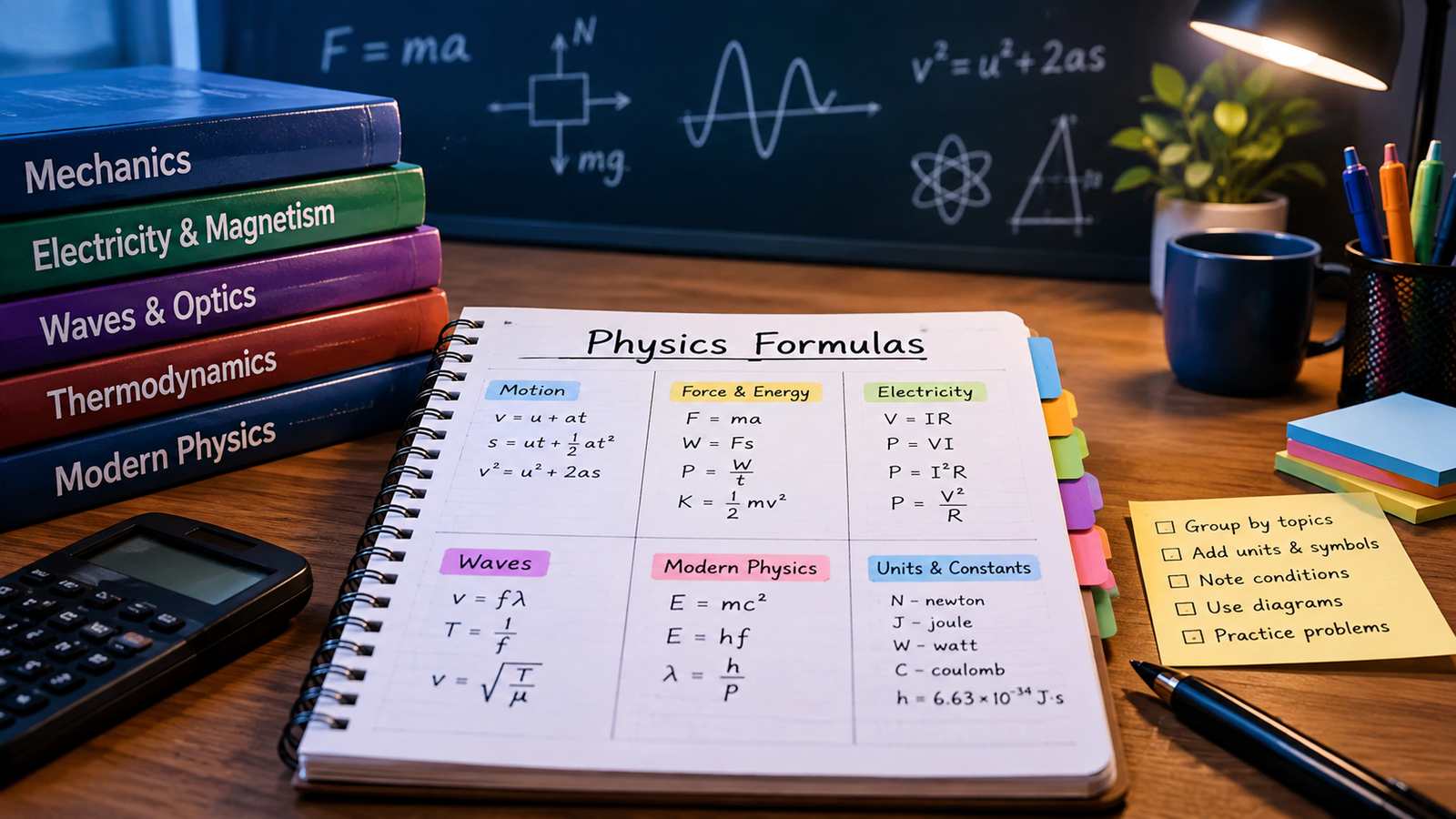
v = u + at
This formula connects all four quantities.
For a force problem, you may use:
F = ma
For work done when force and displacement are in the same direction:
W = Fs
For power:
P = W/t
The important point is that you should choose a formula based on the information in the problem, not simply based on memorization.
Check the Units Before Substitution
Units are an important part of physics calculations. Before putting numbers into a formula, check whether the units are compatible.
For example, if a formula requires time in seconds but the problem gives time in minutes, convert the time first.
1 minute = 60 seconds
Similarly:
1 km = 1000 m
1 hour = 3600 s
For many physics problems, using SI units makes calculations simpler and reduces mistakes.
For example, velocity is commonly expressed in m/s, acceleration in m/s², force in newtons, work in joules, and power in watts.
Rearrange the Formula When Necessary
Sometimes the required quantity is not directly isolated in the formula. In that situation, rearrange the equation before substituting values.
For example, from:
F = ma
If mass is unknown:
m = F/a
If acceleration is unknown:
a = F/m
Similarly, from:
v = u + at
If acceleration is required:
a = (v – u)/t
Rearranging the formula first usually makes the calculation clearer and reduces algebraic mistakes.
Substitute the Values Carefully
After selecting and rearranging the formula, substitute the known values.
Consider the example:
An object starts with a velocity of 5 m/s and accelerates at 2 m/s² for 4 seconds. Find its final velocity.
The formula is:
v = u + at
Substitute the values:
v = 5 + (2 × 4)
Therefore:
v = 13 m/s
The final velocity is 13 m/s.
Writing the substitution step is useful because it shows exactly how the answer was obtained.
Follow the Correct Mathematical Order
Physics formulas often contain several mathematical operations. Perform them in the correct order.
For example:
s = ut + ½at²
If u = 4 m/s, a = 2 m/s², and t = 3 s:
s = (4 × 3) + ½ × 2 × 3²
First calculate the square:
3² = 9
Then:
s = 12 + ½ × 2 × 9
s = 12 + 9
s = 21 m
Following the order of operations helps prevent calculation errors.
Pay Attention to Positive and Negative Signs
Signs are especially important in physics. Positive and negative values can represent direction.
For example, velocity in one direction may be considered positive, while velocity in the opposite direction may be negative.
Suppose an object has:
u = 10 m/s
and acceleration:
a = -2 m/s²
The negative sign indicates that the acceleration is opposite to the chosen positive direction.
Using:
v = u + at
for t = 3 s:
v = 10 + (-2 × 3)
v = 4 m/s
Ignoring the negative sign could produce an incorrect result.
Check the Final Unit
After completing the calculation, always check the unit of the answer.
For example:
Distance → metre (m)
Displacement → metre (m)
Speed → metre per second (m/s)
Velocity → metre per second (m/s)
Acceleration → metre per second squared (m/s²)
Force → newton (N)
Work → joule (J)
Power → watt (W)
Pressure → pascal (Pa)
A missing or incorrect unit can indicate a problem with the calculation or formula.
Check Whether the Answer Makes Sense
A numerical answer should not simply be accepted because the calculator produced it. Ask whether the result is physically reasonable.
For example, if you calculate the speed of a walking person and obtain 50,000 m/s, something is probably wrong. The mistake could be in unit conversion, formula selection, substitution, or arithmetic.
This final check is especially useful in complicated problems.
Use Dimensional Analysis to Check Formulas
Dimensional analysis can help determine whether an equation is physically consistent.
For example, consider:
v = u + at
Velocity has dimensions of [LT⁻¹].
The term u has dimensions [LT⁻¹].
Acceleration has dimensions [LT⁻²], while time has dimensions [T].
Therefore:
[at] = [LT⁻²][T] = [LT⁻¹]
Both terms have the same dimensions, so the equation is dimensionally consistent.
Dimensional analysis does not prove that a formula is completely correct, but it can help detect many errors.
Avoid Common Mistakes
Several mistakes appear frequently in formula-based physics problems.
Using the Wrong Formula
A familiar formula is not necessarily the correct formula. Always compare the given quantities with the variables in the equation.
Mixing Units
Do not substitute kilometres with metres or hours with seconds without conversion when the formula requires SI units.
Forgetting Units
Always include the correct unit with the final answer.
Ignoring Signs
Positive and negative signs may represent direction and should not be removed casually.
Substituting Too Early
Rearrange the formula first when necessary. This makes the calculation easier to follow.
Rounding Too Soon
Avoid excessive rounding during intermediate calculations. Keep suitable significant figures and round the final answer appropriately.
Develop a Consistent Problem-Solving Method
A reliable method can be summarized as:
Read the problem carefully.
Identify what is given.
Identify what must be found.
Write the relevant quantities with units.
Choose the appropriate formula.
Rearrange the formula if necessary.
Convert units when required.
Substitute the values.
Perform the calculation carefully.
Write the final answer with the correct unit.
Check whether the answer is physically reasonable.
Following these steps repeatedly can turn formula-based problem solving into a structured habit.
Conclusion
Solving physics formula-based problems is not simply about remembering equations. It involves understanding the physical situation, identifying the relevant quantities, selecting the correct relationship, handling units, performing the mathematics carefully, and checking the final result. A formula becomes much more useful when you understand what each variable represents and why the quantities are connected. With regular practice, you can learn to approach unfamiliar numerical problems systematically instead of guessing which equation to use. The goal is not just to obtain an answer, but to understand how the answer follows from the physics involved.