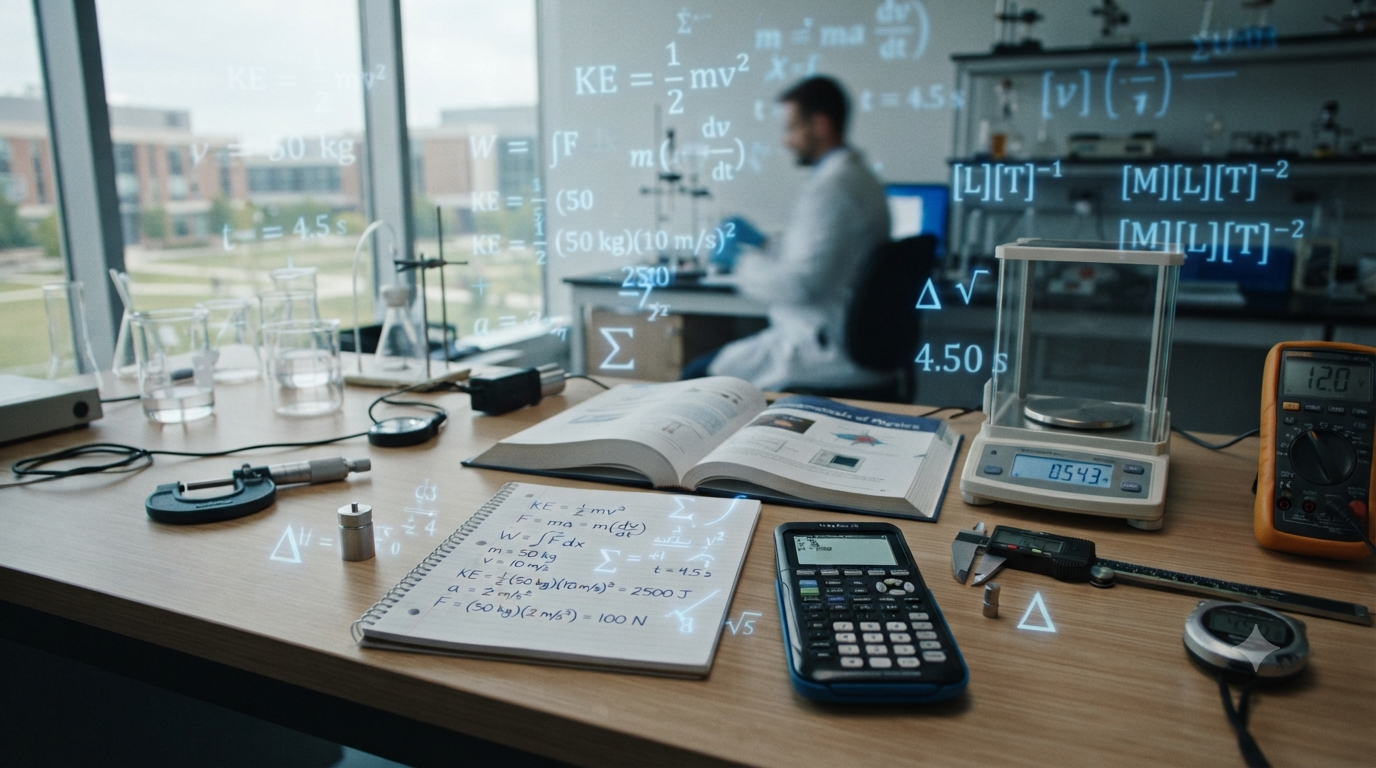
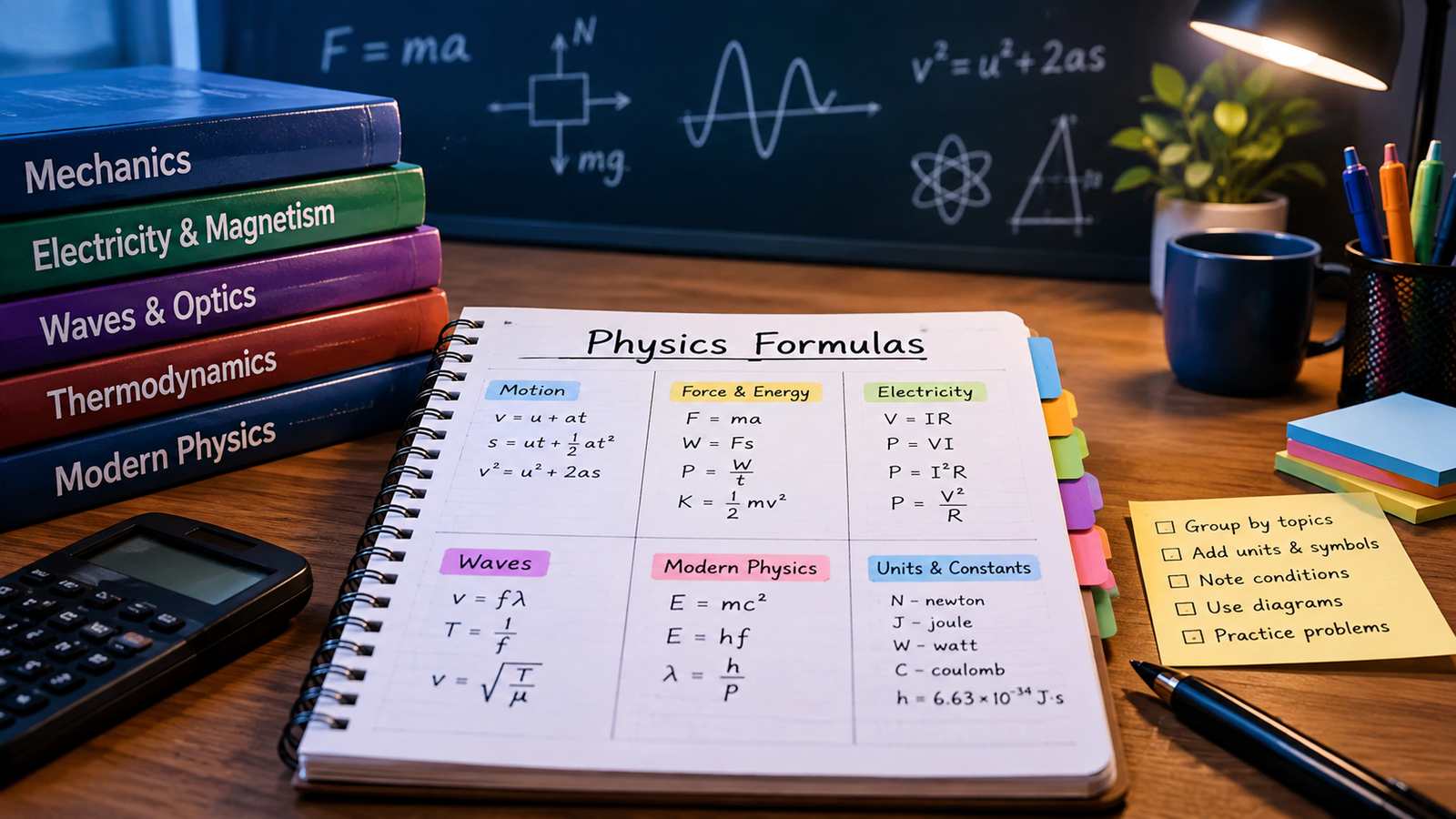
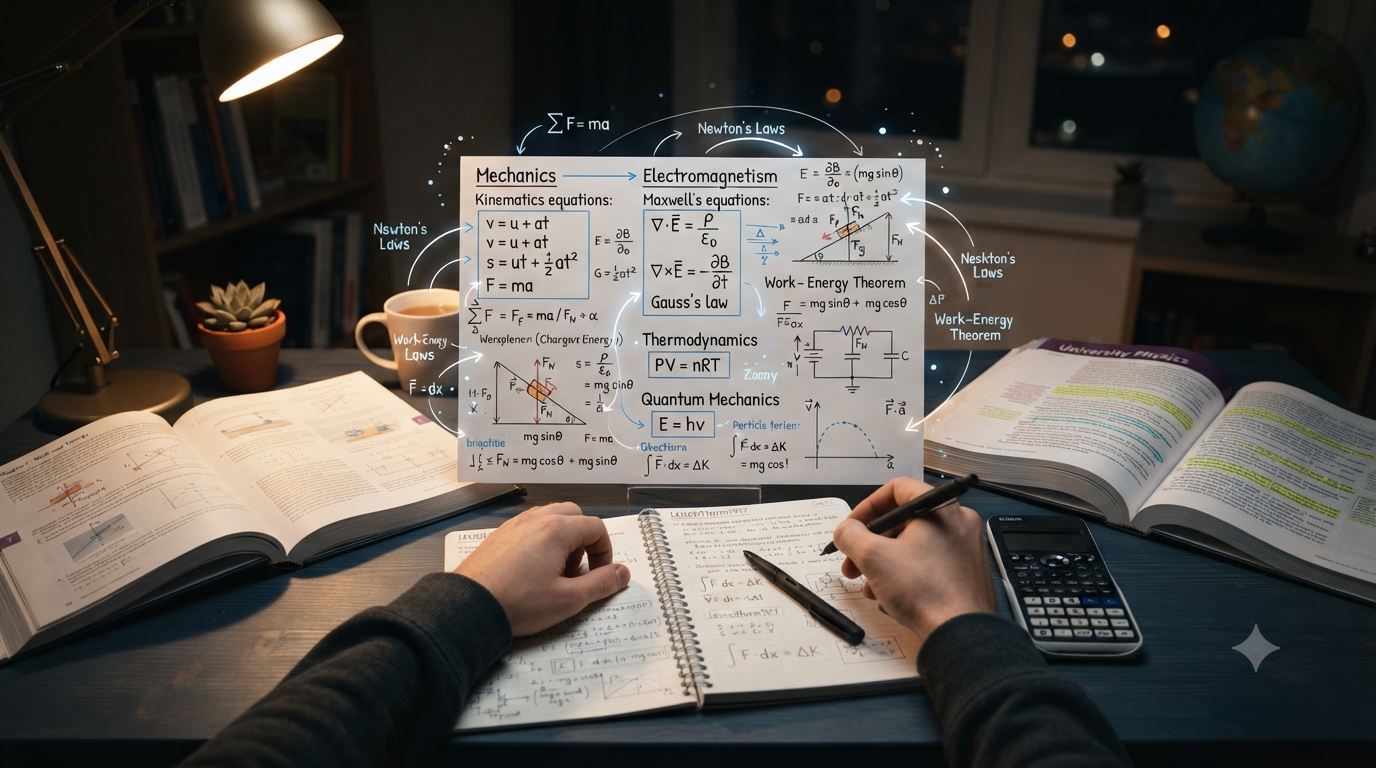
Physics is the study of quantities such as distance, time, mass, speed, force, energy, and temperature. These quantities are used to describe events and processes in the physical world. However, a numerical value alone is not enough to communicate a physical measurement. A number must be accompanied by a suitable unit to tell us what the value actually represents.
For example, writing “the distance is 20” does not clearly tell us whether the distance is 20 metres, 20 kilometres, or 20 centimetres. The unit gives meaning to the number. This is why units are an essential part of physics calculations. They help us understand measurements, choose appropriate formulas, check calculations, convert quantities, and determine whether an answer makes physical sense.
What Is a Unit in Physics?
A unit is a standard quantity used to express and compare measurements. When we measure a physical quantity, we compare it with an agreed standard.
For example:
Length can be measured in metres (m).
Time can be measured in seconds (s).
Mass can be measured in kilograms (kg).
Temperature can be measured in kelvin (K).
Electric current can be measured in amperes (A).
If a car travels a distance of 100 metres, the number 100 tells us the numerical value, while metre tells us what is being measured. Together, “100 m” gives a meaningful physical measurement.
Why Units Are Important in Physics Calculations
Units are important because physics calculations involve relationships between different physical quantities. A correct numerical calculation with incorrect or missing units can lead to a meaningless answer.
Units Give Meaning to Numbers
A number without a unit can be difficult or impossible to interpret in physics.
Suppose someone says that an object is moving at a speed of 25. The statement is incomplete. It could mean 25 metres per second, 25 kilometres per hour, or another unit of speed.
If the statement is written as 25 m/s, we immediately understand the physical meaning.
Therefore, units turn numerical values into meaningful measurements.
Units Help Identify the Physical Quantity
Different physical quantities have different units. Units can therefore provide a quick clue about what a quantity represents.
For example:
m → length or distance
s → time
kg → mass
m/s → speed or velocity
m/s² → acceleration
N → force
J → energy or work
W → power
When solving a physics problem, recognizing the units of the given quantities can help us understand what information is available and what needs to be calculated.
Units Help Us Use Formulas Correctly
Physics formulas connect different physical quantities. Units help us make sure that the quantities are being used correctly.
Consider the formula for speed:
s = d/t
where d is distance and t is time.
If an object travels 100 m in 20 s:
s = 100 m / 20 s
s = 5 m/s
The unit of the answer is metres per second because distance is measured in metres and time is measured in seconds.
Without units, we would simply obtain the number 5 and lose important information about the result.
Units Help Detect Calculation Errors
One of the most useful roles of units is checking whether a calculation is reasonable.
Suppose we use the formula:
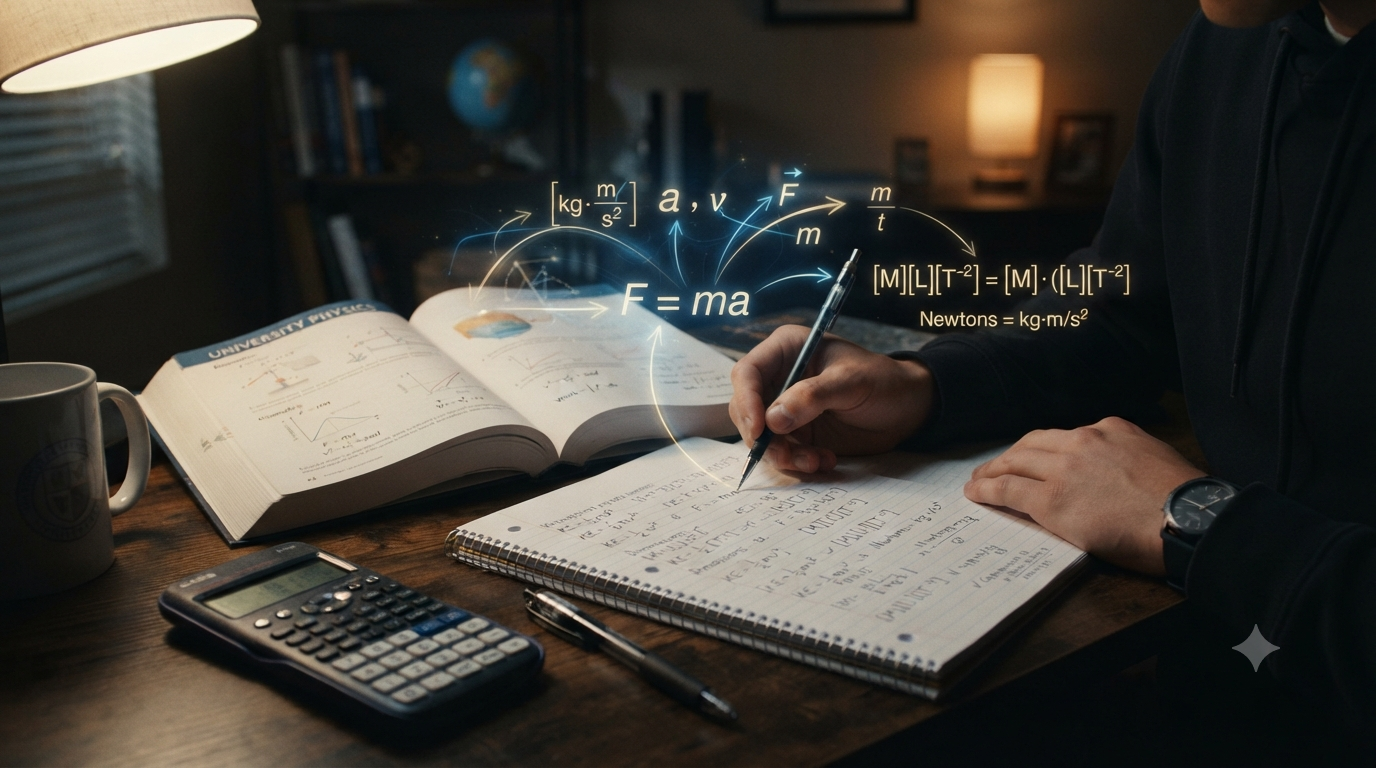
F = ma
where F is force, m is mass, and a is acceleration.
If mass is measured in kilograms and acceleration in metres per second squared:
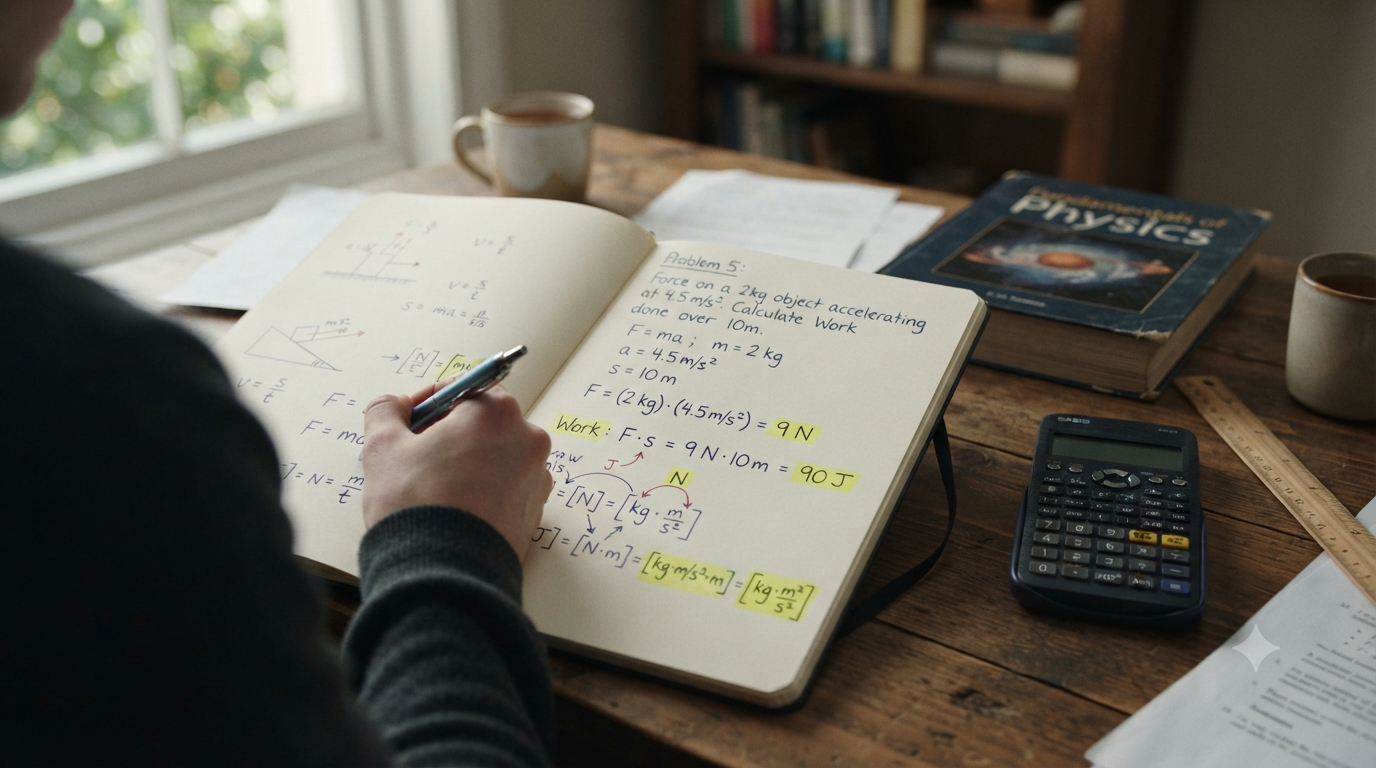
F = kg × m/s²
The resulting unit is kg m/s², which is defined as a newton (N).
Therefore:
1 N = 1 kg m/s²
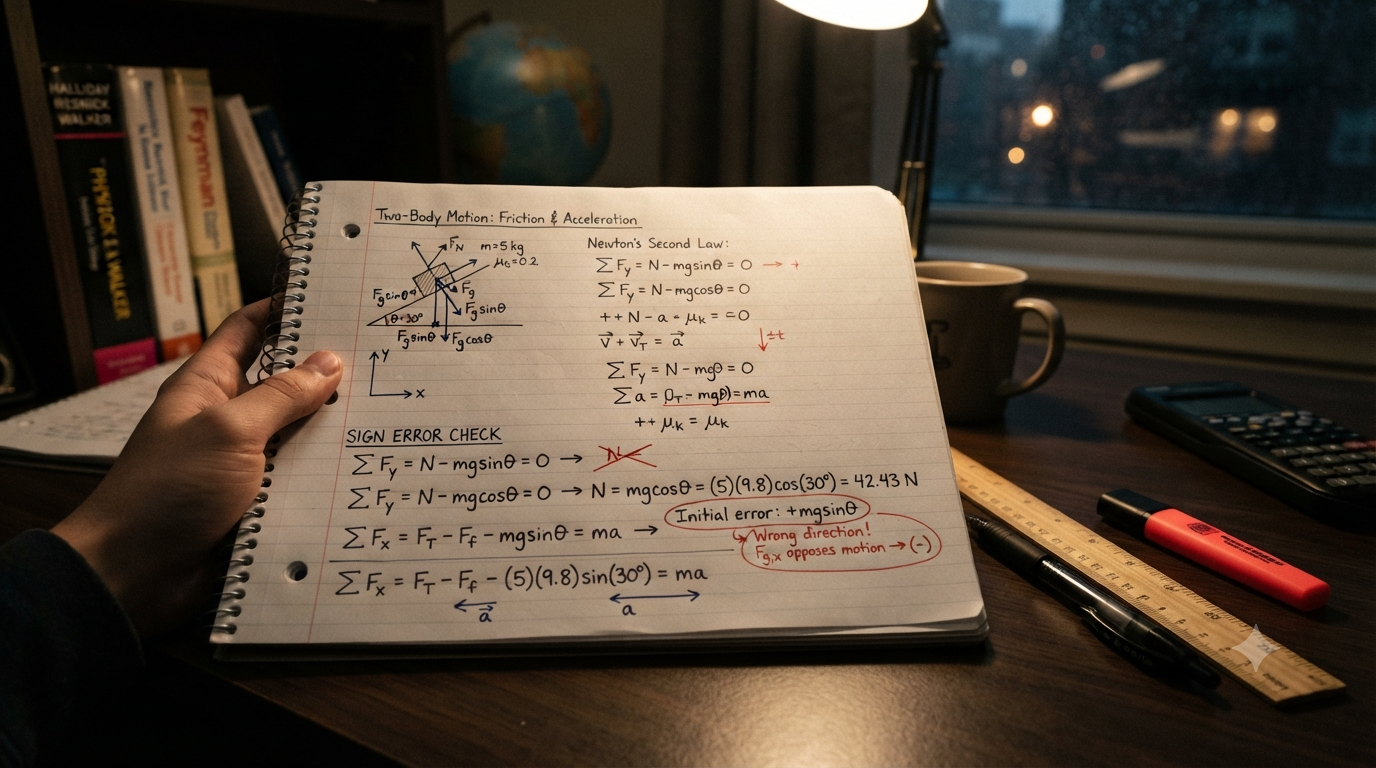
If a calculation intended to find force produces a unit such as seconds or metres, something has probably gone wrong.
This type of checking is called dimensional analysis. It allows physicists to examine equations by comparing the dimensions or units of the quantities involved.
Units Make Different Measurements Comparable
Units provide a common language for measurements. Imagine two scientists measuring the same length. One reports the result in metres while another reports it in centimetres.
Their numbers may look different, but the measurements can still represent the same physical length.
For example:
1 m = 100 cm
Therefore:
2 m = 200 cm
The physical quantity has not changed. Only the unit used to express it has changed.
Standard units make it easier for people in different places and scientific fields to communicate measurements accurately.
Units Are Essential for Unit Conversion
Physics often requires us to convert a quantity from one unit to another.
For example:
1 km = 1000 m
Therefore:
3 km = 3000 m
Unit conversion becomes especially important when quantities from different sources use different units.
Consider a calculation involving distance and speed. If distance is given in kilometres but speed is given in metres per second, using the values directly may produce an incorrect result. The units should first be made compatible.
For example, if a distance is 2 km, it can be converted into metres:
2 km = 2000 m
Now the distance can be used with a speed expressed in metres per second.
Units Help Maintain Consistency
Physics calculations often involve several quantities at the same time. Keeping the units consistent reduces mistakes.
For example, consider:
s = ut + ½at²
Here:
s is displacement
u is initial velocity
t is time
a is acceleration
If velocity is measured in m/s and time in seconds, then:
ut = (m/s)(s) = m
For the second term:
at² = (m/s²)(s²) = m
Both terms have the unit metre, so they can be added together.
This shows why units are not simply labels placed after an answer. They are part of the mathematical structure of a physics equation.
SI Units Make Physics Easier to Communicate
The International System of Units, commonly called SI units, provides a standard system for scientific measurements.
The seven SI base units are:
metre (m) for length
kilogram (kg) for mass
second (s) for time
ampere (A) for electric current
kelvin (K) for thermodynamic temperature
mole (mol) for amount of substance
candela (cd) for luminous intensity
Many other units are derived from these base units.
For example, the newton is used for force:
1 N = 1 kg m/s²
Similarly, the joule is used for energy:
1 J = 1 kg m²/s²
Using a common system allows measurements and calculations to be communicated consistently around the world.
Units Can Reveal Whether an Answer Makes Sense
Units can also help us judge whether an answer is physically reasonable.
Suppose a calculation asks for a time. If the final result has units of metres, the result does not represent time, even if the numerical value looks reasonable.
For example, if a problem asks for velocity and the calculation produces:
50 kg
then the result cannot be a velocity because kilograms measure mass.
The numerical value may be correct in some intermediate calculation, but the final unit reveals that the quantity has been interpreted incorrectly.
Units in Derived Quantities
Many quantities in physics are derived from other physical quantities. Their units are formed by combining the units of those quantities.
For example, acceleration is:
a = change in velocity / time
Since velocity has the unit m/s:
a = (m/s)/s
Therefore:
a = m/s²
Similarly, density is:
density = mass / volume
Its SI unit is:
kg/m³
Pressure is force divided by area:
P = F/A
Its SI unit is:
N/m²
This unit is called the pascal (Pa).
Understanding how derived units are formed makes physics formulas easier to interpret.
What Happens If Units Are Ignored?
Ignoring units can produce serious mistakes. A calculation may have the correct numerical operations but still give an incorrect physical answer.
Common problems caused by ignoring units include:
Using incompatible units in the same calculation
Forgetting to convert kilometres to metres
Confusing mass with weight
Reporting the wrong type of quantity
Misinterpreting a numerical result
Missing errors in a formula
For this reason, it is good practice to write the units alongside the numbers throughout a physics calculation rather than adding them only at the end.
A Simple Method for Using Units in Calculations
A useful approach is to follow these steps:
Identify the physical quantities given in the problem.
Write the unit beside each numerical value.
Check whether the units are compatible.
Convert units when necessary.
Substitute the values into the appropriate formula.
Carry the units through the calculation.
Simplify the units.
Check whether the final unit matches the quantity being calculated.
Consider whether the numerical result is physically reasonable.
This method makes calculations easier to organize and can prevent many common mistakes.
Conclusion
Units are a fundamental part of physics calculations because they give meaning to numbers and connect mathematical results with physical quantities. They help us identify measurements, use formulas correctly, convert between different measurement systems, detect errors, and judge whether an answer makes physical sense. From metres and seconds to newtons and joules, units provide a common language for describing the physical world. Learning to work with units carefully is therefore not just a calculation skill. It is an essential part of thinking and communicating like a physicist.