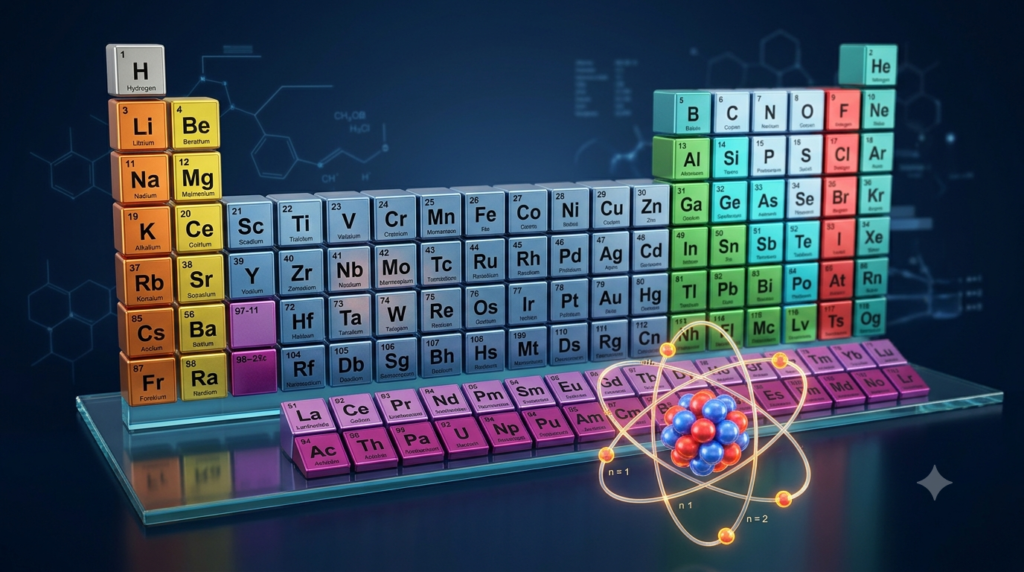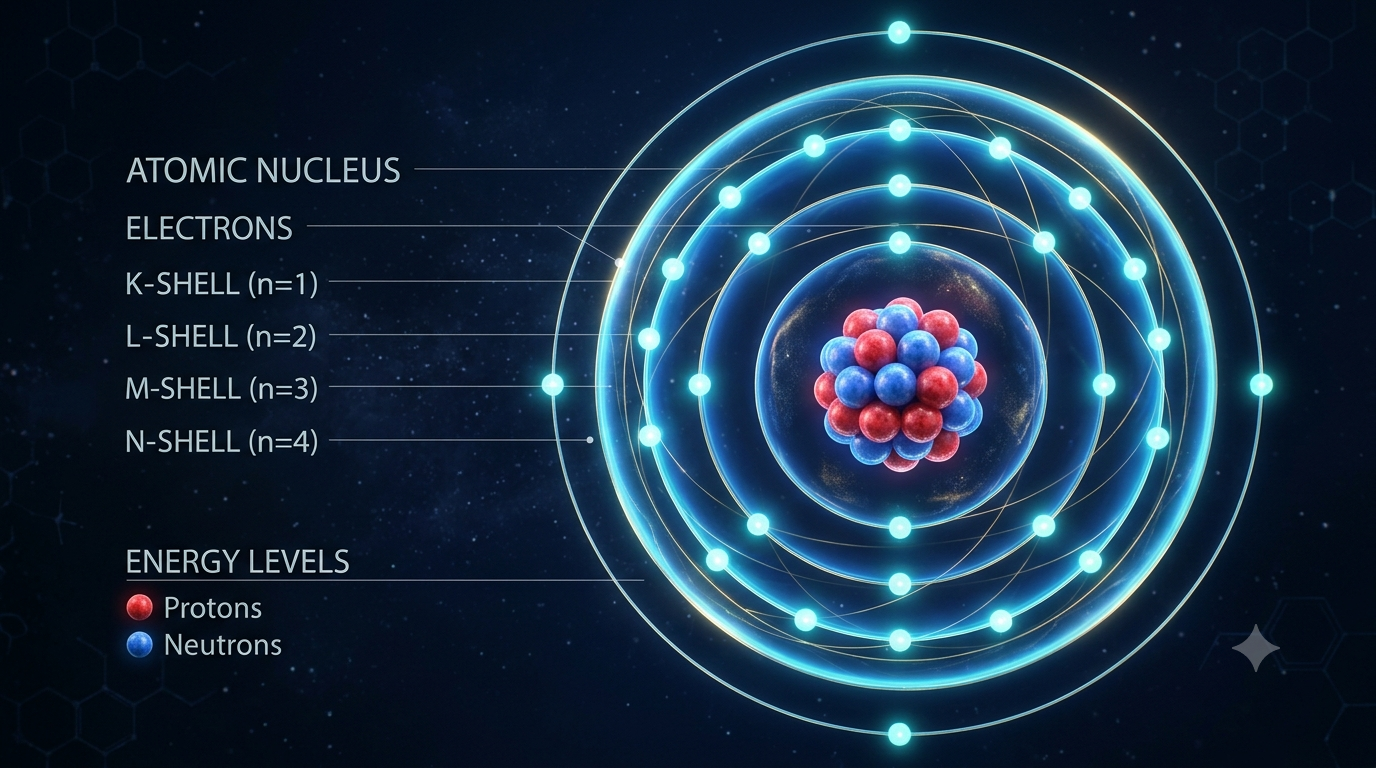
Atoms are the basic building blocks of matter. Every atom consists of three main subatomic particles: protons, neutrons, and electrons. Protons and neutrons are located in the nucleus at the centre of an atom, while electrons occupy the space around the nucleus.
These electrons are not arranged randomly. They occupy specific energy levels called electron shells. The arrangement of electrons in these shells is known as the electronic configuration of an atom.
Understanding electron shells helps explain many important properties of elements, including their chemical behaviour, valency, reactivity, and position in the periodic table. It also helps us understand why some elements readily form compounds while others remain chemically stable.
In this article, we will explore what electron shells are, how they are arranged, how electrons fill these shells, and how their arrangement determines the properties of different elements.
What Are Electron Shells?
Electron shells are regions around the nucleus of an atom that represent different principal energy levels in which electrons can exist.
Each shell has a particular energy. Electrons in shells closer to the nucleus have lower energy, while electrons in shells farther from the nucleus generally have higher energy.
Electron shells are represented by numbers starting from 1. They are also identified by the letters K, L, M, N, O, P, and Q.
The shell closest to the nucleus is called the K shell, and it has the lowest energy. The next shell is the L shell, followed by the M and N shells.
The basic arrangement of electron shells is shown below:
| Shell Number | Shell Name | Principal Energy Level |
|---|---|---|
| 1 | K | First |
| 2 | L | Second |
| 3 | M | Third |
| 4 | N | Fourth |
| 5 | O | Fifth |
| 6 | P | Sixth |
| 7 | Q | Seventh |
Electrons generally occupy the available lower-energy orbitals before entering higher-energy orbitals.
It is important to understand that electron shells are not fixed circular paths around the nucleus. In modern atomic theory, electrons are described using orbitals, which represent regions where electrons are most likely to be found.
Maximum Number of Electrons in Each Shell
Each electron shell can accommodate a maximum number of electrons. This capacity depends on the principal quantum number, represented by the letter n.
The maximum number of electrons in a shell can be calculated using the formula:
Maximum number of electrons = 2n²
Here:
n represents the principal quantum number.
2 is a constant in the formula.
The result gives the maximum electron capacity of that shell.
Let’s understand this formula with different shells.
1. K Shell
The K shell is the first shell, so its principal quantum number is 1.
n = 1
Maximum electrons = 2 × 1²
Maximum electrons = 2
Therefore, the K shell can hold a maximum of 2 electrons.
2. L Shell
The L shell is the second shell, so its principal quantum number is 2.
n = 2
Maximum electrons = 2 × 2²
Maximum electrons = 8
Therefore, the L shell can hold a maximum of 8 electrons.
3. M Shell
The M shell is the third shell, so its principal quantum number is 3.
n = 3
Maximum electrons = 2 × 3²
Maximum electrons = 18
Therefore, the M shell can hold a maximum of 18 electrons.
4. N Shell
The N shell is the fourth shell, so its principal quantum number is 4.
n = 4
Maximum electrons = 2 × 4²
Maximum electrons = 32
Therefore, the N shell can hold a maximum of 32 electrons.
The maximum electron capacities of the first seven shells are given below:
| Shell | Principal Quantum Number (n) | Maximum Electrons |
|---|---|---|
| K | 1 | 2 |
| L | 2 | 8 |
| M | 3 | 18 |
| N | 4 | 32 |
| O | 5 | 50 |
| P | 6 | 72 |
| Q | 7 | 98 |
These values represent the theoretical maximum capacities of the shells. However, electrons do not always fill entire shells one after another. Their actual arrangement follows the relative energies of atomic orbitals.
How Are Electrons Arranged in an Atom?
Electrons occupy shells and subshells according to specific rules. Their arrangement depends on the energy of the available orbitals and the number of electrons in the atom.
The arrangement of electrons in different energy levels is called electronic configuration.
For example, a hydrogen atom contains one electron. Its electron occupies the first shell.
The electronic configuration of hydrogen is:
1
A helium atom contains two electrons. Both electrons occupy the first shell.
Its electronic configuration is:
2
A lithium atom contains three electrons. Two electrons occupy the first shell, while the remaining electron enters the second shell.
Its electronic configuration is:
2, 1
This process continues as the atomic number increases and additional electrons are added to atoms.
Rules for Filling Electron Shells
The arrangement of electrons in an atom follows certain important principles. These principles help determine which orbitals electrons occupy.
1. Aufbau Principle
The Aufbau principle states that electrons occupy orbitals in order of increasing energy.
In simple terms, electrons fill lower-energy orbitals before entering higher-energy orbitals.
For example, the 1s orbital has lower energy than the 2s orbital. Therefore, electrons occupy the 1s orbital before entering the 2s orbital.
The general order of orbital filling is:
1s → 2s → 2p → 3s → 3p → 4s → 3d → 4p → 5s → 4d → 5p → 6s → 4f → 5d → 6p → 7s
This order is important for understanding the electronic configurations of elements.
2. Pauli Exclusion Principle
The Pauli exclusion principle states that no two electrons in an atom can have the same set of four quantum numbers.
As a result, an individual orbital can contain a maximum of two electrons, and they must have opposite spins.
For example, the 1s orbital can accommodate two electrons with opposite spins.
This principle helps explain why electron orbitals have limited capacities.
3. Hund’s Rule
Hund’s rule states that electrons occupy orbitals of the same energy individually before pairing begins.
For example, the three 2p orbitals have the same energy in an isolated atom. Electrons occupy these orbitals one at a time before any orbital receives a second electron.
This arrangement reduces electron-electron repulsion and provides a more stable electronic arrangement.
What Are Subshells?
Each principal electron shell is divided into smaller regions called subshells.
There are four main types of subshells:
s subshell
p subshell
d subshell
f subshell
Each subshell contains a certain number of orbitals and has a specific maximum electron capacity.
| Subshell | Number of Orbitals | Maximum Electrons |
|---|---|---|
| s | 1 | 2 |
| p | 3 | 6 |
| d | 5 | 10 |
| f | 7 | 14 |
The subshells are important because they explain the detailed arrangement of electrons within different shells.
For example:
The first shell contains only the 1s subshell.
The second shell contains 2s and 2p subshells.
The third shell contains 3s, 3p, and 3d subshells.
The fourth shell contains 4s, 4p, 4d, and 4f subshells.
The total electron capacity of a shell depends on the combined capacity of its subshells.
Electronic Configuration of Elements
Electronic configuration describes how electrons are distributed among the shells and subshells of an atom.
The atomic number of an element determines the number of electrons in a neutral atom. Therefore, we can use the atomic number to determine its electronic configuration.
Let’s examine some examples.
1. Hydrogen (Atomic Number 1)
Hydrogen has one proton and one electron in a neutral atom.
Its only electron occupies the first shell.
Electronic configuration:
1
Orbital notation:
1s¹
2. Helium (Atomic Number 2)
Helium contains two electrons. Both electrons occupy the first shell.
Electronic configuration:
2
Orbital notation:
1s²
The first shell is completely filled, making helium chemically stable under ordinary conditions.
3. Lithium (Atomic Number 3)
Lithium contains three electrons.
Two electrons occupy the first shell, and the remaining electron occupies the second shell.
Electronic configuration:
2, 1
Orbital notation:
1s² 2s¹
4. Carbon (Atomic Number 6)
Carbon contains six electrons.
Two electrons occupy the first shell, while four electrons occupy the second shell.
Electronic configuration:
2, 4
Orbital notation:
1s² 2s² 2p²
5. Oxygen (Atomic Number 8)
Oxygen contains eight electrons.
Two electrons occupy the first shell, and six occupy the second shell.
Electronic configuration:
2, 6
Orbital notation:
1s² 2s² 2p⁴
6. Sodium (Atomic Number 11)
Sodium contains eleven electrons.
Two electrons occupy the first shell, eight occupy the second shell, and one occupies the third shell.
Electronic configuration:
2, 8, 1
Orbital notation:
1s² 2s² 2p⁶ 3s¹
7. Chlorine (Atomic Number 17)
Chlorine contains seventeen electrons.
Its electrons are distributed as follows:
First shell: 2 electrons
Second shell: 8 electrons
Third shell: 7 electrons
Electronic configuration:
2, 8, 7
Orbital notation:
1s² 2s² 2p⁶ 3s² 3p⁵
8. Calcium (Atomic Number 20)
Calcium contains twenty electrons.
Its shell-wise electronic configuration is:
2, 8, 8, 2
Orbital notation:
1s² 2s² 2p⁶ 3s² 3p⁶ 4s²
These examples show how electrons are distributed among shells as the atomic number increases.
Difference Between Shell-Wise and Orbital Electronic Configuration
Electron arrangements can be represented in two common ways: shell-wise electronic configuration and orbital electronic configuration.
Both describe the same electrons, but they provide different levels of detail.
| Shell-Wise Configuration | Orbital Configuration |
|---|---|
| Shows electrons in different shells. | Shows electrons in individual subshells and orbitals. |
| Uses numbers separated by commas. | Uses symbols such as 1s² and 2p⁶. |
| Easier for basic understanding. | Provides more detailed information. |
| Useful for identifying valence electrons. | Useful for understanding chemical bonding and orbital structure. |
For example, the electronic configuration of sodium is:
Shell-wise: 2, 8, 1
Orbital-wise: 1s² 2s² 2p⁶ 3s¹
The shell-wise arrangement provides a simple overview, while the orbital-wise arrangement explains exactly where the electrons are located within the energy levels.
What Are Valence Electrons?
Valence electrons are the electrons present in the outermost occupied shell of an atom.
These electrons play an important role in chemical reactions because they are mainly involved in forming chemical bonds.
For example:
Sodium has 1 valence electron.
Magnesium has 2 valence electrons.
Carbon has 4 valence electrons.
Oxygen has 6 valence electrons.
Chlorine has 7 valence electrons.
Elements with similar numbers of valence electrons often show similar chemical properties.
For example, lithium, sodium, and potassium each have one valence electron. They belong to Group 1 of the periodic table and show similar chemical behaviour.
Relationship Between Electron Shells and the Periodic Table
The arrangement of electrons is closely related to the structure of the periodic table.
The periodic table organizes elements according to their atomic numbers and recurring chemical properties.
The electron configuration helps explain the position of an element in the periodic table.
1. Relationship Between Shells and Periods
The period number generally indicates the highest occupied principal energy level in the ground-state electron configuration of an element.
For example:
Lithium has configuration 2, 1 and belongs to Period 2.
Sodium has configuration 2, 8, 1 and belongs to Period 3.
Potassium has configuration 2, 8, 8, 1 and belongs to Period 4.
This relationship helps identify the period of an element from its electron configuration.
2. Relationship Between Valence Electrons and Groups
For many main-group elements, the number of valence electrons helps determine their group.
For example:
Elements in Group 1 generally have one valence electron.
Elements in Group 2 generally have two valence electrons.
Elements in Group 17 generally have seven valence electrons.
Elements in Group 18 generally have eight valence electrons, except helium, which has two.
Transition elements have more complicated electron configurations, so their group positions cannot always be determined simply by counting outermost-shell electrons.
Why Do Atoms Gain, Lose, or Share Electrons?
Atoms interact with other atoms to form chemical bonds. During these interactions, they may gain, lose, or share electrons.
These changes help atoms achieve more stable electronic arrangements.
The tendency of an atom to gain, lose, or share electrons depends largely on its electron configuration, especially the arrangement of its valence electrons.
1. Loss of Electrons
Some atoms lose electrons to form positively charged ions called cations.
For example, sodium has the electronic configuration 2, 8, 1.
It can lose one electron to form a sodium ion (Na⁺).
After losing one electron, its electronic configuration becomes:
2, 8
This arrangement is the same as that of neon.
2. Gain of Electrons
Some atoms gain electrons to form negatively charged ions called anions.
For example, chlorine has the electronic configuration 2, 8, 7.
It can gain one electron to form a chloride ion (Cl⁻).
Its new electronic configuration becomes:
2, 8, 8
This arrangement is the same as that of argon.
3. Sharing of Electrons
Some atoms share electrons with other atoms to form covalent bonds.
For example, two hydrogen atoms share electrons to form a hydrogen molecule (H₂).
Each hydrogen atom contributes one electron to the shared pair. This allows both atoms to achieve a stable two-electron arrangement in their first shell.
Therefore, electron arrangement helps explain the formation of different types of chemical bonds.
The Octet Rule and Stable Electron Configurations
The octet rule states that many atoms tend to gain, lose, or share electrons to achieve eight electrons in their outermost shell.
This arrangement is similar to the electron configuration of noble gases.
For example, sodium loses one electron to achieve a stable arrangement of 2, 8, while chlorine gains one electron to achieve 2, 8, 8.
However, the octet rule is not universal.
Hydrogen and helium follow the duet rule because their first shell can hold only two electrons. Some elements also form stable compounds with fewer or more than eight electrons around the central atom.
Therefore, the octet rule is a useful guideline for understanding chemical bonding, but it does not explain every chemical compound.
Importance of Electron Shell Arrangement
Understanding electron shells is essential in chemistry because it helps explain the structure and behaviour of atoms.
Some important applications include:
Understanding chemical properties: Electron arrangements explain why elements show different chemical behaviours.
Predicting chemical reactivity: The number of valence electrons helps indicate how readily an element may participate in chemical reactions.
Understanding chemical bonding: Electron configurations explain how atoms gain, lose, or share electrons to form compounds.
Explaining the periodic table: Electron shells and valence electrons help explain the arrangement of elements into periods and groups.
Understanding ion formation: Electron arrangements help explain why atoms form positively or negatively charged ions.
Explaining atomic stability: Completely filled and certain partially filled subshell arrangements can contribute to atomic stability.
Understanding spectroscopy: Electronic energy levels help explain how atoms absorb and emit specific amounts of energy.
These concepts form an important foundation for studying chemical reactions, atomic structure, and modern chemistry.
Conclusion
Electron shells are important energy levels that describe how electrons are arranged around the nucleus of an atom. Each shell has a specific maximum capacity, and electrons occupy available orbitals according to their energies and fundamental principles such as the Aufbau principle, Pauli exclusion principle, and Hund’s rule.
The arrangement of electrons, known as electronic configuration, plays a major role in determining the chemical properties and behaviour of elements. In particular, valence electrons influence chemical bonding, ion formation, and reactivity.
Understanding electron shells also helps explain the organization of the periodic table and the stability of atoms. Therefore, electron shell arrangement is one of the fundamental concepts needed to understand atomic structure and the chemistry of elements.
FAQs
1. What are electron shells?
Electron shells are energy levels around the nucleus of an atom where electrons are distributed. Each shell has a specific energy and maximum electron capacity. The shell closest to the nucleus has the lowest energy, while shells farther away generally have higher energy. Electron shells are represented by the letters K, L, M, N, O, P, and Q. The arrangement of electrons in these shells helps determine the chemical properties and behaviour of elements.
2. How many electrons can each electron shell hold?
The maximum number of electrons in an electron shell is calculated using the formula 2n², where n represents the principal quantum number. According to this formula, the K shell can hold 2 electrons, the L shell 8, the M shell 18, and the N shell 32. These values represent the theoretical maximum capacities of the shells. However, electrons fill orbitals according to their energy levels, so the actual filling order does not always follow one shell completely before the next begins.
3. What is electronic configuration?
Electronic configuration is the arrangement of electrons in the shells, subshells, and orbitals of an atom. It describes how electrons are distributed around the nucleus according to their energy levels. For example, sodium has 11 electrons, and its shell-wise electronic configuration is 2, 8, 1. Its orbital electronic configuration is 1s² 2s² 2p⁶ 3s¹. Electronic configuration helps scientists understand the chemical properties, valency, bonding behaviour, and position of elements in the periodic table.
4. What is the difference between electron shells and subshells?
Electron shells are the main energy levels surrounding the nucleus, while subshells are smaller divisions within these energy levels. Shells are represented by numbers or letters, such as 1, 2, 3 or K, L, M. Subshells are represented by s, p, d, and f. Each subshell has a different electron capacity: s holds 2 electrons, p holds 6, d holds 10, and f holds 14. Subshells provide a more detailed explanation of how electrons are arranged within an atom.
5. What are valence electrons, and why are they important?
Valence electrons are the electrons present in the outermost occupied shell of an atom. They are particularly important because they mainly participate in chemical bonding and influence how an element reacts with other elements. For example, sodium has one valence electron, while oxygen has six. Atoms may gain, lose, or share valence electrons to form chemical bonds. The number of valence electrons also helps explain similarities in the chemical properties of elements belonging to the same main group of the periodic table.
6. What are the rules for filling electrons in atomic orbitals?
Electrons are arranged in atomic orbitals according to three important principles. The Aufbau principle states that electrons occupy lower-energy orbitals before higher-energy orbitals. The Pauli exclusion principle states that an orbital can contain a maximum of two electrons with opposite spins. Hund’s rule explains that electrons occupy orbitals of equal energy individually before pairing begins. Together, these principles help determine the electronic configuration of atoms and explain the distribution of electrons among different shells, subshells, and orbitals.
7. How does electron shell arrangement determine the position of an element in the periodic table?
Electron shell arrangement helps identify the period and, for many main-group elements, the group of an element in the periodic table. The period generally corresponds to the highest occupied principal energy level. For example, sodium has the configuration 2, 8, 1 and belongs to Period 3. The number of valence electrons helps determine the group for main-group elements. Elements with similar valence electron arrangements often belong to the same group and show similar chemical properties.
8. Why do atoms gain or lose electrons?
Atoms may gain or lose electrons to achieve a more stable electronic arrangement. When an atom loses electrons, it forms a positively charged ion called a cation. When it gains electrons, it forms a negatively charged ion called an anion. For example, sodium loses one electron to form Na⁺, while chlorine gains one electron to form Cl⁻. These changes allow both ions to achieve electron configurations similar to those of noble gases, which are generally chemically stable.
9. What is the octet rule in electron shell arrangement?
The octet rule states that many atoms tend to gain, lose, or share electrons to achieve eight electrons in their outermost shell. This arrangement resembles the electronic configuration of noble gases and is generally associated with greater stability. For example, chlorine gains one electron to complete its outermost shell, while sodium loses one electron. However, the octet rule does not apply to every element or compound. Hydrogen and helium follow the duet rule, and some elements can have fewer or more than eight electrons around them.
10. How can the electronic configuration of an element be calculated?
The electronic configuration of a neutral atom can be determined using its atomic number, which represents the number of electrons in that atom. Electrons are distributed among available orbitals according to their energy levels and the rules of electronic configuration. For example, oxygen has an atomic number of 8, meaning it contains eight electrons. Its shell-wise configuration is 2, 6, while its orbital configuration is 1s² 2s² 2p⁴. This method can be used to determine the electronic configuration of different elements.