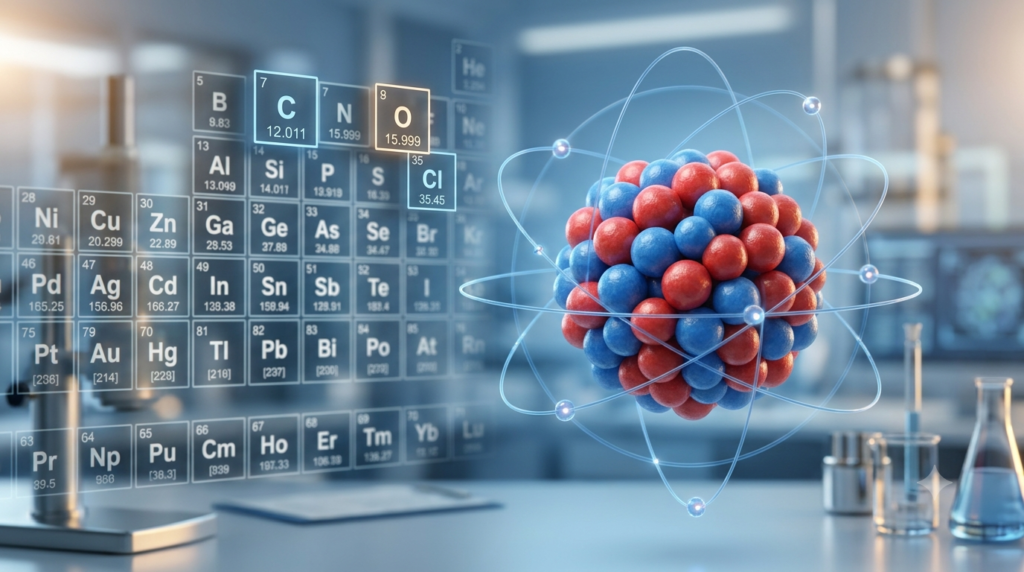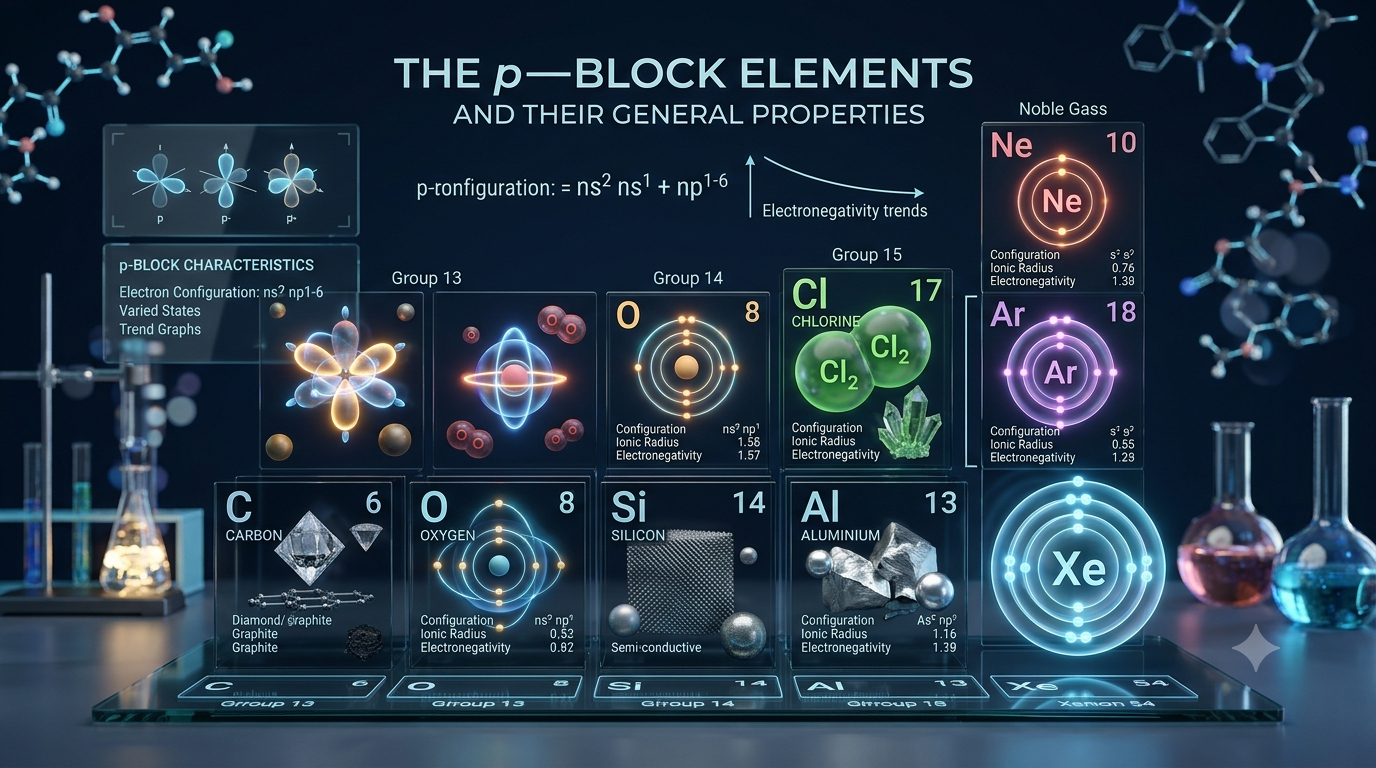
The periodic table is divided into different blocks based on the electronic configuration of elements. These blocks include the s-block, p-block, d-block, and f-block. Among them, the p-block contains a large and diverse group of elements that play an important role in chemistry and everyday life. Many familiar elements, such as carbon, nitrogen, oxygen, fluorine, aluminium, silicon, phosphorus, and chlorine, belong to this block.
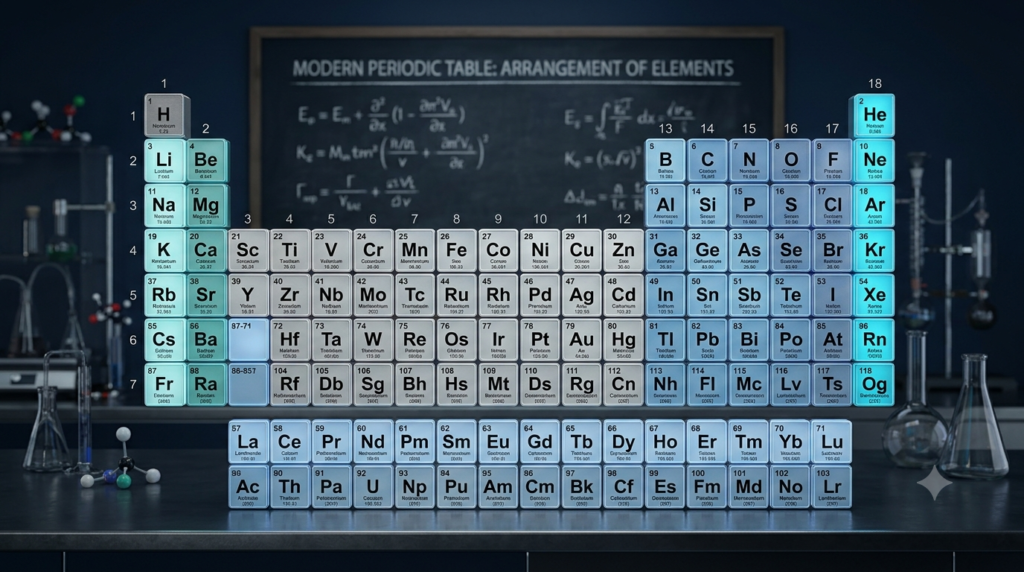
The p-block elements are found on the right-hand side of the periodic table and include elements from Group 13 to Group 18. They show a wide variety of physical and chemical properties. Some are metals, others are non-metals, and a few are metalloids. They are involved in numerous natural processes, industrial applications, biological systems, and modern technologies.
Understanding the p-block elements helps explain important chemical concepts such as bonding, oxidation states, periodic trends, acidity, basicity, and chemical reactivity.
1. What Are p-Block Elements?
The p-block elements are those elements in which the last electron enters the p-subshell of the outermost shell. These elements occupy Groups 13 to 18 of the modern periodic table.
The general electronic configuration of p-block elements is:
ns² np¹ to ns² np⁶
Here:
n represents the principal quantum number.
s² indicates that the s-subshell contains two electrons.
p¹ to p⁶ indicates that the p-subshell contains one to six electrons.
Helium is an exception. Although it is placed in Group 18 because of its chemical properties and complete outer shell, its electronic configuration is 1s². Therefore, it is an s-block element based on its electronic configuration.
The p-block contains elements with different properties, ranging from highly reactive non-metals to metals and relatively unreactive noble gases.
2. Position of p-Block Elements in the Periodic Table
The p-block elements are located on the right side of the periodic table. They begin with Group 13 and end with Group 18.
They include six groups:
Group 13 – Boron Family
Group 14 – Carbon Family
Group 15 – Nitrogen Family
Group 16 – Oxygen Family
Group 17 – Halogen Family
Group 18 – Noble Gas Family
These groups contain elements with similar outer electronic configurations. As a result, elements within the same group often show similar chemical properties.
However, their properties also change gradually from top to bottom within a group and from left to right across a period.
3. Classification of p-Block Elements
The p-block elements can be classified into three major categories based on their physical and chemical properties.
3.1 Metals
Metals are generally good conductors of heat and electricity. They usually have a shiny appearance and can be shaped into sheets or wires.
Some p-block metals include:
Aluminium (Al)
Gallium (Ga)
Indium (In)
Tin (Sn)
Thallium (Tl)
Lead (Pb)
Bismuth (Bi)
These metals are widely used in construction, electrical equipment, packaging, electronics, and manufacturing.
3.2 Non-Metals
Non-metals generally have poor electrical conductivity and do not show typical metallic properties. Many are gases at room temperature, while some are solids or liquids.
Examples include:
Carbon (C)
Nitrogen (N)
Oxygen (O)
Phosphorus (P)
Sulfur (S)
Fluorine (F)
Chlorine (Cl)
Bromine (Br)
Iodine (I)
Non-metals are essential for life and participate in many biological and chemical processes.
3.3 Metalloids
Metalloids are elements that show properties intermediate between metals and non-metals. Their electrical conductivity may increase under certain conditions, making some of them useful as semiconductors.
Common examples include:
Boron (B)
Silicon (Si)
Germanium (Ge)
Arsenic (As)
Antimony (Sb)
Tellurium (Te)
Silicon and germanium are particularly important in semiconductor technology and electronic devices.
4. General Electronic Configuration of p-Block Elements
The outermost electronic configuration of p-block elements is ns² np¹ to ns² np⁶.
The number of electrons in the p-subshell increases from one to six as we move from Group 13 to Group 18.
| Group | General Electronic Configuration | Number of Valence Electrons |
|---|---|---|
| 13 | ns² np¹ | 3 |
| 14 | ns² np² | 4 |
| 15 | ns² np³ | 5 |
| 16 | ns² np⁴ | 6 |
| 17 | ns² np⁵ | 7 |
| 18 | ns² np⁶ | 8 |
The elements of Group 18 have completely filled outermost shells, which generally makes them chemically stable.
The electronic configuration plays an important role in determining the valency, bonding behaviour, oxidation states, and chemical reactivity of these elements.
5. General Physical Properties of p-Block Elements
The p-block elements show considerable variation in their physical properties. This is because the block contains metals, non-metals, and metalloids.
5.1 Physical State
The p-block elements exist in different physical states at room temperature.
Solids: Carbon, boron, silicon, phosphorus, sulfur, aluminium, and many others.
Liquids: Bromine is a liquid non-metal.
Gases: Nitrogen, oxygen, fluorine, chlorine, and several noble gases.
This wide variation makes the p-block one of the most diverse sections of the periodic table.
5.2 Metallic Character
Metallic character refers to the tendency of an element to lose electrons and form positive ions.
Across a period, metallic character generally decreases from left to right because the effective nuclear charge increases and atoms hold their electrons more strongly.
Down a group, metallic character generally increases because atomic size increases and the outermost electrons become easier to remove.
For example, in Group 14, carbon is a non-metal, silicon and germanium are metalloids, while tin and lead are metals.
5.3 Melting and Boiling Points
The melting and boiling points of p-block elements vary considerably.
These differences depend on the type of bonding and the structure of the elements.
For example:
Carbon has a very high melting point because of its strong covalent network structure.
Silicon also has a high melting point due to its giant covalent structure.
Noble gases have very low boiling points because they experience weak London dispersion forces.
Some molecular non-metals, such as oxygen and nitrogen, have relatively low melting and boiling points.
Therefore, there is no single general trend that applies to every p-block element.
5.4 Electrical Conductivity
Electrical conductivity also varies across the p-block.
Metals such as aluminium and tin are good conductors of electricity. Non-metals such as sulfur and phosphorus are generally poor conductors.
Metalloids such as silicon and germanium are semiconductors. Their conductivity can be controlled by temperature and the addition of suitable impurities.
This property makes them essential materials in computers, smartphones, solar cells, and other electronic devices.
6. General Chemical Properties of p-Block Elements
The chemical properties of p-block elements depend mainly on their valence electrons and electronic configurations.
They show different types of chemical reactions and bonding patterns.
6.1 Valency
Valency refers to the combining capacity of an atom.
The valency of p-block elements varies according to the number of electrons present in their outermost shell.
For example:
Group 13 elements commonly show valency 3.
Group 14 elements commonly show valency 4.
Group 15 elements commonly show valency 3.
Group 16 elements commonly show valency 2.
Group 17 elements commonly show valency 1.
Group 18 elements generally have zero valency.
However, many p-block elements can show variable valencies and oxidation states because they can form compounds in different bonding arrangements.
6.2 Oxidation States
One of the important characteristics of p-block elements is their ability to exhibit different oxidation states.
The oxidation state depends on the number of electrons involved in chemical bonding and the stability of the resulting electronic arrangement.
For example:
Carbon shows oxidation states ranging from -4 to +4.
Nitrogen shows oxidation states ranging from -3 to +5.
Sulfur commonly shows oxidation states of -2, +2, +4, and +6.
Chlorine can show oxidation states of -1, +1, +3, +5, and +7.
The variation in oxidation states allows p-block elements to form a large number of compounds.
6.3 Inert Pair Effect
The inert pair effect is an important characteristic of heavier p-block elements.
It refers to the tendency of the outermost ns² electron pair to remain less available for chemical bonding.
As a result, lower oxidation states become more stable in heavier elements of certain groups.
For example:
Thallium commonly shows the +1 oxidation state, although it can also show +3.
Lead commonly shows the +2 oxidation state, although it can also show +4.
Bismuth commonly shows the +3 oxidation state, although it can also show +5.
The inert pair effect generally becomes more significant down a group.
6.4 Covalent Bond Formation
Many p-block elements form covalent bonds by sharing electrons with other atoms.
For example:
Hydrogen and oxygen form water (H₂O).
Carbon and hydrogen form methane (CH₄).
Nitrogen and hydrogen form ammonia (NH₃).
Carbon and oxygen form carbon dioxide (CO₂).
Covalent bonding is particularly common among non-metals and metalloids of the p-block.
However, p-block metals also form ionic and metallic compounds, depending on the elements involved.
6.5 Formation of Oxides
Most p-block elements form oxides when they react with oxygen.
These oxides may be acidic, basic, amphoteric, or neutral.
Acidic oxides: CO₂, SO₂, SO₃ and P₄O₁₀.
Basic oxides: Tl₂O and Bi₂O₃.
Amphoteric oxides: Al₂O₃, SnO₂ and PbO.
Neutral oxides: CO, NO and N₂O.
The acidic or basic character of oxides generally changes with metallic character.
Across a period, oxides generally become less basic and more acidic. However, the exact behaviour depends on the element and its oxidation state.
7. Important Periodic Trends in p-Block Elements
Periodic trends help explain how the properties of elements change across periods and down groups.
7.1 Atomic Size
Atomic size generally decreases from left to right across a period.
This happens because the nuclear charge increases while electrons are added to the same principal shell. The stronger attraction pulls the electrons closer to the nucleus.
Down a group, atomic size generally increases because additional electron shells are added.
7.2 Ionization Enthalpy
Ionization enthalpy is the energy required to remove an electron from an isolated gaseous atom.
It generally increases across a period because the effective nuclear charge increases.
It generally decreases down a group because the outermost electrons become farther from the nucleus and experience greater shielding.
However, there are some exceptions due to electronic configurations and subshell stability.
7.3 Electronegativity
Electronegativity is the tendency of an atom to attract shared electrons towards itself in a chemical bond.
It generally increases from left to right across a period and decreases down a group.
Fluorine is the most electronegative element in the periodic table.
7.4 Electron Gain Enthalpy
Electron gain enthalpy describes the enthalpy change when an electron is added to an isolated gaseous atom.
Many p-block elements show favourable electron gain enthalpy values, particularly the halogens.
However, the trend is not perfectly regular because atomic size, electron-electron repulsion, and electronic stability also influence the process.
For example, chlorine has a more negative electron gain enthalpy than fluorine because the incoming electron experiences less repulsion in chlorine’s larger valence shell.
8. The Six Groups of p-Block Elements
Each group of the p-block has its own characteristic properties and important elements.
8.1 Group 13 – Boron Family
Group 13 contains boron, aluminium, gallium, indium, thallium, and nihonium.
The general electronic configuration is ns² np¹.
Important characteristics include:
Boron is a metalloid, while most other members are metals.
The common oxidation state is +3.
The +1 oxidation state becomes increasingly stable in heavier members due to the inert pair effect.
Boron mainly forms covalent compounds.
Aluminium is widely used in electrical equipment, construction, and packaging.
8.2 Group 14 – Carbon Family
Group 14 contains carbon, silicon, germanium, tin, lead, and flerovium.
The general electronic configuration is ns² np².
Important characteristics include:
Carbon is a non-metal.
Silicon and germanium are metalloids.
Tin and lead are metals.
Common oxidation states are +4 and +2.
Carbon shows exceptional catenation, meaning it can form long chains and rings with other carbon atoms.
Silicon is essential in semiconductor manufacturing.
Carbon is the foundation of organic chemistry and is present in all known living organisms.
8.3 Group 15 – Nitrogen Family
Group 15 contains nitrogen, phosphorus, arsenic, antimony, bismuth, and moscovium.
The general electronic configuration is ns² np³.
Important characteristics include:
Nitrogen and phosphorus are non-metals.
Arsenic and antimony are metalloids.
Bismuth is a metal.
Common oxidation states include -3, +3, and +5.
Nitrogen is an essential component of proteins and nucleic acids.
Phosphorus is important in fertilizers, biological energy transfer, and DNA.
8.4 Group 16 – Oxygen Family
Group 16 contains oxygen, sulfur, selenium, tellurium, polonium, and livermorium.
The general electronic configuration is ns² np⁴.
Important characteristics include:
Oxygen and sulfur are non-metals.
Tellurium is a metalloid.
Polonium is a radioactive metal.
Common oxidation states include -2, +2, +4, and +6.
Oxygen is essential for respiration.
Sulfur is used in the manufacture of sulfuric acid and other industrial chemicals.
8.5 Group 17 – Halogen Family
Group 17 contains fluorine, chlorine, bromine, iodine, astatine, and tennessine.
The general electronic configuration is ns² np⁵.
Important characteristics include:
Halogens have seven valence electrons.
They generally require one additional electron to achieve a stable noble gas configuration.
They commonly show an oxidation state of -1.
Fluorine is the most electronegative element.
They generally exist as diatomic molecules, such as F₂, Cl₂, Br₂, and I₂.
They form salts when they react with many metals.
Chlorine is used in water disinfection, while iodine is important in human nutrition.
8.6 Group 18 – Noble Gas Family
Group 18 contains helium, neon, argon, krypton, xenon, radon, and oganesson.
Except for helium, the general electronic configuration is ns² np⁶.
Important characteristics include:
Their outermost electron shells are generally completely filled.
They have very low chemical reactivity compared with most other elements.
They exist as individual atoms rather than ordinary diatomic molecules.
They have low boiling points.
They are colourless and odourless under ordinary conditions.
Some heavier noble gases, particularly xenon, form chemical compounds.
Helium is used in balloons and cryogenic applications, neon in lighting, and argon in welding.
9. Chemical Reactivity of p-Block Elements
The reactivity of p-block elements varies significantly because they have different numbers of valence electrons.
Elements with one electron missing from a stable outer shell, such as halogens, tend to gain electrons and form negative ions.
Other elements may lose, gain, or share electrons depending on their chemical nature.
For example:
Sodium reacts with chlorine to form sodium chloride.
Hydrogen reacts with oxygen to form water.
Carbon reacts with oxygen to form carbon dioxide under complete combustion.
Nitrogen reacts with hydrogen under suitable conditions to form ammonia.
The reactivity of p-block elements is influenced by atomic size, ionization enthalpy, electron gain enthalpy, electronegativity, and the stability of their electronic configurations.
10. Allotropy in p-Block Elements
Allotropy is the property of an element to exist in two or more different structural forms in the same physical state.
Several p-block elements show allotropy.
Examples include:
Carbon: Diamond, graphite, graphene, and fullerenes are different forms of carbon. Diamond is extremely hard, while graphite is soft and conducts electricity.
Phosphorus: White phosphorus, red phosphorus, and black phosphorus are different allotropes with different structures and properties.
Sulfur: Rhombic sulfur and monoclinic sulfur are two common crystalline forms.
Allotropy occurs because atoms of the same element can be arranged and bonded in different ways.
11. Uses and Applications of p-Block Elements
The p-block elements have numerous applications in daily life, science, medicine, agriculture, and industry.
Some important applications include:
11.1 In Biological Systems
Oxygen is necessary for cellular respiration. Carbon is the fundamental element of organic molecules. Nitrogen is present in proteins and nucleic acids, while phosphorus is essential for DNA, RNA, and ATP.
Sulfur is also present in certain amino acids and proteins.
11.2 In Agriculture
Nitrogen, phosphorus, and sulfur are important plant nutrients.
Nitrogen-based fertilizers support plant growth, while phosphorus-based fertilizers help root development and energy transfer. Sulfur is required for the formation of certain proteins and enzymes.
11.3 In Electronics
Silicon and germanium are important semiconductor materials.
They are used in transistors, integrated circuits, computer processors, solar cells, and other electronic components.
11.4 In Construction and Manufacturing
Aluminium is used in aircraft, vehicles, buildings, and packaging because it is lightweight and corrosion-resistant.
Silicon compounds are used in glass and ceramics. Carbon-based materials are used in electrodes, lubricants, and industrial products.
11.5 In Medicine and Healthcare
Oxygen is used in medical oxygen therapy. Iodine compounds are used in certain antiseptic and diagnostic applications. Some compounds containing p-block elements are also used in medicines and medical treatments.
11.6 In Chemical Industries
Sulfur is used to manufacture sulfuric acid, one of the most important industrial chemicals.
Chlorine is used in water treatment and chemical manufacturing. Ammonia, which contains nitrogen, is an important raw material for fertilizer production.
12. Why Are p-Block Elements Important in Chemistry?
The p-block elements are important because they form a large number of chemical compounds and participate in many chemical reactions.
Their importance can be understood through several key points:
They form the foundation of organic and inorganic chemistry.
They are essential components of living organisms.
They play an important role in industrial chemical production.
They are used in electronic and semiconductor technologies.
They help explain important periodic trends and chemical bonding.
They are involved in environmental processes such as the carbon and nitrogen cycles.
They provide materials for construction, medicine, agriculture, and manufacturing.
Studying these elements helps us understand how the structure of atoms determines the properties and behaviour of matter.
Conclusion
The p-block elements form an important and diverse section of the modern periodic table, covering Groups 13 to 18. They include metals, non-metals, and metalloids, each with different physical and chemical properties. Their general electronic configuration is ns² np¹ to ns² np⁶, which determines many of their chemical characteristics.
These elements exhibit important properties such as variable oxidation states, covalent bonding, allotropy, and the inert pair effect. They also show periodic trends in atomic size, ionization enthalpy, electronegativity, and metallic character.
From oxygen in respiration and carbon in living organisms to silicon in electronic devices and aluminium in construction, p-block elements are essential to modern life. Understanding their general properties provides a strong foundation for learning inorganic chemistry and exploring the behaviour of elements and their compounds.
FAQs
1. What are p-block elements?
p-block elements are those elements in which the last electron enters the p-subshell of the outermost electron shell. They are located on the right-hand side of the periodic table and belong to Groups 13 to 18. Their general electronic configuration is ns² np¹ to ns² np⁶. These elements include metals, non-metals, and metalloids. Examples include boron, carbon, nitrogen, oxygen, aluminium, chlorine, and neon. They play important roles in biological processes, industrial applications, electronics, and chemical reactions.
2. How many groups are included in the p-block?
The p-block contains six groups in the modern periodic table, starting from Group 13 and ending with Group 18. These groups are the boron family, carbon family, nitrogen family, oxygen family, halogen family, and noble gas family. Each group contains elements with the same number of valence electrons and similar outer electronic configurations. As a result, elements within a group often show similar chemical properties, although their physical properties and reactivity may change gradually from top to bottom.
3. What is the general electronic configuration of p-block elements?
The general electronic configuration of p-block elements is ns² np¹ to ns² np⁶. Here, n represents the principal quantum number, while the superscripts indicate the number of electrons in the respective subshells. The s-subshell contains two electrons, whereas the p-subshell contains between one and six electrons. This electronic arrangement determines many important properties, including valency, oxidation states, bonding behaviour, and chemical reactivity. Helium is an exception because its configuration is 1s², although it is placed in Group 18.
4. Why are p-block elements called representative elements?
p-block elements are commonly called representative elements because they display a wide variety of physical and chemical properties. They include metals, non-metals, and metalloids and form different types of chemical compounds. Their valence electrons participate in various bonding arrangements, resulting in different oxidation states and chemical behaviours. These elements are important in understanding fundamental chemical concepts such as covalent bonding, periodic trends, acidity, basicity, and chemical reactivity. Traditionally, the s-block and p-block together are referred to as representative elements.
5. What are the main characteristics of p-block elements?
The p-block elements show considerable variation in their physical and chemical properties. Their main characteristics include the presence of one to six electrons in the p-subshell, variable oxidation states, and the ability to form covalent compounds. They include metals, non-metals, and metalloids. Some elements exhibit allotropy, while heavier elements of certain groups show the inert pair effect. Their metallic character generally increases down a group and decreases across a period. They also form acidic, basic, amphoteric, and neutral oxides.
6. Why do p-block elements show variable oxidation states?
Many p-block elements show variable oxidation states because they can use different numbers of valence electrons during chemical bonding. The number of electrons involved depends on their electronic configuration, bonding partners, and the stability of the resulting compounds. For example, nitrogen shows oxidation states ranging from -3 to +5, while sulfur commonly exhibits -2, +2, +4, and +6. Heavier p-block elements may also show the inert pair effect, which makes their lower oxidation states more stable than their higher oxidation states.
7. What is the inert pair effect in p-block elements?
The inert pair effect is the tendency of the outermost ns² electron pair to remain less available for chemical bonding in heavier p-block elements. As a result, lower oxidation states become increasingly stable down certain groups. For example, thallium commonly exhibits the +1 oxidation state, lead commonly shows +2, and bismuth commonly shows +3. This effect is particularly important when comparing the chemical behaviour of lighter and heavier elements within the same group. It helps explain differences in their oxidation states and compound stability.
8. What is the difference between metals, non-metals, and metalloids in the p-block?
The p-block contains three major types of elements. Metals, such as aluminium, tin, and lead, generally conduct heat and electricity and tend to lose electrons. Non-metals, such as carbon, oxygen, and chlorine, are generally poor conductors and tend to gain or share electrons. Metalloids, such as silicon, germanium, and arsenic, show properties intermediate between metals and non-metals. Some metalloids have semiconductor properties, making them useful in electronic devices, computer chips, and solar cells.
9. What are the important applications of p-block elements?
p-block elements have numerous applications in everyday life and modern industries. Oxygen is essential for respiration, carbon is the foundation of organic compounds, and nitrogen is used in fertilizer production. Silicon and germanium are important semiconductor materials used in electronic devices. Aluminium is widely used in construction, transportation, and packaging. Chlorine is used in water disinfection, while sulfur is essential for manufacturing sulfuric acid. Noble gases are used in lighting, welding, and specialised scientific applications. These elements are also important in medicine, agriculture, and technology.
10. What is the difference between s-block and p-block elements?
The main difference between s-block and p-block elements is the subshell into which the last electron enters. In s-block elements, the last electron enters the s-subshell, while in p-block elements, it enters the p-subshell. The s-block includes Groups 1 and 2, whereas the p-block includes Groups 13 to 18. The general electronic configurations are ns¹ to ns² for s-block elements and ns² np¹ to ns² np⁶ for p-block elements. The p-block contains metals, non-metals, and metalloids, while the s-block mainly contains highly reactive metals, along with hydrogen and helium based on their electronic configurations.