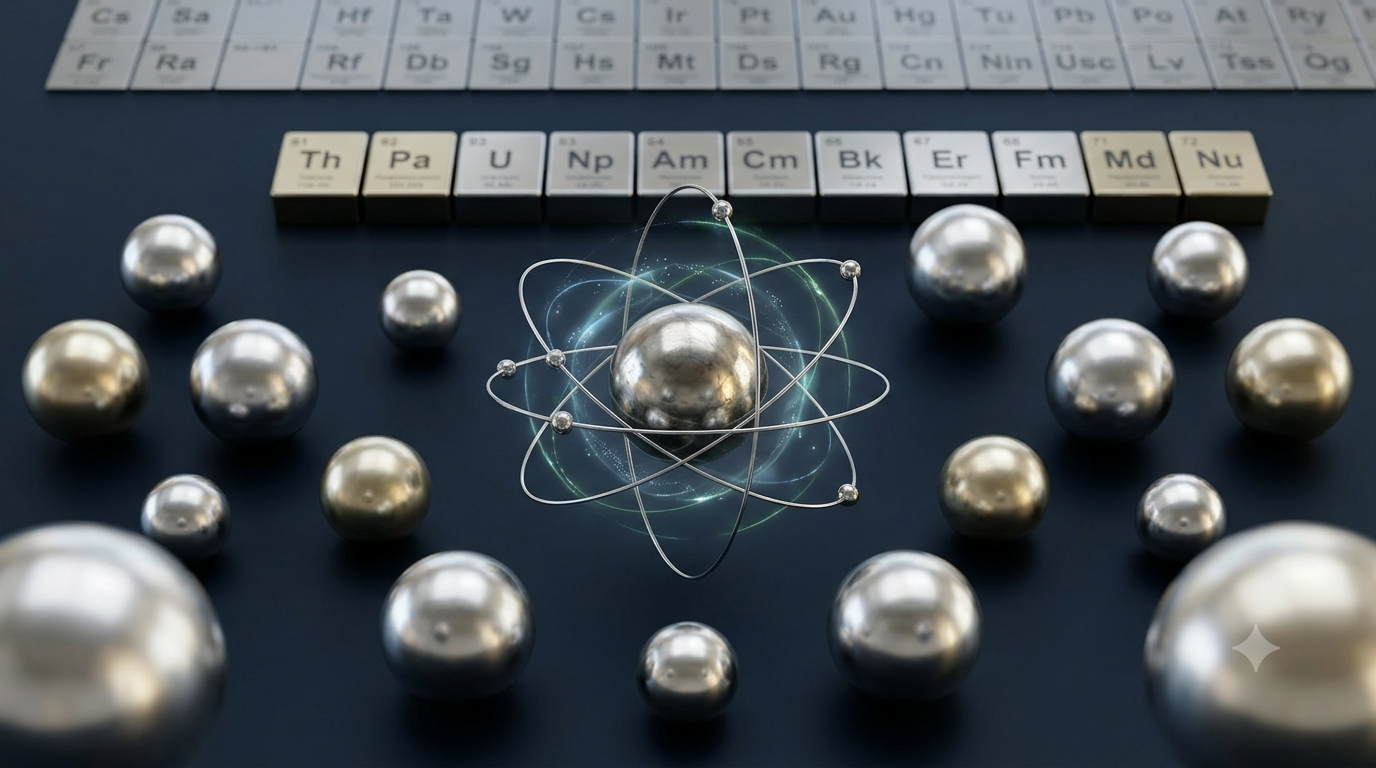
The actinides are a group of metallic chemical elements found in the bottom row of the periodic table, below the lanthanides. They belong to the f-block elements and are also known as inner transition elements. The actinide series consists of 15 elements, starting with Actinium (Ac, atomic number 89) and ending with Lawrencium (Lr, atomic number 103).
Actinides are particularly important in chemistry because of their unique electronic configurations, radioactive properties, and ability to form compounds in different oxidation states. Many actinides are radioactive, and several of them play important roles in nuclear energy, scientific research, and modern technology.
Uranium and Thorium are among the best-known naturally occurring actinides. Plutonium is another important member of this series because of its applications in nuclear reactors and nuclear science. Understanding actinides helps explain the behaviour of heavy elements and their role in nuclear chemistry.
What Are Actinides?
Actinides are a series of 15 metallic elements in which the 5f orbitals are progressively filled. They are located in the seventh period of the periodic table and are part of the f-block.
The name actinides comes from the element Actinium, which is the first member of the series. These elements share several chemical and physical characteristics, although their properties also show considerable variation across the series.
The general electronic configuration of actinides is:
[Rn] 5f⁰–¹⁴ 6d⁰–¹ 7s²
Here, [Rn] represents the electronic configuration of Radon, a noble gas. The 5f orbitals are gradually occupied as the atomic number increases.
Unlike many other groups of elements, actinides are mostly radioactive. Some occur naturally in the Earth’s crust, while many heavier actinides have been produced artificially through nuclear reactions.
List of Actinide Elements
The actinide series contains 15 elements. Their names, symbols, and atomic numbers are given below.
| Element | Symbol | Atomic Number |
|---|---|---|
| Actinium | Ac | 89 |
| Thorium | Th | 90 |
| Protactinium | Pa | 91 |
| Uranium | U | 92 |
| Neptunium | Np | 93 |
| Plutonium | Pu | 94 |
| Americium | Am | 95 |
| Curium | Cm | 96 |
| Berkelium | Bk | 97 |
| Californium | Cf | 98 |
| Einsteinium | Es | 99 |
| Fermium | Fm | 100 |
| Mendelevium | Md | 101 |
| Nobelium | No | 102 |
| Lawrencium | Lr | 103 |
These elements are placed separately at the bottom of the periodic table to make its overall structure more compact and easier to read.
General Characteristics of Actinides
Actinides have several common physical and chemical properties. However, differences in their electronic configurations and nuclear structures produce variations in their behaviour.
1. Metallic Nature
All actinides are metals. They generally have a silvery or silvery-white appearance when freshly prepared and are usually good conductors of heat and electricity.
Like other metals, they can form positive ions by losing electrons. Many actinides are relatively dense and have high melting points, although their exact physical properties vary from one element to another.
Their metallic nature makes them useful in certain industrial and scientific applications, particularly in nuclear technology.
2. Radioactive Nature
Radioactivity is one of the most important characteristics of actinides.
All actinides are radioactive, which means their unstable atomic nuclei spontaneously release radiation as they transform into more stable nuclei. This radiation may include alpha particles, beta particles, and gamma rays.
Some actinides, such as Uranium and Thorium, have naturally occurring isotopes with extremely long half-lives. Others, particularly the heavier synthetic actinides, generally have much shorter half-lives.
Radioactivity is responsible for many important applications of actinides in nuclear energy, scientific research, and radioactive dating.
3. Electronic Configuration
The electronic configuration of actinides is one of the main reasons for their unusual chemical behaviour.
Their general electronic configuration is:
[Rn] 5f⁰–¹⁴ 6d⁰–¹ 7s²
In this series, electrons gradually enter the 5f orbitals. However, the energy levels of the 5f, 6d, and 7s orbitals are relatively close to one another.
As a result, some actinides show irregular electronic configurations. This also contributes to their ability to form compounds in different oxidation states.
4. Variable Oxidation States
Actinides exhibit several oxidation states because electrons from the 5f, 6d, and 7s orbitals can participate in chemical bonding.
The most common oxidation state is +3, but several actinides can also exhibit +4, +5, and +6 oxidation states. Some elements show additional oxidation states under particular conditions.
For example:
Thorium commonly exhibits the +4 oxidation state.
Uranium commonly exhibits +4 and +6 oxidation states.
Plutonium can show +3, +4, +5, and +6 oxidation states.
The ability to exhibit multiple oxidation states makes actinide chemistry more complex than the chemistry of many other elements.
5. Formation of Coloured Ions
Many actinide ions and compounds are coloured.
Their colour is mainly associated with electronic transitions involving the 5f orbitals. The particular colour depends on the element, its oxidation state, and the surrounding chemical environment.
For example, different oxidation states of Uranium can produce compounds with different colours. Uranium compounds may appear yellow, green, or other colours depending on their chemical composition.
This characteristic is useful in studying and identifying certain actinide compounds.
6. High Density
Many actinides are very dense metals. Their high atomic masses contribute to this property.
Uranium and Plutonium are well-known examples of dense actinide metals. Their density makes them important in specialised nuclear and engineering applications.
However, density is not identical throughout the series, and the exact values depend on the element and its physical structure.
7. Complex Formation
Actinides have a strong tendency to form complex compounds with different ligands.
They can interact with substances containing oxygen, nitrogen, sulfur, and other donor atoms. Their relatively large ionic sizes and variable oxidation states allow them to form a wide variety of coordination compounds.
For example, Uranium can form uranyl ions (UO₂²⁺), which are important in aqueous uranium chemistry.
Complex formation plays an important role in the extraction, separation, purification, and environmental behaviour of actinides.
8. Similarity to Lanthanides
Actinides show several similarities to lanthanides because both series belong to the f-block of the periodic table.
Both groups contain metallic elements and show gradual filling of inner f orbitals. They also form compounds in the +3 oxidation state.
However, actinides generally show greater variation in oxidation states and have radioactive nuclei. Their 5f electrons also participate in chemical bonding more readily than the 4f electrons of lanthanides.
Therefore, actinide chemistry is generally more complicated.
9. Actinide Contraction
Actinide contraction refers to the gradual decrease in the atomic and ionic radii of actinides as their atomic numbers increase.
As we move across the series, the nuclear charge increases. The added 5f electrons do not completely shield the outer electrons from this increasing nuclear attraction.
Consequently, the electrons are pulled closer to the nucleus, resulting in a gradual decrease in atomic and ionic size.
This phenomenon is similar to lanthanide contraction and influences the chemical properties of actinides.
10. Natural and Synthetic Occurrence
Actinides can be divided into naturally occurring and artificially produced elements.
Some actinides, including Thorium and Uranium, occur naturally in minerals found in the Earth’s crust. Actinium and Protactinium also occur naturally in very small quantities, mainly as products of radioactive decay.
Elements beyond Uranium are generally called transuranium elements. Most of these are produced artificially through nuclear reactions.
Some transuranium elements, such as Neptunium and Plutonium, can also occur in trace amounts naturally through nuclear processes.
Chemical Properties of Actinides
Actinides show a wide range of chemical properties because of their variable oxidation states and electronic configurations.
1. Reaction with Oxygen
Actinides react with oxygen to form oxides. The nature of the oxide depends on the element and its oxidation state.
For example, Uranium forms several oxides, including:
UO₂ – Uranium dioxide
U₃O₈ – Triuranium octoxide
UO₃ – Uranium trioxide
These oxides are important in nuclear fuel technology and uranium processing.
2. Reaction with Halogens
Actinides react with halogens to form halide compounds.
For example, Uranium can form uranium tetrafluoride (UF₄) and uranium hexafluoride (UF₆).
Uranium hexafluoride is particularly important in the uranium enrichment process because it can exist as a gas at relatively accessible temperatures.
3. Reaction with Acids
Many actinide metals react with suitable acids to produce salts and release hydrogen gas. However, the reaction depends on the metal, the acid, and the conditions.
Some actinide metals can also become protected by surface oxide layers, which influence their chemical reactivity.
4. Formation of Hydroxides
Actinide ions can react with hydroxide ions to form hydroxide compounds.
For example, uranium in the +4 oxidation state can form uranium(IV) hydroxide, U(OH)₄.
These reactions are important in the separation and purification of actinide elements.
Important Uses of Actinides
Actinides have several applications in science, technology, medicine, and nuclear industries. Their uses depend on their radioactive properties, nuclear behaviour, and chemical characteristics.
1. Nuclear Energy Production
Uranium is widely used as nuclear fuel in nuclear power plants. Certain uranium isotopes, particularly Uranium-235, can undergo nuclear fission when their nuclei absorb suitable neutrons.
During nuclear fission, a heavy nucleus splits into smaller nuclei and releases a large amount of energy. This energy is used to generate heat, which produces steam to drive turbines and generate electricity.
Plutonium-239 can also be used as nuclear fuel in suitable reactor systems.
2. Nuclear Weapons
Certain actinide isotopes, particularly Uranium-235 and Plutonium-239, have been used in nuclear weapons.
Their ability to undergo rapid nuclear fission makes them capable of releasing enormous amounts of energy.
This application is associated with serious environmental, humanitarian, and international security concerns.
3. Smoke Detectors
Americium-241 is used in some ionisation-type smoke detectors.
It emits alpha particles that help ionise the air inside the detector. When smoke enters the chamber, it interferes with the ionisation current, allowing the device to detect smoke.
This technology has been used in household and commercial fire-safety equipment.
4. Scientific Research
Several actinides are important in nuclear physics and chemical research.
Scientists study these elements to understand nuclear stability, radioactive decay, atomic structure, and the behaviour of heavy elements.
Artificially produced actinides also help researchers investigate the limits of the periodic table and the formation of superheavy elements.
5. Medical Applications
Certain actinide isotopes have specialised medical applications.
For example, Actinium-225 is studied and used in targeted alpha therapy for certain cancers. It releases alpha particles that can damage cancer cells when appropriately delivered to tumour targets.
Its medical use requires specialised production, handling, and strict radiation-safety procedures.
6. Neutron Sources
Californium-252 is a powerful neutron source.
It undergoes spontaneous fission and releases neutrons that can be used in scientific research, neutron activation analysis, and specialised industrial applications.
It has also been used in certain neutron-based inspection and measurement systems.
Difference Between Actinides and Lanthanides
Actinides and lanthanides are two important series of inner transition elements. Although they share several characteristics, they also have important differences.
| Basis | Lanthanides | Actinides |
|---|---|---|
| Position | Sixth period | Seventh period |
| Atomic numbers | 57–71 | 89–103 |
| Orbital filling | 4f orbitals | 5f orbitals |
| Radioactivity | Most are non-radioactive; Promethium is radioactive | All are radioactive |
| Common oxidation state | +3 | +3 |
| Other oxidation states | Limited variation | Greater variation |
| Complex formation | Comparatively less extensive | Generally more extensive |
| Contraction | Lanthanide contraction | Actinide contraction |
| Natural occurrence | Most occur naturally | Some occur naturally; many are synthetic |
Both series are important for understanding the structure of the periodic table and the chemical behaviour of inner transition elements.
Environmental and Health Effects of Actinides
Although actinides have useful applications, their radioactive nature requires careful handling and management.
Exposure to radioactive actinides can be harmful because ionising radiation may damage living cells and genetic material. The level of risk depends on the isotope, radiation type, amount of exposure, and route of entry into the body.
Some actinides, such as Plutonium, can pose serious health risks if radioactive particles enter the body through inhalation or ingestion.
Actinide contamination may also affect soil, water, and ecosystems. Radioactive waste from nuclear facilities must therefore be carefully collected, treated, stored, and monitored.
Strict safety regulations, protective equipment, radiation monitoring, and proper waste-management systems are essential when working with these elements.
Conclusion
Actinides are a fascinating group of 15 metallic elements that occupy an important position in the f-block of the periodic table. Their most distinctive characteristics include radioactive behaviour, variable oxidation states, gradual filling of 5f orbitals, complex formation, and actinide contraction.
Elements such as Uranium, Thorium, Plutonium, Americium, and Californium have important applications in nuclear energy, scientific research, medicine, and specialised technologies.
At the same time, their radioactive nature requires responsible handling and careful environmental management. Studying actinides provides valuable knowledge about heavy elements, nuclear chemistry, and the behaviour of atomic nuclei.
Understanding their general characteristics is therefore essential for learning advanced inorganic chemistry and the chemistry of inner transition elements.
FAQs
1. What are actinides?
Actinides are a series of 15 metallic chemical elements found in the seventh period of the periodic table. They belong to the f-block and are also known as inner transition elements. The series begins with Actinium (Ac), atomic number 89, and ends with Lawrencium (Lr), atomic number 103. Actinides are characterised by the gradual filling of 5f orbitals, radioactive properties, and variable oxidation states. They are important in nuclear chemistry, energy production, scientific research, and specialised technological applications.
2. How many elements are present in the actinide series?
The actinide series contains 15 elements, with atomic numbers ranging from 89 to 103. These elements are Actinium, Thorium, Protactinium, Uranium, Neptunium, Plutonium, Americium, Curium, Berkelium, Californium, Einsteinium, Fermium, Mendelevium, Nobelium, and Lawrencium. All these elements belong to the seventh period of the periodic table. They are placed in a separate row at the bottom of the periodic table to maintain its compact structure. Each element has distinctive nuclear and chemical properties.
3. Why are actinides called inner transition elements?
Actinides are called inner transition elements because the differentiating electrons generally enter the inner 5f orbitals rather than the outermost electron shell. These orbitals are gradually filled as we move across the actinide series. They belong to the f-block of the periodic table and are located in the seventh period. Their electronic configurations influence their chemical behaviour, oxidation states, and bonding characteristics. Lanthanides are also called inner transition elements because their 4f orbitals are progressively filled.
4. Why are all actinides radioactive?
All actinides are radioactive because their atomic nuclei are unstable and undergo spontaneous radioactive decay. During this process, unstable nuclei release energy in the form of radiation, such as alpha particles, beta particles, and gamma rays. The stability of an atomic nucleus depends on the balance between nuclear forces and the repulsion between positively charged protons. In heavy actinide nuclei, this balance is insufficient to maintain permanent stability. Some actinides have very long half-lives, while others decay much more rapidly.
5. What is the general electronic configuration of actinides?
The general electronic configuration of actinides is [Rn] 5f⁰–¹⁴ 6d⁰–¹ 7s². In this configuration, [Rn] represents the electronic configuration of Radon, the preceding noble gas. The 5f orbitals are progressively filled as the atomic number increases. However, the energy levels of the 5f, 6d, and 7s orbitals are relatively close, resulting in some irregular electronic configurations. This electronic arrangement is responsible for their variable oxidation states and complex chemical behaviour.
6. What are the common oxidation states of actinides?
Actinides exhibit several oxidation states because electrons from their 5f, 6d, and 7s orbitals can participate in chemical bonding. The +3 oxidation state is common throughout the series. However, some elements also show +4, +5, and +6 oxidation states. For example, Thorium commonly exhibits +4, while Uranium commonly shows +4 and +6. Plutonium can exhibit +3, +4, +5, and +6 oxidation states. This variation in oxidation states makes actinide chemistry more complex than that of many other elements.
7. What is actinide contraction?
Actinide contraction refers to the gradual decrease in the atomic and ionic radii of actinide elements as their atomic numbers increase. This happens because the nuclear charge increases across the series, while the added 5f electrons do not completely shield the outer electrons from the increasing nuclear attraction. Consequently, electrons are pulled closer to the nucleus, reducing atomic and ionic sizes. Actinide contraction influences the physical and chemical properties of these elements and affects their ability to form compounds.
8. What are the most important uses of actinides?
Actinides have several important applications in science, technology, and industry. Uranium and Plutonium are used as nuclear fuels in suitable nuclear reactors. Americium-241 is used in some ionisation-type smoke detectors, while Californium-252 serves as a neutron source in scientific and industrial applications. Actinium-225 is used in specialised cancer research and targeted alpha therapy. Other actinides are valuable in nuclear physics and chemical research. Their applications depend on their radioactive properties, nuclear behaviour, and chemical characteristics.
9. What is the difference between actinides and lanthanides?
Actinides and lanthanides are two series of inner transition elements in the f-block. Lanthanides have atomic numbers from 57 to 71 and involve the filling of 4f orbitals, whereas actinides have atomic numbers from 89 to 103 and involve the filling of 5f orbitals. All actinides are radioactive, while most lanthanides have stable isotopes. Actinides also generally exhibit more variable oxidation states and more complex chemical behaviour. Both series show contraction across their respective elements and commonly form +3 ions.
10. Which actinides occur naturally?
Some actinides occur naturally in the Earth’s crust, particularly Thorium and Uranium, which are found in various minerals. Actinium and Protactinium also occur naturally in very small quantities, mainly as products of radioactive decay. Neptunium and Plutonium can occur in trace amounts through natural nuclear processes. Most heavier actinides are produced artificially in nuclear reactors or particle accelerators. Naturally occurring actinides are important sources of information about radioactive decay, nuclear stability, and the geological history of radioactive materials.