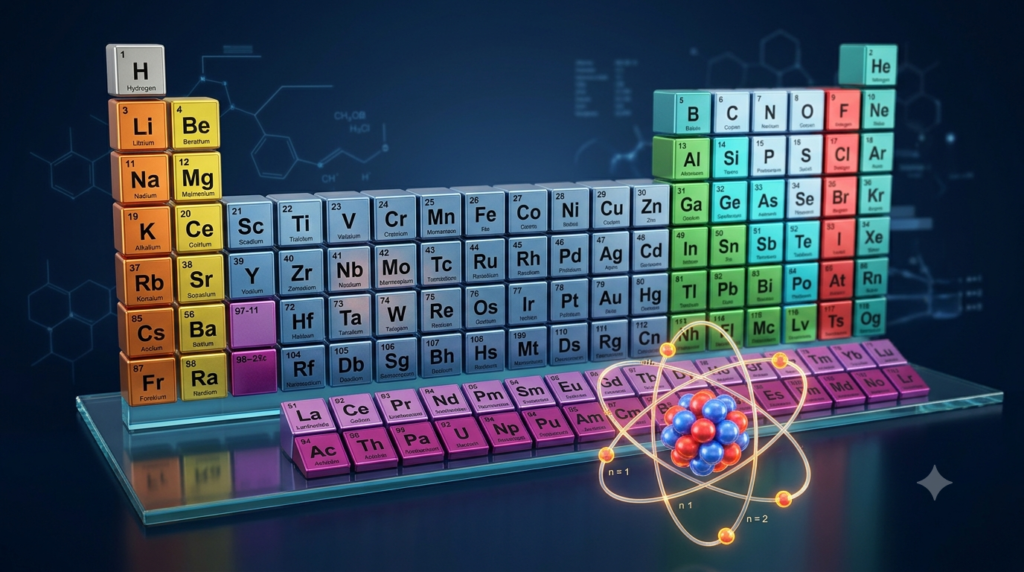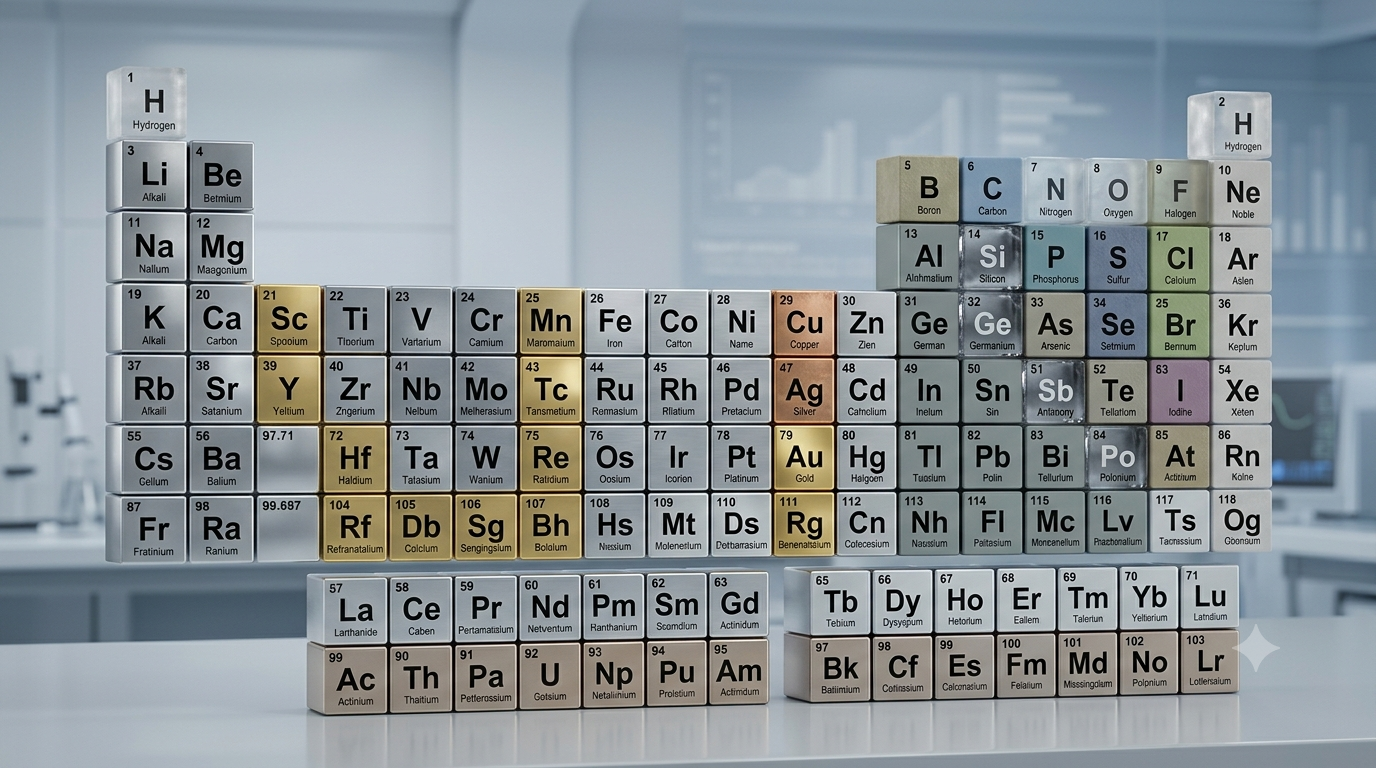
The periodic table is one of the most important tools in chemistry. It organizes all known chemical elements according to their atomic numbers, electron configurations, and recurring chemical properties. Each element has its own characteristics, such as atomic mass, reactivity, conductivity, physical state, and ability to form compounds.
Although the periodic table contains more than 100 elements, these elements are not randomly arranged. They are grouped into different categories based on their physical and chemical properties. These categories help scientists understand how elements behave, how they react with other substances, and how they are used in everyday life.
The major categories of elements in the periodic table include metals, nonmetals, and metalloids. Metals can be further divided into several groups, such as alkali metals, alkaline earth metals, transition metals, lanthanides, and actinides. Nonmetals include reactive nonmetals, noble gases, and other important elements such as hydrogen. Metalloids have properties that fall between those of metals and nonmetals.
Understanding these categories makes it easier to study the periodic table and recognize patterns in the behavior of chemical elements.
1. Metals
Metals are the largest category of elements in the periodic table. Most elements are classified as metals, and they are mainly located on the left side and in the center of the periodic table.
Metals are generally known for their shiny appearance, strength, ability to conduct heat and electricity, and tendency to lose electrons during chemical reactions. Most metals are solids at room temperature, although mercury is an important exception because it is liquid under normal room conditions.
Properties of Metals
Metals share several common physical and chemical properties.
Metallic lustre: Most metals have a shiny surface when freshly polished or cut.
Good electrical conductivity: Metals allow electric current to pass through them easily because they contain mobile electrons.
Good thermal conductivity: They transfer heat efficiently.
Malleability: Most metals can be hammered or pressed into thin sheets without breaking.
Ductility: Many metals can be drawn into thin wires.
High melting points: Many metals have high melting and boiling points, although there are exceptions.
Electron loss: Metals generally lose electrons and form positively charged ions called cations.
Examples of Metals
Some common examples include iron (Fe), copper (Cu), aluminium (Al), gold (Au), silver (Ag), zinc (Zn), and sodium (Na).
Uses of Metals
Metals are essential in modern life. Iron and steel are widely used in buildings, bridges, machinery, and vehicles. Copper is commonly used in electrical wiring because of its excellent electrical conductivity. Aluminium is used in aircraft, vehicles, packaging, and construction because it is lightweight and corrosion-resistant. Gold and silver are used in jewellery, electronics, and other specialized applications.
Metals are divided into several important categories based on their positions and properties in the periodic table.
2. Alkali Metals
Alkali metals are the elements found in Group 1 of the periodic table, excluding hydrogen. They include lithium (Li), sodium (Na), potassium (K), rubidium (Rb), caesium (Cs), and francium (Fr).
These elements are highly reactive metals. They have one electron in their outermost electron shell and generally lose this electron to form ions with a +1 charge.
Properties of Alkali Metals
They are generally soft and can be cut with a knife.
They have relatively low densities compared with many other metals.
They are highly reactive, especially with water.
Their reactivity generally increases down the group.
They form alkaline hydroxides when they react with water.
They usually form ionic compounds with nonmetals.
Examples and Uses
Lithium (Li): Lithium is widely used in rechargeable batteries found in mobile phones, laptops, and electric vehicles.
Sodium (Na): Sodium compounds are used in food production, chemical manufacturing, and various industrial processes.
Potassium (K): Potassium compounds are important ingredients in fertilizers and are essential for plant growth.
Rubidium (Rb) and Caesium (Cs): These elements have specialized applications in research, electronics, and atomic clocks.
Francium (Fr): Francium is extremely rare and radioactive. It has no significant commercial application.
Reaction with Water
Alkali metals react with water to produce hydrogen gas and metal hydroxides. The reactions can be vigorous and sometimes dangerous.
For example:
2Na + 2H₂O → 2NaOH + H₂
This reaction produces sodium hydroxide and hydrogen gas.
3. Alkaline Earth Metals
Alkaline earth metals are located in Group 2 of the periodic table. This group includes beryllium (Be), magnesium (Mg), calcium (Ca), strontium (Sr), barium (Ba), and radium (Ra).
These metals have two electrons in their outermost electron shell. They generally lose both electrons during chemical reactions and form ions with a +2 charge.
Properties of Alkaline Earth Metals
They are generally harder than alkali metals.
They are good conductors of heat and electricity.
They are generally less reactive than alkali metals in the same period.
They usually have higher melting points than alkali metals, although exceptions exist.
Their reactivity generally increases down the group.
They commonly form compounds with a +2 oxidation state.
Examples and Uses
Beryllium (Be): It is used in specialized aerospace components and certain electronic applications because of its light weight and stiffness. Its dust and compounds are highly toxic.
Magnesium (Mg): Magnesium is used in lightweight alloys, fireworks, and some medical preparations. It is also an essential element in living organisms.
Calcium (Ca): Calcium is important for strong bones and teeth. Its compounds are used in cement, construction materials, and agriculture.
Strontium (Sr): Strontium compounds are used to produce red colours in fireworks.
Barium (Ba): Some barium compounds are used in medical imaging and industrial applications.
Radium (Ra): Radium is radioactive and has limited specialized applications.
4. Transition Metals
Transition metals are primarily located in Groups 3 to 12 of the periodic table. They occupy the central region of the periodic table and are known for their strength, conductivity, and ability to form compounds with different colours.
Common examples include iron (Fe), copper (Cu), nickel (Ni), chromium (Cr), cobalt (Co), and manganese (Mn).
Transition metals generally have partially filled d orbitals in their atoms or in at least one of their common ions. This electronic structure contributes to many of their characteristic properties.
Properties of Transition Metals
Most are hard, strong, and dense metals.
They generally have high melting and boiling points.
They conduct heat and electricity effectively.
Many show variable oxidation states.
Many form coloured compounds and ions.
Some act as catalysts in chemical reactions.
They often form alloys with other metals.
Examples and Uses
Iron (Fe): Iron is used extensively in construction, machinery, vehicles, and steel production.
Copper (Cu): Copper is widely used in electrical wiring, motors, plumbing, and electronic devices.
Nickel (Ni): Nickel is used in stainless steel, rechargeable batteries, and protective coatings.
Chromium (Cr): Chromium is used in stainless steel production and metal plating because it improves corrosion resistance.
Cobalt (Co): Cobalt is used in certain rechargeable batteries, high-performance alloys, and industrial catalysts.
Titanium (Ti): Titanium is used in aircraft, medical implants, and sports equipment because it is strong, lightweight, and corrosion-resistant.
Transition metals play a major role in industrial development, modern technology, transportation, and manufacturing.
5. Lanthanides
Lanthanides are a series of 15 chemical elements from lanthanum (La) to lutetium (Lu), with atomic numbers 57 to 71. They are located in the first row of the f-block, which is usually displayed separately at the bottom of the periodic table.
Lanthanides are commonly called rare earth elements, although many of them are not particularly rare in Earth’s crust. Their extraction and separation can be difficult because they have very similar chemical properties.
Properties of Lanthanides
They are generally silvery-white metals.
Most are relatively soft and reactive.
They commonly form ions with a +3 charge.
They have similar chemical properties.
Many show magnetic and optical properties.
They generally have high melting points compared with many common metals.
Examples and Uses
Lanthanum (La): Used in specialized optical glass, camera lenses, and battery materials.
Cerium (Ce): Used in glass polishing, catalytic converters, and certain industrial applications.
Neodymium (Nd): Used to manufacture powerful permanent magnets found in electric motors, headphones, and wind turbines.
Europium (Eu): Used in phosphors for display technologies and lighting.
Gadolinium (Gd): Used in specialized magnetic materials and as a contrast agent in certain medical imaging procedures.
Lanthanides are important in electronics, renewable energy technologies, communication systems, and advanced manufacturing.
6. Actinides
Actinides are a series of 15 elements from actinium (Ac) to lawrencium (Lr), with atomic numbers 89 to 103. They form the second row of the f-block and are generally displayed below the main body of the periodic table.
All actinides are radioactive, meaning their atomic nuclei are unstable and release radiation as they decay. Some occur naturally, while many heavier actinides are produced artificially in nuclear reactors or particle accelerators.
Properties of Actinides
All actinides are radioactive.
Many are dense metallic elements.
Several have multiple oxidation states.
Their chemical properties can be complex.
Some are found naturally in small quantities.
Many heavier actinides are artificially produced.
Examples and Uses
Actinium (Ac): A radioactive element studied for its nuclear and potential medical applications.
Thorium (Th): A naturally occurring radioactive metal investigated as a possible nuclear fuel.
Uranium (U): Used as nuclear fuel in nuclear power plants.
Plutonium (Pu): Used in certain nuclear applications and specialized power sources.
Americium (Am): Used in some ionization-type smoke detectors.
Actinides are important in nuclear science, energy research, radiation studies, and certain medical applications. However, their radioactivity requires careful handling and specialized safety measures.
7. Nonmetals
Nonmetals are elements that generally lack the typical properties of metals. They are mainly located on the upper-right side of the periodic table, with hydrogen positioned separately at the top left.
Nonmetals have different physical states at room temperature. Some are gases, such as oxygen and nitrogen, while bromine is a liquid and several others are solids.
Unlike metals, nonmetals generally have poor electrical conductivity, although graphite, a form of carbon, is an important exception.
Properties of Nonmetals
They generally have a dull appearance when solid.
Solid nonmetals are often brittle.
They are usually poor conductors of heat and electricity.
Many have relatively low melting and boiling points.
They tend to gain electrons or share electrons during chemical reactions.
They form covalent compounds with other nonmetals.
Examples and Uses
Oxygen (O): Essential for respiration in most living organisms and widely used in medical and industrial applications.
Nitrogen (N): Makes up most of Earth’s atmosphere and is used in fertilizer production and food preservation.
Carbon (C): Forms the basic structure of organic compounds and is found in living organisms.
Sulfur (S): Used in the manufacture of sulfuric acid, fertilizers, and other industrial chemicals.
Phosphorus (P): Important for DNA, ATP, bones, and fertilizers.
Hydrogen (H): Used in chemical manufacturing, fuel cells, and several energy-related applications.
Nonmetals are essential for life and are involved in many biological, environmental, and industrial processes.
8. Halogens
Halogens are a group of highly reactive nonmetals found in Group 17 of the periodic table. They include fluorine (F), chlorine (Cl), bromine (Br), iodine (I), and astatine (At). Tennessine (Ts), a synthetic element, is also placed in Group 17.
Halogens have seven electrons in their outermost electron shell. They generally gain one electron to form negatively charged ions with a -1 charge.
Properties of Halogens
They are highly reactive nonmetals.
They have seven valence electrons.
They commonly form salts when reacting with metals.
They usually exist as diatomic molecules in their elemental forms.
Their reactivity generally decreases down the group.
Their physical states vary at room temperature.
Examples and Uses
Fluorine (F): Fluoride compounds are used in dental care products to help prevent tooth decay. Fluorine compounds are also important in industrial chemistry.
Chlorine (Cl): Used to disinfect drinking water and swimming pools. It is also important in the production of many industrial chemicals.
Bromine (Br): Used in certain flame-retardant materials and specialized chemical applications.
Iodine (I): Important for thyroid hormone production and used in antiseptics and medical applications.
Astatine (At): An extremely rare radioactive element studied mainly for scientific and medical research.
Halogens are important in medicine, sanitation, chemical manufacturing, and biological processes.
9. Noble Gases
Noble gases are located in Group 18 of the periodic table. They include helium (He), neon (Ne), argon (Ar), krypton (Kr), xenon (Xe), radon (Rn), and oganesson (Og).
These elements are known for their very low chemical reactivity. Their outermost electron shells are generally complete, making them relatively stable. Helium has two electrons in its only electron shell, while the other commonly discussed noble gases have eight valence electrons.
Properties of Noble Gases
They are generally colourless and odourless gases at room temperature.
They have very low chemical reactivity.
They exist as individual atoms rather than molecules under ordinary conditions.
They have relatively low boiling points.
They are nonflammable under normal conditions.
Their chemical reactivity generally increases down the group, although they remain relatively unreactive compared with most elements.
Examples and Uses
Helium (He): Used in balloons, cooling systems, and scientific equipment.
Neon (Ne): Used in illuminated signs and certain lighting applications.
Argon (Ar): Used in welding because it provides an inert atmosphere that protects hot metals from reacting with air.
Krypton (Kr): Used in specialized lighting and photographic flash applications.
Xenon (Xe): Used in certain high-intensity lamps, medical applications, and ion propulsion systems.
Radon (Rn): A radioactive gas that can accumulate in buildings and create health risks when present at elevated concentrations.
Oganesson (Og): A synthetic, extremely radioactive element. Its properties are difficult to study because only a very small number of atoms have been produced.
Noble gases are valuable in lighting, scientific research, specialized industrial processes, and advanced technologies.
10. Metalloids
Metalloids are elements that have a combination of metallic and nonmetallic properties. They are located along the zigzag or staircase-shaped boundary that separates metals from nonmetals in the periodic table.
The commonly recognized metalloids are boron (B), silicon (Si), germanium (Ge), arsenic (As), antimony (Sb), and tellurium (Te). Polonium (Po) and astatine (At) are sometimes included in broader classifications, depending on the classification system used.
Properties of Metalloids
They have a mixture of metallic and nonmetallic properties.
Many are brittle solids.
Some have a shiny or metallic appearance.
They often behave as semiconductors.
Their electrical conductivity is generally between that of metals and nonmetals.
Their conductivity can change with temperature and the addition of impurities.
Examples and Uses
Boron (B): Used in borosilicate glass, detergents, and specialized materials.
Silicon (Si): Widely used in computer chips, solar panels, electronic devices, and semiconductor manufacturing.
Germanium (Ge): Used in fibre-optic systems, infrared optics, and semiconductor applications.
Arsenic (As): Used in certain semiconductor materials and specialized industrial applications. Many arsenic compounds are highly toxic.
Antimony (Sb): Used in some alloys, flame-retardant materials, and electronic applications.
Tellurium (Te): Used in certain solar cells, thermoelectric materials, and metal alloys.
Metalloids are particularly important in electronics and semiconductor technology because their electrical properties can be controlled.
11. Other Important Classifications of Elements
Apart from the major categories of metals, nonmetals, and metalloids, elements can also be classified according to their electron configurations, positions, and other chemical characteristics.
Representative Elements
Representative elements are the elements found in the s-block and p-block of the periodic table. They include Groups 1, 2, and 13 to 18.
These elements show a wide range of chemical properties. They include highly reactive metals, nonmetals, metalloids, and noble gases.
Examples include sodium (Na), calcium (Ca), aluminium (Al), carbon (C), oxygen (O), and neon (Ne).
Inner Transition Elements
Inner transition elements are the elements of the f-block. They include lanthanides and actinides.
They are placed separately at the bottom of the periodic table to keep its main structure compact. These elements are important in advanced materials, electronics, nuclear science, and specialized technologies.
Synthetic Elements
Synthetic elements are elements that are produced artificially through nuclear reactions, generally in nuclear reactors or particle accelerators.
Examples include technetium (Tc), promethium (Pm), americium (Am), and many elements with atomic numbers greater than 92.
Some synthetic elements have important applications, while many of the heaviest elements exist only for very short periods and are mainly studied in scientific research.
12. Comparison of the Major Categories of Elements
The following table summarizes the main characteristics of the major element categories.
| Category | Position in the Periodic Table | Main Characteristics | Examples |
|---|---|---|---|
| Metals | Left and centre | Good conductors, malleable, generally lose electrons | Iron, copper, aluminium |
| Alkali metals | Group 1, excluding hydrogen | Highly reactive, one valence electron | Lithium, sodium, potassium |
| Alkaline earth metals | Group 2 | Reactive metals, two valence electrons | Magnesium, calcium, barium |
| Transition metals | Mainly Groups 3–12 | Variable oxidation states, often form coloured compounds | Iron, nickel, copper |
| Lanthanides | First f-block series | Similar chemical properties, commonly form +3 ions | Lanthanum, cerium, neodymium |
| Actinides | Second f-block series | All radioactive, many are synthetic | Thorium, uranium, plutonium |
| Nonmetals | Mainly upper-right side | Generally poor conductors, often gain or share electrons | Carbon, oxygen, sulfur |
| Halogens | Group 17 | Highly reactive nonmetals, commonly form -1 ions | Fluorine, chlorine, iodine |
| Noble gases | Group 18 | Very low chemical reactivity | Helium, neon, argon |
| Metalloids | Along the staircase boundary | Intermediate properties, often semiconductors | Boron, silicon, germanium |
Conclusion
The periodic table organizes chemical elements into different categories according to their physical properties, chemical behaviour, and electron configurations. The three broad categories are metals, nonmetals, and metalloids. Metals include important groups such as alkali metals, alkaline earth metals, transition metals, lanthanides, and actinides. Nonmetals include reactive nonmetals, halogens, and noble gases, while metalloids possess a mixture of metallic and nonmetallic characteristics.
Each category has unique properties and practical applications. From the metals used in buildings and electrical equipment to the nonmetals essential for life and the metalloids used in computer technology, every category plays an important role in science and modern society. Understanding these classifications provides a strong foundation for studying the periodic table, chemical reactions, and the behaviour of matter.
FAQs
1. What are the major categories of elements in the periodic table?
The major categories of elements in the periodic table are metals, nonmetals, and metalloids. Metals are generally good conductors of heat and electricity and are usually malleable and ductile. Nonmetals are generally poor conductors and may exist as solids, liquids, or gases at room temperature. Metalloids have properties that are intermediate between metals and nonmetals. These broad categories can be divided into smaller groups, including alkali metals, alkaline earth metals, transition metals, lanthanides, actinides, halogens, and noble gases. Each category has distinct physical and chemical properties.
2. How many categories of elements are there in the periodic table?
There are three broad categories of elements in the periodic table: metals, nonmetals, and metalloids. However, these categories can be further divided into smaller groups according to their chemical properties and positions. Metals include alkali metals, alkaline earth metals, transition metals, lanthanides, and actinides. Nonmetals include reactive nonmetals, halogens, and noble gases. Metalloids form a separate category because they show characteristics of both metals and nonmetals. These classifications help scientists understand the properties, reactions, and applications of different chemical elements.
3. What are metals in the periodic table?
Metals are elements that generally have a shiny appearance and conduct heat and electricity effectively. Most metals are solids at room temperature, and many are strong, malleable, and ductile. They are mainly located on the left side and in the centre of the periodic table. Metals usually lose electrons during chemical reactions and form positively charged ions. Common examples include iron, copper, aluminium, gold, silver, and zinc. Metals are widely used in construction, transportation, electrical equipment, machinery, electronics, and jewellery because of their useful physical and chemical properties.
4. What is the difference between metals, nonmetals, and metalloids?
Metals, nonmetals, and metalloids differ mainly in their physical and chemical properties. Metals are generally shiny, malleable, ductile, and good conductors of heat and electricity. Nonmetals are usually poor conductors, and solid nonmetals are often brittle. Metalloids have properties between metals and nonmetals and commonly show semiconductor behaviour. For example, copper is a metal, oxygen is a nonmetal, and silicon is a metalloid. These differences help scientists classify elements and understand their behaviour during chemical reactions and their applications in technology and industry.
5. What are alkali metals and where are they located?
Alkali metals are highly reactive metallic elements found in Group 1 of the periodic table, excluding hydrogen. They include lithium, sodium, potassium, rubidium, caesium, and francium. These elements have one electron in their outermost shell and generally lose it to form ions with a +1 charge. Alkali metals are usually soft and react readily with water and other substances. Their reactivity generally increases down the group. Lithium is used in rechargeable batteries, sodium compounds are used in chemical industries, and potassium compounds are important ingredients in agricultural fertilizers.
6. What are alkaline earth metals?
Alkaline earth metals are the elements found in Group 2 of the periodic table. This group includes beryllium, magnesium, calcium, strontium, barium, and radium. These elements have two electrons in their outermost electron shell and generally lose both electrons to form ions with a +2 charge. They are usually harder and less reactive than alkali metals. Magnesium is used in lightweight alloys, while calcium is essential for healthy bones and teeth. Their compounds are also important in construction, agriculture, medicine, and various industrial manufacturing processes.
7. What are transition metals and what are their uses?
Transition metals are elements mainly found in Groups 3 to 12 of the periodic table. They are generally strong, dense metals and conduct heat and electricity effectively. Many transition metals show variable oxidation states, form coloured compounds, and act as catalysts in chemical reactions. Common examples include iron, copper, nickel, chromium, cobalt, and titanium. Iron is used in steel production and construction, copper is used in electrical wiring, and nickel is used in batteries and stainless steel. Transition metals are essential in engineering, manufacturing, transportation, electronics, and modern industrial technologies.
8. What are halogens and noble gases?
Halogens are highly reactive nonmetals found in Group 17 of the periodic table. They include fluorine, chlorine, bromine, iodine, and astatine, along with synthetic tennessine. They have seven valence electrons and generally gain one electron during chemical reactions. Noble gases are located in Group 18 and include helium, neon, argon, krypton, xenon, radon, and oganesson. They are generally very unreactive because their outermost electron shells are complete. Halogens are used in water disinfection and chemical manufacturing, while noble gases are used in lighting, welding, cooling systems, and scientific applications.
9. What are lanthanides and actinides?
Lanthanides and actinides are two series of inner transition elements located in the f-block of the periodic table. Lanthanides consist of 15 elements from lanthanum to lutetium, while actinides consist of 15 elements from actinium to lawrencium. Lanthanides are commonly used in powerful magnets, electronic displays, optical materials, and advanced technologies. Actinides are radioactive and include important elements such as thorium, uranium, and plutonium. Some actinides are used in nuclear energy and scientific research. Both series have special chemical and physical properties that make them important in modern science and technology.
10. Why are elements classified into different categories in the periodic table?
Elements are classified into different categories to make the periodic table easier to understand and study. Each category contains elements with similar physical properties, chemical behaviour, or electron configurations. For example, alkali metals are highly reactive, noble gases are generally unreactive, and transition metals often show variable oxidation states. This classification helps scientists predict how elements will react with other substances, what types of compounds they may form, and where they can be used. It also helps students recognize periodic trends and understand the relationships between different chemical elements.