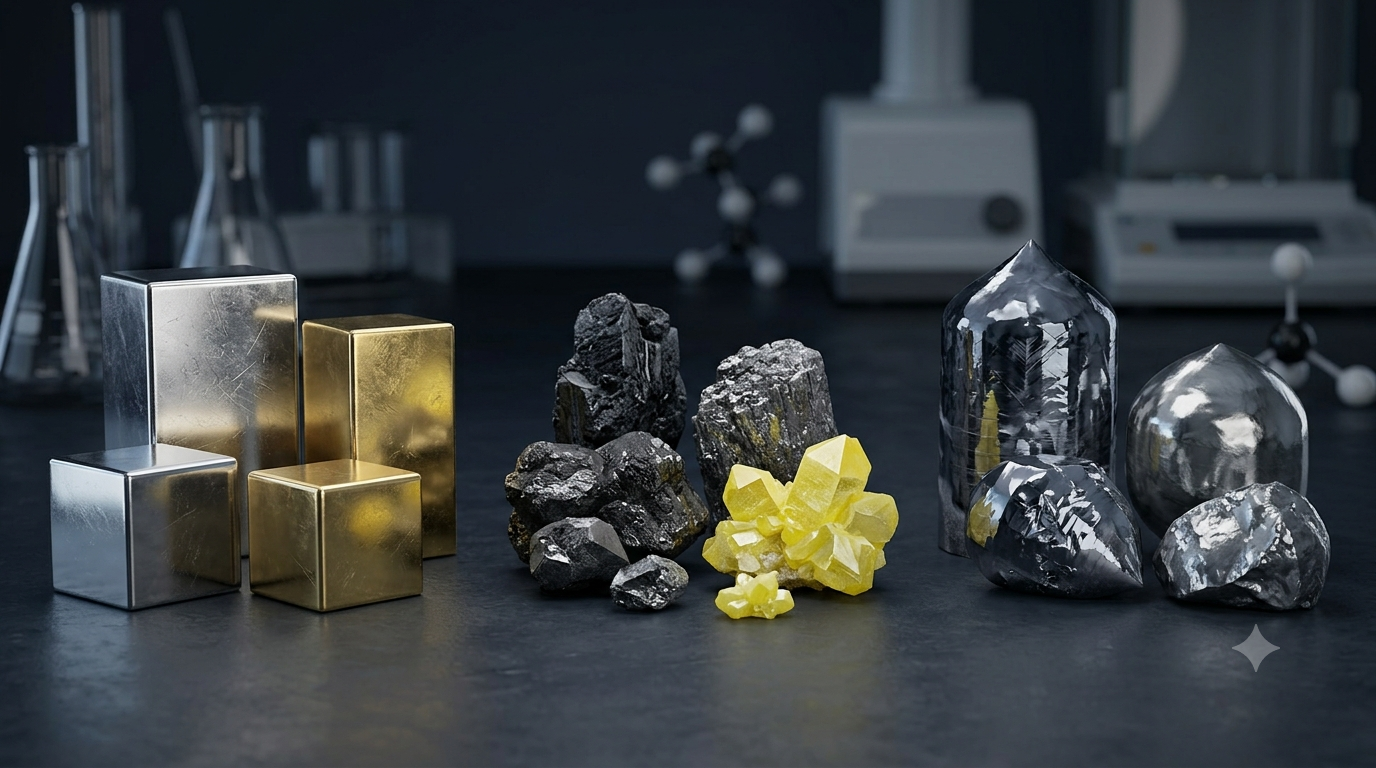
All matter around us is made up of chemical elements. From the iron used in buildings and the copper found in electrical wires to the oxygen we breathe and the carbon present in living organisms, elements play an important role in our everyday lives. Although scientists have discovered many different elements, they do not all have the same physical and chemical properties.
To understand these differences, elements are broadly classified into three main categories: metals, nonmetals, and metalloids. This classification is based on their physical characteristics, chemical behaviour, and position in the periodic table.
Metals are generally shiny, strong, and good conductors of heat and electricity. Nonmetals usually have different properties, such as poor electrical conductivity and a lack of metallic lustre. Metalloids have properties that fall between those of metals and nonmetals.
Understanding these three categories makes it easier to study the periodic table, chemical reactions, and the practical applications of different elements.
1. What Is the Classification of Elements?
The classification of elements is the process of arranging chemical elements into groups according to their common physical and chemical properties.
Every element has its own atomic structure and characteristics. However, some elements share similar properties. Scientists use these similarities to place elements into different categories.
The three major classifications are:
Metals
Nonmetals
Metalloids
This classification helps us understand how elements behave, how they react with other substances, and where they are used in science, technology, and everyday life.
For example, iron is classified as a metal because it is strong and conducts heat and electricity. Oxygen is a nonmetal because it is a gas under normal conditions and does not conduct electricity. Silicon is classified as a metalloid because it has properties of both metals and nonmetals.
2. Metals
Metals are elements that generally have a shiny appearance, conduct heat and electricity efficiently, and can be shaped into sheets or drawn into wires.
Most elements in the periodic table are metals. They are mainly located on the left side and in the centre of the periodic table.
Common examples of metals include iron (Fe), copper (Cu), aluminium (Al), gold (Au), silver (Ag), sodium (Na), and calcium (Ca).
2.1 Physical Properties of Metals
Metals have several common physical properties that distinguish them from other elements.
1. Metallic Lustre
Most metals have a shiny surface when freshly cut or polished. This property is known as metallic lustre.
For example, gold and silver are well known for their attractive shiny appearance. This is one reason they are widely used in jewellery and decorative objects.
2. Good Conductors of Heat
Most metals allow heat to pass through them easily. This property makes them useful for manufacturing cooking utensils, heat exchangers, and industrial equipment.
For example, aluminium and copper are commonly used in products that require efficient heat transfer.
3. Good Conductors of Electricity
Metals generally conduct electricity because they contain mobile electrons that can move through their structure.
Copper and aluminium are widely used in electrical wiring because of their good electrical conductivity.
4. Malleability
Malleability is the ability of a material to be hammered or pressed into thin sheets without breaking.
Gold, aluminium, and silver are examples of highly malleable metals. Aluminium is commonly used to manufacture foil and other thin sheets.
5. Ductility
Ductility is the ability of a material to be stretched into thin wires.
Copper is an excellent example of a ductile metal. It is widely used in electrical cables and wires.
6. Generally High Melting and Boiling Points
Many metals have relatively high melting and boiling points. However, this is not true for every metal.
For example, tungsten has an extremely high melting point, while mercury is a metal that remains liquid at room temperature.
7. Generally High Density
Many metals have high density compared with common nonmetals. However, some metals, such as lithium and sodium, have relatively low densities.
8. Sonorous Nature
Most solid metals produce a ringing sound when struck. This property is called sonority.
Metals are therefore used in the manufacture of bells and certain musical instruments.
2.2 Chemical Properties of Metals
Metals also show several common chemical properties.
1. Formation of Positive Ions
Many metals lose electrons during chemical reactions and form positively charged ions called cations.
For example:
Na → Na⁺ + e⁻
A sodium atom loses one electron and forms a positively charged sodium ion.
2. Reaction with Oxygen
Many metals react with oxygen to form metal oxides.
For example:
2Mg + O₂ → 2MgO
Magnesium reacts with oxygen to form magnesium oxide.
Most metal oxides are basic in nature, although some are amphoteric.
3. Reaction with Water
Some metals react with water to produce metal hydroxides or metal oxides and hydrogen gas.
For example:
2Na + 2H₂O → 2NaOH + H₂
Sodium reacts vigorously with water to form sodium hydroxide and hydrogen gas.
However, not all metals react with water. Their reactivity depends on the nature of the metal and the reaction conditions.
4. Reaction with Acids
Many metals react with dilute acids to produce a salt and hydrogen gas.
For example:
Zn + 2HCl → ZnCl₂ + H₂
Zinc reacts with hydrochloric acid to produce zinc chloride and hydrogen gas.
However, metals such as copper, silver, and gold do not generally release hydrogen from dilute, non-oxidising acids.
2.3 Examples and Uses of Metals
| Metal | Symbol | Common Uses |
|---|---|---|
| Iron | Fe | Buildings, machinery, tools |
| Copper | Cu | Electrical wires, plumbing |
| Aluminium | Al | Aircraft, foil, vehicles |
| Gold | Au | Jewellery, electronics |
| Silver | Ag | Jewellery, electronics |
| Zinc | Zn | Galvanising iron, batteries |
| Calcium | Ca | Alloys, industrial applications |
| Sodium | Na | Chemical manufacturing |
Metals are essential in construction, transportation, electronics, manufacturing, and many other industries.
3. Nonmetals
Nonmetals are elements that generally do not show the typical physical properties of metals. They are usually poor conductors of heat and electricity and do not have metallic lustre.
Nonmetals are mainly located on the upper right side of the periodic table. Hydrogen is an important exception because it is located on the upper left side but is classified as a nonmetal.
Common examples include oxygen (O), nitrogen (N), carbon (C), sulfur (S), phosphorus (P), and chlorine (Cl).
Nonmetals can exist in all three physical states at room temperature:
Solids: Carbon, sulfur, and phosphorus.
Liquids: Bromine.
Gases: Oxygen, nitrogen, hydrogen, and chlorine.
3.1 Physical Properties of Nonmetals
Nonmetals show several physical properties that distinguish them from metals.
1. Generally Dull Appearance
Most solid nonmetals do not have the shiny appearance associated with metals. They are generally dull in appearance.
However, some exceptions exist. For example, iodine has a shiny surface even though it is a nonmetal.
2. Poor Conductors of Heat
Most nonmetals are poor conductors of heat. They do not transfer heat as efficiently as metals.
Diamond, an allotrope of carbon, is an important exception because it conducts heat extremely well.
3. Poor Conductors of Electricity
Most nonmetals do not conduct electricity effectively.
However, graphite, another allotrope of carbon, can conduct electricity because of the movement of electrons within its structure.
4. Brittle Nature
Solid nonmetals are generally brittle. They tend to break into pieces when hammered or subjected to pressure instead of forming thin sheets.
This is different from the malleability of metals.
5. Generally Low Density
Many nonmetals have relatively low densities compared with common metals. However, their densities vary depending on their physical state and structure.
6. Generally Lower Melting and Boiling Points
Many nonmetals have relatively low melting and boiling points compared with metals.
However, some solid nonmetals, particularly network covalent substances such as diamond, have very high melting or decomposition temperatures.
7. Non-Sonorous Nature
Solid nonmetals generally do not produce the ringing sound associated with metals when struck.
3.2 Chemical Properties of Nonmetals
Nonmetals also have characteristic chemical behaviour.
1. Formation of Negative Ions
Many nonmetals gain electrons during chemical reactions to form negatively charged ions called anions.
For example:
Cl + e⁻ → Cl⁻
A chlorine atom gains one electron to form a negatively charged chloride ion.
Not all nonmetals form negative ions. Some, such as carbon, commonly form covalent bonds by sharing electrons.
2. Reaction with Oxygen
Nonmetals react with oxygen to form nonmetal oxides.
For example:
C + O₂ → CO₂
Carbon reacts with oxygen to form carbon dioxide.
Many nonmetal oxides are acidic in nature. Some, such as carbon monoxide and nitrogen monoxide, are neutral oxides.
3. Formation of Covalent Compounds
Nonmetals commonly form covalent bonds by sharing electrons with other nonmetal atoms.
For example, two hydrogen atoms combine with one oxygen atom to form a water molecule (H₂O).
4. Reaction with Metals
Nonmetals often react with metals to form ionic compounds.
For example:
2Na + Cl₂ → 2NaCl
Sodium reacts with chlorine to form sodium chloride, commonly known as table salt.
3.3 Examples and Uses of Nonmetals
| Nonmetal | Symbol | Common Uses |
|---|---|---|
| Oxygen | O | Respiration, medical oxygen |
| Nitrogen | N | Fertiliser production, food packaging |
| Carbon | C | Fuels, graphite pencils, diamond tools |
| Hydrogen | H | Fuel cells, chemical manufacturing |
| Sulfur | S | Sulfuric acid, fertilisers |
| Phosphorus | P | Fertilisers, chemical products |
| Chlorine | Cl | Water disinfection, chemical manufacturing |
| Bromine | Br | Chemical manufacturing |
| Helium | He | Balloons, specialised cooling |
Nonmetals are essential for life and play important roles in biological processes, agriculture, medicine, and industrial production.
4. Metalloids
Metalloids are elements that have properties intermediate between metals and nonmetals.
They do not fit completely into either category because their physical and chemical properties show characteristics of both groups.
Metalloids are generally located along the zigzag or staircase-like boundary separating metals and nonmetals in the periodic table.
Commonly recognised metalloids include:
Boron (B)
Silicon (Si)
Germanium (Ge)
Arsenic (As)
Antimony (Sb)
Tellurium (Te)
Polonium (Po) and astatine (At) are sometimes included in metalloid classifications, although their classification varies among different sources.
4.1 Physical Properties of Metalloids
Metalloids have several distinctive physical properties.
1. Metallic Appearance
Many metalloids have a shiny or metallic-looking surface.
For example, silicon and germanium have a lustrous appearance similar to certain metals.
2. Semiconductor Behaviour
One of the most important properties of metalloids is their ability to act as semiconductors.
A semiconductor has electrical conductivity between that of a good conductor and an insulator. Its conductivity can be controlled by factors such as temperature, light, and the addition of small amounts of impurities.
Silicon and germanium are important semiconductor materials used in modern electronic devices.
3. Brittle Nature
Unlike most metals, solid metalloids are generally brittle. They can break when subjected to strong mechanical pressure.
4. Intermediate Properties
Metalloids display a combination of metallic and nonmetallic characteristics. Their exact properties vary depending on the element.
5. Variable Thermal and Electrical Conductivity
Their ability to conduct heat and electricity differs from one metalloid to another. Their electrical properties are particularly useful in electronic applications.
4.2 Chemical Properties of Metalloids
Metalloids also show a combination of metallic and nonmetallic chemical behaviour.
1. Formation of Different Types of Compounds
Depending on the element and reaction conditions, metalloids can form compounds that show different bonding characteristics.
2. Formation of Oxides
Metalloids react with oxygen to form oxides. Some of these oxides are acidic, while others can show amphoteric behaviour.
For example, silicon reacts with oxygen to form silicon dioxide (SiO₂).
3. Variable Chemical Behaviour
The chemical behaviour of metalloids depends on their atomic structure and the substances with which they react. They may show similarities to metals in some reactions and nonmetals in others.
4.3 Examples and Uses of Metalloids
| Metalloid | Symbol | Common Uses |
|---|---|---|
| Boron | B | Borosilicate glass, detergents |
| Silicon | Si | Computer chips, solar cells |
| Germanium | Ge | Fibre optics, electronic devices |
| Arsenic | As | Specialised semiconductor applications |
| Antimony | Sb | Alloys, flame-retardant materials |
| Tellurium | Te | Solar cells, thermoelectric materials |
Metalloids are particularly important in the electronics industry because of their semiconductor properties.
5. Position of Metals, Nonmetals, and Metalloids in the Periodic Table
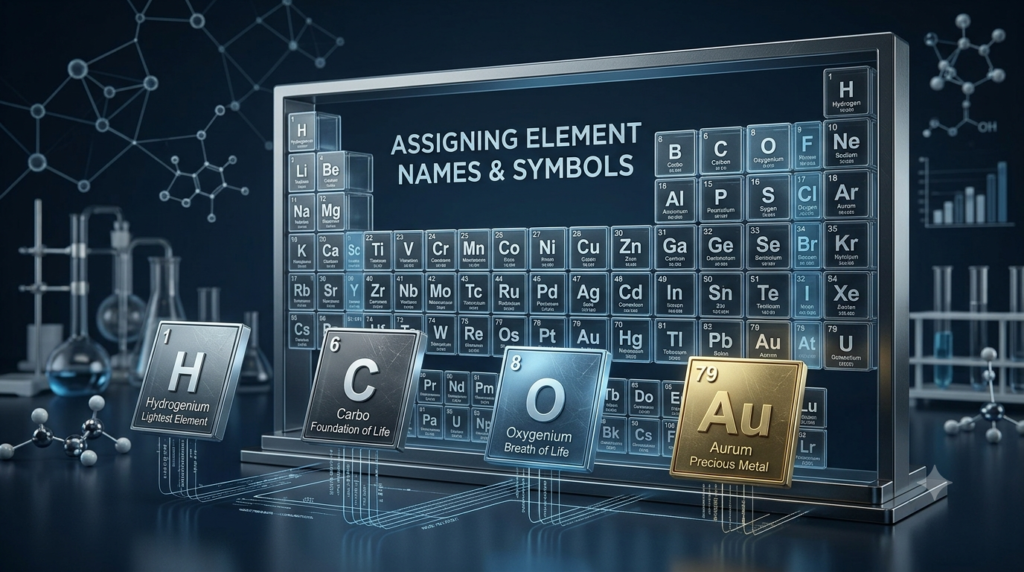
The periodic table provides a clear way to identify the general positions of metals, nonmetals, and metalloids.
Their locations are based on similarities in atomic structure and chemical properties.
5.1 Location of Metals
Metals occupy most of the left side and centre of the periodic table.
They include:
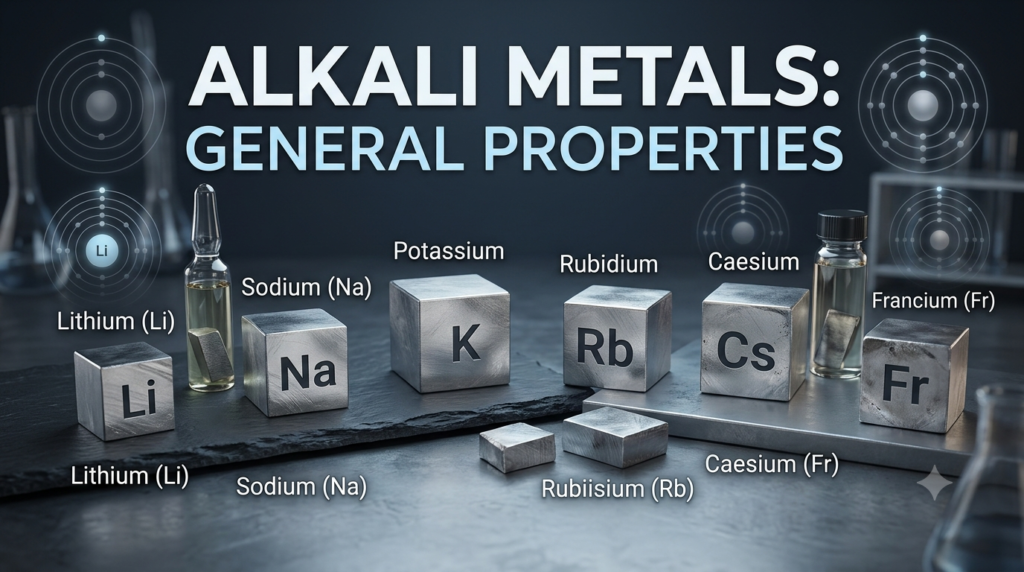
Alkali metals in Group 1, excluding hydrogen.
Alkaline earth metals in Group 2.
Transition metals in Groups 3–12.
Lanthanoids and actinoids in the two separate rows at the bottom.
Certain metals located in the p-block, such as aluminium, tin, and lead.
5.2 Location of Nonmetals
Nonmetals are mainly found on the upper right side of the periodic table.
They include:
Hydrogen
Carbon
Nitrogen
Oxygen
Phosphorus
Sulfur
Halogens
Noble gases
Hydrogen is positioned separately on the upper left because of its electron configuration, but its properties classify it as a nonmetal.
5.3 Location of Metalloids
Metalloids are generally located near the zigzag boundary between metals and nonmetals.
This boundary begins around boron and extends downward through elements near silicon, germanium, arsenic, antimony, and tellurium.
The staircase line is a useful guide, but it is not an absolute classification rule. Different periodic tables may show slightly different metalloid boundaries.
6. Differences Between Metals, Nonmetals, and Metalloids
Metals, nonmetals, and metalloids have different physical and chemical characteristics. The following table highlights their major differences.
| Property | Metals | Nonmetals | Metalloids |
|---|---|---|---|
| Appearance | Generally shiny | Generally dull | Often shiny |
| Electrical conductivity | Generally high | Generally low | Intermediate or semiconducting |
| Heat conductivity | Generally high | Generally low | Variable |
| Malleability | Usually malleable | Not malleable | Generally brittle |
| Ductility | Usually ductile | Not ductile | Generally not ductile |
| Physical state | Mostly solids | Solids, liquids, and gases | Mostly solids |
| Density | Often high | Often low | Variable |
| Electron behaviour | Usually lose electrons | Often gain or share electrons | Variable |
| Oxide nature | Often basic or amphoteric | Often acidic or neutral | Often acidic or amphoteric |
| Periodic table location | Left and centre | Mainly upper right | Near the staircase boundary |
These are general trends rather than universal rules. Individual elements may show exceptions because their atomic structures and bonding arrangements are different.
7. Why Are Elements Classified as Metals, Nonmetals, and Metalloids?
Classifying elements into these three categories helps scientists and students understand the properties and behaviour of different elements.
There are several important reasons for this classification.
1. To Understand Chemical Behaviour
Elements within the same broad category often show similarities in their chemical reactions. This makes it easier to predict how they may interact with other substances.
2. To Study the Periodic Table
Classification makes the periodic table easier to understand. Instead of studying every element separately, we can first identify its general category and expected properties.
3. To Understand Electrical Conductivity
The classification helps explain why copper is suitable for electrical wiring, why rubber is used as an electrical insulator, and why silicon is used in semiconductor devices.
4. To Identify Suitable Materials
Industries select elements according to their properties. For example, aluminium is used in aircraft because of its relatively low density, while copper is used in electrical cables because of its high conductivity.
5. To Understand Modern Technology
Metalloids, especially silicon and germanium, are important in the development of computers, smartphones, solar cells, and other electronic devices.
8. Importance and Applications of These Three Categories
Metals, nonmetals, and metalloids are important in almost every area of modern life.
8.1 Applications of Metals
Metals are widely used because of their strength, durability, conductivity, and ability to form useful alloys.
Some important applications include:
Construction of buildings, bridges, and railway tracks.
Manufacturing vehicles, aircraft, and industrial machinery.
Production of electrical wires and electronic components.
Manufacturing cooking utensils and household equipment.
Production of jewellery and decorative materials.
Manufacturing tools, medical instruments, and machines.
8.2 Applications of Nonmetals
Nonmetals are essential for living organisms and many industrial processes.
Some important applications include:
Oxygen is necessary for respiration.
Nitrogen is used in the production of fertilisers.
Carbon is present in all known forms of life and many fuels.
Chlorine is used for disinfecting drinking water.
Sulfur is used to manufacture sulfuric acid.
Phosphorus is important in fertilisers and biological molecules.
Hydrogen is used in fuel cells and chemical industries.
8.3 Applications of Metalloids
Metalloids have special importance in modern technology.
Some important applications include:
Silicon is used in computer processors and integrated circuits.
Silicon is used in photovoltaic cells for solar energy production.
Germanium is used in specialised electronic and optical devices.
Boron is used in heat-resistant glass and specialised materials.
Antimony is used in certain alloys and flame-retardant applications.
Tellurium is used in some solar-cell technologies.
Their unique properties make metalloids valuable in electronics, renewable energy, and advanced material science.
9. Exceptions in the Classification of Elements
Although the classification of elements is useful, not every element follows the general properties of its category.
Some elements have unusual characteristics that make them important exceptions.
1. Mercury Is a Liquid Metal
Most metals are solids at room temperature. However, mercury (Hg) is a metal that exists as a liquid under normal room-temperature conditions.
2. Bromine Is a Liquid Nonmetal
Most nonmetals are solids or gases at room temperature. Bromine (Br) is an important exception because it is a liquid nonmetal.
3. Graphite Conducts Electricity
Most nonmetals are poor electrical conductors. However, graphite, an allotrope of carbon, can conduct electricity because of its electron structure.
4. Diamond Conducts Heat Very Well
Diamond is a nonmetallic form of carbon, but it is an excellent conductor of heat.
5. Hydrogen Is Located on the Left but Is a Nonmetal
Hydrogen appears in Group 1 of many periodic tables because it has one electron. However, it is classified as a nonmetal due to its properties.
6. Metalloids Do Not Have a Universally Fixed List
The classification of certain elements, particularly polonium and astatine, can vary between reference sources. This is because the distinction between metals, nonmetals, and metalloids is based on several properties rather than one strict rule.
10. How to Identify Whether an Element Is a Metal, Nonmetal, or Metalloid
You can identify the general category of an element by examining its position in the periodic table and its physical and chemical properties.
Follow these basic steps:
Step 1: Check Its Position in the Periodic Table
Look at the element’s location.
Left and centre: Usually metals.
Upper right: Usually nonmetals.
Near the staircase boundary: Usually metalloids.
Step 2: Examine Its Physical Properties
Check whether the element is shiny, conducts electricity, and can be shaped into sheets or wires.
Shiny, malleable, and conductive: Usually a metal.
Generally dull, brittle, and poorly conductive: Usually a nonmetal.
Often shiny, brittle, and semiconducting: Usually a metalloid.
Step 3: Examine Its Chemical Behaviour
Observe how the element behaves during chemical reactions.
Metals commonly lose electrons.
Nonmetals commonly gain or share electrons.
Metalloids can show different chemical behaviours depending on the reaction.
Step 4: Compare Its Properties
Use more than one property to identify the element. A single characteristic, such as shiny appearance or electrical conductivity, may not be sufficient because several exceptions exist.
For accurate classification, always consider the element’s overall properties and its accepted position in the periodic table.
Conclusion
The classification of elements into metals, nonmetals, and metalloids is an important part of understanding chemistry and the periodic table. Metals are generally strong, shiny, and good conductors of heat and electricity. Nonmetals usually have different properties, including poor electrical conductivity and brittleness in their solid forms. Metalloids have intermediate characteristics and are especially valuable because of their semiconductor properties.
Each category contains elements that are essential for everyday life, industrial development, and modern technology. By understanding their properties, positions in the periodic table, and practical applications, we can better understand how different elements behave and why they are used for particular purposes.
FAQs
1. What are the three main classifications of elements?
The three main classifications of elements are metals, nonmetals, and metalloids. These categories are based on the physical and chemical properties of elements. Metals generally conduct heat and electricity well and are usually shiny and malleable. Nonmetals are generally poor conductors and may exist as solids, liquids, or gases. Metalloids have properties intermediate between metals and nonmetals. This classification helps scientists understand the behaviour of elements, predict their chemical reactions, and study their positions in the periodic table.
2. What are metals in chemistry?
Metals are chemical elements that generally have a shiny appearance, conduct heat and electricity efficiently, and can be shaped into sheets or wires. Most metals are solids at room temperature, although mercury is an exception because it is liquid. Metals usually lose electrons during chemical reactions and form positively charged ions. Common examples include iron, copper, aluminium, gold, silver, and sodium. Metals are widely used in construction, electrical equipment, transportation, machinery, jewellery, and various industrial applications because of their useful physical and chemical properties.
3. What are nonmetals and what are their properties?
Nonmetals are elements that generally do not show the typical properties of metals. They are usually poor conductors of heat and electricity and do not have metallic lustre. Solid nonmetals are generally brittle rather than malleable or ductile. They can exist as solids, liquids, or gases at room temperature. Many nonmetals gain or share electrons during chemical reactions. Common examples include oxygen, nitrogen, carbon, sulfur, phosphorus, and chlorine. Nonmetals are essential for life and are widely used in agriculture, medicine, chemical manufacturing, and industrial processes.
4. What are metalloids and why are they called semimetals?
Metalloids are chemical elements that have properties intermediate between metals and nonmetals. They are sometimes called semimetals because they show certain metallic and nonmetallic characteristics. Many metalloids have a shiny appearance but are brittle like nonmetals. Some, particularly silicon and germanium, are important semiconductors because their electrical conductivity can be controlled under suitable conditions. Commonly recognised metalloids include boron, silicon, germanium, arsenic, antimony, and tellurium. Their special properties make them valuable in electronics, computer technology, solar cells, and other advanced technological applications.
5. Where are metals, nonmetals, and metalloids located in the periodic table?
Metals occupy most of the left side and centre of the periodic table. They include alkali metals, alkaline earth metals, transition metals, and several elements in the p-block. Nonmetals are mainly located on the upper right side, with hydrogen as an exception on the upper left. Metalloids are generally found near the zigzag staircase boundary separating metals and nonmetals. This arrangement helps identify the general properties of elements based on their positions. However, the staircase is a useful guide rather than an absolute classification rule.
6. What is the main difference between metals and nonmetals?
The main difference between metals and nonmetals is their physical and chemical behaviour. Metals are generally shiny, malleable, ductile, and good conductors of heat and electricity. Nonmetals are generally poor conductors, and solid nonmetals are usually brittle. Metals commonly lose electrons to form positive ions, while nonmetals often gain or share electrons during chemical reactions. Metals are mainly found on the left and centre of the periodic table, whereas nonmetals are mainly found on the upper right side. These differences determine their uses in various scientific and industrial applications.
7. Why are metalloids important in modern technology?
Metalloids are important in modern technology because some of them have semiconductor properties. Semiconductors have electrical conductivity between that of conductors and insulators, and their conductivity can be controlled. Silicon is widely used to manufacture computer chips, microprocessors, integrated circuits, and solar cells. Germanium is used in specialised electronic and optical devices. Boron is useful in specialised materials and glass manufacturing. These applications make metalloids essential for the electronics industry, telecommunications, renewable energy systems, and the development of advanced technological devices.
8. Can an element have properties of both metals and nonmetals?
Yes, some elements have properties of both metals and nonmetals. These elements are generally classified as metalloids. For example, silicon has a shiny appearance similar to metals but is brittle like many nonmetals. It also behaves as a semiconductor rather than a typical metal conductor. Germanium is another example that shows intermediate properties. However, some metals and nonmetals also have unusual individual characteristics. Therefore, elements are classified by considering their overall physical and chemical properties rather than relying on a single characteristic.
9. What are some examples of metals, nonmetals, and metalloids?
Examples of metals include iron (Fe), copper (Cu), aluminium (Al), gold (Au), silver (Ag), and zinc (Zn). These elements are commonly used in construction, electrical wiring, machinery, and jewellery. Examples of nonmetals include oxygen (O), nitrogen (N), carbon (C), sulfur (S), chlorine (Cl), and hydrogen (H). They are important in biological processes and chemical manufacturing. Commonly recognised metalloids include boron (B), silicon (Si), germanium (Ge), arsenic (As), antimony (Sb), and tellurium (Te). These elements are particularly useful in semiconductor technology and specialised materials.
10. Why is the classification of elements important in chemistry?
The classification of elements is important because it makes the study of chemistry and the periodic table easier. By grouping elements according to their common properties, students and scientists can understand their physical characteristics, chemical behaviour, and possible reactions. It also helps predict whether an element is likely to conduct electricity, form positive or negative ions, or produce particular types of compounds. This classification is useful in selecting materials for industrial applications, electronic devices, construction, and scientific research. It provides a basic foundation for understanding chemical properties and periodic trends.