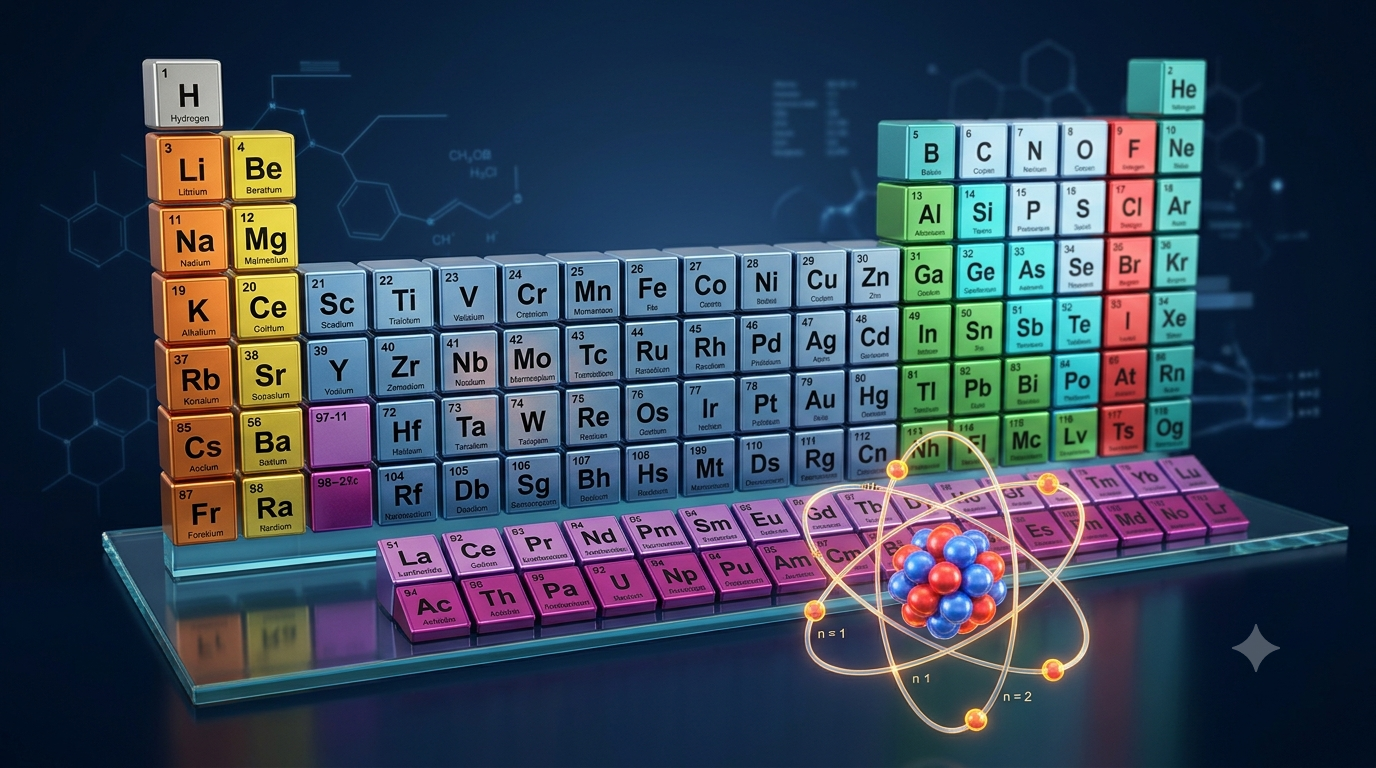
The periodic table is one of the most important tools in chemistry. It organizes all known chemical elements in a systematic arrangement and helps scientists understand their properties, chemical behaviour, and relationships. Elements such as hydrogen, oxygen, carbon, iron, and gold may appear very different from one another, but their positions in the periodic table reveal important patterns in their physical and chemical properties.
The scientific foundation of the modern periodic table is the Modern Periodic Law. This law explains why elements are arranged in a particular order and why their properties show repeating patterns. It is based on the atomic number of elements rather than their atomic masses.
The development of the Modern Periodic Law was an important step in the history of chemistry. It improved the earlier periodic classification of elements and provided a more accurate explanation of periodicity. Understanding this law also helps explain the structure of the periodic table, the arrangement of elements into periods and groups, and the relationship between atomic structure and chemical properties.
1. What Is the Modern Periodic Law?
The Modern Periodic Law states that:
The physical and chemical properties of elements are periodic functions of their atomic numbers.
In simple words, when elements are arranged in increasing order of atomic number, their physical and chemical properties repeat at regular intervals.
The atomic number represents the number of protons present in the nucleus of an atom. In a neutral atom, it is also equal to the number of electrons.
For example, lithium has an atomic number of 3, sodium has an atomic number of 11, and potassium has an atomic number of 19. All three elements belong to Group 1 of the periodic table and have similar chemical properties.
This similarity occurs because these elements have one electron in their outermost shell. Their similar outer electronic configurations give rise to similar chemical behaviour.
The Modern Periodic Law therefore establishes a direct relationship between the atomic number, electronic configuration, and properties of elements.
2. Historical Development of the Modern Periodic Law
The modern periodic table developed through several important scientific discoveries. Early chemists tried to classify elements according to their properties, but they did not initially understand the role of atomic structure.
2.1 Early Attempts to Classify Elements
As more elements were discovered, chemists recognized that some elements had similar physical and chemical properties. They began searching for a systematic method of arranging them.
Early classification systems helped scientists identify relationships between elements, but these systems had limitations because the scientific understanding of atoms was still developing.
2.2 Mendeleev’s Periodic Law
In 1869, Russian chemist Dmitri Mendeleev proposed a periodic table in which elements were arranged mainly in increasing order of atomic mass.
His periodic law stated that the properties of elements are periodic functions of their atomic masses.
Mendeleev noticed that elements with similar chemical properties appeared at regular intervals. He placed these elements in the same groups and left gaps for elements that had not yet been discovered.
One of his most important achievements was predicting the properties of undiscovered elements. When elements such as gallium and germanium were discovered later, their properties closely matched his predictions.
However, Mendeleev’s arrangement had some inconsistencies. Certain elements had to be placed out of strict atomic mass order to maintain similarities in their chemical properties.
These limitations indicated that atomic mass was not the fundamental property responsible for periodicity.
2.3 Discovery of Atomic Number
In 1913, English physicist Henry Moseley conducted experiments using X-ray spectra produced by different elements.
His research demonstrated that each element has a unique atomic number and that this number is related to the positive charge of its nucleus.
Moseley’s work established that atomic number, rather than atomic mass, provides the correct basis for arranging elements.
This discovery led to the development of the Modern Periodic Law and the modern form of the periodic table.
3. Scientific Basis of the Modern Periodic Law
The scientific foundation of the Modern Periodic Law is closely connected to atomic structure and the arrangement of electrons around the nucleus.
An atom consists of three main subatomic particles:
Protons: Positively charged particles present in the nucleus.
Neutrons: Particles with no electrical charge, also present in the nucleus.
Electrons: Negatively charged particles distributed around the nucleus.
The number of protons determines the atomic number and identifies the element.
For example:
Hydrogen has 1 proton and atomic number 1.
Carbon has 6 protons and atomic number 6.
Oxygen has 8 protons and atomic number 8.
Sodium has 11 protons and atomic number 11.
When elements are arranged according to increasing atomic number, their electron configurations change in a systematic manner.
These electron configurations determine how atoms interact with other atoms, form chemical bonds, and participate in chemical reactions.
As a result, elements with similar outer electronic configurations often show similar chemical properties.
This repeating pattern of electronic configurations is the main scientific explanation for periodicity.
4. Relationship Between Atomic Number and Electronic Configuration
Electronic configuration describes how electrons are distributed among different energy levels, subshells, and orbitals of an atom.
Electrons occupy energy levels around the nucleus according to specific rules. The maximum number of electrons that can occupy a principal energy level is given by:
Maximum number of electrons = 2n²
Here, n represents the principal quantum number or energy level.
For example:
First energy level (n = 1): Maximum 2 electrons.
Second energy level (n = 2): Maximum 8 electrons.
Third energy level (n = 3): Maximum 18 electrons.
Fourth energy level (n = 4): Maximum 32 electrons.
The actual filling of orbitals follows the Aufbau principle, Pauli exclusion principle, and Hund’s rule, rather than simply filling entire shells one after another.
Consider the electronic configurations of lithium, sodium, and potassium:
| Element | Atomic Number | Electronic Configuration |
|---|---|---|
| Lithium (Li) | 3 | 2, 1 |
| Sodium (Na) | 11 | 2, 8, 1 |
| Potassium (K) | 19 | 2, 8, 8, 1 |
All three elements have one electron in their outermost shell.
Because of this similarity, they show similar chemical properties and are placed in Group 1.
This demonstrates how atomic number determines electronic configuration and how electronic configuration influences the periodic arrangement of elements.
5. Why Do Element Properties Repeat Periodically?
The periodic repetition of elemental properties occurs because similar outer electronic configurations appear at regular intervals as atomic numbers increase.
The outermost electrons are particularly important because they participate in chemical bonding and determine much of an element’s chemical behaviour.
For example, elements in Group 17, known as halogens, generally have seven electrons in their outermost shell.
These include:
Fluorine (F)
Chlorine (Cl)
Bromine (Br)
Iodine (I)
All these elements tend to gain one electron or share electrons during chemical reactions to achieve a more stable electronic configuration.
Similarly, Group 18 elements, known as noble gases, generally have completely filled outermost electron shells. This makes them relatively unreactive under ordinary conditions.
The repetition of similar valence-shell configurations explains why elements in the same group often have related chemical properties.
However, periodic trends are not perfectly identical for every element. Differences in atomic size, shielding effects, and electronic structure also influence their behaviour.
6. Structure of the Modern Periodic Table
The modern periodic table arranges elements in increasing order of atomic number. It consists of horizontal rows called periods and vertical columns called groups.
6.1 Periods
Horizontal rows of the periodic table are called periods.
The modern periodic table contains seven periods.
The period number generally indicates the highest principal energy level occupied by electrons in the ground-state atom.
For example:
Lithium belongs to Period 2.
Sodium belongs to Period 3.
Potassium belongs to Period 4.
As we move from left to right across a period, the atomic number increases by one for each successive element.
The electronic configuration changes gradually, resulting in systematic variations in elemental properties.
6.2 Groups
Vertical columns of the periodic table are called groups.
There are 18 groups in the modern periodic table.
Elements in the same group often have similar valence-electron configurations and related chemical properties.
Some important groups include:
Group 1: Alkali metals.
Group 2: Alkaline earth metals.
Groups 3–12: Transition metals.
Group 17: Halogens.
Group 18: Noble gases.
For example, lithium, sodium, and potassium belong to Group 1. They are generally soft, reactive metals and form compounds with similar chemical characteristics.
6.3 Blocks of the Periodic Table
The modern periodic table is also divided into four blocks according to the subshell into which the last electron enters.
These are:
s-block: Includes Groups 1 and 2, along with helium based on its electronic configuration.
p-block: Includes Groups 13 to 18, except helium.
d-block: Includes Groups 3 to 12 and contains the transition elements.
f-block: Contains the lanthanoids and actinoids, which are usually displayed separately at the bottom of the periodic table.
The block classification provides information about the electronic structure of elements and helps explain their chemical properties.
7. Periodic Trends and Their Scientific Explanation
Periodic trends are systematic changes in the physical and chemical properties of elements across periods and down groups.
These trends are important evidence of the periodic nature of elemental properties.
7.1 Atomic Radius
Atomic radius refers to a measure of the size of an atom.
Across a period, atomic radius generally decreases from left to right because the nuclear charge increases while electrons are added to the same principal energy level.
The stronger attraction between the nucleus and electrons pulls the electron cloud closer.
Down a group, atomic radius generally increases because additional electron shells are added.
For example, potassium has a larger atomic radius than sodium because potassium has an additional occupied principal energy level.
7.2 Ionization Energy
Ionization energy is the energy required to remove an electron from an isolated gaseous atom in its ground state.
Across a period, ionization energy generally increases because the effective nuclear attraction becomes stronger.
Down a group, ionization energy generally decreases because the outermost electron is farther from the nucleus and experiences greater shielding.
There are some exceptions to these general trends because of subshell arrangements and electron pairing.
7.3 Electronegativity
Electronegativity describes the ability of an atom to attract shared electrons towards itself in a chemical bond.
Across a period, electronegativity generally increases.
Down a group, it generally decreases.
Fluorine is the most electronegative element on the Pauling scale.
Electronegativity helps scientists understand bond polarity and the nature of chemical bonds.
7.4 Metallic and Non-Metallic Character
Metallic character refers to the tendency of an element to lose electrons and form positive ions.
Across a period, metallic character generally decreases from left to right.
Down a group, metallic character generally increases.
Non-metallic character generally shows the opposite trend.
These patterns explain why metals are commonly found on the left and in the centre of the periodic table, while non-metals are mostly located on the right.
8. Importance of the Modern Periodic Law
The Modern Periodic Law is essential for understanding the organization and behaviour of chemical elements.
Its importance can be explained through the following points:
1. Systematic Classification of Elements
It provides a scientific method for arranging elements according to increasing atomic number.
2. Understanding Chemical Properties
It helps explain why elements belonging to the same group often show similar chemical behaviour.
3. Prediction of Element Properties
The position of an element in the periodic table provides useful information about its expected electronic configuration and chemical characteristics.
4. Understanding Periodic Trends
It helps scientists study variations in atomic radius, ionization energy, electronegativity, and metallic character.
5. Explanation of Chemical Bonding
The electronic configurations of elements help explain how atoms lose, gain, or share electrons during chemical reactions.
6. Development of Modern Chemistry
It provides a common framework for studying elements, compounds, chemical reactions, and relationships between different elements.
9. Difference Between Mendeleev’s Periodic Law and Modern Periodic Law
Both periodic laws describe the repeating nature of elemental properties, but they use different fundamental principles.
| Mendeleev’s Periodic Law | Modern Periodic Law |
|---|---|
| Based mainly on atomic mass. | Based on atomic number. |
| Elements were arranged mainly in increasing atomic mass. | Elements are arranged in increasing atomic number. |
| Some elements showed inconsistencies in mass order. | Atomic number resolves these major inconsistencies. |
| Did not provide a complete explanation based on atomic structure. | Explained through atomic number and electronic configuration. |
| Proposed in 1869. | Established following Moseley’s work in 1913. |
The modern periodic law provides a more accurate scientific foundation because atomic number is the fundamental identifying property of an element.
10. Examples Demonstrating the Modern Periodic Law
The following examples help illustrate how the Modern Periodic Law works.
Example 1: Lithium, Sodium, and Potassium
Lithium, sodium, and potassium have atomic numbers 3, 11, and 19, respectively.
Their electronic configurations are:
Lithium: 2, 1
Sodium: 2, 8, 1
Potassium: 2, 8, 8, 1
Each element has one electron in its outermost shell.
Therefore, they belong to Group 1 and exhibit similar chemical properties.
Example 2: Fluorine, Chlorine, and Bromine
Fluorine, chlorine, and bromine have atomic numbers 9, 17, and 35.
Their outermost electron configurations are:
Fluorine: 2, 7
Chlorine: 2, 8, 7
Bromine: 2, 8, 18, 7
Each element has seven valence electrons.
Therefore, all three belong to Group 17 and are classified as halogens.
Example 3: Helium, Neon, and Argon
Helium, neon, and argon belong to Group 18.
Their outermost electron shells are completely filled:
Helium: 2
Neon: 2, 8
Argon: 2, 8, 8
This stable electronic arrangement explains their relatively low chemical reactivity.
These examples demonstrate that the repeating properties of elements are closely related to their electronic configurations.
11. Limitations and Special Features of the Modern Periodic Table
Although the modern periodic table provides a highly effective classification system, some features require special consideration.
1. Position of Hydrogen
Hydrogen has one electron and resembles Group 1 elements in some ways. However, it also shares certain characteristics with Group 17 elements. Therefore, its position remains unique.
2. Position of Helium
Helium has an electronic configuration of 1s², which places it in the s-block according to electron filling. However, because its outer shell is completely filled and it behaves like a noble gas, it is placed in Group 18.
3. Lanthanoids and Actinoids
These elements are generally displayed separately at the bottom of the periodic table to maintain a compact layout. Their actual positions belong to Periods 6 and 7.
4. Exceptions in Periodic Trends
Not all periodic trends follow a perfectly smooth pattern. Electronic configurations, electron-electron repulsion, and other atomic effects produce certain exceptions.
These special features do not weaken the Modern Periodic Law. Instead, they demonstrate the complexity of atomic structure and chemical behaviour.
Conclusion
The Modern Periodic Law provides the scientific foundation of the modern periodic table. It states that the physical and chemical properties of elements are periodic functions of their atomic numbers. The discovery of atomic number through Henry Moseley’s experiments helped scientists understand why elements should be arranged according to atomic number rather than atomic mass.
The periodic repetition of elemental properties is mainly explained by the recurring patterns in electronic configurations, especially the arrangement of valence electrons. This explains why elements in the same group often show similar chemical properties and why properties such as atomic radius, ionization energy, and electronegativity follow recognizable trends.
By connecting atomic structure with chemical behaviour, the Modern Periodic Law makes it possible to classify elements systematically, understand their relationships, and predict many of their properties. It remains one of the fundamental principles of modern chemistry.
FAQs
1. What is the Modern Periodic Law?
The Modern Periodic Law states that the physical and chemical properties of elements are periodic functions of their atomic numbers. This means that when elements are arranged in increasing order of atomic number, their properties repeat at regular intervals. The law explains why elements with similar electronic configurations often show similar chemical behaviour. It forms the scientific foundation of the modern periodic table and helps chemists understand the relationships between atomic structure and elemental properties.
2. Who proposed the Modern Periodic Law?
The Modern Periodic Law was established through the work of English physicist Henry Moseley in 1913. He studied the X-ray spectra of different elements and demonstrated that atomic number is a more fundamental property than atomic mass for classifying elements. His research helped scientists understand the correct order of elements in the periodic table. This discovery improved the earlier periodic classification proposed by Dmitri Mendeleev and established atomic number as the basis of the modern periodic table.
3. Why is atomic number important in the modern periodic table?
Atomic number is important because it determines the identity of an element and represents the number of protons in its nucleus. In a neutral atom, it is also equal to the number of electrons. The atomic number determines the electronic configuration, which influences the chemical properties of an element. Arranging elements according to increasing atomic number produces a systematic pattern of recurring properties. Therefore, atomic number provides the scientific basis for the arrangement of elements in the modern periodic table.
4. What is the difference between Mendeleev’s Periodic Law and Modern Periodic Law?
Mendeleev’s Periodic Law was based mainly on the atomic masses of elements, whereas the Modern Periodic Law is based on their atomic numbers. Mendeleev arranged elements according to increasing atomic mass and grouped elements with similar chemical properties. However, some elements showed inconsistencies in this arrangement. The modern periodic classification resolved these problems by using atomic number as the fundamental property. It also provides a scientific explanation of periodicity through atomic structure and electronic configuration.
5. Why do elements in the same group have similar chemical properties?
Elements in the same group generally have similar chemical properties because they possess similar outer electronic configurations. Their valence electrons determine how they participate in chemical reactions and form chemical bonds. For example, lithium, sodium, and potassium belong to Group 1 and have one electron in their outermost shell. They generally lose this electron to form positive ions. Similarly, halogens have seven valence electrons and commonly gain or share one electron during chemical reactions.
6. How many groups and periods are present in the modern periodic table?
The modern periodic table contains 18 vertical columns called groups and 7 horizontal rows called periods. Elements in the same group generally have similar valence-electron configurations and related chemical properties. The period number generally corresponds to the highest occupied principal energy level in the ground-state atom. As atomic number increases across a period, electronic configurations change systematically. This arrangement helps scientists understand the repeating patterns in the physical and chemical properties of elements.
7. What is the scientific basis of periodicity?
The scientific basis of periodicity is the repeating pattern of electronic configurations that occurs when elements are arranged in increasing order of atomic number. As atomic number increases, electrons occupy different energy levels, subshells, and orbitals according to established principles. Similar outer electronic configurations appear at regular intervals, producing similarities in chemical properties. These repeating patterns explain why elements in the same group often behave similarly and why properties such as atomic radius, ionization energy, and electronegativity show periodic trends.
8. What are the four blocks of the modern periodic table?
The modern periodic table is divided into four blocks based on the subshell into which the last electron enters. These are the s-block, p-block, d-block, and f-block. The s-block mainly contains Groups 1 and 2, while the p-block contains Groups 13 to 18, except helium. The d-block contains transition elements from Groups 3 to 12. The f-block includes lanthanoids and actinoids. This classification helps explain the electronic configurations and chemical properties of different elements.
9. What are periodic trends in chemistry?
Periodic trends are systematic patterns in the physical and chemical properties of elements across periods and down groups in the periodic table. Important periodic trends include atomic radius, ionization energy, electronegativity, electron affinity, and metallic character. For example, atomic radius generally decreases across a period and increases down a group. Ionization energy generally shows the opposite pattern. These trends occur mainly because of changes in effective nuclear charge, electron shielding, and the number of occupied electron shells.
10. Why is the Modern Periodic Law important in chemistry?
The Modern Periodic Law is important because it provides a systematic method of classifying chemical elements and understanding their properties. It helps scientists predict the electronic configurations and chemical behaviour of elements based on their positions in the periodic table. It also explains periodic trends, similarities between elements, and differences in their reactivity. Furthermore, it provides a connection between atomic structure and chemical bonding. The law is therefore essential for studying inorganic chemistry, chemical reactions, and the behaviour of elements.