In mathematics, limits help us understand how a function behaves as its input approaches a particular value. Sometimes, the value of a function does not approach a fixed number. Instead, it increases without bound or decreases without bound as the input approaches a specific point. This situation is known as an infinite limit. Infinite limits are an important part of calculus because they help explain the behavior of functions near certain points, especially where the function becomes extremely large or small. They are also useful for understanding vertical asymptotes, discontinuities, and the behavior of rational functions. Although the idea of infinity may seem complicated at first, it becomes easier when we examine numerical examples, graphs, and simple algebraic expressions. This article explains what an infinite limit is, how it is interpreted, and why it is important in mathematics.
What Is an Infinite Limit?
An infinite limit describes the behavior of a function when its values increase without bound or decrease without bound as the input approaches a particular number.
In an ordinary limit, a function approaches a specific finite value. For example, the function may approach 5 as the input approaches 2. However, in an infinite limit, the function does not approach a fixed finite number. Its values become increasingly large in the positive or negative direction.
Consider the function:
f(x) = 1 / x²
As x approaches zero from either side, the value of x² becomes smaller and smaller. Dividing 1 by this increasingly small positive number produces larger and larger positive values.
For example:
| Value of x | Value of f(x) |
|---|---|
| 1 | 1 |
| 0.5 | 4 |
| 0.1 | 100 |
| 0.01 | 10,000 |
| 0.001 | 1,000,000 |
As x gets closer to zero, the function values increase without bound.
We express this behavior using the notation:
lim x→0 1 / x² = +∞
This means that the function grows without bound as x approaches zero. It does not mean that the function reaches infinity or that infinity is an ordinary numerical value.
An infinite limit describes a pattern of behavior rather than a finite answer.
Understanding the Meaning of Infinity in Limits
Infinity is a mathematical concept used to describe something that has no finite bound. It is not a regular real number that can be reached by counting or ordinary arithmetic.
When a limit equals positive infinity, the function values become larger than any chosen finite number if the input is sufficiently close to the point under consideration.
When a limit equals negative infinity, the function values decrease below any chosen finite negative number as the input approaches the specified point.
These two behaviors are different.
Positive Infinite Limits
A positive infinite limit occurs when the function values increase without bound.
For example:
f(x) = 1 / (x − 3)²
As x approaches 3, the denominator becomes a very small positive number because it is squared. Consequently, the function values become increasingly large and positive.
We write:
lim x→3 1 / (x − 3)² = +∞
This expression indicates that the function grows without bound near x = 3.
Negative Infinite Limits
A negative infinite limit occurs when the function values decrease without bound.
Consider the function:
f(x) = −1 / x²
As x approaches zero, 1 / x² becomes increasingly large and positive. The negative sign makes the resulting values increasingly large in the negative direction.
Therefore:
lim x→0 −1 / x² = −∞
The function decreases without bound as x approaches zero from either side.
How Are Infinite Limits Interpreted?
To interpret an infinite limit, we examine how the output of a function changes as its input gets closer to a particular value.
The key idea is that the input approaches a point, while the output becomes unbounded.
Suppose a function is represented by f(x), and we want to study its behavior as x approaches a number a.
If the function values increase without bound, we describe the behavior as a positive infinite limit.
If the function values decrease without bound, we describe the behavior as a negative infinite limit.
An infinite limit does not necessarily mean that the function is defined at the point being approached. In fact, many functions with infinite limits are undefined at that point.
For example:
f(x) = 1 / (x − 2)
At x = 2, the denominator becomes zero, so the function is undefined. However, we can still study its behavior as x approaches 2 from either side.
From the right, the denominator is a small positive number, and the function increases without bound.
From the left, the denominator is a small negative number, and the function decreases without bound.
Thus, the behavior depends on the direction from which x approaches 2.
This is why one-sided limits are particularly important when interpreting infinite limits.
Left-Hand and Right-Hand Infinite Limits
A function may behave differently when its input approaches a point from the left compared with approaching it from the right.
A left-hand limit examines values of x that are smaller than the target value. A right-hand limit examines values of x that are greater than the target value.
Left-Hand Infinite Limit
A left-hand infinite limit describes the behavior of a function as x approaches a particular number from smaller values.
For example:
f(x) = 1 / (x − 2)
When x approaches 2 from the left, the denominator is negative and approaches zero. The function values become increasingly negative.
We express this as:
lim x→2⁻ 1 / (x − 2) = −∞
The minus sign in the superscript indicates that x approaches 2 from the left.
Right-Hand Infinite Limit
A right-hand infinite limit describes the behavior of a function as x approaches a particular number from larger values.
Using the same function:
f(x) = 1 / (x − 2)
When x approaches 2 from the right, the denominator is positive and approaches zero. The function values become increasingly positive.
We write:
lim x→2⁺ 1 / (x − 2) = +∞
The plus sign in the superscript indicates that x approaches 2 from the right.
Comparing the Two Directions
For the function f(x) = 1 / (x − 2), the left-hand limit is negative infinity, while the right-hand limit is positive infinity.
Because the two sides have different behaviors, the function does not have a single two-sided limit at x = 2 in the extended-real sense of a limit equal to positive or negative infinity.
However, both one-sided limits exist as infinite limits.
Understanding this distinction helps avoid a common mistake: assuming that every infinite limit has the same behavior on both sides of a point.
The Relationship Between Infinite Limits and Vertical Asymptotes
Infinite limits are closely connected to vertical asymptotes.
A vertical asymptote is a vertical line that a function approaches as its input gets closer to a particular value, while the function values grow without bound in at least one direction.
The general equation of a vertical line is:
x = a
If a function has a positive or negative infinite one-sided limit as x approaches a, then x = a is a vertical asymptote of the function.
For example:
f(x) = 1 / (x − 4)
As x approaches 4 from the right, the function increases without bound. As x approaches 4 from the left, the function decreases without bound.
The line x = 4 is therefore a vertical asymptote.
Another example is:
f(x) = 1 / (x − 4)²
In this case, the function increases without bound from both sides as x approaches 4.
The same vertical line, x = 4, is a vertical asymptote.
Vertical asymptotes are useful because they reveal important features of a graph without requiring us to calculate every function value.
However, a function being undefined at a particular point does not automatically mean that the point lies on a vertical asymptote. We must examine the function’s behavior near that point.
Graphical Interpretation of Infinite Limits
Graphs provide a visual way to understand infinite limits.
When a function has an infinite limit near a particular x-value, its graph rises or falls sharply as it approaches the corresponding vertical line.
For example, consider:
f(x) = 1 / x²
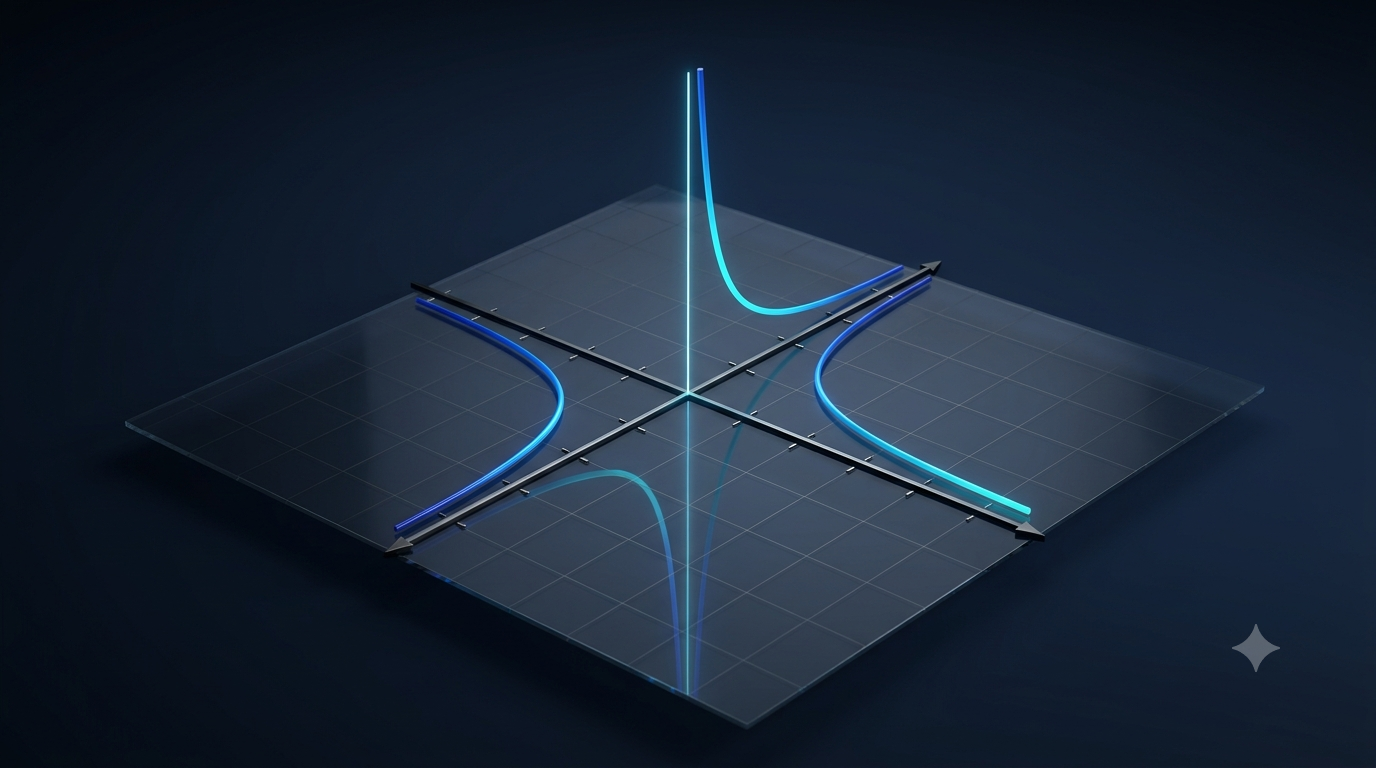
The graph has two branches, one on either side of the y-axis. Both branches remain above the x-axis and rise sharply as they approach x = 0.
The y-axis, represented by x = 0, is a vertical asymptote.
For the function:
f(x) = 1 / x
The graph behaves differently. On the right side of the y-axis, the function rises toward positive infinity as x approaches zero. On the left side, it falls toward negative infinity.
Both graphs illustrate infinite-limit behavior, but their directions differ.
When interpreting a graph, look for three important features:
The x-value being approached.
Whether the graph rises or falls without bound.
Whether the behavior is the same on both sides of the point.
These observations help identify infinite limits and distinguish them from ordinary finite limits.
Solving Infinite Limits Algebraically
Infinite limits can often be understood by examining the algebraic expression of a function.
The most important step is to identify what happens to the denominator, numerator, and overall sign as the input approaches the target value.
Example 1: A Squared Denominator
Evaluate the infinite limit of:
f(x) = 5 / (x − 1)²
As x approaches 1, the denominator approaches zero. Because the denominator is squared, it remains positive for every x other than 1.
The numerator stays equal to 5, which is positive.
Therefore, the quotient becomes increasingly positive.
The result is:
lim x→1 5 / (x − 1)² = +∞
The function has a vertical asymptote at x = 1.
Example 2: A Negative Numerator
Consider:
f(x) = −6 / (x − 3)²
As x approaches 3, the denominator becomes a very small positive number. The numerator remains negative.
Dividing a negative number by a very small positive number produces increasingly negative values.
Thus:
lim x→3 −6 / (x − 3)² = −∞
This is a negative infinite limit from both sides.
Example 3: A Linear Denominator
Consider:
f(x) = 4 / (x + 2)
As x approaches −2, the denominator approaches zero.
From the left, the denominator is negative, so the function decreases without bound.
From the right, the denominator is positive, so the function increases without bound.
The one-sided limits are:
lim x→−2⁻ 4 / (x + 2) = −∞
lim x→−2⁺ 4 / (x + 2) = +∞
This example shows why the sign of the denominator matters when solving infinite limits.
Infinite Limits and Functions That Approach Infinity at Large Inputs
Infinite limits are also used to study what happens when the input itself becomes extremely large or extremely negative.
These limits are different from limits where x approaches a finite number and the function becomes unbounded.
For example, consider:
f(x) = x²
As x increases without bound, the value of x² also increases without bound.
We write:
lim x→+∞ x² = +∞
Similarly, as x decreases without bound, its square becomes increasingly large and positive:
lim x→−∞ x² = +∞
In these examples, the input moves toward positive or negative infinity, and the output also grows without bound.
Now consider:
f(x) = −x²
As x approaches positive infinity, the function decreases without bound:
lim x→+∞ −x² = −∞
These examples demonstrate that infinity can describe the behavior of the input, the output, or both. The context of the limit determines how the notation should be interpreted.
Common Mistakes When Understanding Infinite Limits
Infinite limits can be confusing when their notation is interpreted too literally. The following mistakes are especially common.
Treating Infinity as an Ordinary Number
Infinity is not a regular real number. Therefore, an infinite limit does not mean that a function reaches a final numerical value called infinity.
Instead, it means that the function values become unbounded.
Assuming Every Undefined Point Is a Vertical Asymptote
A function may be undefined at a point without having an infinite limit there.
For example:
f(x) = (x² − 1) / (x − 1)
For x not equal to 1, the expression simplifies to:
f(x) = x + 1
As x approaches 1, the function approaches 2, even though the original expression is undefined at x = 1.
This is a removable discontinuity, not a vertical asymptote.
Ignoring One-Sided Behavior
A function may approach positive infinity from one side and negative infinity from the other.
It is important to examine both sides before making a conclusion about a two-sided limit.
Assuming a Small Denominator Always Produces Positive Infinity
The sign of the numerator and denominator determines whether the quotient becomes positive or negative.
For example, a positive numerator divided by a very small negative denominator produces increasingly negative values.
Paying attention to signs is essential when solving infinite limits.
Why Are Infinite Limits Important in Calculus?
Infinite limits play an important role in understanding the behavior of mathematical functions.
They help identify vertical asymptotes, analyze discontinuities, and describe situations in which function values become unbounded.
They are also useful when studying rational functions, logarithmic functions, and other expressions whose behavior changes dramatically near particular values.
In calculus, infinite limits help students understand how functions behave in extreme situations. They provide a foundation for studying continuity, graph behavior, and more advanced topics involving derivatives and integrals.
Infinite limits also develop mathematical reasoning. Instead of focusing only on the value of a function at a single point, students learn to investigate how the function behaves around that point.
This way of thinking is one of the most important ideas in calculus.
Conclusion
An infinite limit describes a function whose values increase without bound or decrease without bound as its input approaches a particular value or moves toward infinity. Unlike an ordinary limit, it does not approach a fixed finite number. Infinite limits help explain vertical asymptotes, one-sided behavior, and discontinuities. By examining numerical values, algebraic expressions, signs, and graphs, we can determine whether a function approaches positive infinity or negative infinity. It is also important to remember that infinity is not an ordinary real number and that a function may behave differently on either side of a point. Understanding infinite limits provides a strong foundation for learning calculus and interpreting the behavior of mathematical functions.
FAQs
1. What is an infinite limit in calculus?
An infinite limit describes the behavior of a function when its values increase without bound or decrease without bound as the input approaches a particular value. Instead of approaching a fixed finite number, the function becomes increasingly large in the positive or negative direction. For example, the function f(x) = 1 / x² approaches positive infinity as x approaches zero. Infinite limits help mathematicians understand how functions behave near certain points, especially where they become unbounded. They are commonly used to identify vertical asymptotes, study discontinuities, and analyze the behavior of different mathematical functions.
2. What is the difference between a finite limit and an infinite limit?
A finite limit occurs when the values of a function approach a specific real number as the input approaches a particular value. An infinite limit occurs when the function values increase or decrease without bound instead of approaching a finite number. For example, f(x) = x + 2 approaches 5 as x approaches 3, so its limit is finite. However, f(x) = 1 / x² increases without bound as x approaches zero. Understanding this difference is important in calculus because it helps distinguish ordinary limiting behavior from situations involving unbounded function values.
3. What does positive infinity mean in an infinite limit?
Positive infinity means that the values of a function increase without bound as the input approaches a specified value or moves toward positive infinity. The function values can become larger than any chosen finite number when the input is sufficiently close to the relevant point. For example, f(x) = 1 / x² approaches positive infinity as x approaches zero from either side. This behavior is written as lim x→0 1 / x² = +∞. Positive infinity does not represent a final numerical value. Instead, it describes a function that continues to grow without an upper bound.
4. What does negative infinity mean in an infinite limit?
Negative infinity describes a function whose values decrease without bound as the input approaches a particular value or moves toward positive or negative infinity. In this situation, the function values become more and more negative. For example, f(x) = −1 / x² approaches negative infinity as x approaches zero from either side. This can be expressed as lim x→0 −1 / x² = −∞. Negative infinity does not mean that the function reaches a final negative number. It indicates that the function continues decreasing beyond every finite negative bound as the input approaches the specified point.
5. How are infinite limits related to vertical asymptotes?
Infinite limits help identify vertical asymptotes in the graphs of functions. A vertical asymptote is a vertical line that a function approaches while its values increase or decrease without bound. For example, the function f(x) = 1 / (x − 2) has a vertical asymptote at x = 2 because its values become unbounded as x approaches 2. From the left, the function approaches negative infinity, while from the right, it approaches positive infinity. Studying infinite limits makes it easier to identify these lines, understand graph behavior, and analyze discontinuities in mathematical functions.
6. What is the difference between left-hand and right-hand infinite limits?
A left-hand infinite limit describes the behavior of a function as its input approaches a particular value from smaller values. A right-hand infinite limit describes the behavior as the input approaches that value from larger values. These limits may produce different results. For example, f(x) = 1 / (x − 2) approaches negative infinity from the left of x = 2 and positive infinity from the right. Examining both directions is important because a function may behave differently on either side of a point. One-sided infinite limits provide a clearer understanding of vertical asymptotes and discontinuities.
7. Can a function have an infinite limit when it is undefined at a point?
Yes, a function can have an infinite limit at a point where it is undefined. A limit examines the behavior of a function near a point rather than requiring the function to have a value at that exact point. For example, f(x) = 1 / (x − 3) is undefined at x = 3 because its denominator becomes zero. However, its values increase or decrease without bound as x approaches 3 from either side. Therefore, the function has one-sided infinite limits at that point. This distinction is fundamental to understanding limits and discontinuities in calculus.
8. How can you determine whether an infinite limit is positive or negative?
To determine the direction of an infinite limit, examine the signs of the numerator and denominator as the input approaches the specified value. A positive quotient that grows without bound indicates positive infinity, while a negative quotient that decreases without bound indicates negative infinity. For example, f(x) = 5 / (x − 1)² approaches positive infinity as x approaches 1 because the squared denominator is positive on both sides. However, f(x) = −5 / (x − 1)² approaches negative infinity. Checking the signs and considering each side separately helps prevent mistakes when evaluating infinite limits.
9. What is the difference between an infinite limit and a limit at infinity?
An infinite limit usually describes a function whose values become unbounded as its input approaches a particular finite point. For example, f(x) = 1 / x² approaches positive infinity as x approaches zero. A limit at infinity examines what happens to a function as its input increases or decreases without bound. For example, f(x) = x² approaches positive infinity as x approaches positive infinity. Although the notation may look similar, the two concepts describe different situations. Understanding this distinction helps students analyze function behavior near vertical asymptotes and investigate what happens to graphs far from the origin.
10. Why are infinite limits important in mathematics?
Infinite limits are important because they help explain how functions behave when their values become unbounded. They are especially useful for identifying vertical asymptotes, studying discontinuities, and understanding the behavior of rational and other mathematical functions. Infinite limits also help students interpret graphs and determine whether function values increase or decrease without bound near particular points. In calculus, these concepts provide a foundation for studying continuity and more advanced mathematical ideas. Learning to interpret infinite limits encourages students to focus on how functions behave near a point rather than considering only the function’s value at that exact location.