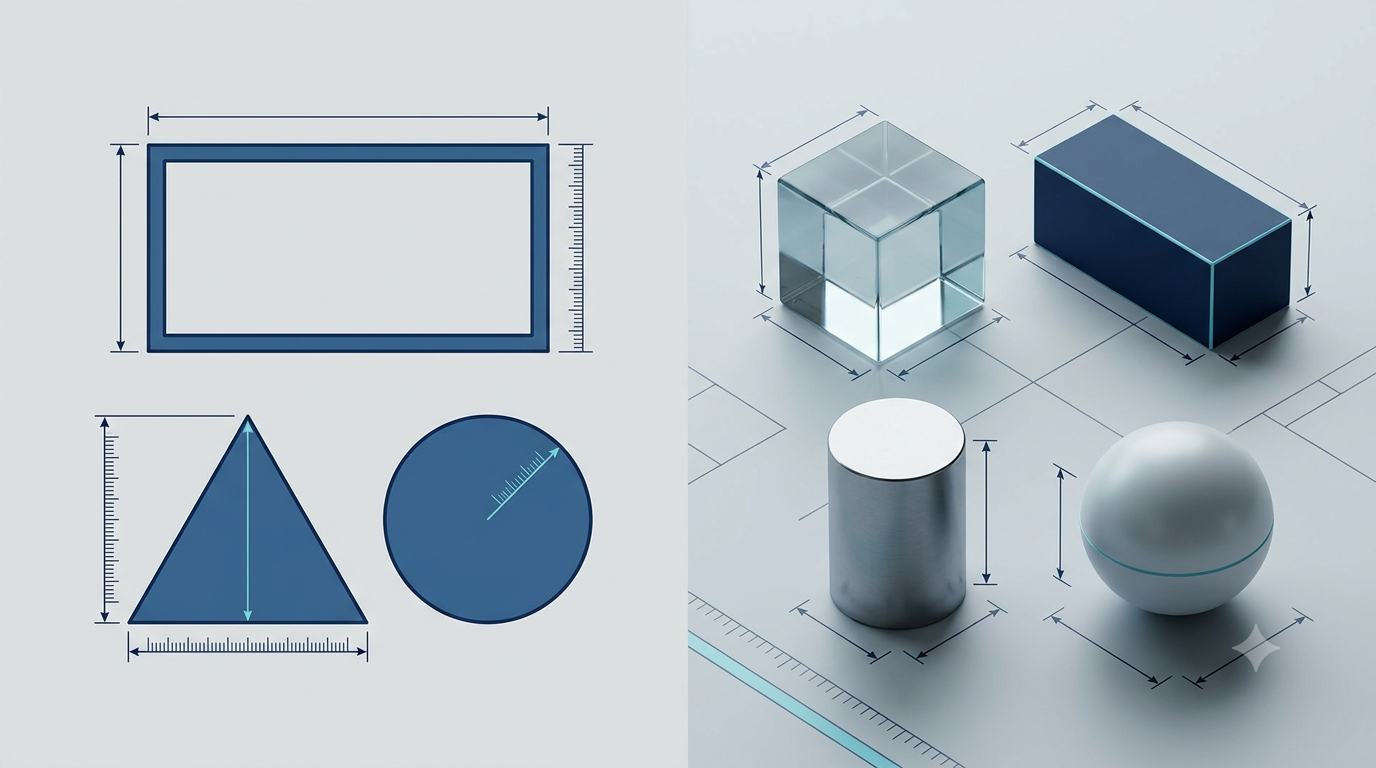
Measurements help us understand the size, shape, and space occupied by objects around us. From calculating the area of a classroom floor to finding the volume of a water tank, measurement plays an important role in mathematics and everyday life. In geometry, measurements are commonly divided into two-dimensional and three-dimensional measurements. Two-dimensional measurements describe flat shapes and include length, width, perimeter, and area. Three-dimensional measurements describe solid objects and include length, width, height, surface area, and volume.
Understanding these two types of measurements makes it easier to solve mathematical problems and handle practical tasks such as construction, packaging, painting, farming, and designing. Although two-dimensional and three-dimensional measurements are closely related, they describe different properties of objects. This article explains their meanings, differences, important formulas, practical applications, and the basic concepts needed to understand them clearly.
What Are Two-Dimensional Measurements?
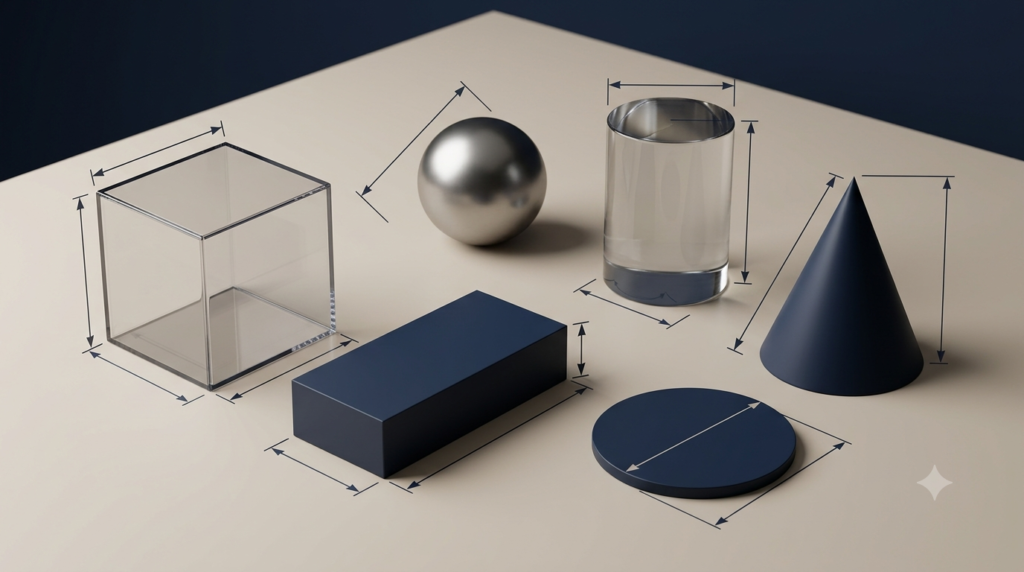
Two-dimensional measurements describe objects or shapes that have two dimensions: length and width. These shapes are usually represented on a flat surface, such as a sheet of paper, a drawing, a screen, or a map.
A two-dimensional shape has length and width but no measurable thickness in the ideal mathematical model. Common examples include squares, rectangles, triangles, circles, and parallelograms.
For example, a rectangular sheet of paper can be described by its length and width. If the sheet is 30 centimetres long and 20 centimetres wide, these measurements tell us how large the flat surface is.
Two-dimensional measurements are especially useful when we need to determine the boundary of a shape or the amount of flat space it covers.
Important Features of Two-Dimensional Measurements
Two-dimensional measurements have several important characteristics:
They describe flat shapes and surfaces.
They involve length and width.
Perimeter measures the total distance around a shape.
Area measures the surface covered by a shape.
Length is measured in units such as millimetres, centimetres, metres, and kilometres.
Area is measured in square units, such as cm² and m².
For instance, the dimensions of a rectangular garden can help us calculate how much fencing is needed around it and how much land is available for planting.
Understanding Length, Width, Perimeter, and Area
To understand two-dimensional measurements properly, it is important to distinguish between their main quantities.
Length and Width
Length describes how long an object or shape is, while width describes how wide it is. These measurements are usually expressed in units of length.
For a rectangle, the longer side is commonly called the length, and the shorter side is commonly called the width. However, these names can depend on the orientation and purpose of the object.
For example, a rectangular table might be 2 metres long and 1 metre wide. These two measurements describe its basic dimensions.
Perimeter
Perimeter is the total distance around the boundary of a two-dimensional shape. It is useful when calculating the amount of fencing needed around a garden, the border required for a picture frame, or the length of material needed to outline a surface.
Text block — Perimeter formulas
Perimeter of a square = 4 × side
Perimeter of a rectangle = 2 × (length + width)
Perimeter of a triangle = side₁ + side₂ + side₃
Circumference of a circle = 2 × π × r
Here, r represents the radius of the circle, and π is approximately 3.14159.
For example, consider a rectangular garden with a length of 10 metres and a width of 5 metres.
Perimeter = 2 × (10 + 5)
Perimeter = 30 m
Therefore, 30 metres of fencing would be needed to surround the garden, assuming no gaps or additional allowances are required.
Area
Area measures the amount of two-dimensional space covered by a shape. It is useful for calculating the amount of paint required for a wall, the floor covering needed for a room, or the land available for cultivation.
Text block — Area formulas
Area of a square = side × side
Area of a rectangle = length × width
Area of a triangle = ½ × base × height
Area of a parallelogram = base × perpendicular height
Area of a circle = π × r²
Area is always expressed in square units when using standard units of length. For example, a rectangular floor measuring 6 metres by 4 metres has an area of 24 m².
It is important to remember that perimeter and area measure different properties. Perimeter measures the boundary, whereas area measures the surface inside that boundary.
What Are Three-Dimensional Measurements?
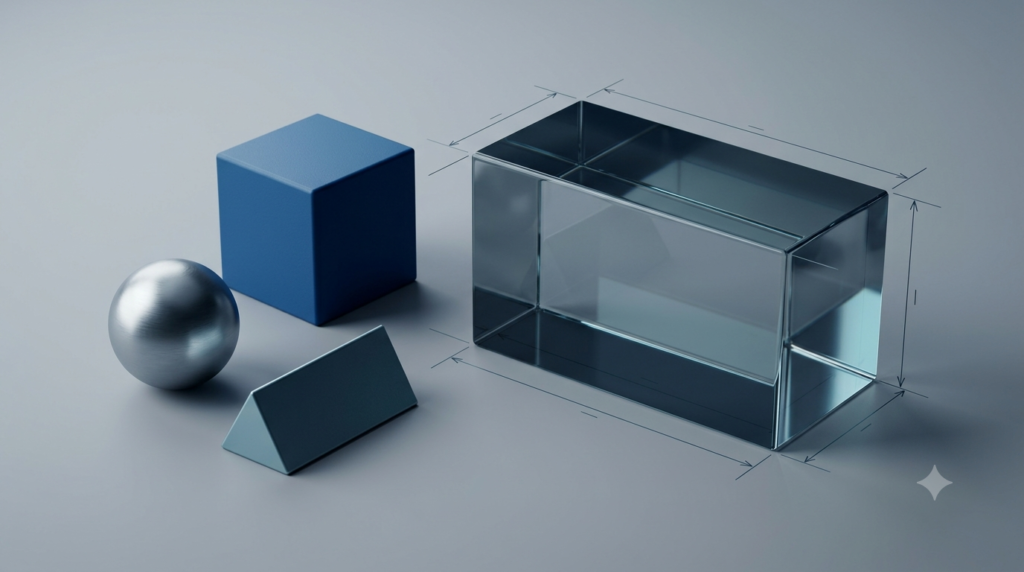
Three-dimensional measurements describe solid objects that have three dimensions: length, width, and height or depth. Unlike flat shapes, three-dimensional objects occupy space and have measurable volume.
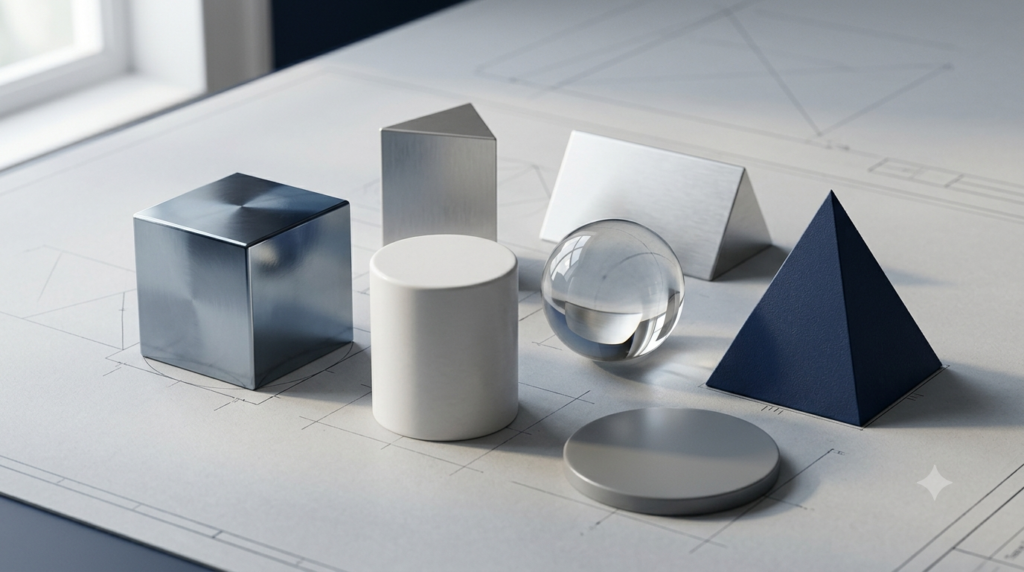
Common examples include cubes, rectangular boxes, cylinders, spheres, cones, and pyramids. Everyday objects such as water bottles, books, buildings, balls, and storage containers can be studied using three-dimensional measurements.
For example, a rectangular storage box has a length, width, and height. Knowing all three dimensions helps us determine how much space the box can hold.
Three-dimensional measurements are important in construction, engineering, architecture, manufacturing, packaging, and many other fields.
Important Features of Three-Dimensional Measurements
Three-dimensional measurements have the following characteristics:
They describe solid objects.
They involve length, width, and height or depth.
Surface area measures the combined area of the object’s surfaces.
Volume measures the space occupied by an object or the capacity of a container.
Surface area is expressed in square units.
Volume is expressed in cubic units, such as cm³ and m³.
A three-dimensional object can be represented by a drawing, but the drawing itself is usually displayed on a two-dimensional surface.
Understanding Surface Area and Volume
Surface area and volume are the two most important measurements associated with three-dimensional objects. Although they are related, they describe different properties.
Surface Area
Surface area is the total area of all the outer surfaces of a three-dimensional object. For a solid with flat faces, it is calculated by adding the areas of its faces. For objects with curved surfaces, the appropriate curved-surface formulas are used.
Surface area is useful when determining how much material is needed to cover an object. Examples include painting a storage tank, wrapping a gift box, coating a machine part, or covering the exterior of a building.
Text block — Surface area formulas
Total surface area of a cube = 6 × side²
Total surface area of a cuboid = 2 × (length × width + width × height + height × length)
Curved surface area of a cylinder = 2 × π × r × h
Total surface area of a cylinder = 2 × π × r × (r + h)
Surface area of a sphere = 4 × π × r²
Here, r represents the radius, and h represents the height of the cylinder.
For example, a cube with a side length of 3 cm has a total surface area of:
Total surface area = 6 × 3²
Total surface area = 54 cm²
This means that the combined area of all six faces is 54 square centimetres.
Volume
Volume measures the amount of three-dimensional space occupied by a solid. It is also used to describe the capacity of containers when discussing how much liquid, gas, or other material they can hold.
Volume is important when calculating the capacity of water tanks, the amount of concrete needed for construction, the space available in a container, or the quantity of material required to manufacture an object.
Text block — Volume formulas
Volume of a cube = side³
Volume of a cuboid = length × width × height
Volume of a cylinder = π × r² × h
Volume of a sphere = ⁴⁄₃ × π × r³
Volume of a cone = ⅓ × π × r² × h
Volume of a pyramid = ⅓ × base area × perpendicular height
Volume is measured in cubic units because it involves three dimensions.
For example, a rectangular box with a length of 5 cm, a width of 4 cm, and a height of 3 cm has a volume of:
Volume = 5 × 4 × 3
Volume = 60 cm³
Therefore, the box occupies 60 cubic centimetres of space.
The Difference Between Two-Dimensional and Three-Dimensional Measurements
Two-dimensional and three-dimensional measurements are connected, but each is used for a different purpose. Understanding their differences helps us select the correct formula for a mathematical problem.
| Feature | Two-dimensional measurements | Three-dimensional measurements |
|---|---|---|
| Dimensions | Length and width | Length, width, and height or depth |
| Main shapes | Squares, rectangles, triangles, circles | Cubes, cuboids, cylinders, spheres |
| Main measurements | Perimeter and area | Surface area and volume |
| Space described | Flat surface or region | Solid space occupied |
| Area units | cm², m², km² | cm², m², and other square units for surface area |
| Volume units | Not normally applicable to flat shapes | cm³, m³, and other cubic units |
| Practical example | Measuring a floor’s surface | Calculating a tank’s capacity |
One important difference is that a two-dimensional area is measured in square units, while the volume of a three-dimensional object is measured in cubic units.
For example, a square floor might have an area of 25 m². A storage container might have a volume of 25 m³. These values cannot be compared directly because they represent different types of measurements.
Understanding Measurement Units
Choosing the correct unit is essential for accurate calculations. A formula may be correct, but the final answer can still be misleading if the units are incorrect.
Units of Length
Length is measured using linear units.
Common units include:
Millimetre (mm)
Centimetre (cm)
Metre (m)
Kilometre (km)
Some useful conversions are:
1 cm = 10 mm
1 m = 100 cm
1 km = 1,000 m
Length units are used to measure the sides, heights, radii, and depths of objects.
Units of Area
Area is measured in square units because it describes two-dimensional space.
Common units include:
Square centimetre (cm²)
Square metre (m²)
Square kilometre (km²)
Hectare (ha)
Useful conversions include:
1 m² = 10,000 cm²
1 km² = 1,000,000 m²
1 hectare = 10,000 m²
For example, a room’s floor area is usually measured in square metres, while a small surface might be measured in square centimetres.
Units of Volume
Volume is measured in cubic units because it involves three dimensions.
Common units include:
Cubic centimetre (cm³)
Cubic metre (m³)
Cubic millimetre (mm³)
Useful conversions include:
1 cm³ = 1,000 mm³
1 m³ = 1,000,000 cm³
For liquid capacity, litres and millilitres are also widely used.
1 litre = 1,000 millilitres
1 litre = 1,000 cm³
1 m³ = 1,000 litres
These relationships are especially useful when calculating the capacity of water tanks, bottles, and other containers.
How to Solve Measurement Problems Correctly
Solving measurement problems becomes easier when the process is followed systematically.
Step 1: Identify the Object or Shape
First, determine whether the problem involves a flat shape or a solid object. A rectangular sheet of paper is treated as a two-dimensional shape, while a rectangular box is treated as a three-dimensional object.
Step 2: Identify What Must Be Calculated
Determine whether the question asks for length, perimeter, area, surface area, or volume.
For example, if the question asks how much fencing is required around a garden, calculate the perimeter. If it asks how much grass can cover the garden’s surface, calculate the area.
Step 3: Write Down the Given Measurements
Record the dimensions provided in the question. These might include length, width, height, radius, diameter, base, or perpendicular height.
Make sure the measurements are expressed in compatible units before using a formula.
Step 4: Choose the Correct Formula
Select a formula that matches both the shape and the required measurement. For example, the area formula for a rectangle should not be used to calculate the volume of a box.
Step 5: Substitute the Values and Calculate
Insert the known measurements into the formula and perform the calculation carefully.
Step 6: Include the Correct Unit
Finish the calculation with the appropriate unit. Use linear units for length, square units for area or surface area, and cubic units for volume.
Following these steps reduces errors and makes mathematical solutions easier to understand.
Real-Life Applications of Two-Dimensional Measurements
Two-dimensional measurements are used in many everyday situations.
Construction and Interior Design
Architects and builders use area calculations to estimate the amount of flooring, carpeting, tiles, and paint required for flat surfaces. Perimeter calculations help determine the length of fencing, borders, and skirting materials.
Maps and Land Measurement
Maps represent geographical regions on flat surfaces. Area calculations help estimate the size of fields, gardens, parks, and plots of land. The scale of a map must be considered when converting measurements on the map into real-world distances.
Agriculture
Farmers use area measurements to calculate the size of fields, estimate planting space, and plan irrigation systems. These measurements can help determine how much seed or fertiliser may be required for a particular area.
Art and Graphic Design
Artists and designers use two-dimensional measurements when creating illustrations, layouts, posters, diagrams, and digital graphics. Understanding proportions and area helps them arrange elements accurately.
Real-Life Applications of Three-Dimensional Measurements
Three-dimensional measurements are equally important in practical work.
Architecture and Engineering
Engineers calculate volume when estimating the amount of concrete needed for foundations, columns, and other structures. Surface area calculations help estimate materials for coating, insulation, and finishing.
Packaging and Storage
Manufacturers use length, width, and height to design boxes and storage containers. Volume helps determine how much a container can hold, while surface area helps estimate the material needed to manufacture or cover it.
Water Storage and Management
The volume of a water tank helps determine its storage capacity. Cylindrical, rectangular, and other tank shapes require different formulas. Capacity calculations are useful for homes, farms, factories, and public water systems.
Manufacturing and Product Design
Manufacturers use three-dimensional measurements to design components, calculate material requirements, and check whether parts will fit together correctly. These measurements are important in automobiles, machinery, furniture, electronics, and industrial equipment.
Science and Medicine
Three-dimensional measurements help scientists study the size and volume of objects, containers, and samples. In medicine, imaging technologies can provide three-dimensional information about body structures, supporting diagnosis and treatment planning by qualified professionals.
Common Mistakes to Avoid
Although measurement formulas are often straightforward, some common mistakes can lead to incorrect answers.
Confusing area with perimeter: Perimeter measures the boundary, while area measures the region inside a shape. Always identify what the question asks.
Confusing surface area with volume: Surface area describes the outside of a solid, whereas volume describes the space it occupies.
Using the wrong units: Do not write cm² as a unit of volume or cm³ as a unit of area.
Forgetting to convert measurements: If a problem gives the length in metres and the width in centimetres, convert them into compatible units before calculating.
Using the wrong height: In triangle and parallelogram area calculations, the height must be perpendicular to the base.
Using diameter instead of radius: The radius is half the diameter. When a circular formula requires the radius, divide the diameter by two before substituting the value.
Applying a formula to the wrong shape: Different shapes have different formulas. Identify the shape carefully before starting the calculation.
Avoiding these errors improves accuracy and builds confidence in solving geometry problems.
Conclusion
Two-dimensional and three-dimensional measurements are fundamental parts of mathematics that help us describe shapes, surfaces, and solid objects. Two-dimensional measurements focus on length, width, perimeter, and area, while three-dimensional measurements include length, width, height, surface area, and volume. Understanding their differences makes it easier to select the correct formula, use suitable measurement units, and solve practical problems accurately.
These concepts are useful in everyday activities, including measuring rooms, planning gardens, designing packages, constructing buildings, and calculating storage capacity. By learning the basic definitions, formulas, unit conversions, and problem-solving steps, anyone can develop a strong foundation in measurement. With regular practice, two-dimensional and three-dimensional measurements become easier to understand and apply in both mathematics and real-life situations.
FAQs
1. What are two-dimensional measurements?
Two-dimensional measurements describe the size of flat shapes using two dimensions: length and width. They are commonly used to measure shapes such as squares, rectangles, triangles, and circles. The main measurements associated with two-dimensional shapes are perimeter and area. Perimeter represents the total distance around a shape, while area measures the surface enclosed within its boundary. These measurements are useful in everyday situations, including calculating the size of a floor, measuring a garden, designing a drawing, or estimating the amount of material needed to cover a flat surface.
2. What are three-dimensional measurements?
Three-dimensional measurements describe the size of solid objects using length, width, and height or depth. They help us understand the dimensions and space occupied by objects such as cubes, boxes, cylinders, cones, and spheres. The two main measurements associated with three-dimensional objects are surface area and volume. Surface area measures the total area of an object’s outer surfaces, while volume measures the space it occupies. These measurements are useful in construction, engineering, manufacturing, packaging, and storage. For example, calculating the volume of a water tank helps determine its storage capacity.
3. What is the main difference between two-dimensional and three-dimensional measurements?
The main difference is the number of dimensions involved. Two-dimensional measurements describe flat shapes using length and width, whereas three-dimensional measurements describe solid objects using length, width, and height or depth. Two-dimensional measurements commonly include perimeter and area. Three-dimensional measurements include surface area and volume. For example, calculating the area of a rectangular floor involves two dimensions, while calculating the volume of a rectangular water tank requires three dimensions. Understanding this distinction helps you choose the correct formula and measurement unit when solving geometry problems or handling practical measurement tasks.
4. What is the difference between area and volume?
Area measures the amount of surface covered by a two-dimensional shape, while volume measures the space occupied by a three-dimensional object. Area is calculated using two dimensions and expressed in square units, such as cm² or m². Volume involves three dimensions and is expressed in cubic units, such as cm³ or m³. For example, the area of a rectangular floor can help determine how many tiles are required to cover it. In contrast, the volume of a rectangular container helps calculate how much water or other material it can hold.
5. What is the difference between perimeter and surface area?
Perimeter and surface area measure different properties of shapes and objects. Perimeter is the total distance around the boundary of a two-dimensional shape. It is measured in linear units, such as centimetres or metres. Surface area, on the other hand, is the combined area of the outer surfaces of a three-dimensional object and is measured in square units. For example, perimeter helps calculate the fencing needed around a rectangular garden. Surface area helps estimate the material required to cover or paint a solid object, such as a storage box or cylindrical tank.
6. What units are used for two-dimensional measurements?
Two-dimensional measurements use different units depending on the quantity being measured. Length and perimeter are expressed in linear units, including millimetres, centimetres, metres, and kilometres. Area is expressed in square units because it measures a two-dimensional region. Common area units include square centimetres (cm²), square metres (m²), and square kilometres (km²). For example, the length of a classroom may be measured in metres, while the area of its floor is measured in square metres. Choosing the correct unit ensures that measurement results are clear, accurate, and suitable for the intended purpose.
7. What units are used for three-dimensional measurements?
Three-dimensional measurements use linear, square, and cubic units, depending on the quantity being calculated. Length, width, and height are measured in units such as centimetres and metres. Surface area is measured in square units, such as cm² and m². Volume is measured in cubic units, such as cm³ and m³. Liquid capacity is also commonly expressed in litres and millilitres. For example, the dimensions of a box may be measured in centimetres, its surface area in square centimetres, and its volume in cubic centimetres. Correct units are essential for accurate calculations and meaningful results.
8. How do you calculate the area of a rectangle?
The area of a rectangle is calculated by multiplying its length by its width. The formula is: Area of a rectangle = length × width. Both measurements should use compatible units before the calculation begins. For example, if a rectangular room is 6 metres long and 4 metres wide, its area is 6 × 4 = 24 m². This means the floor covers 24 square metres. Area calculations are useful for estimating the number of tiles needed for a floor, the amount of grass required for a lawn, or the material needed to cover a flat surface.
9. How do you calculate the volume of a rectangular box?
The volume of a rectangular box is calculated by multiplying its length, width, and height. The formula is: Volume of a cuboid = length × width × height. All three measurements should be expressed in compatible units. For example, a box with a length of 5 cm, a width of 4 cm, and a height of 3 cm has a volume of 5 × 4 × 3 = 60 cm³. This means the box occupies 60 cubic centimetres of space. The formula is useful for calculating the capacity of storage boxes, estimating packaging space, and determining the volume of rectangular containers.
10. Why are two-dimensional and three-dimensional measurements important in everyday life?
Two-dimensional and three-dimensional measurements help people solve practical problems accurately. Two-dimensional measurements are useful for calculating floor areas, measuring land, planning gardens, and determining the amount of material needed to cover flat surfaces. Three-dimensional measurements help calculate the volume of containers, estimate construction materials, design packages, and determine storage capacity. Architects, engineers, farmers, manufacturers, and designers regularly use these concepts in their work. They are also useful in ordinary household activities, such as arranging furniture or estimating the capacity of a water tank. Understanding measurement makes planning easier and helps reduce material waste and calculation errors.