Motion is one of the most basic ideas in physics. We see objects moving everywhere: a car travels along a road, a ball is thrown through the air, a runner moves around a track, and planets travel through space. To describe this motion accurately, physicists need more than just numbers. They need to know not only how much an object moves, but also in which direction it moves. This is where vectors become essential.
A vector is a physical quantity that has both magnitude and direction. Quantities such as displacement, velocity, and acceleration are vectors because their direction is important. Without vectors, many descriptions of motion would be incomplete or potentially misleading.
Motion Needs More Than a Number
Suppose someone says, “A car is moving at 60 kilometers per hour.” Is that enough information to describe its motion?
Not completely. The car could be traveling north, south, east, west, or in any other direction. The number 60 km/h tells us the car’s speed, but it does not tell us where the car is going.
This distinction becomes important when comparing two moving objects. Imagine one car traveling east at 60 km/h and another traveling west at 60 km/h. They have the same speed, but their motions are clearly different because their directions are opposite.
A vector allows both pieces of information to be included. Instead of simply saying that a car is moving at 60 km/h, we can describe its velocity as 60 km/h east. Now the motion is much more clearly defined.
Scalars and Vectors
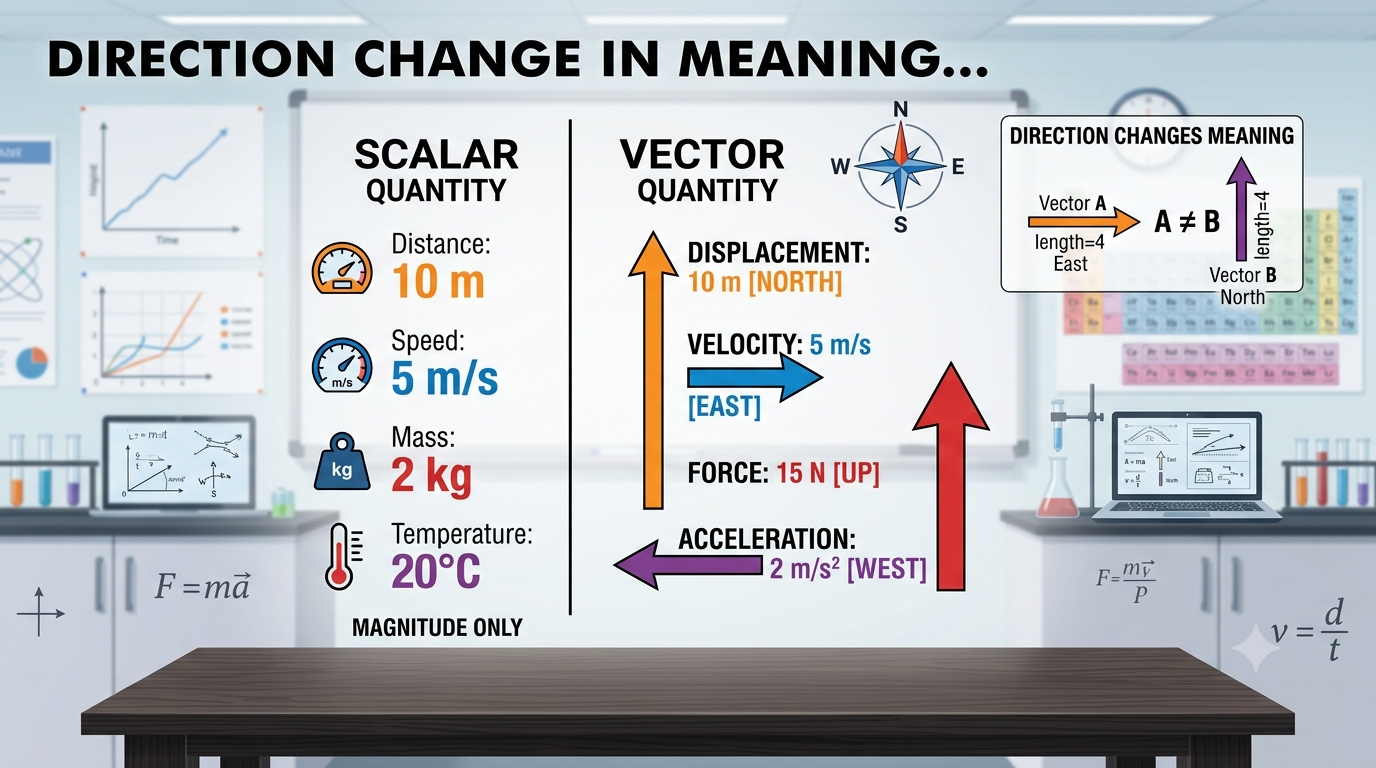
Physics quantities are commonly divided into two groups: scalars and vectors.
A scalar quantity has magnitude only. Examples include:
Distance
Speed
Time
Mass
Temperature
Energy
A vector quantity has both magnitude and direction. Examples include:
Displacement
Velocity
Acceleration
Force
Momentum
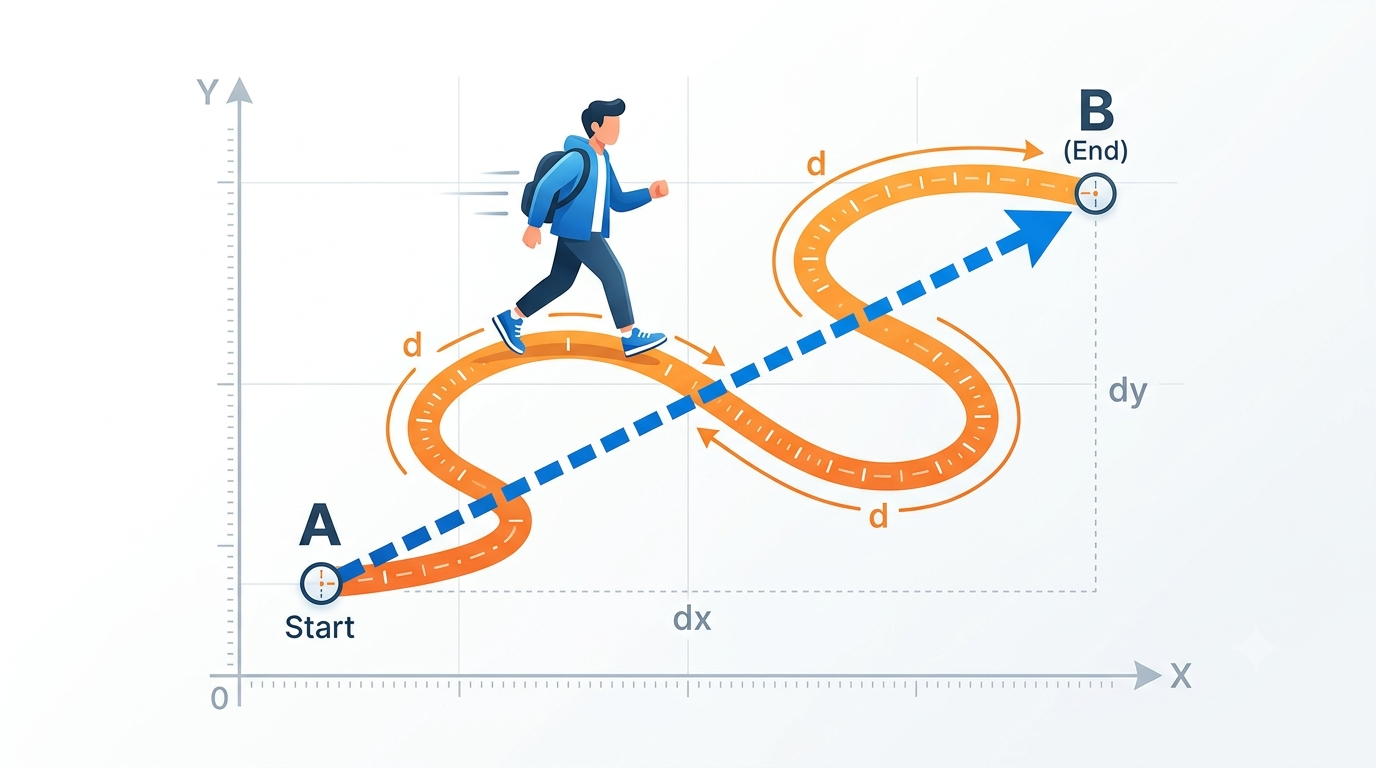
Consider distance and displacement. If a person walks 5 meters east, the distance traveled is 5 meters. Their displacement is also 5 meters east.
But suppose the person walks 5 meters east and then 5 meters west, returning to the starting point. The total distance traveled is 10 meters, while the displacement is zero.
This difference shows why direction matters when describing motion.
Displacement Is a Vector
Displacement describes the change in an object’s position. Because position has a direction relative to a reference point, displacement also has direction.
Imagine walking from your home to a shop that is 500 meters east. Your displacement is 500 meters east.
Now imagine walking 500 meters west instead. The magnitude of the displacement is the same, but its direction is opposite.
If we represented displacement only with the number 500 meters, we would lose important information.
Vectors solve this problem by keeping both magnitude and direction together.
Velocity Requires Direction
One of the clearest reasons vectors are needed in motion is velocity.
Speed tells us how quickly an object moves. Velocity tells us how quickly its position changes and in what direction.
For example:
A cyclist travels at 20 m/s east.
This statement gives both the magnitude, 20 m/s, and the direction, east. Therefore, it describes velocity.
Suppose another cyclist travels at 20 m/s west. The two cyclists have equal speeds but different velocities.
This difference becomes especially important in calculations. If two objects move in opposite directions, their velocities cannot simply be treated as identical positive numbers. Their directions must be included.
Vectors Help Describe Changes in Motion
Vectors are also essential when an object’s motion changes direction.
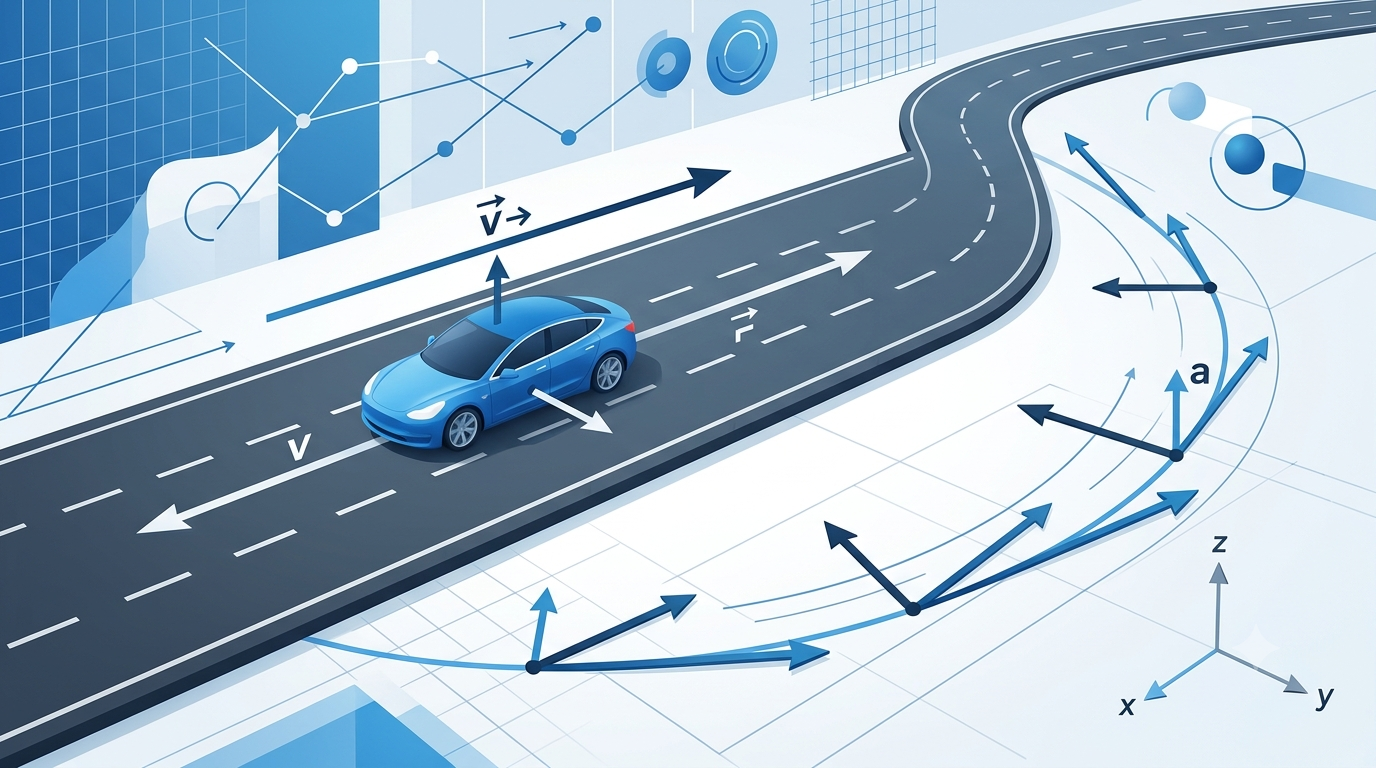
Consider a car traveling around a curved road at constant speed. Its speed may remain unchanged, but its direction is continuously changing. Because velocity depends on both speed and direction, the car’s velocity is changing.
A change in velocity means the car is accelerating.
This is why a vehicle moving around a circular track can experience acceleration even if its speedometer shows a constant value.
Without vectors, it would be difficult to express this idea clearly. Vectors allow physicists to distinguish between a change in the magnitude of velocity and a change in its direction.
Acceleration Is a Vector
Acceleration describes how velocity changes with time. Since velocity is a vector, acceleration is also a vector.
An object can accelerate in several ways. Its speed can increase, its speed can decrease, or its direction can change.
For example, when a car starts moving from rest, its velocity increases. The car accelerates.
When a driver applies the brakes, the velocity decreases. The car experiences acceleration in the opposite direction to its motion.
When a car turns a corner, its direction changes. Even if its speed remains constant, its velocity changes, so the car is accelerating.
Vectors provide a precise way to describe all of these situations.
Vector Addition Helps Describe Real Motion
Objects do not always move in a single straight line. Sometimes several motions occur at the same time.
Imagine a person walking north while a moving walkway carries them east. Their actual motion relative to the ground depends on both movements.
The walking velocity and the walkway’s velocity can be represented as vectors. By adding these vectors, we can determine the person’s overall velocity.
This idea is called vector addition.
Vector addition is used throughout physics to analyze complicated motion. It is especially useful when motion occurs in two or three dimensions.
Projectile Motion
Projectile motion is another excellent example of why vectors are necessary.
When a ball is thrown into the air, its motion has both horizontal and vertical components. The ball moves forward while also moving upward and then downward.
The initial velocity can be separated into horizontal and vertical components. These components allow physicists to analyze the motion more easily.
The horizontal and vertical motions follow different patterns, but together they produce the ball’s curved path.
Without vectors and vector components, describing projectile motion mathematically would be much more difficult.
Vectors Make Motion Easier to Visualize
Vectors are not only useful for calculations. They also provide a simple visual representation of motion.
A vector can be drawn as an arrow. The length of the arrow represents its magnitude, while the arrowhead indicates its direction.
For example, a longer arrow can represent a greater velocity, while an arrow pointing east can show eastward motion.
This makes complex physical situations easier to understand. Instead of working only with numbers and equations, we can see how quantities are related spatially.
Vectors Are Essential in Two and Three Dimensions
Motion in one dimension can sometimes be described using positive and negative signs. For example, east might be positive and west might be negative.
However, this approach becomes less convenient when motion occurs in two or three dimensions.
A plane, for example, can move north, south, east, west, upward, or downward. A single number cannot describe all these possibilities.
Vectors allow motion to be represented using components such as x, y, and z directions.
This is especially important in physics, engineering, robotics, navigation, astronomy, and computer simulations.
Vectors Connect Different Ideas in Physics
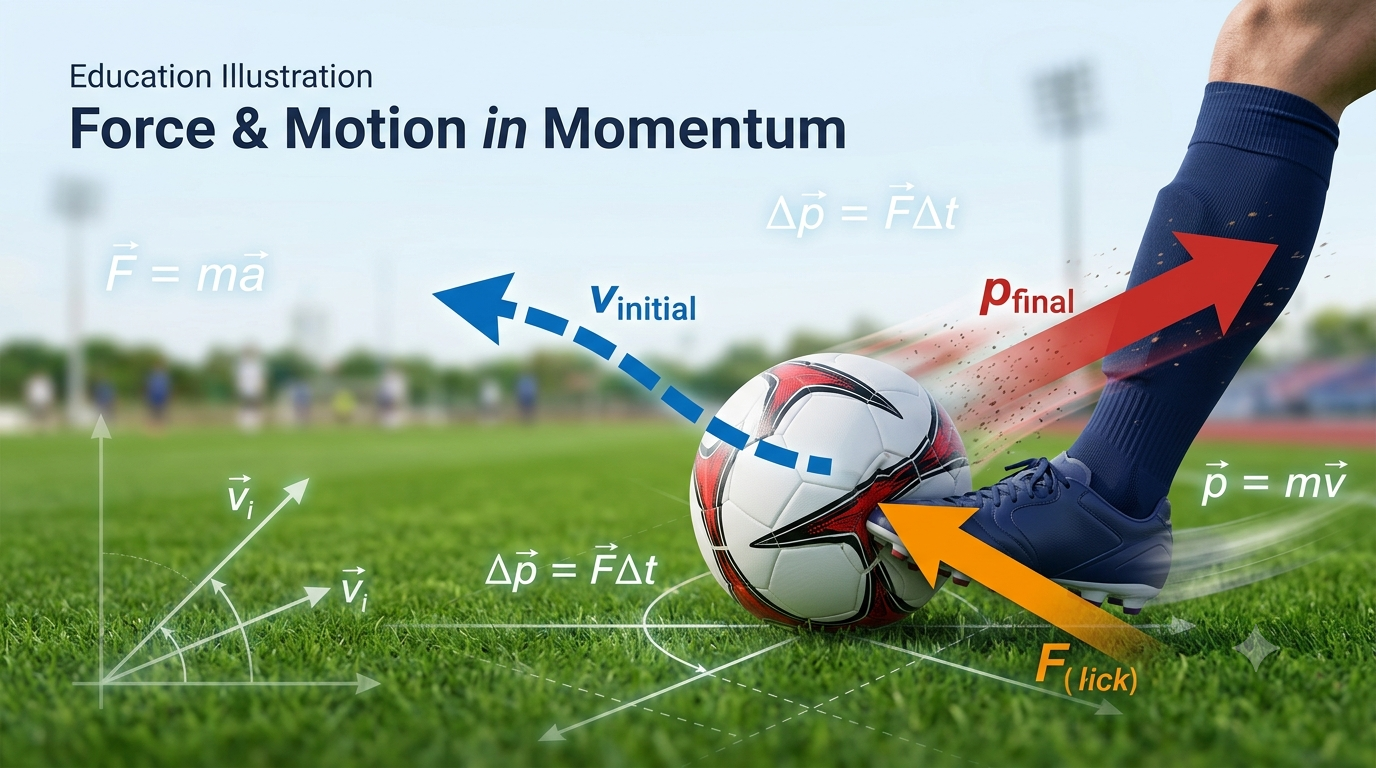
Vectors are not limited to motion. They are used to describe many other physical quantities, including force and momentum.
For example, when several forces act on an object, their directions determine the object’s overall motion. Physicists can represent each force as a vector and add them to find the net force.
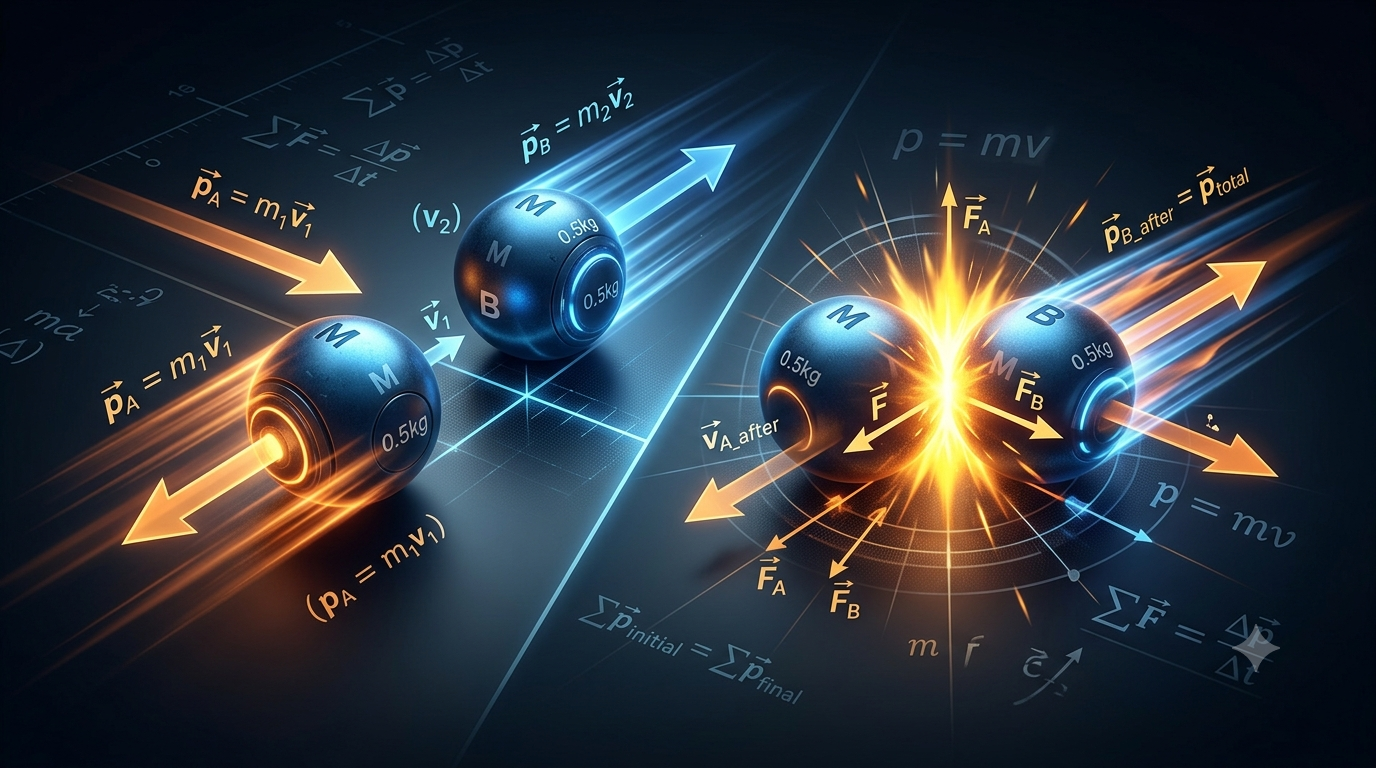
Similarly, momentum has both magnitude and direction. A collision between objects can therefore be analyzed using vector principles.
Learning vectors in the context of motion provides a foundation for understanding many other areas of physics.
Conclusion
Vectors are needed to describe motion because motion is not only about how much an object moves or how fast it travels. It is also about where the object is moving and how its direction changes.
Speed can tell us how fast an object is moving, but velocity tells us both its speed and direction. Displacement tells us how an object’s position changes, while acceleration describes changes in velocity. All of these quantities require vectors.
Vectors also make it possible to analyze motion in multiple directions, combine different motions, understand projectile motion, and describe changes in direction.
In simple terms, a scalar tells us how much, while a vector tells us how much and which way. Because real-world motion almost always involves direction, vectors provide one of the most powerful tools for describing and understanding movement in physics.
FAQs
A vector is a physical quantity that has both magnitude and direction. Magnitude tells us how much of a quantity is present, while direction tells us where it points or acts. For example, a velocity of 20 m/s east is a vector because it includes both the speed, 20 m/s, and the direction, east. Vectors are commonly represented using arrows, where the arrow’s length represents magnitude and the arrowhead shows direction. In physics, vectors are used to describe displacement, velocity, acceleration, force, momentum, and many other quantities. They are especially important when objects move in two or three dimensions.
Vectors are needed because motion involves both magnitude and direction. Simply knowing how fast an object moves does not completely describe its motion. For example, two cars may travel at 60 km/h, but one may move east while the other moves west. Their speeds are equal, but their velocities are different. Vectors allow physicists to include direction along with numerical information. This makes it possible to describe displacement, velocity, and acceleration accurately. Vectors are particularly useful for motion involving turns, multiple directions, or several simultaneous movements. Without vectors, many real-world motion problems would be incomplete or difficult to analyze.
A scalar quantity has magnitude only, while a vector quantity has both magnitude and direction. Examples of scalars include distance, speed, time, mass, temperature, and energy. Examples of vectors include displacement, velocity, acceleration, force, and momentum. For example, saying that a car travels at 50 km/h gives its speed, which is a scalar. Saying that the car travels at 50 km/h north gives its velocity, which is a vector. This distinction is important because direction can change the physical meaning of a quantity. Scalars can usually be combined using ordinary arithmetic, whereas vectors require direction to be considered.
Velocity is a vector because it describes both how quickly an object’s position changes and the direction of that change. For example, a velocity of 15 m/s north tells us that an object is changing its position at 15 meters per second toward the north. If the object changes direction while maintaining the same speed, its velocity still changes. This is why an object moving around a circular path at constant speed is accelerating. Its speed remains constant, but its velocity changes continuously because its direction changes. Understanding velocity as a vector is therefore essential for accurately analyzing changing motion.
Displacement is a vector because it describes the change in position from one point to another, including the direction of that change. Imagine walking 10 meters east and then returning 10 meters west to your starting point. Your total distance traveled is 20 meters, but your displacement is zero because your final position is the same as your initial position. If you instead finish 10 meters east of your starting point, your displacement is 10 meters east. The direction is essential for describing the final position relative to the starting position. Therefore, displacement requires both magnitude and direction and is a vector quantity.
Yes, acceleration is a vector quantity because it describes the change in velocity with time, and velocity itself is a vector. Acceleration can occur when an object’s speed increases, decreases, or its direction changes. For example, a car speeding up along a straight road has acceleration in the direction of its motion. A braking car experiences acceleration opposite to its motion. A car turning around a corner can also be accelerating even if its speed remains constant because its direction is changing. Vectors allow physicists to describe the direction of acceleration and understand how it affects an object’s velocity.
Vectors are commonly represented using arrows. The length of an arrow represents the vector’s magnitude, while the arrowhead indicates its direction. For example, a longer arrow can represent a greater velocity than a shorter arrow. Vectors can also be written using components, such as horizontal and vertical values. In two-dimensional motion, a vector can be divided into x and y components. In three-dimensional motion, an additional z component may be included. This representation makes complicated motion easier to analyze mathematically. Vector diagrams are widely used in physics because they provide a visual way to understand magnitude, direction, and relationships.
Vector addition allows physicists to combine multiple movements or velocities into one overall motion. Suppose a person walks north while standing on a moving walkway that carries them east. Their motion relative to the ground depends on both the walking velocity and the walkway’s velocity. These velocities can be represented as vectors and added together to determine the person’s resultant velocity. The same principle can be used for forces, displacements, and other vector quantities. Vector addition is particularly useful when objects move in different directions simultaneously. It provides a systematic way to determine the combined effect of several physical quantities.
Vectors are essential for understanding projectile motion because a projectile usually moves in more than one direction at the same time. When a ball is thrown through the air, it has horizontal motion while also moving vertically under gravity. Its initial velocity can therefore be separated into horizontal and vertical components. These components allow physicists to analyze the motion independently and then combine the results to understand the projectile’s complete path. The approach is useful for studying thrown objects, sports movements, launched projectiles, and many engineering applications. Without vectors, analyzing motion that occurs simultaneously in different directions would be considerably more complicated.
Vectors are used throughout physics, engineering, technology, and science. In mechanics, they describe displacement, velocity, acceleration, and force. In engineering, vectors help analyze structures, machines, and mechanical systems. Navigation systems use directional information related to vector concepts to determine movement and position. Robotics uses vectors to describe the position, orientation, and movement of robotic components. Astronomy also relies on vectors to describe the motion of planets, spacecraft, and other celestial objects. Computer simulations and video games use similar mathematical ideas to represent movement in virtual environments. Learning vectors therefore provides a foundation for understanding many practical and advanced scientific applications.
Related Posts
How Are Work and Energy Connected?
Work and energy are two of the most important ideas in physics. We use the word “work” in everyday life […]
Read MoreWhy Is Energy Conserved Even When It Seems to Disappear?
Energy is one of the most important ideas in science. We use energy to move objects, produce light, heat homes, […]
Read MoreHow Is Energy Transferred From One Object to Another?
Energy is all around us. It makes objects move, produces heat, creates sound, powers machines, and allows living organisms to […]
Read MoreWhy Does Momentum Matter in Collisions?
When two objects collide, many things can happen. A moving ball can hit another ball and send it in a […]
Read MoreHow Does Force Change the Momentum of an Object?
Momentum is one of the most useful ideas in physics for understanding how objects move and how their motion changes. […]
Read MoreWhy Is Displacement Different From Distance?
When we describe the motion of an object, we often want to know how far it has moved. Two important […]
Read MoreHow Does Direction Change the Meaning of a Physical Quantity?
In physics, numbers alone are often not enough to describe what is happening. A value such as 20 m/s, 10 […]
Read MoreWhy are vectors needed to describe motion?
Motion is one of the most basic ideas in physics. We see objects moving everywhere: a car travels along a […]
Read MoreHow Are Derived Units Built From Fundamental Units?
Physics uses units to make measurements meaningful. Saying that a car travels at a speed of 20 does not tell […]
Read MoreWhy do some physical quantities have no units?
When we study physics, we usually encounter quantities such as length, mass, time, speed, force, and energy. Each of these […]
Read MoreHow can measurement errors be reduced?
Measurement is an essential part of science. Whether scientists are studying the motion of an object, measuring temperature, determining the […]
Read MoreWhy Is Accuracy Different From Precision?
When we measure something, we usually want to know how close our result is to the actual value. But measurements […]
Read MoreHow Does Measurement Uncertainty Affect a Physics Experiment?
Every physics experiment involves measurement. We measure length, time, mass, temperature, voltage, current, speed, or other physical quantities to understand […]
Read MoreWhy Can Experimental Results Differ From Theoretical Values?
In science, theoretical values and experimental results are expected to agree closely. After all, theories are developed to explain observations […]
Read MoreHow Do Experiments Test the Laws of Physics?
Physics is often described as the science of discovering the rules that govern nature. These rules are expressed as physical […]
Read MoreWhy are graphs so useful for understanding motion?
Motion is one of the most important ideas in physics. We see motion everywhere around us. A car travels along […]
Read MoreHow does physics connect mathematics with reality?
Physics is often described as the science of matter, energy, motion, space, and time. But behind almost every physical idea […]
Read MoreWhy Do Some Physics Problems Need More Than One Formula?
Physics problems often look simple at first. You may be given a few values, asked to find an unknown quantity, […]
Read More